Showing posts with label Mesopotamian art. Show all posts

Sunday, 7 May 2023

Arjoune venus

An early Halaf culture figurine from the Arjoune site in Syria. Pic from: Embodiment of the Halaf: Sixth Millennium Figurines from Northern Mesopotamia.

It is made from a natural pebble, and it depicts a female form, with large eyes with eyelashes and long hair. The very very very interesting bit is the pubic area, which is depicted as a square...


The Halaf culture is a neolithic early farming culture which flourished in the Fertile Crescent, in south-eastern Turkey, Syria, and northern Iraq, between about 6100 BC and 5100 BC...


The people from the same area, just slightly later, made this figurine which I interpreted as the depiction of the Fertile Mother Earth between two great rivers, Tigris and Euphrates

Figurine of a nude "woman" form Yarim Tepe, Iraq. Ubaid period, 5000-4000 BCE. Iraq Museum...


I talked about this in my post "Mother of grain from Yarim Tepe"...

So I am convinced that whoever made this figurine in Arjoune, knew very well what vulva looks like...The fact that here we have vulva depicted as a square, makes me believe that what we have here is a depiction of the fertile Mother Earth, and more specifically Mother of grain...Where the square vulva represents a grain field...

Remember this:

Inanna spoke:

...

As for me, Inanna,

Who will plow my vulva?

Who will plow my high field?

Who will plow my wet ground?

...

From: "The Courtship of Inanna and Dumuzi"

More about depictions of Mother Earth, Mother of Grain, can be found in my article "Altyn Tepe mother of grain", in which I talk about this BMAC figurine...Again Mother Earth, Mother of Grain, Goddess, just different mountains and rivers...


Another Early Halaf figurine depicting female form with square pubic area. Tell Kurdu...Pic from: Embodiment of the Halaf: Sixth Millennium Figurines from Northern Mesopotamia.


Late Halaf figurine. Discovery location unknown. Pubic triangle on front with line representing vulva and dots representing pubic hair. On back, two ears of grain...

Pic from: Embodiment of the Halaf: Sixth Millennium Figurines from Northern Mesopotamia.

Mother Earth turned Mother of grain, true and true...

Most common Halaf figurine depicted voluptuous female form covered in horizontal stripes. Are these supposed to be furrows?

Monday, 28 February 2022

Scarlet-Ware harvest vase

This is one of the so called Scarlet-Ware vases, dated to between 2900-2750 BC and found in Tell Agrab, a tell settlement in the Diyala River valley, Iraq...


This is a fascinating object. Beautiful "decorations" are actually panels of an ancient comic strip depicting grain harvest. And telling people when to harvest...Using animal calendar markers...

Here is the part of the Sumerian agricultural calendar which shows the harvest time. The harvest starts at the beginning of summer (Apr/May) and ends at the end of summer (Jul/Aug)

Here is the full unrolled "comic" from the vase. You read it from right to left...

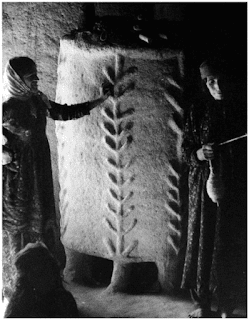
1. Grain is growing tall. That this is indeed symbol for grain, can be seen from the fact that the same symbol was put on grain granaries in Kurdistan until 20th century. Aliabad women standing beside a grain bin, Iranian Kurdistan...From "Home is where we keep our food: The origins of agriculture and Late Pre-Pottery Neolithic food storage". Very important image, as it confirms that this design pattern, found on pottery and figurines since the Earliest Neolithic all over Eurasia, means "grain"... 

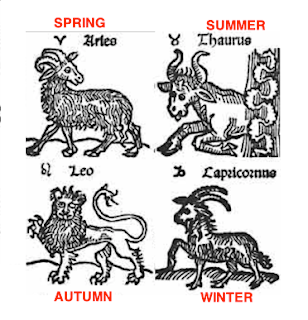
2. Summer (symbolised by a bull and the suns above the bull) begins. I talked about the symbols of the seasons in my post "Symbols of the seasons"...

3. Bull is the symbol of summer, because 

It begins with the calving season of the wild Eurasian cattle 

Ends with the mating season of the wild Eurasian cattle

Unfortunately the Aurochs (wild Eurasian cattle) are extinct now, so I used pics of domestic cattle...I wrote about it in my post "Ram and bull"...

4. The beginning of the summer, Taurus, is symbolised by the head of the bull. Is the wavy line coming out of the bull's mount the Diyala river, whose water level peaks in Apr/May, in Taurus

I talked about this link between bulls and flood in Mesopotamian mythology and art in my post "Elamite water bull"...

The end of the summer is symbolised by the aroused penis of the bull, symbolising the beginning of the Auroch mating season...

5. Bull season (summer) is the harvest season...Hence many artefacts where ripe grains are depicted together with cattle...

I talked about this in my posts "How grain came to Sumer", "Bulls and grains bowls"...

6. Above the bull are pests 🙂 birds and rats...Watch out for pesky pests, so they don't run away with your grain...

7. In the next panel, are the cut off ears of grain...Harvest is finished...The final panel of this amazing ancient comic strip depicts three women doing what? I would say winnowing with trays, a job usually done by women...

What do you think?

This is seriously cool...

The vase images are from this great publication by the University of Chicago: "OIP 63 Pottery from the Diyala Region"...

To read more about ancient animal and plant calendar markers, start here…then check the rest of the blog posts related to animal calendar markers I still didn't add to this page, and finally check my twitter threads I still didn't convert to blog post...I am 9 months behind now...