Showing posts with label Egyptian archaeology. Show all posts

Saturday, 18 May 2024

Giza lioness

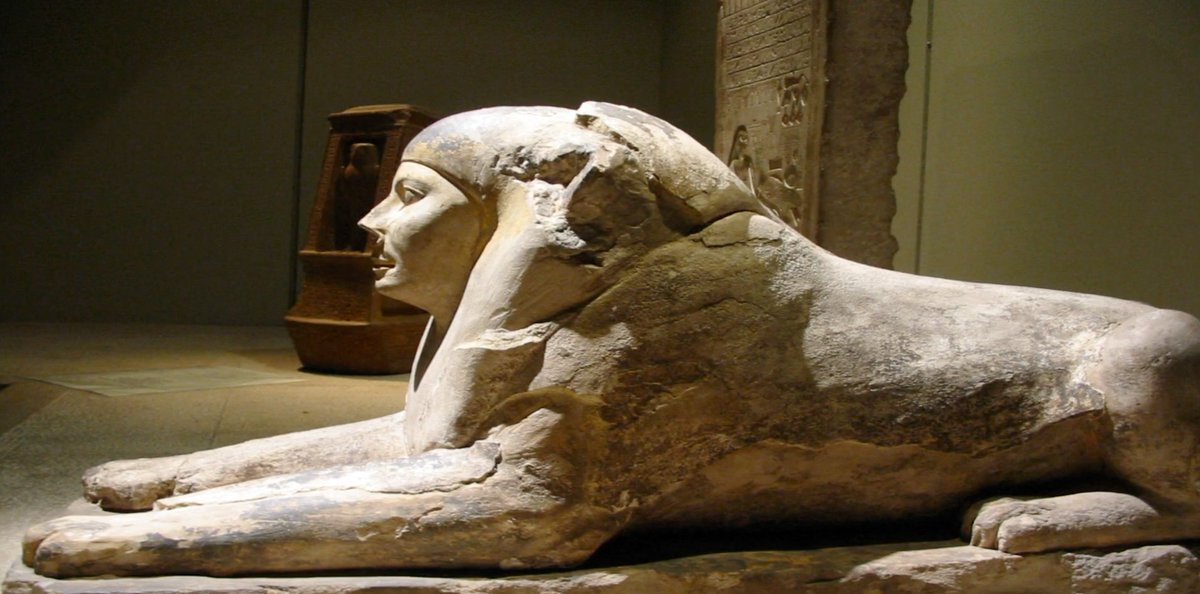
Queen Hetepheres II sphinx – Cairo Museum. 

This sphinx is contemporaneous with the Great Sphinx in Giza. And interestingly, it seems that this was originally a lion(ness) sculpture turned into a sphinx by chiseling the lion(ness) head into the queen's head...

Hetepheres II was the daughter of Khufu, the guy who built the Great pyramid in Giza and a wife of Djedefre, the guy who built the Great sphinx in Giza...

Great sphinx has weird proportions. Its head is too small for its body...Which is totally weird for Egyptians who were obsessed with perfection of measure and proportion...

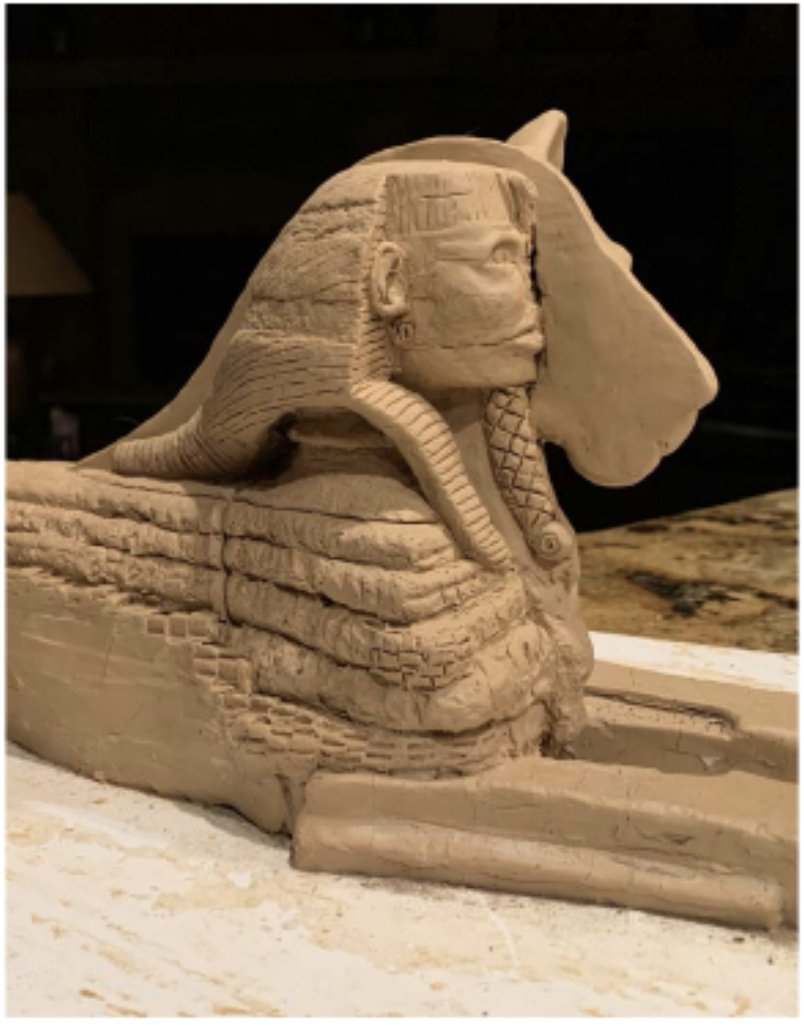
So it has long been speculated that originally the Great sphinx was in fact a Great lion(ness) whose head was chiseled down into the head of Djedefre during his reign...This pic is from one such paper, "Mehit’s Stump: Unmasking the Great Sphinx of Giza"...

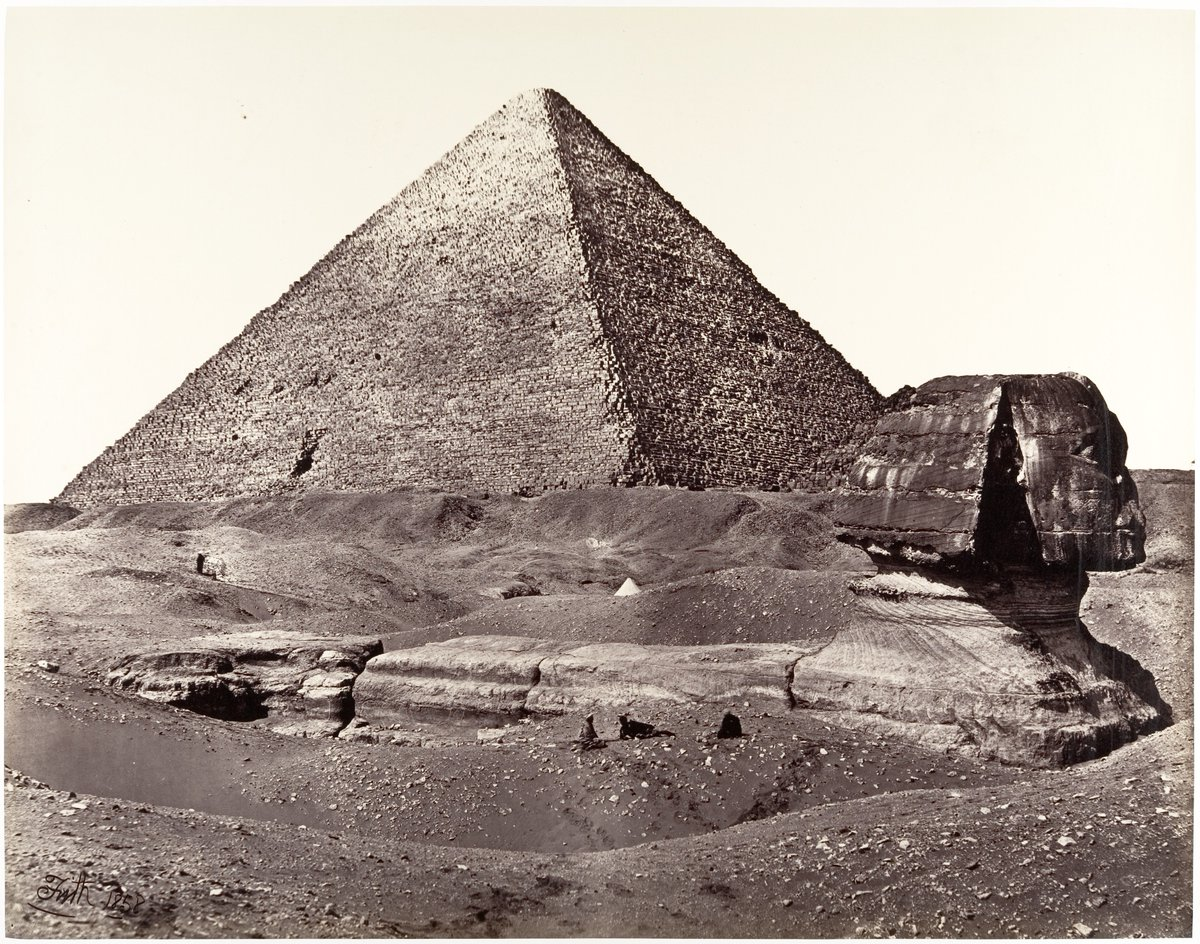
That the sphinx (pharaoh) head is a later addition is supported by the fact that even though, for the most of its existence, only the head was visible above the sand, it is the body that is deeply eroded by the water erosion and not the head...Sphinx before the body was excavated from the sand...

Now we know that the climate got much dryer soon after the reign of Djedefre, which means that the body of the Great sphinx must have been eroded during the centuries/millennia before the Djedefre's reign...

Now as I said already, the common conclusion is that the Great Sphix was originally a Great lion(ness). The problem is that there is no mention of any Great lioness statue anywhere in the Old Kingdom Egyptian texts...

So I wonder if what was turned into the Great sphinx by Djedefre, was not a giant sculpture of a lioness, but instead an ancient, deeply eroded, natural bedrock outcrop which loosely resembled the body of a couchant lion(ness). Like this one from Balochistan, Pakistan.

Now in my post "Sphinx", I explained why Egyptians worshiped lion(ness)s (the annual Nile flood peaks in Jul/Aug, Leo), and why Djedefre would want to create something like a Great sphinx out of a weathered outcrop that resembles a lion(ness)...

That Djedefre (means "He appears as Ra") was depicting himself as Atum/Ra, can be seen from the fact that the Great sphinx originally had "a long braided ‘divine beard’, curled at the end, that gods and deified kings wore, and not a short, square beard worn by living kings"...A part of that beard was found and preserved in the Cairo museum...

This is the same beard worn by Osiris, the god of resurrection directly linked to the annual flood...I talked about this beard and its meaning in my post "The beard of Osiris"...Figurine of a bearded man by the Naqada I culture, 3800–3500 BC, from Upper Egypt... 

In my original sphinx article I also mentioned that Atum, The Creator God, was believed to have created himself as the first thing on the primordial mound after it emerged from the primordial waters. And that some believed that he was actually the primordial mound itself...

I also mentioned that, apparently, Pyramid Texts, Coffin Texts and the Book of the Dead state that "lion emerged from the primeval mass within the primeval waters before all other animals, and mankind"...

Now here is an interesting thought: Is it possible that the Giza plateau, or the bedrock outcrop on the Giza plateau, which looked like a couchant lion(ness) was seen by the Old Kingdom Ancient Egyptians as the Benben, the primordial mound?

That would explain why Khufu would build the pyramids on the Giza Plateau...Reconstructed apex (top stone) of one of the pyramids (G1-d) of the Giza Plateau, symbolising Benben...

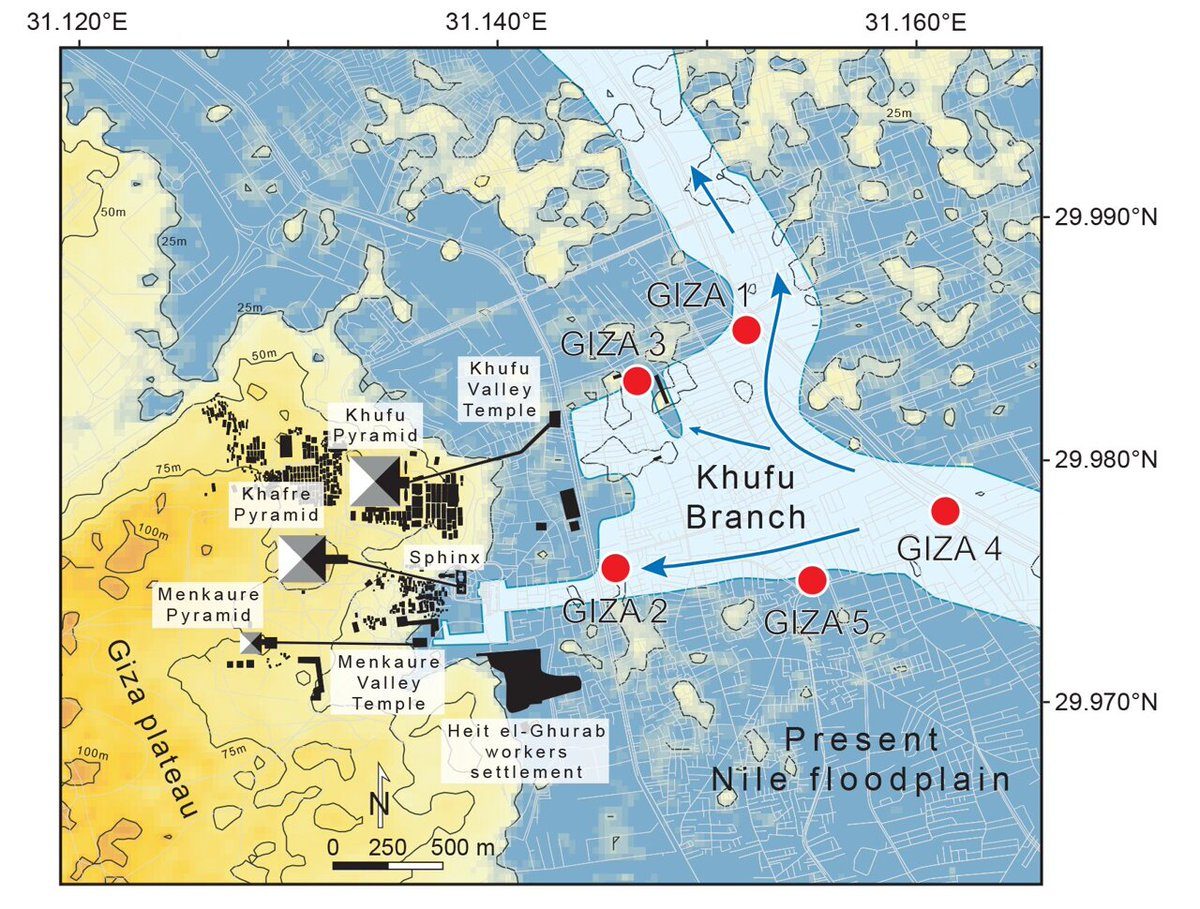
And this would also explain why the ancient, rain eroded rocky outcrop, resembling a couchant lion(ness) overlooking the Nile flood plain, was turned into the Great sphinx, which depicts Djedefre as Atum/Ra who emerged out of the flood as a lion mound...

And this would also explain why when Djedefre decided to turn this primordial lion(ness) shaped mound into the Great Sphinx, Egyptians thought it was such a great idea, totally in keeping with their religion, that every pharaoh worth his beard had one made for him (her) self...

What do you think? Did anyone else propose this already? Would be really surprised if no one did...It's kind of obvious...

To read more about ancient animal and plant calendar markers, start here…then check the rest of the blog posts related to animal calendar markers I still didn't add to this page, and finally check my twitter threads I still didn't convert to blog post...I am 9 months behind now...

Friday, 24 June 2022

Holy carp

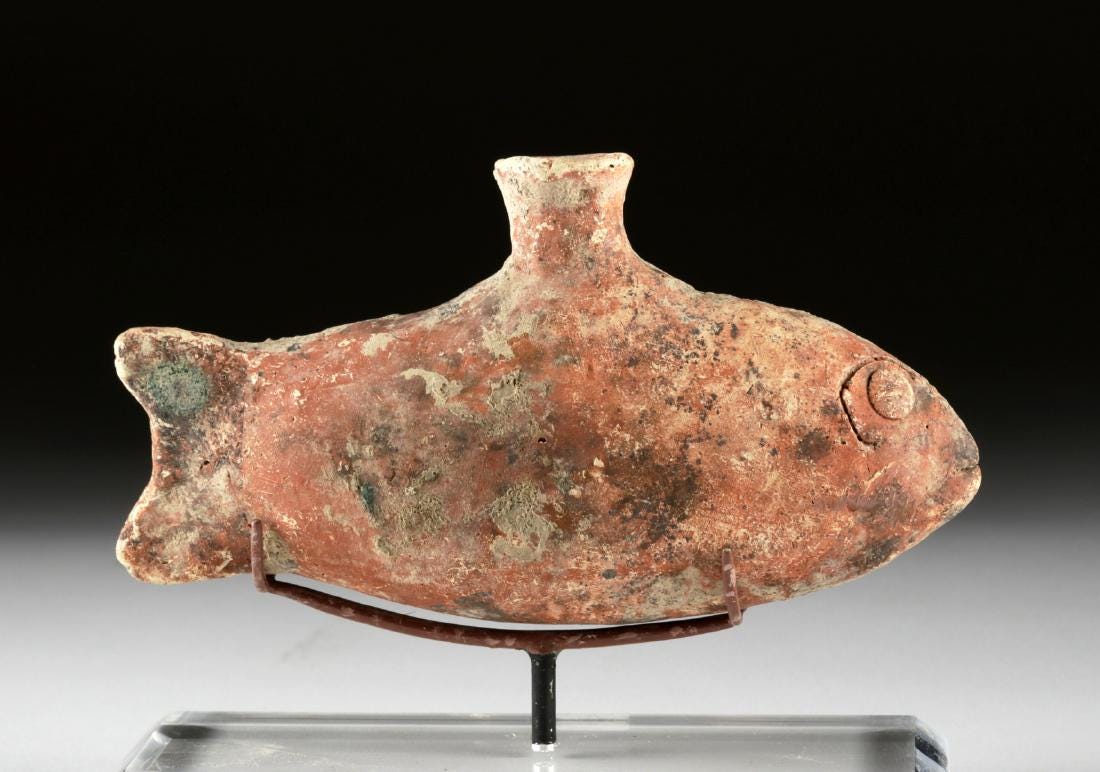
Ancient Egypt, New Kingdom, 18th Dynasty, ca. 1352-1336 BC. Ceramic vessel in the form of a fish, with a narrow, flared-mouthed spout projecting from the top where a fin would be...

According to the object description, "the fish depicted is a Nile carp which plays a significant role in the Osiris mythology"...


So apparently, Set, the brother of Osiris, was pissed off that Osiris was made the Pharaoh of Egypt instead of him after the death of their father Geb...

Set believed that he was the rightful heir to the throne of Egypt, and that Osiris was the usurper...So he decided to kill his brother and take what's rightfully his own...

And so he did...And after killing Osiris, Set then cut his body into bits and scattered these bits all over Egypt. Finally, he threw Osiris's penis into the river Nile, where it was promptly eaten by a Nile Carp...

Apparently, this legend explains why Nile was seen by the Ancient Egyptians as "the water of life", as "fertilising semen emanating from the severed phallus of Osiris"...

This story was reenacted every year as part of the "great mystery festival". This festival which commemorated the death and resurrection of Osiris, was celebrated at the end of the Inundation (Annual flood), on the same day that grain was planted in the ground...

One of the rituals performed during the festival was the construction of "Osiris Beds". They were originally wooden, and later ceramic containers in shape of Osiris, filled with fertile black silt brought in by the Nile river during the Inundation, and sown with barley seeds...

The germinating seeds symbolized Osiris rising from the dead. Basically rebirth of nature, and most importantly, rebirth of grain. These Osiris beds were also placed in tombs, symbolising resurrection...

Interestingly, Horus, the son and the avenger of Osiris, was the lord of the black, fertile (soil) land. While his enemy, Set, the killer of Horus's father, was the lord of the red, infertile (desert) land...

In all fairness, when we look at Egypt, we can see why Set, the lord of the desert, might have thought that he should have been the Pharaoh...It's all red desert...Except for this thing green line in the middle, the land of the black soil...

In "Isis and Osiris", Plutarch says that...[during]...the festival "the priests bring forth a sacred chest containing a small golden coffer, into which they pour some potable water...and a great shout arises from the company for joy that Osiris was found (or resurrected)...

Then they knead some fertile [black] soil with the water...and fashion therefrom a figure, which they cloth and adorn, this indicating that they regard these Isis and Osiris as the substance of Earth and Water"...

Symbolic, right? It is this fertile black soil, the mix of Earth and Water, which every year allowed Horus (the lord of the black, fertile, Nile valley land) to defeat Set (the lord of the red infertile, desert land)...

That black soil is brought to Egypt from the southern highlands, by the the annual Nile flood, without which, Egypt wold have been swallowed by the desert, making Set, the god of the desert, the (rightful) Pharaoh of Egypt...

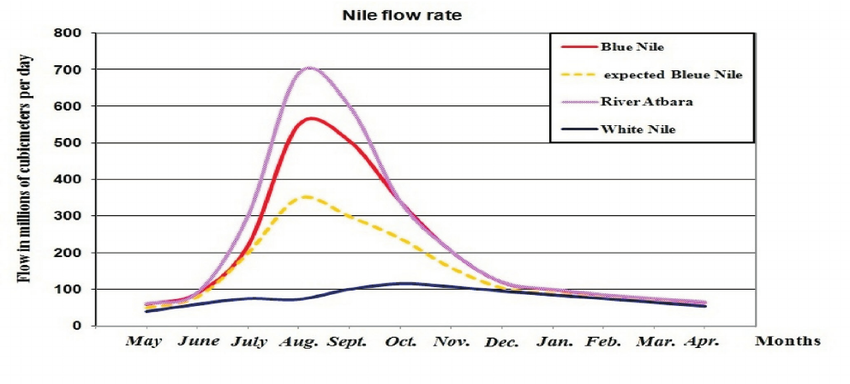
So what does this have to do with Nile Carp? Well, this is the annual flow chart of the river Nile. You can see that the river flow peaks during the period July-September. This is the flod that brings the black fertile soil which makes life possible in the middle of the desert...

According to the research data found in this paper "Study of Some Biological Aspects of the Nile Carp, Labeo niloticus (Pisces, Cyprinidae) from Khashm El-Girba Reservoir and Atbara River, Sudan: I Abundance; Sex Ratio; Gonado-somatic Index and Breeding Season" "gonado-somatic index of Nile Carp...starts rising in late Apr, reaches its peak between Jul and Sep, then starts to decrease decreases until February...

Translated into normal English, this means that Nile Carp mating season coincides exactly with the Nile flood...Sounds like a great candidate for an animal calendar marker?

As the water starts to rise, the carp starts to mate. And when carp mate, you know about it. The fish all come to the shallows, where males fight each other over the right to fertilise female's eggs...Lots of jumping, splashing, wallowing...And fish fucking...


Not a chance to miss this, if you were living by the river, from the river...No wonder that the Nile Carp ended up in the Osiris myth...

If anyone should eat the penis of the god of fertility, which was thrown into the Nile River, who better than Nile Carp whose copulation coincides with the annual flood, the outpouring of the "water of life" (semen) of Osiris...And the source of fertility in Egypt...

This could have been maybe stretching it a bit, if we didn't find animal (and plant) calendar markers embedded into the core of the Egyptian religion since the Pre Dynastic period...I wrote about this in my post "Markhor goat from Naqada"...

Have you ever wondered why we have all these cow mother goddesses in Egypt? Because the beginning of the calving season of the wild Eurasian cattle, Aurochs, which once also lived in Egypt, coincides with the beginning of the rise of the Nile...I talked about this in my post "Holy cow"...This is also the reason why we find the worship of the holy calves in Egypt too...I talked about this in my post "White calf"

Have you ever wondered why sun was worshiped as the source of life in Egypt? In the desert! Cause life giving Nile flood starts at the beginning of the hot part of the year (Apr/May), and ends at the end of the hot part of the year (Oct/Nov)...Hence Ra, the dude...

And have you ever wondered why lionesses are so important in Egyptian mythology? Cause the Nile flood peaks in Leo, which marks the beginning of the mating season of the Eurasian lions...But if the Nile doesn't flood, the season of life becomes the season of death...

Which is what is described in the stories about runaway "goddess of moisture" who got pissed off and left Egypt, bringing famine and destruction had to be "brought back" by baboons...Who mate at the beginning of the monsoon season which feeds the Nile flood...I wrote about this in my post "Baboon"...

I wrote about the monsoon season in my post "Menat" about the holy couple "Shu" (wind) and "Tefnut" (moisture) who together mean "wet wind" = eastern monsoon...

And then we have dogs and dog days, the beginning of the mating season of the old dog breeds, which coincides with the peak flood and the helical rising of Sirius...I wrote about this in my post "Dog days"...

And cats and their veneration around the time of the harvest, when rats multiply and cats give birth to lots of hungry kittens...I wrote about this in my post "Bastet"...

And there's more...

To read more about ancient animal and plant calendar markers, start here…then check the rest of the blog posts related to animal calendar markers I still didn't add to this page, and finally check my twitter threads I still didn't convert to blog post...I am 9 months behind now...

Thursday, 28 April 2022

Cow and calf ivory

Decorative carved ivory with a cow suckling her calf and licking its tail among (very stylised) papyrus flowers. Neo-Assyrian, 9th-7th c. BC. Found in Nimrud, Iraq. Currently in the Iraq Museum in Baghdad...

Take a good look at the scene depicted on this ivory...

Pic by Osama Shukir Muhammed Amin


Now have a look at this: Another decorative carved ivory with a cow suckling her calf and licking its tail among (much less stylised) papyrus flowers.  No idea where it was found. Currently in the Ashmolean museum, Oxford and apparently "it was probably carved in Syria, 850–700BC"

Pic: Ashmolean museum

It must have been a very popular theme at the time...Cause while wondering through Mesopotamian section in the Louvre museum last weekend, I came across three Neo Assyrian ivory plaques, all found in Arslan Tash, all dated 800-700BC and all depicting the same scene: A cow suckling her calf...

Pic: Louvre museum

Pic: Louvre museum

Pic: Louvre museum

Why? Well, one possible explanation could be this: These objects are not (only) decorative...

Well they wouldn't have been if they were made in Ancient Egypt...There, papyrus flowers were sacred to the Egyptian mother goddess Hathor...Celestial Cow goddess Hathor...Who is often depicted emerging from the flowering papyrus thickets...

To understand why papyrus was sacred to Hathor, we need to look at the association of Hathor with Mehet-Weret, another "Celestial Cow goddess" whose name means "Great Flood" and who was thought to bring the inundation of the Nile River which fertilised the land...

Mehet-Weret, had no independent cult of her own. It is presumed that Hathor absorbed most of her attributes as early as the Old Kingdom, as many references of the two as identical are found in Pyramid and Coffin Texts...

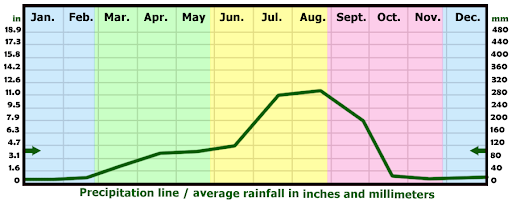
Now Mehet-Weret is goddess who causes the annual Nile River flood. The flooding of the Nile is the result of the yearly monsoon Mar/Apr and Jul/Aug causing enormous precipitations on the Ethiopian Highlands...

This rain causes the nile water flow rate and water level to start rising from May/Jun

And interestingly, the period (Apr/May), right before the Nile water level begins to rise, is marked by a bull animal calendar marker...And has been in Eurasia and North Africa since Neolithic...Animal calendar marker which we today know as Taurus zodiac sign...

But which has nothing to do with stars...This animal calendar marker marks the start of the Eurasian wild cattle calving season. So originally it was a wild cow and calf marker...I talked about this in my post "Ram and bull"...

So Hathor, Mehet-Weret (The Great Flood), arrives during the time when wild cows start giving birth to their calves and start producing milk...Interestingly, Hathor was said to be a "wild cow whose udders were spilling milk on the earth"...

Oh yeah, Taurus is also the beginning of summer, the season marked with the bull throughout Eurasia and North Africa since Neolithic too...In Egypt that is the season during which the Nile water levels rise until the river floods Jul/Aug...I talked about this in my post "Symbols of the seasons"...

Oh and: Hathor arrives carrying sun between her horns...Translation: The half of the year dominated by the sun, starts when the wild cows start calving...In Taurus...

So if the above two ivories were carved by Ancient Egyptian artists, that would explain why the cow and the calf scene wouldn't have been "only decorative"...I think...But what about papyrus?

As I said, papyrus plant was sacred to Hathor. 

The main annual ritual associated with Hathor was the so called "Ritual of Plucking Papyrus for Hathor" which appears to have been an invocation, offering and pacification ritual...

This is the depiction of the ritual. Goddess Hathor emerges from the papyrus thicket on a sacred boat and is greeted by the woman who offers her papyrus flowers...

Apparently: "the ritual has extremely early origins and may have become a ritualised form of the simple act of picking papyrus flowers as votive offerings for the goddess Hathor"...Why papyrus and not some other plant?

Apparently: "papyrus symbolised life, joy and renewal"...Why papyrus and not some other plant?

The answer can be found in this paper: "Ecology and biomass production of Cyperus papyrus L. on the Nile bank at Damietta, Egypt" by Mamdouh S. Serag...

In this article you can find this chart...It seems that if you wanted to go plucking papyrus flowers, the best time to do it was during Taurus (April-May), right at the time of the arrival of the the great flood, Mehet-Weret, Hathor...Calving wild cow...

All of this happens right at the time when the Nile water level start to rise...So flowering of the papyrus plants announces the arrival of Hathor, Mehet-Weret, Great Flood...

I talked about this in my post "Holy cow"...

No wonder papyrus flower symbolised life, joy and renewal. No wonder papyrus flowers were sacred to Hathor and were plucked and offered to her as a sacrifice...No wonder papyrus flowers were sacred to the Ancient Egyptians...

Soooo....The two original carved ivories are calendar markers for Apr/May - when wild cows calve and papyrus plant flowers and Nile water level starts to rise...As I said, a pretty important part of the year in Ancient Egypt...Even more important thing in Ancient Mesopotamia...

As the sun's elevation rises, the earth starts to warm...Which cause the snowmelt to start in the mountains North-East from Mesopotamia...


Which causes the snowmelt runoff to increase and peak in Apr/May (Taurus 🙂)

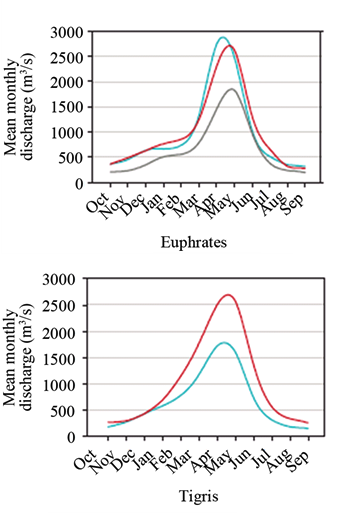
And it is this snowmelt that is the main contributor to the water flow of Tigris and Euphrates...Which also peaks in Apr/May (Taurus)...

In Mesopotamia the flood was thought to be caused by the god of fresh water and flood Enki who: "stood up full of lust like a rampant bull, lifted his penis, ejaculated and filled the Tigris with flowing water. He was like a wild cow mooing for its young in the wild grass..."

At the same time "Enki placed in charge of the whole of heaven and earth the hero, the youth Utu (Shamash), the bull standing triumphantly, audaciously, majestically...the great herald in the east of holy An...with a lapis-lazuli beard, rising from the horizon..."

Pic: Penn museum

I talked about the link between bull and flood in my posts "When Utu steps up into heaven", "Butt chewing", "Green Pastures", "Shamash young and old"...

So the above two carved ivories made a lot of sense to Mesopotamians and probably weren't "only decorative" to them either...

Apparently no one knew why Enky was "like a wild cow mooing for its young", or why Hathor was "a wild cow", or why papyrus was so sacred to her, or why these carved ivories depict cow and calf among papyrus flowers...Until I started researching animal calendar markers...Weird...

To read more about ancient animal and plant calendar markers, start here…then check the rest of the blog posts related to animal calendar markers I still didn't add to this page, and finally check my twitter threads I still didn't convert to blog post...I am 9 months behind now...

Papyrus harvest time

This is a drawing of an Ancient Egyptian papyrus boat. 

And a papyrus plant. 

The papyrus plant grows wild in Egypt in the marshes along the Nile river. The harvested papyrus plants are tied into bundles and these bundles are then tied together to make boats...

According to "Papyrus making 101" page about making of the papyrus, "in ancient times, the entire plant was pulled from the root at harvest time. It is unknown at what time of year the ancient Egyptians harvested papyrus, or whether mature papyrus was preferred over young papyrus"...

Here is a great depiction of the papyrus harvesting, currently kept in the Met museum which dates to 1479–1458BC. You can see that the papyrus plant is pulled out from the root all right. What we can also see is that the papyrus plant is in full bloom...

This is kind of important for determining when the papyrus harvest took place. According to the stats collected in the "Ecology and biomass production of Cyperus papyrus L. on the Nile bank at Damietta, Egypt" by Mamdouh S. Serag, papyrus flowering season peaks in Apr/May and is pretty much finished by Jul/Aug...I talked about this in my post "Holy cow"...

So if papyrus was picked during the flowering season, it was picked between Apr/May and Jul/Aug...But I think we can further narrow down the period when the papyrus harvest took place. This is the east wall relief from the tomb of Ptahhotep...

You can find photos of all the reliefs in the  "The mastaba of Ptahhetep and Akhethetep at Saqqareh" published in 1900, but these photos are not very clear... 

So I will here use the drawings from this page on the https://www.osirisnet.net website which are a bit clearer.

The first register depicts a herd crossing water. The continuation of the representation is dedicated to the gathering of blooming papyrus, its processing and its transportation in bundles. Bundles used for the construction of (small) boats, an activity represented in the fifth register.

The important thing here is that the cattle swim in river covered in blooming blue water lilies (blue lotuses)...And on Nile river, blue water lilies bloom in Jul/Aug/Sep...

The people are harvesting papyrus during the time when both papyrus and water lilies are in bloom. If papyrus blooms Apr/May/Jun/Jul/Aug and water lilies bloom Jul/Aug/Sep, the the time when both of these plants are blooming is Jul/Aug. The peak of the flood...

Is this when papyrus was harvested by the ancient Egyptians? 

To read more about ancient animal and plant calendar markers, start here…then check the rest of the blog posts related to animal calendar markers I still didn't add to this page, and finally check my twitter threads I still didn't convert to blog post...I am 9 months behind now...

Tuesday, 13 July 2021

Markhor goat in Naqada

Ceramic vase - Naqada II, Egyptian Predynastic period 3500 BC. Dim 8,5x7,6 cm. Currently in: Museo Arqueologico Nacional, Madrid, Spain...


Officially depicts a hunting scene...

Have you seen this article called "Nahal Mishmar hoard"? About the treasure throve of bronze objects found at Nahal Mishmar in Israel and dated 4000-3500 BC. 


One of the artifacts found in the treasure is this beautiful staff...

It is topped with the 4 small heads of Ibex goats 

surrounding the big central head of a Markhor goat 

Now Ibex goats are found in Levant. And there they are a symbol of the rainy season, which starts when ibex goats start to mate, in Oct/Nov...Like on this depiction of the mother goddess from Revadim...


The problem is that Markhor goats don't live in Levant. They live in Central Asia, Iran, Iraq, Pakistan...Where they are a symbol of the rainy season, interchangeable with Ibex goat. Because both of their mating seasons start in Oct/Nov, when rains arrive...

I talked about this in my post "Goat in a tree"

So while researching Nahal Mishmar hoard, I proposed that the it must have been made by someone from that part of the world, Central Asia, Iran, Iraq, Pakistan. Cause only they could have seen Markhor goats and had it associated with Ibex goats as a symbol...

It turned out Nahal Mishmar treasure is believed to be made by immigrants from Iran. Because of genetics of the people who made the treasure...And the similarities of artifacts from both areas...

Now the makers of the Nahal Mishmar treasure were expelled by the locals...Those the locals couldn't kill. I thought they went back north to Iran. But what if they went the other way...Down south...To Egypt...

Who else could have made a vase with Markhor goats and Ibexes prancing around the mountains?

By the way, Ibex goats live in Egypt. It is the subspecies known as Nubian Ibex. And Nubian Ibex mating season is from October to December...

Guess what happens in Naqada in October? Rains arrive...

So I think that Ibex was depicted on the above vase for a reason. It is another example of Ibex goat being used as a calendar marker that means: rains arrive when Ibex goats start to mate...

Just like in Levant, Mesopotamia, Arabia, Central Asia, Iran...Amazing...

So I think that  the guy with huge erection standing in the middle of mating Ibex and Bezoar goats is not a hunter. I mean he is unarmed which is usually a dead giveaway for "not a hunter". He is most likely a fertility symbol, fertility god, possibly rain god...

By the way this vase is not an exception. Markhor goats are found on other Naqada vases too. Like this one. Again no explanation how come this goat is here, in Egypt...


Ibex goats are also found all over predynastic artifacts. Here is another vase from Naqada II period. Dated to 3500BC.

It depicts Ibex goats...And Flamingos. 

Why flamingos? Because breeding season of Greater Flamingo, the subspecies found in Egypt, is "Erratic, depending on the rains, but mainly November-February"...Ha!

As a comparison, here is a vase from Susa, Iran, dated to 4000BC...

In its center is a huge Ibex. Its horns surround what looks like a furrow with a plant, most likely grain. Rains make plants grow. And they start falling when Ibexes start mating...It is also "after the first rains" that fields are ploughed and grain is sown...Important!!!

The Susa vase also depicts pile of flamingoes...Flamingoes which arrive to Iran every November from Central Asia, to spend the winter...Interesting...Right?

Guess what happens in Egypt during the Ibex and Flamingos mating? Well grain is planted...The flood has ended, the soil was fertilized, and it's time to plough and plant grain while the first rain is falling...

What is amazing is that once we understand why these animals are depicted on the ancient artifacts, we can then detect anomalies in distribution of these artifacts: pieces that are found in the areas where the animals depicted don't exist...

Or the depicted scene put together makes no sense...When compared with the local climate...Which are all indicators of the foreign influence and possible migrations which brought these influences...

Like these vases. 

Or this for instance

I talked about this in my post "An Ki = Ankh"


PS: Is it possible that the animal with the spiral horns is Kudu antelope? They lived in the North Africa, Levant and Arabia in the early and middle Holocene...Well at least this is what the authors of this paper think the animals with spiral horns depicted on the petroglyphs were...But were they Kudu's or Markhor goats? When did Kudus disappear from these areas? Were they still around in the 4th millennium BC? Did immigrants who came to Egypt from Mesopotamia bring Markhor goats with them? Via Arabia and Levant?