Showing posts with label Fire drill. Show all posts

Sunday, 31 July 2022

12 Olympians

In this article, I would like to again point at things hidden in plain sight...Around 435 BC, Greek sculptor Phidias made a giant seated statue of the sky and thunder god Zeus for the Temple of Zeus in Olympia...

Unfortunately the statue was destroyed during the 5th century AD; but we know what the statue looked like from Greek and Roman coins...
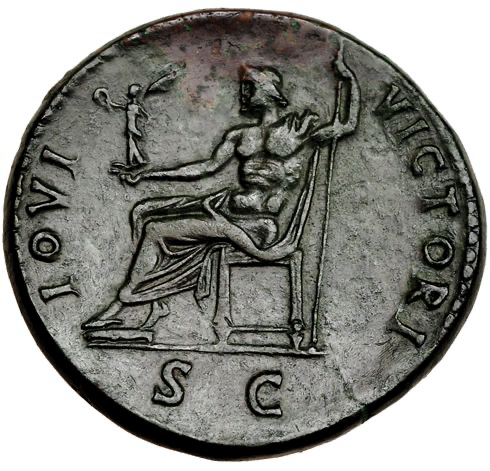
And from written records, like the one left by the 2nd c. AD geographer and traveler Pausanias

What I want to talk about here is what Pausanias says about the platform that supported the throne. He says that it depicted a line of paired deities standing between the sun and the moon...

Zeus and Hera...and Hermes and Vesta close to Hermes...and Eros receiving Aphrodite...and Apollo and Artemis...and Athene and Hercules, and at the end Amphitrite and Poseidon...

They were all coupled based on some mythological link that connected them. What is interesting is that Phidias depicted Hermes coupled with Hestia...Why? 

What is the relationship between these two deities? They are not husband and wife, nor brother and sister, nor mother and son nor protector and protege...

Holy fire and a Messenger of Zeus? What could connect the two? 

That these two were not put together by accident on the Zeus's throne, can be seen from this Fragment of a Hellenistic relief (1st c. BC–1st c. AD) currently in the Walters Art Museum and depicting the twelve Olympians...
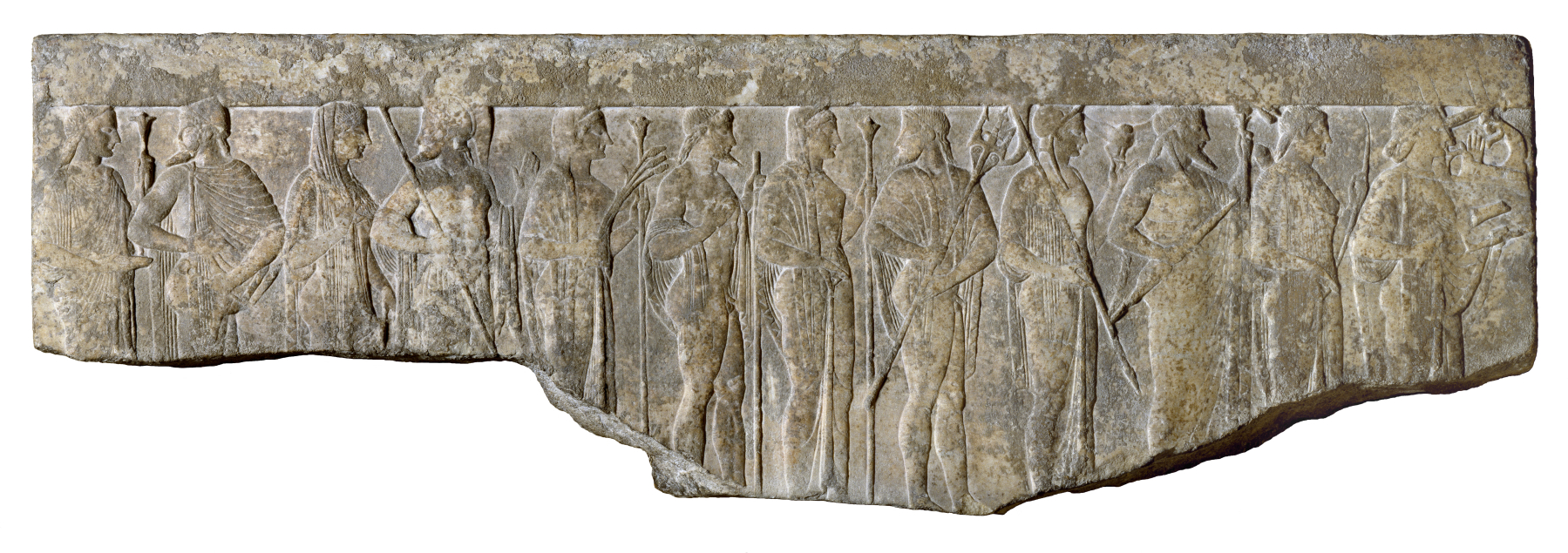

From left to right: 

Hestia, Hermes, Aphrodite, Ares, Demeter, Hephaestus, Hera, Poseidon, Athena, Zeus, Artemis, Apollo

Here they are, Hestia and Hermes...

Hestia and Hermes were also linked together in The Homeric Hymn 29 to Hestia...

"Hestia, in the...dwellings of all, both deathless gods and men who walk on earth, you have gained an everlasting abode and highest honour...for without you mortals hold no banquet...and you, Hermes, messenger of the blessed gods, bearer of the golden rod, giver of good...be favourable and help us, you (Hermes) and Hestia...come and dwell in this glorious house in friendship together; for you two, well knowing the noble actions of men, aid on their wisdom and their strength..."

Really, what's going on with these two? 

Well, lots of people have asked this question before me...

Jean-Pierre Vernant asked this question in 1969 in his paper "Hestia - Hermes : The religious expression of space and movement among the Greeks"

Patricia J. Thompson asked it in 1994 in "Dismantling the Master's House: A Hestian/Hermean Deconstruction of Classic Texts"

Apparently this was still an unanswered question in 2001, so Jean Robert asks it again in "Hestia and Hermes: The Greek Imagination of Motion and Space"

The explanation given by Jean Robert, is that Hestia and Hermes are coupled because they express two opposing, but linked concepts...

Hestia, whose place is at the hearth, in the center of the house, rules over the inside. Hermes, whose place is the door, at the edge of the house, rules over the outside...Hestia anchors, Hermes makes mobile...

Cool. But I think that there is much better reason for this seemingly strange association. Guess what was the first thing Hermes did after he was born? He escaped his cradle, and managed to steal Apollo's cattle...


Funnily enough the thieving Hermes was on the above vase depicted as an adult...With all his attributes including the caduceus, his magic staff...Important detail! Artistic freedom I suppose?

Anyway, after stealing Apollo's cattle, Hermes then wanted to make the first ever sacrifice to the gods. But he couldn't. Cause in order to do so, he needed fire, Hestia, to burn his offerings in...But he had no fire, and apparently, making fire was an art still not invented...

Sooo: "He [Hermes] chose a stout laurel branch and trimmed it with the knife ...held firmly in his hand: and the hot smoke rose up. For it was Hermes who first invented fire-sticks and fire"...From "Hymn 4 to Hermes"...

Wow...


A very strange thing to be attributed to a messenger of Zeus...

Or is it? 

Remember the article about this excerpt from the Homeric Hymn To Hestia: "Hestia, you who tend the holy house of the lord Apollo...come now into this house...having one mind with Zeus the all-wise..."?

In it I talked about how strange it was that Classical cultures still talked about the invention of fire making as if it was a really really big deal?

And I also talked about the fact that before people learned to make fire themselves, Fire (Hestia) descended to earth from the Sun (Apollo, Helios) through Thunder/Lightning (Zeus)... 
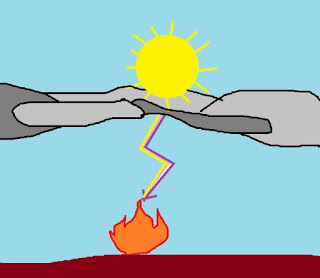
So if fire (Hestia) was made (Fathered) by the thunder/lightning (Zeus) then Hermes, "the messenger of Zeus", is the perfect inventor of the fire stick and fire making... 

Remember, Hermes was not the only messenger of Zeus...He shared his workload with Iris. (Attic Red Figure Stamnos, ca. 480-470 BC, Louvre)

Look they are both holding caduceus stick...

Actually, before Hermes got the job, Iris was the sole "speaker of messages of Zeus"...The only "voice of Zeus"...Which is kind of important...

Remember the article "Iris" in which I proposed that Iris might not have been the personification of the rainbow...But that instead she could have been the personification of thunder/lightning, the true "voice of the thunder god"...


Remember that before people invented the fire stick (sorry before Hermes invented the fire stick), Zeus used lightning to light fires on earth...Lightning was the "fire stick" of the Thunder god...

Thunder, which is inseparable from lightning, is the "voice of thunder god"...Which, as I explained in my article about Iris, I believe is the meaning of the "speaker of messages of Zeus"...

If Iris is personification of thunder/lightning, and Hermes is her later replacement as the messenger of Zeus, then Hermes would be perfect god to invent fire stick...The human replacement for thunder/lightning...

That's it...

I mean could there be a more direct link between Hestia and Hermes? Without Hermes there would be no Hestia...To me this is glaringly obvious...Maybe too obvious for some...

But if you "miss" (ignore) this, you can then go ahead and write endless academic papers trying to answer the question "why are Hestia and Hermes linked together"...

Anyway, this brings me back to one of my favourite unanswered questions: why was invention of fire such a big deal in all our mythologies, if people knew how to make fire, like, for ever?

Having one mind with Zeus

"Hestia, you who tend the holy house of the lord Apollo...come now into this house...having one mind with Zeus the all-wise..." from the "Homeric Hymn To Hestia"...

What does this mean?

Maybe the same thing as this: In Hindu mythology, Agni (fire) was believed to have three manifestations: Sun, Lightning, Fire...Which is why he had three heads...I talked about Agni and why he likes riding on a ram in my post "The ram of Agni"...

Just like Slavic Supreme god Triglav (Three headed)..."Because it is a great secret how Svarog (heavenly and earthly fire) is at the same time Perun (thunder) and Svetovid (Sun)"...I talked about Triglav in my posts "Triglav Trojan Trinity Trimurti Agni" and "Lugus or Triglav"...

Interesting right? Cause before people learned how to make fire, fire descended from the sun through lightning...

By the way, modern science seem to confirm that it is indeed Sun (Surya) which gives power to Indra (lightning) which becomes Agni (fire)...I talked about this in my post "Sun thunder fire"...


Or, Sun (Apollo, Helios) through Lightning (Zeus) gives birth to Fire (Hestia)...Hence "one mind", one essence...

Basically, sun gives birth to fire through lightning...Which is why Surya, the sun god, had a daughter, Tapati, whose name literally means "warming", "the hot one", "burning one"...Who was apparently the same as Scythian Tabiti...And Herodotus claimed that Tabiti was the same as Hestia...

And it is because the hearth fire is the same fire burning inside of the sun, that people make sure the hearth fire burns through the winter solstice (Christmas) night, the longest night, "so the sun's fire doesn't get extinguished"...I talked about this in my posts "Badnjak", "La buche de noel" and "Yule log in English tradition"

This fire which descended from the sky, was imagined as a firebird which came down from the sky to earth to nest. It had to be found, caught and brought home...Hence legends about "the hunt for the firebird whose one feather can light up the whole room"...I talked about this in my post "Firebird"...

How old are these legends? Well they most likely predate the moment when "Prometheus stole the fire from the gods" (thunder god to be more precise)...I talked about this in my post "Prometheus"...

Or, before people accidentally discovered fire making while drilling...I talked about this in my post "Fire-drill"...

And how long ago did people become masters of fire, considering that "fire-drill" was still worshiped as deity in Mesopotamia...I talked about this in my post "Holy fire-drill"...

How long ago did people become masters of fire, considering that fire making or fire stealing or fire catching was still the stuff of legends during classical times?

How long ago did people become masters of fire, considering that hearth was the center of the house cult, the house altar in so many Eurasian cultures until recently? 

And considering that making sure that hearth fire never died was so important to Eurasian people until very very recently? 

And considering that "live fire pulled out of wood" (kindled using fire drill) was believed to have magic properties by may Eurasian people until very very very recently? 

Like among the Serbs...I talked about this in my posts "Fire goddess", "Bride and hearth", "Verige", "Live fire"...

I am not saying that people have not been using fire for a very very long time...But I am pretty sure that the making of fire was a pretty recent invention...Neolithic...Mesolithic at the earliest...Which makes legends about the the time when people had to find or steel fire, before they learned how to make it, very very very old indeed... 

BTW, Hestia, (the etymology unknown, believed to be Pre-Greek) has only one cognate, Slavic word jesteja (yesteya) meaning "hearth, paved area around or in front of a hearth used for cooking food" which comes from "jesti" (yestee) meaning to eat...

Which would make Jesteja (Yesteya) the place where food was cooked...Which is exactly what hestia was...Not any fire...Domestic fire...The fire where food was cooked...

I talked about this in my post "Hestia"...

Saturday, 13 November 2021

Having one mind with Zeus

"Hestia, you who tends the holy house of the lord Apollo...come now into this house...having one mind with Zeus the all-wise..." From "Homeric Hymn To Hestia"...

What does this mean?

In Hindu mythology, Agni (fire) was believed to have three manifestations: Sun, Lightning, Fire...Which is why he had three heads...

Just like Slavic Triglav (Three headed)..."Because it is a great secret how Svarog (heavenly and earthly fire) is at the same time Perun (thunder) and Svetovid (Sun)"...

I talked about this in my post "Triglav Trimurti Agni"

Interesting right? Cause before people learned how to make fire, fire descended from the sun through lightning...Basically sun makes fire using its "heavenly fire drill", lightning...

By the way, modern science seem to confirm that it is indeed Sun (Surya) which gives power to Indra (lightning) which becomes Agni (fire)...I talked abut this in my post "Sun thunder fire"...

Basically, sun gives birth to fire...Which is why Surya, the sun god, had a daughter, Tapati, whose name literally means the "warming", "the hot one", "burning one"...

And it is because the hearth fire is the same fire burning inside of the sun, that people make sure the hearth fire burns through the winter solstice (Christmas) night, the longest night, "so the sun's fire doesn't get extinguished"...

And it is because the fire in the hearth is the fire that descended from the sun through lightning, that in Serbia, Yule log, the magic log that has to burn through the longest night of the winter solstice, "so sun's fire would not get extinguished" was traditionally a log from an oak tree, the holly tree of Perun, the thunder god...Pic: Kissing Yule log before placing in on fire...

I talked about this in my posts "Badnjak" and "La buche de Noel"...

This fire which descended from the sun, was imagined as a fire bird which comes down from the sky to earth to nest...

It then had to be found and "caught" and brought home...Which is why we have legends about "the hunt for the firebird whose one feather can light up the whole room"...I talked about this in my post "Firebird"...

How old are these legends? Well they most likely predate the moment when "Prometheus stole the fire from the gods"...I talked about this in my post "Prometheus"...

What does stealing fire from the gods mean? Did Prometheus steal knowledge of making fire from the gods? Or did people accidentally discover fire making while drilling?  I talked about this in my post "Drill"...


And how long ago did people become masters of fire? 

Considering that "fire-drill" was still worshiped as deity in Mesopotamia...I talked about this in my post "Holy fire-drill"...

And considering that fire making or fire stealing or fire catching was still the stuff of legends during classical times?

And considering that hearth was the centre of the house cult, the house altar in so many Eurasian cultures. And considering that making sure that hearth fire never died was so important to Eurasian people until very recently? Like among Serbs...

I talked about this in my posts "Fire goddess", "Bride and the hearth", "Verige

And considering that rekindling new fire was one of the most important annual ceremonies all over Eurasia until recently...Like in Slovenia for instance where all the fires in the village are ritually rekindled once a year from a communal fire...I talked about this in my post "Blessed fire from the fire fungus"...

But I am digressing...

The important thing here is that originally fire descended from the sun to earth through lightning...Which is why Hestia "tends the holy house of the lord Apollo" and "has one mind with Zeus"...

BTW, Hestia, (the etymology unknown, believed to be Pre-Greek) has only one cognate, Slavic word jesteja (yesteya) meaning "hearth, paved area around or in front of a hearth used for cooking food" which comes from "jesti" (yestee) meaning to eat. 

Which would make Jesteja (Yesteya) the place where food was cooked...Which is exactly what hestia was...Not any fire...Domestic fire...The fire where food was cooked...

Which is why in the "Homeric Hymn 29 to Hestia" we read:

"Hestia...without you mortals hold no banquet..."

I talked about this in my post "Jestija"...

Sunday, 14 March 2021

Holy fire-drill

The Assyrian king Tukulti-Ninurta I with a torch, worshipping the fire god Nusku. About 1200 BC. The artifact is in Berlin. Pic by petrus.agricola.

In Babylonia and Assyria Nusku is the symbol of the heavenly as well as of the terrestrial fire. As the former he is the son of Anu, the god of heaven...

Well no surprises here. Originally fire from sun descended to earth through lightning...So fire was the child of heaven...

I wrote about this in my article "Sun, Thunder, Fire"...

He was also looked upon as the protector of the family. No surprise here either, as fire has always been "the protector of the family from wild beasts"...

He was also the mediator between humanity and the gods, since it is through the fire on the altar that the offering is brought into the presence of the gods...Fair enough...The smoke of the offerings rises to heaven bringing offerings to the Father Sky...Logical...

The fire-god is also viewed as the patron of the arts and the god of civilization in general. Well a great surprise here...Apparently, because of "the natural association of all human progress with the discovery and use of fire"...

"While temples and sanctuaries to Nusku-Girru are found in Babylonia and Assyria, he is worshipped in a more symbolical form than the other gods"...

What does this even mean? 

Wait for it...

Nusku is basically Asyro Babylonian version of the Sumerian god of fire Gibil, god of fire, the son of An (Sky) and Ki (Earth)...

Well, as I already said, no surprises here. Originally fire from sun descended to earth through lightning...The Sumerians actually spell it out pretty clearly here: The fire is the product of lightning which connects the father sky and mother earth...

In some versions of the Enûma Eliš, Gibil is said to have broad wisdom, and that his mind is "so vast that all the gods, all of them, cannot fathom it". 

Again a great surprise here...Why would fire god be smarter than all the other gods put together?

Some versions state Gibil, as lord of the fire and the forge, also possesses wisdom of metallurgy...Again no surprise here as without fire there can be no metallurgy...

No I went and checked the etymology of the name "Gibil"...I came across a very interesting paper entitled "The Vocabulary of Sumerian" that talks about the habit of Sumerian priests to encode gods' names by inverting them...

So Gibil was written bil-gi, where "bil" means fire and "gi" means reed, stick...So Gibil is not a name. It means fire stick, fire drill...Gibil, the fire god is actually a deified fire stick, the tool used for making fire...


Which is exactly what the Assyrian king Tukulti-Ninurta I is worshiping: a fire stick on a throne, altar...

Babylonians and Assyrians are not worshipping Nusku "in symbolical form"...They are worshiping Nusku in his original form, Gi-Bil, Bil-Gi, Fire Stick...

Anyone stopped to think why would Sumerians, Babylonians, Assyrians, people from some of the most developed ancient civilisations, worship a fire stick? If making fire was by their time already a common knowledge for eeee 1 million years (according to official history books)...

Ah wait. I did 🙂

And I published what I thought about it in these three articles: "Fire-drill", "Fire bird", "Prometheus"

Did Sumerians believe that the fire god possessed unfathomable wisdom, because they considered the invention of fire making to be such an amazing thing, that it could only have been a product of "unfathomable wisdom which all gods together could not get". Let alone mortals...

But that is ridiculous....Right? We all "know" that humans have been able to make fire like for ever...

Saturday, 7 November 2020

Drill

This is an example of a Neolithic shaft hammer axe...

It is made of stone. A hole was drilled through it, and a shaft is fixed into it. Nothing special...Except how did they drill this hole through a stone without metal drills? 

Well here is how:

Get a stone from which you are going to shape the axe head. Scrape the initial circle where the hole is going to go using a sharp stone harder than the stone for the axe. Then pour some quartz sand on it...This one in the picture has magnetite in too...

Then get a straight smooth hardwood stick. Place it on the sand and start spinning it with your hands...Fast...

The pressure applied with the stick on the sand particles and the spinning of the stick will cause the sand to scrape at the surface of the stone. The abrasive action of the sand  will remove bits of stone...Slowly...Very slowly...


Eventually you will end up with this...Now repeat...Until you finally go through the stone...


These are stills from this great video by Lucian Aver which demonstrates this drilling technique

Now, here is a million dollar question: what happens if you try the same technique used here to drill through stone, to drill through a piece of wood?

Well depends how lucky (or unlucky) you are...If you pick just the right combination of the drill stick and the wooden board, and you continue spinning your drill after all the sand is gone, you get this:

Is this how it happened? Is this how fire was "invented"? I would say 100% definitely...A lucky coincidence 🙂

I can't see any other way in which people were able to arrive to the idea that spinning a stick on a piece of wood will eventually produce fire...

But accidentally producing fire by drilling wood with wood...Almost inevitable...

Some people are saying that no one would rally drill wood with wood. They would drill wood with stone...

Well, almost correct...

If we look at the known primitive drilling methods we see that there are two main types:  

1. Hand held stone or bone drills, basically just sharp narrow pieces of stone (like the one in the middle of the top row) or bone (antler), which were held in the hand and rotated by twisting the hand left and right...


This way of drilling will never produce fire.

2. Stone tipped wooden drills. These were straight wooden sticks with a stone tip inserted into one end.  

The stone tipped drill is held between the two hands and span by quickly rubbing hands together...


There are primarily two sub types of drills of this type. 

The first one uses sharp edged knapped stone tip, which is inserted into a wooden shaft in the same way an arrow tip is inserted into an arrow shaft. Basically this is and arrow with a slightly narrower tip...Pic from https://www.primitiveways.com


This type of drill will never produce fire as the drill shaft will never get in contact with the wood being drilled, and it is this wood on wood friction that ignites the wood being worked.

The second one uses crystal bits which are inserted into hollow wooden shafts, like the ones from elder tree branches. Pic from http://stoneageskills.com


Now this type of drill can easily produce fire. Do you see how the drill tip is narrower than the drill shaft? Imagine drilling into the wood with this drill. Eventually, the tip of the wooden drill shaft will start rubbing against the board. If you are lucky, this might produce enough friction to create a whiff of smoke...And from there on it's "just keep drilling, just keep drilling..."   🙂

The last method is basically exactly the same technique originally described for drilling through the stone. You basically burn a hole with friction.... 

So was this last technique originally wood drilling or fire drilling or... 

One other thing. The oldest evidence for drilling through hard materials (stone, bone, shell) is not more Thant 40,000 years old...So chances that fire drill was invented before that time are well, pretty slim...