Showing posts with label partholon. Show all posts

Sunday, 25 October 2020

Giant's Ring

This is the so called Giant's Ring, a late Neolithic henge monument at Ballynahatty, near Shaw's Bridge, Belfast, Northern Ireland...

Inside the enclosure, east of the centre, is a small passage tomb with an entrance passage facing west...

The genetic data obtained from the female remains found inside the tomb, and dated to (3343–3020 cal. BC) shows "predominant ancestry from early farmers" and "haplotypic affinity with modern southern Mediterranean populations such as Sardinians".

Also "she shares higher levels of genetic drift with Early and MN samples from Spain rather than those from Germany...and arguing for the possible passage of farming to Ireland via a southern coastal route rather than via the migrations through central Europe".

From "Neolithic and Bronze Age migration to Ireland and establishment of the insular Atlantic genome

Now this is pointing at the neolithic people (first farmers) migrating into Europe following two routes, both starting in the Balkans: 

1. Up along Morava river to Danube and then up along Danube river into centra Europe and onward to North and Baltic seas and then further into Britain. 

2. Along north mediterranean coast via Italy, France, Spain and further into Ireland. 

Now according to the archaeological data presented in "Farming and woodland dynamics in Ireland during the Neolithic" the first farmers arrived to Ireland some time after "the great elm decline" which is pinned to around 3800BC. 

Now at that time, in the 4th millennium BC, the tourists wanting to travel along the north Mediterranean coast had two options: to walk, or to use the Neolithic seafaring trading routes that we know existed between Balkans and Iberia (via Sicily and Sardinia). I talked about this trading route in my post "Neolithic seafarers". 

So our girl (or one of her ancestors) probably travelled from Sardinia to Iberia by boat (probably along the coast, with stops along the way). And then continued on to Ireland by boat too (along the coast to Brittany and then via Cornwall to Ireland?) as there is no other way to get from Iberia to Ireland...

Interestingly, the same maritime trading/migration route along the North Mediterranean coast and then along the Atlantic coast was described in the Irish Annals as the route taken by the many Invaders of Ireland...Like Partholon who allegedly brought metalwork and cattle to Ireland...


I talked about the legends about Partholon and how it fits the archaeological data in my posts "Parthlon and the great flood" and "Or - Ireland's gold" and the rest of the posts from my series about the "Montenegrian tumuluses" (or Montenegrin tumuli as I discovered you should say in "proper English" 🙂)

Tuesday, 14 July 2020

Sicilian amber

Well you learn something every day. Amber is fossilised tree resin, which has been appreciated for its colour and natural beauty since Neolithic times. Here is a Baltic amber pebble with three fossilised flies preserved inside 


For most people, including me until now, the word “amber“ meant Baltic amber. I should have payed more attention to the "science bits" from the Jurassic park 🙂 Amber is actually found all over the world


Not all amber is even "amber" in colour... 

Indonesian amber is blue 

Canadian amber is red 

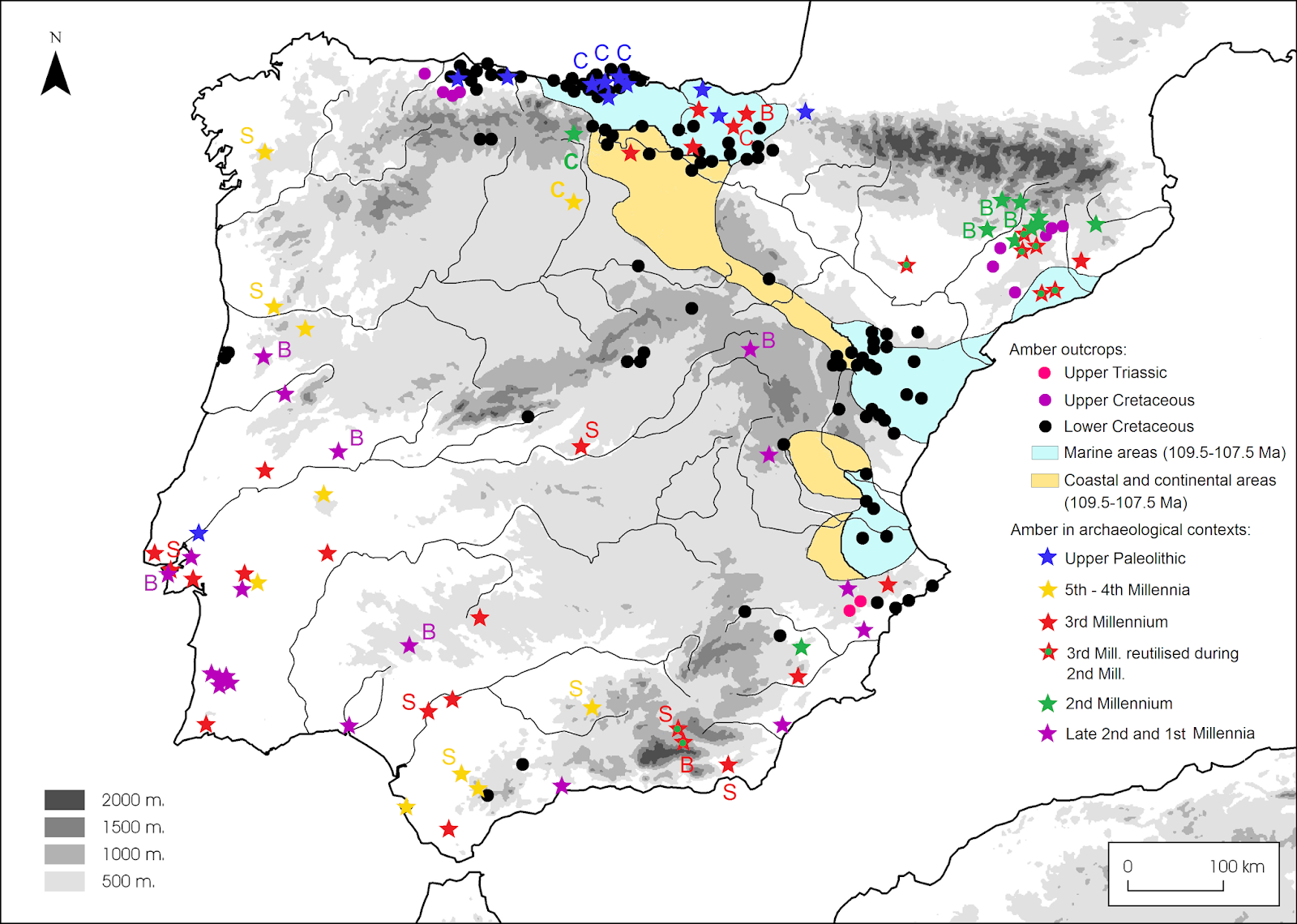
One of the places where amber is found in Europe is Sicily. It is known as simetite, and is named for the locality where it is found, the mouth of the Simeto river in Catania city, Sicily 


Local amber appears in Sicily in the 4th millennium BC. And at the exactly the same time Sicilan amber also appears in Iberia. Like these beads from Los Millares, Llano de la Sabina, Valle de las Higueras... 


This means that during the 4th millennium BC there was a sea trading route connecting Sicily and Iberia. Is this how the amber beads used to make this dress made of amber and shell beads from the tholos of Montelirio


Basically all amber found in Iberia before the 2nd millennium BC comes from Sicily. It is only during the 2nd millennium BC that we find Baltic amber in Iberia


C = Cretaceous (Iberia) S = Simetite (Sicily) B = Succinite (Baltic)

Now here is the "interesting big": 

Irish oral histories, claim that the first metal workers came to Ireland around 2500 BC from Ghotia via Anatolia, Greece, Sicily, and Iberia. BY SEA. Following the same existing Neolithic, Chalcolithic sea trade route?


We actually have proof of the existence of this sea link between the Balkans and Ireland at the beginning of the 3rd millennium BC...More in these articles about Montenegrian tumuluses 

By the way this is the same trade route later used by the Phoenicians...Who could have been the people in Horse head boats depicted on Bronze Age petroglyphs from the Baltic...Like these ones from Bohuslan, Sweden


Sunday, 22 January 2017

Cantre'r Gwaelod

Cantre'r Gwaelod meaning Sunken cantref (province) is a legendary ancient sunken kingdom said to have occupied a tract of fertile land lying between Ramsey Island and Bardsey Island in what is now Cardigan Bay to the west of Wales. 


There are several versions of the legend. The earliest version appears in the Black Book of Carmarthen which dates to the 13th century. In it the land is referred to as Maes Gwyddno (English: the Plain of Gwyddno). In this version, the land was lost to floods when a well-maiden named Mererid neglected her duties and allowed the well to overflow.

It is interesting that a very similar story is also found in "Historical and descriptive notices of the city of Cork and its vicinity" first published in 1839 by John Windele. On Pages 42-43 we can read this:

A short distance to the south west, from the City, is Lough na famog, (probably the Lough Ere of the Hajiology,) now called the Lough of Cork, a considerable sheet of water supplied by streams from the adjoining hills; the high road runs along its eastern shore, and the other sides are skirted by grounds, unhappily without tree or shrub, to add a feature of beauty or interest to the picture. It is the scene of one of CROKER'S charming Fairy Legends, detailing the bursting forth of the lake, through the negligence of the princess Fioruisge (Irish: Fior-uisge - spring water), daughter of King Corc. In taking water from the charmed fountain, she forgot to close the mouth of the well, and the court, the gardens, the King, and his people, were buried beneath the flowing waters. 

The incident is common to almost every lake in Ireland. 

Six centuries ago, Cambrensis had a similar legend concerning Lough Neagh, which Hollinshed has repeated in a less diffusive style. "There was," he says, "in old time, where the pool now standeth, vicious and beastlie inhabitants. At which time was there an old saw in everie man his mouth, that as soon as a well there springing, (which for the superstitious reverence they bare it, was continuallie covered and signed,) were left open and unsigned, so soone would so much water gush out of that well, as would forthwith overwhelme the whole territorie. It happened at length, that an old trot came thither to fetch water, and hearing her childe whine, she ran with might and maine to dandle her babe, forgetting the observance of the superstitious order tofore used: But as she was returning backe, to have covered the spring, the land was so farre overflown, as that it past hir helpe; and shortly after, she, hir suckling, and all those that were within the whole territorie, were drowned; and this seemeth to carie more likelihood with it, because the fishers in a cleare sunnie daie, see the steeples and other piles plainlie and distinctlie in the water." 

In 1770, Welsh antiquarian scholar William Owen Pughe reported seeing sunken human habitations about four miles (6.4 km) off the Ceredigion coast, between the rivers Ystwyth and Teifi.

In the 1846 edition of The Topographical Dictionary of Wales, Samuel Lewis described a feature of stone walls and causeways beneath the shallow waters of Cardigan Bay. Lewis took the view that considering that the Ptolemy maps marked the coastline of Cardigan Bay in the same location as it appears in modern times, the flood described in the legend must have occurred before the second century AD.

Modern historians however rejected the legend as a fantasy. 

But few years ago, ferocious winter storms stripped thousands of tons of sand from beaches in Cardigan Bay. What was revealed was a huge prehistoric forest, hundreds of oaks that died more than 4,500 years ago when they stopped growing and were then submerged under the surface of the Cardigan Bay. This ancient forest, named "the forest of Borth", once stretched for miles on boggy land between Borth and Ynyslas. Then something happened, the climate changed, the sea lever rose and the whole area disappeared under a thick layer of peat and sand and the ancient forest disappeared from view.


What is interesting is that archaeologists also found a timber walkway made from short lengths of coppiced branches, held in place with upright posts. It has been dated to between 3,100 and 4,000 years old, built as the local people found ways to cope with living in an increasingly waterlogged environment. Human and animal footprints were also found preserved in the hardened top layer of peat, along with scatterings of burnt stones from ancient hearths.

So people who lived in the forest of Borth, and who witnessed it's submergence under the waves of the Cardigan Bay, continued to live in the area. They must have passed the account of this event from generation to generation until eventually it came to us as a legend about the submerging of the Maes Gwyddno (the Plain of Gwyddno). 

What is interesting is that the destruction of the forest of Borth happened at the same time when the Irish bog oaks found in the area of the above mentioned Lough Neagh, stopped growing because they were suddenly submerged in water for 10 years.... The I wrote about this in my post "Partholon and the great flood". In that article I talked about a very strange correlation between the Irish myths and legends talking about the great floods of the mid 3rd millennium BC, and the actual dendochronological data from the same period...I concluded that the Irish myths about the great flood of Partholon are probably real histories, memories of the real catastrophic weather even which hit Ireland during the period 2354 BC and 2345 BC. 

And we now see that Wales was also hit by the same event. Dendochronoligical data obtained from the tree stumps found in the Cardigan Bay seems to match the dendochronological data from Lough Neagh. 

Did Welsh people, just like the Irish, manage to preserve the memory of the "great flood" and pass it on to us across 4500 years? Or did some past great winter storms reveal the remains of "the forest of Borth" to the amazed and bewildered medieval witnesses only to cover them again, triggering human imagination and eventually giving us the legend about the submerging of Cantre'r Gwaelod?

I just thought of something. The Laigin people from Ireland at one stage controlled Llyn peninsula. I wonder if this is how we find almost identical "let the tap running" explanation for the legend in both Ireland and Wales? 

In "The Lleyn peninsula : It's history, literature & antiquities" we read that "...practically every lake in Wales has some story or other connected with it. The story about the lake Glasfryn is very interesting. The story says that in the olden times there was a well where the lake is now, and this well, kept by a maiden named "Grassi," was called "Grace's Well." Over the well was a door, presumablv a trapdoor, which Grassi used to open when people wanted water, and shut immediately afterwards. One day Grassi forgot to shut the door, and the water overflowed and formed a lake. For her carelessness Grassi was turned into a swan, and her ghost is still said to haunt Glasfryn House and Cal-Ladi. This little lake is now the home and breeding-place of countless swans..."

This is almost identical to the legend about the Lough from Cork. So it is quite possible that the Laigin are the link here...

We also find similar legend in Brittany. It says that once there was a city called Ys that was built on land reclaimed from the sea. It was a rich place, famed for its beautiful gardens. One night Princess Dahut, under the influence of wine, mistakenly opened the sluices and the city was submerged.

Finally I have to ask this question: who was this "princess" or "maiden" who is blamed for the "great flood"? Cold this be the Old Mother Earth, the Mother Goddess, who controlled the waters, like "Baba", the hag from Slavic mythology did? Wells were considered holy to her, an the well water was called  "živa voda", living water. If the Earth is the Mother Goddess, then the well water is her menstrual blood, the living water indeed... And the flood that destroyed all these ancient cities could have been an actual flood caused by a catastrophic climate change...Like the flood of Partholon described in the old Irish Annals and recorded in bog oaks... This is a very interesting theme to explore....

Friday, 3 June 2016

Dreamtime


In my post about the Montenegrian tumuluses, I argued that the Irish annals contained true historical accounts about the migration of the Partholon and his people from the sea of Azov, via Anatolia, Montenegro, Sicily, Iberia into Ireland which happened in the mid 3rd millennium BC. The Irish annals were originally oral histories which were only written down in the medieval time. And so the main complaint that I got about my Partholon theory was that it is impossible that oral histories can be preserved for so long.

Well we now seem to have proof that some oral histories could be as much as 45,000 years old if not even older...

In a genetic study in 2011, researchers found evidence that the ancestors of the Aboriginal population split off from the ancestors of the European and Asian populations between 65,000 and 75,000 years ago. These Aboriginal ancestors migrated into South Asia and then into Australia, where they stayed, with the result that, outside of Africa, the Aboriginal peoples have occupied the same territory continuously longer than any other human populations. These findings suggest that modern Aboriginal peoples are the direct descendants of migrants who left Africa up to 75,000 years ago.[2][3] The same genetic study of 2011 found evidence that Aboriginal peoples carry some of the genes associated with the Denisovan (a species of human related to but distinct from Neanderthals) peoples of Asia. Examining DNA from a finger bone excavated in Siberia, researchers concluded that the Denisovans migrated from Siberia to tropical parts of Asia and that they interbred with modern humans in South-East Asia at some stage before 45,000 years ago, before Australia separated from Papua New Guinea. [4] They contributed DNA to Aboriginal Australians along with present-day New Guineans and an indigenous tribe in the Philippines known as Mamanwa. This study makes Aboriginal Australians one of the oldest living populations in the world and possibly the oldest outside of Africa, confirming they may also have the oldest continuous culture on the planet.[7]

Now when did these ancestors of the Aboriginal Australians move into Australia is uncertain. But it is possible that this happened sometime between 45,000 and 40.000 years ago. This is supported by the archaeological finds of human remains near Lake Mungo.

Lake Mungo is a dry lake located in south-eastern Australia,in the south-western portion of New South Wales. It is at the Lake Mungo where a so called "Mungo Man and Mungo Lady" remains were found. Mungo Lady is particularly interesting. Mungo Lady, a partially cremated female body, was discovered in 1969 by Dr Jim Bowler from the Australian National University (ANU). Mungo Lady was only partially cremated before the remainder of her bones were crushed. She was initially estimated to be 25,000 years old, although a more recent multi-university study in 2003 determined that she was probably closer to 40,000 years old.

Mungo Man was also discovered by Dr Bowler, on 26 February 1974. The remains were covered with red ochre, in what is the earliest known incidence of such a burial practice. Red ochre is commonly used in burials for ritualistic purposes. The site was dating using OSL dating, or luminescence dating. The site is dated to be 60,000 years ago. If the fossils are actually from 60,000 years old, the fossils would be that of archaic Homo sapiens.

The different years for which artifacts and the remains were found puts into debate the actual time in which Australia was inhabited. If it was inhabited 60 thousand years or over, it puts in question the theory that all civilizations derived from Africa. If, however, Mungo Man and Mungo Lady truly are evidence that Australia has only been inhabited for about 50,000 years, the theory of Africa is stronger than ever. This would put Mungo Man and Mungo Lady's civilization in the same time frame as other cultures that were just beginning to settle outside of Africa.[5]

But regardless, it seems that at some stage between 65,000 and 40,000 years ago the Aboriginal Australians crossed into Australia, and have been isolated there from the rest of the world until the first Chinese and European explorers reached the continent not more than 500 years ago.

During that time they have been carefully preserving their beliefs through a complex set of rituals and stories which are today known as "Dreamtime". But it seems that the "Dreamtime" stories are not just mythologies, but are a mix of mythological stories and actual histories accumulated and preserved over who knows how many thousands of years.

The term Dreamtime is based on a rendition of the indigenous (Arandic) word "alcheringa", used by the Aranda (Arunta, Arrernte) people of Central Australia. The word actually has a meaning closer to "eternal, uncreated" or "so old that it seems that it has been here forever". In "Dreamtime" an individual's entire ancestry exists as one, culminating in the idea that all worldly knowledge is accumulated through one's ancestors. This is extremely good description of the accumulated  memories which were passed through direct contact from generation to generation through stories and rituals. 

And as I said, some of the Dreamtime memories could turn out to be actual ancient histories.  

The flood

"In the beginning, as far back as we remember, our home islands were not islands at all as they are today. They were part of a peninsula that jutted out from the mainland and we roamed freely throughout the land without having to get in a boat like we do today. Then Garnguur, the seagull woman, took her raft and dragged it back and forth across the neck of the peninsula letting the sea pour in and making our homes into islands."

This is a paraphrase of an Aboriginal story about the origin of the Wellesley Islands, a group of islands off the coast of north Queensland in the southern Gulf of Carpentaria:


This story has parallels along every part of the coast of Australia. Along the coast, Aboriginal stories written down early in colonial times talk about the ancient time when these areas were dry, a time when people hunted kangaroo and emu there, before the water rose and flooded them, never again to recede.

In a recent paper [8] presented at an indigenous language conference in Japan, Nick Reid, Associate Professor, School of Behavioural, Cognitive and Social Sciences, University of New England and Patrick D. Nunn, Assistant Director, Sustainability Research Centre; Professor of Geography, University of the Sunshine Coast analysed 18 stories from around Australia’s coast.

They found that all stories tell tales of coastal flooding and argued that these stories recall coastal inundation as sea levels started to rise after the last Ice Age.

During the coldest time of the last ice age about 20,000 years ago, the sea level around Australia stood about 120 metres below its present level. When the ice started to melt, a few thousand years later, huge masses of ice that had built up on the land, particularly in the northern hemisphere, began melting. Water poured into the world’s oceans, raising their levels in ways that are now well understood. By about 13,000 years ago, sea level had risen to around 70 metres below its present level. One thousand years later, it had risen to about 50 metres below present. These dates give us a ballpark for how old the Aborinial stories of flooding may be. Could they have reached us from 13,000 years ago?

I already mentioned the story about the Wellesley Islands. The local tribes from the Cairns area claim that they once lived “where the Great Barrier Reef now stands”. Their story states that the Fitzroy Island was once part of the mainland. 


And that the offshore Green Island was four times larger. 


The story describes several named landmarks with remembered historical-cultural associations that are now underwater.

During the last ice age this whole area which today lies between the Great Barrier reef and the Australian coast, would have comprised broad floodplains and undulating hills with a range of subsistence possibilities, bordered in most parts by steep cliffs plunging down to the narrow shore.

The Great Barrier reef has an average depth of 35 meters in its inshore waters, while on outer reefs, continental slopes extend down to depths of more than 2000 meters. Based on these depths, the above stories about the flooding of the reef might date from as much as 12,000 years ago. A more conservative interpretation, based on a sea level just 30 meters lower than today, would place the age of this story at around 10,000 years ago.

Similar stories come from Spencer Gulf in southern Australia. 


Those from the Narrangga people of Yorke Peninsula recall the time when there was no Spencer Gulf, only “marshy country reaching into the interior” lying just above the ocean surface and dotted with “freshwater lagoons” where birds and other animals flocked.

One day the sea came in, perhaps through the breaching of a natural barrier, and the area has since been submerged. If these stories refer to flooding across the outermost lip of Spencer Gulf, which today lies around 50 metres below present sea level, then they may have originated 12,000 years ago. Even if they refer to inundation of the central part of the Gulf, they are likely to be more than 9,000 years old.

How sea levels changed after the ice ages around Australia is now well known. So if these stories are accepted as authentic and based on observations of coastal flooding, it is clear that they must be of extraordinary antiquity.

But believe or not these are not the oldest Dreamtime stories which could be actual ancient histories. 

The palms

This is Central Australian Cabbage Palm (Livistona mariae). 


How the only native palm tree in Australia got to an isolated Palm Valley in the center of the country has long been a mystery.


Recent research findings seem to back up Aboriginal legend on origin of these palms. Several years ago Tasmanian ecologist David Bowman from University of Tasmania, did DNA tests on palm seeds from the outback and near Darwin. The results led him to conclude the seeds were carried to the Central Desert by humans at some stage between 15,000 and 30,000 years ago. What is interesting is that after he published his findings, Professor Bowman read an Aboriginal legend recorded in 1894 by pioneering German anthropologist and missionary Carl Strehlow, which was only recently translated, describing the "gods from the north" bringing the seeds to Palm Valley.

Professor Bowman said he was amazed. 

"We're talking about a verbal tradition which had been transmitted through generations possibly for possibly 30,000 years," he said.

"Just an amazing coincidence that we'd independently concluded that the seeds had been transported and then subsequently we discover an Aboriginal legend is exactly what we found scientifically.

"The concordance of the findings of a scientific study and an ancient myth is a striking example of how traditional ecological knowledge can inform and enhance scientific research.

"It suggests that Aboriginal oral traditions may have endured for up to 30,000 years, and lends further weight to the idea that some Aboriginal myths pertaining to gigantic animals may be authentic records of extinct megafauna."

This is amazing. A 30,000 years old oral history??? But this is nothing compared to the Dreamtime story which explains the origin of the black swans. 

The swans

The Dreamtime story of the black swans tells how two brothers were turned into white swans so they could help an attack party during a raid for weapons. It is said that Wurrunna used a large gubbera, or crystal stone to transform the men. After the raid, eaglehawks attacked the white swans and tore feathers from the birds. Crows who were enemies of the eaglehawks came to the aid of the brothers and gave the black swans their own black feathers. The black swan red beak is said to be the blood of the attacked brothers, which stayed there forever.

This is truly an amazing story. Evidence suggests that swans evolved in Europe or western Eurasia during the Miocene (23.03 to 5.332 million years ago), spreading all over the Northern Hemisphere until the Pliocene (5.333 million to 2.58 million years ago). 

The swans are generally found in temperate environments, rarely occurring in the tropics. 

Four (or five) species occur in the Northern Hemisphere (all white).


One species is found in Australia and New Zealand (black).


And one species is distributed in southern South America (white with black neck).


The swans are absent from tropical Asia, Central America, northern South America and the entirety of Sub SaharanAfrica. This is the map that shows the natural distribution of swans in the world. 


Now you can see that there we have black swans in Australia and white swans in the Central and Northern Asia. But no swans of any kind in the huge area between China and Australia. As we have seen from the evidence found in the lake Mungo site, Aboriginal Australians have crossed into Australia at least 40,000 years ago. We have also seen that the scientists believe that the mixing between the Denisovans and modern humans, which produced the ancestors of today's Aboriginal Australians, happened in the tropical parts of Asia at some stage before 45,000 years ago. 

Now there are no swans in tropical South East Asia, and the only swans that live in Australia are black swans. This means that the only swans Aboriginal Australians could have seen for over 45,000 years have been black swans. So where and more importantly when did they last see a white swan? Well somewhere on their way from Africa to South East Asia, at some stage between 75,000 and 45,000 years ago. This means that this Dreemtime story is more than 45,000 years old and could be as much as 60,000 years old....

How's this for the resilience of the oral tradition? What is measly 5000 years, which is how old I believe the story of Partholon's migration from the Irish Annals is, compared to the age of the Australian Dreamtime stories?

Why and how did Australian Aboriginal cultures achieve transmission of information about real events from such deep time? Professors Nick Reid and Patrick D. Nunn who wrote about the Aboriginal Australian flood myths suggested that: 

"The isolation of Australia is likely to be part of the answer. But it could also be due to the practice and nature of contemporary Aboriginal storytelling. This is characterised by a conservative and explicit approach to “the law”, value given to preserving information, and kin-based systems for tracking knowledge accuracy. This could have built the inter-generational scaffolding needed to transmit stories over vast periods."

And this is exactly the kind of environment that was found in Ireland. A close knit clan based community living for a long time in a relative isolation at the edge of Europe. No wonder that the Irish managed to preserve such old myths, legends, beliefs and histories  in Europe. 

I also believe that some European myths are much much older and come to us from Mesolithic and maybe even Paleolithic times. But more about this later...Until then stay happy and sweet dreams...

References:

1. "Outback palms were planted", David Bowman, University of Tasmania
2. "An Aboriginal Australian Genome Reveals Separate Human Dispersals into Asia", Rasmussen, Morten; et al.
3. "The first Aboriginal genome sequence confirms Australia's native people left Africa 75,000 years ago.". Australian Geographic. 23 September 2011.
4. "First Aboriginal genome sequenced", Callaway, Ewen. Nature.
5. "Pleistocene human remains from Australia: A living site and human cremation from Lake Mungo, western New South Wales", J. M. Bowlerab, Rhys Jonesab, Harry Allenab & A. G. Thorneab, World Archaeology
6. " Ducks, Geese and Swans. Bird Families of the World. ", Kear, Janet, ed
7. "DNA confirms Aboriginal culture is one of the Earth's oldest". Australian Geographic.
8. "Ancient Aboriginal stories preserve history of a rise in sea level", Nick Reid and Patrick D. Nunn