Showing posts with label great flood. Show all posts

Wednesday, 21 February 2024

Feast plaque from Louvre

Another amazing object I discovered during the 5 hour long stroll I took with my son through the Mesopotamian section of the Louvre museum last weekend. 

Perforated votive limestone plaque, Mesopotamia (where?), ca. 2700-2650BC...Currently kept in Louvre...

The official description: 

"...decoration is arranged in three registers. 

A banquet scene occupies the first register...

In the second register, a stag and ox are placed on either side of the central perforation. 

A banquet scene in a boat occupies the third register..."

So what's so amazing about this?

First amazing thing is that the museum curators didn't identify the two animals depicted between the two banquet scenes correctly. 

The animal on the left is not a stag. It's an ibex goat. And the animal on the right is not an ox. It's a calf...

VERY VERY IMPORTANT...How can you expect to correctly interpret what is depicted on this object, if you don't identify the correctly what is actually depicted on it. 

Oh wait, they never attempted to interpret what was depicted on this object...

So let me try to do it...

But really, this object is amazing because it connects three other objects I talked about earlier, and basically links all the symbols depicted on these objects together...

First object is this perforated votive limestone plaque, from the same period (and most likely the same area) as our original votive limestone plaque. I talked about it in my post "Green pastures"...


It too depicts a banquet scene in its top register. The other two registers depict two ibex goats and two calves, two very important animal calendar markers used extensively in Mesopotamia...

According to the paper "God or worshiper", the first "banquet" scene actually depicts worshipers in front of Abu the god of green pastures, and his consort, goddess of fertility...But this paper says nothing about goats and calves...

What goat and bull calf depict are beginning and end of the fertile, bountiful, time of the year in Mesopotamia, the cool, wet half, winter, which starts in Oct/Nov (ibex goats mating) and ends in Apr/May (auroch cattle calving). The time of plenty, the party time...


I talked about ibex goat as an animal calendar marker in many posts, such as, "Problems with Abzu", "Relief from Dur Sharrukin", "Goatfish", "Flamingos from Susa", "Goat carrier", "Iranian goat of rain", "Strider", "A vessel from Tepe Hissar"... 

I talked about bull/calf as an animal calendar marker in many posts, such as, "Foundation peg of the goddess Nanshe", "Cow and calf ivory", "Butt chewing", "Bulls and grain bowls", "How grain came to Sumer", "Bull leaping in Syria"...

Anyway, the second object is this seal, dated to 2300–2150BC, depicting Enki, god of fresh water and the annual flood, in a boat. 


In my article "Enki's little boat", I explained why Enki's boat is actually the symbol for the annual flood. 

The third object is this seal, from the same period as he previous one, also depicting Enki's flood boat, but this time, above the boat we have an ibex goat and an auroch bull...


In my article "Rain and flood" I explained the relationship between these two animal calendar markers and the annual flood. 

"By hand Winter guided the spring floods, the abundance and life of the Land..." 

This is climate chart for Southern Mesopotamia...


Winter, cool, wet, fertile half of the year in Mesopotamia starts in Oct/Nov (ibex goats mating) and ends in Apr/May (auroch cattle calving)

And as I said, this last votive plaque links all these objects and the symbols depicted on them together. 

Top: God of green pasture and goddess of fertility?

Middle: animal calendar markers marking the beginning and end of winter

Bottom: Enki, God of annual flood in his procession boat. Enki who was also known as Goat of Abzu and Bull of Abzu...And of course before me, no one knew why...Sad...I know I am not that smart...I talked about this procession boat in my post "Problems of the Abzu"...

All having a splendid party, party, party time...Between goat and bull calf...

To read more about ancient animal and plant calendar markers, start here…then check the rest of the blog posts related to animal calendar markers I still didn't add to this page, and finally check my twitter threads I still didn't convert to blog post...I am 9 months behind now...

Friday, 28 October 2022

The gourd that saved humanity

This is Lei Kung/Lei Gong, The Lord of Thunder from Chinese folk mythology...Again...

Did you know that he was the guy who caused "The flood"? You can read about it in "Chinese mythology A to Z"... 

The one that killed all the people except Fuxi and Nüwa, brother and sister who then became the progenitors of the new human race...


BTW, did you notice that they are holding a square and a compass...I wrote talked about this in my post about Father Sky and Mother Earth...And square and compasses, their symbols...I talked about them in my post "Square and compasses"...

Apparently the father of Fuxi and Nüwa, who is in some legends identified as Lei Gong himself, decided to catch Lei Gong and pickle him 🙂 And catch him he did, using a pitchfork, and he put him in a metal cage that hang under the roof...

The father then went to town to buy spices for pickling 🙂 and he told his kids not to give Lei Gong any food or water...Remember Lei Gong was a "bat like monster"...So the whole thing to me looks like something from Gremlins 🙂

Anyway, after Lei Gong begged them and begged them, the kids eventually did give him one drop of water. As soon as the water touched his lips, Lei Gong burst out of the cage with a terrifying bellow. See, Gremlins 🙂 Or Baš Čelik from Serbian fairytales...

The kids cowered in fear, but the god, instead of harming them, thank them for freeing him. Then he took out one of his teeth and gave it to the kids saying that if they plant it "it will grow into a gourd". And then he went off thundering and the rain started to fall...

The kids of course planted the tooth immediately to see what happens. And lo and behold, it immediately started to grown and soon turned into a giant gourd...

When their father came home, the place was already a swamp. WTF happened here? asked the father, and the kids told him everything. After hearing what happened, their father built a boat, got the kids and the gourd into the boat, put the kids into the gourd, and began to row...

The waters rose and rose and soon reached the heaven. The father of Fuxi and Nüwa started to bang on the heavenly door, begging the Lord of Heaven to end the rain and flood before they all drowned...

The Lord of Heaven, fearing that the flood will submerge the heaven itself, ordered the water god to get rid of the water...And so he did...But too fast. And so the boat fell to the ground, the father died from impact, and only Fuxi and Nüwa survived protected inside the gourd...

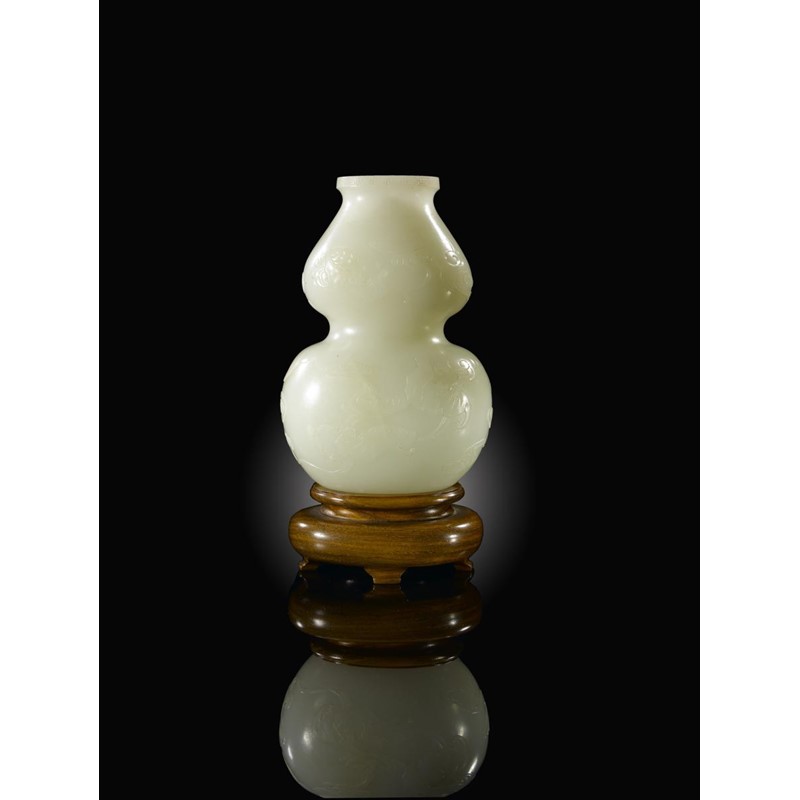
The rest is X-rated history...To me the interesting bit here is "the gourd"...Look, 18th c. Chinese white jade gourd-shaped vase with bats and clouds, Qianlong...


Hmmm...Bats, symbol of the peak of the rain season in China, and (rain) clouds...Maybe here would be a good place for you to take a detour and read through my earlier post about "Lei Kung (Lei Gong)", and all his mad animal and plant calendar markers...The important bit about bats:

What is the link between thunder (god) and bats? Temperate zone bat year is divided into two halves: active (Apr/May-Oct/Nov) and hibernation (Oct/Nov-Apr/May). The most noticeable event during the active period, bat swarming, starts in the middle of the active period, in Aug.

This is climatic year in China in Xian, Hunan, Sechuan...


And this is the thunderstorm frequency chart...

We can see that this is also the peak of the thunderstorm and rain season...So no wonder Thunder God was seen as the "bat like demon"...

But this post is about gourds...The bottle gourd, has a long history in China. Describing the way of life among Chinese farmers 3,000 years ago, the Pinfeng chapter of the Book of Odes relates: "In July, the gourds are in abundant supply, but by August, the season is over"

HA!!! When are gourds harvested? Jul/Aug. Right bang at the peak of the rain, thunderstorm and flood season in China...Caused by Lei Gong/Lei Kung, The Bat Dude...

Pickled bats? 🤮

That's it folks, that's all I have to say about The Lord of Thunder...

To read more about ancient animal and plant calendar markers, start here…then check the rest of the blog posts related to animal calendar markers I still didn't add to this page, and finally check my twitter threads I still didn't convert to blog post...I am 9 months behind now...

Saturday, 23 April 2022

When Utu steps up into heaven

In the Sumerian text "Enki and Ninhursanga" Enki [the god of fresh water and the annual flood] says: "When Utu [the sun god] steps up into heaven, fresh waters shall run out of the ground for you"...

What does this mean?

This makes no sense, right? How can rising of the sun make water run out of the ground? Well it is not the sun's daily elevation, but the sun's annual elevation that this text talks about...

The sun's elevation is the lowest at the start of the solar year, at Winter Solstice. As the solar year progresses, the sun's elevation increases. The sun's elevation is the highest at the Summer solstice, after which it decreases until its minimum at the Winter Solstice...


What does this have to do with water running out of the ground? Well, the elevation of the sun is directly linked to the duration of the day. 

The day is the shortest at the Winter Solstice (lowest elevation) and the longest at the Summer Solstice (highest elevation)...

You would think that the the winter solstice would then be the coldest time of the year, as the day is the shortest. But, because of the way earth-sun system works, the earth continues to cool after winter solstice, even though the days start getting longer...

The coldest time of the year is at the beginning of February, the beginning of spring...After which the earth starts to warm up...


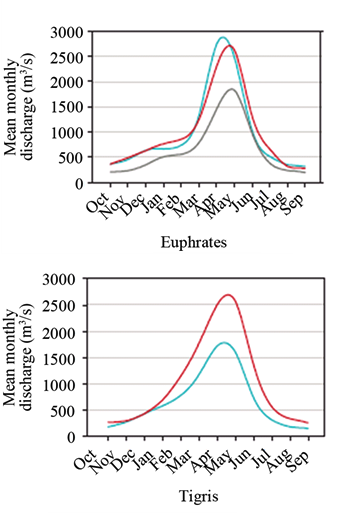
This is Exactly when the water levels of Tigris and Euphrates start to rise. Why? Cause the earth is warming up, and the snow, which covers the mountains to the North and East of Sumer is melting...

The snowmelt starts in Jan/Feb (Aquarius 🙂)...

And the snowmelt runoff peaks in Apr/May (Taurus 🙂)

And it is this snowmelt that is the main contributor to the water flow of Tigris and Euphrates...

And it is the peak snowmelt runoff that causes the peak water flow in Tigris and Euphrates and the annual flood...


I talked about this in my posts "Enki's little boat", "Rain and flood" and many other...

And so, as Utu, The Sun god, climbs higher and higher up the sky, warmer and warmer the earth becomes, more and more snow is melted, and higher and higher the water levels of Tigris and Euphrates become...Symbolically Utu frees Enki from his icy prison...I talked abut this in my post "Shamash young and old"...

And as the water levels of all the rivers in the Tigris and Euphrates catchment area rise, "fresh waters runs out of the ground"...

Just like Father Enki has promised. Enki, "the important one of the great gods" for whom it is said that "there is no one who does not take his skilful advice"... You can find these quotes in Ancient Near Eastern Gods Enki and Ea: Diachronical Analysis of Texts and Images from the Earliest Sources to the Neo-Sumerian Period...

BTW: The water levels in Tigris and Euphrates reach their peaks at the beginning of Summer, in Taurus. Which is why Enki, "the flood of heaven and earth" is also "great bull" who releases his semen into Tigris and Euphrates...

That Iranians used the same symbolic calendar can be seen from this Proto-Elamite silver figurine of a clothed kneeling bull (cow?) which "shows a curious blend of human and animal traits"...holding a spouted [water] vessel...I talked about this in my post "Elamite water bull"...

PS: I just thought of something...You know how originally Sumerian gods lived in Ekur, the holy mountain(s), which later became heaven...The same holy mountain(s) which are the source of Tigris and Euphrates...I talked about this in my post "How grain came to Sumer"...

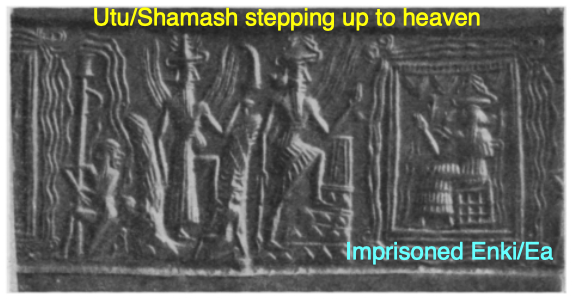
Did "When Utu steps up into heaven" originally mean "When Utu steps up into holy mountain(s)", just like it is depicted on the seal showing Shamash/Utu liberating Enki/Ea?

Technically it's the same thing, as "Sun stepping up the mountain" means "Sun heating up the higher and higher ranges of the mountains", which correspond with the "Sun's elevation getting higher and higher"...

Interesting...

To read more about ancient animal and plant calendar markers, start here…then check the rest of the blog posts related to animal calendar markers I still didn't add to this page, and finally check my twitter threads I still didn't convert to blog post...I am 9 months behind now...

Sunday, 22 January 2017

Cantre'r Gwaelod

Cantre'r Gwaelod meaning Sunken cantref (province) is a legendary ancient sunken kingdom said to have occupied a tract of fertile land lying between Ramsey Island and Bardsey Island in what is now Cardigan Bay to the west of Wales. 


There are several versions of the legend. The earliest version appears in the Black Book of Carmarthen which dates to the 13th century. In it the land is referred to as Maes Gwyddno (English: the Plain of Gwyddno). In this version, the land was lost to floods when a well-maiden named Mererid neglected her duties and allowed the well to overflow.

It is interesting that a very similar story is also found in "Historical and descriptive notices of the city of Cork and its vicinity" first published in 1839 by John Windele. On Pages 42-43 we can read this:

A short distance to the south west, from the City, is Lough na famog, (probably the Lough Ere of the Hajiology,) now called the Lough of Cork, a considerable sheet of water supplied by streams from the adjoining hills; the high road runs along its eastern shore, and the other sides are skirted by grounds, unhappily without tree or shrub, to add a feature of beauty or interest to the picture. It is the scene of one of CROKER'S charming Fairy Legends, detailing the bursting forth of the lake, through the negligence of the princess Fioruisge (Irish: Fior-uisge - spring water), daughter of King Corc. In taking water from the charmed fountain, she forgot to close the mouth of the well, and the court, the gardens, the King, and his people, were buried beneath the flowing waters. 

The incident is common to almost every lake in Ireland. 

Six centuries ago, Cambrensis had a similar legend concerning Lough Neagh, which Hollinshed has repeated in a less diffusive style. "There was," he says, "in old time, where the pool now standeth, vicious and beastlie inhabitants. At which time was there an old saw in everie man his mouth, that as soon as a well there springing, (which for the superstitious reverence they bare it, was continuallie covered and signed,) were left open and unsigned, so soone would so much water gush out of that well, as would forthwith overwhelme the whole territorie. It happened at length, that an old trot came thither to fetch water, and hearing her childe whine, she ran with might and maine to dandle her babe, forgetting the observance of the superstitious order tofore used: But as she was returning backe, to have covered the spring, the land was so farre overflown, as that it past hir helpe; and shortly after, she, hir suckling, and all those that were within the whole territorie, were drowned; and this seemeth to carie more likelihood with it, because the fishers in a cleare sunnie daie, see the steeples and other piles plainlie and distinctlie in the water." 

In 1770, Welsh antiquarian scholar William Owen Pughe reported seeing sunken human habitations about four miles (6.4 km) off the Ceredigion coast, between the rivers Ystwyth and Teifi.

In the 1846 edition of The Topographical Dictionary of Wales, Samuel Lewis described a feature of stone walls and causeways beneath the shallow waters of Cardigan Bay. Lewis took the view that considering that the Ptolemy maps marked the coastline of Cardigan Bay in the same location as it appears in modern times, the flood described in the legend must have occurred before the second century AD.

Modern historians however rejected the legend as a fantasy. 

But few years ago, ferocious winter storms stripped thousands of tons of sand from beaches in Cardigan Bay. What was revealed was a huge prehistoric forest, hundreds of oaks that died more than 4,500 years ago when they stopped growing and were then submerged under the surface of the Cardigan Bay. This ancient forest, named "the forest of Borth", once stretched for miles on boggy land between Borth and Ynyslas. Then something happened, the climate changed, the sea lever rose and the whole area disappeared under a thick layer of peat and sand and the ancient forest disappeared from view.


What is interesting is that archaeologists also found a timber walkway made from short lengths of coppiced branches, held in place with upright posts. It has been dated to between 3,100 and 4,000 years old, built as the local people found ways to cope with living in an increasingly waterlogged environment. Human and animal footprints were also found preserved in the hardened top layer of peat, along with scatterings of burnt stones from ancient hearths.

So people who lived in the forest of Borth, and who witnessed it's submergence under the waves of the Cardigan Bay, continued to live in the area. They must have passed the account of this event from generation to generation until eventually it came to us as a legend about the submerging of the Maes Gwyddno (the Plain of Gwyddno). 

What is interesting is that the destruction of the forest of Borth happened at the same time when the Irish bog oaks found in the area of the above mentioned Lough Neagh, stopped growing because they were suddenly submerged in water for 10 years.... The I wrote about this in my post "Partholon and the great flood". In that article I talked about a very strange correlation between the Irish myths and legends talking about the great floods of the mid 3rd millennium BC, and the actual dendochronological data from the same period...I concluded that the Irish myths about the great flood of Partholon are probably real histories, memories of the real catastrophic weather even which hit Ireland during the period 2354 BC and 2345 BC. 

And we now see that Wales was also hit by the same event. Dendochronoligical data obtained from the tree stumps found in the Cardigan Bay seems to match the dendochronological data from Lough Neagh. 

Did Welsh people, just like the Irish, manage to preserve the memory of the "great flood" and pass it on to us across 4500 years? Or did some past great winter storms reveal the remains of "the forest of Borth" to the amazed and bewildered medieval witnesses only to cover them again, triggering human imagination and eventually giving us the legend about the submerging of Cantre'r Gwaelod?

I just thought of something. The Laigin people from Ireland at one stage controlled Llyn peninsula. I wonder if this is how we find almost identical "let the tap running" explanation for the legend in both Ireland and Wales? 

In "The Lleyn peninsula : It's history, literature & antiquities" we read that "...practically every lake in Wales has some story or other connected with it. The story about the lake Glasfryn is very interesting. The story says that in the olden times there was a well where the lake is now, and this well, kept by a maiden named "Grassi," was called "Grace's Well." Over the well was a door, presumablv a trapdoor, which Grassi used to open when people wanted water, and shut immediately afterwards. One day Grassi forgot to shut the door, and the water overflowed and formed a lake. For her carelessness Grassi was turned into a swan, and her ghost is still said to haunt Glasfryn House and Cal-Ladi. This little lake is now the home and breeding-place of countless swans..."

This is almost identical to the legend about the Lough from Cork. So it is quite possible that the Laigin are the link here...

We also find similar legend in Brittany. It says that once there was a city called Ys that was built on land reclaimed from the sea. It was a rich place, famed for its beautiful gardens. One night Princess Dahut, under the influence of wine, mistakenly opened the sluices and the city was submerged.

Finally I have to ask this question: who was this "princess" or "maiden" who is blamed for the "great flood"? Cold this be the Old Mother Earth, the Mother Goddess, who controlled the waters, like "Baba", the hag from Slavic mythology did? Wells were considered holy to her, an the well water was called  "živa voda", living water. If the Earth is the Mother Goddess, then the well water is her menstrual blood, the living water indeed... And the flood that destroyed all these ancient cities could have been an actual flood caused by a catastrophic climate change...Like the flood of Partholon described in the old Irish Annals and recorded in bog oaks... This is a very interesting theme to explore....