Showing posts with label irish history. Show all posts

Friday, 9 April 2021

Head cutters

Celts, "When their enemies fall, cut off their heads and fasten them about the necks of their horses...." (Diodorus Siculus). 

Celtic bronze fibula of a horseman with enemy's severed head (2nd c. BC), Museo Arqueológico Nacional, Spain


A mounted Celtic warrior with what is interpreted as a decapitated head suspended from the neck of his horse. From Entremont (oppidum) France.


In case you are in doubt that this could be a severed head, have a look at this. One of the Celtic warrior statues from Entremont oppidium southeastern France. The warrior is sitting in a lotus position, with the cut off heads of his enemies on his laps. Reconstructed from fragments...
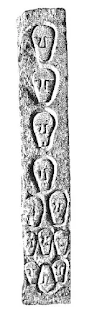
The head of a deceased person placed under a hand (of a seated hero?). The position of the head on the knee of a warrior almost certainly indicates it was one of the trophies accumulated during his life...From official Entremont site..


Closeup of two other heads. One with the hand resting on the head under a streak of long hair...From the official Entremont site... 


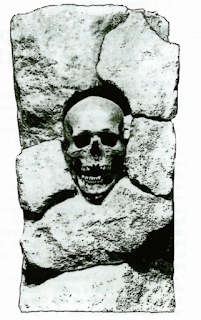
Decapitated head in one of the scull pillars of the Sanctuary of Roquepertuse, Southern France...From "The head hunters"...


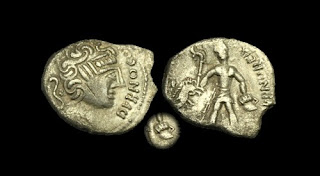
Gold quinarius, Central Gaul, 100-50BC. 

Front: female head looking right with inscription DVBNOC[OV] (Dubnocoveros, giant of the world) 

Back: warrior standing, holding boar standard in right hand and human head in left hand with inscription[D]VBNOREX (Dubnorex, king of the world)


Some habits die hard...Once a headhunter, always a headhunter...Even if you are now "Roman"...Tombstone of Insus, son of Vodullus of the Treveri, cavalryman of the Ala Augusta. c. 80 AD...Treveri were a Celtic tribe who inhabited the lower valley of the Moselle. And collecting the heads of dead enemies was one of Celtic favourite hobbies... 


"...human crania themselves, sometimes perforated for display, have proved to be a recurrent find on Iron Age archaeological sites right across Europe, from southern France to northern Scotland..."

That head cutting and collecting was a widespread custom among Celts, can be seen from the Irish annals, oral histories first written down during early medieval time by the Irish monks:

Examples of the practice of cutting off the heads of dead enemies, from Fragmentary Annals of Ireland 


"Cuchulain turned on them, and straightway he smote off their twelve heads. And he set up twelve stones in the earth for them, and he put the head of each one of them on its stone and he likewise put Ferchu Longsech's head on its stone..."

I think this is enough to illustrate that this was a widespread practice in Ireland...

Finally we come to "kern". Kern (Anglicised Middle Irish "ceithern", fighting men) was a Gaelic (Irish) warrior, specifically a light infantryman, and light cavalry in Ireland in the late Middle Ages. Like many Gaels historically, Kerns often found themselves on multiple sides of conflicts; for example, the native Irish forces of the Norman-English in Ireland would have had levies of Kerns. As a result, they also found themselves fighting upon distant shores in Europe where they were famous as ferocious light infantrymen. This is a 15th century description of the kerns in action in France:

The Prior and many of his men were killed. The kern had made a strong impression by their outlandish dress and their ferocity, riding back from raids with severed heads dangling from their bareback ponies...

Sunday, 25 October 2020

Giant's Ring

This is the so called Giant's Ring, a late Neolithic henge monument at Ballynahatty, near Shaw's Bridge, Belfast, Northern Ireland...

Inside the enclosure, east of the centre, is a small passage tomb with an entrance passage facing west...

The genetic data obtained from the female remains found inside the tomb, and dated to (3343–3020 cal. BC) shows "predominant ancestry from early farmers" and "haplotypic affinity with modern southern Mediterranean populations such as Sardinians".

Also "she shares higher levels of genetic drift with Early and MN samples from Spain rather than those from Germany...and arguing for the possible passage of farming to Ireland via a southern coastal route rather than via the migrations through central Europe".

From "Neolithic and Bronze Age migration to Ireland and establishment of the insular Atlantic genome

Now this is pointing at the neolithic people (first farmers) migrating into Europe following two routes, both starting in the Balkans: 

1. Up along Morava river to Danube and then up along Danube river into centra Europe and onward to North and Baltic seas and then further into Britain. 

2. Along north mediterranean coast via Italy, France, Spain and further into Ireland. 

Now according to the archaeological data presented in "Farming and woodland dynamics in Ireland during the Neolithic" the first farmers arrived to Ireland some time after "the great elm decline" which is pinned to around 3800BC. 

Now at that time, in the 4th millennium BC, the tourists wanting to travel along the north Mediterranean coast had two options: to walk, or to use the Neolithic seafaring trading routes that we know existed between Balkans and Iberia (via Sicily and Sardinia). I talked about this trading route in my post "Neolithic seafarers". 

So our girl (or one of her ancestors) probably travelled from Sardinia to Iberia by boat (probably along the coast, with stops along the way). And then continued on to Ireland by boat too (along the coast to Brittany and then via Cornwall to Ireland?) as there is no other way to get from Iberia to Ireland...

Interestingly, the same maritime trading/migration route along the North Mediterranean coast and then along the Atlantic coast was described in the Irish Annals as the route taken by the many Invaders of Ireland...Like Partholon who allegedly brought metalwork and cattle to Ireland...


I talked about the legends about Partholon and how it fits the archaeological data in my posts "Parthlon and the great flood" and "Or - Ireland's gold" and the rest of the posts from my series about the "Montenegrian tumuluses" (or Montenegrin tumuli as I discovered you should say in "proper English" 🙂)

Friday, 21 August 2020

Dun Briste

This is Dún Briste (literally Broken Fort) in Co. Mayo, Ireland. This 50 metres tall sea-stack stands just off Downpatrick Head, in the townland of Knockaun, east of the quiet village of Ballycastle. The stack is crowned by an old ruined fort...

There is a local legend that explains the name "Broken Fort". It was collected by Douglas Hyde and published in 1914 book "Legends of Saints & Sinners"...It is called "St Patrick and Crom Dubh" and I will here give a short version...With interpretation 🙂

...Before St. Patrick came to Ireland there lived a chieftain...in Co. Mayo, and his name was Crom Dubh. Crom Dubh lived beside the sea in a place...which is now called Dún Briste, or Broken Fort. My story will tell why it is called Dún Briste...

...Crom Dubh was one of the worst men that could be found, but as he was a chieftain over the people of that country he had everything his own way; and that was the bad way, for he was an evil-intentioned...man, with desire to be avenged on every one who did not please him...

...He had two sons... (who were) were worse than himself, and that leaves them bad enough! Crom Dubh (also) had two hounds of dogs...and if ever there were [wicked] mastiffs these two dogs were they....

...And, to go further, Crom Dubh had a big fire kindled...Anyone who displeased him, used to be brought before Crom Dubh, as he sat beside the fire, and Crom used to pass judgment upon him, and after the judgment the man used to be thrown into the fire...

...It is said that a fairy sweetheart walked with Crom Dubh, and giving him knowledge according as he used to require it. And every scheme hatched against Crom Dubh to put him out of the world, he overcame them all, for he had too much wizardry from the fairy sweetheart...

...The fame of Crom Dubh and his two sons, and his two mastiffs, went far and wide, for their evil-doing; and the people were so terrified at his name, not to speak of himself, that they used to hide their faces in their bosoms when they used to hear it mentioned in their ears...

...Crom Dubh was continuing his evil deeds for many years...and every year it was getting worse...Some say that he was a native of hell...But people had no knowledge of God or Mary...and for that reason they could not put trust in any person beyond Crom Dubh...

Here is the interesting bit 🙂 

...because they thought, bad as he was, that it was he who was giving them the light of the day, the darkness of the night, and the change of seasons... 

Who gives light and darkness and seasons? The sun god of course...The god for whom the Bronze Age Grange stone circle was built. 

The stone circle aligned to Crom Dubh's day, the day that marks the moment of maximum heat and to summer solstice, the day of maximum daylight...

It is Crom Dubh that St Patrick had to defeat to Christianise the Irish...After which Patrick took over Crom Dubh's holy mountain

And became "the one who decides the faith of the Irish"... 

And so enters Patrick:

...During this time St. Patrick was going throughout Ireland, working diligently and baptising many people....

...St. Patrick began explaining to the Pagans about the light and glory of the heavens. Some gave ear to him, but the most of them paid him no attention...Patrick took all those who listened...to be baptised to the well which is now called Tobar Phadraig or Patrick's Well...

...When these Pagans got the seal of Christ on their forehead...they began telling St. Patrick about the doings of Crom Dubh and his evil ways, and they besought him...to chastise Crom Dubh, rightly or wrongly, or to give him the Christian faith if it were possible...

Interesting right? The pagans get baptised and the Old God becomes Devil. Actually not even Devil, as that would give the Old God too much importance. The Old God becomes an Evil Chieftain...Much easier to deal with...

To cut the long story short, St Patrick arrives to Crom Dubh's house "...with his defensive company with him..."

Now does this imply that St Patrick used force during his conversion of the Irish?

...Crom Dubh set his dogs on St Patrick, with coals of fire coming out of their mouths, and a blue venomous light burning in their eyes...But Patrick tamed Crom Dubh's hounds and they become Patrick's hounds. Then Patrick extinguished Crom Dubh's fire. Then Patrick tried to "put the seal of Christ on Crom Dubh's forehead, but Crom Dubh did not give any ear to St. Patrick's words"...

...Then Crom Dubh tried "deviltry, druidism, witchcraft and  black art" trying to gain the victory over St. Patrick. But it was all no use for him, for the words of God were more powerful than the deviltry of the fairy sweetheart...

Finally:

...St. Patrick gave a blow of his crozier to the cliff under the base of the gable of the house, and he separated that much of the cliff from the cliffs on the mainland, and that is to be seen there today...and that is the cliff that is called Dún Briste or Broken Fort...

...Crom Dubh had to remain on top of the cliff "until the midges and the scald crows had eaten the flesh off his bones". And that is the death that Crom Dubh got...

...The people gathered in multitudes from every side doing honourable homage to St. Patrick, and the pride of the world on them that an end had been made of Crom Dubh...There was a well near and handy, and he baptised them all...

...There is not a year from that out that the people used not to make a pilgrimage to the well, on the anniversary of that day; and that day is the last Sunday of the seventh month, and the name of the Sunday is Crom Dubh's Sunday...

And so the people, on whose foreheads Patrick put the sign of the cross, after he banished their Sun God Crom Dubh, continued celebrating Crom Dubh's day...🙂 Under the pretext that they celebrated the victory of Patrick over Crom Dubh...I mean the day is still today known as "Domhnach Crom Dubh" which means "Crom Dubh's Sunday"...

Being a proper Sun God, Crom Dubh's day is Sunday. But not any Sunday. Sunday marking the middle of the hottest part of the year, the time when Sun's fire burns the strongest (like Crom Dubh's fire). Which accidentally falls in the middle of the Dog Days (like the Crom Dubh's ones which breathe fire and have light flashing out of their eyes)...

Oh by the way, did you know that right about the time when Patrick killed the Sun God and extinguished his fire, there was a major drop in temperature in Europe? You see the sudden drop in the second part of the 5th century AD?

How cool is this story? 

It is a historical account of the forceful conversion of the Irish and turning of their Sun god into Devil basically, by "The Patron Saint" of the Irish St Patrick "and his defensive company"...Oh and of the beginning of the medieval ice age...

Saturday, 18 April 2020

Stake

This Ogham Stone stands overlooking Smerwick Harbour, Co. Kerry, Ireland. It can be found just off the route of the Dingle Way - Slí Chorca Dhuibhne, in Ballinrannig, close to Wine Strand and Béal Bán beaches...


Ogham stones are found mainly in burial grounds, and churchyards. But some ogham stones are found outside of these areas. Here the stones may have been boundary or territorial markers, or perhaps memorials, marking where someone died, or fell in battle, or indeed was buried...

In "A smaller social history of ancient Ireland", published by Joyce Patrick Weston in 1906, we can read that "when tribe-chief had taken possession of a district, he "erected pillar-stones there...in order that his share there may be known"... 


Joice then goes to say "But pillar-stones were erected for other purposes, of which the most usual was as a monument over a grave...Battles were (also) often commemorated by pillar-stones..."

And finally he says that "...pillar-stones were sometimes erected as idols..." and "...that a stone set up to mark a boundary was sometimes called a 'stone of worship'..."

In Serbia, people also erected boundary stones between villages until recently. Erecting of the boundary stones was witnessed by both sides accompanied by many religious rituals aimed at consecrating the stone. Consequently the boundary stone was considered sacred...

Any damage to the stone, falling the stone or moving the stone and even touching the stone was prohibited. These stones were always visited by the village processions from both villages during religious festivals, reaffirming the holiness of the stones and the sacredness of the border they represented...

The use of stones as border markers is very old. But I believe, that before people used stones, to mark the land as theirs, they used stakes...


This ancient tradition was preserved again by culturally super conservative Balkan Serbs...

In Serbia every unclaimed or uninhabited land was considered a wasteland, no man's land, unclean land. In the old times it was enough to stick a stake into such land to clean the land from demons and to claim the ownership of that land...

Interestingly, in Serbia when people wanted to insure that the dead stay dead :) and don't turn into a vampires, they stuck a stake through the dead body lying in the grave to "tie it down". I talked about this in my post "Vampires"... 

It seems that the land, earth was similarly subdued and "tied down" by sticking the stake into it...

The english expression "stake a claim to the land" actually describes this ancient custom. I have tried to find any explanation how this custom and expression entered the English language. I found this explanation in the English Etymological Dictionary: "From early 14c. as 'divide or lay off and mark (land) with stakes or posts'". 

When claiming the land, the stake was usually stuck in the middle of the claimed land where future clan village would be erected. Old clan histories still remember who was the first to stick the stake into the land and therefore claim the land for the clan...

In villages on mountain Rudnik, there was a custom to first stick a stake in the place where a new house was going to be built to purify the land, to clean it of bad spirits, and only then the house was built on "clean land"...

That stake was a tabu, and was never removed or in any way spoiled. People believed that doing so would bring bad luck to the family...

Once few clans moved into the same territory, clan lands would be merged into a village land. At that stage a new communal stake would be stuck into the ground to mark the communal village land...

These communal stakes were usually stuck on crossroads, near wells, in the centre of the future village and that stake would become the cult centre of the whole village. These village stakes would later be the places where churches and or graveyards would be placed...

Until recently in some parts of Serbia stake was also used as grave marker. Archaeologists have discovered remains of wooden stakes, always one stake per grave stuck at the head of the grave where today we find tombstones and crosses...

Stakes were used to mark the borders between private and communal land and also to mark the border between two village or clan lands...

Just like the border stones I talked about earlier, these border stakes were considered holy. And it was their holiness which made moving of the borders a tabu, and therefore prevented expansionist wars between the neighbouring tribes and clans...

In the Balkans, Slavs used the word "stup" (stake) to also denote "arable land, agricultural land, village land, cleared land which wholly belongs to one person"...

The ethnographic data from Montenegro and Stari Ras (Hercegovina), shows that when the new land was claimed, a wooden or stone "stake" was stuck into the land to mark the clan, tribe ownership over the land "until the end of time"...Which is why stake came to mean "owned land"...

Stup is mentioned as the word for arable land is found in 1321-1331 "Dečani charter", signed by Stefan Uroš III Dečanski of Serbia, the Serbian King, which contains a detailed list of households and villages in what is today Metohija and northwestern Albania...


One last thing. 

In both Ireland and Serbia, people lived in kin-groups, based on a belief that there was common male ancestor.

The closest kin group that was specifically defined consisted of the descendants of a common grandfather. In Ireland this group was called "gelfine" and in Serbia this group was called "zadruga".

This kin-group, consisting of grandparents, their sons and their families, could sometimes have over 100 individuals. All the property was owned by the family and the only personal property was what was on ones person.

The leader of this kin-group was the grandfather, and he was known either as "the head of the family", "cenn fine" in Irish and "glava porodice" in Serbian or "the pillar (stake) of the family", "ágae fine" in Irish and "stub porodice" in Serbian. 

Serbian sources:

Душан Бандић–"Народна религија Срба у 100 појмова" 
Бранислав Русић–"Старији обичаји код одређивања земљишних међа и око пољских радова у Кичевији, Гласник етнографског музеја у Београду XIX"
Група аутора-"Српски митолошки речник"

Wednesday, 21 November 2018

The invasions of hurlers


In my post "The cross between hockey and murder" I talked about the history of Hurling, Irish stick and ball game.


Hurling is of course not the only European ball game that once was or is still played using a curved stick. We have shinty in Scotland, cammag in Isle of Man, bando (bandi) in Wales, field hockey in England, choule in France, knattleikr in Iceland and Bandi in Scandinavia and in Russia.

The historians generally agree that these games are related. But in this article I would like to explain why I believe that these games are all descendants of the Irish hurling. 

As I already explained in my post about hurling, we have medieval written sources talking about hurling being played in Ireland during the Bronze Age, Iron Age and early Medieval time. We have depictions of hurling stick and ball on two high crosses from Kells and Monsterboice dated to the 9th/10th century AD. 

Particularly important is the fact that hurling, together with some 20 other stick and ball games is discussed in Brehon Law, the native Irish system of law, which developed from customs and which was passed on orally from one generation to the next until it was finally written down in the 7th century AD. The Brehon Law tract called "Meallbreatha" (Judgements related to games) lists rules and regulation related to stick and ball  games most of which resemble hurling.

This is two centuries earlier than the next earliest written record of a ball game played with a curved stick anywhere in the Northern and Western Europe.

The next earliest mention of a stick and ball game is believe or not from Iceland. The game was called "Knattleikr" (Literally ball-game). It was described as early as late in the 9th century and also appears in many of the Icelandic legends.


Today, no one knows exact rules of Knattleikr, but some information has survived from the Viking Age in Iceland (beginning around the 9th century).

The most complete descriptions of the game in the sagas are: Grettis saga (Gr.s.) chapter 15; Gísla saga (G.s.) chapters 15 and 18; Egils saga (E.s.) chapter 40, and Eyrbyggja saga (Ey.s.) chapter 43.

I love this reconstruction of the game based on the description from the sagas compiled in "ReCreating Knattleikr" by Folo Watkins:

1. Any sober person, man or woman wishing to play must be chosen for one side or another, and each player must be set up against another player of comparable skill and strength. Captains are chosen in any manner acceptable to all players, and these captains then choose players on their side. Only an even number of players may be chosen unless the captains agree. The players wear scarves to show which side they are on. The captains shall agree on an umpire, who shall make certain that play is legal.

2. The captains agree on the size and placement of the playing field. Spectators may set up anywhere outside the limits of this field. Players may position themselves at will within the confines of the field when play begins.

3. To begin play, the umpire shall throw the ball onto the field.

4. Play ceases if the ball leaves the field but not if a player does.

5.The ball may be struck with the bat on the ground or in the air. Theball may be struck with the hand or carried. Players may be tackled, but may be intercepted only above the waist. Players may not strike another player with hands or bat.

6. Any person who break these rules may be removed for a set period or permanently by the umpire, who may also levy a weregild against the transgressor, to be paid to the injured party.

7. Any player may remove himself from the game for any reason. After this, sides may be uneven. A substitute may be put into the game with the agreement of both captains.

8. Play continues until the players decide to end or to suspend the game or the umpire decides that it has become too unsafe.

9. Players get drunk.

I believe that Knattleikr was brought to Iceland by immigrants from the Ireland as it had large similarities to the games played by the Irish, Hurling. As in Iceland, the Irish legends often have heroes who display their skill with their hurley (hurling stick).

But wait. What immigrants from Ireland?

In my post "I(r)celand" I wrote about the huge genetic and cultural influence that the Irish seem to have had on the early Iceland.

There is a popular story in Iceland which says that the first humans who set the foot on the shores and volcanic terrain of Iceland were Christian monks from the north-west of Ireland, in the eighth century. The story is based on one written source, the Islendingabok (‘Book of the Islanders’) by  Ari Þorgilsson, written between 1122 and 1133, about 250 years after the first Norse settlements. Even in such established works as The history of Iceland by Gunnar Karlsson the arrival of the monks has become accepted history. Apparently the monks, having initially discovered a stable sea route from Ireland to Iceland, made repeated return journeys over the course of several decades until the arrival of the first Norse settlers.

There is little to suggest that these monks established any permanent settlements in Iceland. While conclusive archaeological evidence of the presence of monks has been unearthed on the remote Orkney and Shetland Islands, no such proof has ever been found in Iceland and so this story about the Irish monks being the first colonizers of Iceland remains under question.

But it seems that when the settlement of Iceland got underway some time around 800AD, there were a lot of Gaelic people among the original settlers. Genetic analysis has shown that a quarter of the men and up to half of the women among the founding population would have been of "Gaelic" origin.

The presence of Gaelic people among the first arrivals in Iceland is confirmed by numerous written references in both the Book of Settlements and the Book of Icelanders. In the former is found a comprehensive list of 400 names, of which at least 60 are distinctly Gaelic.

On top of that there are huge Gaelic cultural influences found in early Icelandic sagas. Icelandic oral and written traditions of the twelfth and thirteenth centuries were completely unique development in the Nordic world and historians agree that the influence of the Gaelic presence in Iceland is the most plausible explanation for the emergence of the Icelandic sagas tradition. There are undeniably striking resemblances in the literary output of Iceland and Ireland during the 12th and 13th century not just in form but in content too. In both traditions we find leprechaun-like creatures and boy stalwart heroes like Cú Chulainn from Irish sagas, and Starkaðr (Strong man) from the Icelandic Fornaldarsogur sagas, popular in the early fourteenth century.

The Gaelic influence is even more obvious when we look at the Icelandic family sagas. The sagas that come from the west of Island have a more powerful Gaelic element than others, which could be explained by the stronger Gaelic presence in this area. How come? The western area of Iceland would have been the exact place where a boat coming from Ireland would have landed. And if the Irish settled permanently on Iceland, that would have been the exact place where they would have done so...Interesting...

And of course there is Knattleikr the Icelandic version of Irish hurling. The Irish settlers definitely brought with them their favourite game, and it probably very quickly became everyone's favourite game.

But how did the Early Medieval Irish reach Iceland? Well because at that time, the Irish ruled the north western seas. They invaded and settled Western Scotland and gave it its name. The name Scotland comes "Scoti" which was the old name for the Irish. They invaded and settled Northern Wales, giving the name to the Llŷn Peninsula which was named after one of the Irish tribes, the Laigin. They also settled in the Isle of Man.

In all three places we find ball games played with curved sticks.

Since the beginning hurling was played by one clan against another clan, and one tribe against another tribe. This later turned into village against village matches and finally county against county matches. These inter-village and inter-county hurling matches flourished throughout the 19th century and became the base for the modern hurling which is still organised around village (parish) teams and county teams.

The stick and ball games found in Scotland, Isle of Man and Wales were also played as inter-clan games.

In Scotland, we find Shinty (camanachd or iomain in Scots Gaelic)


The old form of hurling played in the northern half of Ireland, called "commons", resembled shinty more closely than the standardised form of hurling of today. Like shinty, it was commonly known as camánacht and was traditionally played in winter.

In the "In Shinty's place in time and world" by Hugh Dan MacLennan Shinty we read that Shinty arrived to Scotland with the Irish, nearly two thousand years ago. "...Indeed, it is worth noting, 1,400 years after St Columba's death, that the venerable Saint is said to have arrived on these shores as a result of a little local difficulty at an Irish hurling match..."

We know that it was a very popular game during medieval time, as it was played by, among others, King Alexander I (died 1124).

In 1589, in the Kirk Session Records of Glasgow, The Club of True Highlanders regarded shinty as being: "...undoubtedly the oldest known Keltic sport or pastime. The game is also called Cluich bhall, shinnie, shinty, bandy, hurling, hockey, and at one time was a universal and favourite game of the whole of Keltland....The origin of this game is lost in the midst of ages... indeed, it is said, and, no doubt, with great truth, that the game of Camanachd, or club playing, was introduced into the Green Isle by the immediate descendants of Noah. On such authority we may rationally conclude that it was played by Noah himself; and if by Noah, in all probability by Adam and his sons..."

This engraving from 1750, shows early shinty being played, probably between two clans.


In "The Correspondence of James Boswell and John Johnston 1759–95" we can read that: "There is a ball thrown down in the middle of a space above the house, or on a strand near it; and each party strives to beat it to one end of the ground with clubs or crooked sticks. The club is called the shinny. It is used in the low-country of Scotland. We corrupt it to shinty."

And in the "History of the the Burgh Schools of Scotland 1876" we find "The rough but manly old game of “shinty” has not yet quite fallen into desuetude: it is played at Forfar academy, Inverness academy, Moffat grammar school."

"Dictionary of the Scots Language" has a lot more info about historical and linguistic info about shinty.


In the Isle of Man we find cammag. Once the most widespread sport on Man, it ceased to be played around 1900 though it has experienced a revival in the 21st century.


Cammag was played on roughly marked out fields, lanes, highways or shores. Any hooked piece of wood was used as a stick, from a rough root of gorse to a carefully hewn ash or elm branch. The cammag stick is known in Manx as the maidjey. The cammag ball, the crig, was made of cork or wood, varied from circular to egg shaped, differed from two inches to the size of a fist and was occasionally wrapped in a rag. Matches were remembered with as little as four players on each side whilst others had no limit on the number of participants, up to 200 was not unusual! These matches were played amongst local teams, as travel outside walking distance was unusual. Consequently, this isolation meant that rules varied from district to district.

The earliest known mention of the game is from the March 1760. The church court for Kirk Michael examined three men and a boy who were reported for playing cammag on a Sunday: "They also present John, son of William (Willy) Cannell, Thomas Kneen, said Cannel’s servant, and John, son of John Cannell, of Kerrooglass for prophanation of the Lord’s day, by playing at what is called the cammag. They also present there William Cannell for suffering John Caine, his ward, a child under age, to prophane the Lord’s Day in manner above mentioned.

This being the first complaint against these persons, and the Vicar recommending them to the clemency of the court, and the persons themselves, after being admonished in court, faithfully promising not to offend in prophanation of the Lord’s Day for the future, their censure for this time is remitted, and the Vicar and Wardens are to have a strict eye over their future behaviour."

The Manx word Cammag, as in modern Scottish Gaelic and Irish camán, is derived from the Gaelic root word cam, meaning bent. This linguistic link also points to Ireland as being the most likely origin of the game.

In Wales we find Bando (bandy)


There are two etymologies for the name of the game.

1. The name is derived from the Germanic word "bandja" meaning a "curved stick". I have no idea where this etymology came from but it is all over internet.
2. bandy (v.) 1570s, "to strike back and forth, throw to and fro," from Middle French bander, from root of band. Also Irish ball game, precursor of field hockey, 1690s, played with a curved stick, also called a bandy (1620s).  From English Etymological Dictionary.


A couple of historic Bando sticks can be found in the Welsh folk Museum.


The game was first recorded in the late eighteenth century, and in 1797 a traveller en route from Cowbridge to Pyle noted "the extraordinary barrenness" of the locality in ash and elm trees, hard woods ideal for bando bats, and came across hordes of people hastening to the sea shore to watch a game of bando. Whereas the sticks were made of hard wood, the ball, known as a "colby", was normally of yew, box or crabapple. The sport was often played between local villages, with fierce rivalries in the west of Glamorgan between Baglan, Aberavon and Margam and in mid Glamorgan between Pyle, Kenfig and Llangynwyd. Edward Matthews of Ewenni records that no-one above the age of twelve-month would be seen without a bando stick


The oldest known depiction of bando (bandy) is the 13th century painted glass window in the Canterbury cathedral where a boy is holding a curved stick in one hand and a ball in the other. Unfortunately I couldn't find a picture of that window anywhere. If anyone has it I would really appreciate if I could add it to this post.

There is also this stained glass window from Gloucester Cathedral, dating from about 1350, which is often cited by scholars as a portrayal of bando (bandy)


This picture from a 14th century book of prayers is another early record of what looks like Bandy.


Shakespeare also mentions Bandy in "Romeo and Juliet" - "The Prince expressly hath forbidden Bandying in the Verona streets". Except that "bandying" seems to be synonym for violent fight.

The game was also known as "cambok". In the "Middle English Dictionary: C.1" By Hans Kurath we find that "cambok(e (n.) Also cambake [ ML cambuca]: A curved staff or stick; also, a game played with curved sticks"

In "Daily Life in Chaucer's England" by By Jeffrey L. Forgeng, Jeffrey L. Singman, Will McLean: "Cambok or Cammock was a game played with a curved stick, similar to a shepherd crook and a ball. Variants (or other names) of the same game were Goff and Bando (Bandy)"

The game was also played in eastern English counties of Suffolk and Norfolk at that time, although in Norfolk it was called bandy-hoshoe and in Sufolk the game was known as "hawkey".

In England we today find field hockey.


The modern game grew from English public schools in the early 19th century and was probably standardised Bando (hawkey). The word hockey itself has no clear origin. Some believe that it is a derivative of "hoquet", a Middle French word for a shepherd's stave.


The curved, or "hooked" ends of the sticks used for hockey would indeed have resembled these staves.

One more game which I believe was derived from Irish hurling is French game called "choule".


To put it simply, it is a game for which you have to bring a "ball" (or something that will be used as a ball like a stone or a oval piece of root) with a curved stick into an area that serves as a "goal". There is no information regarding any additional rules. Age and status of the players was not restricted: adults, rural or urban, children, priests. For example,  in 1248 the Archbishop of Rouen, Eudes Rigaud, condemns the behaviour of a priest of his diocese who was playing choule with his flock. Perhaps even some members of the gentry also played it. On the other hand, it seems that players were exclusively male. It is certain that the game was tough but it does not seem that free violence was tolerated.

In the article "La soule à la crosse" by Par Bernard we read that: "The choule (from Normand "to fall", "to jostle", and corresponding phonetically to "soule" in French), is a traditional Norman sport. There are two types of choule: the big choule and the croule crosse, or choulette. The first is played by hand and foot, is cousin of Gaelic football, calcio, rugby, football and footy Australian; the second uses a curved stick just like Irish hurling. The stick would have been introduced in England in the 11th century at the time of its conquest by William the Conqueror..."


Walters Ms. W.88, Book of Hours, French Flanders (Cambrai?), is a small Book of Hours, made for use in the diocese of Cambrai ca. 1300. It contains illustrations depicting a variety of activities, such as cooking, playing games, climbing, fishing, making music, and dancing. One of them depicts two men playing a curved stick and ball game.


Another depiction of "choule" can be found in the "Decretals of Gregory IX with gloss of Bernard of Parma (the 'Smithfield Decretals')", which was made in the first half of the 14th century in southern France (probably Toulouse). However the marginal scenes were added in England (London), so the game depicted could actually have been Bando...


There is one more team game which is played with curved stick and a ball. Bandy. Not Welsh Bandy (Bando). The other Bandy.


Bandy is a team winter sport played on ice, in which skaters use sticks to direct a ball into the opposing team's goal. The playing field is the size of a Football (Soccer) field and is played with eleven players in each team. Many rules, like offside, are the same as, or very similar those in Soccer. Hence, Bandy is sometimes referred to as "the winter soccer".

A game that could be recognised as essentially modern bandy was very popular among Russian nobility in early 1700s, with the royal court of Peter the Great playing bandy on Saint Petersburg's frozen Neva river. In the early 18th century ball hockey was played almost everywhere, and these games always attracted crowds of spectators. The number of players in a team was strictly limited. Russians played bandy with sticks made out of juniper wood. Peter I brought iron skates from Holland and Russian hockey players started using them first.


Bandy appeared in English records in the late 19th century. There is a record of a game of "hockey on the ice" being played in 1875 at The Crystal Palace in London. Members of the Bury Fen Bandy Club published rules of the game in 1882. They also introduced the game into the Netherlands and Sweden, as well as elsewhere in England where it became popular with cricket, rowing and Hockey clubs. The National Bandy Association was started in England in 1891, which is also the year of the first official international game between an English and Dutch team.


Bandy was introduced to Sweden in 1895. The Swedish royal family, barons and diplomats were the first players. Swedish championships for men have been played annually since 1907. In the 1920s students played the game and it became a largely middle class sport. Swedish championship in 1934 it became popular amongst workers in the smaller industrial towns and villages. Bandy remains the main sport in many of these places.

Bandy was introduced to Norway in the 1910s. The Swedes contributed largely, and clubs sprang up around the capital of Oslo. Oslo, including neighbouring towns, is still today the region where bandy enjoys most popularity in Norway.

Bandy was introduced to Finland from Russia in the 1890s. The first Finnish national championships were held in 1908. The top national league is called Bandyliiga.

So here is a question I have to ask. Is it possible that considering that Bandy was originally a upper class game, and that upper classes all over Western and Northern Europe in the 18th and 19th century were inter related, and considering that the Bandy was super popular in Russia 100 years before anywhere else, is it possible that Bandy (Ice hockey) was a Russian import into Western Europe?

If that was so, that would have almost completed the full historical transition circle.


What is interesting is that games that are accepted as direct predecessors to Russian bandy (zagon, kotel) have been recorded in Russian monastery records dating back to the 10th to 11th centuries. This is why Russians see their old countrymen as the creators of the sport – reflected by the unofficial title for bandy, "Russian hockey" (русский хоккей). But are these games native Russian games or were they introduced into Russia and if so by whom? Do you remember the Icelanders and their Knattleikr? The first records of this Norse stick and ball game, which most likely descends from Irish hurling, are from the 9th century. The first records of the Russian stick and ball game are from the 10th and 11th century, the time of the Kievan Rus, which was majorly influenced by the Norse. Did some of the Norse who settled in Russia brought with them Knattleikr which eventually turned into Russian hockey? Remember that Irish hurling was played both on dirt and on ice. The same was true for Icelandic Knattleikr. The traditional Russian zagon and kotel games were also the same.

It is worth pointing that these old Russian medieval games, the ones that possibly descended from Hurling were until recently still played in Russia. But they were also until recently played in the Balkans, far away from Northern Europe.

In my next post I will talk about Slavic shepherd's games and why they could be remnants of the very ancient Gaelic (Celtic or possibly much older Bronze Age Gaelic) culture in the Balkans and why they could be the root of Hurling...Spoiler alert: In the Balkans these games have a Gaelic name...