Showing posts with label Gazelle mythology. Show all posts

Saturday, 30 November 2024

Kassite bird demon

A Kassite period (1595-1155 BC) seal depicting a "bird-demon" ๐Ÿ™‚, holding two ibexes, by their hind legs. 


Found in Iraq, UChicago, A29439. The description reads: "Marduk, great lord, on the servant who reverences you show mercy."

What is really depicted here?

First, who is the birdman? Did you know that originally rain god was in Mesopotamia imagined as a giant storm bird, giant black eagle? Why?

Eagle dance...


Montenegro 1963AD

Syria, 1800BC

Eagle (vulture) couples dance above the mountains at the beginning of their mating season, which coincides with the beginning of the rain season in Fertile Crescent...I talked about this in my post "Eagle dance"...

The storm bird eventually became anthropomorphised, and became first a birdman and then a storm god with a pet eagle...

Who is the mysterious "birdman" depicted with his hands tied behind his back, being judged by Enki, Sumerian god of water and the annual flood? This article, "The judgement of the birdman" tries to answer this question...

Birdman=Old thunder god, starts flying over Mesopotamia in Oct/Nov. The rain that the Birdman brings supports the tree of life. This is also when Ibex goats start to mate. 

Which is why ibex became "The goat of rain"...

I talked about symbolism of ibex goats in many of my posts, like 

Europe:

"Pitys", "Goat in European culture", "Patera of Rennes"... 

Levant:

"The tree of life/light", "Lachish animal calendar"...

Mesopotamia:

"Feast plaque from Louvre", "Green pastures", "Problems with Abzu", "Relief from Dur Sharrukin", "Goatfish"...

Iran: 

"Flamingos from Susa", "Goat carrier", "Iranian goat of rain", "Strider", "A vessel from Tepe Hissar"...

This is also when gazelles start to mate. 

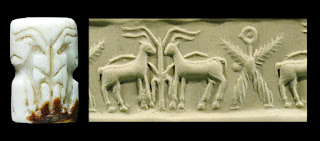
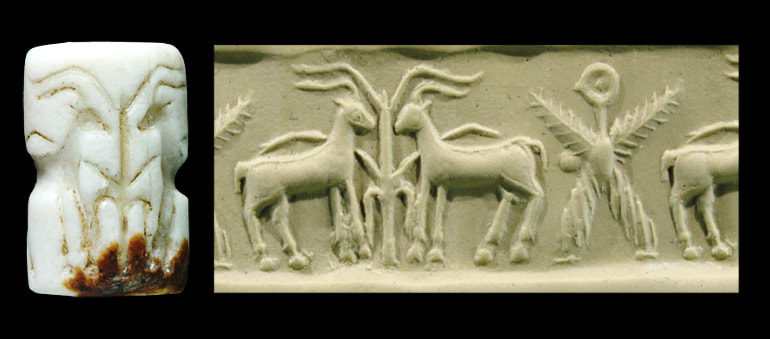
Hence gazelles flanking the tree of life on this Akkadian cylinder seal which also depicts a birdman. I talk about this seal in my article, "Mysterious creature"...
Speaking of gazelles, you'll like this ๐Ÿ™‚:

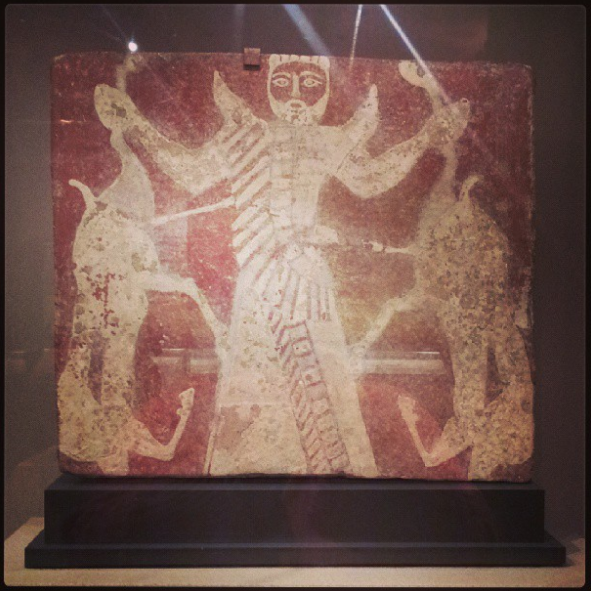
This is a wall painting from a provincial palace on the Assyrian borderlands, c. 9th - 7th century BC, depicting a "demigod holding animals that urinate on him to purify him". OMG...Winter animal calendar markers (gazelle) and winter moon...Rain season...I talk about this in my post "Pissing gazelles"...
Gazelles, are identical calendar markers as ibex goats depicted on the Kassite seal. They both have the same mating season, starting in Oct/Nov, when rain (bird) arrives...

Anyway, the same "birdman holding ibex goats" scene is also found in Bactria.  Here is winged vulture guy holding two winged ibex goats...From Bactrian seal, end of 3rd beginning of 2nd millennium BC...I talked about it in my post "Fluffy"...

Finally, this Kassite seal, (18th-12th centuries BC) from Syria, currently in the National Museum of Damascus, spells the link between vultures, ibex goats and Enki, the God of the source of fresh water...The full analysis can be found in my post "Kassite seal with Apkallu"

See the same tree of life? Anyway, time to go. 

For the end: My post "Pero", in which I proposed that the root of the name of the Slavic thunder god Perun is "pero" = feather, which would make Perun = Feathered one, and not from PIE perkwus, meaning "oak" or "mountain"...


To read more about ancient animal and plant calendar markers, start here…Then check my twitter threads I still didn't convert to blog post...I am way way behind...

Friday, 17 May 2024

Origin of griffins

Proto-Elamite seal, 3000 BC. A griffin, followed by ibex goat, or goitered gazelle...


From "The Elamite Cylinder Seal Corpus, c.3500 - 1000 BC" volume II part I

Finally a proof (at least to me ๐Ÿ™‚) that griffin is a complex animal calendar marker...

If you look up "griffin", this is what you get: "The griffin, griffon, or gryphon is a legendary creature with the body, tail, and back legs of a lion; the head and wings of an eagle; and sometimes an eagle's talons as its front feet"...

Legendary creature? Nah...It's a complex animal calendar marker for autumn (Jul/Aug - Oct/Nov)...

Eeee, why, how?

If you wanted to depict this time period, using animal calendar markers how would you do it?

Well you could find an animal whose mating or birthing takes place in Jul/Aug and mark the beginning of autumn. And then you could find an animal whose mating or birthing takes place in Oct/Nov and mark the end of autumn...

Like for instance, you could take eurasian lions, whose main mating season starts in Jul/Aug...

In the "THE ASIATIC LION: A study of ecology and behaviour" by Paul Joslin we can read that based on the observation of the large number of wild lions, the mating season of the Asiatic lions starts in August and lasts until October. 


Which is why lion is the symbol of the hottest, driest part (Jul/Aug) of the hot, dry half of the year (Apr/May - Oct/Nov)...I talked about this in many of my posts. For instance in my post "Angra Mainyu", about this amazing Middle Assyrian Cylinder Seal with a "Lion-Dragon", 1300-1200 BC. 

Eurasian lion main mating season marks the beginning of autumn and spans the whole of autumn (Aug,Sep,Oct)...

Which is why lion is also the symbol for autumn. I talked about this in my post "Symbols of the seasons"... 

Oh by the way, the symbol for summer (Apr/May - Jul/Aug) is bull, because summer starts with the calving of wild Eurasian cattle. Which is why "lion killing bull" symbol found all over the place means "the end of summer, BEGINNING OF AUTUMN"

I talked about this in many of my posts. For instance "Cypriot stamp seal with cow and calf", about this amazing conoid stamp seal, Late Cypriot III. Cyprus (?), ca. 13th–12th c. BC. 


So, I guess, you could use lion as the symbol marking the beginning of autumn...What about the symbol for the end of autumn?

Well, you could take old world vultures, whose mating season starts in Oct/Nov, with synchronized flying mating dances...

Which is why Vulture (Eagle) is the symbol of for the END OF AUTUMN, beginning of winter...

I talked about this in many of my posts. For instance "Eagle dance", about this interesting cylinder seal from North Mesopotamia-Syria, 1800–1500 BC, from the Leroy Golf collection.

So now put these two symbols together, lion-eagle...And you get griffin...Symbol of autumn...Here they are on another amazing Proto Elamite seal from "The Elamite Cylinder Seal Corpus, c.3500 - 1000 BC" volume II part I

That I am right about the meaning of the griffin, can be seen from the fact that on the original seal griffin, symbol of autumn is followed by ibex goat (or goitered gazelle), both symbols of winter...


I wrote many posts about ibex goat as symbol of winter, because ibex mating season coincides with the beginning of winter (Oct/Nov). For instance "Goats with tree of life from Alalakh", about "rampant goats flanking tree of life" images discovered in Bronze Age city of Alalakh/Tell Atchana, located 20 km from Antakya (Antioch) in what is now Turkey's Hatay Province. 

I wrote many posts about about gazelle as symbol of winter, because gazelle mating season coincides with the beginning of winter (Oct/Nov). For instance "Mysterious creature", about this Akkadian Cylinder Seal dated to 2300-2200 BC. 

Oh, by the way, do you see the green branch between the griffin and the goat/gazelle? 

In Elam, the climatic year is divided into hot, dry half (Apr/May - Oct/Nov) and cool, wet half (Oct/Nov - Apr/May)...

It is the rain that arrives in Oct/Nov, at the end of autumn (griffin), beginning of winter (goat/gazelle) that made life in Elam possible...

To read more about ancient animal and plant calendar markers, start here…then check the rest of the blog posts related to animal calendar markers I still didn't add to this page, and finally check my twitter threads I still didn't convert to blog post...I am 9 months behind now...


Sunday, 16 January 2022

Birth giver from Luristan

Luristan bronze disk pin, c. 1500 to 700 BC, showing a woman giving birth while holding her breasts, between 2 gazelles, and among flowers. Louvre museum, Paris. From Iranian province of Luristan...


Archaeologists interpret this image as "depiction of Mother Goddess", basically Mother Earth giving birth to all and providing food for all...And I 100% agree with this...

I think the fact that the Birth Giver is depicted between the two gazelles (Goitered Gazelles to be more precise) and the flowers is the proof that this is indeed Mother Goddess, Mother Earth...

Here is why. This is climate chart for Luristan...You see how the year is divided into hot dry summer (May-Oct) and cool wet winter (Nov-Apr)?

Guess what happens in Oct/Nov? Goitered gazelles start mating...Which is why they are used in this part of the world as animal calendar markers for the beginning of the rain season (winter) and for the whole rain season (winter)

So this image basically means: Mother earth gets fertile and produces life and food because of the rain (and snow) which falls during winter, period between the mating and birthing of Goitered gazelles (gestation period of Goitered gazelles is 5-6 months)...

Here is the same "girl", this time holding a shawl, basically a stylised rainbow...Bronze disc from Luristan, western Iran. 8th century BC...Sold by Christies for 28,000$...

Rainbows are only visible during rain season...And this same symbol for the "moist fertile earth" was used in Iran from Jiroft culture until Sassanian culture...I talked about this in my post "Anahita" and "Jiroft flood vase"...

This link between Mother Earth's fertility and rain, depicted through the image of birth giver surrounded by plant and animal calendar markers for rain season, is what I was talking about in my previous post "Modesty", about the Indian version of this goddess, Lajjฤ Gaurฤซ...

What is very interesting is that because the climate in Iran and India is different, the animal and plant calendar markers used to link the birth giver with the rain are different...Appropriate for the local climate...

If you are interested in animal (and plant) calendar markers, start here, then check the rest of the blog posts I still didn't add to this jump page (I got lazy after a while), and finally check my twitter threads @serbiaireland I still didn't convert to blog post...I am 11 months behind now...

Sunday, 28 November 2021

Gazelle mystery

I am flicking through the great paper "Podobe zivljenja in mita" This is an Illyrian situla from Novo Mesto, Slovenia dated to 5th century BC...


And there is something really really weird abut it...

This is the drawing of the decorative frieze from the situla...A row of horned animals...Which ones?


If you look at the horns, you will see that these are undoubtedly gazelles. 

Either Goitered gazelles...Which is found in Georgia, Azerbaijan, Iran, parts of Iraq and Pakistan, Afghanistan, Tajikistan, Kyrgyzstan, Uzbekistan, Turkmenistan, Kazakhstan, China and Mongolia...Not in Slovenia...


Or mountain gazelles...Which are found in Levant and Anatolia...Not in Slovenia...


I can't believe that no one before me saw this and wandered: how the fuck did this animal from Central Asia end up on an a ritual vessel buried in an Iron Age grave in Slovenia???

Was this situla an import? In which case were all Illyrian situlas imports? And if so from where?

Thursday, 11 November 2021

Tulip goddess

Seated female figure (goddess? ) drinking out of a goblet - next to a tulip, bronze seal, late 3rd - early 2nd millennium BC, (BMAC), Afghanistan. Currently in a Private collection Linenthal, San Francisco. 


Just a pretty picture or...? Who is this girl?

Mobile perfume or cosmetic bottle, winged goddess among flowering tulips. Bactrian, the end of the 3rd, beginning of the 2nd millennium BC, Louvre Museum...

Tulips grow wild in Central Asia and bloom in Spring...So who's the goddess? The zigzag and wavy lines at the top usually represent flowing water. So is the goddess somehow linked with the flowing water?

Bactria was centered around the upper reaches of  Amu Darya (Oxus River). This river was fed 


Amu Darya (Oxus River) is partially fed by the rain that falls during the cool, wet half of the year (Oct/Nov-Apr/May)...


Climate Tajikistan

Climate Uzbekistan


Climate Afghanistan


But the majority of the water in the river comes from the snowmelt from the Hindu Kush, Tian Shan and Pamirs mountains. 


Total snow melt contribution is between 65 and 72%...


You can read more about this in "Runoff from glacier ice and seasonal snow in High Asia: separating melt water sources in river flow"

The annual Amu Darya water level chart. 

The water level starts rising sharply in Feb, at the beginning of the snowmelt season. Now you know why Aquarius ๐Ÿ™‚ water pourer, is where it is on the zodiac.  

The water flow peaks in May. In Taurus, and then sharply decreases...

This rising of the water level, which enables irrigation and agriculture in the area, happens during the tulip flowering season...So tulips are definitely linked with flowing water...


I talked more about tulips as calendar markers in Bactria in my post "Sumer and winter BMAC seal"...


So who is the goddess? Earth...Mother Earth...Young, virgin, spring earth...Who just had her first period...So let me introduce you to: Aunt Flo...๐Ÿ™‚

This could be the same girl. From a Bactrian seal: Mother earth flowering with tulips next to the flowing river. The snake is under ground (cold part of the year) and the Goitered gazelle (whose mating coincides with the beginning of the cool wet season) is looking at the amazing effect of "the rain it has brought"...I talked about this in my post "Fluffy"...

I wander if this girl has anything to do with Iranian Anahita, the goddess of water...Which features on Iranian artifacts since at least Jiroft culture...The Annual water cycle is identical, so...I talked about it in my post "Anahita"...


I think this answers my original question about the identity of the girl with the drinking cup sitting among the flowering tulips...