Srbska zagonetka: Visok otac, široka majka = nebo i zemlja 🙂
Serbian riddle: Tall (high) father, wide mother = sky and earth 🙂
Father Sky and Mother Earth creating Life, preserved in Serbian tradition.
Because of the above identification of Sky = Father = Male and Earth = Mother = female, in many cultures around the world we find symbolic and ritual linking between:
Male fertility (ability to produce semen), sky fertility (ability to produce rain), seed and sowing...
Female fertility (ability to conceive after being inseminated), earth fertility (ability to grow plants after them being sown), fruit and harvesting...
I talked about this in my post "Sowing", in which I discussed this strange Serbia custom: In Serbia in the past people lived in extended families called "zadruga". When grain needed to be sown, the family would choose one man to do all the sowing. He had to abstain from sex from that moment until all the seeds were sown...
This brings me to a great Italian documentary I saw years ago, "Ultime grida dalla savana" ( Final Cry of the Savanna) which was in 1975 directed by Antonio Climati and Mario Morra...
And in it, if my memory is serving me right, they showed men from some African tribe, ritually inseminating Mother Earth, by each digging a small hole in the ground, lying down over it and...
Basically ritually playing the role of the Sky Father...
A Kassite period (1595-1155 BC) seal depicting a "bird-demon" 🙂, holding two ibexes, by their hind legs.
Found in Iraq, UChicago, A29439. The description reads: "Marduk, great lord, on the servant who reverences you show mercy."
What is really depicted here?
First, who is the birdman? Did you know that originally rain god was in Mesopotamia imagined as a giant storm bird, giant black eagle? Why?
Eagle dance...
Montenegro 1963AD
Syria, 1800BC
Eagle (vulture) couples dance above the mountains at the beginning of their mating season, which coincides with the beginning of the rain season in Fertile Crescent...I talked about this in my post "Eagle dance"...
The storm bird eventually became anthropomorphised, and became first a birdman and then a storm god with a pet eagle...
Who is the mysterious "birdman" depicted with his hands tied behind his back, being judged by Enki, Sumerian god of water and the annual flood? This article, "The judgement of the birdman" tries to answer this question...
Birdman=Old thunder god, starts flying over Mesopotamia in Oct/Nov. The rain that the Birdman brings supports the tree of life. This is also when Ibex goats start to mate.
Which is why ibex became "The goat of rain"...
I talked about symbolism of ibex goats in many of my posts, like
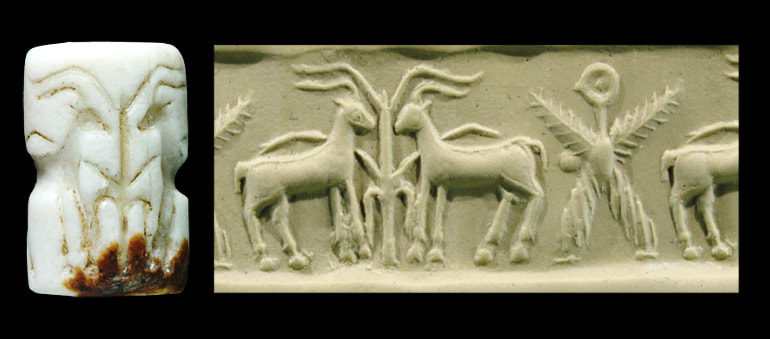
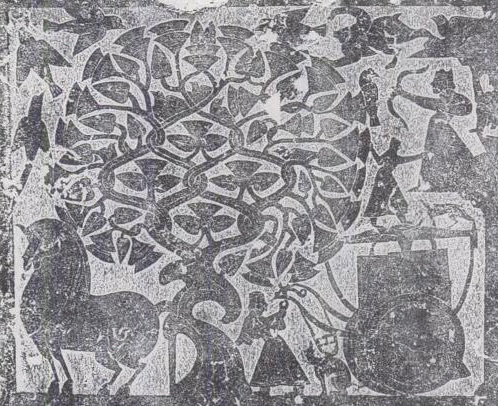
Hence gazelles flanking the tree of life on this Akkadian cylinder seal which also depicts a birdman. I talk about this seal in my article, "Mysterious creature"...
Speaking of gazelles, you'll like this 🙂:
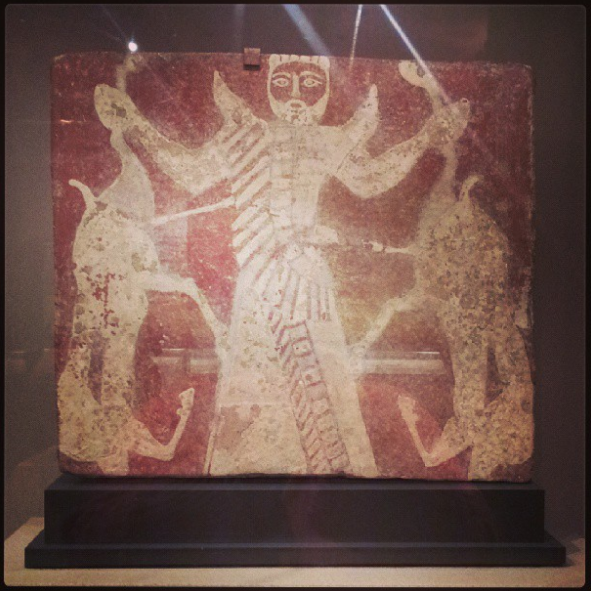
This is a wall painting from a provincial palace on the Assyrian borderlands, c. 9th - 7th century BC, depicting a "demigod holding animals that urinate on him to purify him". OMG...Winter animal calendar markers (gazelle) and winter moon...Rain season...I talk about this in my post "Pissing gazelles"...
Gazelles, are identical calendar markers as ibex goats depicted on the Kassite seal. They both have the same mating season, starting in Oct/Nov, when rain (bird) arrives...
Anyway, the same "birdman holding ibex goats" scene is also found in Bactria. Here is winged vulture guy holding two winged ibex goats...From Bactrian seal, end of 3rd beginning of 2nd millennium BC...I talked about it in my post "Fluffy"...
Finally, this Kassite seal, (18th-12th centuries BC) from Syria, currently in the National Museum of Damascus, spells the link between vultures, ibex goats and Enki, the God of the source of fresh water...The full analysis can be found in my post "Kassite seal with Apkallu"
See the same tree of life? Anyway, time to go.
For the end: My post "Pero", in which I proposed that the root of the name of the Slavic thunder god Perun is "pero" = feather, which would make Perun = Feathered one, and not from PIE perkwus, meaning "oak" or "mountain"...
To read more about ancient animal and plant calendar markers, start here…Then check my twitter threads I still didn't convert to blog post...I am way way behind...
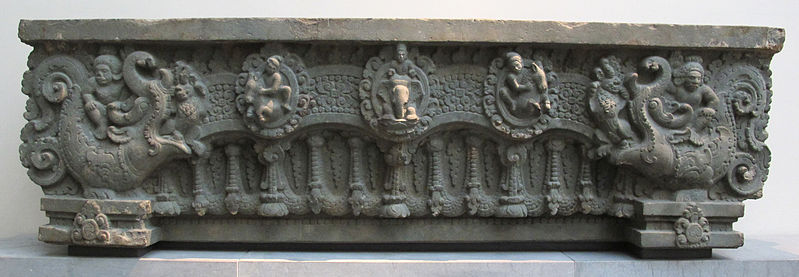
Most Vedas interpreters agree that Maruts are deified moisture laden monsoon storm winds, turned into rain bringing deities armed with thunder and lightning. Even I agree with that and I even wrote this post, "Maruts" talking about this through analysis of this 7th c. Maruts relief, Sambor Prei Kuk, Kampong Thom Province, Cambodia.
But, the Mysore Palace edition of the Rigveda, which gives in 36 volumes an exhaustive introduction, the text, traditional meaning, ritual application, grammatical explanation, and the Sanskrit commentary of Sâyan says that: Vâyu (winds) and Maruts are distinctly different...
And so in the above paper, R.N. Iyengar proposes that Maruts were, in the oldest layers of Rigveda, a deified meteorite shower, resulting from a close encounter of Earth with a comet. And I actually agree with his proposal...
So...I can hear you ask, you believe that Maruts are deified storms and deified meteorite shower? Actually I do. It will all make sense at the end of this post. So read on...
Here are some things that Vedas tell us about Maruts, and which R.N. Iyengar interpreted as description of a meteorite shower, resulting from Earth's close encounter with a comet. You can find a lot more in his article. It's well worth reading...
Agni was born (among gods, in the sky) bright like the sun and was moving in the night sky along with smoke. After that Maruts were born with great commotion holding shining spears. Then the Maruts stood surrounding Agni with their lights.
Maruts then came (to earth) along with Agni from above. They are visible at a distance shining like stars. They come down in thousands to earth together. They are shaped like drops and are bright like fires. They gleam like serpents as they approach the earth.
They roar as they fly towards on the ground. The whole world is afraid to look at them during their brightened travel. They move/shake/crash the hills and mountains and disturb the oceans.
A flash of bright light, the sound of explosions - what witnesses report and cameras captured as a meteor broke apart as it entered the atmosphere...
They have an epithet "asurâh", which, apparently, means "one who throws". The material of the weapons of Maruts is made clear by Agastya in: "Far be from us, your impetuous shaft. Far from us be the stone you hurl". So Maruts are deities which "throw stones towards earth".
I love this in particular: They can bring "airless showers to deserts" (apprently, an intense meteoritic shower can make the target region airless for some time).
The author concludes that: Three broad phases can be discerned in the description of Maruts.
The first, probably the earliest in time, are hymns which express awe at the approach of Maruts. These also express a sense of fear that Maruts are prone to kill people on earth.
In the second group are prayers that the shower of stones may avoid the worshippers of Maruts.
The third layer contains hymns wherein Maruts are invoked to arrive at a prayer or worship.
It may not be wrong to conjecture that this trend should have been directly matching with the frequency of the storms of Maruts.
As Maruts were constant companions of Indra, the author concludes that originally Indra was the equivalent of the Celestial Agni and the personification of the comet which created the Maruts meteorite shower.
A point to be reconciled is the meaning of Maruts as storm wind deities in later literature. We guess, with the status of Indra getting downgraded in time to a mere rain god, Maruts always linked with Indra, were also brought down as wind deities.
This has happened notwithstanding the fact parjanya and vâyu are the independent rain and wind deities in Rigveda. One reason for this mismatch should be the absence of recognisable Indra and Maruts in the skies...
Important!!! I would beg to disagree with the last sentence...
Evidence for the evolution of the concept of Indra from the concrete to the abstract is found in RV itself. In the hymn (VI.21.4) the poet wonders: "Where the famous Indra is now located? Where he travels, among what people? What prayers summon him? Indra!"
In many hymns of RV Maruts are said to be the children of Rudra...The author concludes that "It is most likely that Maruts were thought to originate from a particular object or constellation in the sky, called Rudra".
This object, which has not been identified yet, could, according to the author, be planet Mars??? Cause Rudra is red and Mars is red...
Eeeeee....This makes no sense...Considering that he spends the whole paper talking about comets...Why Mars? Why not a comet?
I think that Rudra was originally another name for the same comet which the author thinks was named Agni and Indra. I mean in Rigveda Rudra was called He Who shines like [the] Sun, He Who shines like gold, He Who has [long] matted/braided hair...
Sadhu (holy man) ritual during the holy bathing for Magh Mela, an annual festival that celebrates the beginning of the universe...
What does this remind you of?
I mean...
Anyway...Who's Rudra?
Rudra (the roaring one, the wild one, the terrible one, the red, burning one) is a Rigvedic deity who is praised as the "mightiest of the mighty" and described as "extremely terrifying".
Rudra is one of several deities identified with Agni, most likely the same celestial Agni, the comet, who was said to give birth to Maruts...
Rudra is also called asura (the one who throws). Actually he was called "The great asura of heaven"...Significant I think 🙂
He was so feared, that in Rigveda he was often not named and was referred as "asau devam" (that god) and was given the adjective śiva (shiva) in the sense of "propitious" or "kind".
Rudra is also called Śarva (the archer), Dhanvin (bowman) and Bāṇahasta (Armed with a hand-full of arrows) and bow and arrow are his essential attributes. RV declare that Rudra discharges "brilliant shafts which run about the heaven and the earth" (RV 7.46.3)...
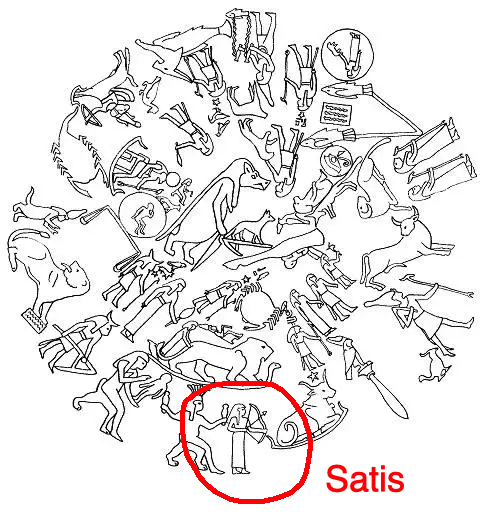
I talked about another heavenly archer in my post "Invisible archer":
If arrows are shooting down from the night sky, there must be an [invisible] archer standing somewhere up there shooting them out of his bow...
Orionid meteorite shower
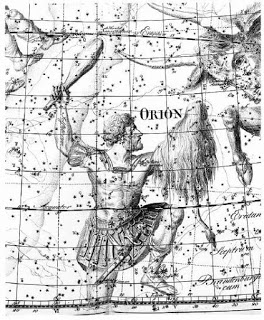
Orion
An example of an ancient "scientific" explanation for an annual natural event...
Even the gods were afraid of the strung bow and the arrows of Rudra, lest he should destroy them...Sounds familiar? It should. Remember my post "Apollo the great archer"?
Apollo armed with bow and arrows. Why?
"I will remember and not be unmindful of Apollo who shoots afar. As he goes through the house of Zeus, the gods tremble before him and all spring up from their seats when he draws near, as he bends his bright bow..."
Why was everyone so frightened of Apollo and his bow and arrows?
So, the Earth survived the near collision with the comet. It was most likely already broken into 3 really big bits as it approached Earth, which could be the reason why Rudra/Shiva has 3 eyes or 3 heads/faces. Three-headed Shiva, Gandhara, 2nd century AD.
As the comet passed by earth, comet either further disintegrated into many smaller but still big enough bits which could create the chaos described in Vedas...
These large comet bits fell on Earth causing all the death and destruction described in the Vedas. And then every following year the Earth flew through the comet's path full of debris which kept producing a meteorite shower full of destructive large meteorites.
Eventually, after who knows how many years, all the big bits fell down on Earth. And as time passed, the stories about the terrifying Rudra (the comet) and his murderous children Rudras (the large meteorites) turned from history to myths. 11 Rudras, Udayagiri Caves, c. 401 AD...
And now Rudra is indeed just the name for the area of the sky from which the Rudras/Maruts meteorite shower (still) emanates every year.
Important!!!
And the later Vedic texts corroborate the above points. The Taittirîya Brâhmana states that "There is only one Rudra and the innumerable thousands Rudra’s children, and that they are not seen any more but only remembered"...
At the end of his paper, R.N. Iyengar says: This raises the question whether Marut was a generic word for all types of meteoritic activity or it referred to particular types. This can not be answered definitively at present.
Well, I think it can. Here comes the interesting bit:
In his paper R.N. Iyengar talks about the fact that the Taittirîya Âranyaka, says that Rudras appear in the grîsma-rtu, the two month before summer solstice and the Maruts appear in the hemanta-rtu, the two months before winter solstice.
That would make Rudras = Aquarids meteorite shower which falls in May and Maruts = Orionids meteorite shower which falls in Oct/Nov, both result of the Earth crossing the debris full path of the Haley comet, which swings by Earth every 75 to 76 years.
Why was Orion seen by Ancient Greeks as a "the greatest hunter" armed with a cudgel (club)? And why do Bulgarians call Orion "cudgels (clubs)" and why do Serbs call Orion "Baba's (grandmother's) sticks" and all the stars "Baba's (grandmother's) cudgels (clubs)"?
Maybe because of this
Wow, amazing, we solved the identity of Rudra/Agni/Indra and the identity of Rudras/Maruts and we resolved the ancient dilemma whether Rudras and Maruts are one and the same or different. They are both...
Done and dusted...
Weeeeeeell...It all fits except for one tiny thing...
The above interpretation doesn't fit Indian climate and is therefore wrong...You know whose climate it fits? Mesopotamian. Perfectly...But that is a completely different archer...I explained it all in this in my post "Invisible archer" I already mentioned earlier...There the rains arrive when Orion appears in the night sky, right when the rains start, rains that kill drought caused by the sun of the dry season.
An example of an ancient "scientific" explanation for an annual natural event...
So, we can't just take parts of Rigveda that describe Indra and Maruts as respectively comets and meteorite showers and ignore the other parts where they are clearly described as storm/rain deities directly linked with annual monsoon.
Every year, Indra and Maruts slay Vritra, the drought dragon. In India, Orionids mark the beginning of the dry season and Aquarids mark the end of the dry season. Neither of them can be Rudras/Maruts, the bringers of rain. Which means that Helley comet can't be Rudra/Indra.
So who were/are Rudra/Indra and Rudras/Maruts? I think that Rudra/Indra is deified comet Swift–Tuttle and that Rudras/Maruts are deified Perseids meteor shower. Why?
Perseids meteor shower peaks in Jul/Aug, the same time when the monsoon rains peak in India. This means that Rudras (meteor shower) can also be Maruts (thunderstorm shower)...
See I told you it will all make sense in the end...
The comet Swift–Tuttle, whose trail of debris is the source of the Perseid meteor shower, is on an orbit that makes repeated close approaches to the Earth–Moon system...
It seams that (at least) once, it came too close to the Earth, and this terrifying close encounter was eventually deified as the birth of Rurdra/Indra/Agni in the sky...
That we are onto something here can be seen from this:
The abode of Rudra is commonly regarded as in the north, while that of the other gods is in the east. From "Vedic Mythology" by Macdonell, Arthur Anthony. This sounds strange until you realise that: "To see the Perseids meteors, you should look up and to the north"...
In Rgveda Rudra is described as "armed with a mace"...Why? Maybe because mace/club looks so much like a falling meteor...I talked about this in my post "Jack and the magic beans" about "might smiters".
Baal with his battle mace...
But he is mostly seen as an archer, who is still there, shooting arrows that cause plague and other infectious disease...Rudra, just like Apollo, was believed to both inflict and cure infectious diseases...
I talked about this side of Apollo in my post "Apollo Sminthius"...
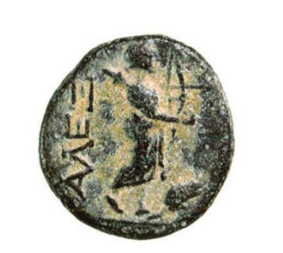
Coin depicting Apollo Sminthius (Apollo lord of the mice) with his plague causing bow and a mouse/rat at his feet. Minted in Alexandria, Troas/Troad. Around 300 AD. Currently in The British Museum, Department of Coins. London...
The peak plague/infectious diseases season is Jul/Aug, the peak Monsoon season and the peak Perseid meteor shower season...So this again points at Rudra being comet Swift–Tuttle and Rudras being Perseid meteor shower.
One other thing. In "The Presence of Siva" by S. Kramrisch we can read this about Rudra:
So Rudra is (directly linked to) Sirius. Which rises with the sun in Jul/Aug. At the peak of the Perseid meteor shower...
in "Vedic Mythology" by Macdonell, Arthur Anthony we can read that Rig Veda tells us about Rudra's widemouthed, howling dogs, who swallow their prey unchewed...Sirius is also linked to dogs and dog days. I talked about it in these posts:
When our mythologies were made out of animal calendar markers, Sirius, the Dog Star rose with the sun in Jul/Aug, when mating season of the old dog breeds began...
And Sirius in Jul/Aug is finally linked to archers and bows and arrows, not just in India, where we find Rudra, but also in Greece (Apollo/Artemis). I mentioned Apollo the archer earlier.
I talked about Artemis, Apollo's twin seister, the archer in my post "Artemis Orthia"...
Mesopotamia (Ninurta/Ishtar, bow and arrow constellation). I talked about this in my post "The brightest star"
This might finally answer my question: Why was Sirius deemed so important that everyone seems to have tracked it? Maybe because it's heliacal rising announced the arrival of the Terrible Archer, who (at least for a while) terrorised people all over the world every Jul/Aug...
It also explains why rising of Sirius was announcing the beginning of the time of fires and why Sirius was called The Scorcher...
July/Aug is the hottest time of the year in the northern hemisphere, so that could explain it...But maybe the "Fire that descends from the sky" also had something to do with such Sirius's reputation...
Anyway...I think this is enough for tonight...
So, what do you think? For the end I just want to send my regards to Perseus...
To read more about ancient animal and plant calendar markers, start here…Then check my twitter threads I still didn't convert to blog post...I am way way behind...
How the hell did I end up here? When I was at school, my two most hated subjects were history/archaeology and biology...And yet today I will talk about animal calendar markers in the Alósaka cult of the Arizona's Hopi tribe.
The above figurine is a rare representation of Alósaka/Muyingwa, two aspects of the (supreme?) being or deity of the Hopi Kachina pantheon: the God of Germination and God of Growth of Corn...
There is also possibility that Alosaka and Muyingwa were two brothers (soon to see why this is important) and not two aspects of the same god. In any case, he/they lived in the Underworld and was/were the one(s) who made the seeds sown by the Hopi germinate and grow...
This two-horned deity was associated with rain. The symbols on the cheeks and at the base of the two horns are rain clouds. The long black hair at the back of the mask symbolises the curtains of heavy rain that this spirit is supposed to bring to irrigate the fields...
Alósaka/Muyingwa was the main god of the Aaltu (Two-Horned Priests) sect or secret/sacred society...Photograph by H.R. Voth, from the "Book of the Hopi" by Frank Waters
Pic H.R. Voth
During the religious ceremonies, these guys wore Headdress of Alósaka, like this one: Basket head cap with a twine and two imitation horns of rawhide leather. Previous S.N. Los Angeles collection (not further specified)...
Pic by unknown (to me) author...
These ceremonial headdresses with fake leather horns were supposed to help the priests to personify either the horned god Alósaka, or the animal from whom the god borrowed his horns: the Desert Big Horn sheep...
Pic by Andrew Barna
Some ceremonial headdresses of the Two-Horn priests of Alósaka were actually made with real Big Horn sheep horns, like this one kept in the College of Eastern Utah Prehistoric Museum...
Pic by Tim Riley
Both Horn God Alósaka (or his Two-Horned priest wearing Desert Big Horn sheep horns headdress) and Desert Big Horn sheep were found depicted on petroglyphs from the Hopi area.
Pic by Moki John
Danny Rodman
Soooo...What's all this about? Why do we have a horned god, a deified Desert Big Horn sheep, associated with rain and corn?
The answer is animal calendar markers...
Now, animal calendar markers are ancient calendar markers derived from the annual mating (most often) or birthing or migrating or hibernating habits of the animal in question...
In this case that animal is Desert Big Horn sheep...Their mating season is Jul–Oct. During that time, desert bighorn sheep, which normally live in separate ram and ewe bands, get together in big mixed herds to party baby!!! 🙂
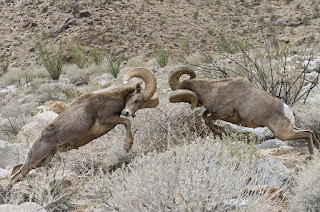
Well every really good party with loads of horny guys all going for the best girl, eventually ends in fighting...Desert Big Horn rams are no exception. They charge at each other head-on crashing their massive horns together with tremendous impact...And bang...
Pic by Anthony Mercieca
Now this is not something you can miss if you lived anywhere near...Every year at the same time you would start hearing mighty crashing of ram's horns...And so this part of the year became known by Hopis as "the time of the Big Horn Rams"...
This would have been just a very very annoying time of the year, when everyone walked around with cheese in their ears (🙂) if something else very very very very important didn't happen at the same time...
To understand what I am talking about, let's first have a look at the climate in Arizona...That spike you see in Jul/Aug/Sep is the arrival of monsoon rains...Only the most important annual event, the one that makes corn agriculture (and life) possible in Arizona...
Soooo...The Big Horn rams start banging their horns and spilling their semen at the same time when the sky god starts banging his thunder drums and spilling his heavenly semen, rain...
Pic by mdesigner125
What do you think, how long did it take for Hopis to associate Big Horn Rams with the arrival of rain and to somehow magically correlate these two events? To turn Big Horn Ram into The Ram of Rain? And then to turn The Ram of Rain into The Ram Horned God of Rain?
BTW, you can see here why Alósaka/Muyingwa could have been one Big Horned God with two faces or two "brothers" Big Horned Gods...It takes two Big Horned Rams to produce the thundering sound that brings rain...🙂
So why would The Rain God also be The God of Germination and Growth of Corn? The Hopis relied on rains to grow corn, practicing dry farming in desert valleys that stretch between the mesas...No rain, no corn...
Because of the temperatures in the area, the corn planting in Hopi country may some years start as early as April, but most corn goes into the ground in late May and early June...You can read more about Hopi corn agriculture here
Corn seeds germinate after about 2 week, and the new corn seeds (cob) start forming after about 10 weeks...Now in order for corn to develop cobs it needs water and sunshine...Which is exactly what The Big Horned God provides when Big Horned Rams start banging their heads...
The entire middle screen is taken up by the depiction of the Horned God, Alósaka, holding in his right hand a cob of corn...A triple rain cloud symbol is depicted above god's head...So far so The Big Horned God of rain and corn...Nothing new...
In the lower left corner is the symbol of the sun...This guy minus feathers...
Why? Cause the sunniest, hottest time of the year is also the wettest, the rainiest time of the year...Hence the constant confusion whether the supreme Hopi god was sun or rain god...
On each side of the screens are attached four artificial flowers. And on the right side of the screen, is what??? Well, J. Walter Fewkes didn't know...Let me see if I can help identify this "mysterious" 🙂 object...
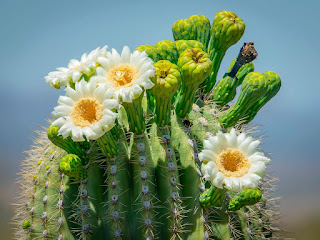
Ever heard of Saguaro cactus? Only the most recognisable thing from the Hopi land...Is the Horned God, Alósaka looking at a cactus? And if so, why would the God of Grain be looking at a cactus while holding a corn cob?
Saguaro flowering begins around the last two weeks of April, and peak flowering occurs during the last week of May through the first week in June.
Pic by unknown (to me) author
Pic by unknown (to me) author
Saguaro flowering is triggered by winter rain as well as the increased day length, and warmer temperatures of spring.
This is exactly when Hopis planted their corn...For corn to germinate, it needs soil soaked with water and warm temperature...Exactly what Saguaro cactus needs to start flowering...Hence Corn god looking at a cactus surrounded with flowers?
But before someone start talking about "Ancient Trans-Oceanic connections" and such stuff, I don't think that these two examples of Big Horned gods is a result of any such connection...It is an inevitable product of the hunter gatherers turning into farmers...
And farming needs some kind of calendar to tell you when to plough, when to sow, when to reap...A calendar which is in tune with the local climatic and vegetative cycle...
Now these hunter gatherers didn't know stars and such stuff to create stellar calendars...What they knew were plants and animals...And if you have animals that do the same thing every year, at the same time, then you can use them as calendar markers...
As agriculture become more and more important, and people start depending on it more and more, the animals related to the most important annual agricultural events become more and more important. To the point where they become deified...
And turned into gods...With characteristics of the original animal calendar markers animal...Or with the original calendar markers animal as their sacred animal...And this seems to have happen everywhere...And I believe totally independently...