Showing posts with label Bactrian archaeology. Show all posts

Saturday, 19 September 2026

Winged camel

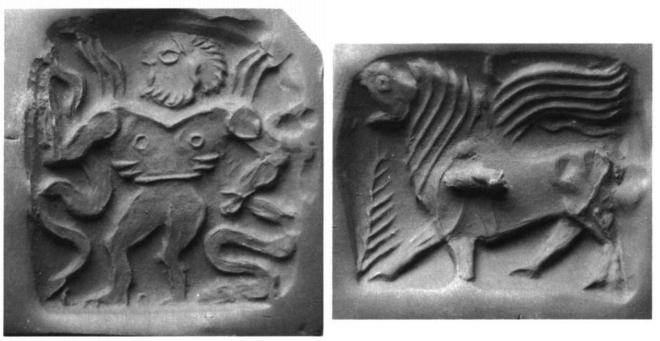
I want to thank Gabriella Brusa-Zappellini for alerting me to this amazing book, "National museum of Afghanistan: illustrated guide" by Dupree, Nancy Hatch. In it, on page 37 is this Bactrian bone seal dated to the 2nd millennium BC. WOW!!!

The official description says that the seal depicts a winged camel on the front and a bird on the back...Gabriella Brusa-Zappellini thinks the bird is an eagle and the camel's wings are also eagle wings...I would say the bird is a vulture...

Hmmmm...Winged camel...If it was just a winged camel, I would say "Eh, Afghanistan is a weird place, maybe camels there really have wings" and would move on, just like the authors of this book...

But the "winged camel" also has a very, very long stripy tail, like a tiger tail...Or are my eyes deceiving me???

And when I see something like this, I put my super suit, assume a super pose and shout out my super slogan: "Animal calendar markers!!!" 🙂

All of these animals (Bactrian camel, eagle/vulture, Caspian tiger) mate during winter, starting in Oct/Nov...This is a complex animal calendar marker for winter...

I actually wrote about all of these animals separately as animal calendar markers for winter.

I wrote about Bactrian camel as animal calendar marker for winter in my posts "Bactrian camel", "Volga mirror", "Camel and buffalo"...The reason why they are an animal calendar marker for winter is because they start breeding in (Oct/Nov), the beginning of winter...


I wrote about Griffon Vultures as animal calendar marker for winter in my posts "Double headed eagle", "Summer and winter BMAC seals" and many others...The reason why they are an animal calendar marker for winter is because they start breeding in (Oct/Nov), the beginning of winter...


I wrote about Tingers as animal calendar marker for winter in my posts "Spots and stripes", "Tigers tigers everywhere", "Tiger and dragon" and many others...The reason why they are an animal calendar marker for winter is because they start breeding in (Oct/Nov), the beginning of winter...

So:

Bactrian camel - mating season winter

Caspian tiger -  mating season winter

Old world vultures - mating season winter

You put them all together and you get complex animal calendar marker for the beginning of the rain and snow season in Afghanistan.

And it is this rain and especially snow, that feeds all the local rivers and supports life in the land of flying camels with vulture wings...Source of water in local rivers. I talked about this in my posts "Tulip goddess"...


That's it. To read more about ancient animal and plant calendar markers, start here…Then check my twitter threads I still didn't convert to blog post...I am way way behind...

Sunday, 22 May 2022

Snake hiding behind a tree

Double-sided stamp seal: snake behind tree; winged dragon, ca. late 3rd–early 2nd millennium B.C. Bactria-Margiana. Currently in the Met Museum...

I just love this: "snake behind tree" 🙂 "winged dragon" 🙂 What is actually depicted on this seal?

First the "winged dragon"...It is actually winged lion, the symbol of the hot dry half of the year (Apr/May-Oct/Nov) in Central Asia. 

I talked about this in my post "Lion radiating heat", "Summer and winter BMAC seal", "Nude winged hero dominating snakes"...


And the extreme heat of the hottest part of the year in the Northern Hemisphere, in Jul/Aug, Leo...

Now "snake"...Snake is the symbol of sun's heat...Snakes are the only true solar animals. They are in our world when sun is in our world (day and hot part of the year) and they are in the underworld when sun is in the underworld (night and cold part of the year)...

I talked about this in my posts "Bactrian snakes and dragons", "Enemy of the sun", "Chthonic animal", "Letnitsa treasure",  "Wolf and snake"...

That snake as a symbol is directly linked to the sun, can be seen from this Bactrian seal: 

Sun god, with a cool hairdo and with sun heat rays coming out of his shoulders, just like Sumerian Utu and Akkadian Shamash. And snakes instead of hands...And a snake belt...Just so we all know that snake is a solar animal...

Snakes hibernate during the cold part of the year and come out only when the ground and air get sufficiently warm...Over 60 degrees° Fahrenheit (16° C)...Which in the area of the old Bactria is Apr/May...


And that is the exact same time when wild alliums start to bloom in Central Asia...Like these, Allium karataviense Regel...

Plant data from "Medicinal Plants of Central Asia: Uzbekistan and Kyrgyzstan"

There are many other wild alliums found in the area of old Bactria. 

Like 

Yellow Allium Obliquum

Purple Allium Przewalskianum. 

They all flower during the hot part of the year...You can find the list of (all?) of them here (search for Central Asia) https://pacificbulbsociety.org/pbswiki/index.php/AllAlliums

Alliums have always been used in Central Asia as food (Source Edible Alliums of Uzbekistan) and as medicines (Source Wild Allium species (Alliaceae) used in folk medicine of Tajikistan and Uzbekistan)

Why do I think this is a flower and not a tree? Cause wild flowers appear as calendar markers on other Bactrian artifacts...

I talked about this in my post "Tulip goddess" about this mobile perfume or cosmetic bottle depicting a winged goddess among flowering tulips. Bactrian, the end of the 3rd, beginning of the 2nd millennium BC, Louvre Museum...


The "allium" leaves on the seal don't match the true allium leaves. That made me wonder if I identified the flower correctly as allium. But you can see that the leaves on tulips depictions are also cerated and don't really match the actual leaves. So I am sticking with it 🙂

Unless one of you has a better match? Anyway, as a calendar marker, flowering of the first alliums and the emergence of the first snakes from hibernation marks the time of the winged dragons (lions)...Hot part of the year...

To read more about ancient animal and plant calendar markers, start here…then check the rest of the blog posts related to animal calendar markers I still didn't add to this page, and finally check my twitter threads I still didn't convert to blog post...I am 9 months behind now...

Thursday, 11 November 2021

Tulip goddess

Seated female figure (goddess? ) drinking out of a goblet - next to a tulip, bronze seal, late 3rd - early 2nd millennium BC, (BMAC), Afghanistan. Currently in a Private collection Linenthal, San Francisco. 


Just a pretty picture or...? Who is this girl?

Mobile perfume or cosmetic bottle, winged goddess among flowering tulips. Bactrian, the end of the 3rd, beginning of the 2nd millennium BC, Louvre Museum...

Tulips grow wild in Central Asia and bloom in Spring...So who's the goddess? The zigzag and wavy lines at the top usually represent flowing water. So is the goddess somehow linked with the flowing water?

Bactria was centered around the upper reaches of  Amu Darya (Oxus River). This river was fed 


Amu Darya (Oxus River) is partially fed by the rain that falls during the cool, wet half of the year (Oct/Nov-Apr/May)...


Climate Tajikistan

Climate Uzbekistan


Climate Afghanistan


But the majority of the water in the river comes from the snowmelt from the Hindu Kush, Tian Shan and Pamirs mountains. 


Total snow melt contribution is between 65 and 72%...


You can read more about this in "Runoff from glacier ice and seasonal snow in High Asia: separating melt water sources in river flow"

The annual Amu Darya water level chart. 

The water level starts rising sharply in Feb, at the beginning of the snowmelt season. Now you know why Aquarius 🙂 water pourer, is where it is on the zodiac.  

The water flow peaks in May. In Taurus, and then sharply decreases...

This rising of the water level, which enables irrigation and agriculture in the area, happens during the tulip flowering season Feb/Mar-Apr/May...So tulips are definitely linked with flowing water...


I talked more about tulips as calendar markers in Bactria in my post "Sumer and winter BMAC seal"...


So who is the goddess? Earth...Mother Earth...Young, virgin, spring earth...Who just had her first period...So let me introduce you to: Aunt Flo...🙂

This could be the same girl. From a Bactrian seal: Mother earth flowering with tulips next to the flowing river. The snake is under ground (cold part of the year) and the Goitered gazelle (whose mating coincides with the beginning of the cool wet season) is looking at the amazing effect of "the rain it has brought"...I talked about this in my post "Fluffy"...

I wander if this girl has anything to do with Iranian Anahita, the goddess of water...Which features on Iranian artifacts since at least Jiroft culture...The Annual water cycle is identical, so...I talked about it in my post "Anahita"...


I think this answers my original question about the identity of the girl with the drinking cup sitting among the flowering tulips...