Showing posts with label Romanian folklore. Show all posts

Sunday, 5 March 2023

Wheat cross

A ceremonial "wheat cross" from Romania. It was made on the last day of the wheat harvest to carry the "wheat wreath" from the fields to the village. Pic from this great paper about crosses from the Alba county in Romania, "Crucea in patrimoniul spiritual al judetului Alba" (In Romanian)...

The wheat wreath was the most important part of the Romanian end of harvest ceremonies. It was made from the last sheaf of wheat...

It was normally then used to "crown" the "most beautiful unmarried girl" that participated in the harvest, who then carried it back to the village on her head...Love these pics of the reenactment of this ceremony by Vasile Sarb


The same Wheat wreath ceremony was performed by the Slavs. Wheat wreath, worn by the "corn maidens" and made from the last sheaf of wheat, was the first batch of grain to be threshed on the threshing floor. This grain was then set aside for next year's sowing and was the fist grain to be sawn. I talked about this in my post "Wheat wreath"...

BTW, a lot of Slavs once lived in Romania, which is attested by huge number of Slavic toponyms and hydronyms and by the amount of Slavic words still present in Romanian language...

Romanians, like many other Europeans, believed that the last sheaf of wheat, from which the wreath was made, contained the "spirit of grain"...This spirit was preserved in a "Corn dolly" made from the last sheaf instead or together with the wreath. I talked about this in my post "Corn dolly"...


Who corn dolly represents can be seen from the fact that in Gaelic, the word Cailleach means both an old woman and the last sheaf of wheat and the corn dolly made from it. Corn dolly which represents Mother Earth, the life (grain) giving mother...

I talked about this in my post "The old woman of the mill dust"...

And in Slovenia we find this: Men bringing an old woman in a grain basket into the mill, where she gets transformed through milling into a young girl. An old story about the rebirth (sowing/sprouting) of the Mother Earth (Mother of grain) over winter? I talked about this in my post "Bablji mlin"...

What is very interesting about the "wheat wreath" was placed on the head of the most beautiful unmarried (fertile!!!) girl which participated in harvesting, who then carried it to the village "while everyone else sang wedding songs and performed various wedding rituals"...

This seems to be directly linking female fertility and land fertility, again something found also in Slavic and Gaelic folklore (remnants of old religions)...

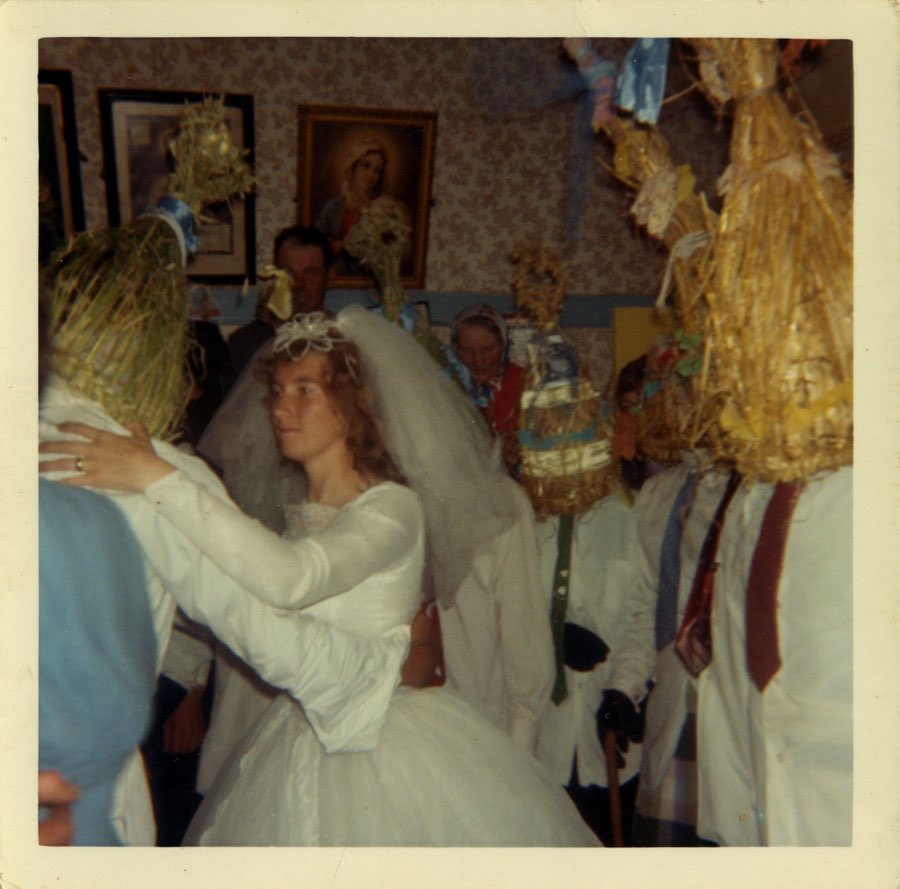
In Ireland "grain sheafs appear at weddings and dance with a bride"...

More about walking sheaves of wheat in European folklore can be found in my post "Walking sheafs of wheat"...
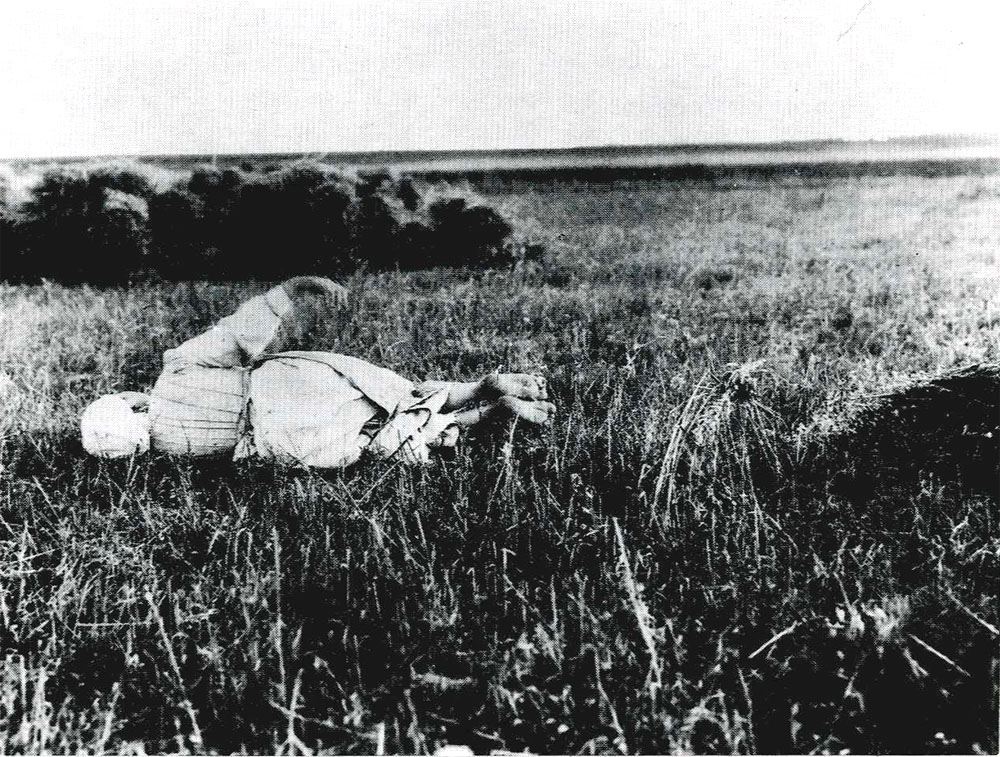
In Russia, in the past, after the last sheaf of grain was cut, women harvesters would lie down on the ground and roll around the field "to return the strength to the earth". 
The Wheat wreath was in Romania always made by women standing in a circle, and originally was made "the way you would plait women's hair"...


Which (thank you @another_barbara) looks like ear of wheat...The girl carrying the wheat wreath was the embodiment of the Corn Maiden...

BTW, this link between female fertility and land, and especially grain field fertility is ancient, and can be traced back to Neolithic Fertile Crescent, from where it spread to Europe...

As I said, all over Europe, The last sheaf of grain represents the living "sprit of grain"...But in Eastern Slavic countries, it also represents The Ancestors...This is Diduch (Grandfather) Christmas sheaf from Ukraine... I talked about this in my post "Diduch"...

And interestingly, the girl carrying the wheat wreath, is sprinkled with water all along her journey from the field to the village...Why? Slavs believed that thirsty ancestors can cause droughts which destroys wheat...I talked about this in my post "White feast"...

Wednesday, 2 June 2021

Bear dancers

Romanian bear dancers...At the end of the year, boys and men in eastern Romania put on heavy bear costumes, often made of real fur, and dance through the streets of towns and villages...


They dance to the rhythm of drums. In the end a ritual scene is performed in which the bear collapses because a demon is inside him. The "Gypsy" comes with a knife and bleeds the bear, lets the demon out and the bear gets resurrected. You can watch a documentary about this ritual here: 

In some versions of the tradition, the bear, the Gypsy and the drummers also go from house to house in the village, singing and dancing to ward off evil and bring good luck...

Officially "It’s thought that the tradition of dancing bears originated many centuries ago among the Roma who would visit villages just before New Year with real bears on leashes to dance and chase away bad spirits from the outgoing year"...

I can see why people would think that this ritual could have Roma origin...Roma's with their dancing bears were until recently a common scene in Eastern Europe...

I wrote about this in my post about St Gallen and the bear...

The thing is, at the end of the Solar Year, we also find Dancing bears in Slavic countries of Eastern Europe...But there, the bear is not dancing alone. He is dancing with a goat and a stork...

In Slavic countries however the bear is not the main character in this ritual dance...The goat is...The dancing goat...


Which also gets killed, bled and then resurrected...I talked about this in my post "Krampus"...

The goat is the most common symbol for winter in Eurasia...

I talked about the symbols of the seasons in my post "Symbols of the seasons" 🙂 The reason why goat is the symbol of winter, is because ibex goats start their mating season at the beginning of winter...End of October beginning of November...This is marked by wild goat fights...

I talked about this in my post "Goat"...

In Eastern Mediterranean, Middle East, Central Asia, Mesopotamia...wild goat mating season coincided with the beginning of the rain season which was source of life in those dry areas...Which made the wild goat symbol of rain, life, resurrecting nature...I talked about this in many of my posts, including "Pan, the goat of rain"... 

But in continental Europe, winter brought by the dancing wild goats wasn't the season of life...It was the season of death by cold...Which is why in Europe goat became symbol of winter cold...Cold which can bite your fingers and ears and nose off...

I talked about this in my post "Tanngnjostr and Tanngrisnir"...

Because in continental Europe nature dies at the beginning of winter, and gets resurrected at the end of winter, and because winter is the season of the goat, the goat has to die, so nature can get resurrected...

Here we see the hunter armed with a bow and arrow hunting the goat in the above winter ritual from Ukraine...

The same scene is described in the Slovenian legend about Zlatorog (Gold horn): Hunter kills the goat from whose blood grows magic flower...

And this is exactly what is depicted by the winter zodiac: Sagittarius (hunter) kills Capricorn (goat)  from whose blood Aquarius (snow melt) brings Spring (rebirth of nature)....

Anyway back to the dancing bears...In Slavic end of Solar Year ritual dances, the bear and stork are accompanying the dancing, dying and resurrecting goat, because they are also in a way, dying and resurrecting...

In the past people didn't know what happens with the migratory birds in the autumn...Slavs believed that migratory birds went with the sun to the land of the dead...

I talked about this in my post "Nav"...

Slavs also believed that on their return from the land of the dead, in the spring, the migratory birds brought souls that are ready to be reborn...Sounds suspiciously like "storks bringing babies"???

So storks "died" (went to the otherworld taking with them the souls of the recently deceased) at the end of autumn, when nature died too. And were "resurrected" (came back from the otherworld bringing with them the souls of then future children) when nature was resurrected too...

Now finally back to bears :) The bear disappears at the end of autumn (goes to hibernation, goes underground, to the underworld) where it spends the winter...It comes out of hibernation, underground, underworld at the beginning of spring...With the cubs...

Back to the Romanian bear ritual again: 

Bear dances (spring, summer, autumn)

Bear collapses because a demon is inside him (beginning of winter) 

Bear is killed and bled to let the demon out (winter, hibernation-death)

Bear gets resurrected and dances again (spring, summer...)

This is just another version of the same death - resurrection of nature ritual, part of the same Old European belief system which was built around European climate...And which was populated by animal symbols, basically animal calendar markers based on animal behavior in Europe...

Bear wandering about in the middle of winter is an unlikely site as bears only dance (are active) during warm part of the year: spring, summer, autumn...

So a bear dancing in the middle of winter is a magic ritual designed to summon spring...

The only bears not in hibernation (the underworld) in the middle of winter were bears owned by the Gipsy bear tamers...Enterprising Gipsies would not miss the chance to earn some money (food, drink) by taking their bears from house to house and performing the "real" bear dance...

So Romanian dancing bears and Slavic dancing bears are not something that had to be an imitation of Gipsy dancing bears...Could actually be the other way round...

To read more about ancient animal and plant calendar markers, start here…then check the rest of the blog posts related to animal calendar markers I still didn't add to this page, and finally check my twitter threads I still didn't convert to blog post...I am 9 months behind now...

BTW, the oldest example of a zodiac circle, as we know it today, was found in Croatia, in Nakovana cave.... 


Wednesday, 26 August 2020

Babe(le)

Ok this is going to be fun. This amazing rock formation covered in snow is known as Babele. The name means "Grandmothers" and it's derived from Slavic (Serbian) "baba" meaning grandmother but also rock. 


Here is the same rock formation just without snow.

It is located in Romania, on the Bucegi plateau which itself is located on Bucegi Mountains, part of the Southern Carpathian mountain chain...The name "Bucegi" is derived from the Slavic (Serbian) "buk" meaning beech tree. So the mountain name means "Beech mountains"...

The Babele rock formation is located near the mountain peak called "Baba Mare". The name is again derived from Slavic (Serbian) "baba" meaning "grandmother" or "rock" and Romanian mare meaning great, big...

Baba (Grandmother, Rock) is a common root for mountain peaks and rock outcrops in Balkan Slavic countries. I have collected quite a few of them in my article "Baba mountains and crags" 

For instance Velika Baba (Big Grandmother, Big Rock) peak, Jezersko, Slovenia

If you thought that Babele rock formation is wow, how about this one, also located on the same Bucegi plateau...It is just like the sphinx in Egypt. Just organic...

Here is the same rock formation just without snow but with some sheep...

Bucegi plateau is located on the borders of three counties in Romania, all three with Slavic names:

Brașov-from "baras", fortress

Prahova-from "prag", doorstep, water cataract or "prah" dust

Dâmbovița-from "dămb" (dub), oak

List of Romanian counties and the etymologies of their names

The main pass through the Bucegi mountain range Bran pass, once marked by border crossings between Wallachia and Transylvania, and was defended by the Bran Castle, named after Bran village situates nearby. Bran is a Slavic (Serbian) word means "to defend"... 


The castle is linked to Vlad III Dracula, better known as Vlad the Impaler, who was ruler of Wallachia on and off from 1448 to 1476. And an inspiration for the Bram Stoker's Count Dracula. Whether Vlad ever set foot to the Bran Castle is disputed and not really relevant to the theme of this article. What is relevant is that the name Vlad is Slavic and means Ruler. 

Oh and there is a letter written by Vlad III's father Vlad II to the citizens of Brașov (Slavic name) in written in medieval Serbian, and a letter written by his uncle Aleksander to the citizens of Sibiu (Slavic name) in also written in medieval Serbian, and containing a very juicy Serbian curse still used today...I wrote about this this post "And those who lie"

Now...Back to the Babele rock formation. There is a legend linked to it. It goes like this: 

This is interesting, considering that Baba is a Slavic word. And that Baba Dochia is basically Romanian version of South Slavic Baba Marta (Grandmother March), The Hag, Winter Earth, the spiteful old witch...Originally Baba Morana, the goddess of death...I wrote about this in my post "Gryla"...

In Romania there are three main legends related to Baba Dochia as Baba Marta, the Old Hag Winter Earth...

First legend says that Baba Dochia was a proud old woman who insulted the month of March either by badmouthing Him or by going up to the mountain with a herd of goats (way before she should, in May). March then borrows frosty days from February to punish her...

Interestingly in Serbian folklore, "babini jarci" (grandmother's goats) and "pozаjmenci" (borrowed days), both mean "cold stormy snowy days in March or April"...I wrote about this in my post "Gryla"...

Second legend goes like this:

The whole story is an allegory about the animosity between the old hag winter and the young maiden spring. Just like in these Irish and Slavic legends. I talked about this in my posts "The old woman of the mill dust" and "The Snow White" 

Now in this legend, Baba Dochia's son's name is Dragomir, Slavic name meaning "The one who is very dear" . I wonder if this is euphemism for the sun, which is "very dear" as it is the sun that turns old hag winter earth into young maiden spring earth...

We have parallel to Dragomir (very dear)=Sun, Summer in Radegast (dear guest)=Sun, Summer 

The wild strawberries are a summer fruit, ripening at the earliest at the end of May, beginning of June. May is the time when in the Balkans the flocks are moved to the highland pastures.

Which is why Baba Dochia, The Old Hag, Winter goes into the mountains with her flock of Goats when she sees that her daughter in law, Young Maiden, Spring brought the strawberries from the forest...

In the third legend Baba Dochia's son's name is partially Romanised to Dragobete. The legend goes like this:


In Serbia, traditionally, sheep were sheared twice. First time in February, when dirty wool between the legs and around the udder was sheared in preparation for lambing and suckling. This is the black dirty wool which was usually thrown away. The main shearing season is in May, after the lambing is over, and before the sheep are taken up to the mountain pastures. This is the clean white wool...

The sheared wool was washed in rivers before being dried and further processed. The washing of wool is the signal to take the flocks to the highland pastures...Which is why Baba Dochia, The Old Hag, Winter, sets off with her flocks up the mountain when she sees that her daughter in law, Young Maiden, Spring, have brought back home freshly washed white wool...

The reason why in one legend Baba Dochia goes up the mountain wearing 9 coats and in the other 12 coats, is this. There is a belief in Carpathian region of Romania, that the first 9 (in some parts 12) days of March are the "Baba days". This is the time when Baba Dochia can bring snowstorms and cold weather before the spring fully sets in. 

There was also once a custom in the same region, for women to pick a day out of these Baba days, on the first of March. And if the day turns out to be fair, they'll be fair in their old days (when you are a baba yourself), and if the day turns out to be cold, they'll turn bitter when you get old (when you are a baba yourself). 

Very interesting considering that Baba is a Slavic word meaning Grandmother. And that in Serbian folklore, "baba" (grandmother) also means changeable weather at the beginning of March when snow is likely to fall. And that in Serbian folklore, "bаbini dni" (grandmother's days) means cold stormy snowy days in March or April...I wrote about this in my post "Gryla"...

By the way, why is Baba Dochia called Baba Dochia? Apparently, the name originates from the Byzantine calendar, which celebrates the 2nd-century martyr-saint Eudokia of Heliopolis (Evdokia) on 1st of March...

I love this. 

The name Eudokia comes from Greek Eudoxia (Ancient Greek: Εὐδοξία, Eudoxía), originally meaning "good fame or judgement" or "she whose fame or judgement is good". And on her day the judgement ritual is performed by women...Eudokia is from Heliopolis (the Sun City) and the Baba Dochia celebration is about the defeat of winter by the sun. St Eudocia was celebrated on the 1st of March, "because she was beheaded on that day" and the Slavic mythological equivalent of Baba Dochia, Baba Marta, is celebrated by the Balkan Slavs on the 1st of March...Well people celebrate the killing of winter...

How can such an importan Romanian folk character be basically Slavic, Serbian in origin? Well even the Romanian national hero, Iovan Iorgovan was, according to Romanian legends, of Serbian origin...

How come? Well someone had to give names to all the Slavic toponyms and Hydronyms in Romania...Huge number of Serbs once lived in the southern areas of Romania...They are, almost all, Romanised now, through a process organised and "encouraged" by Austor-Hungarian state...

All that's left are toponyms, hydronyms and legends...