Showing posts with label Turtle symbolism. Show all posts

Saturday, 21 January 2023

Resurrection of the Maize god

Codex-style plate depicting the rebirth of the Maize god. Maya, Late Classic Period. 680–740AD...Currently kept in the Museum of Fine Arts Boston...

In this article I would like to analyse the scene description which says:

"Maize god emerges from the Underworld through a cracked turtle shell, symbolizing the earth. The Hero Twins pour water onto their father to facilitate his resurrection, as Maya farmers water maize seeds to help them sprout"...

So corn god "emerging from the Underworld" is a symbolic depiction of a corn sprouting...So when does corn sprout in the Maya land? In the 1848 book "Incidents of Travel in Yucatan, Vol. I" by John L. Stephens we read that:

"In the dry season...Jan/Feb...a place is selected in the woods, from which the trees are cut down and burned. In...May/Jun...the corn is planted...by making little holes in the ground with a pointed stick, putting in a few grains of corn and covering them over..."

Local farmers in the old Maya lands even today plant corn in Apr/May/Jun, with planting season peaking in May...And, it takes only 4 days at 25 degrees celsius or more for corn to sprout...

Soooo...Turtle...Why "emerging through cracked turtle shell"...

Any guesses? Maaaaaybe this is another animal calendar marker, derived from a major turtle annual reproductive lifecycle event? 

Bingo...

When Maya made their mythology, every year, from May to Sep, thousands and thousands of sea turtles descended on the beaches of Central America to lay their eggs...They still do today...

Guess what happens in Maya land, right when the first turtle comes to lay its eggs, in May? Corn planting begins...

Guess what happens in Maya land right when the last turtle lays its eggs, in Oct? Corn harvest begins...
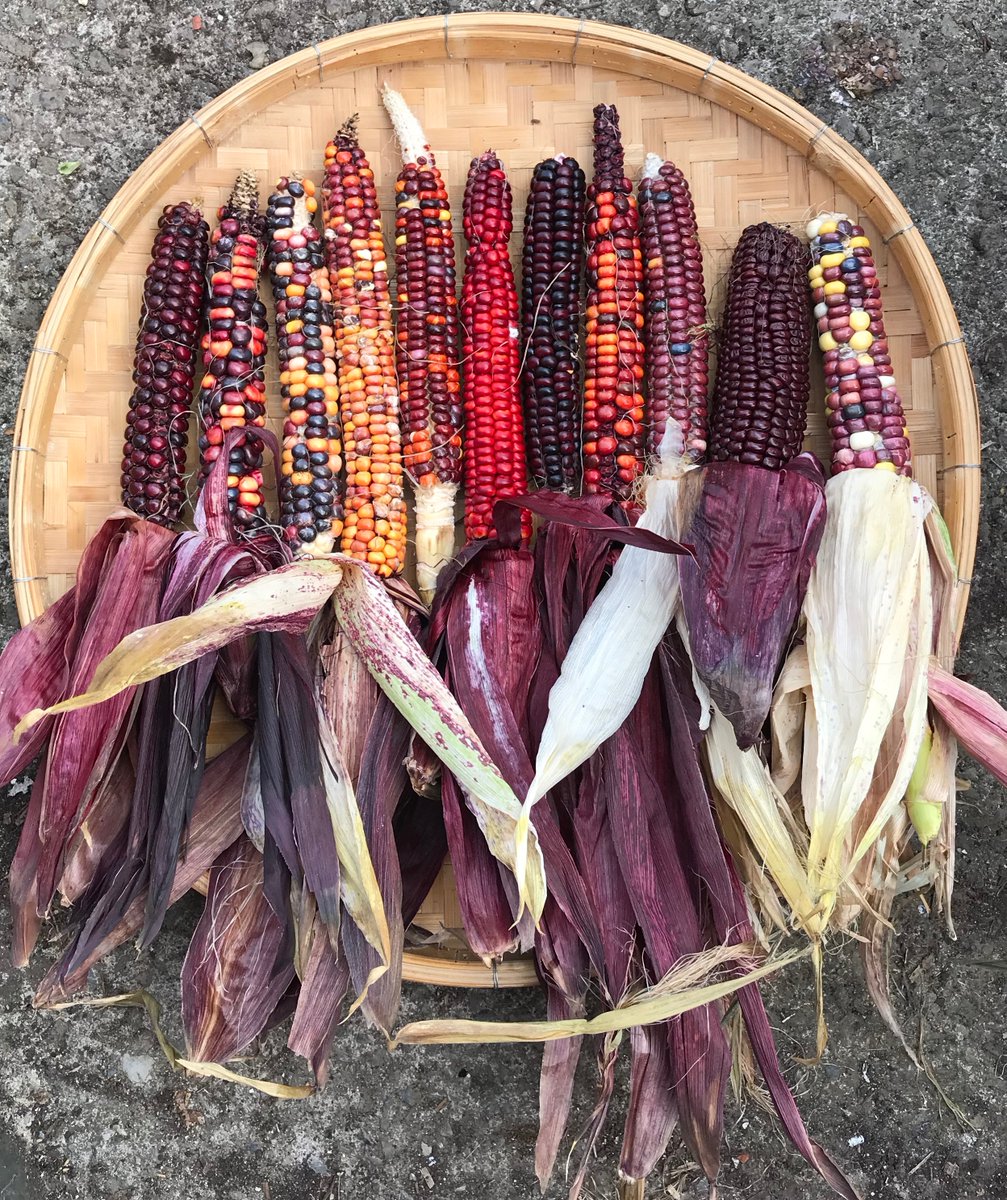
So corn god "emerging through cracked turtle shell"...

I am sure that turtles were a major food source for the Mayas...You can only hunt turtles during their nesting season, which is also corn growing season...And to get to the turtle meet you have to break the turtle's shell...

BTW, this is not the only place in the world where we find turtles (tortoises) as animal calendar markers...

Remember this article about turtles in Indian mythology? 

About earth being carried by four elephants standing on the back of a giant turtle (tortoise)? From my article "Turtles all the way"...

And these articles about turtles in Sumerian mythology?

"The keel of Enki's little boat was trembling as if it were being butted by turtles"...From my article "Enki's little boat"...That must have been some scary turtle, cause "Against Ninurta [Thunder god], Enki fashions a turtle"...From my article "Ninurta and the turtle"...

And this article from Greek mythology?

About "The lyre of Apollo" made out of turtle (tortoise) shell and bull horns? 

All these turtles from all these legends turned out to be animal calendar markers linked with fertility of the land and grain agriculture in their respective areas...

So no surprises here then.


This is 
the House of the Turtles in Umaxl was a Mayan temple which has been named such because of the turtles which adorn the top of the building. The turtle in Mayan mythology/religion represented creation.


Hmmm...The description says "...turtles were associated with rain and the earth's cycles..." 

No one knows why...Maybe because sea turtles come to Maya land to nest during rain season? I

Now what about "The Hero Twins pour water onto their father to facilitate his resurrection"? 

Well here we have to look at the climate in the Maya territory. Here is Yucatan climate chart...It is hot year-round. The wet season usually starts in Jun and ends in Oct...

See how rain season proper starts in Jun, right after the planting of corn? Do you know of any twins which like to hang around Jun? I do...All the horse twins from Eurasia...I talked about it in my post "Hayagriva"...

They mark summer solstice...The moment which marks the middle of the solar year. Solar year which starts when the old sun dies and is reborn as the new sun, on winter solstice...Two halves...Twins?

Mayan calendar also started on winter solstice...And considering that in Maya land, the time of the twins, Jun/Jul, is also the time when the rains arrive, we have the twins (rain season) pouring water on the resurrecting (growing) corn (god)...


BTW, this just reminded me of another pair of twins...Well actually it's a single god, Hapi, the god of the annual flooding of the Nile, who was "often depicted as twins, tying papyrus and lotus flowers together". I talked about him/them 🙂 here, in my post "Lotus and papyrus"...

In my article I said that "this depiction of Hapi as twins, is depiction of flooding Nile, which rises between flowering of papyrus and flowering of lotus, when it floods...

But I completely missed the fact that in the middle of this period between flowering of papyrus (Apr/May) and flowering of lotus (Jul/Aug) is Summer solstice...The twins central...🙂

Does this make sense? 

To read more about ancient animal and plant calendar markers, start here…then check the rest of the blog posts related to animal calendar markers I still didn't add to this page, and finally check my twitter threads I still didn't convert to blog post...I am 9 months behind now...

Turtles all the way

In Hindu mythology, the earth is supported by four elephants standing on the back of a turtle. 


It's Diskworld by Terry Pratchett. He stole his Diskworld idea from the Hindus...For a laugh...Cause he thought it was the most idiotic world myth there was...Bonkers, right? Complete nonsense, right? 

Not if you look at turtle and elephants as animal calendar markers: It's all a complex calendar marker for the monsoon season...

Elephants:

Indian elephants mate during Indian monsoon season...

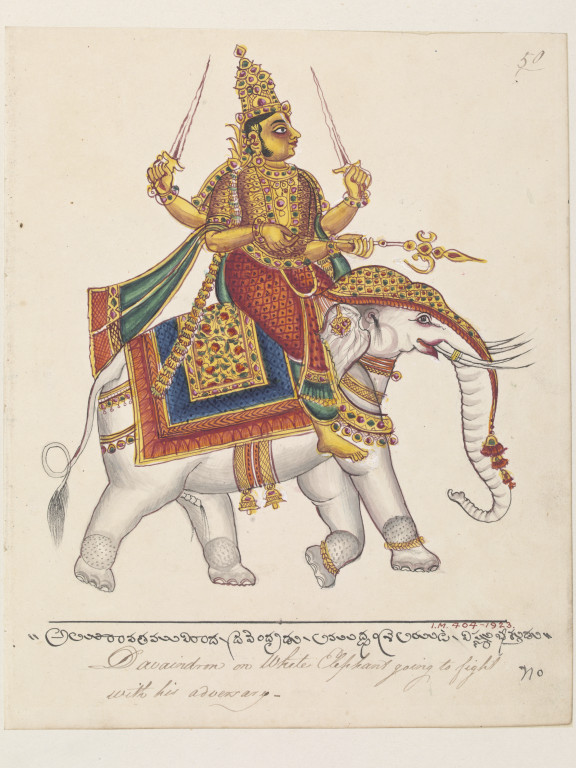
Which is why Indra, the thunder and rain god, rides on a white elephant...

I wrote about elephant as an animal calendar marker in India in these articles: "Musth", "Samantabhadra", "Modesty", "Ganesha".

Turtles:

There are many turtle and tortoise species in India. So which one is "The World Turtle"? Apparently, The World Turtle is the reincarnation of the Hindu god Vishnu...And Hindus believe that the animal in question is Indian Star Tortoise. You can read about it in this paper "A star attraction: The illegal trade in Indian Star Tortoises"... 

And Indian Star Tortoises mate during monsoon season. You can read about it in this paper "Husbandry Guidelines For Indian Star Tortoise" 

It is very interesting that this sacred tortoise of Vishnu, Kurma, is associated "with the sun"...Vishnu has tendencies to be associated with solar animals...I talked about this in my article about Solar Horse Hayagriva, also Vishnu avatar...

But equally tortoise was believed to be "The lord of waters" and "The sap of life". You can read about it in this article "Tortoise in the Vedic mythology and ritual"...

Why is this important? Cause the monsoon season in India is the sunniest, hottest time of the year in India...

So I don't think that in this legend, the earth is really "The Earth"...It is more like Life giving earth...Apparently, Prajapati, the Procreator, took the shape of a turtle when creating all living beings...

So that's one possible explanation...But maybe I am wrong and this is all just a bonkers story that makes no sense...

To read more about ancient animal and plant calendar markers, start here…then check the rest of the blog posts related to animal calendar markers I still didn't add to this page, and finally check my twitter threads I still didn't convert to blog post...I am 9 months behind now...

Friday, 14 October 2022

Lyre of Apollo

Seated Apollo with laurel wreath, holding a lyre and pouring a libation. Attic white-ground kylix. Found in Delphi and dated c. 460BC. Archaeological Museum of Delphi...

In this post I would like to talk about this lyre...Its origin, and its symbolism...

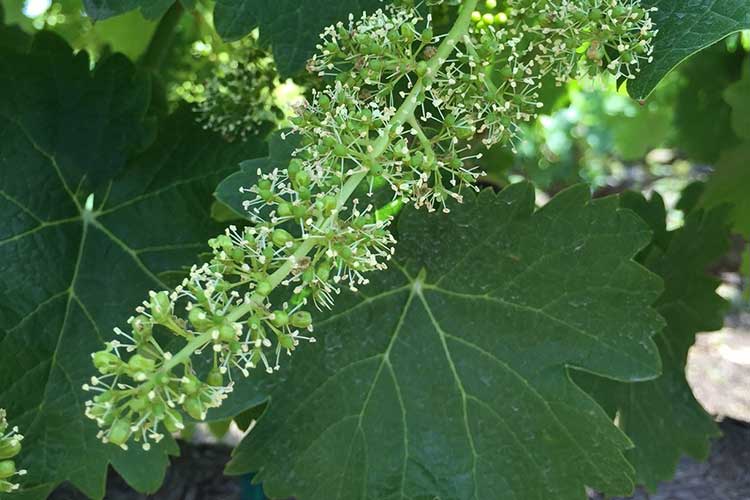
First, according to the "Homeric hymn 4 to Hermes", this lyre was given to Apollo by his younger brother Herms...In exchange Apollo gave Hermes caduceus...All very important... Symbolically... But why did this exchange of gifts take place? Remember this post, "When grapes flower" in which I figured out Hermes's birthday?


This post is an analysis of (some) animal and plant calendar markers contained in the "Homeric hymn 4 to Hermes" which describes what Hermes did the day he was born (4th of May, when grapes flower)...

What Hermes did on the day he was born, was steal Apollo's cows. 


He then invented fire drill, made fire, and sacrificed one of the cows to the gods...I talked about this in my post "12 Olympians" about (apparently inexplicable 🙂) link between Hermes and Hestia (fire)... 

Apollo eventually caught Hermes and called on Zeus to decide how this "situation" should be resolved...And Zeus decided that they should shake hands and make friends, hence the exchange of presents...

But where did Hermes get the lyre? Well, he invented it...He made it himself...Apparently, as soon as he was born, he ran out of the cave he was born in, and at the entrance he saw a tortoise crawling in the grass...

He then "...killed the tortoise and cleaned its shell. He cut stalks of reed to measure and fixed them, fastening their ends across the back and through the shell of the tortoise, and then stretched ox hide all over it by his skill..."

"...Also he put in the horns and fitted a cross-piece upon the two of them, and stretched seven strings of sheep-gut...[then] he proved each string in turn with the key...At the touch of his hand it sounded marvelously..."

Here is a reconstructed 5th-4th century BC lyre found in Athens in parts. Currently in the British Museum...

Obviously based on the original design by Hermes...

Now, what if I told you that the lyre made by Hermes was a complex animal calendar marker for the day when Hermes was born, the 4th of May, mid Taurus...

If you have never heard of animal and plant calendar markers you would tell me I was mad...But if you did hear of them...

If you did hear of animal and plant calendar markers, you know that they mark important event from the annual cycle of the depicted animal or plant: mating, birthing, migration, flowering, fruiting...

So...the lyre's sound box was made of a tortoise shell.

The most common type of tortoise from Mediterranean, Greek tortoise, mates in Greece in Apr/May, in Taurus...When Hermes was born...

The sound box made from the tortoise shell was then covered with stretched ox hide. 

After making the sound box, Hermes then attached horns to it...No explanation what that means...But judging by the shape of the lyre horns, I can bet that these were Auroch horns...

Here I want to thank @realVoxVulgaris for posting this in one of his twitter threads: 

It is a natural thing to believe the curves were "flat", extending mostly outwards like on paintings but a couple of rare sideviews show that they curved mostly frontwards. Maybe best represented on this, the (Roman archaicising) Heidelberg Votive Lyre

See, shaped like bull horns...

Taurus marks the beginning of the calving season of the wild Eurasian Auroch cattle...

I talked about this in many of my posts, for instance this one, "Cow an calf ivory"...

Anyway, after creating the lyre frame, Hermes then attached 7 strings to the lyre...Why 7? The Poeticon astronomicon attributed to Hyginus says:

"...[Hermes], when he invented the lyre on Mount Cyllene in Arcadia, gave it seven strings, from the number of Atlas's daughters [Pleiades], of whom his mother, Maia was one"...

Pleiades, which at the time when the Homeric hymn to Hermes was written, rose with the sun at the beginning of May, when Hermes was born...

Oh, and the first song Hermes sang with his lyre was about his mum...

But also, 7 months of summer (hot dry half of the year) which starts in Apr/May, in Taurus???

BTW, Orphic hymn to Apollo says:

"[Apollo, You are] the cause of the blooming of all things; with your...lyre you harmonize...the heavens...You have arranged the highest three strings in the winter, the lowest in the summer...The middle one in spring...

Now, he used sheep guts for strings...Remember my post "Aries must die" about shepherd's rituals performed on St George's day, in which I explained why rams are sacrificed to St George, the end of Aries and the beginning of Taurus? 

Aries must die (end) so Taurus can begin...BTW Aries marks the end of the lambing and the beginning of the sheep Milking season season. And Taurus marks the beginning of the calving and cow milking season...

And if we look at the lyre which Hermes made, its parts mark this super important part of the year for shepherds...Hence, Good Shepherd...


Interesting, right? Considering that after Hermes made the magic lyre, he stole Apollo's cows...In the middle of Taurus...

Which eventually lead to in exchange of gifts between Apollo and Hermes: Hermes gave Apollo the lyre (complex animal calendar marker for Apr/May) and Apollo gave Hermes "shepherd's staff" which is to become caduceus...

Now according to the Greek and Roman tradition, caduceus was a staff made from either bay laurel (Apollo's sacred plant) or olive wood...

Interestingly, both bay laurel (L) and olive (R) flower in Greece in Apr/May...

Which one is more suited to adorn the sun god? 🙂 I would definitely pick laurel...

Hermes used the shepherd staff Apollo gave him to separate two fighting snakes. They coiled around his staff in perfect harmony, creating the familiar caduceus tip...

Interestingly, most common snakes in Greece mate in Apr/May, when males engage in ritualised fights that once were interpreted falsely as mating ceremonies... 

I talked about this in my post "Who were Persephone's parents"...

Soooo, Hermes gave Apollo lyre, complex animal calendar marker for Apr/May...And in exchange, Apollo gave Hermes caduceus, a complex animal and plant calendar marker for...Apr/May...Beginning of summer, the time of the year dominated by the sun, Apollo...

But why would Hermes, messenger of Zeus, carry a staff which is a calendar marker for Apr/May? Cause the messenger (the voice of) Zeus is thunder/lightning...I talked about this in my post about Iris, another messenger of Zeus (also carries caduceus 🙂) ...

And so Hermes, the messenger of Zeus, the one who announces Zeus, carries the staff made from the wood of trees which flower in Apr/May, around which are coiled snakes which mate in Apr/May, cause in Greece, the thunderstorm season starts in...Apr/May...

I talked about this in my post "Eagle and snake struggle"...

So when Greek poet Alcaeus in his hymn to Apollo written by the 6th c. BC says that it was Zeus who gave Apollo his lyre, this actually doesn't change anything in the interpretation of the lyre as a complex animal calendar marker for Apr/May...

Sooo...Cool, right? 


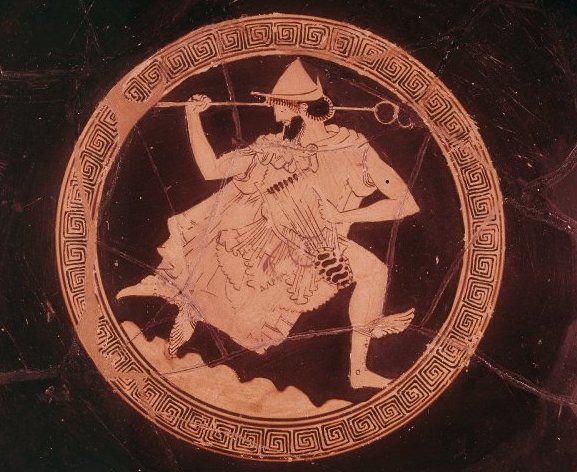
Oh look! Hermes with both the lyre and the caduceus...Thief...


To read more about ancient animal and plant calendar markers, start here…then check the rest of the blog posts related to animal calendar markers I still didn't add to this page, and finally check my twitter threads I still didn't convert to blog post...I am 9 months behind now...

Sunday, 31 October 2021

The judgement of the birdman

This is a very interesting seal from the Babylonian period (I presume first half of the 2nd millennium BC), currently in the Penn museum

The birdman, who has head, arms, chest of a man and the body, legs, feet, wings and tail of a bird, is led by a divine officer, with clasped hands, wearing a long skirt. From behind, he is pushed by the second divine officer, who carries a club, and short skirt...


At the end of the procession, a human worshiper, with bare head, short hair, long beard and plaited skirt brings a kid (baby goat) as an offering...

He is probably a king. I explained why in my post "Goat carrier"...

The birdman is brought before the seated Enki/Ea, who is surrounded by streams, with fish swimming along the stream towards him...He is holding a round vase in his left hand....Above him is a crescent moon pointing upward and stars...

It is one of several seals kept in the Pen Museum which show "the judgment of the birdman". Here is another one...

Very cool...What does this mean? 

To figure this out, we need to look at another, much older and much cooler seal. This one, apparently from Nipur, and dated to before 3000BC depicts "the judgment of the bird, not the birdman"... From "SOME SEALS OF THE BABYLONIAN COLLECTIONS"...


The eagle is captured by two divine attendants and probably brought in judgment before Enki/Ea. The bird – this time not a birdman – is fighting with claws and wings to free himself...

One attendant has caught him by the leg and kneels down as if to avoid his wings and beak. The other stands up and grasps one flapping wing while striking him with a short club...

A third officer leads in front with a club on his shoulder. All have the horned mitre, the symbol of divine officers, their hair tied in a loop behind, and flounced skirt leaving bare the upper body...

Soooo??? Remember my article "Pero" about ferns, feathers, lightning, feather/fern like lightning scars and thunder gods? 

In it, I talked about Ninurta/Ningirsu, Sumerian thunder god, who was in the earliest times imagined as a huge black bird, with outstretched wings...An eagle (vulture)...The Thunderbird....

"...and when Gudea sees the god Ninurta/Ningirsu in a dream the god still has the wings of his old form, the Thunderbird..."

And I then talked about the evolution of the eagle (thunderbird), into the eagle man (birdman), and then further into a thunder god (who can transform into an eagle, can ride on an eagle or has eagle as his sacred animal, avatar)...

Could the birdman on the Babylonian seals be Ninurta/Ningirsu in his old birdman form? And could this bird on the Nipur seal be also Ninurta/Ningirsu in his oldest, thunderbird form?

But why would Ninurta/Ningirsu be arrested and brought before Enki/Ea to be judged? Well, remember my article about "Ninurta and the turtle"?

There is a "weird" Sumerian text called "Ninurta and the turtle". In it, the Rain god Ninurta contemplates to overthrow the Flood god Enki. Enki gets the wind of it, and then unleashes a deadly turtle, which digs a huge hole and drags Ninurta into it...

This apparently nonsensical story makes a lot of sense, when you look at Ninurta, Enki and the turtle as calendar markers. 

The climatic year in Mesopotamia is divided into two halves: summer, hot and dry half (Apr/May-Oct/Nov) and winter, cool and wet half (Oct/Nov-Apr/May)...

The winter starts in Oct/Nov, with the rain, brought by the rain god Ninurta...And right at that time vultures start their mating season...Huge eagles with outstretched wings gliding below the gathering clouds performing their mating ritual flights...

And it ends in Apr/May...With the flood, brought by the flood god Enki...And right at the end of the rains season, at the peak of the flood, the Mesopotamian softshell turtles start digging huge holes in river and canal banks to lay their eggs...

The rain season starts with the beginning of the vulture mating season and ends with the beginning of the flood and the turtle mating season...Turtle drags eagle into the hole in the ground...Rain season ends. Flood starts...Enki overpowers Ninurta...

This is what "Ninurta and the turtle" story symbolically depicts. So "imprisoning" of the the bird and the birdman, and bringing them to be judged by Enki/Ea, is another symbolic depiction of Enki/Ea overpowering Ninurta/Ningirsu...

One last thing. The moon...

The moon pointing up is another sign that we are talking about winter, the rain season...

I talked more about this in my post "Seven stars of scorpio" where I analysed this amazing Mesopotamian seal


The moon points up between Ninurta (beginning of rain season) and Enki (end of the rain season). 

Which is why moon (god) is so important...

So... My hunch (from "Pero" ) that the names of all these "Per" thunder gods: Slavic Perun, Baltic Perkūnas/Pērkons, Finnish Perkele, Albanian Perëndi, Indian Parjanya, Thracian Περκων/Περκος, are derived from PIE "*perH-" meaning feather, wing, to fly, just got more support...

Amazing really...

To read more about ancient animal and plant calendar markers, start here…then check the rest of the blog posts related to animal calendar markers I still didn't add to this page, and finally check my twitter threads I still didn't convert to blog post...I am 9 months behind now...