Showing posts with label Christmas customs. Show all posts

Friday, 24 February 2023

Party

Winter Solstice Celebration, by the Latvian painter Evalds Dajevskis, Acrylic, 1989...

The traditional masked characters dancing in the room are all symbols of death and resurrection  of nature...

stork

bear

goat

white horse

death, the dead

bride

sheaf of wheat

Ever wondered why these characters? Well, because they all represent the idea of death and resurrection...

Stork:

Storks are migratory birds, which disappear in the autumn and reappear in the spring...Slavs believed that in autumn, migratory birds followed the sun to Iriy, the land of the dead...And that they came back from Iriy to our world in spring, again following the sun...

In pre-Christian times, Slavs believed that souls of their dead entered birds and through birds entered heaven, Iriy. So feeding birds with grain during  winter was basically a form of feeding the ancestors, sacrificing to the ancestors...

Slavs also believed that migratory birds brought the souls back from Iriy, so they can be (re)born as people...And so the belief that storks brought babies...

I talked about this in my posts "Leto", "Julenek", "Nav", "Bird wedding", "Inviting spring"...

So stork = death - resurrection...

Bear:

Bear goes underground, underworld (to hibernation) in the autumn and comes out from the underground, underworld, in the spring, with cubs...

So Bear = death - resurrection...

I talked about this in my post "Bear dancers", about a winter ritual bear dance from Romania. 

During which:

Bear dances (spring, summer, autumn)

Bear falls cause a demon took over him (winter) 

Bear is killed and bled to let the demon out (hibernation. death-rebirth)

Bear gets up and dances again (spring, summer...) 

Bears also danced during the winter in Russia, during Koliada, Christmas (Winter Solstice processions)...

Goat: 

Ibex goats mate during the winter, with the peak in midwinter, Winter Solstice. The mating season is marked by vicious male goat fights, which from the distance look like a dance...

This is why ibex goat is the symbol of winter throughout its range. Hence Slavic Christmas carol goat mask...

In Slavic lands the carollers performed ritualistic dance which showed the goat dying and then being brought back to life...You can read more about this in my post "Krampus"...


This basically depicts the winter zodiac:

Sagittarius (start of winter), Capricorn (mid winter), Aquarius (end of winter, snowmelt)...
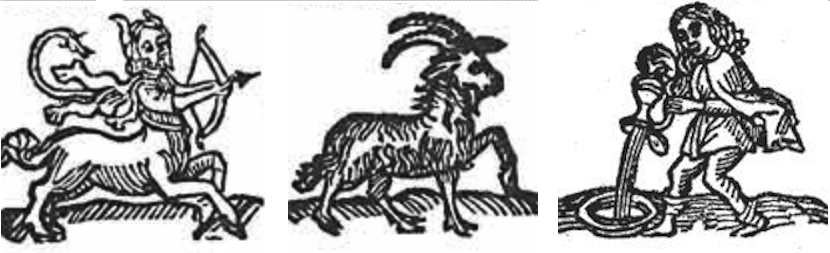
Hunter, (almost) kills the goat, from whose blood spring spring flowers...The meaning of these symbols was preserved in Slovenian legends. You can read about this in my post "Trentar", "Zlatorog"...

So Goat = death - resurrection...

Oh look, goat, bear and stork dancing together in Russia...

Horse:

Horse fertility is governed by the sunlight, meaning horses are most fertile on summer solstice, peak fertile time of the year...Which is why horse is one of the main solar symbols and symbols of summer...I talked about this in my posts "Trojan horse", "Archaic rider", "Hayagriva", "Shamash playing with solar horse", "Goddess on a horse", "Longma"...

A dead horse would then be a good symbol for...Winter and Winter Solstice of course... The day when the sun is reborn...I talked about this in my post "Gray mare"...

So Horse = death - resurrection 

Sheaf of wheat:

In the autumn, grain dies and gets buried (sown)...It then gets resurrected (sprouts) over winter and spring and grows into new grain...

So Grain = death - resurrection

The last sheaf of grain represents the living "sprit of grain"...I talked about this in my posts "Diduch", "Julenek", "Corn dolly"...

Which is why sheafs of grain dance around Europe every winter. I talked about this in my post "Walking sheafs of wheat"...

Winter was in Continental Europe seen as the time of death. The nature died at the beginning of winter, when the sun went to the land of the dead...The nature got resurrected at the end of winter when the sun returned from the land of the dead...

While in the land of the dead, sun had a lot of time to chat with the dead. And, Slavs believed, it was the dead ancestors which were remembered by the living, that "put the good word in for the living" and were the source of the prosperity of their descendants...

I talked about this in my several of my posts: "Diduch", "Lapis manalis", "White feast"...

The dead ancestors also visited their descendants during the winter (the scull guys behind St Nick). St Nick is telling the kids that they should be good Christians...The reason why kids are not looking at St Nick, is cause they are staring at St Nicks gang of the dead ancestors standing behind him, ready to take bad Christians away...Somewhere in Austria...I talked about this in my post "Little Christmas"...

The ancestors expected to be wined and dined by them and shown the good time during winter parties...Or else...In some parts of Serbia, on Christmas Eve people used to take a table laid with food on the doorstep of the house and would invite the dead to the feast in the same way... I talked about this in my post "Wolf feast"...

The people on this picture from Moldova are "Koledari", Slavic masked "Christmas" carollers. The man with the blackened face, representing dead ancestor, holds ritual solar bread called kolač or kovrtanj (wheel). Slavs believed that all good comes from ancestors...

So The Dead = death - resurrection

The Bride:

The Bride is the hag (winter earth) which magically gets transformed into the maiden (spring earth)...

A girl dressed as a faceless "bride", who brings presents (and good luck) to Sorbian families on the last Wednesday before Christmas (originally probably on Winter Solstice day). I wrote about it in my post "Bescherkind"...

In Scotland a special folk dance commemorates the death of "The old woman of the mill dust" and the marriage of her daughter....

"Bablji mlin", meaning "Granny's mill" scene, Slovenia. An old hag is being milled, and thus transformed, into a young maiden. Winter being transformed into Spring...In this depiction of the rebirth scene, the granny is being pushed into a mill by a goat...I talked about this in my post "Bablji mlin"....

At Imbolc, the first day of Spring according to Gaelic calendar, St Bride's "bannock" or "bonnach" was baked and given to the young girls as a blessing. One was also left outside as a gift for St Bride when she passed in the night to bless all the homes...I talked about this in my post "Bannock"...

Here is the "bride" representing St Bride (Brigid), made out of the butter churn on Imbolc, the day that marks the beginning of spring...

Slavs call the day that marks the beginning of spring, "Maslenitsa" (butter festival)...Oh, and on Maslenitsa, they hold a festival that celebrates the death (end) of the old hag (winter earth), and the arrival of the young bride (spring earth). During the festival, people parade the effigies of Marzana (goddess of death and winter) which are dressed in white, like brides (or snow maidens)...

Add to this the Snow-White story, where a young maiden gets killed by her own mother by a poisoned apple, only to get resurrected by a young prince to whom she then gets married...I talked about this in post "Snow-white"...

So The Bride = death - resurrection

Ready for the party?

To read more about ancient animal and plant calendar markers, start here…then check the rest of the blog posts related to animal calendar markers I still didn't add to this page, and finally check my twitter threads I still didn't convert to blog post...I am 9 months behind now...

Sunday, 26 June 2022

Yule log in English tradition

Have you cut your Yule log yet?


"The ancient fire-festival of the winter solstice...has survived...in the custom of the Yule log...[once]...widespread in Europe, it seems to have flourished especially in England, France, and among the South Slavs"...From "The Golden Bough"... 

I wrote about South Slavic Yule log customs in my posts "Badnjak" and "First footer"...

I wrote about old French Yule log customs in my post "La buche de noel"...

In this post I will write about Yule log customs from England:

Robert Chambers, in his 1864 work, "Book of Days" notes that "one of popular observances belonging to Christmas is more especially derived from the worship of our pagan ancestors: the burning of the Yule log."

Clement A. Miles in Christmas in "Ritual and Tradition" published in 1912, says: 

"...within the memory of many [Yule log] was a very essential element in the [Christmas] celebration...not just for warmth, but as possessing...magical properties..."

"In some remote corners of England it probably lingers yet. English customs, they can hardly be better introduced than in Robert Herrick's words:  


"We may note especially that the [Yule log] must be kindled with last year's brand; here there is a distinct suggestion that the lighting of the log at Christmas is a shrunken remnant of the keeping up of a perpetual fire..."

Another tradition and its origin are thus described by Sir Laurence Gomme in "Folk Lore Relics of Early Village Life"...

"From there being an ever-burning fire, it has come to be that the fire must not be allowed to be extinguished on the last day of the old year, so that the old year's fire may last into the new year"...

"In Lanarkshire it is considered unlucky to give out a light to any one on the morning of the new year, and...if the house-fire has been allowed to become extinguished recourse must be had to the embers of the village fire [on New Year's Eve a great public bonfire is made]"...

J. Ashton, in "A righte Merrie Christmasse!!" says: "In the north of England...[over Christmas] it was useless to ask a neighbour for light, so frightfully unlucky was it to allow any light to leave the house between Christmas Eve and New Year's Day"...

Georgina F. Jackson say in "Shropshire Folk-Lore: A Sheaf of Gleanings": 

"In Shropshire the idea is extended even to ashes, which must not be thrown out of the house on Christmas Day, 'for fear of throwing them in Our Saviour's face'"...

"Perhaps such superstitions may originally have had to do with dread that the 'luck' of the family, the house spirit...might be carried away with the gift of fire from the hearth"...

"In the 1880s there were still many West Shropshire people who could remember seeing the Christmas Brand drawn by horses to the farmhouse door, and placed at the back of the wide open hearth, where the flame was made up in front of it"...

"The embers, says one informant, were raked up to it every night, and it was carefully tended that it might not go out during  the whole season, during which time no light might either be struck, given, or borrowed"...

"At Cleobury Mortimer in the south-east of the county the silence of the bells during 'the Christmas' points to a time when fires might not be extinguished during that season"...

In 1849 "Notes and Queries" George Bell says: "The place of the Yule log in Devonshire is taken by the "ashen faggot" (sticks of ash fastened together by ashen bands), still burnt in many a farm on Christmas Eve...

In 1740 "Observations on Popular Antiquities", Henry Bourne writes: "Our Fore-Fathers lit up Candles of an uncommon Size, which were called Christmas-Candles, and layed a Log of Wood upon the Fire, which they termed a Yule-Clog, or Christmas-Block"...

"The Yule-Clog therefore...seems to have been used, as an Emblem of the return of the Sun, and the lengthening of the Days. For as both December and January were called Guili or Yule, upon Account of the Sun's Returning, and the Increase of the Days"...

"So, I am apt to believe, the Log has had the Name of the Yule-Log, from its being burnt as an Emblem of the returning Sun, and the Increase of its Light and Heat"...

H. J Rose says in 1923 "Folklore Scraps": "In the last generation the Yule log was still burned, and a piece of it saved to light the next year's log"...

In the 1790 "The Gentleman's Magazine", we can read that: "In England the Yule log was often supplemented or replaced by a great candle"...

"At Ripon in the eighteenth century the chandlers sent their customers large candles on Christmas Eve, and the coopers, logs of wood"...

And finally: In 1841 "Medii Aevi Kalendarium", Hampson says: "Candle that is lighted on Christmas Day must be so large as to burn from the time of its ignition to the close of the day, otherwise it will portend evil to the family for the ensuing year"...

So basically Christmas candle is just a Yule log in disguise...

Anyway, may your fire burn bright...

Merry Christmas eve to all who celebrate Christmas tomorrow...

Tuesday, 31 December 2019

Nav


"On Christmas morning in Scandinavia every gable, gateway, or barn-door, is decorated with a sheaf of grain fixed on the top of a tall pole, wherefrom it is intended that the birds should make their Christmas dinner"

Quote from 1902 book "Christmas: Its Origin and Associations", by William Francis Dawson

"In pre-Christian times, Slavs believed that souls of their dead entered birds and through birds entered heaven, Iriy. So feeding birds with grain during  winter was basically a form of sacrificing grain to the ancestors."

Quote from my post "Bird wedding

Are these customs linked? 

This is the page about a strange creature from Serbian folklore called "Nav". 


The page is from the beautiful illustrated children's book on Serbian mythology called "Ale i Bauci" by Rastko Ćirić.

According to the Serbian mythology, soul of a dead unbaptised child enters a bird and becomes a "nav". It screeches during the night most commonly making crying sounds. It can make breastfeeding mothers go dry. Crossing yourself and saying "I baptise myself" makes it disappear.

This is very interesting. Slavic word Nav denote the souls of the dead in Slavic mythology. The singular form (Nav or Nawia) is also used as a name for the "otherworld". 

In Slavic mythology, souls of the dead entered birds who brought them to irij, paradise. Birds then brought the souls back when they were ready to be reborn. It is interesting that only the souls of unbaptised (still pagan) children become "nav" 🙂

What is even more interesting is that in Irish the word for saint is "naomh" which is pronounced like "n(i)ev" and which comes from Old Irish noíb (noeb) meaning sacred, holy. 

And that in Irish the word for heaven (where saints (naomh) go) is "neamh" which is pronounced like "nav" 🙂and which comes from PIE "*nébʰos." meaning sky which is in Slavic "nebo" 🙂

So in Slavic languages the dead, (navi) go to underworld, old pagan heaven probably, (nav) and in Irish language saints (niev) go to haven (nav)...


Tuesday, 24 December 2019

La bûche de Noël

Yule log rituals were between 12th and 19th century the most important part of Christmas celebration in France. Pic: "Tradition of the Great Christmas log. Drawing by Léon Lhermitte printed in Le Monde from the 1st of January 1884... 


The whole family went to to the woods to cut the Yule log. It had to be a big thick oak or beach trunk that could burn for 12 days (from Christmas to Kings) without going out...

After choosing and cutting the Yule log, it was decorated with leaves and ribbons and carried home. There it was blessed by the head of the family and then lit by the youngest and the oldest in the household...

The Yule log had to burn continuously for 12 days and all the ashes and charcoals were carefully kept and then ceremonially deposited somewhere on the family land...

These ashes and charcoals from the old Yule log were then brought in next year and placed on the floor of the fireplace before new Yule log was brought in and lit. This was symbolically connecting the old and the new solar year, the old and the new fire of the sun...

If a family didn't have their own forest where they could cut their own Yule log, they were given Yule log by their neighbours...

As soon as the night fell, people took great care to extinguish their hearths, then went to the church to light torches from the fire that burned in the church. A priest blessed the torches and people then brought this blessed fire home to rekindle the house hearths...

In some parts of France, like Berry, charcoals from the #Yule log were kept under the bed of the oldest male in the family. During thunderstorms, a bit was thrown into the fire "and that was enough to protect the family from thunder"...

This is very interesting. In Berry the Yule log had to be oak, the tree of the thunder gods. Which would explain why Yule log charcoals would protect from thunder. This belief that the Yule log charcoal protected from thunder was recored by P. Sébillot in his 1886 "Coutumes populaires de la Haute-Bretagne". He says that: "In Brittany the tison de Noël (Yule log) is a protection against lightning and its ashes are put in wells to keep the water good...

In some parts of France, wine was poured over the Yule log before it was lit, and fruit and nuts were placed next to it...The same kind of sacrifices to the Yule log were recorded in Serbia...

You can read about Serbian Yule log customs in my posts "Badnjak" and "First footer"

Frederic Mistral (1830–1914), Occitan writer and lexicographer of the Occitan language, who received the 1904 Nobel Prize in Literature talks about Yule log customs from his childhood in his Memoirs:


W. Mannhardt, in his book “Der Baumkultus der Germanen und ihrer Nachbarstämme” printed in 1875 says this about Yule log customs from France:


I particularly like the magic use of the Yule log charcoal and ash. It shows that this custom has pre-Christian root...The Yule (Oak) log was "Sky god materialised". Serbs definitely saw Yule log as such and directly addressed the log and asked it for protection and help...

It is funny that today most French people don't know anything about this...

Anyway, I wish everyone who celebrate Christmas Eve today bright burning Yule log. May next year bring you and your family prosperity, luck, happiness and health...


Sunday, 22 December 2019

The end of time

Image of the Virgin Mary, nursing the Infant Jesus from the Catacomb of Priscilla in Rome. It was dated to the late 2nd century AD. This is earliest known image of Mary and the Infant Jesus. The figure at the left appears to be the prophet Balaam pointing to a star. 


There is a very interesting Serbian (And Bulgarian) Koledar song which starts like this:

Serbian:

"Замучи се божја мајка,
Од Игњата до бадњака,
Да роди Божића"

Bulgarian:

"Замъчи се Божа̀ майка,
от Игнажден до Коледа,
да си роди Млада Бо̀га."

"God's mother laboured
From St Ignatius to Christmas (Koleda)
To give birth to Young God"

Koledari are traditional Slavic carol singers who went from house to house during Koleda (Originally Winter Solstice, bot now Christmas) singing ritual songs celebrating the immanent brith of the new god (once new Sun God, now Son of God)...

I talked about one of these traditional Serbian Winter Solstice songs in my post "Young God".

Here I would like to talk about the reason why in Serbia, Koledari went out and sang their songs 5 days before Christmas...

The reason why Koleda, the day that marks the end of "kolo" (wheel), the end of solar wheel, the end of solar year is marked 5 days before Christmas (25th of December) is simple: it is the 20th of December, the Winter Solstice eve. Right? I don't think so. That's too simple 🙂...

In the mind of Serbian peasants, Christmas was Winter Solstice day and Christmas Eve was The Eve of Winter Solstice. So why did they then sing Koleda songs five days before Christmas? 

To understand this, we need to understand how our ancestors measured time. They used days, moons and suns. The Moon takes 27.3 days to orbit Earth, but the period from full moon to full moon is 29.5 days. Or approximately 30 whole days. 


Year has full 12 moons. The last full moon of the solar year ends on the 30X12=360th day. What is left are 5 "extra" days. Five days which lay outside of the "calendar" (koledar?). Five "dead days" as they are called in Serbia. 

Which is why the mother of god goes into labour on that day, labours for 5 days, and only gives birth to the new Sun God (Son of God), new solar year, on Christmas (Winter solstice) day.

I talked about this in my post "Calendar". 

What is interesting is that in Bulgaria, this day, the end of the last full moon, 20th of December,  is called "Nov Dan" (New Day) and all the rituals performed on this day are the rituals related to the beginning of the new year, the birth of new sun...This is the day when the first footer ceremony is performed, the ceremony which is in Serbia performed on Christmas Day. I talk about this ceremony in my post "First footer".

Bulgarians count the "dead days" from that day and call them "dirty days"...I think that this is later change. Normal counting of time would start on winter solstice, would go through 12 moons X 30 days each, and would end 5 days before new winter solstice...

On this day, the "end of calendar" day for Serbs and the "beginning of calendar" day for Bulgarians, Serbs and Bulgarians celebrate St Ignatius who is also known as "Ignatius Nurono" (The fire bearer).  I find it very interesting that the saint that marks the time when rekindling of the Sun's fire begins is called Ignatius, from Serbian "Oganj", Latin "Ignis", Sanskrit "Agni" all meaning Fire...

I talked about the yule fire ceremonies in Serbia in my post "Badnjak".

Another funny thing about St Ignatius is that he is also known as "Ignátios ho Theophóros" (God bearer, God carrier). In Serbia they say "because he carried god across frozen river". Which is very good description of what happens during sun's winter journeying through 5 dead days outside of calendar. St Ignatius (20th of December) comes before Winter Solstice (25th of December). It and symbolically "holds the new baby god" in his hands. Interestingly Christianity inverted this into "When Ignatius was a kid, Christ held him in his hands and blessed him". Which makes no sense. 

But what is most interesting is what you get when you put the two St Ignatius's nicknames together:

God bearer = Fire bearer...

As I said in my post "Young God", the young god whose birth Serbs celebrate in their Koledar songs is Svarožić. Svarožić, whose name means "young fire". This "young fire" is the fire of the sun, which is rekindled on the day of the winter solstice, the day when the new sun is born and the new solar year, new "kolo" starts...

St Ignatius who is both "God bearer" and "Fire bearer" is just another pointer to the true identity of the Young god who is born on "Christmas" (Winter Solstice) day: New sun...

This is all of course just a coincidence...

Saturday, 21 December 2019

Young god

Solar rider from a Celtic coin...


In Slavic mythology, Svetovid was associated with a white horse, which was kept in his temples and used for divination...In this article I will talk about a Serbian ritual song which talks about solar rider and Christmas...

"Dodaj meni hladne vode, Koledo Koledo, Da kupamo, okupamo mladog boga, tog Božića Svarožića… Konjic mu je jarko sunce, bojni doro ognjeviti"

"Pass me cold water, o Koledo, to bath the young god, Božića Svarožić... His horse is the bright sun, a flaming war steed"

This is a Serbian ritual "Christmas song" recorded in Bosnia by Milojević in 1869. In it the narrator asks Koledo for water. Koledo is winter solstice. The end of the old Kolo (wheel, Solar wheel, solar year) and the beginning of the new Kolo (wheel, Solar wheel, solar year)...

The water is needed to bath "the young god" who is called Božić. In Serbian the word "Bog" means god and the ending "ić" means small, young.  So Božić literally means young god, but also it means Christmas...So far so Christian...🙂

But the young god Božić is also called Svarožić (young Svarog). Triglav (Dabog), Serbian supreme deity, consisted of Svetovid, Perun, Svarog. Svetovid represented Sun, Perun represented Thunder and Svarog represented Fire. I talked about Triglav in my post "Triglav, Trojan, Trinity, Trimurti, Agni"

So Svarožić (the other name of the young god) means "young fire". This "young fire" is the fire of the sun, which is rekindled on the day of the winter solstice, the day when the new sun is born and the new solar year, new "kolo" starts...

The main ritual performed over Christmas (Solstice) is "lighting the Yule log in the evening, keeping it burning through the longest night, and then making it spark in the morning". 

Watching over Christmas (Solstice) fire, Serbia


I talked about this in my posts "Badnjak" and "First footer"

In this way people helped "preserving sun's fire", "rekindling of the fire of the new sun"...This was not just symbolic action. People believed that "all fire is one" and that if their fire was kept burning, the sun's fire would be kept burning through the longest night...


This equates Svarožić (young fire) with Jarilo (young sun) who is born during the longest night...Svarožić is Jarilo's fire. Jarilo's name comes from "jar' which means both young and fiery, raging...It is his fire which grows ever stronger and warmer which brings spring...

That Svarožić (young fire) is Jarilo (young sun) can be seen from the second verse which says that Svarožić rides on the bright sun, which is his flaming war horse...He is the Solar rider... 

Depiction of the solar rider from Bosnia from my post "The horseman"


Christmas is coming, get your Badnjaks (Yule logs) ready...🙂

Sunday, 6 January 2019

Badnjak

A young oak covered in golden leaves is the traditional Christmas tree in Serbia. Felling, bringing in, and burning of "badnjak" (as Christmas tree is called in Serbian) are surrounded by elaborate rituals and are the central part of the Serbian Christmas


The cutting of "badnjak", young oak tree used as a Christmas tree in Serbia, was accompanied by elaborate rituals which directly linked the oak with the sun and fertility and identify the oak tree as the earthly seat of the sky god.


"Good morning and happy Christmas Eve to you, o Holy Badnjak. I have come to take you to my home, to be my faithful helper to every progress and improvement, in the house, i the pen, in the field, and in every place" Part of the Oak cutting ceremony.

According to the old tradition, Badnjak (Yule log) is cut early on Christmas Eve, before sunrise. When the head of the household finds a suitable tree, a young straight oak full of golden leaves, he stands in front of it facing east. This shows that the Badnjak oak is directly connected with the sun and the solar cult. The head of the household then throws some wheat at the Badnjak as a sacrifice. This shows that the Badnjak oak is also directly linked to the grain agriculture which is directly dependent on the sun...After throwing grain at the tree, the head of the household greets it with the words "Good morning and happy Christmas Eve to you". He then says the prayer, makes the sign of the cross and kisses the tree. The tree is sometimes addressed as "Holy Badnjak". The head of the household may also explain to the tree why it will be cut: "I have come to you to take you to my home, to be my faithful helper to every progress and improvement, in the house, i the pen, in the field, and in every place". The fact that the Badnjak Oak is directly addressed, and it is addressed as a being of power, shows that the oak tree was itself regarded as sacred or even as a deity in its own right. The head of the household then cuts the tree slantwise on its eastern side, using an axe. Some men put their gloves on before they cut the tree, and from that moment on, never touch Badnjak with their bare hands. The tree once cut should fall to the east, unhindered by surrounding trees. It must not be left half-cut as then it will curse the house and the man who cut it. In some regions, if the tree is not cut down after the third blow of the axe, then it must be pulled and twisted until its trunk breaks. The resulting Badnjak has a so called "beard", the part of the trunk at which it broke off from the base of the tree. This is considered a good luck. In Šumadija, half of the circular loaf of bread, which is especially made for this purpose, is left on the stump, the other half being eaten on the way home...This is the second wheat sacrifice made to the Badnjak, and another indication of the direct link between Badnjak and grain agriculture...In some regions, the stump is covered with moss and dry leaves, and it is visited again in the spring. The stump sprouting through the cover is an omen of good luck and prosperity...

Series of pictures showing the ritual cutting of Badnjak in Leskovac, southern Serbia. Source Youtube video

1. Finding young oak


2. Saying prayer


3. Sharing bread with the oak


4. Sharing brandy with the oak


5. Addressing oak: "O Badnjak, Dadnjak our happy (lucky) cousin"


6. Kissing of the oak


7. Cutting of the oak


 8. Carrying


Once in the home, the badnjak (Serbian Yule log) is leaned vertically against the house where it spends the day. In parts of eastern Serbia and Kosovo the badnjak is wrapped in a man's or a boy's shirt swaddled like a baby. 


The Badnjak (Serbian Yule log) is brought into the house after dark on Christmas Eve.


Generally each family cuts only one Badnjak (Yule log). But in some areas one Badnjak is cut per male member of the family and in some areas one Badnjak is cut for men one for women and one for children..


Immediately after the badnjak has been brought in, or immediately before in some places, an armful of straw is spread over the floor. A handful of nuts and dried fruit is strewn over the straw for the children and one nut is put in every corner for the dead.


At the same time, all sharp metal objects are removed from the house, probably because they attract lightning. Bringing oak into the house probably means that Perun the thunder god is also invited into the house, oak being the holy tree of the thunder good Perun.


The Christmas eve dinner in Serbia was in the past always eaten on the floor. It was not a meal eaten only by the living members of the family, but by all the dead ancestors as well.


The culmination of the Badnjak (Yule log) ceremonies is its ceremonial placing on the fireplace and its burning. 


After the Badnjak (Serbian Yule log, usually a young oak log) is placed on the fireplace, it is kissed and offered various food sacrifices


The head of the household pours some wine and throws some wheat grains on the burning Badnjak (Serbian Yule log) while saying "Hail Badnjak! I give you wheat and wine, and you give me every good thing and peace!" 


Once placed on the fireplace, it is imperative that Yule logs burn all through the Christmas Night, or bad luck would befall the family. Watching over Yule logs (Badnjaks), 1937 village Stragari, Jasenica, Central Serbia.


The Badnjak (Serbian Yule log) ceremonies finish on the Christmas Morning, when "Položajnik" (The first footer) visits the house and performs fire striking divination ritual. 


 You can read more about the first footer tradition in Serbia (and other parts of Europe) in my post "First footer".