Showing posts with label Assur. Show all posts

Thursday, 29 February 2024

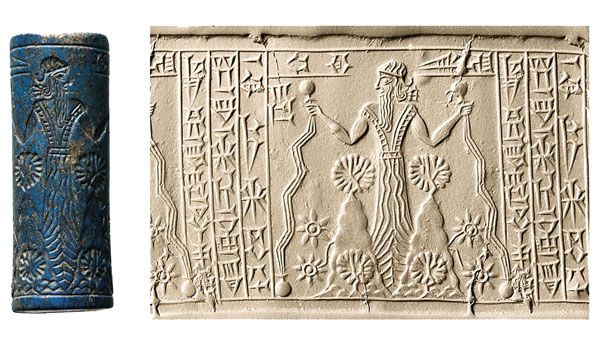
Kassite seal with Apkallu

Kassite seal (18th-12th centuries BC) from Syria. National Museum of Damascus. Not 100% sure about provenance, so any confirmation would be welcome. But I am 110% sure about the meaning of the symbols we see depicted on this amazing seal...

In the centre we have a  male figure, wearing a long skirt and a horned hat (which identifies him as a god). Which god? Well, the same god depicted on this water basin from Assur: Ea/Enki. I talked about it in my post "Basalt water basin from Assur"


Enki is flanked by Apkallus, the holy carp (men) of Enki...I talked about them and what they represent in my post "Apkallu"...In short they are deified giant Mesopotamian carp, these monsters...Which every year, during the annual flood, swim upstream for spawning...Towards Abzu, the source of Tigris and Euphrates...And Enki, who is (in) Abzu...

On the water basing from Assur the water is pouring out of two jars in the sky, which represent rain clouds. On our seal, the water is instead pouring out of the two beaks of the two headed eagle which is depicted flying above the god...Why?

This is climate in Syria. 


You can see that in Syria, climatic year is divided into hot, dry and cool, wet half...The end of the dry half and the beginning of the wet half is marked by the arrival of first rains, in Oct/Nov...

Rains arrive exactly when old world vultures start their mating flying routines...
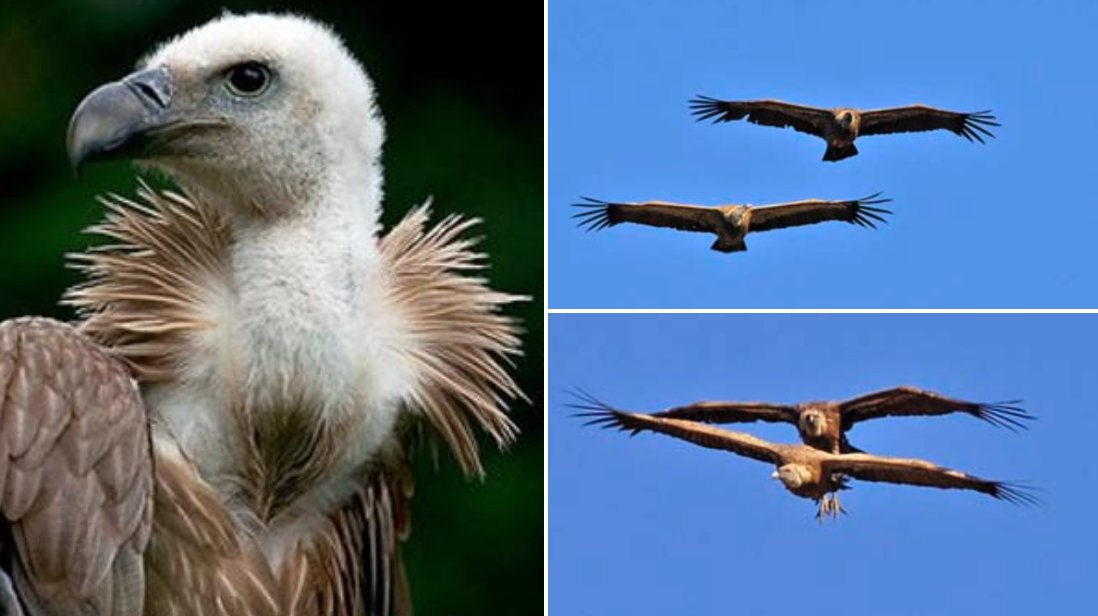
Which from the ground look like "double headed eagle"...Hence water pouring out the the beaks of the double headed eagle...It's an animal calendar marker for the beginning of the vulture mating season and the beginning of the rain season...


Another depiction of this areal eagle dance which brings rain

Eagle dance...

Montenegro 1963AD


Syria, 1800BC

Eagle (vulture) couples dance above the mountains at the beginning of their mating season, which coincides with the beginning of the rain season in Fertile Crescent...I talked about this in my post "Eagle dance"...

This is why the rain (god) was in Mesopotamia originally imagined as huge black eagle, then as an eagle man, then as a man with a pet two headed eagle...I talked about it in many posts, this one "Mysterious creature" is a good starting point...


The water flowing out of the eagle's beaks is followed by two prancing male Ibex goats. Why? Well, the beginning of the rain season in Mesopotamia also coincides with the beginning of the mating season of the Ibex goats which live in the North-Eastern mountains...


Mountains which are Abzu, the source of the two great rivers. Mountains which are Enki who is (in) Abzu...Majority of the water from Tigris and Euphrates comes from the snowmelt from these mountains...

I talked about this in my post "Problem with Abzu" and many other...

Hence mountain goats of (rain) water depicted on the shoulders (slopes) of Enki/Ea/Abzu...Actually some people suggest that this god is actually Assur, and not Enki/Ea...Actually, they are both the same deified source of fresh water, under different names. I talked about this in my post "Assur"...

Some say that this is also Assur...Sure 🙂 Assur, the great imposter...One of many...

Why did so many Mesopotamian "Supreme" gods have an attribute "The Great Mountain"? Cause they all wanted to be Enki...But there is only one Enki, who is (in) Abzu, "place that is a big mountain"...All the others are just imposters...I talked about this in my post "Great imposter"...

"Abzu, place that is a big mountain, princely crown of the heaven and earth. To the lord Nudimmud (Enki), (give) praise!"

Enki/Ea, the god of sweet water standing between two mountains, with trees and flowers...Enki is identifiable by the fact that he is holding two jars from which a water is pouring out, and which are symbols of the source of Tigris and Euphrates... 

Super important image...

So water flows through two great rivers from eagle / goat to fish...Here is why:  

Goatfish, the sacred animal of Enki, the Sumerian god of fresh water, is a complex animal calendar marker for the wet half of the year in Mesopotamia...Between the mating season of wild goats and the mating season of giant Mesopotamian carps...I talked about this in my post "Goatfish"...

And the water out of Enki/Ea/Abzu/Mountains and flows towards "the tree of life" which in Mesopotamia is a palm tree, which grows out of the jar representing a spring, a well, an irrigation channel...I talked about this in my post "When Utu steps up into heaven"...

A date palm is also a plant calendar marker for Jul/Aug, when Leo (symbol of autumn) kills Taurus (symbol of summer)...cause this is when date harvest starts in Mesopotamia...I talked about this in my post "Lion killing bull under palm tree"...


This is also when the annual Tigris and Euphrates flood ends, and the drought season starts...

So this seal is basically a hydrological calendar for Mesopotamia, where significant dates are depicted using animal and plant calendar markers...

To read more about ancient animal and plant calendar markers, start here…then check the rest of the blog posts related to animal calendar markers I still didn't add to this page, and finally check my twitter threads I still didn't convert to blog post...I am 9 months behind now...

Wednesday, 21 February 2024

Basalt water basin from Assur

God of fresh water and annual flood Ea/Enki flanked by fish-cloaked Apkallus. Part of the 7th century BC basalt water basin from Assur, Iraq. Pergamon Museum, Germany...


Ea/Enki is often depicted as the source of the two great rivers, Tigris and Euphrates, which either flow out of his shoulders, or out of a cup that he holds in his hands...Enki is (in) Abzu, The Northern mountains/highlands, the source of Tigris and Euphrates...

I love the fact that on the relief from the water basin from Assur, the water is depicted flowing out of the "jugs" in the sky (rain), into the "jug" held by Enki/Ea (Abzu, mountains/highlands which are source of Tigris and Euphrates) and then out of it as two great rivers...

What about the fish dudes?

Fish are often depicted swimming towards Enki. I talked about this in my posts "Adda seal", "Goatfish", "Utu and Enki"...

These are giant Mesopotamian carps, migratory fish which migrate upstream, towards Enki who is (in) Abzu, the source of Tigris and Euphrates, for spawning during the flood...Hence the expression "carp flood" found in Mesopotamian texts...


These were then seen as Enki's messengers, and on the Stella of the Vultures, we can read that they were "sent with messages to Enki"...You can read about this in my post "Goatfish".

These giant fish were eventually turned into Apkallu, which are on the Assur basin seen "facing" Enki. Apkallu were seen as proxies through whom Enki, the god of wisdom and civilisation, established civilisation in Lower Mesopotamia...Basically Neolithic settlers from Anatolia...I talked about them in my post "Apkallu"...
 

So that wasn't so difficult to understand, right? Well if you know what animal calendar markers are and how to interpret them...

Oh and what about the things Apkallu are holding in their hands? They are buckets. Containing "holy" water. Which is then sprinkled by Apkallu using a pine cone.  

Pine cone is a plant calendar marker for Oct/Nov. Because this is when pine nut harvest starts in Eastern Mediterranean and Western Asia...


Pine nut harvest season

Oct/Nov is also when the rain (holy water) season starts in Eastern Mediterranean and Western Asia...Including Mesopotamia...


Sprinkling of holy water (usually on a tree of life) from the water bucket then becomes extremely symbolically important...

To read more about ancient animal and plant calendar markers, start here…then check the rest of the blog posts related to animal calendar markers I still didn't add to this page, and finally check my twitter threads I still didn't convert to blog post...I am 9 months behind now...

Sunday, 18 September 2022

The great imposter

A Kassite seal, dated to ca. 1350 BC, currently in the Archaeological Museum in Thebes, Greece. One of several Kassite seals listed in "Reflecting on the Thebes Treasure and its Kassite Findings The Glyptic Art and its Geo-Political Context and Distribution"...

It depicts Enki/Ea, the god of sweet water standing between two mountains, with trees and flowers...Enki is identifiable by the fact that he is holding two jars from which a water is pouring out, and which are symbols of the source of Tigris and Euphrates... 

Super important image. Important cause of this: "Enki lives in Abzu, the source of Tigris and Euphrates"...The official explanation is that Abzu is "an underground aquifer"...

Which I think is completely wrong. I think Abzu was the name for the great mountains from which Tigris and Euphrates emerge...


That Abzu is a mountain is actually spelled for us in the Early Dynastic Za-me hymns where we read:

"Abzu, place that is a big mountain, princely crown of the heaven and earth. To the lord Nudimmud (Enki), (give) praise!"

Also, the late 3rd millennium BC text "Debate between Bird and Fish" tells us that it was Enki who: "laid out side by side the Tigris and the Euphrates, and caused them to bring water from the mountains"...

Do we need any more hints that Abzu is not underground?

And on the original image we see Enki, in Abzu (mountain) pouring out Tigris and Euphrates...Or Enki as Abzu, as Enuma Elish tells us that Enki killed Abzu, and then replaced Abzu and made Abzu his home...

I talked about Abzu in several of my posts: "Maran", "Utu or Enki", "Goatfish", "When Utu steps up to heaven", "Shamash young and old"...

And so we get the above image depicting Enki, as Abzu, The Great Mountain, source of Tigris and Euphrates...

Wait...Wasn't "Great Mountain" the title of Enlil? Hmmm...I will have to write another thread about this (imposter 🙂???) soon...

If you think Enlil is bad, wait until you meed Ashur (Assur), another god who also had the epithet "The Great Mountain"...I talked about this in my post "Ashur"...And some say that the above image actually depicts Ashur, not Enki...

Recently my friend @TheAncientWorld posted this reply to one of my twitter threads:

"Did you know that Tukulti-Ninurta & Tukulti-apil-Esharra are basically the same name? Ninurta was the son of Enlil (chief of Sumerian pantheon) but was also 'adopted' by both Marduk (chief of Babylonian pantheon) and Ashur (chief of Assyrian pantheon). Hence  'apil-Esharra' = son of Ashur = Ninurta..."

Of course they did...This is all the same play with different actors and slightly different choreography 🙂...But the important thing is that all of them point at "The Great Mountain" which is Abzu, where Enki resides...

To read more about ancient animal and plant calendar markers, start here…then check the rest of the blog posts related to animal calendar markers I still didn't add to this page, and finally check my twitter threads I still didn't convert to blog post...I am 9 months behind now...

Tuesday, 15 December 2020

Assur

This was part of a wall relief was found inside a well within the courtyard of the temple of Assur at the city of Ashur, the capital city of the Assyrians...Gypsum. First half of the second millennium BCE. The Pergamon Museum, Berlin.


The central part of the relief depicts a male deity. He holds two long branches, and two ibex goats (standing on their hind legs) appear to eat from these branches. Two other identical branches seem to grow out the bottom half of his body...

Two smaller figures, identified as female deities, stand on each of his sides, holding two jars from which water flows out...

Official interpretation: Probably this bearded deity represents the god Assur, while the goddesses protect the plant and animal world in this city...I would not agree with this entirely...

I kind of agree with the main deity being identified as Assur. One of his epithets was "šadû rabû" (great mountain) and if we look at his skirt, kilt, we can see that it is "decorated" with the same design that Sumerians and Akkadians used to depict mountains...

The great mountain is not any one mountain in particular. It is the collective name for the North-Eastern mountains and highlands, where we find the source of both Tigris and Euphrates...

The climatic year in this part of the world is divided into wet, cool season (Nov-Apr) and dry, hot season (May-Oct). 


The start of the wet season coincides with the start of the Ibex mating season characterised by fighting upright. Ibex is used here as a calendar marker...

The rain brought by the "dancing" ibexes, revives the nature and makes everything in the lowlands green again after months of scorching heat and drought...Hence green branches growing out of the god's body and held by the god. Munched by the ibexes...

This rain also feeds the two rivers, which are depicted by the two small "goddesses" with jars overflowing in two flows. In Sumerian art this jar with two flows was always used to symbolise the two rivers, Tigris and Euphrates...

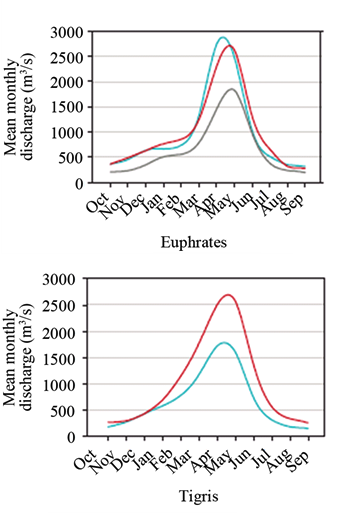
However, the water supplied by the rain during the rain season (Nov-Apr) is nothing compared to the water supplied by the snowmelt from the "Great Mountain" (Feb-Jul). 

The snow falls on the mountains starting from Oct-Nov. The snowmelt, starts in Feb-Mar. 


The snow melt increases suddenly in Apr-May.


It is this snowmelt that creates the life giving annual flood of Tigris and Euphrates which makes Mesopotamia fertile...The flood:


Euphrates flow


Tigris flow


Which is what is depicted on this relief found in a well.

O Assur, The Great Mountain, you who is covered with snow, when Ibex goats are mating, and the rain is turning everything green, fill the two rivers with overflowing water...

Amen...

Now check the "zodiac sign" for Apr-May, the peak flow of Tigris and Euphrates. Yes it's Taurus... 

And then the Assur's and Assyrian iconography...Any idea why bulls on Assyrian standards?

For those who want to read about solar year animal calendar markers from around the Eurasia and North Africa have a look at this jump page. Work in progress... 

To read more about ancient animal and plant calendar markers, start here…then check the rest of the blog posts related to animal calendar markers I still didn't add to this page, and finally check my twitter threads I still didn't convert to blog post...I am 9 months behind now...