This rectangular-sided monument made of black basalt in 670 BC, records Assyrian King Esarhaddon's restoration of Babylon, after it was destroyed by his father Sennacherib in 689 BC. Currently in The British Museum, London...
The top side of this memorial (or foundation) stone is carved with a very interesting relief whose meaning is not understood...
I came across the paper "The black stone of Esarhaddon" by D. D. Luckenbil, which claims to have found the solution to the relief riddle. First, here is what the author says is depicted on the relief:
In the upper register we have a shrine surmounted by the horned headdress, symbol of deity. Next a man, probably a king, with hand upraised in adoration. Back of him stands the conventionalized sacred tree. And at the end a bull...
In the lower register there comes, first of all, a symbol of doubtful significance; next a plow with seed drill attached; then a palm tree with two clusters of dates. And, finally, another enigmatic symbol consisting of four circles at the corners of a square...
In the paper, the author then says: "Assuming that the explanation would most probably be found in the texts accompanying the symbols, I made a search which almost immediately led me to what I regard as the solution of the problem"...
"The general meaning [of this sentence] is, I believe, perfectly evident: 'Pictures in colored clay (in the form of) constellations, the likeness of the writing of my name, I engraved (or impressed) thereon'"...
The author of the paper then interprets this as "the symbols on the relief on the black stone of Esarhaddon represent constellations, which have been chosen because each looks similar to one of the cuneiform characters spelling Esarhaddon's name"...
And so the rest of the paper is his attempt to identify which constellations these symbols represent...You can read the full paper here...
However, in the paper, the author says that "The colored' clay does not, of course, fit into a description of the symbols found on the stone or metal memorials. But it does for that impressed upon the clay prisms"...What prisms?
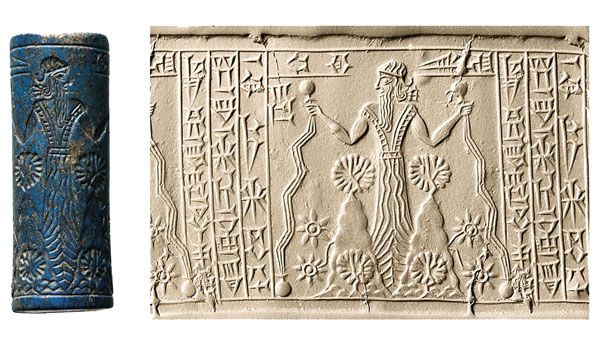
This is the cuneiform prism describing the restoration of Babylon by Esarhaddon, stamped with Assyrian hieroglyphic inscription dated to 676-672 BC. Currently in the Met Museum...

It also has pretty pictures on its top, some of the them the same as the ones found on the top of the black basalt stone. And the guys from the Met say that "Together, the signs are thought to form a cryptographic writing of Esarhaddon’s name and titles"...

Which is possible...Esarhaddon himself said he impressed his name in constellations on colored clay...But I don't think that the symbols on The black stone of Esarhaddon are constellations and that they spell Esarhaddon's name...
Here is what I think that relief means...
In the above clay prism, Esarhaddon, while rebuilding the city, ascribes Babylon’s destruction not to his father, but rather to the anger of Babylon’s chief deity, Marduk, provoked by the Babylonian people’s neglect of their gods and rituals...
In the paper "The black stone of Esarhaddon" we can read about a brick inscription which tells how "for Marduk, his lord, Esarhaddon, king of Assyria, king of Babylon, had made new bricks for Esagila and Babylon"...
The author of the paper then says that "Schmidke's conclusion that this text must come from the end of Esarhaddon's reign, since, 'so long as city and temple lay in ruins, there could be no king of Babylon' is a marvelous bit of reasoning"...
So, were the inscriptions stamped on the bricks after they were in the walls of the restored temple and city? And is the temple shown on the black stone of Esarhaddon, the rebuilt temple of Marduk? I think so...
The temple is "surmounted by the horned headdress, symbol of deity"...The etymology of the name Marduk is conjectured as derived from amar-Utu ("immortal son of Utu" or "bull calf of the sun god Utu")...
The same Sun God Utu depicted as the golden bull with lapis lazuli beard...Why?
Well because It is Shamash/Utu, the sun, that melts the snow on the mountains that feed the sacred rivers, Tigris and Euphrates...

This is the result of the heating up of the mountains which are the source of the two great rivers: Anatolian highlands and the Zagros mountains...Which causes the snow to melt, which causes the rivers to swell...

Symbolically, Utu (Sun) climbs to Abzu (Melts the snow on Zagros mountains) and frees Enki from his icy prison (Snowmelt runoff)...
I talked about this in many of my posts. For instance "Maran", "Utu or Enki", "Goatfish", "When Utu steps up to heaven", "Shamash young and old", "Problem of the Abzu"...
This flood peaks during Taurus (Apr/May)...The golden bull (sun in Taurus) brings flood (lapis lazuli beard in a shape of the flowing water)
Taurus of course originally had nothing to do with stars...This part of the year (Apr/May) is marked by a bull, Taurus, Because this is the beginning of the calving season of wild Eurasian

Which is why in "Enki and the world order" we read: "...Father Enki...he stood up full of lust like a rampant bull, lifted his penis, ejaculated and filled the Tigris with flowing water. He was like a wild cow mooing for its young in the wild grass..."
Oh by the way, the flood peaks in Apr/May, the beginning of summer, when Aurochs calve, and ends in Jul/Aug, the end of summer, when Aurochs mate...Which is why the symbol for summer is Bull...You can read more about this in my post "Symbols of the seasons"...

The flood is what makes the fields (the square) fertile...I talked about square as the symbol for a field in my post "Arjune venus"...

Having fun so far? Let's continue...
Right after the end of the flood, during the driest and hottest part of the year, Jul/Aug, Leo, is time to pick dates...I talked about this in my post "Lion killing bull under a date palm"...

The hottest, driest part of the year is marked by the lion animal calendar marker...Leo...The reason for this is that this is when the Eurasian lions main mating season starts...
The lion mating season lasts throughout autumn (Jul/Aug-Oct/Nov)...Which is why the symbol for autumn is a lion...
At the end of autumn, Oct/Nov, is when the first rains arrive, brought by the goat of rain. Here is rain god Ninurta/Ningirsu, who was, in the earliest records, also agriculture god, giving plough to the people...

He is sitting on a throne, behind which we can see a mountain and an ibex goat. Why? Because in Mesopotamia, ploughing is done after the first rains, which arrive in Oct/Nov, when Ibex, Goat of rain, climbs to the mountain tops and starts mating...

Like on this Akkadian seal, dated to 2250–2150 BC, currently in the Met Museum

The seal doesn't depict hunting scene, like the Met guys think. No one hunts goats with a scimitar...The dude with a scimitar is Nergal, the god of destructive sun, the hot, dry, yellow part of the year. He is killing Ibex, symbol of the cool, wet, green part of the year...
Old Babylonian cylinder seal from Larsa, depicting the underworld (the god of death) Nergal, holding his distinctive scimitar and the double lion headed scepter. I talked about Nergal and his symbols in my post "Winged superhuman hero"...
I think we covered all the symbols depicted on The black stone of Esarhaddon 🙂 And so here is how this relief "can be" interpreted:
Esarhaddon rebuilds the temple of Marduk, the bull calf of the triumphant bull god Utu. The old faith has been restored...He prays to Marduk, to support (the tree of) life in his kingdom, and his prayers are heard...
The bull calf of the triumphant bull god Utu releases Enki, the (God of) flood from his icy prison, during the time of the calving of the wild Eurasian cattle, which feeds the tree of life...The king is happy...
It is this flood that supports (the tree of) life in Mesopotamia, irrigates the grain fields and date gardens...The food is plentiful and the kingdom is happy...And the king is even happier...
Right after the bull (flood) dies, the date harvest begins...Then the ploughing and sowing of grain begins...
And then the snow covers the mountains...Enki retreats to Abzu...And the year ends...Until the prayer to Marduk, the bull calf of the triumphant bull god Utu, stars the whole cycle again...
That's it, I think...What do you think? No need for stars?