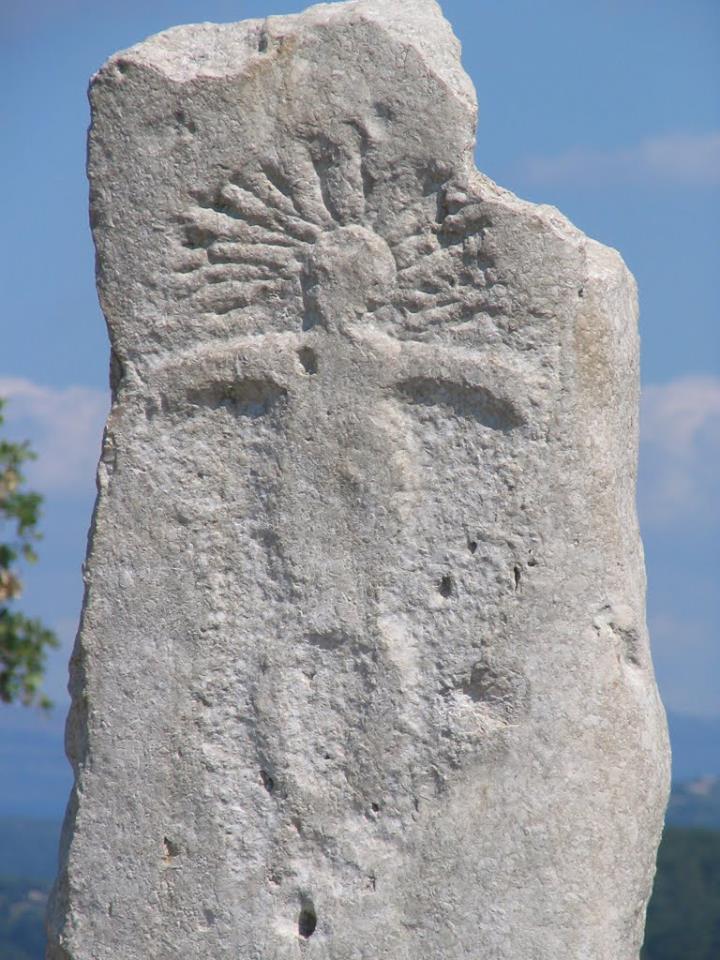
While the other tumuluses in the area are located on tops of hills, these two tumuluses are located in the middle of the Tivat field. The local people preserved the legends that these two stone tumuluses were Prokletije, piles of stones accumulated through centuries as part of the cursing ceremony. I wrote about Prokletija ceremony in my post entitled "Prokletija - The cursing ceremony". As a result, these tumuluses were preserved as the taboo linked with Prokletije forbids removal of even a single stone.
Velika Gruda and Mala Gruda tumuluses are only 270 meters away from each other. Mala Gruda is a single phase burial tumulus and has only a late Copper Age (early Bronze Age) tumb. Velika Gruda is a multi phase burial which has late Copper age (Early Bronze age), Iron age and Medieval burials. The late Copper Age (early Bronze Age) burial from Velika Gruda is equivalent to the late Copper Age (early Bronze Age) burial from Mala Gruda. These were rich princely graves, full of well made and decorated ceramics and metal objects made from silver, gold and copper alloys. The archaeologists who excavated these burials postulated that the people who were buried inside the Velika and Mala Gruda late Copper Age (early Bronze Age) burials were involved in trades between the Balkan Hinterland and Southern Italy and probably the rest of the Mediterranean.
So who was buried in these tumuluses? The archaeologists admit that despite all the modern procedures, analysis and equipment used it is "difficult to understand who built the Mala and Velika Gruda burials. This is because there is at present so little knowledge about what was going on in the Southwestern Balkans during the time when these tumuluses were built. Basically the problem is that the way these tumuluses were built, the way they were positioned in the low lying landscape as well as some of the burial rite details have no parallels in the Mediterranean basin except in a small area of Montenegro and Northern Albania. The first next similar late Copper Age (early Bronze Age) burial is found in the steppe of the Yamna culture homeland....

The investigation of the Velika Gruda tumulus was completed in the early 1990s and the results were published in these two books:
"Tumulus burials of the early 3rd millenium BC in the Adriatic - Velika Gruda, Mala Gruda and their context" which was published in 1996 by Margarita Primas who excavated the late Copper Age (early Bronze Age) burial.
"The Bronze Age necropolis Velika Gruda (Ops. Kotor, Montenegro) : middle and late Bronze Age groups between Adriatic and Danube" published in 1994 by Philippe. Della Casa who excavated the Middle and Late Bronze Age burials.
A short review of both works by John Bintliff was published in the American Journal of Archaeology.
Archaeological investigation of the Mala Gruda tumulus was performed during the period 1970 - 1971. The tumulus was damaged during the First World War, when Austrian army built a bunker on top of it. The tumulus height in the middle is about 4 meters and the diameter is about 20 meters. Originally it was proposed that the tumulus dated to the period 1900 to 1800 BC. Howevere the latest dating pushes the date when this tumulus was built almost 1000 years back into the past to the period between 2800 to 2700 BC.
The Mala and Velika Gruda tumuluses have very unusual structure. Remember the Bjelopavlovic tumulus and Mogila na Rake tumulus that I already talked about? They both had central dolmen cists which were built on the surface of the earth. Mala and Velika Gruda tumuluses also have central dolmen cists built from massive stone plates. But these stone plates were placed inside the grave pit which was dug into the earth to the depth of half a meter. First the bottom of the grave pit was covered with a stone plate and then the vertical stone plates were placed on top of it to form the dolmen cist. The cover stone plate was then placed on top of it. The stone dolmen cist was then covered with a tumulus pile of yellow - brown clay. The surface of this clay inner tumulus was then burned using very strong fire, probably during the sacrificial rite which took place on top of this inner tumulus. This resulted in the whole inner clay tumulus being covered with a layer of ash which contained the most of the ceramic and stone finds. The clay inner tumulus was then covered with the layer of stones (large river pebbles) which varied in thickness between 0.3 - 0.5 meters. This stone layer was then covered with earth (humus). It is unclear if his layer of humus was natural or artificial.

The orientation of the dolmen cist was north - south. The body which was placed inside the dolmen cist was very badly preserved and was not possible to determine its precise position, but it is presumed that it was placed into the cist in the fetal position.
In the north part of the stone cist, next to the scull of the deceased, archaeologists have found five golden lock rings.

Lock rings are a type of jewelry from Bronze Age Europe. They are made from gold or bronze and are penannular, providing a slot that is thought to have been used for attaching them as earrings or as hair ornaments. Ireland was a centre of production in the British Isles though rings were made and used across the continent, notably by the Unetice culture of central Europe. But these lock rings from Mala Gruda tumulus predate all the examples from northern Europe by many centuries and millenniums.
The only other lock rings from the late Copper Age (early Bronze Age) period which are similar to the lock rings from Mala gruda tumulus were found in Velika Gruda tumulus and in Gruda Boljevića tumulus, which is even older than the Velika and Mala gruda tumuluses. I will write about the Gruda Boljevića tumulus in my next post. Velika gruda tumulus also had lock rings of the type found in the Lefkas (Leukas) cemetary. But these Lefkas type rings are much simpler than the Mala Gruda type rings, and look like an inferior quality imitation of the Mala Gruda type lock rings. Here are the Lefkas type lock rings from Lefkas cemetary.

Next to the feet of the deceased, next to the eastern edge of the stone cist, archaeologists have found a set of ceramic dishes in fragments.
First is a shallow bowl with the ring leg:


Again we find the cross in the circle symbol which we see in the plate which was found in the Mogila na rake tumulus.

Second is a jug with one handle:

Both dishes were made from reddish brown clay and were richly decorated and polished.
In that respect the plate from the Mala Gruda tumulus is very similar to the the ceramic bowls from the Vučedol culture from the same period like these two:


The most important artifacts were discovered at the eastern edge of the grave cist, at the waist level. These were a golden dagger and a silver axe. Actually both objects were made from complex alloys and not of pure gold and silver. Spectrographic analysis had shown that the dagger was made from the alloy of silver, gold and copper in proportion 3:2:2 and that the axe was made from the same alloy but in proportion 4:1:1.
The golden dagger:


The dagger is leaf shaped with straight edges and rounded top. It has a short tong for attaching it to the handle and a triple profiled central ridge. Similar daggers are found in Anatolia dating to the mid 3rd millennium bc. Her is the Mala Gruda dagger and its Anatolian comparisons:

1. Mala Gruda: N. TASIĆ (ed.), Praistorija Jugoslavenskih Zemalja III. Eneolitsko doba (1979) pl. 42:8.
2. Karataş: M. MELLINK, “Excavations at Karataş-Semayük 1970,” AJA 73 (1969) pl. 74:21 (drawing J. Maran) dated to 2900 - 2600 BC.
3. Bayindirköy: K. BITTEL, “Einige Kleinfunde aus Mysien und aus Kilikien,” IstMitt 6 (1955) fig. 1 dated to 2500 - 2200 BC.
4. Bayindirköy: BITTEL (supra) fig. 4 dated to 2500 - 2200 BC.
5. Alaca Höyük: STRONACH (supra n. 47) fig. 3:4 dated to 3rd millennium bc.
The silver axe:


This silver axe is the last and the most important find from the Mala Gruda tumulus. For two reasons. Firstly the new dating of this axe opens some interesting questions about our understanding the chronology of the distribution of the shaft hole axes in the Balkans. Secondly the new dating of this axe opens some very interesting questions about our understanding of the Early Bronze Age Irish and British history.
So, why is Mala Gruda axe important for our understanding the chronology of the distribution of the shaft hole axes in the Balkans?
The silver axe has a thin and narrow triangular blade with a cylindrical socket. In the literature we read that "this type of axe belongs to the Vučedol Kozarac type axes". However no axes like the Mala Gruda axe have been found in Vučedol culture.
Shape wise Mala gruda axe does look like Vučedol culture axes with one blade and a cylindrical extension for a handle haft. These type of axes were exported to the Eastern Mediterranean including to Troy via Lemnos. This is a picture of a hoard of such axes from Brekinjska (Pakrac) in Croatia.

However the axe from Mala Gruda tumulus is of an exceptional quality and made of Gold + Silver + Copper alloy and not bronze. Silver axes were found in Vučedol site of Stari Jankovci.

You can read about them in this Croatian article and this English article. The Stari Jankovci axes are also silver shaft-hole axes, but their shape is completely different from the shape of the Mala Gruda axe. So we can't talk about direct link between these Vučedol silver axes and the silver axe from Mala Gruda. However this shows that both the knowledge how to make Mala Gruda type axe shape and material existed in the Vučedol culture, so we can say that it is possible the people who made the Mala Gruda axe were influenced by the Vučedol culture. So we could say that the Mala Gruda axe could have indeed been made by Vučedol metalworkers. Except that the site where the above two silver axes ware found was dated to 2500 - 2040 BC wheres Mala Gruda was dated to 2800 - 2700 BC. This means that the Mala Gruda axe is hundreds of years older. This is a very good article on the dating of the Vučedol culture sites .This opens a big question: who influenced who? Who learned from who?
It is assumed that the earliest shaft-hole axes were developed in the the north Caucasus by the Maikop culture sometime between 3500 and 3128 BC.

From here they spread within few hundred years to a large area in Central and Western Asia and Eastern and Central Europe and the Balkans.

This picture shops main types of shaft-hole axes and axe molds from the above distribution area from the period late fourth millennium bc - early third millennium bc:

Aegean: 1 Thebes, 2 Servia, 3 Petralona, 4 Triadi, 5 Poliochni;Montenegro: 6 Mala Gruda;
Hungary: 7 Zók-Várhegy;
Rumania: 8 Virgis;
North Caucasus: 9 Lebedi, 10 Novosvobodnaya/Klady;
Daghestan: 11 Velikent;
East Anatolia: 12 Arslantepe, 13 Norşuntepe.
"...The earliest axes in Southeastern Europe are assumed to be the Baniabic type (Vîlcele) axes because their blade is not differentiated from the shaft. The upper edge of the axe is straight, while in the case of the axes of the Fajsz type and Corbasca type this edge is convex. At least some of the axes can be dated to the early Vučedol Culture (c. 31th – 28th century BC). The problem is that this dating is based on the fact that their shape is generally comparable to axes or moulds for axes from the northern Caucasus and Koban region, like the mold from Lebedi or from the Kura-Araxes Culture which were dated to that period. But the type is so simply shaped that even comparisons to much later axes are possible, and this makes the dating of the Baniabic type axes uncertain. The southeast European types of Dumbrăvioara, Izvoarele, Darabani and Kozarac have short shaft tubes and can be grouped to the second morphological trend. In some cases their tubes are faceted or ribbed. This feature is also found on one axe from the hoard of Stublo (Steblivka) in the western Ukraine. These types can be dated mainly to the earlier half of the third millennium BC.... "
So Vučedol culture Kozarac type axes are dated to the same period to which the Mala Gruda tumulus axe was dated. So is it possible that the Mala Gruda axe predates the Vučedol culture Kozarac type axes? And is it possible that knowledge how to make this type of axes was transferred from the South of the Balkans up North and not the other way round?
Finally why is Mala Gruda axe so important for our understanding of the Early Bronze Age Irish and British history?
According to the archaeological data, a new people appeared out of nowhere on the Atlantic coast of Europe around the mid 3rd millennium BC: The Bell Beaker people. The Wiktionary says: "Bell Beaker is a complex cultural phenomenon involving metalwork in copper, gold and later bronze, archery, specific types of ornamentation and shared ideological, cultural and religious ideas....Several proposals have been made as to the origins of the Bell Beaker culture, notably the Iberian peninsula, the Netherlands and Central Europe. And debates are still continuing. Archaeologists and historians are still debating whether the spread of Beaker culture was due to the migration of people or spread of ideas or both...".
Well for Ireland we know that the arrival of the Beaker culture was due to the arrival of the Beaker people. Before 2500 BC there was no metalwork in Ireland and no beakers. After 2500 BC there was as thriving sophisticated metalworking culture in Ireland and beakers. That can only happen if we have an influx of people with metalworking skills into Ireland around 2500 BC. And archaeologists and historians all agree on this. But where did these metalworking beaker using new Irish come from and who they were is "a mystery".
The golden dagger:


The dagger is leaf shaped with straight edges and rounded top. It has a short tong for attaching it to the handle and a triple profiled central ridge. Similar daggers are found in Anatolia dating to the mid 3rd millennium bc. Her is the Mala Gruda dagger and its Anatolian comparisons:

1. Mala Gruda: N. TASIĆ (ed.), Praistorija Jugoslavenskih Zemalja III. Eneolitsko doba (1979) pl. 42:8.
2. Karataş: M. MELLINK, “Excavations at Karataş-Semayük 1970,” AJA 73 (1969) pl. 74:21 (drawing J. Maran) dated to 2900 - 2600 BC.
3. Bayindirköy: K. BITTEL, “Einige Kleinfunde aus Mysien und aus Kilikien,” IstMitt 6 (1955) fig. 1 dated to 2500 - 2200 BC.
4. Bayindirköy: BITTEL (supra) fig. 4 dated to 2500 - 2200 BC.
5. Alaca Höyük: STRONACH (supra n. 47) fig. 3:4 dated to 3rd millennium bc.
The silver axe:


So, why is Mala Gruda axe important for our understanding the chronology of the distribution of the shaft hole axes in the Balkans?
The silver axe has a thin and narrow triangular blade with a cylindrical socket. In the literature we read that "this type of axe belongs to the Vučedol Kozarac type axes". However no axes like the Mala Gruda axe have been found in Vučedol culture.
Shape wise Mala gruda axe does look like Vučedol culture axes with one blade and a cylindrical extension for a handle haft. These type of axes were exported to the Eastern Mediterranean including to Troy via Lemnos. This is a picture of a hoard of such axes from Brekinjska (Pakrac) in Croatia.

However the axe from Mala Gruda tumulus is of an exceptional quality and made of Gold + Silver + Copper alloy and not bronze. Silver axes were found in Vučedol site of Stari Jankovci.

You can read about them in this Croatian article and this English article. The Stari Jankovci axes are also silver shaft-hole axes, but their shape is completely different from the shape of the Mala Gruda axe. So we can't talk about direct link between these Vučedol silver axes and the silver axe from Mala Gruda. However this shows that both the knowledge how to make Mala Gruda type axe shape and material existed in the Vučedol culture, so we can say that it is possible the people who made the Mala Gruda axe were influenced by the Vučedol culture. So we could say that the Mala Gruda axe could have indeed been made by Vučedol metalworkers. Except that the site where the above two silver axes ware found was dated to 2500 - 2040 BC wheres Mala Gruda was dated to 2800 - 2700 BC. This means that the Mala Gruda axe is hundreds of years older. This is a very good article on the dating of the Vučedol culture sites .This opens a big question: who influenced who? Who learned from who?
It is assumed that the earliest shaft-hole axes were developed in the the north Caucasus by the Maikop culture sometime between 3500 and 3128 BC.

From here they spread within few hundred years to a large area in Central and Western Asia and Eastern and Central Europe and the Balkans.
This picture shops main types of shaft-hole axes and axe molds from the above distribution area from the period late fourth millennium bc - early third millennium bc:

Aegean: 1 Thebes, 2 Servia, 3 Petralona, 4 Triadi, 5 Poliochni;Montenegro: 6 Mala Gruda;
Hungary: 7 Zók-Várhegy;
Rumania: 8 Virgis;
North Caucasus: 9 Lebedi, 10 Novosvobodnaya/Klady;
Daghestan: 11 Velikent;
East Anatolia: 12 Arslantepe, 13 Norşuntepe.
You can read more about the early shaft-hole axes in this great article entitled: "Indications for Aegean-Caucasian relations during the third millennium BC". The most interesting part of this article I believe is this:
"...The earliest axes in Southeastern Europe are assumed to be the Baniabic type (Vîlcele) axes because their blade is not differentiated from the shaft. The upper edge of the axe is straight, while in the case of the axes of the Fajsz type and Corbasca type this edge is convex. At least some of the axes can be dated to the early Vučedol Culture (c. 31th – 28th century BC). The problem is that this dating is based on the fact that their shape is generally comparable to axes or moulds for axes from the northern Caucasus and Koban region, like the mold from Lebedi or from the Kura-Araxes Culture which were dated to that period. But the type is so simply shaped that even comparisons to much later axes are possible, and this makes the dating of the Baniabic type axes uncertain. The southeast European types of Dumbrăvioara, Izvoarele, Darabani and Kozarac have short shaft tubes and can be grouped to the second morphological trend. In some cases their tubes are faceted or ribbed. This feature is also found on one axe from the hoard of Stublo (Steblivka) in the western Ukraine. These types can be dated mainly to the earlier half of the third millennium BC.... "
So Vučedol culture Kozarac type axes are dated to the same period to which the Mala Gruda tumulus axe was dated. So is it possible that the Mala Gruda axe predates the Vučedol culture Kozarac type axes? And is it possible that knowledge how to make this type of axes was transferred from the South of the Balkans up North and not the other way round?
Finally why is Mala Gruda axe so important for our understanding of the Early Bronze Age Irish and British history?
According to the archaeological data, a new people appeared out of nowhere on the Atlantic coast of Europe around the mid 3rd millennium BC: The Bell Beaker people. The Wiktionary says: "Bell Beaker is a complex cultural phenomenon involving metalwork in copper, gold and later bronze, archery, specific types of ornamentation and shared ideological, cultural and religious ideas....Several proposals have been made as to the origins of the Bell Beaker culture, notably the Iberian peninsula, the Netherlands and Central Europe. And debates are still continuing. Archaeologists and historians are still debating whether the spread of Beaker culture was due to the migration of people or spread of ideas or both...".
Well for Ireland we know that the arrival of the Beaker culture was due to the arrival of the Beaker people. Before 2500 BC there was no metalwork in Ireland and no beakers. After 2500 BC there was as thriving sophisticated metalworking culture in Ireland and beakers. That can only happen if we have an influx of people with metalworking skills into Ireland around 2500 BC. And archaeologists and historians all agree on this. But where did these metalworking beaker using new Irish come from and who they were is "a mystery".
But as I already said in my post about the Irish Gold, the answer to this "mystery" has been hidden in plain view in the ancient Irish annals. If only the archaeologists and historians read the ancient Irish annals as histories and not as "pseudo histories" as they like to call them.
So what can the Irish annals tell us about the arrival of the Beaker people to Ireland?
Well the old Irish annals don't talk about Bell Beaker people of course. But they tell us that: "...after the flood, came Partholón with his people..." The Annals of the Four Masters says that Partholóin arrived in in Ireland 2520 Anno Mundi (after the "creation of the world"), Seathrún Céitinn's Foras Feasa ar Érinn says they arrived in 2061 BC, Annals of Four Masters says that they arrived at 2680 BC. So Sometimes in the second half of the 3rd millennium.
Partholón and his people are credited with introducing cattle husbandry, plowing, cooking, dwellings, trade, and dividing the island in four and most importantly for this story, they are credited with bringing gold which before them was not used in Ireland. As I already said in my post about the Irish gold, this has was actually confirmed by the archaeological finds from Ireland. Some people came to Ireland around the 2500 BC or there after, and brought with them copper metalworking knowledge. They opened the first copper mine in Ireland in Ross Island and started making copper axes. The archaeologists originally believed that these immigrant copper metalworkers also started mining gold in Ireland. And that they used that gold to make golden ornaments. The reason for this belief is that around the same time when the Beaker copper metalworkers arrived to Ireland, we suddenly see gold being used for making ornaments, mostly gold lunulae, about which I wrote in my post about the Irish Gold, and gold cross discs like these ones:


The archaeologists believed that these types of ornaments originated in Ireland because they have no precedence in Europe. Until the discovery that the gold from which these ornaments were made did not come from Ireland but from Cornwall. Now they believe that these types of ornaments originated in Ireland or Britain. And I would agree with them when it comes to lunulae. So far there is no precedence for this type of gold ornaments. But I have to say that now we have a proof that the golden cross discs did not originate in Ireland or Britain. I can say this because now we know that hundreds of years before these gold cross discs appeared in the British isles, they were made and used in the Balkans, more precisely in Montenegro.
Have a look again at the silver axe from Mala Gruda tumulus.
This silver axe was found together with a strange golden cap covering the the top of the axe shaft. The cap was made from a golden disk which is a thin embossed sheet of gold with a cross at the centre, surrounded by a circle.

The design on the gold disc cap resembles the most the design found on the gold sun disc which was found in a burial mound at Monkton Farleigh, just over 20 miles from Stonehenge, in 1947 along with a pottery beaker, flint arrowheads and fragments of the skeleton of an adult male.

The two pence piece sized gold disc was made in about 2,400 BC, soon after the Sarsen stones were put up at Stonehenge, and is thought to represent the sun.It was kept safe by the landowner since its discovery and has only now been given to the Museum. The disk is a thin embossed sheet of gold with a cross at the centre, surrounded by a circle, and between the lines of both the cross and the circle are fine dots which glint in sunlight.
The golden cross discs found in Ireland and Britain were all dated to 2400 BC - 2100 BC. The golden cross disc from Mala Gruda was originally dated to the period 1900 to 1800 BC. I believe that this is why no one before made a connection between the Mala Gruda golden cross disc and the cross discs found in Ireland and Britain. Even if someone did make a connection, the Mala Grida golden cross disc was probably classified as being made under the influence of the late Beaker culture. However the latest dating pushes the date when Mala Gruda tumulus was built almost 1000 years back into the past, to the period between 2800 to 2700 BC. Now this changes everything. Someone in Montenegro was making golden cross discs 300 - 400 years before the first such disc appeared in Ireland and Britain. The thing is that this golden cross disc from Mala Gruda has no precedence. Except for another golden cross disc which was used in the same way, for making the axe shaft cap. And this other golden cross disc was found in an even older Montenegrian tumulus, which was dated to the end of the 4th - beginning of the 3rd millennium bc and which was linked directly to the late Yamna culture. I will write about this tumulus in one of my next posts. This means that we can say that unless new archaeological data emerges, the origin of these golden cross disc ornaments is in the early 3rd millennium BC Montenegrian tumulus building culture.
Now the big question: Is it possible that people who made these golden cross discs in Montenegro or their descendants, were the same people who later made the golden cross discs in Ireland and Britain? Was there a migration from Montenegro to British Isles around the middle of the 3rd millennium BC? I believe so. And guess what, the Irish annals says so too. But I will talk about this more in one of my next posts.
Until then stay happy and keep smiling.