Sunday, 5 November 2023

Seahorse ring

I posted this as a tweet a while back:

This is the "Ring of Minos", a Minoan gold seal ring, dated to c. 1500–1400 BC. 

And I asked if this was an inverted horse's head on the boat's prow? 

I then went on to talk about Phoenician boats with horse heads


And Phoenician and Greek sea gods who loved horses

And what mating season of horses has to do with all this...


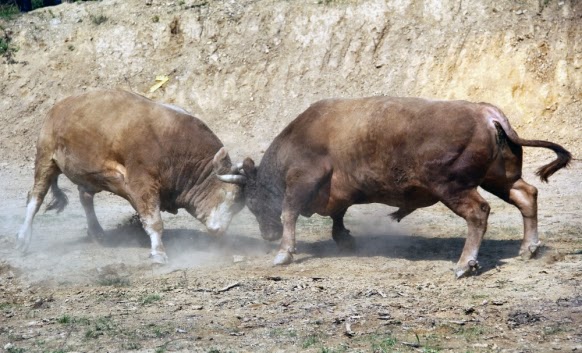
In short, the mating season of wild horses, Apr/May-Sep/Oct, marked by the violent stallion fights for mares, coincides with the sailing season in the Eastern Mediterranean. Basically, in the maritime mythology of the Eastern Mediterranean, horse was used as an animal calendar marker for the beginning of the sailing season. You can read all this in my posts: "Trojan horse" and "Three sacrifices"...

Then someone replied to my twitter thread and said that the animal head on the prow of the Minoan ship actually looked very much like a seahorse head. 

So, what about seahorses as animal calendar markers?

Until today I haven't really looked at seahorses at all...But I did just now, and what I found is actually quite interesting indeed...

Two species live in the Mediterranean Sea: 

H. guttulatus (the long-snouted seahorse)

H. hippocampus (the short-snouted seahorse)

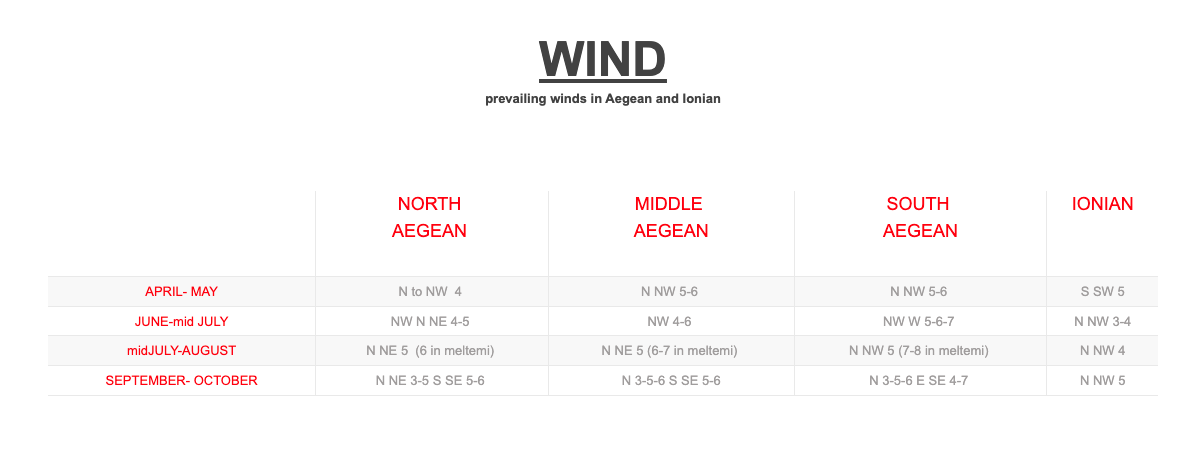
And, it turned out that "for most seahorses breeding season lasts between Apr and Oct and is related to environmental temperature"...

Funny that terrestrial horses mate between Apr and Sep...

April, the beginning of the mating season of both horse species coincides with the start of the sailing season in the Eastern Mediterranean...

Because this is when the winter storms end and the trading winds start to blow. 


As I already said, spotting the beginning of the horses mating season is quite easy, because you can't miss the stallions all of a sudden starting to fight for the right to mate with mares...And you can't miss what happens after these fights either...🙂

But I don't know if our ancestors knew very much about the mating season of seahorses...Possibly...Most seahorse species, including Mediterranean ones, live in shallow sheltered waters of seagrass beds, estuaries, coral reefs, up to 15m in dept. So they could have noticed this...

They were fishermen who lived off the seas, and knew the wildlife in shallow waters well...And so what they must have noticed, is appearance of seahorses in the shallow coastal waters in the spring and their disappearance from the shallows in the autumn...

As I said, most seahorse species live in very shallow coastal waters. 

But, during winter months, they move to deeper water, up to 77 m deep, mostly because of the storms...

Which batter the coast and would crash them to death.

According to seahorse lifecycle data that I could find, seahorses usually appear in the shallows by late April to early May depending on the sea temperature and go into deeper water by mid-October at the latest...

These dates sound familiar? 🙂

So our ancestors living by the sea and fishing the shallow estuarine waters full of fish, would have noticed that as the winter storms started to calm down, seahorses started appearing in their nets as the bycatch...

And that as the weather started getting more and more unsettled around the beginning of winter, our ancestor fishermen/seamen would have noticed that seahorses disappeared from their nets...

And the period between appearance and disappearance of seahorses was the time to go sailing in Eastern Mediterranean...

I have to admit that I couldn't find data specifically for Mediterranean, but all the sources say that seahorses migrate to deeper waters for the winter...

So I would be very grateful if anyone can get hold of any info on seahorse seasonal migrations from Greece or Turkey...

And that's it...Terrestrial horse or Sea horse, it makes no difference from the animal calendar marker point of view, if you wanted to use a horse to mark the beginning of the sailing season in Eastern Mediterranean...

How cool is this? 🙂

To read more about ancient animal and plant calendar markers, start here…then check the rest of the blog posts related to animal calendar markers I still didn't add to this page, and finally check my twitter threads I still didn't convert to blog post...I am 9 months behind now...

Saturday, 4 November 2023

Vučedol dove

How old are "Ancient Greek" myths? And are they "Greek" in origin? Like the myth about Hephaestus, the lame/limping Smith God and his wife, the goddess of love and beauty, Aphrodite? 

Why do I ask?

This is the so called "Vučedol dove"...
This figurine, is one of the most well-known objects from Vučedol culture, a  Chalcolithic/Bronze Age culture which flourished in the Balkans between 3000 and 2200 BC, and was contemporary with Sumerian Mesopotamia, Early Dynastic Egypt and Troy I/II.


Vučedol Culture was a metallurgical culture which made bronze objects on an industrial scale. The bronze made by Vučedol Culture smiths was arsenic bronze, the most primitive form of bronze, and most dangerous, if you are a smith...


Arsenic is extremely poisonous, and it gets released into the air from the molten metal in a form of toxic fumes. The first sigh of arsenic poisoning is the loss of the sensation in the legs, which then expands throughout the body and finally leads to death...

Therefore forging this metal was a dangerous job. But if you got out of your workshop on time, then the danger passed, although limping due to loss of sensation in the legs remained for some time...

Sounds familiar so far? We have a lame, limping smith...who had a figurine of a dove in his blacksmith workshop (this is where Vučedol dove was found)...

So???

Well dove is the bird of Aphrodite...Who was married to a lame/limping Smith God Hephaestus...

So, is it possible that this is an indication that some kind of mythological, symbolic link between lame limping smiths and doves, a precursor of the Lame/Limping Smith God/Love Goddess mythology, existed in the 3rd millennium BC Balkans?

I think so. But there is more...

Recently, some archaeologists proposed that this figurine does not depict a dove, but instead it depicts a partridge, and so should be known as not as "Vučedol dove" but as "Vučedol partridge".

Native Balkan dove


Native Balkan partridge


You can see how it can be difficult to determine which one of these two birds was depicted...

These archaeologists draw the link between limping smiths and male partridges, because when a predator manages to find a partridge nest, male partridge will draw the predator from the nest by running away from the nest pretending to limp, acting as if they are wounded...

Interesting...

Hephaestus, the smith, was a lame, limping Smith God.

The sister of Daedalus, the smith, is called Perdix (partridge) and her son, who became Dedalus's student was also called Perdix (partridge)...

Some say that Deadalus's student's name was Talos and that Perdix (partridge) was the name of Talos's father. Talos was such a good smith himself, that Daedalus, in a jealous rage, threw him off the rock of the Acropolis at Athens...

But Athena intervened and turned Talos/Perdix into a partridge to save his life. According to Ovid, that partridge later watched the death and burial of Daedalus’s son Icarus with glee...

Hephaestus limped like a partridge and was flung from Olympus...

Talos/Perdix (partridge), whose father was "Perdix" (partridge), and whose nickname was "Tantalus" (hobbling, or lurching), was flung from the Acropolis and was turned into a partridge...

So, we have either

1. A lame/limping Vučedol culture smith and "Vučedol dove" = Hephaestus and Aphrodite
2. A lame/limping Vučedol culture smith and "Vučedol partridge" = Hephaestus and Talos

Or both...

That's it folks. Cool, right? 🙂

Wednesday, 18 October 2023

Oldest narative scene

Archaeologists have discovered what may be the earliest known narrative scene, telling an ancient story, at the 11,000-year-old site of Sayburç in south-eastern Turkey. 

The two panels depict people interacting with dangerous animals. In one, a human grasps their penis whilst leopards approach from either side. In the other panel, a squatting male holding a rattle or snake faces a bull. 

What could this all mean? We don't know, but it sure must mean something...

You can read the full article about this archaeological site in "The Sayburç reliefs: a narrative scene from the Neolithic". 

The "earliest known narrative scene, telling an ancient story" is actually a complex animal calendar depicting seasons in the Sayburç area: 

Here is the climate chart for the Sayburç area:


Hot/Dry Season (Apr/May-Oct/Nov)

Cool/Wet Season (Oct/Nov-Apr/May)

But how can this scene be related to this climate chart? Well, through animal calendar markers, which mark either mating or birthing or migrating time of the depicted animal...

So let's analyse the animal calendar markers depicted on the Sayburç relief:

Charging bull


Bull is the most common animal symbol for summer (May/Jun/Jul)... 

I talked about (most common) animal symbols for seasons (still imbedded into out zodiac today), found all over Eurasia and North Africa since Neolithic, in my post "Symbols of the seasons"...

Summer starts in Taurus (Apr/May), the ancient animal calendar marker which marks the time of the year when Wild Eurasian cattle used to start calving... I talked about it in many of my posts, like "Bull carrying granary", "Cow and calf ivory", "Ram and bull"...

The summer, which started in Apr/May with the calving of Wild Eurasian cattle, ended in Jul/Aug, with mating of Wild Eurasian cattle...Mating which was marked by vicious bull fights...Where bulls "charged" at each other...

I talked about this in my posts "Alidjun" and "Bull leaping in Syria"

Jul/Aug is also the hottest time of the year in Eurasia...

Snake is a pure solar animal. It is in our world when sun is here (day, hot half of the year) and it is in the underworld when sun is there (night, cold half of the year)...I talked about it in these posts:

"The chthonic animal", "Enemy of the sun", "Letnitsa treasure"...

This is why we see sun gods depicted with snakes. A seal depicting the sun god (see heat rays emanating from his shoulders) holding snakes, symbols of sun's heat...You know, like Utu/Shamash, the sun god? 


I talked about this in my post "Nude winged hero dominating snakes", "Snake god from Hatra", "Sun god from Tell Brak"...

Also, the beginning of the mating season of the most common Eurasian snakes, vipers (Apr/May), coincides with the beginning of the drought season in Mesopotamia and surrounding regions...

This is why we find Snake as a symbol for sun's heat, and an animal calendar marker, of "sunny, hot" half of the year world over...

Examples:

Eagle-Snake struggle mosaic from the palace of the Emperor Justinian I  (527-565), Istambul...This is actually a complex animal calendar marker for the thunderstorm season in Europe Apr/May -  Sep/Oct, when migratory snake eagles can be seen in Europe...

I talked about it in my post "Eagle snake struggle"

A "Scythian" gold belt buckle depicting a "fight between a wolf (winter) and a snake (summer)"...Made between 7th c. BC and 2nd c. AD... 

I talked about this in my post "Wolf vs Snake"...

Now bull is running towards the man (god) holding a snake with a snake pointing downwards (If I can see correctly). A dead snake? Representing the end of the sunny, hot half of the year...

Leopard: 

According to the article about this relief, one of the leopards is male and the other is female. Leopards are solitary animals which only come together during mating season...

Eurasian temperate climate leopards mated in Jan/Feb...So I believe that the leopards mark this time of the year...Which just happens to be the peak of the rain season in the Sayburç area...


And this this then raises the question: who is the masturbating dude standing "in leopard" (Jan/Feb), which is what "standing between the two (mating) leopards" means...

I am not sure if I am seeing things, or the great masturbator has a feline (leopard) features? Look at the ears and the shape of the face...To me it doesn't look "completely" human...

If so, we have here the earliest clear depiction of the deification of an animal calendar marker: leopard, marker for the Jan/Feb peak of the rain season, being turned into the leopard-man sky/rain god...Rain being the sky/rain god's semen, which makes the barren earth fertile...

BTW, the link between leopard's semen (mating season) and rain (heavenly semen) is still there in Mesopotamia thousands of years later

It is depicted explicitly on this vessel from Tepe Hissar, dated to 4500-4000 BC...Both Ibex goat (main rain season animal calendar marker from Western Asia and Mediterranean, check "Shell plaque with ibexes") and Leopard/Cheetah are actually ejaculating rain...


I talked about this in my post "A vessel from Tepe Hissar"...

So...Back to our "narrative scene, telling an ancient story": 

The furious bull of dry, hot summer is stopped...The sun's heat has died down...The leopards of the rain season are mating, the (leopard) rain god has arrived and is spreading his holy semen on the land...Rejoice...

To read more about ancient animal and plant calendar markers, start here…then check the rest of the blog posts related to animal calendar markers I still didn't add to this page, and finally check my twitter threads I still didn't convert to blog post...I am 9 months behind now...

Sunday, 3 September 2023

Eye idols from Tell Brak

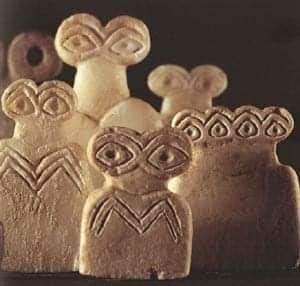
Various "eye idols" from the settlement of Tell Brak, which flourished in Upper Mesopotamia from the 4th millennium BC

Mother and child?


Ideal family?

Couples?

Birth giver? See the M symbol? 


This depiction of women in, what is called "Natural birthing position" is found all over Eurasia...I talked about this in my posts "Birth giver", "Birth giver from Luristan" and "Mama"...

Only "living beings" have eyes. So here eyes are used to symbolise living things. These Tell Brak Eye-dolls 🙂 probably belong to the same group of idols as this one, where eyes are used to symbolise "Living" "Mother" Of Grain...

An early Halaf Culture figurine from the Arjoune site in Syria with a square (field) vulva and large eyes symbolising Mother of grain. I talked about it in my post "Arjoune venus"...

These Neolithic ones from Levant use the same visual symbolism to depict "Mother" Earth.  What is the best way to symbolically depict "Mother Earth"? Well, place mountains, plants and animals between wide open eyes and vulva...Simple...

Decorated bone depicting slightly bewildered "Mother Earth", 6th - 5th millennium BC, Hagoshrim, Southern Levant.

I talked about this in my post "Eyes"...

So I don't think that all Tell Brak Eye-Dolls 🙂 depict humans. Compare the above Levantine one with this one from Tell Brak. Eyes, ibex, bird..."Living" "Mother" Earth?  "Living" "Mother" Mountain?

Now remember the post "Mother of grain from Yarim Tepe"? About this figurine from the same area where Tell Brak is located, that (possibly) symbolically depicts "Mother Earth", "Mother of grain" between two rivers, Tigris and Euphrates?

Figurine of a nude woman form Yarim Tepe, Iraq. Ubaid period, 5000-4000 BCE. Iraq Museum. 

This is the location of Tell Brak

How about these two Tell Brak figurines? Eyes, water...

Are these depictions of the "Living" "Mother" (or "Father" 🙂) Mountain?

Remember the post "Altyn Tepe mother of grain"?

How to depict "Mother Earth", more specifically "Mother of Grain" in Central Asia? Like a voluptuous woman (Mother) whose vulva (where new life come from) is horizontal (like Earth, Field) with horizontal lines (furrows) with plant (Grain) growing out of them, between two rivers, Amu Darya and Syr Darya, which make the land between them fertile?

Mountain were supper important in Mesopotamia too, as it is the snowmelt from the mountains to the North East of Mesopotamia, that is the major source of water in Tigris and Euphrates...


These mountains are "Abzu", the source of water, the home of Enki. 

I talked about Abzu in several of my posts: "Maran", "Utu or Enki", "Goatfish", "When Utu steps up to heaven", "Shamash young and old", "The great imposter", "Problems of the Abzu"...

These mountains are also E-Kur, the mountains of the gods, the original heaven on earth...I talked about it in my article "Eagle dance"...

Oh, while we are talking about mountains, did you know that the guys from Tell Brak were obsessed with mountain Ibex goat. You know The Goat (God) of Rain...

Here is the Goat Dude from Tell Brak, dating to c. 3800-3600 BC.He is wearing "opanak" shoes and holding two snakes...

This is the same guy we find in Iran a bit later, around 3000BC...I talked about this figurine in my post "Strider". See the shoes? Cool right? 

And the same guy we still find in Iran, a lot later, around 8th–7th century BC. I talked about this in artefact in my post "Dancing goat men from Luristan"...

On the Tell Brak seal, the Goat Man is holding (dominating) two snakes. Why? The climatic year in the region is divided into hot, dry summer (Apr/May-Oct/Nov), and cool, wet winter (Oct/Nov-Apr/May)...Al Hasakah is the capital of the province where Tell Brak is located...

The beginning of the mating season of Bezoar Ibex goats (Oct/Nov) coincides with the beginning of the rain (and snow) season in Mesopotamia and surrounding regions...Hence Ibex goat as the symbol of the cool, wet half of the year...

The beginning of the mating season of the most common Eurasian snakes, vipers (Apr/May), coincides with the beginning of the drought season in Mesopotamia and surrounding regions. Hence snake as the symbol of the hot, dry half of the year...

Hence Goat (God) of rain holding (dominating) Snake of drought...


BTW the Goat Man dominating snakes from Tell Brak is not the oldest one found so far. Here are another two seals depicting the same scene from Susa Iran, dated to 4000BC. 


So that's it...What you think?

To read more about ancient animal and plant calendar markers, start here…then check the rest of the blog posts related to animal calendar markers I still didn't add to this page, and finally check my twitter threads I still didn't convert to blog post...I am 9 months behind now...