Showing posts with label Susa. Show all posts

Sunday, 30 August 2026

Ibex cup from Susa

Cup with zoomorphic handle in a shape of an Ibex, wild goat. Discovered in Susa, Iran and dated to 2100-1550 BC. Currently in Louvre... 

On the back of the cup are two Ibex, wild goats, carved in bas-relief, kneeling on either side of a (palm) tree, and forming the palm tree branches with their horns...

This back "decoration" is very interesting indeed. Palm tree was the symbol for the "Tree of Life" in the region where this cup was found...The fact that the Ibex goats were positioned in such a way as to form the branches of the "Tree of Life" is not accidental...

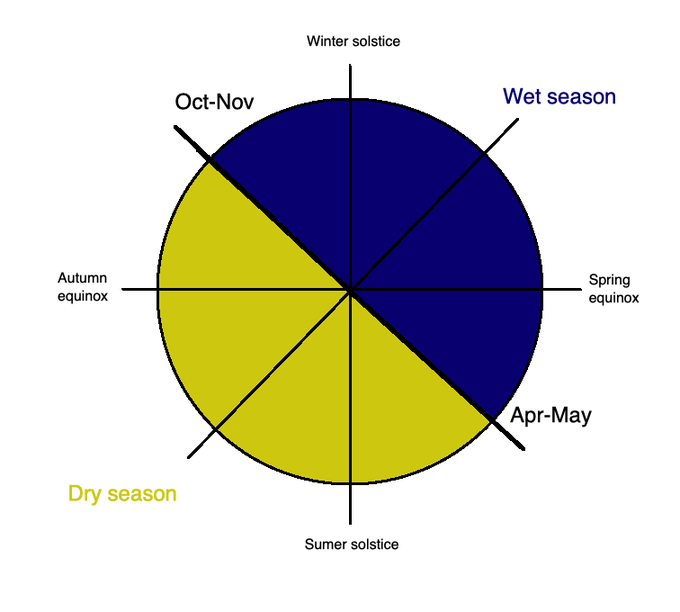
In the region where this cup was found, the climatic year is divided into hot, dry summer and cool, wet winter.


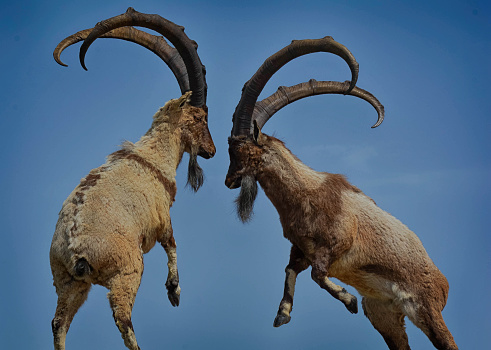
The rain season starts in Oct/Nov, which coincides with the beginning of the mating season of Ibex, wild goats...Mating season which is marked by vicious male goat fights...

This is why Ibex, wild goat, became a symbol of the cool, wet half of the year...And life that the rain that falls during the wet season makes possible...Hence, Ibex, wild goat, symbolically forming the branches of the "Tree of Life" with their horns...

The same symbolism can be found in Iran 2500 years later. Two Sassanian wall relief slabs dated to the 5th-6th c. AD, depicting rampant ibex goats flanking "the tree of life"...


I talked about this in my post "Sassanian goats with the tree of life"...

I talked about the significance of ibex goats in the mythology of Susa in my posts "Jackals from Susa" and "Flamingoes from Susa" in which I provide symbolic analysis of these two super cool vessels made between 4200BC and 3500BC...


I also talked about Ibex mythology in Eurasia in many of my other posts...

That's it. To read more about ancient animal and plant calendar markers, start here…Then check my twitter threads I still didn't convert to blog post...I am way way behind...

Friday, 25 October 2024

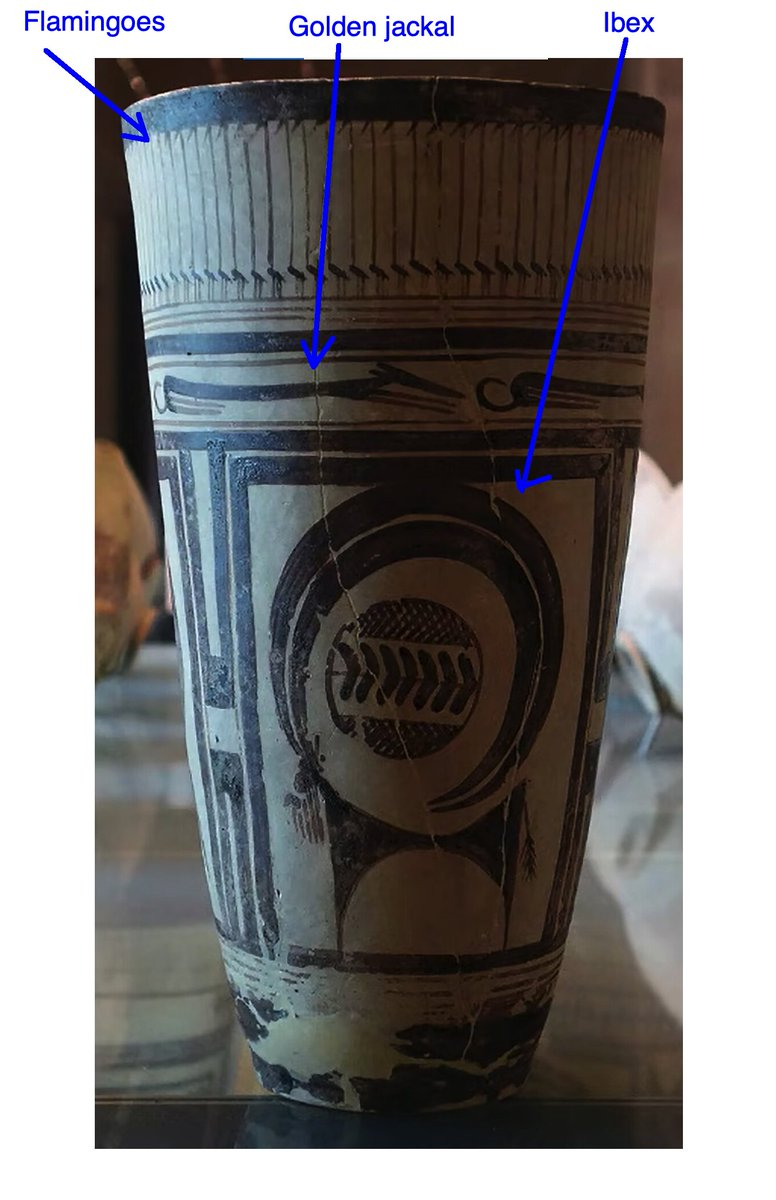
Jackals from Susa

An amazing vase/beaker, made between 4200 and 3500 BC in Susa, an ancient city in the Near East located in modern-day Iran...

Full of animal calendar markers for Oct/Nov, beginning of the rain season in the Susa area...

If we look at the climate chart for Susa area, we can see that the climatic year is divided into hot, dry summer and cool, wet winter...


As it happens, in Iran, the beginning of the Ibex mating season (Oct/Nov), overlaps with the beginning of the rain season, which is marked by violent and loud male goat fights for females...

So ibex goat became animal calendar marker for the beginning of the rain season (rains arrive when ibexes start to mate)...

And because rain supports (the tree of) life...

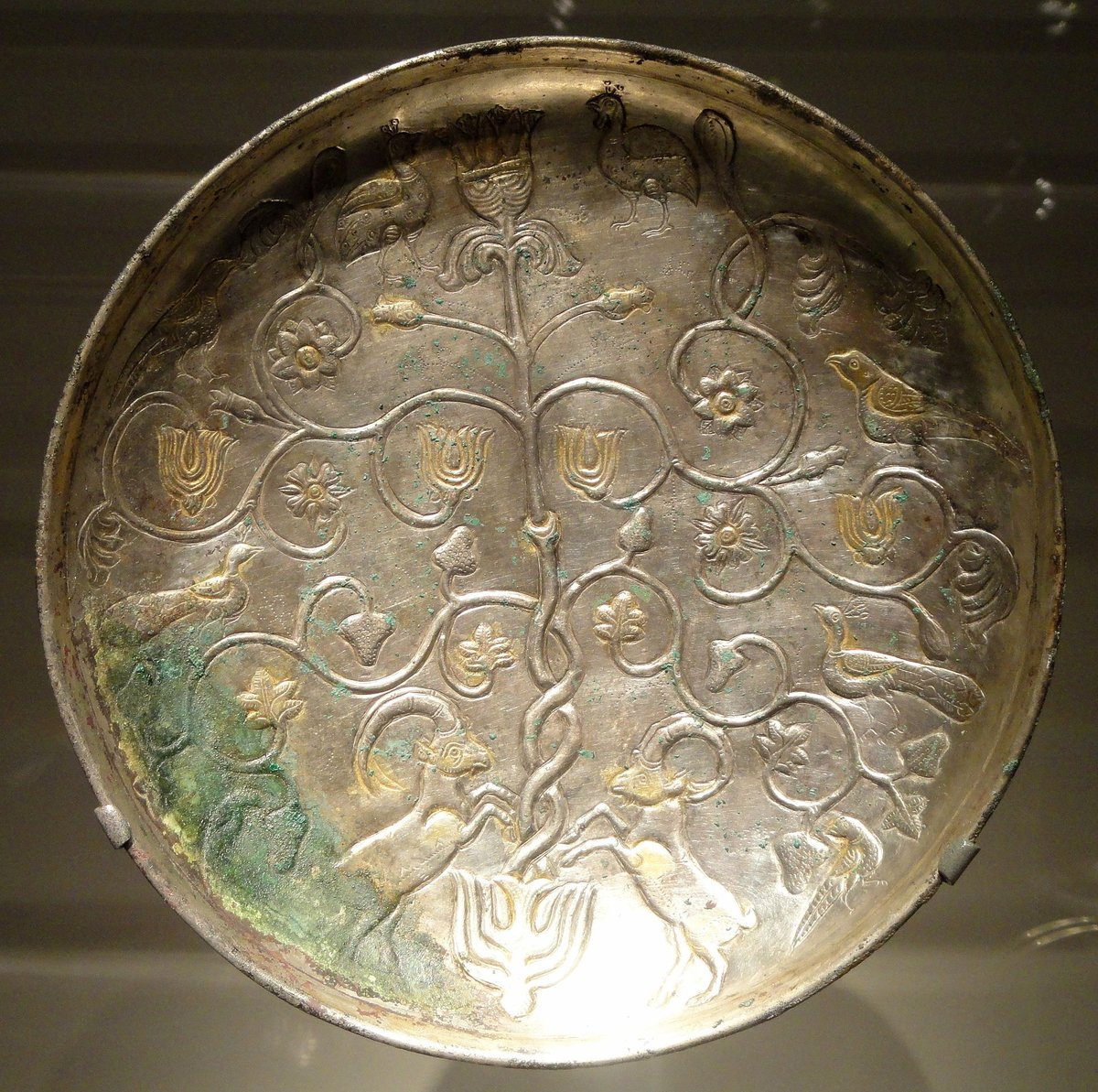
Iran, Sasanian period, 6th-7th century AD silver and gilt plate depicting the tree of life flanked by between two prancing ibex goats...


I talked about this in my posts "Anahita" and "Jiroft flood vase"...

Eastern Mediterranean, Levant, Mesopotamia, Iran, Central Asia have the same climate and so we find the same symbol, ibex goats flanking the tree of life, in all these places. Check my post "Bactrian bronze age menorah", in which I talk about this very cool Bactrian bronze stamp, dated to 2400BC-1600BC, for examples

Neolithic Farmers from Iran progressed very quickly from a calendar marker "rains arrive when ibexes start to mate", to "rains are brought by ibexes" to "rains are a gift of the ibex god (anthropomorphised ibex)"...

"Master of Animals" stamp seals, Tepe Giyan, Iran, 5000-4000 BC...


You can read more about the eternal struggle between the rain goat and the sun serpent/dragon in my post "Master of animals from Tepe Giyan"...


As I said once before, all our mythologies are the result of the fact that people are very good at noticing patterns in nature while simultaneously being very bad at distinguishing between correlation and causation 🙂...

As for anthropomorphization...It's hard to pray to goat for rain. It's much easier, psychologically, to pray to a human like god of rain (with goat horns)...

Anyway, back to our amazing beaker from Susa. 

This beautiful vase is not a Modern Art Masterpiece...It is almost 6000 years old, and is currently kept in Louvre, Paris in the "Département des Antiquités orientales"...Analysis of the symbols + lots about sad state of Flamingos in Iraq can be found in my post "Flamingos from Susa"... 

And in it I provided the calendaric link between ibex (beginning of the mating season of ibex goats, Oct/Nov) and flamingoes (arrival of Greater Flamingos to their wintering grounds in the warm Southern Mesopotamian marshes, Oct/Nov)...

So that's two out of three animal calendar markers from the original Susa vase identified. So what about the canine?

Dog...Right?

Wrong...from the animal calendar markers point of view...Dog is a well known animal calendar marker for Jul/Aug, dog days.

When our mythologies were made out of animal calendar markers, Sirius, the Dog Star rose with the sun in Jul/Aug, when mating season of the old dog breeds began...

Egypt: "Dog days"

Mesopotamia: "Tishtrya"

India: "The bitch of the gods"

It would not make sense to put dog on this vessel together with ibex and flamingoes...There must be another kind of canine that lives in Iran and starts mating in Oct/Nov...

And there is. Golden jackal.

Could this be the canine depicted on our Susa vessel?

All the animals are identical calendar markers, all marking Oct/Nov, the arrival of rains to Susa...

Rains that make grain grow. Kind of a big deal if you are a Neolithic farmer in Iran...Is this grain symbol under the Ibex horns? Grain was planted in Iran in Oct/Nov too...

Some posts about the symbol for grain and the Mother of grain in Neolithic Europe, Central Asia, Mesopotamia, Iran, Levant: "Mother of grain", "Altyn Tepe mother of grain", "A person in a little boat", "Sabi Abyad venus", "Hathor grain pendants"...


That's it. To read more about ancient animal and plant calendar markers, start here…Then check my twitter threads I still didn't convert to blog post...I am way way behind...


Wednesday, 10 April 2024

Snake water bowl

Spouted silver bowl decorated with entwined serpents. Southeastern Iran Mid 3rd millennium BC. From Al-Sabah collection.

Why was this vessel decorated with entwined serpents? Here's what I think:

I already talked about this type of vessels in my post "Elamite water bull" about this Proto-Elamite silver figurine of a clothed anthropomophised kneeling bull...holding a spouted [water] vessel. c. 3000BC. Currently in the Met Museum...

My guess that this figure is either Enki (Sumerian god of sweet water) or Utu (Sumerian sun god)...Or their unnamed Elamite equivalent who possibly combines both of them in one...

They were both described as bulls. Why?

These are yearly charts of the water levels in Tigris and Euphrates. You can see that they both peak in Apr/May, Taurus, Bull...

BTW, Taurus here is The Old Taurus, the animal calendar marker for the beginning of the calving season of wild eurasian cattle...

This rise in water levels in Tigris and Euphrates is the result of the sun heating up of the mountains which are the source of the two great rivers: Anatolian highlands and the Zagros mountains...Which causes the snow to melt, which causes the rivers to swell...

Snowmelt, Zagros


Hence the humanoid bull holding a spouted water vessel...Which looks just like the vessel from the  Al-Sabah collection...

I talked about another water carrier figurine from Iran in my post "Water carrier equid", about this "Spouted Anthropomorphic Vessel", Western Iran, circa 1000-650 BCE. Currently in Los Angeles County Museum of Art...


Here the anthropomorphised animal water carrier is not a bull but an equid, horse or a donkey. Why? Cause equid mating season, starts in Apr/May, right when the water discharge peaks in the rivers in Mesopotamia/Iran...

But why was the vessel from the Al-Sabah collection decorated with entwined serpents?

First, snake is a solar animal, pretty much a universal symbol of the sun's heat. Snakes follow sun everywhere. They are in our world when sun is in our world (day, summer) and in the underworld when the sun is in the underworld (night, winter)...I talked about this in many of my posts. For instance "Snake god from Hatra"...

And it is the sun's heat that melts the snow...

Second, snake mating season, when snakes intertwine, starts in Apr/May, the time of the peak snowmelt runoff in Iranian mountains, and the peak discharge of the rivers in the Tigris/Euphrates system...

Which is why in the Deliver Me from Evil: Mesopotamian Incantations, 2500-1500 BC, By Graham Cunningham, we can read that in the Earliest Sumerian texts, Enki, the god of sweet flowing water and the source of Tigris and Euphrates, was associated with poisonous snakes...

Hence Enki (Or at least Elamite equivalent of Enki) sitting on a snake throne....

And which is why I think the [water] vessel from the Al-Sabah collection is decorated with entwined serpents...

Great info can be found in this X thread by @dalaygiz

“Twenty different officiants are attested in connection with Napiriša. Their designations vary from simple šatin (4) and makuš (7) to (makuš) pirramadda (3) and (makuš) haturmakša; their names are all Iranian except for two.”

“Elsewhere, the same individuals are associated with a range of other sacrifices, including sacrifices for or at various mountains, for Adad, Auramazdā, Išpandaramattiš, and (the) Mišebaka.”

(‘The Heartland Pantheon’, Henkleman, pg 1229)

“The syllabic spellings of the name (AN na‐pír‐šá‐ra, AN na‐pír‐ir‐šá‐ir‐ra) follow the development riša > irša, “great,” suggesting that the name of the god was still understood as a compound (logographic spellings: AN dingir.gal MEŠ, AN gal MEŠ).”

The origins of Napiriša, attested since the early second millennium BCE, may lie in the eastern highlands of Elam. This may also account for his popularity in the PFA*. 

The water‐giving god and his wife are shown here at the open‐air sanctuary of Kūrāngūn:

It’s majorly held for the figures above that they are Napiriša (or Napiriša‐Inšušinak) and his spouse Kiririša, the ‘Great Goddess’ of Liyan/Būšehr. 

Also, Mesopotamians identified “Naprušu/Napriš” as their own Ea/Enki.  

(‘The Heartland Pantheon’, Henkleman, pg 1228)

*Persepolis Fortification Tablets 

This deity is attested for 26 times and given Iranian epithets.

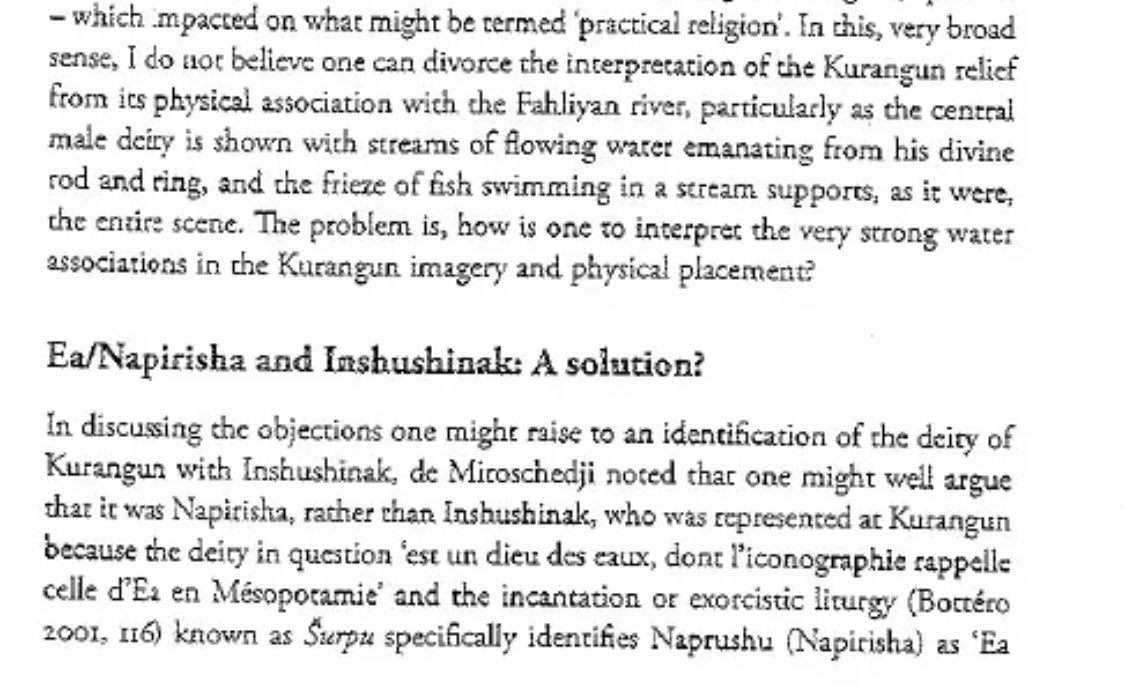
Here’s the Kurangun relief, which depicts a horned Elamite deity seated upon a snake-coiled throne. 17th century BCE. It’s in Fars, Iran. 

“He is seated on a throne formed by the body of a snake, coiled back upon itself over and over again, and he grasps the tail of the snake in his left hand. In his right he holds the divine rod and ring [my comment, he is not holding rod and ring, he is holding a cup, just like Enki/Ea] from which two streams of water flow [...]” 

(D.T Potts, From Handaxe to Khan, 1990, pg.146) 

You can read more here: The numinous and the immanent

Snakes did appear a lot in Elamite art...

"In terms of identification, he has been called Inshushinak, who was the patron of Susa anyways. Enki/Ea/Napirisha are mentioned as well; the author deduces that these names/figures are all in fact related, with the former being used as epithets, besides the shared identity"...


That's it. To read more about ancient animal and plant calendar markers, start here…then check the rest of the blog posts related to animal calendar markers I still didn't add to this page, and finally check my X threads I still didn't convert to blog post...I am 9 months behind now...

Sunday, 3 September 2023

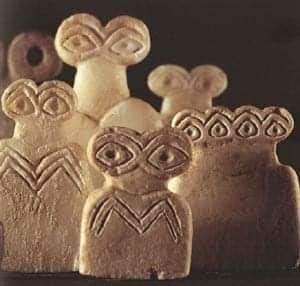
Eye idols from Tell Brak

Various "eye idols" from the settlement of Tell Brak, which flourished in Upper Mesopotamia from the 4th millennium BC

Mother and child?


Ideal family?

Couples?

Birth giver? See the M symbol? 


This depiction of women in, what is called "Natural birthing position" is found all over Eurasia...I talked about this in my posts "Birth giver", "Birth giver from Luristan" and "Mama"...

Only "living beings" have eyes. So here eyes are used to symbolise living things. These Tell Brak Eye-dolls 🙂 probably belong to the same group of idols as this one, where eyes are used to symbolise "Living" "Mother" Of Grain...

An early Halaf Culture figurine from the Arjoune site in Syria with a square (field) vulva and large eyes symbolising Mother of grain. I talked about it in my post "Arjoune venus"...

These Neolithic ones from Levant use the same visual symbolism to depict "Mother" Earth.  What is the best way to symbolically depict "Mother Earth"? Well, place mountains, plants and animals between wide open eyes and vulva...Simple...

Decorated bone depicting slightly bewildered "Mother Earth", 6th - 5th millennium BC, Hagoshrim, Southern Levant.

I talked about this in my post "Eyes"...

So I don't think that all Tell Brak Eye-Dolls 🙂 depict humans. Compare the above Levantine one with this one from Tell Brak. Eyes, ibex, bird..."Living" "Mother" Earth?  "Living" "Mother" Mountain?

Now remember the post "Mother of grain from Yarim Tepe"? About this figurine from the same area where Tell Brak is located, that (possibly) symbolically depicts "Mother Earth", "Mother of grain" between two rivers, Tigris and Euphrates?

Figurine of a nude woman form Yarim Tepe, Iraq. Ubaid period, 5000-4000 BCE. Iraq Museum. 

This is the location of Tell Brak

How about these two Tell Brak figurines? Eyes, water...

Are these depictions of the "Living" "Mother" (or "Father" 🙂) Mountain?

Remember the post "Altyn Tepe mother of grain"?

How to depict "Mother Earth", more specifically "Mother of Grain" in Central Asia? Like a voluptuous woman (Mother) whose vulva (where new life come from) is horizontal (like Earth, Field) with horizontal lines (furrows) with plant (Grain) growing out of them, between two rivers, Amu Darya and Syr Darya, which make the land between them fertile?

Mountain were supper important in Mesopotamia too, as it is the snowmelt from the mountains to the North East of Mesopotamia, that is the major source of water in Tigris and Euphrates...


These mountains are "Abzu", the source of water, the home of Enki. 

I talked about Abzu in several of my posts: "Maran", "Utu or Enki", "Goatfish", "When Utu steps up to heaven", "Shamash young and old", "The great imposter", "Problems of the Abzu"...

These mountains are also E-Kur, the mountains of the gods, the original heaven on earth...I talked about it in my article "Eagle dance"...

Oh, while we are talking about mountains, did you know that the guys from Tell Brak were obsessed with mountain Ibex goat. You know The Goat (God) of Rain...

Here is the Goat Dude from Tell Brak, dating to c. 3800-3600 BC.He is wearing "opanak" shoes and holding two snakes...

This is the same guy we find in Iran a bit later, around 3000BC...I talked about this figurine in my post "Strider". See the shoes? Cool right? 

And the same guy we still find in Iran, a lot later, around 8th–7th century BC. I talked about this in artefact in my post "Dancing goat men from Luristan"...

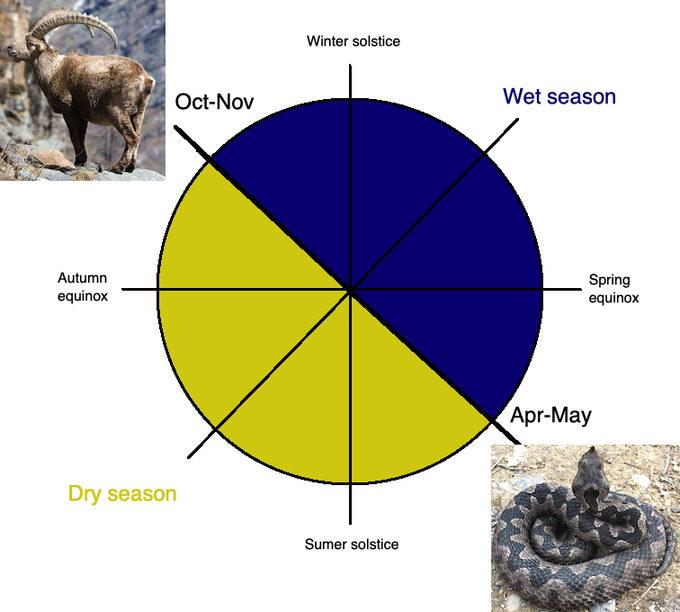
On the Tell Brak seal, the Goat Man is holding (dominating) two snakes. Why? The climatic year in the region is divided into hot, dry summer (Apr/May-Oct/Nov), and cool, wet winter (Oct/Nov-Apr/May)...Al Hasakah is the capital of the province where Tell Brak is located...

The beginning of the mating season of Bezoar Ibex goats (Oct/Nov) coincides with the beginning of the rain (and snow) season in Mesopotamia and surrounding regions...Hence Ibex goat as the symbol of the cool, wet half of the year...

The beginning of the mating season of the most common Eurasian snakes, vipers (Apr/May), coincides with the beginning of the drought season in Mesopotamia and surrounding regions. Hence snake as the symbol of the hot, dry half of the year...

Hence Goat (God) of rain holding (dominating) Snake of drought...


BTW the Goat Man dominating snakes from Tell Brak is not the oldest one found so far. Here are another two seals depicting the same scene from Susa Iran, dated to 4000BC. 


So that's it...What you think?

To read more about ancient animal and plant calendar markers, start here…then check the rest of the blog posts related to animal calendar markers I still didn't add to this page, and finally check my twitter threads I still didn't convert to blog post...I am 9 months behind now...