Saturday, 16 May 2020

Poppies

I came across this interesting artefact recently.


The artefact turns out to be from Urartu and is forehead part of the horse head gear. It is currently kept in Karlsruhe, Badisches Landesmuseum.


It was dated to c. 800BC

Urartu is a geographical region commonly used as the exonym for the Iron Age kingdom also known by the modern rendition of its endonym, the Kingdom of Van, centered around Lake Van in the historic Armenian Highlands (present-day eastern Anatolia).


The symbols depicted on this artefacts are very interesting indeed.

The "god", I presume it's a god, is riding on a bull. He is standing in the middle of (wearing) a flying winged disc, usually symbol for the sun and he has what looks like sun disc on his crown. And the whole metal thingy is shaped like a sun with rays pointing upward...

But he couldn't be a sun god.

Because there is only one god in Urartian pantheon which rides on a bull: Theispas the thunder god. He is basically the same god as the Hurian Teshub and Luwian Tarhunz...

And all these gods "ride on a bull" and cary a trident (symbol of lightning)...

And so does the guy on the above artefact. He rides on a bull and holds a trident in each hand...

Or does he?

Here is the close up of one of the "tridents":


To me this looks very very vey much like this: opium poppies...


But why would a storm god cary opium poppies?

Have a look at this:

The planting of poppies throughout the poppy growing regions of the Balkans, Asia Minor and Middle East takes place in the autumn, from September to December, depending on the locality...

If the plant survives the winter, it requires ample rain in between March and May.

The rainfall pattern in the Anatolian (Armenian) plateau

Here is the average precipitation in eastern Anatolian plateau, lake Van region, the land of Urartians and Hurians. The rain peaks in April.


In the rest of the Anatolian plateau, the land of the Hittites, the rain peaks in May.


Taurus Taurus (20 April – 21 May) covers the maximum rain, maximum thunderstorm season in both of these areas.

Which is why, I believe, Urartian Theispas, Hurrian Teshub, Luwian Tarhunz...All ride on a bull...


And cary tridents


Hmmm...Trident's you say...Why tridents? 

But Taurus doesn't only bring rain to Anatolian (Armenian) plateau. It also brings summer. 

As you can see in the above precipitation tables, the May-June is when the rains stop and the hot weather starts. Exactly what opium poppies need to flower and ripen:


I already wrote in my posts "Ram and bull" and "Symbols of the seasons", about the bull being the symbol of the summer.


The summer starts at the beginning of May, during wild Eurasian cattle calving season and ends at the beginning of August, during wild Eurasian cattle mating season...

Bull is the true symbol of summer...

And summer is the main opium poppy harvesting season:

In Turkey, opium poppy harvest season starts in May...
In Afghanistan, the opium poppy harvest season starts in late April early May...
In Iraq, the opium poppy harvest season starts in late April early May...
In Iran, the opium poppy harvest season starts in later April early May...


In the Balkans, the opium poppy harvest season starts in May...

These are stills from an amazing Macedonian documentary from 1955 called Rhythm And Sound. Showing poppy harvesting. 


You can find video here: part 1part 2

Basically opium poppies are harvested during the summer, symbolised by the bull. The bull, or more precisely the guy on the bull, the pusher, brings the poppies...

So here are some questions:

1. Is the guy on the Urartian artefact the thunder god? I presume he is a god and not a stoned acrobat...
2. Is he carrying poppies to announce the beginning of the opium harvest season? Sort of: The pusher's here!!! The Thunder dude!!! It's party time!!!
3. Did the trident, the symbol of thunder gods, develop from poppies? 

What do you think?

Great source of information about the cultivation of poppies in the Balkans, Asia Minor and Middle East is this article entitled "Some Observations on the Cultivation of Opium Poppy (Papaver somniferum L.) for Its Latex" by A. D. Krikorian and Myron C. Ledbetter

What is very interesting as well is that apparently, opium poppies were "...most likely first cultivated for human use in Asia Minor or in the Balkans..." according to "Troubling Fields: The Opium Poppy in Egypt" by Joseph J. Hobbs

So the link between the poppies harvest, which starts right after the Thunder gods bring thunderstorms in Taurus, during the calving of the wild cattle, was very strong in the area from the beginning...

Thursday, 14 May 2020

Gourd pottery

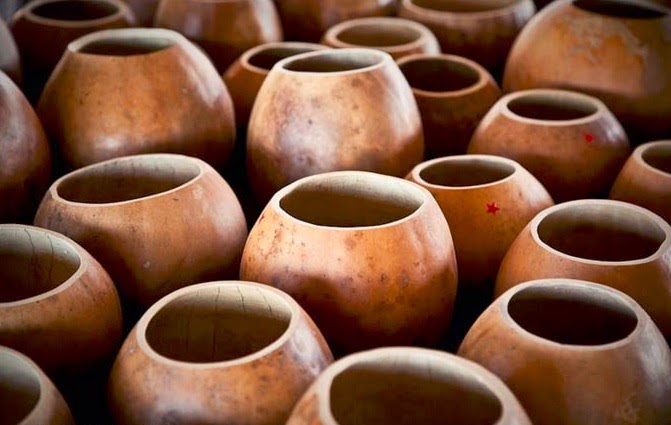
This is an example of a "Dark Faced Burnished Ware", the earliest form of pottery developed in the western world...This bowl is from Shir, in Syria and was dated to c. 7000 BC. 


Interestingly, this almost spherical vessel looks very much like a clay version of one of these:


And each one of these vessels is made of one these: a bottle gourd.


And gourd is what pre pottery, pre metal, pre glass people used for making vessels and utensils for handling cold liquids...Well people continued to use gourd for the same purpose even after pottery, metal and glass were invented. My grandparents had loads of things like these...


Now back to the original Dark faced burnished ware vessel. How was it made? Did people use a gourd vessel as a mould? Basically plastering the clay on the outside of the gourd vessel and then firing it all together? Gourd would combust leaving just a ceramic crust (pot)?

The oldest pots ever made were made in Asia, about 20,000 years ago. They look like someone plastered an inside of a basket and then fired the whole thing together. Basket burned away, leaving basket shaped and patterned vessel. I wrote about it in my post "Basket pottery":  


Interestingly, the vessels made in Syria before the "Dark faced burnished ware", in 9th millennium BC, are known as "White ware". They are crumbly form of proto-pottery made from white plaster kind of mixture and then just air or sun dried. Don't they look like plastered baskets?


So we know that Pre Pottery Neolithic Syrians knew how to make plaster, and that they possibly used some kind of basket mould for making their White ware vessels...So it is possible that eventually someone made a "plaster" that when accidentally burned turned hard and black...

What was the first product of this newly discovered technology was something like this. Selection of pots and bowls from Tell Sabi Abyad (ca. 6600-6200 B.C.), among the earliest pottery currently known from Syria...Again very sack, basket like, right? 


What I find absolutely amazing, is that before people of Neolithic Syria discovered how to make proper clay pots, in the 8th millennium BC, they were making things like this: A bowl made from stone, calcite alabaster...From Met museum


This whole thing is a great example of two things: 
1. How people "invent" by trying to imitate nature
2. How skill and technology are so very different.

Which brings me to the question: what should we use for judging cultural development? Aesthetics or technology? Because they don't always match...Just look at the last two pictures...

Tuesday, 12 May 2020

Alexander romance

Alexander Romance is a fictional account of the life of Alexander the Great, originally written in Greek, in the early 4th c. It was widely copied and translated. This is one of the pics from the Armenian illuminated manuscript of 14th century of 5th century translation. 


I would here like to talk about the part which talks about Alexander's conception and birth. The story goes like this:

The last Egyptian Pharaoh (and evil wizard) Nectanebo, is thrown out of Egypt by a Barbarian army lead by Egyptian gods themselves (sure sign it's time to pack and leave). He disguises himself as a fortuneteller and flies to Macedonia...

It just so happens that King Philip is out fighting some war or something and his gorgeous wife Olympia is all alone and lonely lonesome...And apparently Nectanebo likes the ladies...So he devises a cunning plan how to get into Olympia's bed...

He uses horoscope to convince Olympia, who had no children, and who was afraid Philip was about to replace her with another wife, that Amun Ra (Sun god) will come to her and make her pregnant with a son who will "avenge all the wrongs which will come to you from Philip"...

Then he told Olympia, who was intrigued to say the least, that she would have a dream, in which Amun will show himself to her and will tell her something like "I'm coming baby!"...And then he did some magic mumbo jumbo and Olympia did dream of Amun. And was much impressed...

And Olympia said: "You have spoken wisely, Prophet. I shall give you access to my room; and if I experience the mating and conceive, I shall greatly honour you as an infallible seer, and I shall receive you as though you were father of the child." Nectanebo was much pleased... 🙂

And he said: "Go inside and sit in your room. You shall see a serpent (Dragon) come slithering to you. Do not extinguish the light of the lamps, go and recline on your couch and cover your face. Once again you shall see the god whom you saw come to you in your dreams"...

Nectanebo tells Olympia about great sex she will have with Amun. She is all excited. So is he...


Anyway, he makes a Serpent (Dragon) from clay, magically breaths life into it, and the Serpent slithers into Olimpia's room, and it all happens as "prophesied": Olympia reclines covers her eyes, Serpent changes into Amun, and "mates" with Olympia...


Olympia is so pleased with what happens that she orders her servants to put Nectanebo into a room next to hers and to give him keys of her room. And from then on Amun spent every night between Olympia's legs...Until her belly started growing big...

Slightly freaked out Olympia asked "Prophet, what shall I do if Philip comes and finds me pregnant?" And he said: "Be not afraid, my lady, for the god Ammon is helping you in this matter; he will come to him in a dream, and inform him of what was destined to happen"...

And so Nectanebo makes a falcon, breaths life into it, and sends it to Philip, who, in his dream, seas a handsome god shag his wife and then proclaims that "he has just made her pregnant with a son who will avenge the death of his father..." Ouch...

And then, also in the same dream, Philip seals Olympia's womb with papyrus and then stamps the papyrus with his golden seal ring which had on it rays of sun, lion's head and lances...Philip, completely freaked out, asks his dream magic guy what the hell is going on. And he says:

Blah blah ...you will be raising a son of god, rejoice...He will be great, he will kick the crap out of everyone in the world...

But Philip was not convinced at all. As a matter of fact he hurried home, to kick the crap out of the bastard who just made him a bastard son...

Nectanebo, who was hiding in the palace heard Philip saying to Olympia: "You were not made pregnant by the gods, but, in fact, were smitten by someone else whom I shall send forth from this life with pitiless tortures if he falls into my hands". And he was concerned...

So during the feast celebrating the king's return (and the fact that his wife's was pregnant), Nectanebo transformed himself into the form of a serpent much bigger than the first. He passed through the palace breathing so fiercely that even the foundations quivered...

And those who saw him fled away, startled and shaken by fear. Olympia recognizing her bridegroom was stunned and raised her right hand from her lap and extended it. And he circled the room, and then came to Olympias' knees, and flicked out his double-forked tongue and kissed her.


Wow! Neat trick...Philip had been terribly frightened. When he regained his composure, he said: "My lady, as sure proof, I saw the god come to help you in your peril. But, as to who the god was, I did not know, for he showed us the form of Ammon"...

And Olympia said, "As he revealed himself to me at the time of mating with me, he is Ammon" And when the king heard this, he considered himself blessed for "I am destined" he said, "to be the father of a child of a god."

Few days later, Philip was in the garden. A bird came and laid an egg on his lap and flew away. The egg rolled from his lap to the ground and broke open. From it a little serpent came forth and circled it many times. Then it tried to go back into the egg but on the way in it died

An omen teller interpreted the dream like this: "You will have a son who, having traversed the whole world, shall subdue everyone by his strength and shall be subdued by no one; and while returning to his country, he shall die, having lived but for a short time..."

Sooooo...Another son of god? The authors of the Alexander romance thought not. Not a holy bastard. Just bastard...But to me the interesting bit is the Serpent (Dragon) bit of this story. Why was Serpent seen by everyone as the sure sign Amun Ra (Sun god) was in the house???

In Slavic mythology, Serpent (Dragon) is seen as the symbol of the sun. In folk poetry it is called "Sun's ray's brother". And he loves the ladies...As a matter of fact, Serbian Dragons seem to live for the ladies...Every one of them has a lady lover, usually a princess (queen)

They prefer earthly women to supernatural women, like Vilas (fairies). In a folk song recorded in Bosnia in the 19th century, two dragons, are fighting over the same girl. A Vila (Mountain Fairy, who calls them "her brothers") tells them that they should go check out the other Vilas instead of chasing mortal girls. only to be told to to piss off, as "no Mountain Fairy can come anywhere near to a mortal girl"...

Interestingly, in Serbian folklore, sons born out of the affairs  between Dragons and earthly women are always great heroes...Just like Alexander...Also Dragons can take both serpentine and human  shape...Just like Nectanebo...

The seal ring with which Philip "seals the deal with Amun" 🙂 is also very interesting. The sun is hottest in the middle of Leo. This is the time of the Dragon, who represents the destructive power of the late summer sun, which dries the skies and the land and creates drought...I talked more about Dragons in Serbian folklore in my post "Dragon who stole rain"

Kudurru

Kudurru was a type of stone document used as boundary stones and as records of land grants to vassals by the Kassites in ancient Babylonia between the 16th and 12th centuries BCE...


The kudurrus recorded the land granted by the king to his vassals as a record of his decision. The original kudurru would be stored in a temple while the person granted the land would be given a clay copy to use as a boundary stone to confirm legal ownership...

The Kassites controlled Babylonia after the fall of the Old Babylonian Empire c. 1531 BC and until c. 1155 BC. They gained control of Babylonia after the Hittite sack of the city in 1595 BC, and established a dynasty based first in Babylon and later in Dur-Kurigalzu...

The Kassites were members of a small military aristocracy. The chariot and the horse, first came into use in Babylonia at this time...

The original homeland of the Kassites is not well-known, but appears to have been located in the Zagros Mountains, in what is now the Lorestan Province of Iran...

This is interesting: The Kassite language has not been classified...Officially "their language was not related to either the Indo-European language group, nor to Semitic or other Afro-Asiatic languages, and is most likely to have been a language isolate"...

Even more interesting: "However, the arrival of the Kassites has been connected to the contemporary migrations of Indo-European peoples (Chariots!!!)"...

Even even more interesting: "Several Kassite leaders and deities bore Indo-European names, and it is possible that they were dominated by an Indo-European elite (military aristocracy!!!) similar to the Mitanni, who ruled over the Hurro-Urartian-speaking Hurrians of Asia Minor..."

Why is this interesting? Kudurru, "the gift stone". Apparently "...a word probably of Elamite origin that means both 'boundary marker' but also 'eldest son'"...This is interesting as it is the eldest son who usually inherits the land in Indo-European culture...

KUDURRU specifies WHO the land was GIVEN AS GIFT

In Serbian (and other Slavic languages) we have these two words:

KO, KUJ (who)-from Proto-Slavic *kÑŠto, from Proto-Indo-European *kÊ·os
DAR (gift)-from Proto-Slavic *darÑŠ, from Proto-Indo-European *deh₃rom.

Was kudurru more like a Indoeuropean ko+dar=who+gift?

When was Kudurru first recorded as a word? During Kassites rule or before? Maybe this is just a coincidence...

Monday, 11 May 2020

Dog days


Ahhh. I always wandered why the Egyptian "Dog days" were located on the solar year at the hottest part of the year, the end of July, beginning of August...So I looked at the Ancient Egyptian dog breeds...

First thing I found out that the Ancient Egyptian loved hunting dogs. 


And that their word for "hunting dog" was "Tesem". And that it was written in hieroglyphics using the image of a prick-eared, leggy dog with a curled tail from the early Egyptian age...


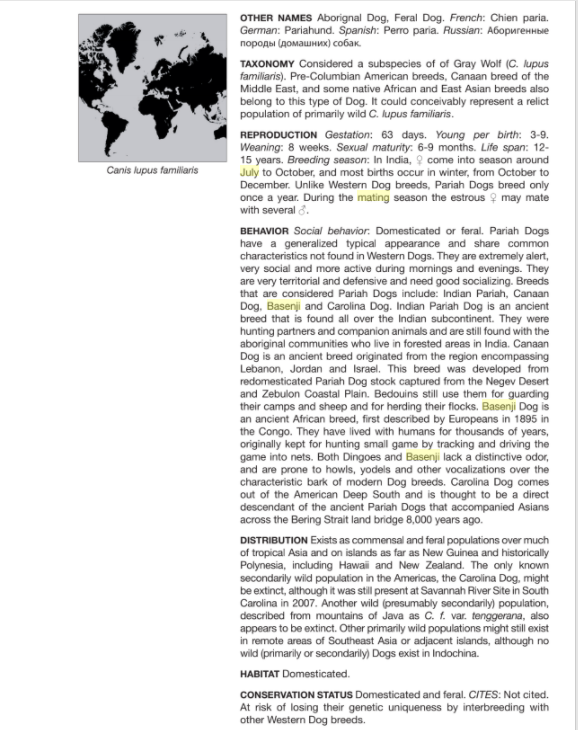
There were three main types of dogs in Ancient Egypt: pariah dog (basenji), two kinds of greyhound-like dogs and a molosser-type dog....And the one shown on Tesem hieroglyph is definitely the "pariah dog" known in Egypt as basenji.


The "pariah dog" is the name given to the half wild dog species still found around the world. They are the closest we still have to the old wild dogs...And they have preserved one important characteristic of wild dogs: They have one breading season...

And guess when that breeding season starts? You guessed correctly. During dog days, end of July beginning of August, the hottest part of the year in the Northern hemisphere...Here is the page about the "pariah dogs" from Princeton "Canids of the world".


Basenji dogs are close cousins of Canaan dogs also known as Egyptian desert dogs, Bedouin Sheepdogs and Palestinian Pariah Dogs...


For the Egyptians the sight of these doggies dogging must have been a very pleasing sight indeed. Because the start of the Basenji breeding season coincided with Nile flood maximum...


I talked about this in my post "Holy cow". 

No wonder then that it is the Dog headed god Set who "defends Ra from the Serpent of Chaos Apep". The serpent is the symbol of sun's heat. And the dog days mark that maximum. After that the northern hemisphere starts cooling (the serpent is dying)...I talked about this in my post "Apep". 


Of course Set (Dog) is helped in his valiant fight against Apep (The Dragon) by Bastet (Lion, Cat). No wonder. Dog days fall in the middle of Leo...And Leo is where it is because it marks the beginning of the mating season of the Eurasian lions...I talked about this too in my post "Apep". 


And that's that...

Oh almost forgot. The time when in Ancient Egypt the Pariah dogs started getting frisky and when the Nile flood arrived, at that same time, Sirius, the brightest star in the night sky, was also rising...Is his why the star was eventually, when Greeks, who called that part of the year "Dog days" arrived to Egypt, called The Dog Star? The star that rises during Dog Days? The days when Pariah dogs are mating? 

This link between this ancient dog breed, Dog Days and Dog Star seems to have once been widespread. North America, China, India, Mesopotamia, Ancient Greece, Rome...Finally Egypt...I think this is a very interesting theme which requires more research and which will most likely point at the common prehistoric system of symbols and beliefs linked to the common dog breed, with common single breeding season, dog days, found in all these areas... 

If we look at the oldest known depictions of dogs, they all show Pariah dogs. 

Prehistoric rock art found in Saudi Arabia shows humans hunting with Pariah dogs on leashes. These pictures could be at least 8,000 years old, making them the earliest art depicting dogs. 


Before the discovery of this rock art from Saudi Arabia, it was was believed that the oldest depictions of dogs were the ones found on pottery shards from Tepe Sabz in Iran, which are almost 8000 years old. They depict the same Pariah dog breed... 


The domestication of dogs happened at the European edges of the Eurasian steppe. 30,000 years old dog fossils from Palaeolithic sites in Belgium, the Ukraine and Russia are the earliest proof we have of canids which are different from wolves...

The earliest proof of dogs actually being part of human society are the remains of a dog found buried with two humans, dating back 14,700 years, in Germany... 

So, it seems that the dogs spread throughout the world from Europe. And because domesticated dogs stay with humans, they must have spread with the humans who originally domesticated them...Which haplogroup was responsible for the dog diffusion? Was that dog the Pariah dog? Did Pariah dog always have a single mating season which started at the same time (July-August)? And is it during this expansion of the Mesolithic-Neolithic hunters and their Pariah dogs, that the link between the mating period of Pariah dogs (Dog Days) and the Dog Star - Sirius was forged in all these places around the world? 

Sunday, 10 May 2020

Kharif and Rabi seasons

I came across this interesting Indus Valley civilisation bowl today. 


Intrigued by what was depicted on it, I spent an hour digging around and here is what I found...

First I stumbled across the article "Distribution and features of the Indus Civilization" by Dilip K Chakrabarti which gave me the origin of the bowl. It was found in Nausharo site in Baluchistan 


In the article I also found the actual unrolled full decoration of the vessel. It was even more interesting now that I could see both sides...


Why are there cattle with chicken on their back tied to trees with broad leaves and then goats tied to large fruit bearing trees? These are the kind of questions I like asking. I am that boring...To find out I had to try to identify the animals and plants on the image...

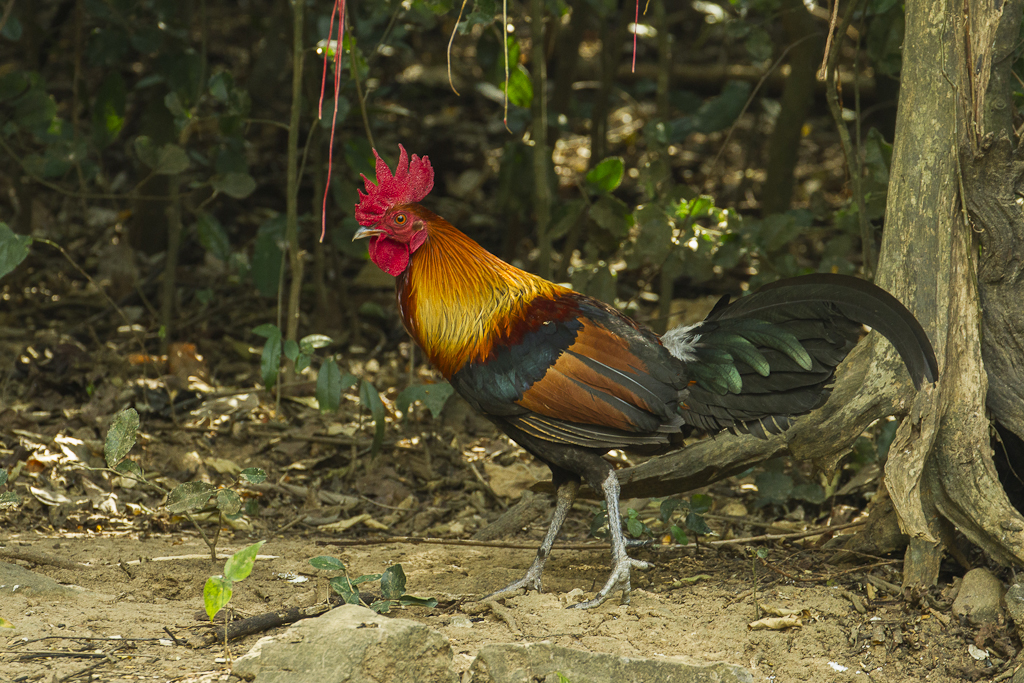
The chicken first...It is most likely the red junglefowl (Gallus gallus), a tropical bird in the family Phasianidae, the primary progenitor of the domestic chicken... 


The cattle second...It is one of many subspecies of the  humped Zebu cattle (Bos indicus) 


The goat is our old friend, Ibex. Sindh Ibex to be more precise, the subspecies which lives in lower areas of Pakistan...


Animals were by our ancestors used as calendar markers, where animal marks part of the solar year which corresponds to some part of its reproduction cycle. So I decided to learn more about the reproduction cycles of red junglefowl, Zebu cattle and Sindh ibex and see what happens...

In my post "Symbols of the seasons" I proposed that in the past each season had its animal symbol: Goat=Winter, Ram=Spring, Bull=Summer and Lion=Autumn. This corresponds to the part of the zodiac that these animals fall into... 


Sindh Ibex mating season is November-December. Winter...

I couldn't find much info about natural mating season of Zebu cattle. Except two notes from "Zebu cattle of India and Pakistan": 

Dhani cattle (Mating has slight peak May to August)


Kankrej cattle (Mating tendency March to August)


1/8/2022. Just came across this article entitled "Seasonal fluctuations of reproductive functions in Zebu cattle" in which we read that "Fertility maxima coincided with the onset of the rainy season (June to August), with significant rank correlations between conceptions and temperature (+ 0.827), pressure (− 0.751) and precipitation (+ 0.632)"...

Ha!

Knowing that Aurochs, the ancestors of all the Eurasian cattle bread in nature July-August, it seems that mating season of Zebu was also in nature summer activity (May to August). I talked about natural reproductive seasons of wild cattle and sheep in my post "Ram and bull".

O yeah. The chicken. It seems that the mating season for the red junglefowl in India starts in April, peaks in May and ends in June...Right in Taurus. Or as the ancients would say: "on top of the bull"... 

Now what about tying the different quadrupeds to different trees. Well as I said Goat represents Winter, and the half of the year starting with winter (November-May), and Bull represents Summer, and the half of the year starting with summer (May-November)...

What is really really cool, is that the agricultural year in Indus valley is divided into two parts, two harvests, with two completely different crops: 

Kharif season (May to November)
Rabi season (November to May)

Cool right? And guess when the main large fruit season, like for instance pomegranate, is in Indus valley? Rabi season, goat season, of course...

Cool right? 

Wait till you see this:

The broad lief tree is Ficus religiosa or sacred fig (also known as bodhi tree, pippala tree, peepul tree, peepal tree or ashwattha tree). 


This tree is Drought deciduous, Dry season deciduous plant. It sheds its leaves during the peak of the dry season, between February and April. And new leaves start growing in end of April beginning of May, during Taurus...Beginning of summer, season marked by Bull...

I mean...


Sooooo...What can I say...One hour to get all this data...Everything fits perfectly...Nothing is random on this image. The trick to understanding it is to have the key. And the key is: it is that simple and it is that "shallow"...Enjoy it...It's beautiful...

To read more about ancient animal and plant calendar markers, start here…then check the rest of the blog posts related to animal calendar markers I still didn't add to this page, and finally check my twitter threads I still didn't convert to blog post...I am 9 months behind now...