Showing posts with label Sirius. Show all posts

Friday, 10 July 2026

Whore of Babylon

Whore of Babylon on the Seven-Headed Beast, Illustration for Rev. 17:3–8. From the Las Huelgas Apocalypse, ca. 1220

I love this. The Whore of Babylon (aka Sirius, aka Ishtar) riding (in the middle of, in Jul/Aug, in Leo) seven headed beast (seven months of Mesopotamian summer Apr/May - Oct/Nov), just before she starts rising with the sun before dawn (so still invisible in the day, red sky)...

I talked about her in my post "Apocalypse" in which I give full symbolic analysis of the Woman of the Apocalypse, described in Chapter 12 of the Book of Revelation...

The same girl...


The Woman Clothed with the Sun (aka Sirius rising with sun in Leo, aka Ishtar), an illustration from the Rothschild Canticles, c. 1300

The same girl again...

3rd mill BC Mesopotamian dragon has lion body (Jul/Aug, Leo is the hottest time of the year) and seven snake heads (one for each hot month of Mesopotamian summer, Apr/May-Oct/Nov)...Analysis of this seal dated to 2200 BC can be found in my post "Seven headed dragon"...

The "dragon" (summer) is depicted while his 4th head (4th month, Jul/Aug) is being killed (is in progress). To the left we see "The Lady" standing under a star (Ishtar -  Sirius)...

Why is Ishtar depicted standing next to the seven headed dragon? 

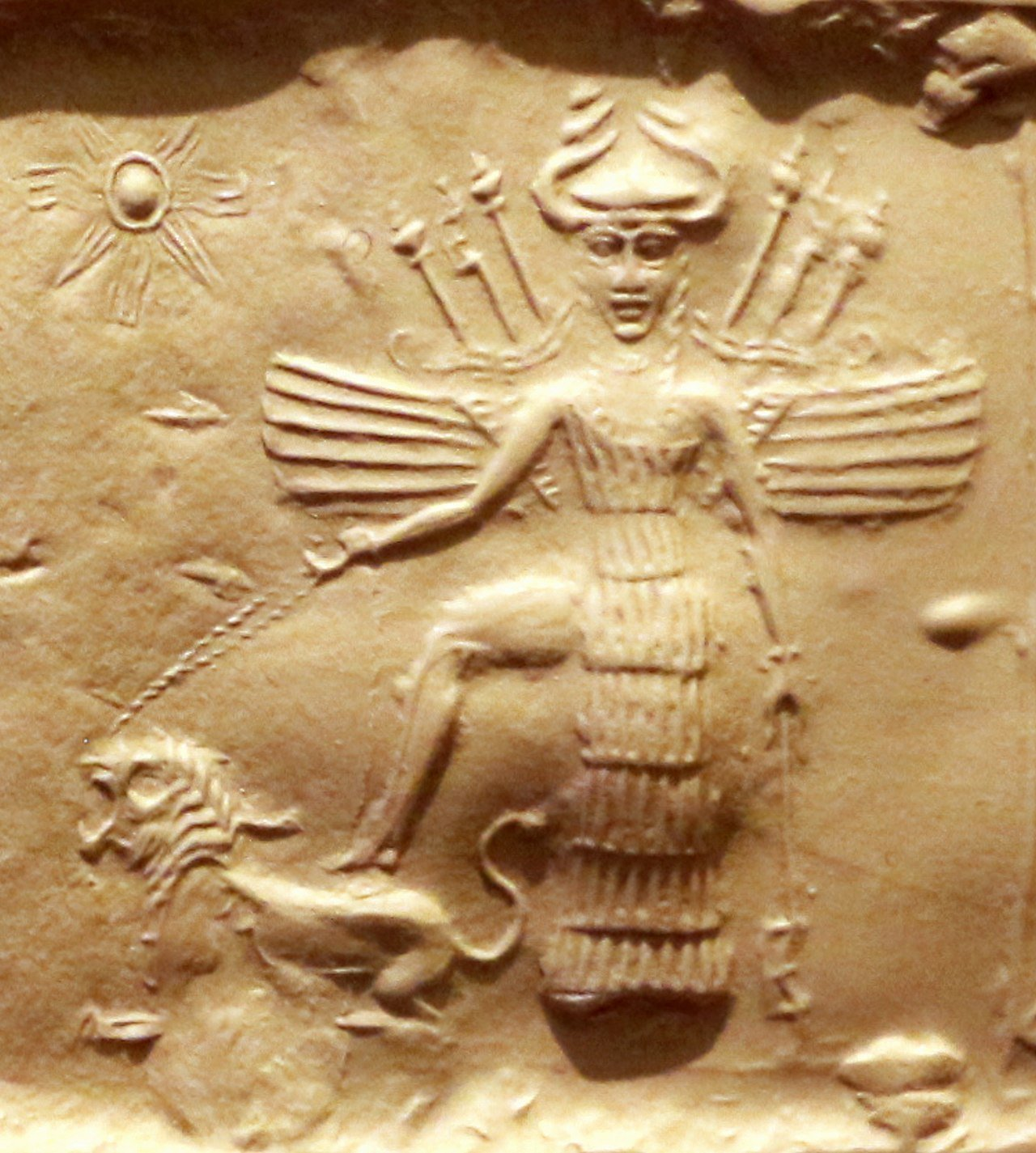
For the same reason she is depicted here standing on a lion. Cause she is deified Sirius, which rises with the sun (morning star) in Leo, Jul/Aug, the hottest time of the year. Which is why she is depicted standing on a lion with the sun above lion's head and is known as "The Lioness of heaven"...

For the same reason she is the one who sits on a lion throne...

I gave complete explanation of why Ishtar is Sirius and not Venus in this article containing full symbolic analysis of the Sumerian poem "Inanna and Šukaletuda"...

I talked about Inanna/Ishtar and why it was Sirius that was her original "morning star" in many of my posts...


You can start here: You know how everyone thinks that Inanna/Ishtar (Morning Star) is Venus and how I think that it was originally Sirius, and only later became Venus?

Well, it seems that Ancient Egyptians preserved the proof of this switch in their myths about Sopdet...


I talked about this in my post "Sirius mother of Venus"...

She of course has many faces and names...

Silver seal from Gonur Tepe, Turkmenistan, late 3rd-early 2nd mill BC. Depicting a winged goddess riding on a lioness...

Who could this be?

Well, of course, a Central Asian version of the "Lioness of heaven", Inanna/Ishtar/Asherah/Artemis.../Sirius in Leo...

I talk about this in my post "Silver seal from Gonur Tepe"

Back to the original Whore of Bablylon painting and why I like it so much. The same "two skies" trick was used here: Does anyone else think that this picture, allegedly showing King John on a stag hunt, looks strange, and may be hiding something in plain sight? No? 


Well I do 🙂 I explain why in my post "King John"...

In short, King John here is symbolic depiction of St John's day, Midsummer day, Summer solstice. 

White horse is a universal solar symbol. On this Celtic coin from Hungary, this is symbolically depicted through "solar rider", an anthropomorphised sun riding a horse. 


I wrote many posts about horse/equid as a solar symbol from Around the world. 

Horse is a solar symbol because horse fertility is governed by sunlight and peaks on Summer solstice. St John (day), Summer solstice is in the middle of the solar horse, going from red sky (increasing sunlight, before summer solstice) to blue sky (decreasing sunlight, after summer solstice)...

John is riding after (towards) a stag, (the symbol of) winter...

Jingle bells, Jingle bells, Jingle all the way...Bronze stag pendant with bell feet, early 1st mill BC, Transcaucasia or Iran. Currently in the Met Museum...

Stag is a symbol of winter because it is through the winter that stags have their full grown antlers. 

I talked about the stag as the symbol of winter in my posts "Winter deer"  and "Deer kills snake

What is very interesting is that deer antlers are fully grown in Sep/Oct, right in time for the start of deer mating season and the end of the horse mating season. The old antlers fall off, and the new ones start growing, in Mar/Apr/May right in time for the start of the horse mating season. 


This means that deer and horse are natural animal calendar markers for the opposite halves of the year...Which is why King John on his white horse will (symbolically) never catch the deer... 

So, (never ending) stag hunt..Talked about it in my post "White stag"...


If you are interested in reading more about ancient animal and plant calendar markers, which are at the root of all our mythologies, start here…Then check my twitter threads I still didn't convert to blog post...I am way way behind...

PS: Just came across this amazing painting: The woman clothed with the sun and the seven-headed dragon, c. 1360-70 by Giusto di Giovanni de Menabuoi.


Which is, I think, much b
etter viewed like this...


The Woman clothed with the sun - Sirius rising with the sun in Jul/Aug, the middle, the hottest part of the Mesopotamian summer which lasts seven months...

The Dragon - Nergal, The Destructive Sun (God) Shamash...The God whose seat is in Jul/Aug, the middle, the hottest part of the Mesopotamian summer which lasts seven months...Whose main head is the middle head of the seven headed dragon...

This guy...


Saturday, 25 April 2026

Winged Artemis

Shard of a late 7th c. BC amphora, found on the island of Paros, showing a winged Artemis holding a lion by its tail and ear, surrounding by what looks like sun symbols, swastikas and crosses...

What does this all mean?

Well, if we want to figure this out we have to start in Mesopotamia, with Nergal. 

Nergal, the deified destructive "burning" sun, was depicted as a lion man, because Jul/Aug, Leo, is the hottest and driest part of the year in Mesopotamia...

Talked abut him for the first time in my post "Winged superhuman hero"...

BTW, Leo (Jul/Aug), originally had nothing to do with stars either. It is the ancient animal calendar marker marking the beginning of the main mating season of the Eurasian lions. 


Talked about lion as an animal calendar marker in many of my posts...

This is why "Behind a lion", "On a lion", "Between lions" means in Jul/Aug, in Leo. I talked about this in many of my posts, like this one for instance, about this interesting shard from a Hittite vessel with a depiction of a god (?) standing on a lion with a plant above lion's head. Currently Museum of Anatolian Civilisations, Ankara, Turkey

Anyway, in Greece, the "terrible" sun god, Nergal, became The "terrible" sun god Apollo...


I explained this in detail in this series of post about the link between Nergal and Apollo:

1. "Palil". About "Palil" a nickname of Nergal, the terrible, burning, destructive sun of Jul/Aug, Leo...And about the origin of the name Apollo and its meaning...

2. "Lord of the flies". About Nergal and Apollo as "The lords of the flies"...And about Jul/Aug, Leo, being the peak of the fly and fly born diseases season in Northern Hemisphere...

3. "Lions of Delos". About the Lions of Delos, the burning destructive sun in Jul/Aug, Leo, and the fact that both Nergal and Apollo are linked to lions. 

4. "Apollo and dolphins". About Jul/Aug, Leo being the "best time to sail in Eastern Mediterranean", and the link between dolphins and Lions...and Apollo...

5. "Marble throne of Apollo". About snakes (symbols of sun's heat), dragons (symbols of burning sun's heat) and terrible sun gods, Nergal and Apollo who are dragons themselves...

6. "Apollo and Python". About why Python followed Apollo after his birth? Cause snakes are solar animals...According to the Delphian tradition, Apollo was born on the 7th day of the month of Bysios (Jan/Feb)

7. "White raven". About the black and white raven legend which is found in both Nergal and Apollo mythology, Egyptian vultures and the twins that guard the gates of hell. And some other weird stuff...

8. "Threshing floor of Apollo". About the threshing floors as solar observatories/temples, about the threshing floor of Apollo from Delphi, about Jul/Aug, Leo, being the holy month of Apollo, and about solar bonfires...

9. "Apollo the great archer". About why Apollo was the terrible "far shooting" archer...About arrow and bow constellation from Mesopotamia, Ishtar, Sirius, and Jul/Aug, the season of Perseid meteor shower...

10. "Apollo Sminthius". About Apollo his arrows that cause plague and peak infectious diseases season, Jul/Aug

This transformation of Nergal into Apollo went through an an intermediary, Syrian god Resheph...I talked about this in my article "Apollo - Resheph"...

Now Artemis, the Twin Sister of Apollos, is holding the ear and tail of the lion deliberately, to indicate that she is standing in Jul/Aug, in Leo...Lion here is symbolic depiction of the sun in Leo...Apollo...Nergal...

So if Apollo is Nergal, Sun god Shamash in Leo, Jul/Aug, who is Artemis, Apollo's twin sister? Well, who is the twin sister of the sun god Shamash?

She is this girl

For those who will say "Ishtar was the morning star", yes she was, in Leo (Jul/Aug), when Sirius rose in the morning with the sun...Which is why Ishtar stands on a lion (with sun above the lion) and why Ishtar is known as "The Lioness of heaven"...

For those who will still say Ishtar is Venus and not Sirius. This post, "Sirius the mother of Venus", and linked articles might be of interest: You know how everyone thinks that Inanna/Ishtar (Morning Star) is Venus and how I think that it was originally Sirius, and only later became Venus? 

Well, it seems that Ancient Egyptians preserved the proof of this switch in their mythology. 

Meet Sopdet...

Sopdet, the personification of Sirius, was the consort of Sah, the personification of Orion. And their child was Sopdu, the personification of Venus, "Lord of the East" (Venus as morning star)....

Ta Ta Taaaaaaa!!!!

Identification of Artemis as Greek version of Ishtar is not that difficult really when you think about it...I talked about the identity of Artemis in Detail in my post "Artemis Orthia", about this drawing of an archaic carving of a chariot on ivory plaque from the Sanctuary of Artemis Orthia in Sparta. The chariot is pulled by winged (solar) horses and is driven by a female (goddess?) charioteer. A lion is depicted lying behind the horses...Again, in Leo...

Finally, about suns, crosses and swastikas. Check this post, "Boeotian solar pyxis", about this late 7th c. BC Boeotian clay pyxis depicting the "(Mysterious) Mistress of the Animals and some animals" 🙂 that explains the reason why cross and swastika are solar symbols, just like horses and serpents...

I also talked about solar cross in my post "Ponte Sodo fibula" about this amazing Etruscan gold disc fibula, from the Necropolis of Ponte Sodo, Vulci, Etruria, Italy. 650 BC 


And I talked about solar cross in my post "Alexamenos graffito" in which I explain why this graffito depicting Christ with a donkey head is not actually a mockery of Christ...


Christ is born on Winter Solstice, (re)birth day of the sun (god), he enters Jerusalem on a donkey, "animal of the (sun) gods and kings", and gets put on a cross, symbol of the sun (god)...

BTW, cross was originally symbol of Mesopotamia Sun god Shamash...


You know Shamash, the solar deity of the early Hebrews, to whom they dedicated their first temple (according to their own scriptures)...

I talked about this in my posts "The cross of Shamash" and "Sun god tablet" and "Temple of Isis on Philae Island"...

Shamash, whose destructive aspect is Nergal, Shamash in Leo...

Anyway, I think that all of this makes it pretty clear who is depicted on the Paros amphora. What do you think? 

To read more about ancient animal and plant calendar markers, start here…Then check my twitter threads I still didn't convert to blog post...I am way way behind...


Saturday, 9 August 2025

7 heads

Good morning. Old Assyrian (2000 BC-1800 BC) cylinder seal. Currently in the British museum...

Official description: Man in a chariot driving four horses; before him seven human heads and two birds; one other bird is above the two horses

Hmmm...

Quadriga in 2nd millennium BC Mesopotamia... Interesting...A man? Or a God? Like Sun god? They love horse drawn chariots...Like Helios depicted in his horse drawn quadriga on this Apulian vase dated to 350BC...

Why would sun gods like horses so much? The natural breeding season of horses starts in Apr/May and ends in Sep/Oct spanning the sunny, hot half of the year in the continental Eurasia, and is marked by wild stallion fights for mares...

The horse fertility is governed by the sunlight and peaks on summer solstice. I heard summer solstice was a big thing for sun worshipers....

Hence solar horses all over Eurasia...

Articles about solar horse (equid):

Iran "Water carrier equid", "Dioscuri plate from Iran"

Mesopotamia "Shamash playing with the solar horse", "Sun god from Tell Brak"

India "Hayagriva"

China "Longma", "Three legged crow", "Mythical beast from Xian"

Levant "Alexamenos graffito", "Goddess on a horse", "Unicorn"

Europe "Archaic rider", "Beotian solar pyxis", "Pegasus and chimera", "King John", "The horseman"

But the quadriga rider depicted on this Assurian seal can't be Helios...And his quadriga can't be pulled by horses...

He is most likely Sun God Shamash who was depicted on this 3rd mill BC cylinder seal imprint found in Tell Brak, Syria riding on a quadriga. Quadriga pulled not by horses but by "kungas", donkey hybrids so highly regarded, that "they were the preferred draught animal for drawing the chariots of kings and gods"... I talked about this in my post "Sun god from Tell Brak"...


Shamash rides on the quadriga pulled by donkeys, because donkeys are also solar animals, just like horses. This is because just like the mating season of horses, the mating seasons of donkeys is directly linked with the amount of sunlight and peaks on Summer solstice... 

Interestingly: In a letter dated to 1775 BCE, Bahdi-Lim, governor under the Mari king Zimri-Lim, insists that the king should not ride horses in his capital, as it was considered uncivilised. Instead, he urges the king to honour his royal status by riding in a donkey-drawn wagon...

From my post "Alexamenos graffito" about this:

Christ riding into Jerusalem on a donkey by Oleksandr Antonyuk. 

Why did Jesus have to ride into Jerusalem on a donkey?

People say: He was fulfilling a scripture prophecy.

"Rejoice, O people of Zion! Shout in triumph, O people of Jerusalem! Look, your king is coming to you. He is righteous and victorious, yet he is humble, riding on a donkey" Zechariah 9:9

God/King riding on the favourite ride of the old Gods/Kings... 

And this:

Christ is born on Winter Solstice, (re)birth day of the sun (god), he enters Jerusalem on a donkey, "animal of the (sun) gods and kings", and gets put on a cross, symbol of the sun (god)...Interesting...Early Christian "Alexamenos graffito", Rome. 


Anyway, back to our Assyrian seal. Why 7 human heads? Maybe 7 months of Mesopotamia summer? 

I talked about this first in my post "Seven headed dragon" The oldest depiction of a Hero(es) killing a 7 headed dragon dragon...Mesopotamia, 2200BC...With 7 snake heads...One for each hot month of Mesopotamian summer...They are killing the 4th head. Apr/May, May/Jun, Jun/Jul, Jul/Aug...  


Leo...The time when Sirius rises with the sun..There is also a princess (Inanna/Ishtar) standing under a star (Sirius) 🙂...

Here is Inanna/Ishtar, deified Sirius, which rises with the sun (morning star) in Leo, Jul/Aug, the hottest time of the year. Which is why she is depicted standing on a lion with the sun above lion's head and is known as "The Lioness of heaven"...

I talked about Inanna/Ishtar as Sirius in many of my posts...

Same girl, same beast (summer)...

Woman of the Apocalypse...I gave Full symbolic analysis of the Chapter 12 of the Book of Revelation in my post "Apocalypse"...

Anyway, back to our Assyrian seal. Why birds? Originally I thought that maybe these are migratory birds, cause migratory birds announce the start and end of summer, the domain of the Sun god?

I talked about migratory birds in Mesopotamian mythology in my post "Nanshe'. In Sumerian mythology, Nanshe was the daughter of Enki (god of water) and Ninhursag (earth goddess). This 3rd Dynasty or Ur plaque depicts goddess Nanshe with geese.


This is because the arrival and departure of migratory geese marks the beginning and end of the wet half of the year in Mesopotamia. On the flip side the departure and the arrival of the migratory geese marks the beginning and the end of the dry half of the year in Mesopotamia.


 But now, I am thinking that based on the shape of the birds they could actually be doves. 

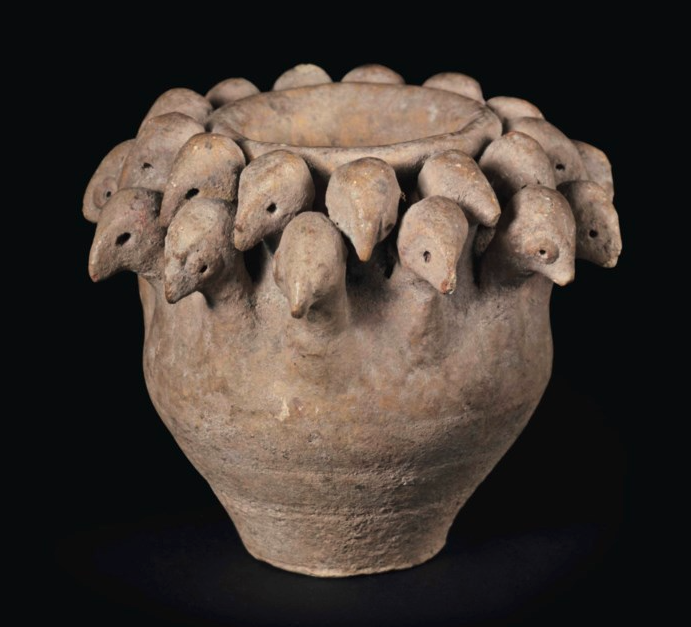
Dove was sacred to Inanna/Ishtar. 1800-1600 BC pottery cup, Syria. The rounded body tapering to a flat base, with 26 bird heads. Similar objects were interpreted as votive objects dedicated to Ishtar/Inanna, who was also linked to grain and doves. 

The reason for that is that nesting season of doves overlaps with the grain harvest season. 

Which brings me to: is that grain depicted just above the two birds? Right in front the chariot...

We know that this has been a grain symbol in Eastern Mediterranean, Mesopotamia, Central Asia, Iran, since at least Sumerian times...

I talked about this in many of my posts...

Mesopotamian harvest coincides with the beginning of summer (Apr/May), the beginning of the mating of wild donkeys and the beginning of summer, the domain of the Sun God...

Maybe I am just reading too much into this. Maybe it is a man, a king, riding triumphantly over severed heads of his enemies which are being pecked by vultures and ravens....That's kind of cool too...

PS: A 5,000-year-old toy chariot found during the excavations in the ancient city of Sogmatar in the southeastern Turkish province of Sanliurfa...With what looks like grain symbols?


To read more about ancient animal and plant calendar markers, start here…Then check my twitter threads I still didn't convert to blog post...I am way way behind...

Saturday, 19 April 2025

Rhomb

Some items of a sexual nature from the Middle Assyrian temple of Ishtar at Ashur. Models of human sexual organs, with holes for attachment and suspension: phalli of stone, and a pubic triangle and vulva of baked clay. Interesting...


Here is Inanna/Ishtar, deified Sirius, which rises with the sun (morning star) in Leo, Jul/Aug, the hottest time of the year. Which is why she is depicted standing on a lion with the sun above lion's head and is known as "The Lioness of heaven"...

I talked about Inanna/Ishtar as Sirius in many of my posts...

Now look at this: palm tree as a plant calendar marker for Jul/Aug in Mesopotamia. Date harvest season starts in Jul/Aug, in Leo, when Lion (autumn) kills (ends) Bull (summer) and lasts until Oct/Nov. I gave full symbolic analysis of this seal in my post "Lion killing bull under palm tree"...


See the rhombs? Now, originally I proposed that the rhombs depicted on the date harvest seal were symbols for a date fruit. But, could it be that rhombs there were also symbols for Inanna/Ishtar's vulva? 

Palm tree is directly linked with Inanna/Ishtar. I talked about it in my post "Tree huggers" in which I analysed this Babylonian moulded plaque dated to ca. 2000–1600 BC. Currently in the Met Museum, New York...


Guess what ends in Mesopotamia in Jul/Aug, right when the date harvest starts? Grain harvest...

Now remember "Mother of grain"? Look at this:

Mesolithic Lepenski Vir culture from Serbia bone figurine depicting Mother Earth (Mother of grain) whose vulva is giving birth to plants (grain?)... 


Mesolithic Lepenski vir culture from Serbia stone vulva depicting vulva at the start of birth


Grain seeds


Compare their shapes...

The Mother of Grain had a name in Mesopotamia: Inanna/Ishtar. In "The Courtship of Inanna and Dumuzi" we find these verses:

As for me, Inanna

Who will plow my vulva?

Who will plow my high field?

Before my lord, Dumuzi ...

I poured out grain before him

I poured out grain before my womb...

Articles about the Mother of grain in Europe, Central Asia, Mesopotamia, Iran, Levant: "Mother of grain", "Altyn Tepe mother of grain", "A person in a little boat", "Sabi Abyad venus", "Arjoune venus", "Mother of grain from Yarim Tepe", "Hathor grain pendants", "Cup of Nestor", "Sacred marriage on the threshing floor",  "Mother of grain from Mari", "Baba, last sheaf of wheat"...

Ha!!! Right on the next page of the "Gods, Demons And Symbols Of Ancient Mesopotamia An Illustrated Dictionary" we find this 🙂

I guess I was right 🙂 It does depict date fruit, grain seed and vulva...

To read more about ancient animal and plant calendar markers, start here…Then check my twitter threads I still didn't convert to blog post...I am way way behind...