Saturday, 12 June 2021

Overpowering

Roman stone sculpture of a bear overpowering a boar, from an ancient tomb monument, Trier...🙂 I think that "overpowering" is a nice way to "put it"...


Hmmm...Should I talk about obvious or hidden...

Considering everyone else is going to talk about animal sex,  I will talk about it too...And animal calendar markers derived from mating seasons of animals caught here in the act....

The wild boar mating season in Eurasia starts in November...At the beginning of winter...Which is why wild boar has been used to represent winter...

I talked about wild boar symbolism in my posts "Calydonian boar" and "Double headed eagle"...

Bears don't like shagging in the snow...They are asleep while boars are having fun...Bears emerge from their hibernation in spring, and are seen in some parts of the world, like Slavic countries, Romania as heralds of Spring...Which is why bears are part of Spring festivals...

I talked about bear symbolism in my post about "Bear dancers"...

There disappearance underground at the beginning of the winter and there reemergence from the underground at the end of the winter is seen as a symbolic death and rebirth...Just like sun and nature die and are reborn every winter...

The Christian holiday known as "Presentation of Jesus at the Temple" is celebrated on February the 2nd. In Serbia known as "Sretenje" (Meeting)... Serbians say that this is the day when "winter meets summer"...

Which is interesting because this is actually the beginning of spring...

I talked about this "Natural year division" in my post "Two crosses"...

Now Serbian tradition says that on this day, bears will awaken from their winter hibernation. If a bear comes out of his den and sees his shadow, he will get frightened back into hibernation, and winter will last 6 more weeks...Otherwise, winter will end soon...

So what about bear shagging??? Well, bear mating season stats in May...At the beginning of summer...This makes bear the opposite to boar from the symbolic point of view...

Bear is basically a solar symbol, because it is in our world during the warm part of the year, when sun is here too, and is in the underworld during the cold part of the year, when sun is there too...

This is why in Slavic mythology, the God Veles, the enemy of the Thunder God Perun, is represented as bear...Now it is well known that Thunder God's enemy is The Summer Sun, which causes drought...

So back to our "bear overpowering boar"...Knowing all this, this statue could be interpreted as summer overpowering winter...

But, whether whoever made this statue knew any of this or whether he had any ulterior motives or he was just a lover of bestiality, I honestly don't know...But this was a great excuse to talk about animal symbolism and animal calendar markers 🙂

To read more about ancient animal and plant calendar markers, start here…then check the rest of the blog posts related to animal calendar markers I still didn't add to this page, and finally check my twitter threads I still didn't convert to blog post...I am 9 months behind now...

Winged bull with ibex horns

"Hero and a Winged bull with ibex horns"...Iran, Pre-Achaemenid Period, 8th-6th c. BC, Silver, gold, H-27.5 W-22.2 Currently in Miho museum, Japan


Amazing and weird...Winged bull with Ibex horns??? What could that be??? 

Well a calendar marker of course...


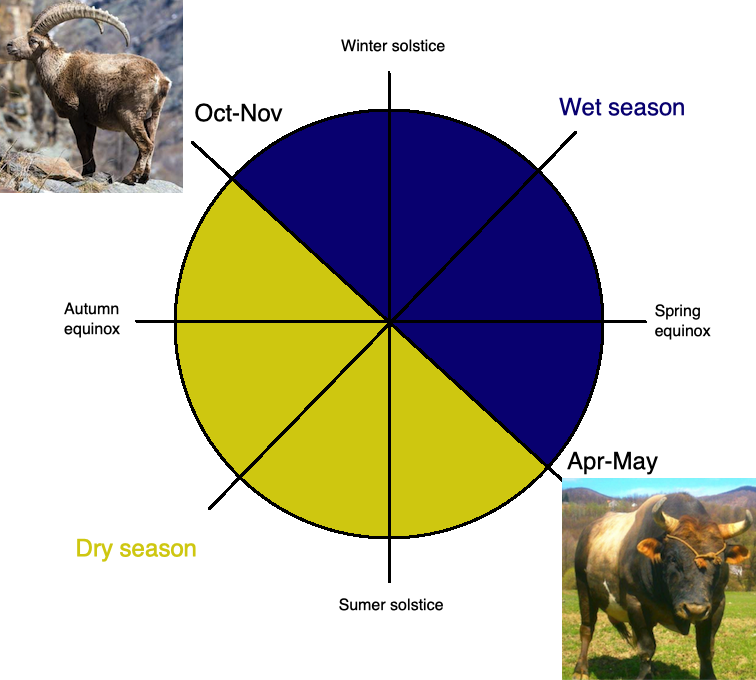
The climatic year in Western Iran is divided into dry season (May-Oct) and wet season (Nov-Apr). The rain that falls on the hills and valleys during the wet season revives the parched dry earth and makes it green again...


Ibex (Bezoar) goat mating season starts at the end of Oct beginning of Nov, with Ibex males, which are normally solitary, gather to fight for females...And so the Ibex became the "Goat of rain", the calendar marker that marks the beginning of the wet season.

I talked about this in my post "Strider", about this weird looking fellow from the same neighbourhood...


The snow that falls in the mountains during the wet part of the year, melts in spring, starting from February, Aquarius :) Pic: snow cover of the Iranian mountains per month


The rivers in the mountain areas of Iran, are fed by rainfall during the winter, but mostly by snowmelt during spring and summer. The snowmelt starts in late Feb early Mar, and peaks in late Apr, early May. In Taurus, Bull...Pic: the flow of Iranian rivers per month

Which is why we find all these depictions of bulls with flowing water on Western Iranian Jiroft culture artefacts. 

I talked about this in these two posts: "Khafajeh vase" and "Jiroft flood vase"

What we know today as Taurus is an ancient calendar marker, marking calving season of Eurasian wild cattle, Aurochs...April-May...

This bull symbol is found with the same meaning (Apr-May) all over Eurasia and North Africa...And interestingly it is linked to rivers and floods in Egypt, India, Mesopotamia

The bull symbol also marks the beginning of summer, hot dry part of the year, making it the opposite of the ibex symbol which marks the beginning of winter, cool wet part of the year...

So....


Back to our "Winged bull with ibex horns"...Here we have both of the above markers. So combined they could mean: 

1. Hot and dry part of the year, May to October (Bull to Goat)

2. Cool and wet part of the year, November to April (Goat to Bull)

Which is it?

Bull is the back part of the composite "creature" (calendar marker) and Goat is the front part. The creature is standing on its hind legs, with an erect penis, just like Ibex goats do during their mating season. 

Originally I thought that this was the marker for the end of the hot and dry part of the year...And that the "Hero" was actually a rain god...Who kills the composite creature which represents hot dry part of the year...

That was before I did my research on Nergal, the god of scorching, destructive sun of the end of the summer (Jul/Aug). I wrote about him in my post "Winged super human hero". Nergal is easily identified by the fact that he always caries a scimitar. 


Just like the "hero" killing the "Winged bull with ibex horns"...


So this is definitely not a rain god killing "hot dry part of the year"...This is Nergal, the god of the hot and dry half of the year, killing cool and wet half of the year...

Now, what about the face? Remember Shamash (Utu) the Mesopotamian sun god depicted as a bull with lapis lazuli beard??? He who frees Enki, the god of water, from his prison (ice) so he can fill the holy rivers, which peak in Taurus...This guy:

In "Enki and the world order" we read that:

"Enki placed in charge of the whole of heaven and earth the hero, the youth Utu (Shamash), the bull standing triumphantly, audaciously, majestically...the great herald in the east of holy An...with a lapis-lazuli beard, rising from the horizon..."

I talked about this in my posts "Shamash young and old" and "Butt chewing"...

Oh and the wings. I think they were added just to emphasize that we are dealing with heavenly symbols...Sun, Rain, Climate, Solar year...

Finally, the fact that both figures wear masks also indicates that here we are looking at a symbolic ritual role-play, that takes place in heaven every year at the same time...At the end of summer, Jul/Aug...

Cool artefact...Very cool...


Sunday, 6 June 2021

Rain and flood


Sumerian, Early Dynastic seal, from Ur. Source: L. Legrain, Archaic Seal-Impressions, New York, 1936 (Ur Excavations III), plate 28, 492.

Description: Crescent-shaped boat with two boatmen equipped with round paddles...That's it...

That's it? Of course not...


As I explained in my article "Shamash young and old", Enki is the god of the source of fresh water...And the god of flood...Annual flood of the Tigris and Euphrates. Which is why he is depicted with two streams of water full of fish (rivers) coming out of him...


Enki is standing on the bull, because the annual flood peaks in Apr/May. Annual flow charts:

Tigris

Euphrates


In Taurus...


But this taurus has nothing to do with stars. This is an ancient animal calendar marker which marks the time when wild Auroch cattle start to calve...I talked about this in this post "Ram and bull". 

Here is the original Taurus marker from Tell Barak, Syria...


BTW, on the above image of Enki standing on a bull, with streams of water pouring out him, we can also see an eagle descending from above to land upon Enki's outstretched right arm...Eagle with a snake in its beak...

This is another animal calendar marker that marks the beginning of the annual flood...This eagle is Short-toed Snake-eagle (Circaetus gallicus) is found throughout the Mediterranean basin, into Russia and the Middle East, and parts of Asia...


And here is the important bit: This eagle is a summer visitor to Northern Iraq where it nests in Apr/May. In Taurus...At the peak of Enki's flood...Hence eagle with the snake in its beak landing on the hand of the good of flood, who is standing on a bull...

So back to the flood...The time of the flood is when large tracts of Mesopotamia used to be submerged, making boats the only viable means of transport...So Enki, the god of flood, in a boat...


This is also the main boat transport season in the area. You can read more about it in Marsh Dwellers of the Euphrates Delta...

The time of the flood is when large tracts of Mesopotamia used to be submerged, making boats the only viable means of transport...So Enki, the god of flood, in a boat...

Flood...Hence central zigzag line, symbolizing flowing water...

But what about the two animals above? The first one, leading, is Ibex goat. The second one, following, is an Auroch bull...Does that mean anything? Of course it does. (BTW Aurochs are extinct 🙁 so instead a cool looking Spanish bull acting as a stunt double 🙂)


The climatic year in Mesopotamia is divided into two halves: summer, hot and dry half (Apr/May-Oct/Nov) and winter, cool and wet half (Oct/Nov-Apr/May)...


The two most important natural events in Mesopotamia are the arrival of the rains, end of hot dry season / start of cool, wet season (Oct/Nov). And the arrival of the flood (peak Tigris, Euphrates water levels), at the end of cool wet season / start of hot dry season (Apr/May)...

The arrival of the rains coincides with the beginning of the mating season of the wild Ibex goats (Oct/Nov). And the arrival of the flood (peak water level in Tigris and Euphrates) coincides with the beginning of the calving season of the wild Auroch cattle (Apr/May)...


It is the rain (and snow) season, Winter, which lasts between the mating of the wild goats and the calving of the wild cattle that is the source of the Enki's flood...

The "Debate between Winter and Summer" says exactly that: "By hand Winter guided the spring floods, the abundance and life of the Land, down from the edge of the hills. He set his foot upon the Tigris and Euphrates like a big bull and released them into the fields"...

And so finally, this is what the original seal depicts, in full:

Rain (and snow) during the cool wet season, which starts in (leading) goat and ends in (following) bull, is the source of the flowing water in Tigris and Euphrates (zigzag line) and Enki's flood (boat)...

Do you think someone is going to update the description of this seal after this? I doubt it...

To read more about ancient animal and plant calendar markers, start here…then check the rest of the blog posts related to animal calendar markers I still didn't add to this page, and finally check my twitter threads I still didn't convert to blog post...I am 9 months behind now...

Thursday, 3 June 2021

Origin of saffron

During the excavations of the the Temple Repositories at Knossos, among many early 2nd millennium BC faience (glazed ceramic) objects, Arthur Evans unearthed ceramic crocuses and models of female garments decorated with crocuses...


I found this image in the "Bronze Age Flower Power: The Minoan Use and Social Significance of Saffron and Crocus Flowers". Really cool article...

In it the author, Rachel Dewan, states that: "...If Evans’ interpretation of the faience models as votive offerings is correct, than here again is evidence for significant links between women, textiles, crocuses, and the divine..."

In the conclusion of her article, Rachel Dewan says: "It is clear from the iconographic evidence that crocuses and saffron were regarded as more than mere crops by the inhabitants of  the Bronze Age Aegean...

As a functional ingredient within the dyeing and perfuming industries, an effective medical treatment, a meaningful cultural symbol most likely used in cultic activities, and a profitable commodity, the plant was revered by the Minoans...

The  numerous correlations between this valuable plant and Minoan females, seen both in iconographic representations  and  archaeological finds, suggests that saffron was held in particularly high esteem by women who embraced it as a symbol of female identity and culture...

By the Mycenaean period, saffron’s value and versatility were well-established, and its detailed recording in Linear B documents reflects its status as a treasured commodity worthy of palatial attention...Saffron ideogram on tablets from Knossos highlighted in yellow...


Interestingly, however, crocus imagery became a rare motif in Mycenaean art throughout the Aegean, suggesting that the plant lost some of  its symbolism in this later period, even as its economic importance remained..."

So there are two unanswered questions here:

1. Why was crocus revered by Minoans before the Mycenaean conquest?

2. Why was crocus not revered by Mycenaeans?

The answers to the first of these questions is: because of climate. The climate in Crete which shaped Minoan mythology...

The climate in Crete is divided into two seasons: 

The dry and hot season May-Sep...

The wet and cool season Oct-Apr...

This is temperature and precipitation chart for Knossos (Modern Heraklion) area of Crete...

The end of the dry season is the moment of prayer in Crete...The rivers and wells are dry...The soil is dry and cracked...Everyone is looking at the sky, waiting for the arrival of the first rain clouds...

And then the Cretan Ibex goat mating season starts, and the first rains arrive...The land turns green. The wells and riverbeds start filling up. The life returns... 

Which is why Ibex goat was venerated as the goat of rain by Minoans. I talked about this in my article "Goat riding thunder gods"...

And right after the first rains, the wild flowers appear everywhere. Including saffron crocuses which flower in November - December...They were picked by Minoan women, as depicted on these Minoan frescoes...


I talked about this in my article "Saffron"...

These flowers were picked because of their vivid crimson stigmas...About 400 hours of labour is needed to produce just one kilogram of saffron...Which is why saffron was worth its weight in gold...Still is by the way...


We know this because saffron was the only spice to be measured by weight, in the same small, intricate values used for gold, suggests that it was considered to be a valuable commodity, carefully monitored by the palace...

The appearance of the saffron ideogram (CROC) on 59 whole or partial Linear B tablets is indicative of its economic importance. It was a valuable commodity...The reason for this is because it was used in the production of luxury goods...

Because of its extremely strong color, saffron was  used to die clothes yellow, the color which was from Eastern Mediterranean to Mesopotamia considered to be the color of divinity and royalty...

Because of its aroma and color, saffron was used as a food spice and as a compound in cosmetics, like cremes, body paint, and perfumes...

Because of its medicinal properties, saffron was used in preparation of medicines. As a matter of fact it was in the past one of the most famous medicinal plants...Amongst medicinal plants known in the Near East and Mediterranean, saffron has the largest number of applications...

Here is the interesting bit: the spice’s most common ancient reference is as a pain-reliever for menstrual cramps and childbirth. Saffron can act as an abortive in high doses, and may have functioned as an early form of birth control...

A women's plant...

Rachel Dewan quotes Robert Arnott who notes the prominent role that herbal healing would have played within the ancient Aegean, particularly amongst ancient midwives and female healers. I talked about the old midwife cult in my article about Balkan village midwives "Baba's day"... 

Rachel Dewan then says that "The fact that women, rather than men, are shown in scenes involving crocuses and saffron has led many scholars to suggest that the Minoans were aware of the gynecological benefits of saffron, and thus exploited the plant’s medicinal properties..."

Indicating that maybe this plant was sacred to Minoan women precisely because of its obstetrical-gynecological medical application...And I do agree that this is part of the reason why saffron crocus was sacred to the Minoan women...

But I also believe that the saffron crocus acquired religious significance because of when it flowered: right after the first rains...

The plant directly connected with feminine beauty and fertility flowered at the moment when Mother Earth's beauty and fertility was restored by her first "period": the first trickle of water in dry riverbeds after the first winter rains...You could make a religion out of it...

Now what about the decline of the crocus veneration under Mycenaeans...

To answer this question we have to look at the saffron crocus plant itself...The saffron crocus plant grown commercially today is Crocus Sativus...

But this is not the crocus flower picked by Minoans...They picked this: Crocus Cartwrightianus, the wild ancestor of the Crocus Sativus...

If we look at the natural distribution of this wild saffron Crocus Cartwrightianus we can see that it is found in Crete, Cyclades islands and Attica...

Now the Crocus Sativus is a triploid with 24 chromosomes. This makes the plant sterile due to its inability to pair chromosomes during meiosis. Which means that it has to be propagated by corms...And transplanted from place to place by humans...

The ancestor of the Crocus Sativus, which is unknown in the wild is Crocus Cartwrightianus.

Now today I came across the article "Saffron (Crocus sativus) is an autotriploid that evolved in Attica (Greece) from wild Crocus Cartwrightianus".

In this interesting article we read that: "...From Minoan frescos it is clear that more than 3600  years ago humans already harvested and used wild saffron in the southern Aegean...

The first clear indication for the cultivation of triploid saffron can be found in Historia Plantarum (350 BCE–287 BCE) where Theophrastus described the plant as being propagated by corms...

Our GBS (genotyping-by-sequencing) data point to the small Greek region around Athens as the place where Crocus Sativus evolved. We assume that sometime in between 1600 BCE and 350 BCE a triploid Crocus Cartwrightianus cytotype originated in Attica and was selected by humans...

They must have realized that they have a highly aromatic and stable type at hands that keeps the valuable properties of saffron through time and (vegetative) generations..."

Now "between 1600 BCE and 350 BCE" is a huuuuge time period...Can we narrow down the time when the domestication of Crocus Sativus happened? Well I think we can...

Something extremely important happened "between 1600 BCE and 350 BCE". The eruption of Thera, which according to archaeological data occurred in c. 1500 BC. It and the tsunami that followed caused cataclysmic destruction and the decline of the Minoan civilization of Crete...

This turn of events gave the opportunity to the Mycenaeans to spread their influence throughout the Aegean. Around c. 1450 BC, they were in control of Crete itself, including Knossos, and colonized several other Aegean islands, reaching as far as Rhodes...

I would here argue that the domestication of Crocus Sativus, if it happened in Attica, definitely didn't happen before the Mycenaean conquest of Minoan territories...Because I don't think that Mycenaeans knew what the source of saffron was before that...

Here is my theory: The wild Crocus Cartwrightianus was before Minoans endemic to Crete and this was the only place where it was originally found...

Minoans brought it to their colonies on Cycladic islands where they planted it, grew it and harvested it for saffron...The substance worth its weight in gold...

What I think is that Minoans probably kept the whole thing as a sacred secret...Partially because if you keep the source of your product secret you make sure no one else can take over your market by stealing few plants and planting them in their back garden...

But also because for Minoans saffron crocus was not just valuable. It was sacred...You wouldn't want some foreign devils laying their filthy barbaric eyes or hands on your sacred plant...

Then Thera exploded and Mycenaeans invaded Crete...Mycenaeans of course knew about saffron and now they were able to get their hands on the plant that saffron was extracted from...And of course they brought it to their mainland home and planted it in their back garden...

I believe that this is when Crocus Cartwrightianus left Minoan territory for the first time and was for the first time planted in Attica...

The plant was originally grown and harvested as a "wild plant"...Just like it was on Crete... Eventually at some point "between 1450 BCE and 350 BCE" somewhere in Attica someone came across the mutated Crocus Cartwrightianus and hey presto, Crocus Sativus...

Mycenaeans only saw economic importance of saffron crocus...As a male dominated warrior society, to Mycenaeans, the whole link between feminine beauty and fertility and the beauty and fertility of the Mother Earth was alien, unimportant and most likely laughable...

This was part of the Minoan culture and religion which they hated and probably actively eradicated...Which is why after the arrival of Mycenaeans, saffron crocus disappears from divine images and remains only in profane accounting tables...

That's it...What do you think?

Enki's little boat

The boat journey of the god Enki (cylinder seal impression, ca. 2300–2150 BCE). Source: W. H. Ward, The Seal Cylinders of Western Asia...

There is a very strange part in the Mesopotamian poem called "Gilgameš, Enkidu and the nether world"...

It goes like this: 

"...When he set sail...when Enki set sail for the nether world, against the lord a storm...arose...The waves at the bow of the boat rose to devour the lord like wolves and the waves at the stern of the boat were attacking Enki like a lion..."

So first, why would Enki be going to the netherworld? On a boat? And is the choice of animals, to which the waves are compared, significant? Let me see I can find answers to these questions...

As I explained in my article "Shamash young and old", Enki is the god of the source of fresh water...And the god of flood...Annual flood of the Tigris and Euphrates. Which is why he is depicted with two streams of water full of fish (rivers) coming out of him...


The water levels of Tigris and Euphrates start rising sharply in Jan/Feb, at the beginning of spring, peak in Apr/May, at the end of spring, beginning of summer, and then start falling sharply until Jul/Aug, the end of summer...

Annual flow charts:

Tigris

Euphrates


Oh, by the way, Enki is standing on the bull, because the annual flood peaks in Apr/May...The time when wild Eurasian cattle start to calve...Which is marked by Taurus...An ancient animal calendar marker. Which had originally nothing to do with stars...I talked about this in my article "Ram and bull"


The time of the flood is when large tracts of Mesopotamia used to be submerged, making boats the only viable means of transport...So Enki, the god of flood, in a boat...


The climatic year in Mesopotamia is divided into two halves: summer, hot and dry half (Apr/May-Oct/Nov) and winter, cool and wet half (Oct/Nov-Apr/May)...

The end of the flood, Jul/Aug, Leo, is the hottest and driest part of the hot and dry half of the year. The lair of the fire breathing dragons...Depicted as winged lions...I talked about this in my article "Is that you Gilgamesh"...


These winged lions were most likely derived from lions with sun heat waves radiating from their back...Basically symbolically saying: dragon is the sun in Leo, the hottest, driest part of the year...I talked about this in my article "Nude winged hero dominating snakes"...

Sometimes the dragons were depicted as beasts with lion's body and 7 snake heads...Snake is the symbol of sun's heat...And there are 7 of them, because old Sumerian summer (🙂), hot dry season, had 7 months. So dragon = hot dry season...I talked about this in my article "Seven headed dragon"...

Leo, the hottest, driest part of the year, is is also where we find Nergal...The god of death, and the husband of Ereshkigal, the goddess of the underworld...Standing on a lion, holding lion scepter, being a lion...Or being a winged lion, dragon...I talked about this in my article "Winged super human hero"...

Nergal is standing at the gates of hell...The hottest and driest part of the year, when nature dies...And this is exactly where the annual flood, Enki, is going...This is the end of Enki's journey...The end of the annual flood...

But what about the wolf and lion attacking the two opposite ends of Enki's boat...

Eurasian wolves main mating season starts in Jan...At the beginning of the annual flood...

Eurasian lions main mating season starts in Aug...At the end of the annual flood...


So the wolf and lion would be at the opposite ends of the Enki's boat...Of Enki's flood...Which starts when wolves mate, peaks when aurochs calve and ends when lions mate...


Oh, did I say that in the same chapter of the "Gilgameš, Enkidu and the nether world" we also read that "The keel (middle) of Enki's little boat was trembling as if it were being butted by turtles" 🙂

Guess when the terrible Mesopotamian turtles, you know that ones that Enki "unleashed" against Ninurta  mate? In Apr/May, middle, peak of the flood...I talked about this in my article "Ninurta and the turtle"...

BTW, that star, above the end of the Enki's boat...That's Sirius, which rises with the sun, the destructive, deadly sun in Leo...Nergal...At the gates of hell...At the end of Enki's boat journey...At the end of his boat...

Sirius, rising before the sun, pretending to be "the morning star"... Otherwise known as Inanna/Ishtar "The queen of heaven"...The one that poses on the lion...In Leo...

I talked about this in my article "Ninshubur"...

So here you go...Hope you enjoyed this...I will get back to Nergal standing at the gates of hell in my next thread...Until then, as a Henry Miller once said: "drink cold, piss warm"...🙂

To read more about ancient animal and plant calendar markers, start here…then check the rest of the blog posts related to animal calendar markers I still didn't add to this page, and finally check my twitter threads I still didn't convert to blog post...I am 9 months behind now...