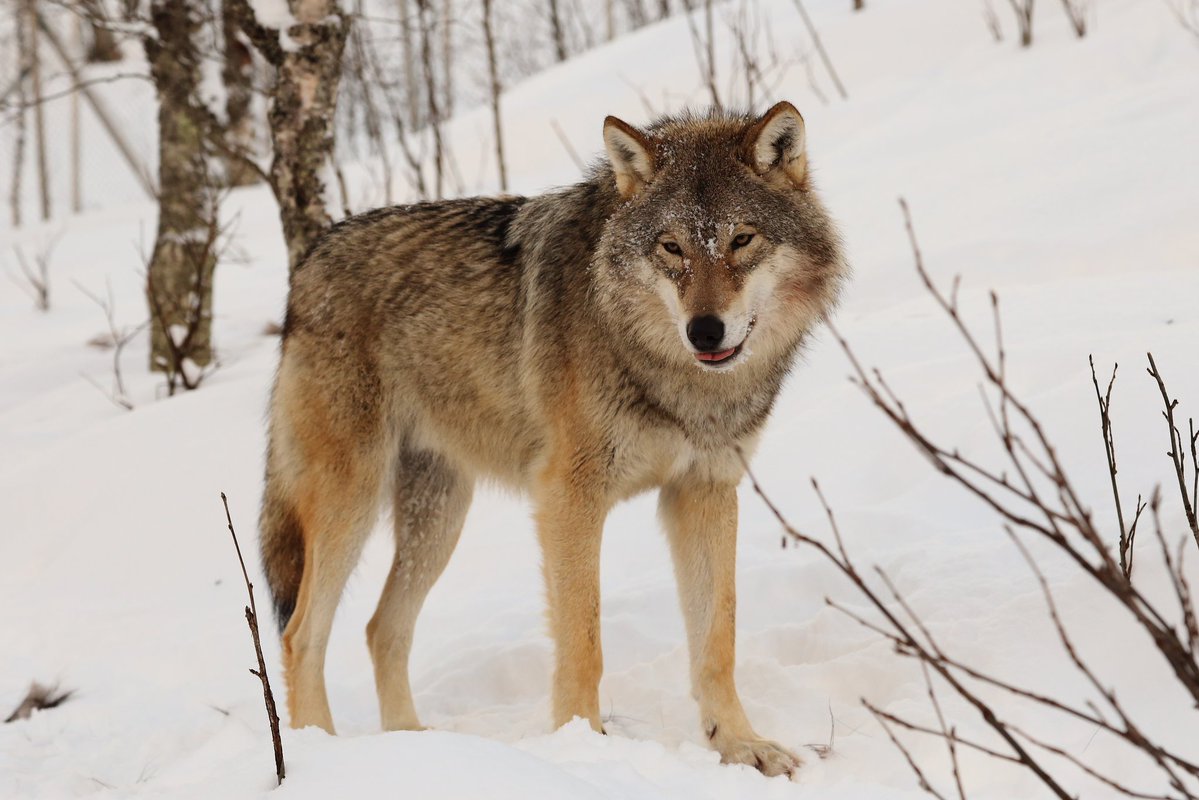
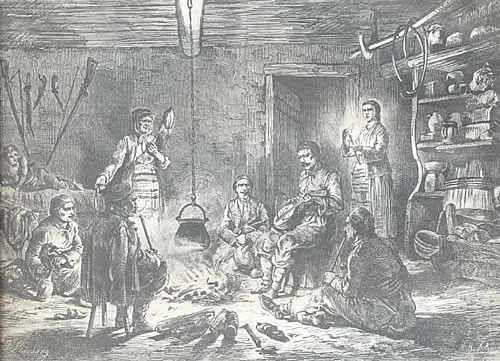
In the past Serbs believed that wolves were "enemies of demons". Which is why when the devil, a vampire, or an "unclean" deceased person was mentioned in conversation in Central Serbia and Montenegro people always added: "Vuk mu na put!" (May a wolf stand in his path!)
Serbs from Bosnia and Croatia drank rainwater from a wolf's paw-prints believing it had magic properties. This was because "wherever a wolf's paw treads, all evil is fended off from people, cattle, and crops"...
In Hercegovina, a hot arid area of the Balkans, people shouted "Vuk, vuk, oro krstaš!" (Wolf, wolf, imperial eagle!) to protect themselves from rising whirlwinds – which were believed to be of demonic origin and said to cause disease and insanity...
Incantation from Central Serbia "against any disease": "U kurjaka četir’ noge, dva uva, rep i zev. U kurjaka strašan zev: boljku će zazenut! Ustupi i beži!" (Wolf has four legs, two ears, a tail, and jaws, terrible jaws: it will devour the disease! Back off, go away!)
Serbian ritual practice recorded in Serbia, Montenegro, and East Bosnia, performed to ensure lasting health and strength of children, involved pulling the newborn baby through "vučiji zev" (wolf's yawn), the skin cut from around a wolf’s jaws...
Serbian incantation from Vojvodina "against any disease": "Spusti se kurjak nizbrdo da uhvati ovcu. Ne uhvati ovcu neg' uhvati svo zlo" (The wolf came down the hill to seize a sheep. But instead of seizing a sheep he seized all evil)...
In the past, when a son was born, it was customary in Serbian villages for the father to open the house door, stand on the doorstep, and announce the birth of the son by shouting: "Rodila vučica vuka!" (A she-wolf just gave birth to a wolf cub!)
When in some family male children kept dying, Serbs would give the next boy to be born name "Vuk" (Wolf). It was believed that this name would scare away demons which cause illnesses...
Wolf teeth were considered to be particularly magically potent. Serbs put them in bed around mother and baby as protection against demons. Children wore them as talismans which were meant to give them good strength and health. Serbs also used to call first child's teeth "wolves".
This magic ritual was recorded in Eastern Serbia and Kosovo. Local Serbs would look at a house through a wolf larynx (throat) if they wanted to cause quarrel in the family that lived in it. "Da bi se pojeli ko vuci" (So they would kill each other like wolves)...
In Serbia (and other Slavic countries and Finland), horse skull was placed on top of beehives to protect bees from pests and diseases. Particularly powerful was a scull of a horse killed by a wolf...Wolf sculls were also used for this purpose...
More bee related Slavic folklore in my post "bees".
It's getting late. In the mountains of the Balkans we find a peculiar type of "old style" singing which can only be compared with the howling of wolves. It is called "ojkanje" and could be the oldest polyphonic singing that has survived til today.
More about this ancient singing style in my post "Wolf singing".
Riddle:
Q: "Kroz goru odilo, kući ne doodilo?" (Wanders through mountain/forest, never comes home?)
A: Wolf
Symbolically this riddle is also a magic spell which forbids wolf to come from his mountain/forest to "our" human home...
In Serbia, when shepherds lost their sheep in the mountain, they ritually tied "verige" (chain on which cauldron is hang over the hearth). This was done to "close wolf's jaws" and protect the sheep...
More cauldron chain folklore in my post "Verige".
Recently I came across a very interesting article about the link between epilepsy and wolves in Balkan (mostly Serbian) folklore...
"Falling Sickness, Descending Wolf: Some Notes on Popular Etymology, Symptomatology, and 'Predicate Synonymy' In Western Balkan Slavic Folk Tradition" by Pieter Plas
The article is full of great ethnographic data, it makes some interesting connections, but it falls short of actully explaining this strange link. I would like to continue where the article stopped.
Wolves feature prominently in West Balkan (mostly Serbian) magic rituals used for curing epilepsy.
Among the Serbs in Kosovo and Metohija, epileptics drank water through the boiled throat or larynx of a wolf, which they ate afterwards; a wolf’s heart may also be eaten (raw or roasted) or worn (dried) on the body so as to cure epileptic fits.
In Zaječar (East Serbia) the testicles of a wolf were eaten for the same purpose. And in Central Serbia wolf’s eyes are worn sewn into the clothes as a prophylactic or curative medicine against epilepsy...
In North Croatian, almanac from the first half of the 19th century recommended drinking the powder of a wolf’s heart or liver (dried, pounded, and mixed with water) or eating wolf’s meat as a cure for apilepsy. A folk prescription in a Bosnian medicinal manuscript dated 1749 advises epileptics to drink rainwater found in a wolf's footprint...
In Metohija, Serbs wore the skin cut from around a wolf’s jaws, called vučji zev (wolf’s yawn) around the neck for three days as the cure for epilepsy. In North Croatia belts of wolfskin were worn on the body. In the Kučaj region of East Serbia, epileptic children are placed inside a circle formed with a string of wolf’s hair, which was then set on fire.
In the area of Leskovac (South East Serbia), the ‘falling’ of children due to fras ‘convulsions, spasms, eclampsia’, the symptoms of which are associated with epilepsy, is believed to be cured by the exclamation "Vuk, sine, vuk, majko!" (Wolf, o son, wolf, o mother!).
In Skopje region of Macedonia, any conversation about epilepsy must be ended with the words "Vuk pri nas" (The wolf with us), to prevent the disease to be called by uttering its name...
Why does wolf feature in all these magic cures for epilepsy?
Let me try to answer this question.
The main Serbian names for epilepsy are "padanje" (falling), "padajuća bolest", "padavica" (falling sickness). This name refers to the most severe symptoms of epilepsy: seizures, during which the sick person falls on the ground, loses consciousness or awareness and jerks uncontrollably.
In Serbian, epilepsy is also called "velika bolest" (the big disease), "rđava bolest" (bad/evil disease), "ona bolest, daleko bila" (that disease, may it be far away), "od onaj strana" (from the other side)...
Now you would imagine that there were much worse ilnesses than epilepsy. So why was epilepsy called "the big disease"? And what does it mean that it is "the disease that came from the other side"?
To understand this we need to look at another set of names for epilepsy:
"gora", "gorica", "gorska bolest" (forest illness) "goropad", "goropadna", "goropaština", "goropadilo", "goropaditi se", "pada od gore", "padati s gore" (which is falling, which fell from the mountain/mountain forest) illness...
Now this is a very very strange way to name a disease like epilepsy...
The word "goropad" is a very interesting word in Serbian langauge. Its literal meaning is indeed "one who fell from the mountain/mountain forest"... But it is used to mean "raging, wild, violent, forceful, fierce, unruly, devastating, untameable, scary, enraged, delusional, hellish, powerful, uncontrollable, restless, terrible".
This word is used to describe both humans who are in a state of high negative aggitation and wolves in their natural state...
So wolves are naturally "goropadan" fear inducing monsters...Which is why Serbs believed that "strava" (literally horror, but meaning fear fits, panic attacks, night terrors) in small children was the result of visual contact of their mothers with a wolf during pregnancy. There is an assertion recorded in Bosnia, that "strava" can "manifest itself as goropadica (epilepsy)”...Which indicates that Serbs believed that the wolf could induce epilepsy by passing his "goropadnost" (his natural state of horror inducing) to children who then develop "goropadica" (falling sickness induced by horror???)...
Which is why Serbian children that suffered from "strava" (horror, fear fits) were fumigated with (burning) wolf’s hair. Or they were rubbed with a wolf’s fur while saying "Da mi bidneš ka vuk" (May you be like a wolf) meaning fearless, the one who scares not the one who is scared. Or they were bathed in water in which a wolf’s heart (seat of courage) was rinsed...
Among the Serbs and Muslims in the Borja mountains in North Central Bosnia it was believed that "Ko kurjaka pati, taj će padati s gore" (If one tortures wolves, he will fall from the mountain, meaning will contract epilepsy)...They also believed that the livestock of the the man who tortured the wolf will also contract the same illness...
This is very interesting. It seems that people believed that the wolf will inflict the "goropadilo" as a punishment for mistreatment, disrespect. This is understandable if we know that Serbs respected wolves and equated them with their dead ancestors. Serbian old supreme god Dabog could take shape of "Lame wolf" and he was able to direct wolves and tell them what to do and who to attack. Which is why he was known as "The Wolf Shepherd". So disrespecting a wolf was a big sin and was therefore punishable by getting "goropadilo", "velika bolest" (the big disease) from (another) wolf.
Or the wolf god Dabog himself...
That this punishment could have been seen as coming from Dabog himself, can be seen from an ancient prayer against epilepsy recorded in Bosnia. In it, the devil, who in Serbian Christian folklore was assigned a lot of old prerogatives of Dabog, The Wolf Shepherd, The Lame Wolf, is ordered "not to gape his jaws at God's servant"...
After Christianisation, Serbian supreme god Dabog was replaced by Serbian patron saint Sava. And he also inherited the title of the "Wolf Shepherd" and the ability to command and control wolves...
In a Serbian folk tale, Saint Sava is requested by shepherds to christen a captured wolf that has killed their sheep, to prevent it from causing more damage. Remarkably enough, a monk is ordered by the saint, before the christening, to read out a prayer against "goropadilo" (falling sickness, lit. mountain/wood falling) to the wolf...Why? Is it because only wolves who themselves have "goropadilo" (the big disease), which makes them "goropadan" (terrible, frightful, monstrous), attack people???
In Svrljig, South East Serbia. There, children suffering from epilepsy were "locked in and unlocked from" a wolf trap at crossroads "in the dead of night".
The crossroads were one of the places where the dead gathered "in the dead of the night"...This is also a place where Serbs used to set up ritual feasts for wolves "in the dead of the night" so that they would take the offered food and leave people alone...I talk about these ritual wolf feasts in my post "Wolf feast".
This shows that Serbs saw wolves as their dead ancestors. And that they saw wolf actions as punishment coming from the ancestors. Including the original ancestor God Dabog, The Wolf Shepherd...
Wolf's natural habitat is "gora", word meaning both mountain and mountain forest. Which is why in Serbian folklore wolf always "silazi s gore" or "pada s gore" (both meaning comes down from the mountain/mountain forest). He is "sin gore" (the son of the mountain/mountain forest) and when wolf kills someone it is said "gora ga uzela, odnela" (mountain/mountain forest took him/it).
This is very interesting because in East Serbia, epilepsy is believed to be caused by a mythical or demonological character called "Gorska majka" (Mountain Mother) or "Šumska majka" (Forest Mother)...
So if we know that the word "padati" (falling down) in Serbian is actually a synonim of "silaziti" (coming down from), then "goropadilo" (epilepsy) could also mean "sickness that came down from the mountain/mountain forest"...
How can a sickness like epilepsy "come from the mountain/mountain forest"?
Well as we have seen the sickness is brought down from the mountain/mountain forest by a wolf, the son of the mountain/mountin forest...And not just any wolf. Wolf which is "goropadan" (terrible, frightful, monstrous).
There is a very intersting ritual recorded in all parts of the Balkans inhabited by Serbs. When a wolf is attacking the village, villagers organise a hunt, kill the wolf and bring it to the village. Then an effigy is made from the wolf's skin. This effigy is then paraded through the village, and villagers give food and drink to the hunters for killing the wolf. Actually, it seems that originally villagers were giving the food and drink to the wolf, as offering, as the whole procession is accompanied with the song that asks villagers for offerings "so that wolf will not come down from the mountain/mountain forest again"... This wolf effigy has to be made to look "goropadan" (terrible, frightful, monstrous) as "the dead wolf did a lot of evil things" before it was killed...
So here is what I think is going on here.
I believe that here we have a confusion between two ilnesses, with the same extreem symptoms: seizures, fear, anxiety, agitation, muscle twitching, jerking excessive movement, drooling and foaming at the mouth.
The first one is epilepsy "padanje" (falling), "padajuća bolest", "padavica" (falling sickness).
The other one is rabies, "padanje sa gore", "goropadanje", "goropad" (falling from the mountain/mountain forest sickness). This is "the big disease" which "came from the mountain/mountain forest" and which was brought from "the other side" by the wolf.
I wonder if people couldn't distinguish between these two illnesses and somehow they merged them into one. In the past people didn't know that things like bacteria and viruses existed and that they were the cause of diseases. They knew that if a "goropadan" wolf burst into a village and bit someone, the victim would develop "goropadanje" (falling which was brought from the mountain by the wolf) and which made the victim have seizures, fear, anxiety, agitation, muscle twitching, jerking excessive movement, drooling and foaming at the mouth...
Rabies. This is a horrible incurable disease which results in terrible agonising death.
Then when someone developed epilepsy, which had very similar extreme symptoms, people would believe that the person suffered from the same "wolfish" disease... Which is why epilepsy eventually started being called "goropadica". And which is why we see all these wolf related magic rituals used to cure epilepsy which has nothing to do with wolves...
That this indeed could be what happened can be seen from the fact that Serbs saw the epileptic symptoms as fury, rage which is why they associated epilepsy with "strava" (horror, panic attacks in children). And these panic attacks were in turn associated with insanity and rabies which is in Serbian called "besnilo" (rage, fury) which is one of the meaning of the word "goropadnost" used for epilepsy...
Serbs also believed that "besnilo" (rage, fury, rabies) was an an innate or intrinsic quality/property of wolves, which can be seen from a phrase "bijesan kao vuk" (furious, raging, rabid as a wolf) used for persons with "bad temper".
Which must be the consequence of relatively frequent rabid wolf attacks in the past...
We known that an attack of a rabid wolf is a horrifying traumatic experience. So traumatic that it can cause "unborn babies to develop night horrors if their mothers have seen a wolf while pregnant". To understand what I am talking about, here is a report describing an attack of a rabid wolf in India and the horrible consequences that it left on the community:
Imagine the consequences before vaccines...
It is interesting that the report says that a dog developed rabies after eating a rabid pig carcass. In Serbia people believed that insanity can be caused by eating the brains of a rabid wolf...
So...
Normal healthy wolves avoid humans and especially human settlements. Only rabid frenzied wolves would burst into a village and start attacking people for no reason...Well except during big snows, when "in the dead of winter", hungry wolf packs would out of desperation, and again in frenzy induced by starvation, attack villages "in the dead of the night" in search of food...
And if the wolves were rabid, and if they bit people or their animals, they would fall ill with "the big bad sickness brought down from the mountain by a wolf"...
What do you think?