Showing posts with label Helios. Show all posts

Saturday, 9 August 2025

7 heads

Good morning. Old Assyrian (2000 BC-1800 BC) cylinder seal. Currently in the British museum...

Official description: Man in a chariot driving four horses; before him seven human heads and two birds; one other bird is above the two horses

Hmmm...

Quadriga in 2nd millennium BC Mesopotamia... Interesting...A man? Or a God? Like Sun god? They love horse drawn chariots...Like Helios depicted in his horse drawn quadriga on this Apulian vase dated to 350BC...

Why would sun gods like horses so much? The natural breeding season of horses starts in Apr/May and ends in Sep/Oct spanning the sunny, hot half of the year in the continental Eurasia, and is marked by wild stallion fights for mares...

The horse fertility is governed by the sunlight and peaks on summer solstice. I heard summer solstice was a big thing for sun worshipers....

Hence solar horses all over Eurasia...

Articles about solar horse (equid):

Iran "Water carrier equid", "Dioscuri plate from Iran"

Mesopotamia "Shamash playing with the solar horse", "Sun god from Tell Brak"

India "Hayagriva"

China "Longma", "Three legged crow", "Mythical beast from Xian"

Levant "Alexamenos graffito", "Goddess on a horse", "Unicorn"

Europe "Archaic rider", "Beotian solar pyxis", "Pegasus and chimera", "King John", "The horseman"

But the quadriga rider depicted on this Assurian seal can't be Helios...And his quadriga can't be pulled by horses...

He is most likely Sun God Shamash who was depicted on this 3rd mill BC cylinder seal imprint found in Tell Brak, Syria riding on a quadriga. Quadriga pulled not by horses but by "kungas", donkey hybrids so highly regarded, that "they were the preferred draught animal for drawing the chariots of kings and gods"... I talked about this in my post "Sun god from Tell Brak"...


Shamash rides on the quadriga pulled by donkeys, because donkeys are also solar animals, just like horses. This is because just like the mating season of horses, the mating seasons of donkeys is directly linked with the amount of sunlight and peaks on Summer solstice... 

Interestingly: In a letter dated to 1775 BCE, Bahdi-Lim, governor under the Mari king Zimri-Lim, insists that the king should not ride horses in his capital, as it was considered uncivilised. Instead, he urges the king to honour his royal status by riding in a donkey-drawn wagon...

From my post "Alexamenos graffito" about this:

Christ riding into Jerusalem on a donkey by Oleksandr Antonyuk. 

Why did Jesus have to ride into Jerusalem on a donkey?

People say: He was fulfilling a scripture prophecy.

"Rejoice, O people of Zion! Shout in triumph, O people of Jerusalem! Look, your king is coming to you. He is righteous and victorious, yet he is humble, riding on a donkey" Zechariah 9:9

God/King riding on the favourite ride of the old Gods/Kings... 

And this:

Christ is born on Winter Solstice, (re)birth day of the sun (god), he enters Jerusalem on a donkey, "animal of the (sun) gods and kings", and gets put on a cross, symbol of the sun (god)...Interesting...Early Christian "Alexamenos graffito", Rome. 


Anyway, back to our Assyrian seal. Why 7 human heads? Maybe 7 months of Mesopotamia summer? 

I talked about this first in my post "Seven headed dragon" The oldest depiction of a Hero(es) killing a 7 headed dragon dragon...Mesopotamia, 2200BC...With 7 snake heads...One for each hot month of Mesopotamian summer...They are killing the 4th head. Apr/May, May/Jun, Jun/Jul, Jul/Aug...  


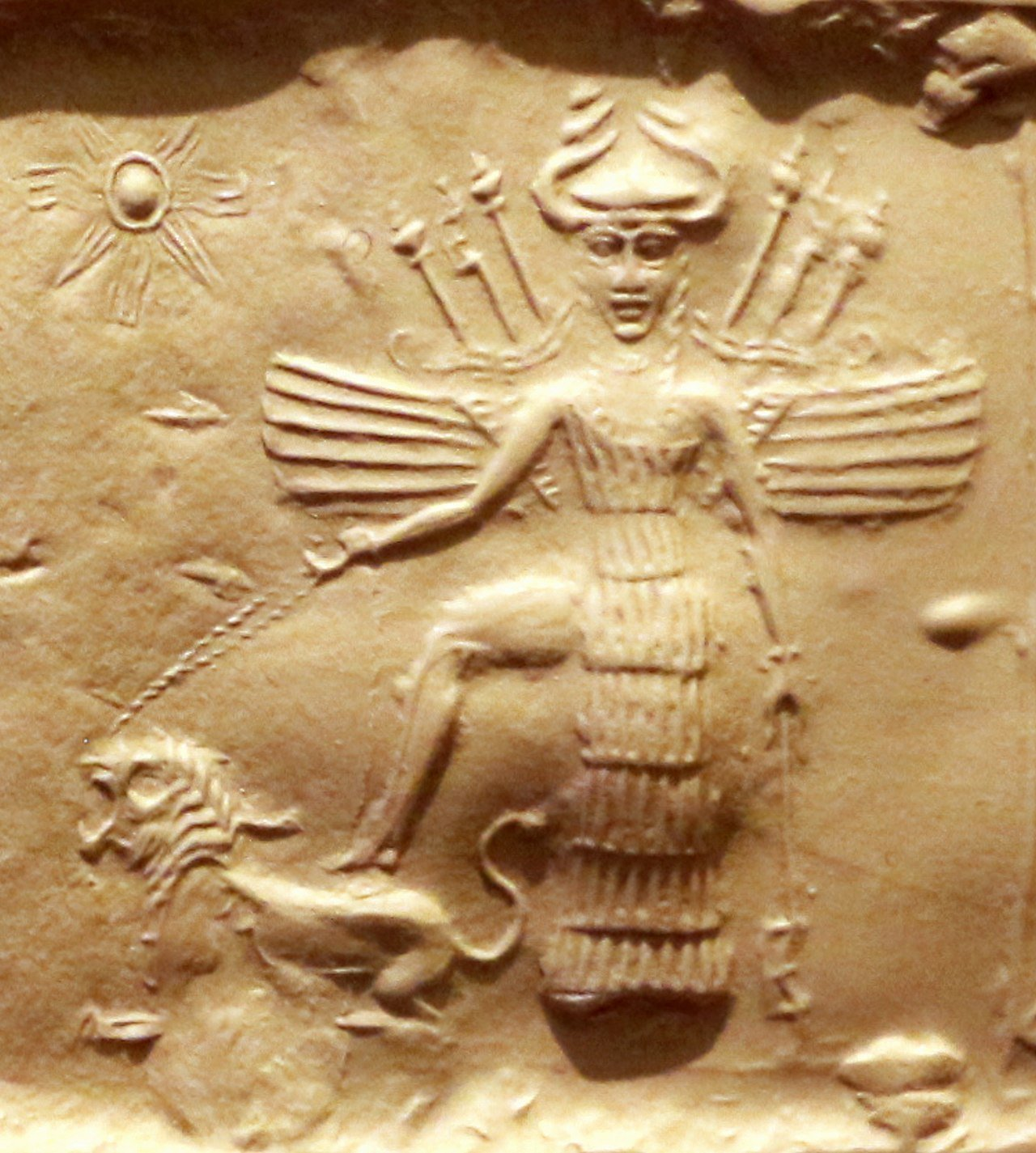
Leo...The time when Sirius rises with the sun..There is also a princess (Inanna/Ishtar) standing under a star (Sirius) ๐Ÿ™‚...

Here is Inanna/Ishtar, deified Sirius, which rises with the sun (morning star) in Leo, Jul/Aug, the hottest time of the year. Which is why she is depicted standing on a lion with the sun above lion's head and is known as "The Lioness of heaven"...

I talked about Inanna/Ishtar as Sirius in many of my posts...

Same girl, same beast (summer)...

Woman of the Apocalypse...I gave Full symbolic analysis of the Chapter 12 of the Book of Revelation in my post "Apocalypse"...

Anyway, back to our Assyrian seal. Why birds? Originally I thought that maybe these are migratory birds, cause migratory birds announce the start and end of summer, the domain of the Sun god?

I talked about migratory birds in Mesopotamian mythology in my post "Nanshe'. In Sumerian mythology, Nanshe was the daughter of Enki (god of water) and Ninhursag (earth goddess). This 3rd Dynasty or Ur plaque depicts goddess Nanshe with geese.


This is because the arrival and departure of migratory geese marks the beginning and end of the wet half of the year in Mesopotamia. On the flip side the departure and the arrival of the migratory geese marks the beginning and the end of the dry half of the year in Mesopotamia.


 But now, I am thinking that based on the shape of the birds they could actually be doves. 

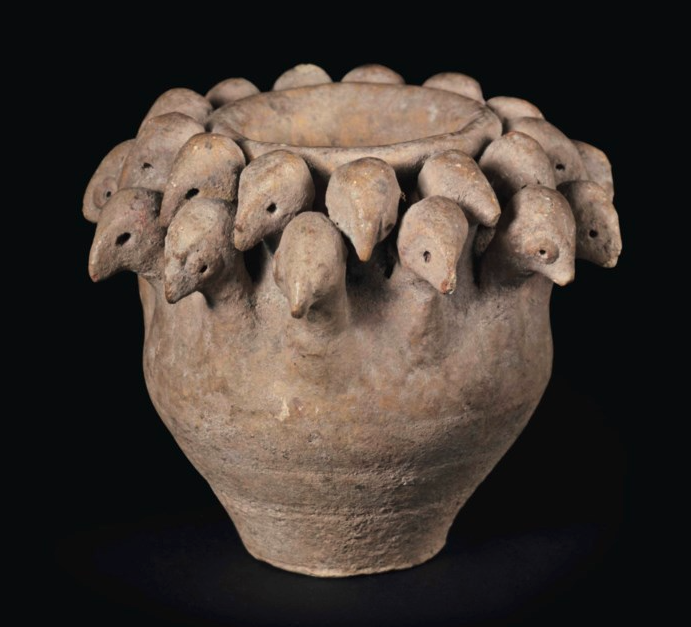
Dove was sacred to Inanna/Ishtar. 1800-1600 BC pottery cup, Syria. The rounded body tapering to a flat base, with 26 bird heads. Similar objects were interpreted as votive objects dedicated to Ishtar/Inanna, who was also linked to grain and doves. 

The reason for that is that nesting season of doves overlaps with the grain harvest season. 

Which brings me to: is that grain depicted just above the two birds? Right in front the chariot...

We know that this has been a grain symbol in Eastern Mediterranean, Mesopotamia, Central Asia, Iran, since at least Sumerian times...

I talked about this in many of my posts...

Mesopotamian harvest coincides with the beginning of summer (Apr/May), the beginning of the mating of wild donkeys and the beginning of summer, the domain of the Sun God...

Maybe I am just reading too much into this. Maybe it is a man, a king, riding triumphantly over severed heads of his enemies which are being pecked by vultures and ravens....That's kind of cool too...

PS: A 5,000-year-old toy chariot found during the excavations in the ancient city of Sogmatar in the southeastern Turkish province of Sanliurfa...With what looks like grain symbols?


To read more about ancient animal and plant calendar markers, start here…Then check my twitter threads I still didn't convert to blog post...I am way way behind...

Sunday, 18 December 2022

The Tree of Light (Life)

3,000 BCE Sumerian Stamp Seal with Impression Tree of Life with Rampant Goats. Mesopotamia. Chicago. Oriental Institute Museum...

This "Tree of Life" looks a lot like Hanukah Menorah...So maybe I should look into it???

Ok First...I got this image and the info years ago and I added it to my notes where it lay until two days ago when I decided to use it as an illustration for this article. Unfortunately, I can't find this image using the Oriental Institute search any more...Searching the net, all I could find was a bigger picture of the same seal in a display cabinet, next to what looks like a top of a plaque (?) with a depiction of a Sumerian deity with characteristic horned headdress...


Because I couldn't find any direct link to the data about this object on the Oriental Institute Museum website, I have to put a big question mark about the data I posted about this seal. I would be grateful if anyone can give me more info about it, where is it, what is it exactly. Thank you.

Anyway...

If this "Tree of Life" was an ordinary looking tree, like this 2600 BC one found in the Sumerian Queen Pu-abi's tomb, I would say Ibex animal calendar markers marking Ibex mating season which overlaps with rain season which supports (the tree of) life...I talked about it in my post "Shell plaque with ibexes"...

But is the shape of that Tree of Life a coincidence? I started digging around and I found this: A 13th c. BC pottery shard from Lachish, an ancient Canaanite and Israelite city in the lowlands of Judea, mentioned in the Hebrew Bible. O look, Temple Menorah! Flanked by Ibex goats! Pic from Western Asiatic Tree-Goddesses by Irit Ziffer


Soooo...

This is the reconstruction of the menorah of the Temple in Jerusalem, created by the Temple Institute of Israel. Menorah is widely recognised as a symbol of Hebrew culture...

But what was Menorah supposed to have been the symbol of originally?

Apparently Yahveh himself gave the instructions how to make the original Menorah to Moses: 

Hammer a lamp out of one piece of pure gold. It should have a base and shaft, with 3 branches on one side and 3 on the other, ending in cups shaped like almond flowers...

The menorah was made and placed in the antechamber of the Temple sanctuary, over against its southernmost wall...Its cups were lit daily from fresh, consecrated olive oil and burned from evening until morning...

There is a story in Talmud that says that although all the lamps were filled with the same amount of oil, and the central lamp was lit first, all the other lights would run out of oil by the morning, except the central lamp which continued burning oil all through the day too...

This miracle, according to the Talmud, was taken as a sign that the god dwelt among Israel and the central lamp was actually called the lamp of god...

Most people associate Menorah with the winter holiday of Hanukah. The Menorah lit during Hanukah though has 4 branches on each side...Apparently, the Talmud states that it is prohibited to use a seven-lamp menorah outside of the Temple...Hence eight-lamp Hanukah Menorah...

But apparently this is not why the Hanukah Menorah has 8 branches. There are two stories explaining why Jews celebrate Hanukah when they celebrate it (end of Nov/Dec beginning of Dec/Jan, basically mid winter), and why they light Menorah with 8 branches during this celebration...

The first one states that this is to commemorate the recovery of Jerusalem and subsequent rededication of the Second Temple at the beginning of the Maccabean revolt against the Seleucid Empire in the 2nd century BC...

According to the Talmud, there was only enough consecrated olive oil left to fuel the eternal flame in the Temple for one day. Miraculously, the oil burned for eight days, giving the Jews enough time to press more fresh oil...Hence Hanukah and 8 branch Menorah...

But there is another story, also from Talmud, that says that when Adam, during his first winter, saw the days growing shorter and shorter, he feared that God was angry and planned to destroy the world...

So what did he do while he waited for the end of the world? He feasted for eight days and nights ๐Ÿ™‚ Then the light began to grow longer. What did Adam do when he realised that the world was actually not going to end? He feasted for eight days and nights of course ๐Ÿ™‚

The next year, Adam celebrated both the eight days of darkness (before winter solstice) and the eight days of light (after winter solstice). The Talmud gives this story as the explanation for the Roman winter solstice festival of Saturnalia...

But Talmud scholars, like Prof. Moshe Benovitz, believe that "The ritual of candle lighting on Hanukkah developed from Roman custom of lighting lights during the Solstice festival of Saturnalia, most likely during the reign of King Herod"... 

Prof. Benovitz also says that it was only later that 8 days of Hanukah and the 8 branches of Hanukah Menorah were connected to the Maccabees, in the form of the miracle of the oil...

Implying that this was just a Roman fashion adopted by the Jews during Roman occupation...

This would mean that lighting of candles over Hanukah (winter solstice) has the same ritual significance as burning of the Yule log during Christmas (winter solstice)...It is a ritual rekindling of the sun's fire...

"The ancient fire-festival of the winter solstice...has survived...in the custom of the Yule log...[once]...widespread in Europe, it seems to have flourished especially in England, France, and among the South Slavs"...From "The Golden Bough"... 

I talked about it in these articles:

"Yule log in English tradition", "Yule log in French tradition", "Yule log in South Slavic tradition", "First footer"...

And this foreign custom was later absorbed into Judaism through Maccabees oil miracle story...Hmmmm...I definitely agree that lighting of the Hanukah Menorah is a winter solstice ceremony. But I would disagree that the Jews learned how to worship sun from the Romans...

I would argue that the original Maccabean Menorah lighting ceremony, which took place in the Second Temple of Jerusalem, was performed on winter solstice too. Deliberately...

In fact, I would argue that the whole Maccabean revolt against the Seleucid Empire in the 2nd century BC was timed to start at "auspicious time", so that lighting of the Temple Menorah can lit in the rededicated temple on winter solstice...

Which would mean that Hanukah is NOT a Jewish festival commemorating the recovery of Jerusalem and subsequent rededication of the Second Temple at the beginning of the Maccabean revolt...It is the same winter solstice ceremony Maccabeans performed themselves...

And it is definitely NOT a Roman import...

Do I have any proof for this? 

Weeeell...Remember the Talmud story about the central light of the First Temple Menorah, which was the only light that burned through the day...Just like The Sun, does...The God light...

Knowing the link between Menorah Hanukah and the Sun, the fact that the central candle of the Hanukah (Solstice) Menorah is called Shamash (The name of the old Akkadian sun god), and that this candle has to be lit first, and then used to light all the other candles, shouldn't be a surprise any more...

Of course, we are told that the name of the central Menorah candle, shamash, means "attendant" or "servant"...That could be so...Hebrew is written without vowels...So ืฉืžืฉ (sh-m-sh) can be interpreted in different ways, depending which vowels are inserted...Any one means servant?

However, when we look at the Hebrew Old Testament, what we find as the translation of the word ืฉืžืฉ (sh-m-sh), is this:

Strong’s H8121, ืฉืžืฉ shemesh, a concrete noun meaning, “sun, sunrise,” from an unused primitive root meaning, “to be brilliant.”

Out of 134 times that this word appears in the text

119 times shemesh is translated as “sun.”

9 times it is translated as “sunrising.”

2 times it is translated as “east side.”

1 time each it is translated as “window,” “eastward,” “west,” “westward.”

Like: And take heed, lest you lift your eyes to heaven, and when you see ืฉืžืฉ (the sun), the moon, and the stars, all the host of heaven, you feel driven to worship them and serve them, which YHVH your God has given to all the peoples under the whole heaven as a heritage. Deu 4:19

And so it is pretty clear that the central light of the Hanukah (Winter Solstice) Menorah, Shamash, represents The Sun, The True Light which lights up everything else...

Here is another interesting scripture excerpt featuring ืฉืžืฉ (the sun):

Then he removed the horses that the kings of Judah had dedicated to ืฉืžืฉ (the sun), at the entrance to the house of YHVH...and he burned the chariots of ืฉืžืฉ (the sun) with fire. 2 Kin 23:11

Remember this? My article "Boaz and Jachin" about the  (First) Temple, built on a Threshing Floor (also used as solar observatory), and "oriented" (made to face east). A "House of God" made to face the "House of (Sun) God"...

And do you remember this? My article "The sun god from the first temple" about the solar cult from the First Temple? In it, I asked: was Helios the Sun God of The First Temple who rode in a horse pulled quadriga? 


I asked this (silly) question, because the sun god worshiped in The First Temple rode on quadriga pulled by 4 horses. And when I wrote that article, way back when, I didn't know that Shamash also rode on a quadriga...3rd mill BC cylinder seal imprint found in Tell Brak, Syria...

I talked about this in these two articles: "Sun god from Tell Brak", "Shamash playing with solar horse"

So I think that the Sun God that Josiah says the Jews worshiped in the First Temple was no other than Shamash himself... 

Interestingly, the quadriga of the sun god Shamash rode on was not originally pulled by horses but by but "kungas", a specially bred hybrids between female domesticated donkey and a wild male Syrian wild ass...Basically a fancy donkey...Pic: Male Syrian wild ass...

Kungas were so highly regarded, that "they were deemed especially suitable for drawing the chariots of kings and gods"...

Kings and gods...Kings and gods...Why did Jesus have to ride into Jerusalem on a donkey/ass again? To prove what?

People would say: He was't proving anything. He was fulfilling a scripture prophecy.

"Rejoice, O people of Zion! Shout in triumph, O people of Jerusalem! Look, your king is coming to you. He is righteous and victorious, yet he is humble, riding on a donkey— riding on a donkey’s colt." Zechariah 9:9

Except he didn't ride on a donkey to show he was humble...He rode on a donkey, cause donkey was the ride of kings since Sumerian times...And he and his "revolutionary" pals new it...And when I say revolutionaries...I talk about religious revolutionaries...Or maybe counter-revolutionaries...Not everyone in Judea liked what Josiah and his followers did...

And even though Jesus says: "My Kingdom is not an earthly kingdom. If it were, my followers would fight to keep me from being handed over to the Jewish leaders. But my Kingdom is not of this world." John 18:36

There is no way that him and his followers weren't aware of the significance of the fact that donkey was originally the mount for God/King...Shamash...

But I am digressing...This is all really cool so far. But I don't think that this was the (only) original meaning of the Menorah that Yahveh told Jews to make "in a shape of a blossoming almond tree" and which should be lit only by freshly pressed olive oil...

Sure the fact that this Menorah was a lamp made from pure gold hints at the solar aspect of this symbol...But Menorah was a lamp shape like a tree. The Tree of Light? Sure...The Tree of Life too? Let's see what plant calendar markers can tell us...

In Levant, almond trees are the first trees to bloom each year...They blossom in Jan/Feb. At the end of winter, beginning of Spring...I don't think Yahveh chose the Menorah tree randomly...

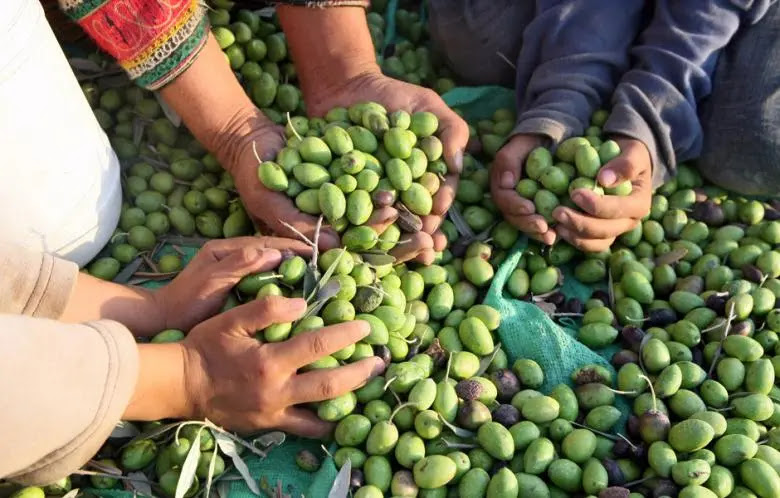
In Levant, olive harvest season is Oct/Nov/Dec (in the past even Jan). It starts at the end of autumn, beginning of winter...Oil is pressed right after all the olives were harvested...So in Oct/Nov/Dec...I don't think Yahveh chose the Menorah fuel randomly...

Here is why I think Menorah could be a complex calendar marker...This is climate in Levant...You can see that the climatic year is divided into two halves, the hot, dry summer (Apr/May - Oct/Nov), and cool, wet winter (Oct/Nov - Apr/May)...

In Levant, it is the rain that falls during the winter that supports "The Tree of Life", that makes life possible...And the wettest time of the year Levant is between the harvesting of olives and blossoming of almonds, peaking right around winter solstice...

And as I said at the beginning of this article, there is one other thing that happens in Levant, Mesopotamia between Oct/Nov and Jan/Feb, peaking around winter solstice: mating of wild ibex goats marked by wild loud buck fights...This is why Ibex was in Levant, Mesopotamia associated with winter, rain and the tree of life...


Interestingly, Hanukah (winter solstice), the rainiest time of the year in Levant, falls at the beginning of the month of Tevet, which usually occurs in Dec/Jan on the Gregorian calendar...BTW, Tevet comes from Araแธซ แนฌebฤ“tum, the "muddy month"...Appropriate for the wettest month of the year in both Mesopotamia and Levant...

The mazal (constellation) for Tevet is gedi (goat), Capricorn...Capricorn, Tevet, ends when wild Ibex goats stop mating, and almond trees start blooming in Levant, in Jan/Feb...Soon after that the rains stop, and shamash ืฉืžืฉ (the sun) god, who disappeared in Oct/Nov comes back...

Sooooooooo....What should we make out of all this? Was Menorah deliberately shaped like a tree of life, because it was originally just burned during the winter, rain season, Oct/Nov - Jan/Feb, during the time when Sun, Shamash, was absent, to symbolically replace his light?

Don't know...I will leave it all this info here. It might be useful to someone for something...

Oh, and Merry Christmas and Happy Hanukah...

To read more about ancient animal and plant calendar markers, start here…then check the rest of the blog posts related to animal calendar markers I still didn't add to this page, and finally check my twitter threads I still didn't convert to blog post...I am 9 months behind now...


Friday, 24 July 2020

Croesus

This is Croesus, the last Lydian king. In 546 BC, he misunderstood the prophecy from Delphi, which said that "If Croesus attacked the Persians, he would destroy a great empire". Croesus went to war with Persia which ended up with the destruction of his empire...


Apart from being famous for his disastrous prophecy interpreting abilities, Croesus was also famous for minting the earliest known gold coins known as "Croeseids". They always depicted lion and bull in this pose, and the meaning of this scene is still debated... 


Finally, Croesus was also famous for the fact that no one knows what actually happened to him after he was captured by the Persian king Cyrus the Great...

In the version of the story written by Bacchylides, Croesus tried to commit suicide, by burning himself on a pyre. But at the last moment Zeus sent the storm with rain which extinguished the fire, and then Apollo took Croesus to the Hyperboreans where he lived happily ever after


In the version written by Herodotus, Cyrus captured Croesus and ordered for him to be burned to death on a pyre. But at the last moment, Croesus was saved from death by Apollo who sent a violent storm with rain which extinguished the flames. Cyrus then made Croesus his advisor..

The fact that we don't know how Croesus ended up on the pyre and what happened to him after he was saved, is not that interesting (to me at least). What is interesting (to me at least) is who and how saved him...

In the Bacchylides' version, Zeus, the God of Thunder, sends the rainstorm which extinguishes the flames. But in the Herodotus' version, it is Apollo who sends the rainstorm which extinguishes the flames...A weird thing for a Sun god to do...

A lot of people say that Herodotus was "known" to have written crap...But maybe not. Maybe Herodotus just had access to information other Greeks didn't...

Homer pictures Apollo on the side of the Trojans, fighting against the Achaeans, during the Trojan War. Believe or not the Hittite records, which called Troy "Wilusa", identify Trojan tutelary deity as a god named Appaliunas (A-ap-pa-li-u-na-aลก), usually identified as Apollo...

Now there is a recently translated Hittite document which talks about a peace contract made between Hittite king Muwatalli and Wilusa king Alaksandu...The kings swear not to break the contract and list their deities as witnesses...

And in that document, one of three gods guaranteeing the terms of the treaty on the side of Alaksandu is A-ap-pa-li-u-na-aลก who was described as the "Storm-god of the Army"...

Well, I guess, a storm god could easily send a rain storm to extinguish the flames of the Croesus' pyre...Right?

You know how you always wandered (well I did anyway) why Greeks were so afraid of lyre playing Apolo? They weren't. They were afraid of A-ap-pa-li-u-na-aลก...

The same way Serbs were afraid of Sveti Ilija Gromovnik (St Elijah the Thunderer), The Thundering Sun. Serbs celebrate him at the end of summer and beginning of autumn. The moment when summer (represented by a bull) ends and autumn (represented by a lion) begins. Lion and bull???

In Serbian folklore, St Elijah is a weird character indeed. He is both the sun god (Helios, Veles) and storm god (Zeus, Perun)...Like A-ap-pa-li-u-na-aลก??? I talked about St Elijah in my article "Thundering sun god"

He gets so angry every year around his pattern day, 2nd of August, the hottest part of the year, called in the Balkans "Kresovi, Krijesovi" (fires), that he "wants to burn the world to cinder". Just like any real scary sun god would do...

But he doesn't...His wife/sister Ognjena Marija (Burning Mary, the ever hotter summer earth) calms him down...After St Elijah calms down, his wife turns to Blaga Marija (Mild, Kind Mary, the ever cooler autumn earth)... 

And right then, at the end of summer, beginning of autumn, the temperature starts to decrease and the first autumn rains arrive, the world is saved...By the way, Serbs believed that these rains were brought by St Elijah himself...As any decent thunder god would have done...Hence Elijah (Helios) "The Thunderer" (Zeus)...

Climate chart for Belgrade, Serbia...


In Serbian the expression "On vedri i oblaฤi" means "he rules", "he has absolute control, absolute power". Literally this expression means "he makes the sky clear and cloudy"...

Originally the all powerful one was the Sky God...I talked about this in my article "The power of the thunder giant"

Was the original Apollo, "A-ap-pa-li-u-na-aลก", before Greeks borrowed him from the Anatolians, one such god? The sun god + storm god = scary MF who can destroy your crops, dry out your wells, flood your houses, kill you with fire and lightning and disease? I believe so...

Finally, did you know that apparently no one knows what Croesus's name means??? Croesus comes from Latin Croesus, from Greek Kroรฎsos (the name has no further etymology)...

As i said he was famous for his gold, and for the pyre...Now Ancient Greek word for gold was ฯ‡ฯฯ…ฯƒฯŒฯ‚ (kสฐryห.sรณs)...Was this the root of his name? Golden king? Just misspelled???

At the same time Slavic word Kres, Krijes, Kris means "fire" but also "ritual summer solstice bonfire" representing the sun's fire...


Looks very much like Croesus's pyre...And sounds very much like Croesus...Probably a coincidence...

Wednesday, 22 January 2020

Herald of spring

At the Minoan site of Akrotiri, which was devastated by the Thera eruption in the mid-second millennium BCE, the Minoan ‘Spring Fresco’ (c. 1600 BCE) features blooming lilies and dancing swallows...


Hesiod (c. 700 BCE), one of the earliest Greek poets, believed that swallows proclaimed spring. This drawing, copied from an Attic red figure vase (c. 510 BCE), shows three men looking at a swallow and cheering: "Look, a swallow. It must be spring!"...


The people of Rhodes particularly loved the swallow; you were considered lucky if a swallow nested in your house... Terracotta scent bottle found in Kameiros, Rhodian, c. 610–550 BCE...


Athenaeus of Naucratis (3rd c. CE) writes that in ancient times, after the first swallow was spotted, the Rhodians would hold a festival. The only other festival celebrating the return of the migratory birds (that I know of) is recorded in Macedonia...I talked about this in my post "Leto".


During the festival the Rhodian children would sing:

He comes! He comes! Who loves to hear
Soft sunny hours, and seasons fair:
The swallow hither comes to rest
His sable wing and snowy breast.

The children then ran to different houses and "played the swallow", demanding food...

This Rhodian "obsession" with swallows is interesting. They are also the only Classical Greeks who were "obsessed" with Helios, at the time when "no cultured Greek would worship him"...The Colossus of Rhodes was a statue of Helios...


Helios is usually depicted as a handsome young man crowned with the shining aureole of the Sun, who drove the chariot of the Sun across the sky...Homer described Helios as a god "who gives joy to mortals"...So he was the young sun, the bringer of Spring...


The swallows announced the arrival of Helios, the bringer of spring. Passage from Greek Magical Papyri says of Helios, "the earth flourished when you shone forth and made the plants fruitful when you laughed, and brought to life the living creatures when you permitted."...

Just like in Slavic mythology, where the return of the migratory birds announced the arrival of the young sun Jarilo, the bringer of spring...It is his return from the land of the dead which was celebrated by the spring festivals across Europe...

The word for swallow in Ancient Greek was ฯ‡ฮตฮปฮนฮดฯŽฮฝ (/kสฐhttp://e.liห.dษ”̌หn/ → /xe.liหˆรฐon/ → /รงe.liหˆรฐon/). This was also a name of a constellation, which is today part of the Pisces (fishes)...

This constellation was called swallow: "...in consequence of the entrance of the sun into this constellation, when the swallow appeared in Greece as the herald of Spring..." Pisces: 19 February – 21 March, just before Spring equinox...From: "Astronomia"

At this time, at the beginning of the Spring, the constellation swallow rises at twilight, just before the sun, Helios, to announce his arrival. Very poetic indeed. Interestingly, swallow was in Ancient Greece associated not just with spring but with the time just before dawn...


So here is another example of constellation named after an animal, which marks a significant yearly reoccurring event from this animal's lifecycle. In this case return of swallows. Just like all the animal constellations from the Zodiac. 


More in my posts about zodiac signs.

Slavs also venerated swallows as solar animals. 

You can read about slavic swallow folklore in my post "Swallows". 

There is even a legend that says that if it wasn't for swallow the sun would not be shining in the sky...


You can read more about this in my post "Three suns".

Great web page about the Cultural responses to the migration of the swallows.

Friday, 13 April 2018

Lion killing snake


I came across this very interesting object on edgarlowen.com auction site:

9764. ROMANESQUE MARBLE SCULPTURE. France or Northern Italy, Romanesque period, c. 11th-13th century. A free standing triangular sculpture, likely from an early church, with a man with unkept hair, most likely Jesus, grasping the head of a lion which in turn holds a serpent in its mouth. Clearly a highly symbolic piece though the exact meaning is somewhat obscure. 5.5 x 10.5 x 19 inches. Excellent condition, all original with no repair or restoration. Extremely rare and a very remarkable piece of early Christian iconography.

Though not certain, the symbology of this piece most likely refers to Psalm 91:11-13 "Thou shalt tread upon the lion and adder: the young lion and the dragon shalt thou trample under feet." which is traditionally taken to refer to the defeat of Satan (represented by the serpent and the lion) by Jesus. The passage led to the Late Antique and Early Medieval iconography of Christ treading on the beasts, where beasts were most often depicted as lion and snake, both of which represented the devil, as explained by Cassiodorus and Bede in their commentaries on Psalm 91.  

The earliest and one of the most beautiful example of the depiction of the "Christ treading on the beasts" scene can be found in the "Basilica of San Vitale" in Ravenna which was built by Ostrogoths and completed by the 27th Bishop of Ravenna, Maximian, in 547 AD.


In my post "You will trample the great lion and the serpent" I wrote that this scene could actually have a secret meaning linked to the solar cult, which Christianity was trying to replace at the time when this scene started to appear. 

Summer starts on the 6th of May, Day of Jarilo, Beltine. Jarilo represents the sun's heat, symbolized by the snake and the dragon. Funnily Jarilo was Christianized into St George, the Dragon killer :) In Serbia, St Jeremija who is celebrated at the beginning of May is known as the Snake Saint. His day (1st of May according to the Julian calendar, 14th of May according to the Gregorian calendar) is the time when people perform magic ceremonies for protection from snakes...Interesting both names Jarilo and J(a)eremija have the root "jar" meaning "bright heat".

Summer ends on the 2nd of August, Day of Perun, Lughnasadh. Day of Perun falls in the middle of the Leo (Lion) zodiac sign. 


So summer is the period between the Day of Jarilo (Snake) and the Day of Perun (Lion). And in the middle of the summer is Day of Svetovid, the Summer solstice. The point when Sun in the northern hemisphere reaches its highest point above the horizon. 

Now have a look at "Christ treading on the beasts" scene again: 

Christ standing with his legs spread, with one leg on the snake (the beginning of the summer) and the other leg on the lion (the end of the summer). His head, with the solar halo is right at the point of the summer solstice, when Sun god is the most high...

If you make the Most High your dwelling...you will trample the great lion and the serpent...

You will be in the summer on the northern hemisphere...


How look at the above artefact again.


Christ is gone, and instead we see a head with what looks like dreadlocks. I believe that this head is the head of Helios, the old Titan Sun God. On Ancient Greek coins, he is portrayed in three different ways:

A man with dreadlocks hair and long sun rays


A man with dreadlocks hair and short sun rays


A man with dreadlocks hair and no sun rays


The sun's heat increases all the way through the summer until we reach the hottest point of the summer, the 2nd of August. This point marks the end of the summer and the beginning of autumn, the end of the heating and the beginning of the cooling of the northern hemisphere. I talked about this in my post "Two crosses".

The 2nd of August, is when Serbs celebrate Sveti Ilija (St Elijah) who is Christian version of Helios.

This is Helios


This is Elijah


As I already said, the sun's heat is represented by a snake. And the 2nd of August, the end of summer, the end the heating of the northern hemisphere, falls in the middle of the zodiac sign Leo, lion. 

The Serbian folk tradition says that every year at the end of the summer, St Elijah gets so angry that he wants to "burn the whole world down". But he never does, because right on the day of St Elijah, the summer ends, the lion kills the snake and the autumn begins...

Very interesting, right?