@another_barbara alerted me to this cave painting from the La Pileta Cave, Province of Malaga, Andalusia, Spain, dated to c. 20,000BC...
She said: "...There is a mention of an early idea of an angel, but I bet @serbiaireland knows better 😇"
I didn't at first, but now:
After quick googling this is what I found out:
This is where Malaga is on the map. It lies at the bottom tip of the Iberian peninsula...
It also lies on the main bird migration route between Europe and Africa. Every autumn, between Jul/Aug and Oct/Nov, millions of birds fill the skies over Malaga heading south...And they did too at the time when the people painted the bird man on the walls of the La Pileta Cave.
The last birds to migrate are the most spectacular: Vultures. Today, they gather in the skies of Andalusia in their thousands and are a spectacle not to be missed. At least according to this page...
During Palaeolithic there were probably hundreds of thousands, or more vultures circling over the heads of the Malaga cave painters, right at the time when the first rains arrived to the region. Well if the climate was in anyways similar to the today climate.
I talked about migratory birds as animal calendar markers in many of my posts...
Interestingly in Mesopotamia vultures are linked with storm, rain gods...I talked about this in my post "Eagle dance"...
Eagle dance...
Montenegro 1963AD
Syria, 1800BC
Eagle (vulture) couples dance above the mountains at the beginning of their mating season, which coincides with the beginning of the rain season in Fertile Crescent...
I also talked about this in my post "Kassite seal with Apkallu", about this Kassite seal (18th-12th centuries BC) from Syria. National Museum of Damascus...
You also might find this interesting...Article "Pero" (feather), in which I proposed that the root of the name of the Slavic thunder god Perun is "pero" = feather, which would make Perun = Feathered one, and not from PIE perkwus, meaning "oak" or "mountain". Zeus, Jupiter, Perun were all linked to eagles. Why?
And I want to thank @another_barbara for alerting me to this amazing rock painting of a (maybe the earliest) "bird man", "eagle man"...vulture turned storm/rain god???
To read more about ancient animal and plant calendar markers, start here…Then check my twitter threads I still didn't convert to blog post...I am way way behind...
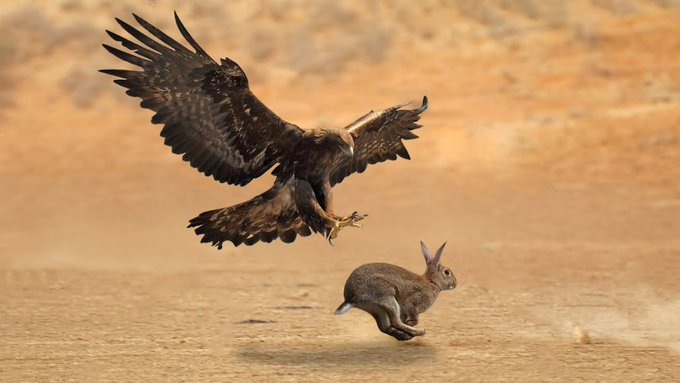
Interestingly, the breeding season of both golden eagles and hares overlap, meaning they are identical animal calendar markers.
Golden eagle mating season is Mar/Apr. It is marked by mad mating ritual flights, known as the sky dance...After which, they do the...you know...
The female lays 1-3 eggs. The incubation period is 41-45 days. This means that the hungry golden eagle chicks are born in Apr/May. They stay in the nest and are fed by their parents (baby hares, their favourite) for about 65 days...
Wild hare mating season is Mar/Apr. It is marked by mad mating (not ritual, real 🙂) fights between an unwilling female and a very very very much willing male... After which, if the male is lucky (or good enough fighter), they do the...you know...
The female gets pregnant with 3 or more babies. The gestation period is 41 to 42 days. Baby hares leave their hole within a week...Which means that from Apr/May the fields are full of baby hares, the favourite food of baby golden eagles...
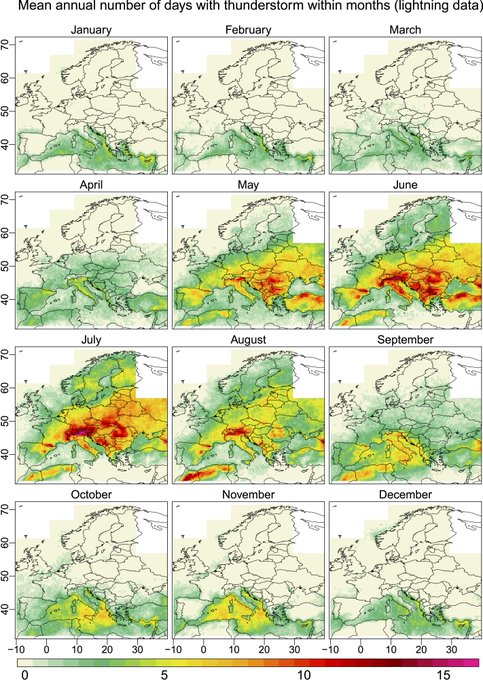
So if you were from Ancient Elis, the best time to see golden eagle killing hare scene was during the summer, starting from Apr/May until Jul/Aug...Which is the peak thunderstorm season in Peloponnese...
Here is another coin from Elis, Peloponnese, ca. 450-440 BC.
Obverse: Eagle flying, grasping snake with its talons and its beak.
Reverse: F–A. Thunderbolt with volutes above and wings below
Interesting. Why eagle killing snake?
Believe or not 🙂 this is another animal calendar marker for the thunderstorm season, Apr/May - Sep/Oct, which is the only time when migratory snake eagles can be seen in Greece hunting snakes...
It is interesting that both of these coins were issued by the same Ancient Greek city state. Deliberate use of animal calendar markers for thunderstorm season?
BTW, I was just reminded of this: Hittite imperial eagle...
The meaning of which we have just discovered, I think...
Two headed eagle normally means eagle mating/nesting season.
Two hares (two of any animal) means hare mating/birthing season.
Look at the Hittite land in Anatolia in Apr/May...
PS: I talked about the meaning of two headed birds in these articles:
Archaeologists, anthropologists, art historians...studying ancient artefacts depicting animals, are still not sure what these animal symbols mean. And non of them thought to look at the depicted animal's lifecycle for clues...Bactria, 2500-1500BC. I talked about this in my post "Double headed eagle"...
Once I realised that the double headed eagle (vulture) marks Old World Vultures mating season, I checked if the double headed eagles (vultures) symbols from Central America had the same meaning (Vulture mating season). They do...I talked about this in my post "Golden eagles from Costa Rica"...
If double headed eagle (vulture) had the same meaning in different, completely unrelated cultures on different continents and different ages, I wondered if any double headed bird symbol would have the same meaning. Like this one from Easter Island. It does...I talked about this in my post "Birdman from Easter Island"...
Leroy Golf was an American who worked in the oil industry in the Middle East in the 1930s and 1940s where he acquired a number of very interesting seals...
Leroy returned home around 1950 and died shortly thereafter. He had no family and only one close friend, a Mr. Henderson in Kansas who inherited his collection...
Mr. Henderson died in 1974, when the collection was wrapped up and placed in a carpenter’s wooden chest in the attic. Mrs. Henderson died in 2001 and the Leroy's collection, along with the contents of the house, was then sold to a local second hand dealer...
The items were sold by her on eBay or to other dealers in 2002 and 2003...
I wonder if the local second hand dealer knew what she was selling...
Today I would like to talk about one of these very interesting seals. This one found in North Mesopotamia-Syria, and dated to about 1800–1500 BC.
Why is this seal interesting? Cause all the symbols depicted on it point at the same time of the year: winter. Suggesting that this is a complex calendar marker...
The seal depicts two birds with outstretched wings facing each other. The birds are depicted over what looks like a mountain. A crescent moon is depicted above one of the birds...Why?
I would suggest that the birds depicted on the seal are eagles, more specifically vultures. Just like this one depicted on this older sea, also found in Syria, and was dated to about 3000-2000 BC. and also from Leroy Golf collection.
The way they are depicted, facing each other, looks almost like they are fighting...Or dancing, jumping, with outstretched wings...
There is a dance from the Dinaric mountains of the Balkans called Oro. It is danced usually during wedding ceremonies, by a man and a woman facing each other, jumping with outstretched arms...
You can see the eagle dance performance by a folk ensemble here
The locals says that the name of the dance comes from the local word for an eagle "oro" and that the dancers are imitating the mating dance of eagles. More precisely vultures...
Why was I talking about this dance in a post about the Shield of Achilles? Cause this dance is identical to the description of the dance from Iliad...Check the above blog post...
Anyway, what the dancers of this Balkan mountain dance are trying to imitate is this: courtship aerial display performed by vultures at the beginning of their mating season...
I talked about this in my post "Double headed eagle". Cause the vultures performing this aerial dance look like this from the ground...
The beginning of the Vultures mating season coincides with the beginning of the cool wet season (Nov-Apr), Mesopotamian winter, and spans this season. This is the only time when rain and snow fall in this part of the world...
This is why the rain god was originally imagined as huge black eagle, then as an eagle man, then as a man with a pet eagle...
Vultures nest in the mountains north east of Mesopotamia and Syria. And it is the the rain and snow that fall on these mountains, when vultures dance in the air above them, during the cool wet half of the year, that feed the two great rivers, Tigris and Euphrates...
These mountains are Abzu, the source of sweet water from Sumerian mythology...I talked about this in my post "Shamash young and old".
In it I analysed this seal showing young (spring) sun god Shamash/Utu, climbing the mountains of Abzu towards Enki (sweet water) who is imprisoned (the ice and snow on the mountain tops) to free him (melt the ice and snow)...Over 70% of all the water flowing down Tigris and Euphrates comes from annual snowmelt...
These mountains are also E-Kur, the mountains of the gods, the original heaven on earth...From where gods brought grain, agriculture and culture in general to Mesopotamia. I talked about this in my post "How grain came to Sumer"...
So the interpretation that the mountain depicted under the two birds is "the sacred double mountain of Mashu, the sacred mountains that Gilgamish had to pass before he could reach the land of the gods" is not off the mark at all...
I explained why we should look for this sacred "Cedar Mountain" North East of Mesopotamia in my post "Humbaba"
So we have two eagles dancing above the mountains...Which means winter...Now do you see the crescent moon depicted above one of the two dancing eagles? It is pointing upwards. Which only happens during winter...
This is another common symbol for winter...I talked about winter moon in several of my posts.
Now do you see this "star" above the ploughing scene? Next to the moon? That's Sirius, which appears in the night sky with the moon at the beginning of winter. At the time when grain fields are ploughed and grain is sown in Mesopotamia...
After the first rains brought by the eagles dancing over the holy mountains...
That's as far as I can go today. Finally, we are left with 3 dots...I have no idea what they mean...I will have to leave that symbol, which I have seen on other seals too, for some other time. I think this is quite enough for today...
Official description: "...central figure of a winged giant, with muscular human torso and legs, the head and talons of an eagle, wearing a short open tunic with wide belt, and a pendant necklace, grasping in each hand an inverted ibex..."
What the heck is the meaning of this scene? Here is the stamp print which makes the scene depicted on the stamp much clearer...
Well to understand this, we need to first identify the two animals the "winged giant" is holding in his hands. They are not Ibex goats...They are not goats at all. They are wild sheep. Mouflons...
Look at the horns...
Bezoar goat, native to Bactria.
Mouflon sheep, native to Bactria...
But I am just being picky...It actually makes no difference whether these are Bezoars or Mouflons, from the point of view of understanding this scene...
This is because both species have the same mating season, which starts in Oct-Nov, at the beginning of the rain season in Bactria...And the beginning of winter...
You can see that in Bactria, the climatic year is roughly divided into hot and dry and cool and wet parts
Both animals were used in Eurasia as animal calendar markers marking the beginning of the rain season and the beginning of winter...The rejuvenation of nature...Like on this vase design from Jiroft culture, just a bit down south from Bactria...
Both animals mating season last throughout the winter, Nov-Dec-Jan...Which is also the time when local vultures have their mating season....
Which is why vulture, and more specifically, a vulture dude, like our winged giant, became a symbol of the rain season...Basically the vulture (eagle) dude is the rain god...I talked about this in my post "Eagle calendar markers"...
Here is another Bactrian seal, with the same eagle dude, this time actually holding two Bezoar goats...Just so you see that Bezoars and Mouflons are actually interchangeable as calendar markers...