Wednesday, 15 November 2023

The cross of Shamash

Beaker, Sialk South Mound, Kashan, Isfahan, Late Calcolithic period, Sialk III7 period, ca. 3750-3350 BC, the National Museum of Iran, Tehran, Iran. Pic by Michele Mitrovich

Why are there crosses under Ibex goat horns?

first asked this question in my post "Maltese cross seal from Elam" about this Proto-Elamite cylinder seal found in Jemdet Nasr and dated to 3100BC-3000BC. 

At that time I wasn't sure what the cross meant... 

The second time I asked this question was in my post "Iranian goat of rain" about the depictions of the Iranian Goat of Rain. 

I still didn't know what the cross under Ibex goat horns meant.  

But I knew very well what the ibex goat represented. In Mesopotamia and in Iran, Ibex goat was the most depicted animal during Neolithic and Bronze Age...I talked about this in my post "Goat petroglyphs from Iran"...

Because in Mesopotamia and Iran rains arrive when Ibex goats start mating, in Oct/Nov...


Super important event, because it is the rain and snow that fall during the goat mating season that support life in Mesopotamia and Iran. 

I talked about this in several of my posts: Problems of Abzu, Goatfish, Goat carrier, Iranian goat of rain, Strider, Goat petroglyphs from Iran, A vessel from Tepe Hissar

And many more...

This is why Ibex was venerated in Iran, and this is why it is in Iran that we find the first Goat man...The earliest transition from Goat of rain to God of rain...

Which eventually lead to Pan and Zeus, Thor, Perun, Perkunas riding on goats or goat pulled chariots...And to this...I talked about this in my post Goat in European culture

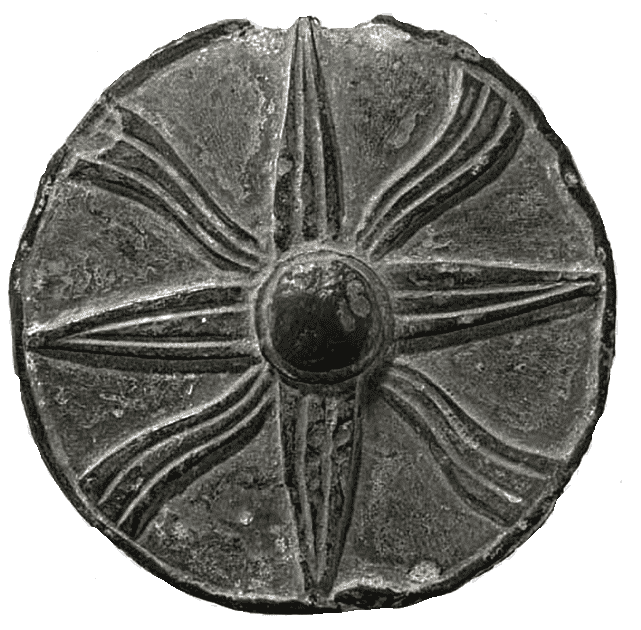
Anyway, considering how important rain was in Iran, I thought that maybe the cross under the horn of the Ibex goat just meant "VERY IMPORTANT!!!" 🙂 But then I learned that crosses like these were in Mesopotamia/Iran used as a symbol of the sun god (!)...


This version of the Sun God symbol combines a sun, cross (solstices and equinoxes???), and wavy lines representing sun (heat) rays...

I talked about this in my post "Canals": 

Sun God Utu/Shamash with sun (heat) rays emanating from his shoulders, standing in in an empty canal, in Leo (between the lions), the hottest, driest time of the year in Mesopotamia, and the time when canals were repaired, holding reed cutting knife...

And in my post "Nude winged hero dominating snakes":

This is 3rd millennium BC, Bactrian seal depicting the sun god (see heat rays emanating from his shoulders) holding snakes, symbols of sun's heat...See snakes, Solar animals number one, the symbols of sun's heat... 

So how does this fit together?

The Ibex goat mating season in Mesopotamia/Iran spans the whole of winter, Nov,Dec,Jan. And in the middle of the Ibex goat mating season is the Winter Solstice...The (re)birth of the new sun (solar year)...

Is this why cross, the symbol of the sun god, was placed under the horns of an Ibex goat, the animal calendar maker (symbol) for winter?

Early Mesopotamians/Iranians definitely had a notion of young and old sun...I talked about this in my post "Shamash young and old":

When I am young, I fill the rivers with water. When I am old, I dry them...Utu/Shamash, young and old... 

And I talked about it in my post "Descending to Hades": 

The Sumerian poem "Enki and the World Order" exclaims: Young Utu (the sun), father of the Great City (the realm of the dead)...Young Utu here meaning both morning sun and spring sun...

So this is why I think we see cross depicted under Ibex goat horns. BTW, for people who still doubt if swastika is a sun symbol. Another Neolithic Iranian goat of winter with swastika under its horns where sun cross usually is...


To read more about ancient animal and plant calendar markers, start here…then check the rest of the blog posts related to animal calendar markers I still didn't add to this page, and finally check my twitter threads I still didn't convert to blog post...I am 9 months behind now...

Sunday, 12 November 2023

Tuna boats

This is the amazing fortified Bronze Age settlement of Kastri, located on the Greek island of Syros and dated to the Early Cycladic II period (Keros-Syros culture, 2600–2300 BC)... 

Near this settlement, archaeologists have discovered a cemetery, with more than 700 graves excavated to date. The graves are of the subterranean corbelled type, which is exclusive to Syros...

This is the grave XI with some of the grave goods found in it...You can read more about it in "Figurines in context at the Chalandriani cemetery on Syros".

For this article, the most interesting thing found in this grave is the so called "frying pan"...

Curious objects, which do resemble frying pans, but no one really knows what they are or what they were used for... 


Here is what these objects look like from both sides...

One proposal is that they were used as liquid mirrors. You fill the vessel with a liquid and...Pics of the reflection in four liquid mirrors with: (a) water, (b) olive oil, (c) ‘black’ water (d) ‘black’ olive oil...

You can read more about it in "The ‘frying pans’ of the Early Bronze Age Aegean: an experimental approach to their possible use as liquid mirrors"...

Another proposal is that these were vessels used for salt extraction through natural solar evaporation...Structures, which until recently were used for solar brine evaporation in Greece...

You can read more about it in "Neolithic flat-based pots from the Carnac Mounds in the light of Cycladic ‘frying pans’". Those interested in ancient salt extraction techniques might like this post "Fulacht fiadh salt extraction facility"...

Now quite a lot of these Cycladic frying pens have depictions of boats as part of the decoration...Like this one...A boat depicted among the swirling spirals representing waves, or moving, running water...And right above the bow of the boat there is always a depiction of a fish...Which would suggest that Cycladic boatsmen were fishermen...

Here are some examples of the the boat-fish designs from the Cycladic frying pans...

The fish depicted has a very big dorsal and tail fins...To me the look the most like tunas...

Which would suggest that Cycladic boatsmen were not just fishermen, but tuna fishermen...

Now in my post about the "Tuna coin from Akanthos" I talked about different native types of tuna fish that live in Mediterranean, their mating seasons and their fishing season...

Basically, the tuna fishing season in Mediterranean, including Cycladic islands is from Apr to Nov...With the peak in Jul/Aug...Basically when summer (which starts in Taurus) ends (gets killed) by autumn (which starts in Leo)...


Ram, marks lambing of Eurasian wild sheep

Bull, marks calving of Eurasian wild cattle

Lion, marks mating of Eurasian lions

Goat, marks mating of Eurasian wild goats

You can read more about it in my post "Symbols of the seasons"...

This time when lion kills bull (Jul/Aug) is also "the best time to go to the sea" according to Hesiod... 

I talked about this in my post "Tetradrachm from Byblos"...

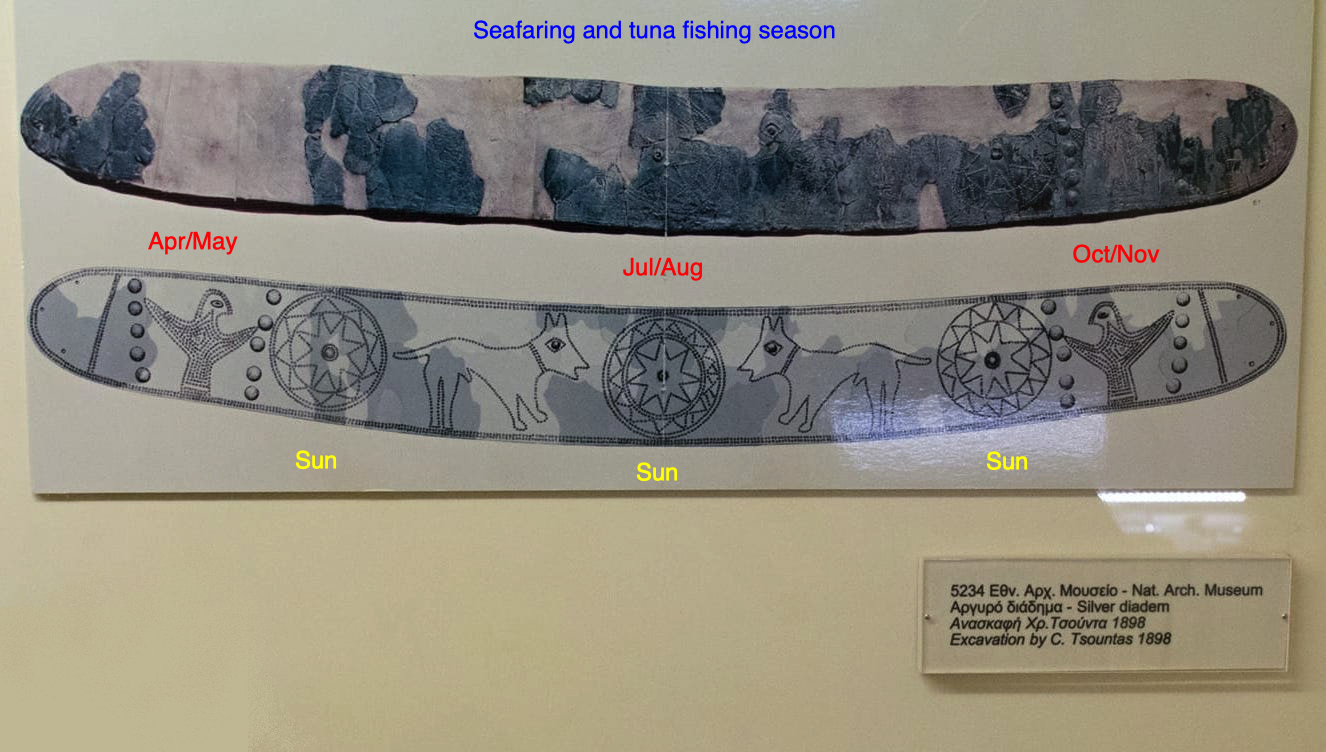
So after this lengthy intro 🙂 let me get to the interesting bit: This is a silver belt found in one of the Cycladic graves on Syros. This is an amazing object...Which no one knows how to interpret...

I would propose that this is a calendar...No surprises there, if you have been following me for a while🙂 

But why calendar? 

And calendar depicting what?

The answer to the second question, "calendar depicting what?" is "calendar depicting tuna fishing season"...

The answer to the first question "why calendar?" is "because birds and dogs are well known animal calendar markers which when depicted the way they are depicted on the diadem, mark the beginning the end and the peak of the tuna fishing season in the Cyclades area"...

Let me explain what I mean: The Cyclades are on the major bird migration route between Europe and Africa. 

The spring migration from Africa to Europe suddenly peaks in Apr/May...

Sudden appearance of millions of migrating birds above the Cycladic islands coincides with the onset of the sailing (and tuna fishing) season in the Eastern Mediterranean...

Birds announcing the time to go to the sea...Interesting...I talked about the sailing season in the Eastern Mediterranean and how birds were used as animal calendar markers for the beginning of the sailing season in my post "Three sacrifices" made for "good winds" by the Greeks at the beginning and the end of the Trojan war...

The birds migrate from Europe to Africa between Sep and Oct...

When the last migrating flock disappears in the southern skies, it is time to pull the boats on the beach, as this marks the end of the seafaring (and tuna fishing) season in Eastern Mediterranean...

So that could explain the birds depicted on the Cycladic silver belt...What about the dogs?

Remember this? 

When our mythologies were made out of animal calendar markers, Sirius, the Dog Star rose with the sun in Jul/Aug, when mating season of the old primitive dog breeds began...


I talked about this in my posts "Dog days" Egypt, "Tishtrya" Mesopotamia, "The bitch of the gods" India...

The middle point between the beginning of the spring bird migration and the end of the autumn bird migration...

And "the best time to go to the sea in Cyclades in search of tuna"...

Apr/May - Jul/Aug - Oct/Nov

Oh, and these "discs" between the animal calendar markers are suns...Apr/May - Jul/Aug - Oct/Nov is the sunny, hot, dry half of the year in Syros...

So to recapitulate, I believe that this belt is a kind of calendar, which using animal calendar markers depicts the sunny, dry half of the year, which is also the time when you can go to the sea in search of tuna fish...

I could be wrong, but I can't see any other reason why someone would depict birds, suns and dogs on such a precious object...And I refuse to accept that the choice of the depicted symbols was random...

To read more about ancient animal and plant calendar markers, start here…then check the rest of the blog posts related to animal calendar markers I still didn't add to this page, and finally check my twitter threads I still didn't convert to blog post...I am 9 months behind now...

Friday, 10 November 2023

Tetradrachm from Byblos

Silver Tetradrachm from Byblos, Phonecia, apparently, minted during the reign of Adramelek, 315 BC-...and currently in the British Museum...

A hippocampus swims below a Phonecian galley with 3 hoplites aboard...Why?

On the reverse, a lion attacks a bull...Why?

Well, the sailing season in the Eastern Mediterranean starts when wild horses start to mate, in Apr/May...And lasts until the end of the horse's mating season, Sep/Oct...This is why horse was the symbol of Eastern Mediterranean sea gods...They are basically an animal calendar marker for the sailing season...

I talked about this in my posts "Trojan horse" and "Three sacrifices"...

Some people will say that the horses associated with Eastern Mediterranean sea gods are actually seahorses.... 

Believe or not sea horses have the same mating season in Mediterranean...Making them the equivalent animal calendar marker for the sailing season to terrestrial horses...

I talked about this in my post "Seahorse ring"...

As for the lion killing bull, according to Hesiod

"Fifty days after the solstice, 

when the season of wearisome heat is come to an end, 

is the right (best) time for men to go sailing". 

These are most common symbols of the seasons:

Ram (marks lambing of Eurasian wild sheep) - spring

Bull (marks calving of Eurasian wild cattle) - summer

Lion (marks mating of Eurasian lions) - autumn

Goat (marks mating of Eurasian wild goats) - winter

And on the coin, we see lion killing bull from behind...

Summer, which starts in Taurus (Apr/May) is followed by autumn, which starts in Leo (Jul/Aug)...

I talked about this in my posts "Mystery seal", "Cypriot stamp seal with cow and calf", "Angra mainyu" and many others...

So...I hope the scenes depicted on Adramelek's coin make a bit more sense now...

To read more about ancient animal and plant calendar markers, start here…then check the rest of the blog posts related to animal calendar markers I still didn't add to this page, and finally check my twitter threads I still didn't convert to blog post...I am 9 months behind now...