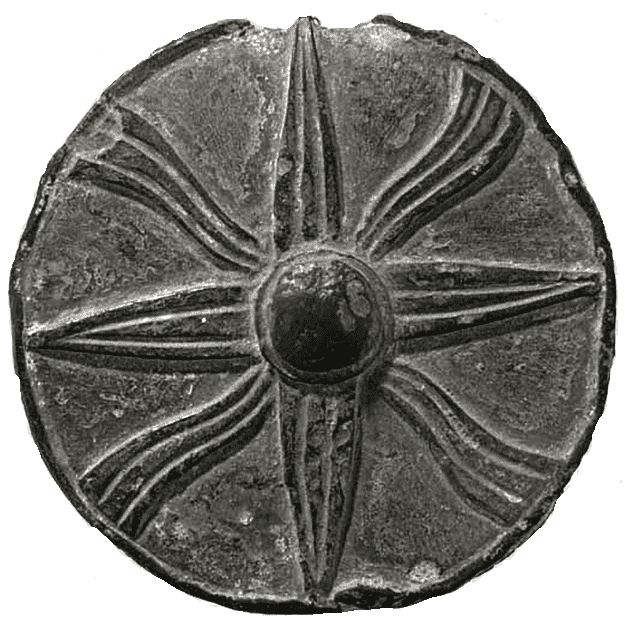
This is the 860BC-850BC Middle Babylonian limestone "Sun God Tablet", currently in the British Museum.

In this post, I would like to add few bits of information that will help us understand some of the symbols depicted on this tablet.
From the museum description:
"The tablet depicts the king being led by a priest and a goddess into the presence of the Sun-god Shamash, who is seated in his shrine. Before the god is the Solar Disc, resting upon an altar which is supported by ropes held by attendant deities..."
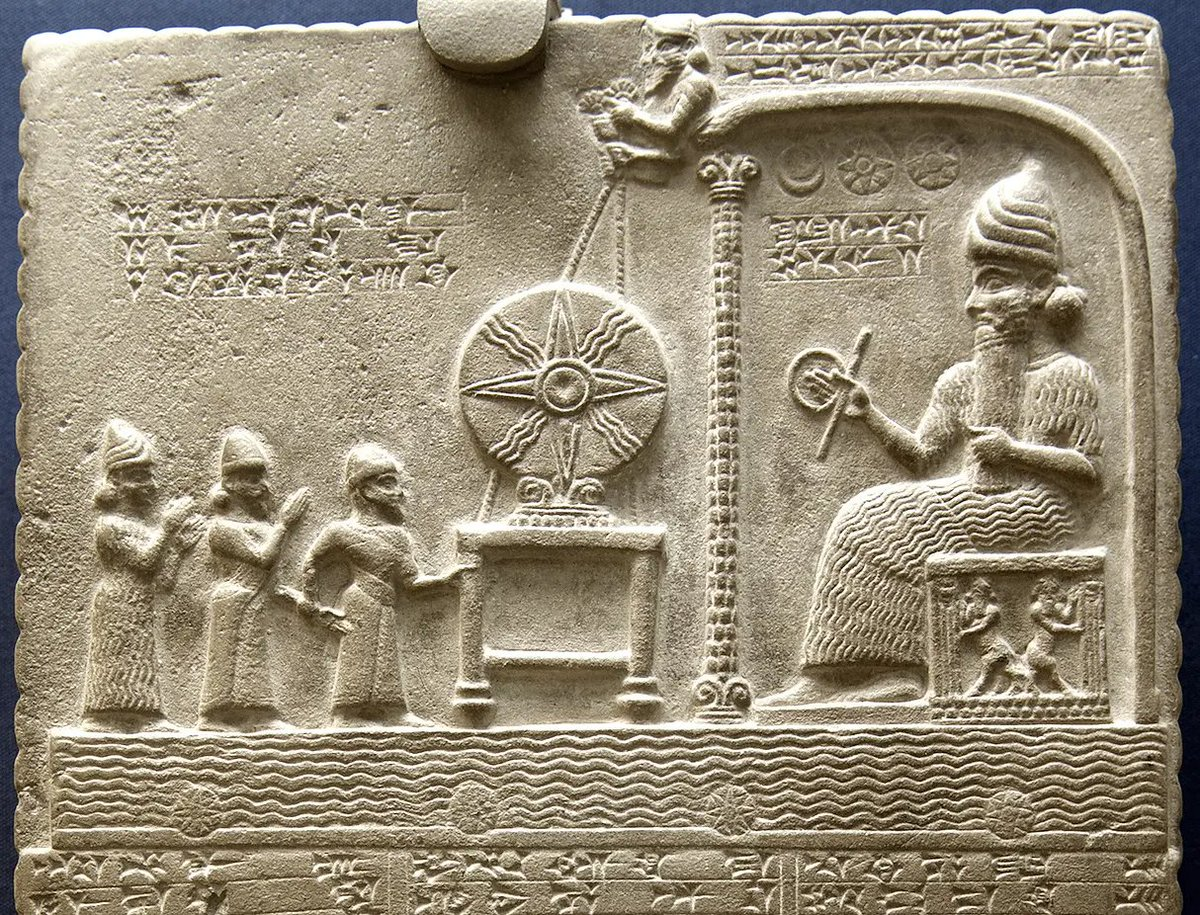
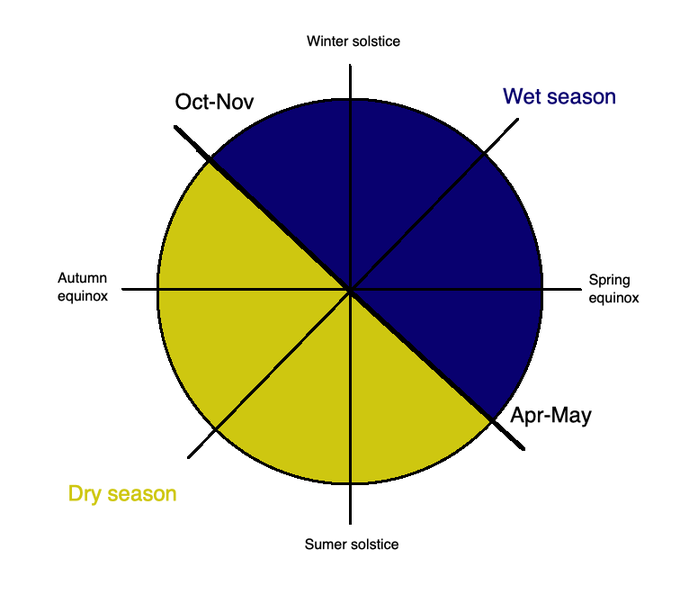
The symbol on the Solar Disc is the Solar Cross, The Shamash Cross. It combines a sun, cross (solstices and equinoxes???), and wavy lines representing sun (heat) rays...

I talked about this in this post "The cross of Shamash"...
The same wavy lines can be seen on this seal depicting Sun God Utu/Shamash with sun (heat) rays emanating from his shoulders, standing in in an empty canal, in Leo (between the lions), the hottest, driest time of the year in Mesopotamia, and the time when canals were repaired, holding reed cutting knife...

I talked about it in my post "Canals", "Lion radiating heat", "Nude winged hero dominating snakes", "Utu and Enki"...
Also, did you know that the central candle of the Hanukah Menorah, the source of light, is called Shamash...I talked about this in my post "Menorah from Nipur"...

Anyway, the museum description continues with: "The god wears a horned headdress and carries the ringed rod in his right hand. The shrine is represented as resting on the heavenly ocean..."
Uuuuu so much to talk about here...
Ever thought why in Mesopotamia gods wore (bull) horned headdresses to indicate that they are important? And the more important they were, more pairs of horns they had on their headdress?
Well, this is because the most important annual event in Mesopotamia, the annual flood of the Tigris and Euphrates happens in Apr/May, in Taurus...

Taurus here is The Old Taurus, the animal calendar marker for the beginning of the calving season of wild eurasian cattle...I talked about this in my post "Cow and calf ivory"...

The annual flood is the result of the snowmelt on the mountains north-east of Mesopotamia, which are the source of Tigris and Euphrates, Abzu.

Snowmelt contributes more than 70% to the annual water flow of these great rivers. And this snowmelt peaks in Apr/May...

And so, symbolically, every spring, the sun god Utu / Shamash climbs the holy mountain (Abzu, source of water) to free Enki / Ea, the god of sweet water from his icy prison and release the waters...

I talked about this my posts "Shamash young and old" and "When Utu steps up into heaven"...
This is also the reason why the Mesopotamian sun god Utu/Shamash was depicted as a golden bull (Sun in Taurus) with flowing lapis lazuli beard (flowing water)...
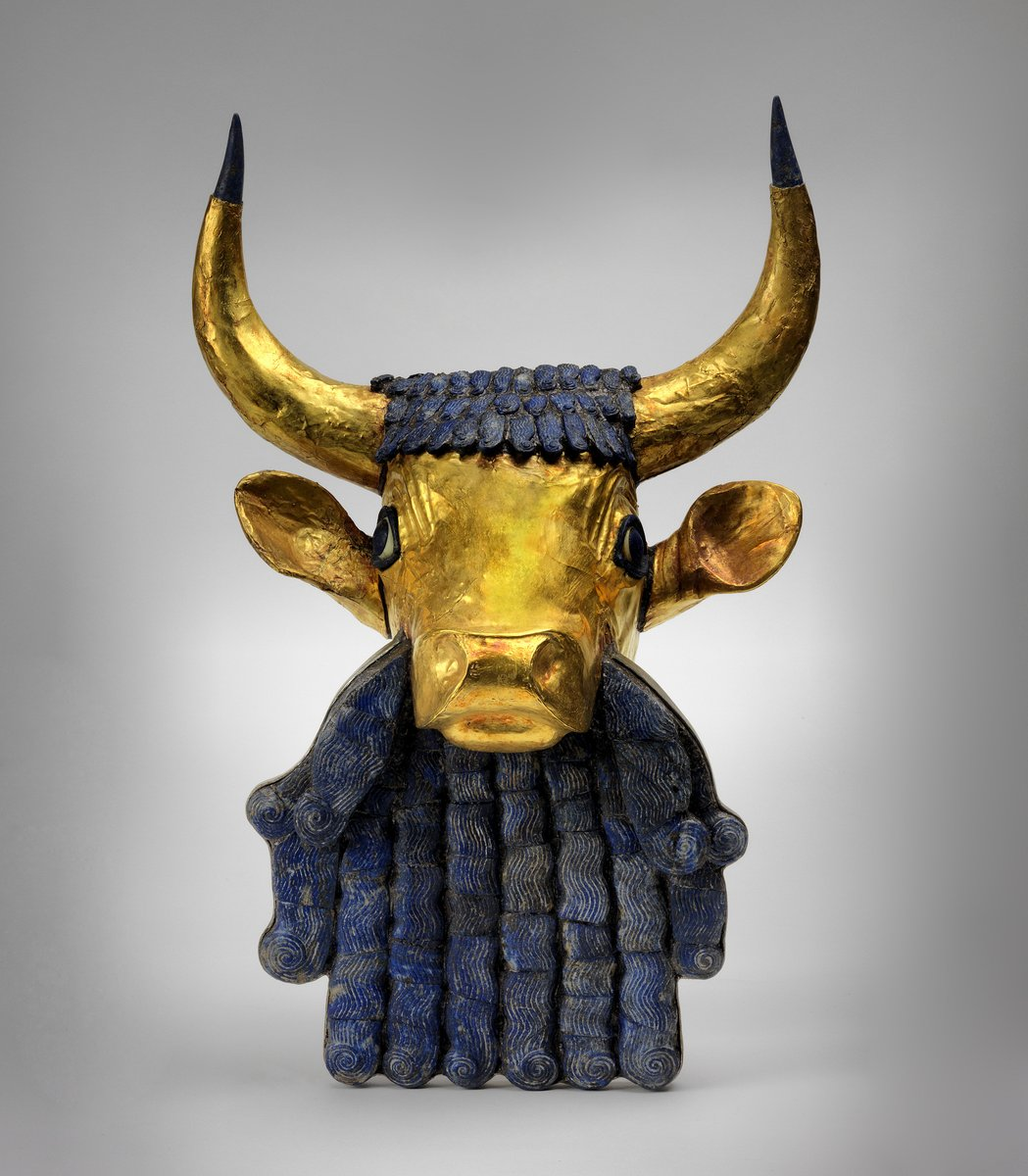
This object was found in Ur and dates to 2450 BC. Pen Museum https://penn.museum/collections/object/9347
And this is the reason why on the Sun God Tablet, the Sun God Shamash was depicted sitting on a throne supported by two bearded bull-men...Symbol for "Sun in Taurus".

I talked about bearded bull men, sun and rivers in my post "Achelous"...

And why on the Sun God Tablet, the shrine of the Sun God Shamash is resting not on the heavenly ocean, but on the overflowing waters of the Tigris and Euphrates which flood in Apr/May, when the sun is in Taurus...

The annual flood is the source of life in Mesopotamia. And the source of the annual flood is the Sun God Shamash, because he is the one that releases the life giving water into the rivers through snowmelt...
So Shamash is the source of life, and this is depicted through Shamash holding not "the ringed rod" but the original, most primitive form of ANKH (life) symbol.

I talked about it first in my posts "Etemenanki" and "An-Ki Ankh"...


It consists of a measuring rope (compasses, sky) and a measuring stick (square, earth)...So I proposed: AN (sky, father) + KI (earth, mother) = AN-KI = Life = Ankh...I talked more about it in my posts "An-Ki Ankh" and" Square and compases":

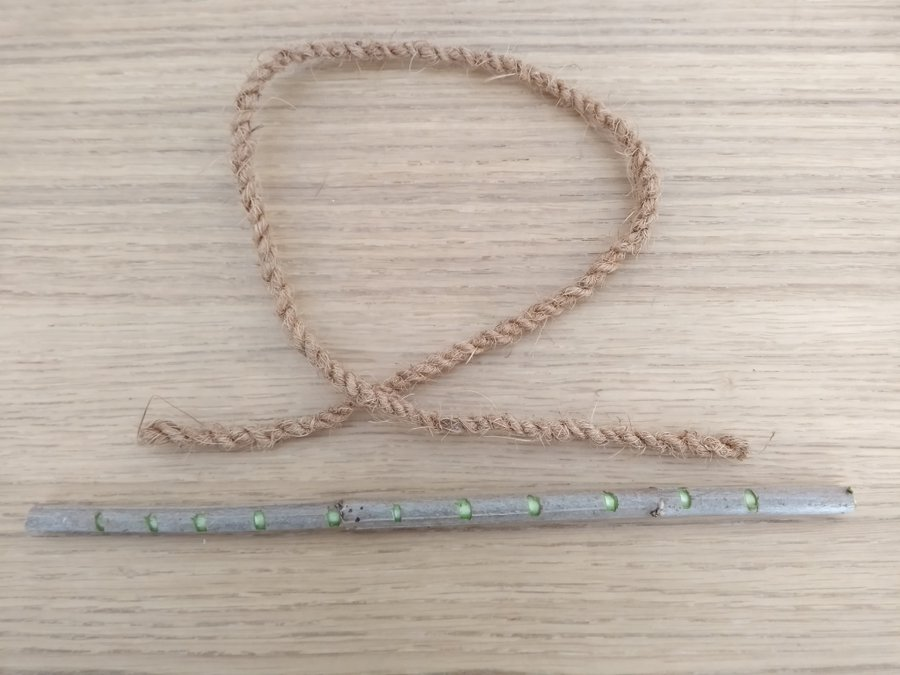
At that time I could not understand why it was Shamash that is holding the ankh...Now that I know more about the climate, hydrology and agriculture in Mesopotamia, it is obvious why the sun is the source of Life in Mesopotamia...
The same "Water=Life=Ankh" link is found in Ancient Egypt. Sycamore tree goddess, originally Hathor, and later Isis, both goddess of flood, pouring water which is depicted with ankh (life) symbols inside it...Tomb, Siwa Oasis, 400-600 BC. Egypt...

And the same primitive ankh symbol (the loop) is also found in Ancient Egypt

Ankh = Life = Water...I talk about the link between Ankh, symbol for Life and papyrus (flowers at the beginning of the Nile flood) and lotus (flowers at the peak of the Nile flood) and the flood, and few other related things, in my post "Goddess on horse" and "Lotus and papyrus"...
Sooooo....Shamash (Young Sun) the giver of life sitting on his throne in Taurus (Apr/May) holding Ankh symbol of life...
But once Shamash becomes old, and moves his throne to Leo (Jul/Aug) he turns to Nergal...

Nergal, the deified destructive "burning" sun, was depicted as a lion man, because Jul/Aug, Leo, is the hottest and driest part of the year in Mesopotamia...

Talked abut him in my post "Winged superhuman hero"...
So Shamash has a dual nature, the life giver and life taker...
To read more about ancient animal and plant calendar markers, start here…then check the rest of the blog posts related to animal calendar markers I still didn't add to this page, and finally check my twitter threads I still didn't convert to blog post...I am 9 months behind now...