Wednesday, 22 October 2014

Oaks


Have you ever wondered why oak trees and oak groves were considered sacred in the past? In the next couple of posts I will talk about oaks, acorns, and people who worshiped Oaks and ate acorns. I hope you will enjoy the story.

I will start with Oaks.

Oaks are the most widespread trees in the world. They belong to the family Fagaceae, native to the Northern Hemisphere. This plant family also includes beeches, chestnuts, and chinquapins. Fagaceae are woody trees and shrubs whose nut is enclosed in a shell-like casing. The Fagaceae family originated in Asia, first appearing in the fossil record during the Early Cretaceous, more than 100 million years ago. Subsequent radiation toward Europe and North America produced geographic dispersion as well as divergence of genera. The extinct genus Dryophyllum, one of the earliest known Fagaceae, is believed to be the ancestor of modern oaks.

Based on molecular genetics analysis, the genus Quercus is estimated to have separated from Castanea about 60 million years ago. Oaks first appear in the fossil record in North America during the Paleogene between 55 to 50 million years ago. Most interspecific separations occurred within the Quercus species between 22 and three million years ago. During this period, oaks became the most dominant tree type in the Fagaceae family.

Depending on the classification scheme, there are somewhere between 450 and 600 oak species; one of the chief points of confusion is the taxonomic status of many hybrid oaks. North America contains the largest number of oak species, with approximately 90 occurring in the United States. Mexico has 160 species, of which 109 are endemic. The second greatest center of oak diversity is China, which contains approximately 100 species. However all the oaks can be divided into two broad sub groups: white oaks and red and black oaks.

The white oaks of Europe, Asia and North America. Acorns mature in 6 months and taste sweet or slightly bitter; The inside of an acorn shell is hairless. The bark is light in color, gray to light gray. The leaves mostly lack a bristle on their lobe tips, which are usually rounded.

The red and black oaks of Europe Americas and Asia. Acorns mature in 18 months and taste bitter to very bitter. The inside of the acorn's shell can be hairless but is in most cases woolly. The bark darker in color. Its leaves typically have sharp lobe tips, with bristles at the lobe tip.


The greatest concentrations of oaks are between subtropical and middle-temperate climate regimes. Further north than this, conifer species typically become dominant; further south, oaks cannot successfully compete with taller trees of tropical rainforests with respect to sunlight, and in some cases due to intolerance to high rainfall combined with high temperatures. Many oaks occur as top level canopy species, but an equally large number are shrubs or sub-canopy level associates.

In Europe, fossil pollen evidence indicates that during the last Glacial Maximum (20 000 years ago), oak species were confined to three main Pleistocene refugia in southern Europe, in Iberia, Italy and the Balkans, and it is believed that oak started to emerge from these refugia as the ice caps began to retreat at the beginning of the Holocene, 12 000 years ago. Since then oak trees have been an important element of the vegetation of much of Europe. The common presence of oaks in forests throughout prehistory is evidenced by the numerous charcoal fragments found within the archaeological record of most prehistoric cultures. In the Boreal period, 9000 - 7500 years ago, mixed oak forests increasingly dominated the forest landscape. Mixed forests expanded from the floodplains into their current range and then gradually transformed to acidophilous (acid loving) oak forests. A new type of forest, in which beech and fir were the dominant species, spread and became dominant in the Subboreal period, late Bronze Age and early Iron Age, 5700–2600 years ago. However, the process of the degradation of mixed oak forest and the spread of modern forest communities did not happen everywhere at the same time and with the same effect. For instance in Central Serbia, ancient oak forests survived until the 19th century giving the place its name "Šumadija" meaning the land of forests.


There is a strong association between human civilisations and oaks, beginning at least 30,000 years ago in Europe and Asia, and 14,000 years ago in North America. The reason for this is that oak is one of the most useful trees in the world.

Oak trees are hardwoods which means that they are strong and hard yet easy to work with. In addition, oak wood is one of the most dense naturally occurring materials, while high content of tannin makes it resistant to both fungal diseases and insects. Because of all these properties, oak wood has been used since ancient times for general construction purposes as roundwood for pillars and split for planks for flooring and furniture. Oak is also used to make shingles for traditional roof construction. In Slavic countries Oak has been the main wood used for house and furniture building since neolithic times. This is an example of a traditional house from Montenegro which contains storage for animals, carts, and tools on the ground level and living spaces on the upper level for the family. The ground level walls are constructed using stones and two wooden reinforcing bands made from oak for stabilisation as well as portions made with oak timber and planking. The upper level walls are constructed using oak timber frame with wattle and daub covered with a plaster material. The covered exterior stair and gallery are typically found in the region. The roofing is framed with oak wooden rafters and purlins and covered with oak wooden shingles (šindra)


Because of its toughness and water and rot resistance, oak has also been used to make agricultural tools like ploughs (19 century Serbia):

 
as well as waggons (20th century Croatia).

 
White oak wood is water and rot resistant but also waterproof and was used for making kitchen utensils such as serving bowls and other liquid containers such as casks, butter churns, bread kneading and washing basins, chopping boards...


For the same reason white oak was used for boat and ship building since the neolithic times. The earliest boats were dugouts made from single oak or linden trunks. In Slavic countries oak dugouts were still being made in the 19th century, like this one from Serbia:

 
Oak wood is extremely good firewood. Dense hardwoods like oak have a higher energy content per cord and so release more heat per firebox load. They also produce long-lasting fires and coal beds. This makes them ideal for domestic heating but also as the source of heat in metallurgy particularly in iron working.


Oak is particularly good for making charcoal. Charcoal is a light black residue consisting of carbon, and any remaining ash, obtained by removing water and other volatile constituents from wood, mostly oak. Charcoal is a light black residue consisting of carbon, and any remaining ash, obtained by removing water and other volatile constituents from wood, mostly oak. Charcoal is usually produced by slow pyrolysis, the heating of wood or other substances in the absence of oxygen. Historically, production of wood charcoal in locations where there is an abundance of wood and dates back to a very ancient period, and generally consists of piling billets of wood on their ends so as to form a conical pile, openings being left at the bottom to admit air, with a central shaft to serve as a flue. The whole pile is covered with turf or moistened clay. The firing is begins at the bottom of the flue, and gradually spreads outwards and upwards. The logs burn very slowly and transform into charcoal in a period of 5 days' burning. The massive production of oak charcoal was a major cause of deforestation, especially in Central Europe. The same traditional method of making oak charcoal is still used in the Balkans. These are burning charcoal piles in Bosnia, present time:


Oak bark is also rich in tannin, and is used by tanners for tanning leather. Tanning is the process of treating skins of animals to produce leather, which is more durable and less susceptible to decomposition. Traditionally, tanning used tannin, an acidic chemical compound from which the tanning process draws its name (tannin is in turn named after an old German word for oak or fir trees, from which the compound was derived). This picture is showing bark peeling from a cut down oak tree:


Oak apple or oak gall is the common name for a large, round, vaguely apple-like gall (outgrowth) commonly found on many species of oak. Oak apples range in size from 2–5 cm in diameter and are caused by chemicals injected by the larva of certain kinds of gall wasp in the family Cynipidae. The adult female wasp lays single eggs in developing leaf buds. The wasp larvae feed on the gall tissue resulting from their secretions.Oak galls have been used in the production of ink since at least the time of the Roman Empire. From the Middle Ages to the early twentieth century, iron gall ink was the main medium used for writing in the western world.


Oak is also, with beech and birch, a host to one of the most important fungi in the world, Fomes fomentarius. Fomes fomentarius, commonly known as the tinder fungus, false tinder fungus, hoof fungus, tinder conk, tinder polypore or ice man fungus, is a species of fungal plant pathogen found in Europe, Asia, Africa and North America. The species produces very large polypore fruit bodies which are shaped like a horse's hoof and vary in colour from a silvery grey to almost black, though they are normally brown. It grows on the side of various species of tree, which it infects through broken bark, causing rot. The species typically continues to live on trees long after they have died, changing from a parasite to a decomposer.


Though inedible, F. fomentarius has traditionally seen use as the main ingredient of amadou, a material used primarily as tinder. Tinder is the material used to catch the spark in primitive fire making and also to transport fire across long distances. Tinder fungus can smolder for days preserving the amber alive.


The 5,000-year-old Ötzi the Iceman carried four pieces of F. fomentarius, concluded to be for use as tinder. It also has medicinal and other uses. F. fomentarius has a circumboreal distribution, being found in both northern and southern Africa, throughout Asia and into eastern North America, and throughout Europe, and is frequently encountered. The species most typically grows upon hardwoods. In northern areas, it is most common on birch, while, in the south, beech is more typical. In the Mediterranean, oak is the typical host.

Mixed oak forests and oak savannahs are also ideal growing ground for numerous edible mushrooms. Some of them grow on fallen trees and stumps, some near the roots, some under the foliage. Different species ripen at different times of the year. Depending on the climate there is at least one type of a mixed oak forest mushrooms that can be harvested pretty much at any time of the year, but the main mushroom season is from late spring to late autumn. Mushrooms would have been one of the main food sources during this time as they are easy to collect and prepare and would by themselves provide enough protein in the diet. The main types of mushrooms which grow on or around oaks are: truffles (tartuf or gomoljača in Serbian), porcini (vrganj in Serbian), lumpy bracket (Jelenovo uvo or hrastov žbunac), Caesar's mushroom (jajčara or rujnica in Serbian), royal bolete (kraljevka in Serbian), the miller or the sweetbread mushroom (brašnjača in Serbian), russula (medena, medenka in Serbian). My favourite is porcini (vrganj in Serbian). Balkans is the home of the giant porcini mushrooms which grow in oak savannahs. Me and my brother used to make a lot of money every year from picking mushrooms in forests. Once when we were 10 and 8, while picking mushrooms with my father on mountain Vlasina in the south east of Serbia, we found a truly giant one which was over half a meter in diameter and over 4 kilos in weight. Unfortunately I don't have any picture of this mushroom, but here are some other giant vrganj (porchini) mushrooms found in Serbia and Croatia:


Oak doesn't lose all the leaves during the winter like other decidious trees. The leaves turn golden but stay on the branches until spring.


In the Balkans at the end of October farmers used to cut the outer branches of young oak trees, specifically grown for this purpose in thickets, and store them in stacks for fodder to feed livestock during the winter. This practise is in English called polarding. Polarding produces "pollard hay", basically dry branches with lots of dry leaves, which are used as livestock feed. The trees are pruned at intervals of two to six years so their leafy material would be most abundant. Apart from oak, ash branches are also cut for this purpose. In Serbian this "pollard hay" is called "lišnjak" or "šuma". The branches are cut and then dried for two days. They are then collected in armloads and brought to the specially prepared stake called "stožina", "stožer" where the armloads of branches are placed around the central stake, leaves towards the stake, in the same way you would place armloads of hay or wheat. As they are laid down, the branches are compressed by standing on them. In the end the top of the stack is covered with fern and hay and thick oak branches with leaves turned outward. This type of fodder is used for feeding sheep and goats during the second part of winter when other animal food like hay is running low. In Croatia Lamb is sacrificed at the beginning of the oak polarding and eaten communally by the men who do the branch cutting. Polarding is considered dangerous, probably because the oak is considered sacred and cutting oaks is activity that brings bad luck. This is a picture of stacked "lišnjak":


The oak inner bark, as well as the inner bark of certain trees like cedar, poplar, linden (basswood, lime), sweet chestnut, willow, elm can be used to make excellent cordage... Tree bark is made up of two portions, the inner bark or phloem (which passes the sugary sap around the tree), and the outer bark, which acts as the waterproof skin of the trunk, protecting from disease and extremes of temperature. The bit that is good for making cordage is the inner bark. It consists of long interwoven fibres that form an interlocking weave. It peels readily from the tree and is easy to work with. Bark from dead limbs provides the best material. The best dead limbs are ones that have been dead for a week or two. Any longer and the bark will have dried out a lot. The inner bark cordage is very strong and durable and it stays flexible without cracking when bent when dry.


Oaks were also used as medicine for millennia. Oak was used to treat bleeding, tumors, swelling and dysentery as well as a diuretic and as an antidote to poison. Snuff made from powdered root was used to treat tuberculosis. The leaves have been employed to promote wound healing. Oak has been used as a Quinine substitute in the treatment of fevers. Tannins provide many of the healing properties of oak. Tannins bind with proteins in tissues, making a barrier resistant to bacterial invasion. Tannins strengthen tissues and blood vessels. They reduce inflammation and irritation, especially of skin and mucus membranes.The plant parts used for healing include the inner bark, root, leaves and acorns. Modern scientific research confirms that oak possesses the following healing properties: astringent, fever reducing, tonic, antiseptic, anti-viral, anti-tumor, and anti-inflammatory actions. In addition, oak has been used to get rid of worms and other parasites.

You can see from all of this that Oak is something of a wonder tree. But the best part is yet to come. Acorns. Oaks produce acorns, a lot of them. Squirrels, deer, wild boar love to eat acorns, sometimes to the point of acorns being 25% of their fall diet.

 
Which makes oak forests ideal hunting grounds for early hunters who hunted with fire hardened spears made from oak or ash like this one.


But people were not going to watch all those animals munching acorns without trying acorns themselves. The rest is history....Acorns have been eaten by humans since at least late Paleolithic times right up to modern times. And I will write about acorns and acorn eaters in my next few posts.

Thursday, 2 October 2014

Brajan, Rajan, Kola, Deda

The Census from Skadar region from 1485 and 1497, the medieval Serbian territory, today the border area between Kosovo, Makedonia, and Montenegro, lists all the personal names of the Serbian people living there for each village. You can see that Brajan, Rajan, Kola and Deda are very common medieval male Serbian names. But they are also Irish medieval male names Brian, Rian, Colla and Deda. 

Ryan is a common Irish surname, as well as being a common given name. There are several possible origins for the surname. In certain cases it can be a simplified form of Mulryan. In some cases the surname may be derived from the Irish Gaelic Ó Riagháin (modern Irish Ó Riain), meaning "descendant of Rían"; or Ó Maoilriain "descendant of Maoilriaghain", or Ó Ruaidhín "descendant of the little red one". The old Gaelic personal name Rían is of uncertain origin. It may be derived from the Gaelic rí, meaning "king".

Rajan (pronounced rayan) is a common medieval Serbian male name. 

The Three Collas were the founders of the Kingdom of Airghialla.  They were the sons of Eochy Dubhlen and Alechia, daughter of Updar, King of Alba (Scotland).  Muireadach or Colla da Chrioch, meaning Colla of the Two Countries, Ireland and Alba, was one of three sons and the first King of Airghialla after their conquest of Ulster.  This new kingdom consisted of the modern Counties Monaghan, Armagh, and parts of Fermanagh, Louth, and Tyrone. 

It appears that the legend of the Collas is true for it is documented in numerous sources and has held up to considerable scrutiny over the years. It also appears that they must have been incredibly talented at war, to have displaced the Ulaid, one of the most powerful of all the tribes in Ireland.

It is possible that they were disenfranchised Roman Centurions as their rise in Ireland were taking place at the same time that the Romans were slowly pulling out of Britain. The three brothers, or perhaps more correctly kinsmen, were Romanized Britons, originating in the tribe named Trinovantes, who when independent of the Romans had had their capital at Camulodunum or Colchester in southeastern Britain.  In Ireland their names were Carrell Colla Uais, Muredach Colla da Crioch (or fo Crioch, perhaps originally focrach, meaning mercenary), and Aed Colla Menn.  In the Roman naming system that they used, each had a personal name or praenomen (Carrell, Muredach, and Aed), a family name or nomen, Colla, and a descriptive name or epithet, a cognomen.  Their ancestors, who had become citizens of the Empire in 214 when citizenship was extended to all free subjects of the Empire, seem to have taken for their nomen some form of the root col, which was prominent in the vicinity of Colchester for many centuries.  Colla was not used as a personal name until about the year 1400, when the MacDonnell gallóglaigh of Connaught, aware of their descent from Colla Uais, began the practice, which soon was picked up by other descendants of the Collas, especially the McMahons, McDonnells of Clan Kelly in Fermanagh, and MacDonalds of the southern Hebrides. 

Colla has no meaning in Gaelic.

Kola is a common medieval Serbian male name. What is very interesting is that the Book of Veles also mentions Kola as one of the military leaders of the Slavs:

“A krvi mnogo beše od tada i deoba velika za setve i njive na obe strane Dona i do gore ruske i do pašnjaka karpatskih. I tamo su radili i Kola za vođu svoga izabrali, jer on neprijatelju otpor pružio, porazio i oterao....“ 


Which means: And a lot of blood was spilled since then and huge splits happened within the Slavic nation over the division of land and fields on both sides of the river Don and all the way to the Carpathian Mountains. And there (on Carpathian Mountains), they elected Kola as their leader and he organized the resistance to the enemy and expelled them....

Deda mac Sin (Deda, son of Sen) was a prehistoric king of the Érainn of Ireland, possibly of the 1st century BC. Variant forms or spellings include Dedu, Dedad, and Dega. He is the eponymous ancestor of the Clanna Dedad, and may also have been a King of Munster.

Through his sons Íar mac Dedad and Dáire mac Dedad, Dedu is an ancestor of many famous figures from legendary Ireland, including his "grandsons" (giving or taking a generation) Cú Roí mac Dáire and Eterscél, "great-grandsons" (again) Conaire Mór and Lugaid mac Con Roí, and more distant descendant Conaire Cóem. A third son was Conganchnes mac Dedad. Through these Dedu is also an ancestor of several historical peoples of both Ireland and Scotland, including the Dál Riata, Múscraige, Corcu Duibne, and Corcu Baiscind, all said to belong to the Érainn (Iverni), of whom the Clanna Dedad appear to have been a principal royal sept.

Deda  has no meaning in Gaelic.


Deda is a common medieval Serbian male name. 

Brian (sometimes spelled Bryan) is a male given name of Irish and Breton origin, as well as a surname of Occitan origin. It is common in the English-speaking world. It is possible that the name is derived from an Old Celtic word meaning "high" or "noble". For example the element bre means "hill"; which could be transferred to mean "eminence" or "exalted one". One of the most famous Irish Brians was Brian Boru (c. 941 – 23 April 1014, Old Irish: Brian Bóruma mac Cennétig; Middle Irish: Brian Bóruma; modern Irish: Brian Bóroimhe) who was an Irish king who ended the domination of the High Kingship of Ireland by the Uí Néill. Building on the achievements of his father, Cennétig mac Lorcain, and especially his elder brother, Mathgamain, Brian first made himself King of Munster, then subjugated Leinster, eventually becoming King of Ireland. He is the founder of the O'Brien dynasty.

Brajan (pronounced Brayan) is a common medieval Serbian male name. 

Here is a portrait of one of the medieval Serbian Brajans. This is the portrait fresco of the builder of the White Church of Karan, Župan Petar-Brajan. In his hands he holds the model of his church. The church was built between 1340 and 1342 ad. 


The White Church of Karan, in proximity of the town of Uzice is dedicated to Annunciation and date from the period of reign of the Serbian King Dusan. The White Church of Karan was built in the Rashka architectural style.


The church contains beautiful frescoes. The portraits of the founders, dressed in festive and rich noble attires are depicted on the north side of the western part of naos, while the portraits of Nemanjic Family are on the opposite side : Simeon Nemanja, St. Sava, King Milutin and the ruler of that time – King Dusan with his son Uros and wife Jelena /Helen/. Donors and all involved in the building of the White Church of Karan were also depicted. Monumental and well preserved fresco painting of the Bela Crkva Karanska (the White Church of Karan) represents significant monumental ensemble of the north western part of King Dušan’s state. This is one of the frescoes from the White Church depicting Župan Petar-Brajan on the right. 


The White Church of Karan is one nave structure with the semi circular apse. It has the semi circle covering with the cupola on the circled base. The first built iconostasis painted with frescoes is preserved.  

As I already said in my post about Bran, Balkans and the territory of the medieval Serbia in particular, was the Celtic Central for centuries before the Roman Conquest. If we look at the genetic, ethnographic and linguistic data, it seems that a lot of these "Balkan Celts" stayed on the Balkans and contributed to the ethnogenesis of the Serbians and other Balkan people. But considering that the origin and meaning of the Irish names Brian, Rian, Colla and Deda is uncertain, it is possible that the names actually originated in Central Europe and maybe even in the Balkans.

Here are some more names to think about: 
Irish: gordan. Serbian: gordan (both name and surname); 
Irish: gabran, Serbian: gavran; 
Irish: cuileann, Serbian: kulin; 
Irish: beara, Serbian: beara (both name and surname); 
Irish: Dabhag, Dabhóg, Serbian: dabog; 
Irish: ross, ros, Serbian: rus, rosa; 
Irish: ana, una, Serbian ana, una; 
Irish: Dáire (dara), Dáirine (darina) fruitful; fertile, Serbian: dara (givin, gift); 
Irish: Gobán, Serbian: Kovan, Kovač (blacksmith);
Irish: Íde (act of eating), Serbian: iće (food, act of eating), jede (eats); 
Irish: Lomán (bare), Serbian lom = break, lomiti = to break, loman = breakabal, branch is bare when you break twigs off, name Loma; 
Irish: Marcán (steed), Serbian (Sanskrit) mrga (Strong virile man, stag); 
Irish: Neasa, Neasán (no clear etymology), Serbian: naša, našan (našinci) our, one of us; 
Irish: Rúadhán, Serbian: rudan, rudonja (read head, read in color); 
Irish: Miach (honorable; proud), Serbian Mija, Mijak; 
Irish: Olcán (wolf), Serbian: vuk, vlk (both name and surname); 
Irish: Maolán (warrior), Serbian: Milan (warrior); 
Irish: Muirne, Myrna, Serbian: Mirna;

Sunday, 14 September 2014

Ojkanje - the wolf singing

In the mountains of the Balkans we find a peculiar type of "old style" singing which can only be compared with the howling of wolfs. The singing can be solo or group singing. If it is done in a group it has the same polyphonic characteristics as the howling of a wolf pack


Gray wolves howl to assemble the pack (usually before and after hunts), to pass on an alarm (particularly at a den site), to locate each other during a storm or unfamiliar territory and to communicate across great distances. Wolf howls can under certain conditions be heard over areas of up to 130 km2 (50 sq mi). Wolf howls are generally indistinguishable from those of large dogs. Male wolves give voice through an octave, passing to a deep bass with a stress on "O", while females produce a modulated nasal baritone with stress on "U". Pups almost never howl, while yearling wolves produce howls ending in a series of dog-like yelps. Howling consists of a fundamental frequency which may lie between 150 and 780 Hz, and consists of up to 12 harmonically related overtones. The pitch usually remains constant or varies smoothly, and may change direction as many as four or five times. Howls used for calling pack mates to a kill are long, smooth sounds similar to the beginning of the cry of a horned owl. When pursuing prey, they emit a higher pitched howl, vibrating on two notes. When closing in on their prey, they emit a combination of a short bark and a howl. When howling together, wolves harmonize rather than chorus on the same note, thus creating the illusion of there being more wolves than there actually are. Lone wolves typically avoid howling in areas where other packs are present. Wolves from different geographic locations may howl in different fashions: the howls of European wolves are much more protracted and melodious than those of North American wolves, whose howls are louder and have a stronger emphasis on the first syllable. The two are however mutually intelligible, as North American wolves have been recorded to respond to European-style howls made by biologists.
In Serbian it is called "ojkanje". The center of this musical tradition seems to be in the area of the Dinaric alps and in the Balkan mountains. Ethnographers from the end of the 19th and the 20th century, which researched this type of traditional singing in the Dinaric alps and Bosnia, all report that it was part of the tradition of the "Orthodox population" meaning "Serbians". Czech historian and ethnographer Ljudevit Kuba, writes in the text ”Narodna glazbena umjetnost u Dalmaciji” (Zbornik za narodni život i običaje južnih Slavena, Zagreb, 1899) that ojkanje is only found in Serbian populated areas of the western Balkans. Antun Dobronić writes in his essay "Ojkanje" (Zbornik za narodne običaje i život Južnih Slavena, Zagreb, 1915) that the only people who sing like this are Orthodox Serbs. Dušan Umićević writing in magazine Razvitak, Banjaluka, 1939 says "No Catholic or Muslim sings like this in Bosnia"Stanko Opačić Ćanica writes in "Narodne pjesme Korduna", Zagreb, 1972 that ojkanje was also known as "Cyrillic singing" referring to the fact that only Orthodox Serbs sang like this and they were the ones who wrote using Cyrillic alphabet.

This is a Serbian singing group from Nevesinje doing ojkanje.


Similar types of polyphonic "old style" singing is also found in other parts of the Balkans.  

Here is the list of examples of this type of singing from Serbia, Croatia, Albania, Bulgaria, Macedonia and Greece (Epirus, Makedonia). 

Serbian Old style singing

https://www.youtube.com/watch?v=YFYzPNxpCig
https://www.youtube.com/watch?v=fL8xoSvq6gg
https://www.youtube.com/watch?v=vmPSfwBd5d8
https://www.youtube.com/watch?v=gc9aMu3396s
https://www.youtube.com/watch?v=UQmwHSyXPGg
https://www.youtube.com/watch?v=gjmTMWnvTBs
https://www.youtube.com/watch?v=1lJHnnYnd7g
https://www.youtube.com/watch?v=VdsD2HynnNM
ttps://www.youtube.com/watch?v=-R1fFks-en8
http://www.youtube.com/watch?v=sUiISp3rD-s

Croatian Old Style singing

https://www.youtube.com/watch?v=ZSvrZJ2lws8
https://www.youtube.com/watch?v=wfFkk_GJiyw
https://www.youtube.com/watch?v=NISpYgW6Nuk
https://www.youtube.com/watch?v=jk6hOLBNh5Y

Albanian Old Style singing

https://www.youtube.com/watch?v=G4V2cE-LmBU
https://www.youtube.com/watch?v=noduXN6LVpc
https://www.youtube.com/watch?v=uIaycDljvvs
https://www.youtube.com/watch?v=4JtL_l-Z8rk&index=3&list=PL3DAB3085F232A0D7

Macedonian Old Style singing from Rodopi mountains

https://www.youtube.com/watch?v=ILqlcZESGvs&list=PL3DAB3085F232A0D7

Bulgarian Old Style singing

https://www.youtube.com/watch?v=jCepk9gF1AA
https://www.youtube.com/watch?v=jiMJ-EscUCg
https://www.youtube.com/watch?v=embqg-yKHNQ

Romanian Old Style singing (Doina)


Epirus Old Style singing

https://www.youtube.com/watch?v=b41OFxPY8hw
https://www.youtube.com/watch?v=gvICM2lPYpY&index=5&list=RDb41OFxPY8hw
https://www.youtube.com/watch?v=gvICM2lPYpY

Greek Makedonia

https://www.youtube.com/watch?v=ysEswAbecEQ
https://www.youtube.com/watch?v=rouc1VZPcDg
https://www.youtube.com/watch?v=oHIgRAclCU4
https://www.youtube.com/watch?v=DaPQNuFMlWQ

We can find similar type of old style singing in Sardinia, Basque country, Ireland, Estonia and Georgia. But the singing seems to become less animal and more human like, the further away you go from the Balkans. 

Sardinian old style singing

https://www.youtube.com/watch?v=cWVCMvbGcPA
https://www.youtube.com/watch?v=i-Yl0i2xgxc

Basque old style singing:

https://www.youtube.com/watch?v=cli6zH3Z2SU
https://www.youtube.com/watch?v=N7nfyzkFXAw

Irish Sean Nós (Old style) Singing

https://www.youtube.com/watch?v=N8paj2hQHIo
https://www.youtube.com/watch?v=K7FvokKTF-o
https://www.youtube.com/watch?v=u3ZDLuguJ0g
http://www.youtube.com/watch?v=AbeUwSyKvQs
http://www.youtube.com/watch?v=JzrETE3RqWc

Estonian Old Style singing

https://www.youtube.com/watch?v=k-5Lz_p5Ey4

Polish highlands Old Style singing

https://www.youtube.com/watch?v=Wp-QE5vxAB8

Georgian Old Style singing. I have to put a big questionmark here. This is the only example I could find where Georgian choral singing loses its characteristic harmony and "disintegrates" into wolf singing.

https://www.youtube.com/watch?v=yTkFrWc36XI

I was recently made aware of a type of singing from Georgian region of Guria, western Georgia,  where it is called "guruli krimanchuli". This is the old style true and true. What is interesting is that this version of wolf singing has parts which strangely resemble Yodling from Alps...What is interesting is that this is the part of Georgia where we also find higher percentage of the I2a haplogroup...

https://www.youtube.com/watch?v=hju_IC_ft-k

What is extremely interesting is that this type of singing is found only in Northern Greece where it is known as Dorian singing. Dorians came from the north, from the Balkans, and there is still a debate about their ethnic origin.

How old is this type of singing? Is this maybe the oldest, the most primitive type of singing which dates from the time when people still learned from the animals? Is this neolithic or maybe even paleolithic singing? Why is this type of singing so concentrated in the Balkans? Is it linked to any particular genetic tribal group? It is interesting that this type of singing has its epicenter in the Balkans, which is also the epicenter of the I2a haplogroup and that it is also found in Sardinia, another I2a haplogroup hot spot. Is this type of singing linked to the I2a haplogroup tribes?


The grey wolf was once one of the world's most widely distributed mammal, after humans and lions, living throughout the northern hemisphere north of 15°N latitude in North America and 12°N in India. Event today, gray wolves are one of most widespread land mammals, inhabiting various ecosystems throughout North America, Europe, Asia, and a small portion of Africa.


Considering the distribution of wolves I would expect to find similar type of singing throughout the wolf distribution area. However it seems that this particular "wolf" singing either only developed in certain cultures, or was only preserved to this day in only the most culturally conservative communities. 

I would appreciate any links to recordings of "wolf" singing from other cultures which are not in the above list so that I can update this article.

Every group singing is ceremonial. Group singing confirms and reinforces the group bond. Animals use it for precisely this purpose and I believe that originally humans used group singing in the same way. There is no surprise then to find group singing at the heart of religious ceremonies. Early medieval Balkan Christian music developed directly from the group wolf singing. 

Serbian Christian chanting:

https://www.youtube.com/watch?v=P2wTh80skuI
https://www.youtube.com/watch?v=g5Iy_Wxc4VE
https://www.youtube.com/watch?v=jkfLtKEu-Jc

Greek Christian chanting:

https://www.youtube.com/watch?v=VcK26_mYD4Q

Albanian Christian chanting

https://www.youtube.com/watch?v=eFtKkCzpdVE 

This is a very good recording of the hymn to the Mother of God chanted on the Holy Liturgy at Serbian Dečani Monastery by an Orthodox Byzantine Choir of the Christ's Resurrection Cathedral in Tirana:

https://www.youtube.com/watch?v=B9xfV7xJ_Vs 

Bulgarian Christian chanting:

https://www.youtube.com/watch?v=S-XMydhFXFk

Thursday, 11 September 2014

Grange circle

In several of my previous posts I have been talking about sun circles. I talked about their origin in my post about Henges - rondel enclosures. I talked about how they were used as solar observatories for determining the beginning of the lunisolar calendar in my post about Calendars. In my post about Stone circles on mountain Devica, I talked about the solar observatory called Bogovo Gumno from Serbia, and I said that this sun circle can help us understand the purpose of the stone circle complex known as Grange circles from Ireland and the meaning and significance of the term Grange itself. In this post I will finally talk about Grange circle.

Grange stone circle (Lios na Gráinsí or Fort of the Grange) 300m west of Lough Gur in County Limerick, Ireland, is situated beside the Limerick-Kilmallock road, 4 km north of Bruff. Composed of 113 standing stones, the Grange Stone Circle is the largest and finest in Ireland. Seán P. Ó Ríordáin excavated the Grange Stone Circle in 1939. During the excavations he found more than 4,000 shards of pottery, dating from the Early Neolithic to the Late Bronze Age, spanning a period of some 2,600 years.


Photo by David Hogwood
Seán P. Ó Ríordáin concluded that the Grange circle was a site of great importance, most likely of a ritual nature, from possibly as far back as the Early Neolithic period.


I believe that Grange circle was originally a threshing floor. I also believe the Grange circle is an example of a threshing floor which was eventually turned into a temple dedicated to the Thundering Sun, the god of weather, god of grain, Crom Dubh, Hromi Daba, Grom Div, the Thunder Giant. 

Threshing floor is a flat, smooth and hard surface used for threshing, a process of separating the grain from the straw and husksThe process of threshing is performed generally by spreading the sheaves on the threshing floor and causing oxen, cattle or horses to tread repeatedly over them. The animals are made to walk in a circle. In order to make the animals walk in circles, a man needs to stand in the center of the pile of grain which is being threshed and restrict and direct the movement of the oxen, cattle or horses using reins or rope. Alternatively a central pole can be erected, to which the animals are tied and then they are urged to walk in circles by a man walking behind them.The threshing floors also usually have walls built around them to prevent the grain from being blown off the threshing surface by the wind. This is done to mark the edge of the threshing circle and to prevent the grain being blown away. This creates a flat shallow pan like circular enclosure with a compacted hard surface and a central pole.


The Grange stone circle comprises a ring of continuous upright stones up to 2.8m high, with a diameter of 45m and backed by an earthen bank 9m wide and about 1.2m tall (the wall). The entrance on the eastern side is paved and flanked by upright stones. Clay has been packed down to a depth of 60 cm across the whole area of the enclosure (compacted hard surface). Its near perfect shape and the discovery of a post hole in the very centre of the enclosure, indicates that the circle was measured out from a central stake with a rope (central pole). Here is the picture of the Grange circle.


This creates a flat shallow pan like circular enclosure with a compacted hard surface and a central pole, a threshing floor, a grange. 


In my post called Bogovo Gumno - God's threshing floor I explained how in the Balkans the threshing floors are linked to solar cereal farming agricultural cults. I explained how they were until very recently used not only for threshing grain but also as solar observatories and as religious ceremonial grounds. 

Agriculture is shaped around the weather. At certain times of the year, certain things had to be done by peasant farmers or crops would not have grown. Farming, in this sense, is  controlled by the weather and the weather is controlled by the Sun and its cycle.

In order to know when certain activity needed to be done, the farmers needed to know the exact date. To determine the exact date, the farmers used threshing floors as a solar observatories.

Grange circle in Ireland was also used as a solar observatory. The stone circle is aligned with the rising sun at the Summer Solstice on the morning of which the sun shines on top of the largest stone in the stone circle known as Crom Dubh's stone casting the shadow directly into the centre of the circle. 


These two amazing pictures are taken from a great photo article about Grange circle by Tom Nelligan, which you can find on "The Standing Stone" blog.

If you are able to determine the exact date of the summer solstice, you are able to determine the beginning of the solar year. And that allows you to use 12 months lunar calendar for calculating time and determining the exact date repeatedly and accurately. Being able to determine the exact date, gives you the power to predict the weather, to predict "the will" of the Sun god. 


And this is why it is important for the cereal farmers to determine the exact date. The cereals can only be sown after the soil thaws and the temperature of the soil reaches certain temperature. The minimum germination soil temperature for wheat, barley and oats is about 5 degrees Celsius but the optimal germination temperature is about 20 degrees Celsius. So the sowing has to be done at the time of the year when the temperature is rising between 5 degrees and 20 degrees Celsius. This is the temperature of the period between the end of March and the end of April. After the cereal germinates, it then takes, depending on the temperature,  approximately 103 days for spring wheat to grow and ripen. This is why the harvest time is the end of July beginning of August.

And this is why it is "the will" of the Sun that people plow and harrow in March, sow in April, and harvest in August.  

Here is the list of the main agricultural activities per month. The dates are most appropriate to central and northern Europe. In southern Europe the growing season is going to be longer and drier and the winter not as harsh. 

Month work that needed to be done weather the farmer expected (wanted)

January
mending and making tools, repairing fences showers, snow

February
carting manure and marl
showers, snow

March
plowing and spreading manure dry, no severe frosts

April
spring sowing of seeds, harrowing showers and sunshine

May
digging ditches, first plowing of fallow fields showers and sunshine

June
hay making, second plowing of fallow field, sheep-shearing dry weather

July
hay making, sheep-shearing, weeding of crops dry early, showers later

August
cereal harvesting, threshing warm, dry weather

September
legumes harvesting and threshing, plowing and pruning fruit trees showers

October
last plowing of the year dry, no severe frosts

November
collecting acorns showers,snow and sunshine

December
mending and making tools, killing animals showers, show and sunshine

In the above list you can see the list of the agricultural activities and the weather that the farmer expected, wanted. But we all know that the weather we expect and want is not always the weather that we get. Agriculture is extremely sensitive to climatic oscillations. Particularly sensitive to weather changes is grain farming. Grain farming is a long drawn out process which spans over four months from plowing to threshing. During that time the weather can turn bad and the late frost can kill the seeds, the heavy rain or hail in late summer can break the stalks, the drought during the growing season can burn the plants and the crops will be ruined. This means that even if you are able to determine the day of the year and even if you know what needs to be done and when it needs to be done, and even if you do it all right, you are still not guaranteed the bountiful harvest.

If you are a cereal farmer, and if your life depends on grain yield, and if grain yield in turn depends on the weather, and if the weather depends on the Sun, then sun very quickly becomes your God, the God of weather, the God of grain.

In Serbian tradition, Sun is called the "Višnji Bog", the High God, and is perceived as a living being. Sun is born every year in the winter on the winter solstice day. He then grows into a young man Jarilo on the 6th of May. The 6th of May is the day of the strongest vegetative, reproductive power of the sun. This day marks the middle of the growing season. This day also marks the beginning of the summer. Sun then becomes the powerful ruler Vid on the day of the summer solstice, the 21st of June the longest day of the year. This is the end of the growing season and the beginning of the ripening season. The sun then becomes the old man and terrible warrior Perun on the 2nd of August the hottest day of the year. This day marks the end of the summer, the beginning of autumn and the beginning of the harvest season.


These three gods are just different ages, faces of one god, the Sun god, the god of weather, the god of Grain, Dabog, the God that gives. He has three faces (Jarilo, Svarog (fire), Svetovid (light), Perun (thunder)) and this is why he is also Triglav, Trojan, Trinity, Trimurti. 


In his most powerful incarnation, at the end of summer and beginning of autumn, in the middle of the light part of the year, at the beginning of the harvest season, he is becomes the Thundering Sun Ilios, Hromi Daba, Crom Dubh, Grom Div, the Thunder Giant. This thunder giant has many names in many cultures. He is Slavic Perun and Celtic Lugh, Breton luc'h and Cornish lughes, Serbian Luč meaning spark, lightning. The proof that the thunder good represents the cumulative power of the sun, that he is Triglav, Trojan, can be seen from the representations of the Celtic god Lugh. He is represented as three headed, Triglav:


And from the Irish tradition and the fact that Lughnasad and Domhnach Crom Dubh are one and the same, we can conclude that Lugh and Crom Dubh are also one and the same. Lugh is the lightning face of the Thundering Sun, Thunder Giant, Grom Div, Crom Dubh

It is to this Three Headed Thunder Giant that the final, the most important prayer is uttered on the threshing floor just before the harvest, on the first (second) of August, Lughnasad, Domhnach Crom Dubh

"Please god give us enough grain so that we can survive through the winter".

Then the grain is harvested and threshing starts. The threshing is the moment when the months of hard work and fervent pray are finally supposed to turn into food. Threshing time is the moment when the people will find out whether they will feast or whether they will starve through the winter. The threshing time is also the time of truth. The threshing floor is the place where every year the relationship between the farmers and their God of Grain is tested. If the harvest was bountiful, the Thunder Giant, the God of Weather and the God of Grain did hear the prayers and did receive the sacrifices and was pleased with both and that is why the threshing floor is full of grain. But if the threshing floor is empty, that means that the Thunder Giant, the God of Weather and the God of Grain is angry and displeased and that more prayers and more sacrifices are needed to please him, and maybe next year he will give good weather and the threshing floor will be full of grain. 

The harsher the climate is the and more unpredictable and volatile the weather is, the more and more uncertain the outcome of the harvest becomes and more and more likely are people to starve. This makes people more and more dependent on the apparent "will of the weather god" and more and more desperate. In Europe this eventually lead to the creation of the God of Weather, the God of Grain. And to the conversion of a threshing floors into temples of Grom Div, Crom Dubh, Hromi Daba.

The largest stone in the Grange stone circle is known as Rannach Cruim Duibh which suggests that the circle was associated with the festival of Domhnach Crom Dubh, Lughnassa. Cruim Duibh, Crom Dubh is according to the Irish annals credited with bringing grain to Ireland. The stone is estimated to weigh more than 40 tons and was transported over a distance of three miles. It is very significant that the Crom Dubh stone is cuboid, an obelisk with orthogonal sides. I will talk about that more in one of my next posts.


Next to the massive Crom Dubh stone is a smaller stack of stones said to represent the grain child. I would suggest that the small stack of stones represents a stack of breads like this one:


Bread is the grain child. It is bread that Crom Dubh brought with him. It is bread that people are praying for. It is bread that will be made from the grain threshed on this holy ground, the threshing floor. This is why a representation of a stack of breads was placed next to the Crom Dubh stone.

Here I have to ask a question: What does "Rannach Cruim Duibh" actually mean? The Irish dictionary says that the word "rannach" means apportioning, sharing; open-handed, departmental. Put together with Cruim Duibh, this name is both ungrammatical and 
meaningless. But what if these are just the names for the small stack of stones representing breads and for the big stone representing Crom Dubh? The word "gráinne" in Irish means corn, grain. In Serbian word for food is "hrana" but it is often pronounced as "rana". I believe that the word was originally "grana" and that it comes from times of the first neolithic farmers and which is based on the ancient root "gra" meaning something small round. Word gra is still used in Serbian as a word for legume seeds. I will talk about this in detail in one of my next posts. So "Rannach Cruim Duibh" should really be "Rannach, Hrana, Grana", "Cruim Duibh" meaning "grain, food", "grom div, god". 

Professor Ó Ríordáin postulated that the circle dated from the Late Neolithic and that it was built c. 2,200 B.C. Archaeologist Helen Roche, however, has suggested that the Grange stone circle was constructed in the Late Bronze Age (c. 1000 BCE) on a site that may have been sacred for thousands of years.

I believe that the building date proposed by Seán P. Ó Ríordáin (2200 bc) is much closer to the actual building date. I believe that the Grange circle was contemporary with the Newgrange and that was certainly built between 3200 bc and 2200 bc. However, additions and changes were probably made in the following millenniums as the worship of Crom Dubh persisted in Ireland up until the arrival of Christianity. 

The worship of Crom Dubh or Crom Cruiach, the old Irish god of agriculture, is most closely associated with Tigernmas, sometimes called Tiernmas, the Irish high king who is said to have perished while worshiping this god. Tigernmas is sometimes referred to as the “culture king”, because it is said that he was the one who brought aspects of civilisation to Ireland including the cereal farming, smithing of gold and silver, the dyeing of fabrics, and the making of music and art.

Grain farming arrived in Ireland in the fourth or third millennium bc. The Grange circle, the temple of Crom Dubh, the god of grain was built in the third millennium bc. Metallurgy was brought to Ireland in the third millennium bc. 

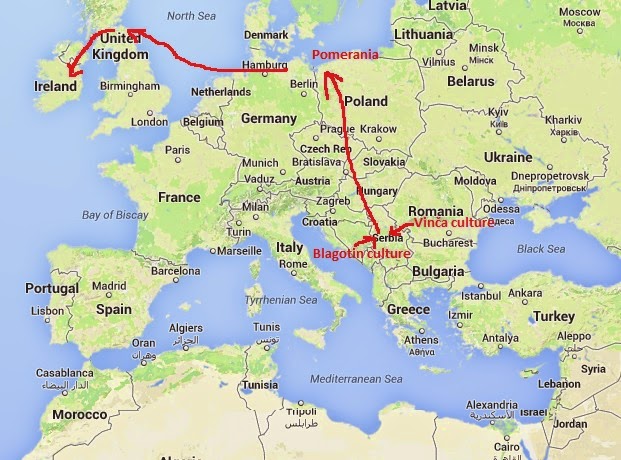
There is a well established cultural distribution path Balkans - South Baltic (Pomorje, Pomerania) - Ireland which has been in operation since at least fifth millennium bc. I wrote about this in my posts about henges and in my post about tochars.  

In the 6th millennium bc, in Serbia, mixed together we find highly developed metallurgical Vinča culture and highly developed grain farming Blagotin culture. These two cultures had to be in contact with each other. Vinca houses had grinding stones and bread baking ovens. Is it possible that from the 6th millennium bc, metallurgy and grain farming spread together into Europe from Serbia? And if so did they reach Ireland together, brought by the same people, Fomorians, people from Pomorje, the land by the sea, South Baltic, known today as Pomerania?


If this is the case, then Tigernmas lived in the 3rd or 4th millennium bc. Is it possible that the Irish oral tradition has preserved records of events that happened 5000, 6000 years ago? Is it possible that metallurgy arrived in Ireland earlier than we think, at the same time when grain farming arrived? Or did grain farming arrive in Ireland later than we think, at the same time with metallurgy? Is Crom Dubh 5000 thousand years old deity and is Crom Dubh, Hromi Daba, Grom Div the oldest European God who is still celebrated in Ireland and Serbia? Did Grom Div arrive to Ireland from the Balkans with the first metallurgists to reach Ireland? Did he then in Ireland turn into Crom Dubh over the following milleniums as the meaning of the name was lost? And did he then arrive back to the Balkans with Celts where he finally became Hromi Daba?

Appart from the biggest stone in the circle being called Cruim Duibh, we have another clue that the Grange circle functioned as a temple of Crom Dubh. The Grange circle has a ceremonial entrance. 


This ceremonial entrance is lined with stones in the same way as the Grange circle itself. The very entrance of the circle is marked with two large stones. This great pic is taken from http://irishantiquities.bravehost.com article about Grange circle. 


Originally, I thought that the ceremonial entrance was aligned with the sunrise on Lughnasadh, but I was wrong. 

The ceremonial entrance was made in such a way that it is aligned with the sunrise on Beltine and the sunset on Samhain, the actual Celtic New Year (in Celtic calendar, days start with sunset). Here is a great pic of that sunset by Ken Williams.


This day also marks the end of the harvest. Which means that on that evening, both the people and the God would enter the threshing floor together so that people can pray in the presence of the God and offer him their thanksgiving sacrifices... 

Like bulls. During excavations no structures were found but two hearths; a few un-burnt human bones, some animal bones (mainly cattle), some bronze materials and numerous Neolithic pottery pieces were discovered.


According to an Irish dinsenchas ("place-lore") poem in the 12th century Book of Leinster, Crom Dubh's, Crom Cruach's cult image, consisting of a gold figure surrounded by twelve stone figures, stood on Magh Slécht ("the plain of prostration") in County Cavan. In the 9th century Tripartite Life of Saint Patrick the deity is called Cenn Cruach, and his cult image consists of a central figure covered with gold and silver, surrounded by twelve bronze figures. Jocelin's 12th century Life and Acts of St. Patrick tells much the same story. Here the god is called Cenncroithi, interpreted as "the head of all gods". 

In the Grange circle, twelve large stones have been placed at intervals around the stone ring, each standing directly opposite one of the other 'axial' stones. This corresponds to the 12 lunar months of the solar year. Are these the 12 stones which eventually became 12 stone idols from the Irish legends? In central Serbia, on the first day of threshing, the first sheaf of grain is stuck on top of the stožer, the central pole of the threshing floor, and it stays there until the end of threshing. As I said in my post about threshing floors, I believe that originally the god of grain lived in the stožer, the central pole of the threshing floor. I believe that the cuboid obelisk representation of Crom Dubh is a later development. The sheaf of wheat stuck on top of the stožer central pole is Crom Dubh carrying a sheaf of grain, which eventually became the golden idol of Crom Cruach from the Irish legends. Cruach means a sheaf, a stack of corn, a heap of grain. In Serbian "kruh" mean heap of grain, bread.


Is the Grange circle the temple of Crom Dubh (Cruach) that the Irish annals talk about? Or Is Grange circle just one of many similar holy threshing floors strewn across pre-Christian Ireland?

Grange circle was a threshing floor which was at the same time also a solar observatory and a temple dedicated to Crom Dubh. Crom Dubh was the main god of pre-Christian Ireland and it is not a surprise to find many Grange place names around Ireland. Here is the map showing the distribution of place names with the root gráinsí, gráinsigh, gráinseach, Ghráinseach in Ireland:


What does the word grange mean and where does it come from? Official etymology says that the word grange comes from Irish gráinsí, gráinsigh, gráinseach, Ghráinseach. It is said that it means "granary, monastic farm"). Is there a reason why "grange" means a monastic farm and just a farm? Is it possible that many Monasteries were built on the grounds of old Granges, holy threshing floors dedicated to Crom Dubh, the god of grain? I believe that the word "gráinseach" originally meant threshing floor.  Gráinne in Irish means corn, grain. In my post about the people of the blade i talked about the ancient "sk, sek" root meaning to cut. In Irish it survived as a small cluster represented with the word "scean" (pronounced shkian) means knife but also to crack, split, sever. Is it possible that "gráinseach" is "gran" + "sek" = grain + cut = harvest, the place where cut grain was brought to be threshed, threshing floor, granary?

In the end, the dual use of Granges as both threshing floors and solar observatories, and the link between the Sun and Granin is embedded in the Irish language. In Irish "grian"  means sun and "gráinne" means corn, grain. But I will talk about that in my next Post. Until then stay happy.