This is quarter shekel from the British Museum. Struck before 333 BCE, it is considered to be the first Jewish coin. Following the description in Ezekiel of the flying throne of Yahveh with wheels and wings, the image is interpreted as the representation of Yahveh, The God...

Ezekiel is a Hebrew prophet and the central protagonist of the Book of Ezekiel in the Hebrew Bible, which reveals prophecies regarding the destruction of Jerusalem and the first temple.
The author of the Book of Ezekiel presents himself as Ezekiel, the son of Buzzi, born into a priestly (Kohen) lineage. Apart from identifying himself, the author gives a date for the first divine encounter which he presents: "in the thirtieth year". If this is a reference to Ezekiel's age at the time, he was born around 622 BCE, about the time of Josiah's reforms. His "thirtieth year" is given as five years after the exile of Judah's king Jehoiachin by the Babylonians, which according to Josephus happened in 598 BCE.
The vision Ezekiel had "in his thirtieth year" and which turned him into a prophet was of Jahveh sitting on the throne carried by the "four living creatures".
As I looked, a stormy wind came out of the north: a great cloud with brightness around it and fire flashing forth continually, and in the middle of the fire, something like gleaming amber. In the middle of it was something like four living creatures. This was their appearance: they were of human form. Each had four faces, and each of them had four wings...As for the appearance of their faces: the four had the face of a human being, the face of a lion on the right side, the face of an ox on the left side, and the face of an eagle; such were their faces...

In the middle of the living creatures there was something that looked like burning coals of fire, like torches moving to and fro among the living creatures; the fire was bright, and lightning issued from the fire. The living creatures darted to and fro, like a flash of lightning...As I looked at the living creatures, I saw a wheel on the earth beside the living creatures, one for each of the four of them...When the living creatures moved, the wheels moved beside them; and when the living creatures rose from the earth, the wheels rose. Wherever the spirit would go, they went, and the wheels rose along with them; for the spirit of the living creatures was in the wheels. When they moved, the others moved; when they stopped, the others stopped; and when they rose from the earth, the wheels rose along with them; for the spirit of the living creatures was in the wheels.
In another part of his book, Ezekiel identifies the "living creatures" as cherubim, one of the unearthly beings who directly attend to God according to Abrahamic religions. The numerous depictions of cherubim assign to them many different roles; their original duty having been the protection of the Garden of Eden, and in particular the Tree of Life.
Interestingly the same vision appeared to the Christian prophet John, who described it in his Revelation:
In the center, around the throne, were four living creatures, and they were covered with eyes, in front and in back. The first living creature was like a lion, the second was like an ox, the third had a face like a man, the fourth was like a flying eagle. Each of the four living creatures had six wings and was covered with eyes all around, even under its wings.

Day and night they never stop saying:
"Holy, holy, holy
is the Lord God Almighty
who was, and is, and is to come."
The four living creatures from Ezekiel's and John's visions gave birth to the Christian "tetramorph".
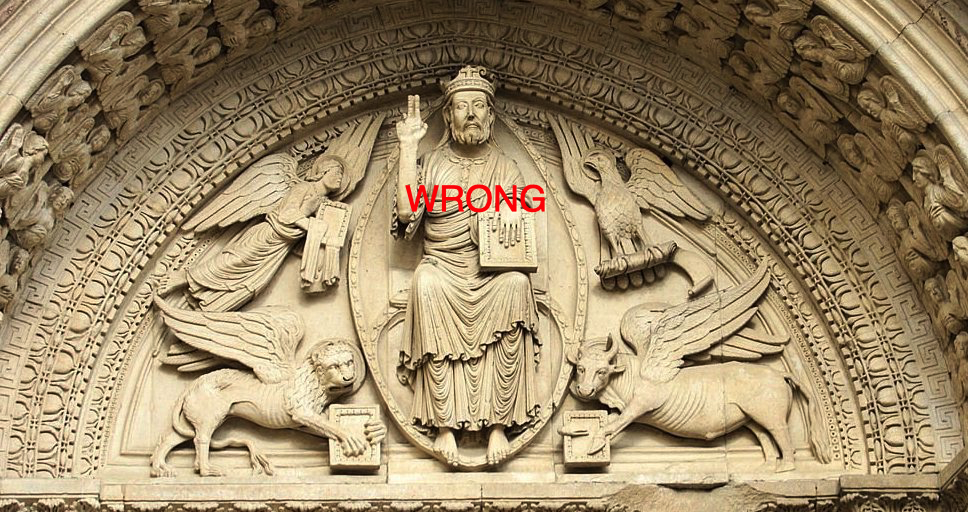
In Christian art, the tetramorph is the union of the symbols of the Four Evangelists, derived from the four living creatures in the Book of Ezekiel, into a single figure or, more commonly, a group of four figures.
In their earliest appearances, the Evangelists were depicted in their human forms each with a scroll or a book to represent the Gospels. By the 5th century, images of the Evangelists evolved into their respective tetramorphs, each of the four Evangelists is associated with one of the living creatures, usually shown with wings. The most common association, but not the original or only, is: Matthew the man, Mark the lion, Luke the ox, and John the eagle. Christ in Majesty is often shown surrounded by the four symbols.

By the later Middle Ages, the tetramorph in the form of creatures was used less frequently. Instead, the Evangelists were often shown in their human forms accompanied by their symbolic creatures, or as men with the heads of animals.
In images where the creatures surround Christ, the winged man and the eagle are often depicted at Christ’s sides, with the lion and the ox positioned lower by his feet, with the man on Christ's right, taking precedence over the eagle, and the lion to the left of the ox. These positions reflect the medieval great chain of being.
Now how are we to understand these strange creatures from Ezekiel's and John's visions? Well this has been bothering people for a long time.
In Judaism the four faces of the living creatures represent different creatures god created. The lion represents all wild animals, the ox represents domestic animals, the human represents humanity, and the eagle represents birds.
In the context of the Christian tetramorph, the winged man indicates Christ’s humanity and reason, as well as Matthew’s account of the Incarnation of Christ. The lion of St Mark represents courage, resurrection, and royalty, coinciding with the theme of Christ as king in Mark’s gospel. It is also interpreted as the Lion of Judah as a reference to Christ’s royal lineage. The ox, or bull, is an ancient Christian symbol of redemption and life through sacrifice, signifying Luke’s records of Christ as a priest and his ultimate sacrifice for the future of humanity. The eagle represents the sky, heavens, and the human spirit, paralleling the divine nature of Christ.

The same type of zodiac wheel, with Helios or Sun in it's center, sitting in a chariot (throne) pulled by four horses (beings), just like in Ezekiel's and John's visions, is found in contemporaneous synagogues throughout Israel such as Naaran, Susiya, Hamat Tiberias, Huseifa, and Sepphoris.
Now when we look at the four faces of the "living creatures" and compare them with the zodiac symbols, we can see that these four faces match the four fixed points of the zodiac:
The man is Aquarius
The ox or cherub is Taurus,
The lion is Leo
The eagle is Scorpio (Few people know that Scorpio has another form, Eagle, sometimes Phoenix).
When we connect these four points we get a cross:

And so lets correct the four evangelist's positions around Christ:

But why did Jews adorn their synagogues during early Christian Era with these strange zodiacs? And what is the reason that these exact four zodiac signs were chosen to be the faces of the "four living creatures"?
In my post "Boaz and Jachin" I talked about the significance of the fact that Solomon built his temple on a threshing floor. The reason why this is significant is because in the past threshing floors were not only used for threshing and winnowing, but were also used as solar observatories and for ceremonies which were part of a solar cult. At the end of that article I suggested that the First Temple, whose entrance was oriented towards true east, towards the area of the horizon where the sun rises, was a temple dedicated to the sun and built by sun worshipers. And I said that we actually have indications that this could in fact have been the case.
In my post Sun god from the first temple I continued talking about this. Interestingly it was Ezekiel who told us explicitly that the First Temple was solar temple.
In Ezekiel 8:16 we read this:
"In the sixth year, in the sixth month on the fifth day, while I was sitting in my house and the elders of Judah were sitting before me, the hand of the Sovereign Lord came on me there. I looked, and I saw a figure like that of a man. From what appeared to be his waist down he was like fire, and from there up his appearance was as bright as glowing metal. He stretched out what looked like a hand and took me by the hair of my head. The Spirit lifted me up between earth and heaven and in visions of God he took me to Jerusalem...He then brought me into the inner court of the house of the Lord, and there at the entrance to the temple, between the portico and the altar, were about twenty-five men. With their backs toward the temple of the Lord and their faces toward the east, they were bowing down to the sun in the east."
Interesting right?
The fact that people still prayed to the sun during the time of Ezekiel is very interesting, because it shows how strong this solar cult was among the people of Judah. Ezekiel was born during the reign of Josiah (649–609 BCE). And it was Josiah, who according to the Hebrew Bible, instituted major religious changes aimed at eradicating the solar cult which flourished in Judah before and during his time. How strong the solar cult was in Judah just before the time of Josiah can be seen from the royal seal of the Kingdom of Judah from the time of the King Hezekiah (739 - 687 BC).

This means that the solar cult was not a minor religious curiosity. It was a state religion whose main temple was the First temple. A state religion supported by at least a significant part of the Judah's population.
So when Josiah started his religious reforms, not everyone was pleased. A lot of people saw these changes as sacrilege and continued to practice the old solar religion.
As part of his crusade, Josiah did the major cleanup of the First temmple. In 2 Kings 23:11 we read:
"He (Josiah) removed from the entrance of the LORD's Temple the horse statues that the former kings of Judah had dedicated to the sun... He also burned the chariots dedicated to the sun..."
This is most peculiar. We have a temple, build on a threshing floor (ancient solar observatory). The temple was oriented towards the east, and in the temple people prayed to the rising sun as if it was a god. And the temple housed a chariot and horses dedicated to the sun god???
Who was this sun god to whom ancient kings of Judah dedicated horses and chariot?
Well Helios of course.

Official story is that Ezekiel really hated the solar worshipers...But now I am wondering...Is it possible that he was actually one of them? Is it possible that he saw Josiah's reforms as totally sacrilegious and that when he prophesied the destruction of of Jerusalem and the first temple, he did so because he believed that that was the fitting punishment for the Jews turning their backs to the Sun, their God? And is it because of this that he was hated by the same Jews? And is it because of that that his vision of god is basically Sun god sitting in a chariot pulled by four horses???
Qumran scrolls, which are attributed to the Essens, seem to confirm that Josephus was telling the truth. In the Hodayom, there are several references to prayer at dawn. 1QH 4:5 states: "I thank thee, O Lord, for Thou hast illuminated my face by Thy covenant, and I seek Thee, and sure as the dawn Thou hast appeared to me as perfect light."

This means that the solar cult was not a minor religious curiosity. It was a state religion whose main temple was the First temple. A state religion supported by at least a significant part of the Judah's population.
So when Josiah started his religious reforms, not everyone was pleased. A lot of people saw these changes as sacrilege and continued to practice the old solar religion.
As part of his crusade, Josiah did the major cleanup of the First temmple. In 2 Kings 23:11 we read:
"He (Josiah) removed from the entrance of the LORD's Temple the horse statues that the former kings of Judah had dedicated to the sun... He also burned the chariots dedicated to the sun..."
This is most peculiar. We have a temple, build on a threshing floor (ancient solar observatory). The temple was oriented towards the east, and in the temple people prayed to the rising sun as if it was a god. And the temple housed a chariot and horses dedicated to the sun god???
Who was this sun god to whom ancient kings of Judah dedicated horses and chariot?
Well Helios of course.
Here is a depiction of Helios, the old titan (Old European) sun god. He is mostly depicted as a youth with sun ray halo driving the chariot pulled by winged horses across the sky, from east to west.

Official story is that Ezekiel really hated the solar worshipers...But now I am wondering...Is it possible that he was actually one of them? Is it possible that he saw Josiah's reforms as totally sacrilegious and that when he prophesied the destruction of of Jerusalem and the first temple, he did so because he believed that that was the fitting punishment for the Jews turning their backs to the Sun, their God? And is it because of this that he was hated by the same Jews? And is it because of that that his vision of god is basically Sun god sitting in a chariot pulled by four horses???
As I already mentioned, Ezekiel sees priests in the First Temple worshiping the sun. Interestingly, historian Josephus, who lived during the 1st century AD, records an Essene practice that he says was handed down to them by the forefathers where it appears that they were praying to the rising sun (War 2.8.5).
Qumran scrolls, which are attributed to the Essens, seem to confirm that Josephus was telling the truth. In the Hodayom, there are several references to prayer at dawn. 1QH 4:5 states: "I thank thee, O Lord, for Thou hast illuminated my face by Thy covenant, and I seek Thee, and sure as the dawn Thou hast appeared to me as perfect light."
And at the same time someone built synagogues with depictions of Helios surrounded by the Zodiac??? Like this one from the Hammat Tiberias Synagogue, dated to 286 and 337 CE, when Tiberias was the seat of the Sanhedrin. The mosaic floor is made up of three panels featuring the zodiac, and Helios, the sun god. Women who symbolise the four seasons of nature appear in each corner.

So were the synagogues with Helios built by Essenes? Essenes who wanted to "restore the first temple", the "temple of the sun god who rides in a chariot pulled by four horses"???
Well we don't know, but what we know is that the early Christian churches which were also oriented towards the east i.d. toward the Rising Sun, the same orientation found in the First temple.
And, at the same time when the helios synagogues were being built, the vision of a god in a chariot appeared to John who described it in Revelation:
In the centre, around the throne (chariot with four wheels), were four living creatures, and they were covered with eyes, in front and in back. The first living creature was like a lion, the second was like an ox, the third had a face like a man, the fourth was like a flying eagle. Each of the four living creatures had six wings and was covered with eyes all around, even under its wings.
Why Man, Bull, Lion and Eagle? Why are these four zodiac signs chosen to be the faces of the living creatures?
These four zodiac signs cover these four periods of the solar year:
Aquarius 21 January – 19 February
Taurus 21 April – 21 May
Leo 23 July – 22 August
Eagle (Scorpio) 24 October – 22 November
In my post "Two crosses" I talked about Earth's cross, whose hands point to the so called "cross quarter days" which mark the transitional points of the climatic, vegetative cycle in the northern hemisphere, more precisely Europe:
The four points of this solar cross are at the core of the Celtic calendar:
1. Imbolc- the beginning of the spring
2. Bealtaine - the beginning of the summer
3. Lughnasa - the beginning of the autumn
4. Samhain - the beginning of the winter

And the Serbian calendar:
1. St Sava - the beginning of the spring
2. St George - the beginning of the summer
3. St Ilija - the beginning of the autumn
4. St Mitar - the beginning of the winter

The sun cross (Solstices and Equinoxes) and earth cross (Cross quarter days) are out of sync. The earth cross is rotated forward by 45 degrees and the earth circle cardinal points fall right in between the sun circle cardinal points. This is because the earth climatic, vegetative cycle lags behind the solar cycle.
Winter solstice (21st of December) is the the shortest day. So we would expect that this is also the coldest day. We would also expect that from that day on, as the days start getting longer, the days also start getting warmer. But as we all know, this is not the case. The days do get longer, but the earth continues to cool. It is only at the beginning of February that we start seeing the first signs of the earth warming up. This is why the beginning of spring is at the beginning of February (Imbolc, St Sava (14th of January, but probably a replacement for the old Imbolc which is celebrated on the 1st of February)). The actual mid point is 4th of February. Which falls right in the middle of Aquarius (21 January – 19 February).
Spring equinox (21st of March) is the moment when the day is as long as night. From that day the days are longer than nights. We would expect that this would mark the beginning of the summer. But the real heat does not start until the beginning of May. This is why the beginning of summer is at the beginning of May (Bealtaine, which is today celebrated on the 1st of May, but there are indications that it was once celebrated on the 6th of May. Here we find St George's day celebrated on the 23 of April, probably replacement for old Bealtaine). The actual mid point is 6th of May. Which falls right in the middle of Taurus (21 April – 21 May).
The four points of this solar cross are at the core of the Celtic calendar:
1. Imbolc- the beginning of the spring
2. Bealtaine - the beginning of the summer
3. Lughnasa - the beginning of the autumn
4. Samhain - the beginning of the winter

And the Serbian calendar:
1. St Sava - the beginning of the spring
2. St George - the beginning of the summer
3. St Ilija - the beginning of the autumn
4. St Mitar - the beginning of the winter

The sun cross (Solstices and Equinoxes) and earth cross (Cross quarter days) are out of sync. The earth cross is rotated forward by 45 degrees and the earth circle cardinal points fall right in between the sun circle cardinal points. This is because the earth climatic, vegetative cycle lags behind the solar cycle.
Winter solstice (21st of December) is the the shortest day. So we would expect that this is also the coldest day. We would also expect that from that day on, as the days start getting longer, the days also start getting warmer. But as we all know, this is not the case. The days do get longer, but the earth continues to cool. It is only at the beginning of February that we start seeing the first signs of the earth warming up. This is why the beginning of spring is at the beginning of February (Imbolc, St Sava (14th of January, but probably a replacement for the old Imbolc which is celebrated on the 1st of February)). The actual mid point is 4th of February. Which falls right in the middle of Aquarius (21 January – 19 February).
Summer solstice (21st of June) is the longest day of the year. We would expect that this would also be the hottest day of the year. We would also expect that from that day on, as the days get shorter, the days also get colder. But again as we all know, that is not the case. The days do get shorter, but earth continues to warm. It is only at the beginning of August that we start seeing first sings of earth cooling down. This is why the beginning of autumn is at the beginning of August (Lughnasa which is today celebrated on the 1st of August but was once probably celebrated on the, 2nd of August. Here we find St Ilija's day celebrated on the 20th of July, probably replacement for old Lughnasa). The actual mid point is 2nd of August. Which falls right in the middle of Leo (23 July – 22 August).
Autumn equinox (21st of September) is the moment when the day is as long as night. From that day the days are shorter than nights. We would expect that this would mark the beginning of the winter. But the real cold does not start until the beginning of Novermber. This is why the beginning of winter is at the beginning of November (Samhain, St Mitar (26th of October, but probably the replacement for the old Samhain which is celebrated on the 31st of October)). The actual mid point is 5th of November. Which falls right in the middle of Eagle (Scorpio) (24 October – 22 November).
This is indeed incredible. The four points of the vegetative cross define climate, which is created during the continuous interplay between the Father Sun and Mother Earth. I talked about this in my post Yin and Yang. Interestingly these four points fall into four zodiac signs which are the four faces of the four living creatures described by Ezekiel. The four living creatures whom he identifies as cherubim, the guardians of the "Garden of Eden" and particularly "The Tree of Life". Garden of Eden is this earth and the Tree of Life is the life it produces. The life which can be only produced because the Father Sun and Mother Earth produce the ever changing climate whose change is marked by the four points of the Climatic cross Aquarius = Spring, Taurus = Summer, Leo = Autumn, Eagle = Winter...
The problem with his vision is that this climatic cross only corresponds with the climate in Europe. Not with the climate in Middle East and definitely not with the climate in Babylon...
I already said that this climatic cross is at the base of the Serbian and Celtic calendar. Ezekiel (allegedly) had his vision in the 6th century BC. Solomon who built the solar temple on David's threshing floor (allegedly) built it in the 10th century BC.
There is no mention of anything like it in Hebrew Scriptures or Tradition. So why would Ezekiel "see" it in his vision?
The thing is this climatic cross was already known and was already sacred during the early Bronze Age. In Ireland. The same place where we found the so called "Celtic calendar" based on the above four cross quarter days. How do we know this? Well because we have stone circles aligned with these cross quarter days.
This is Grange stone circle. It is located on Lough Gur in County Limerick, Ireland. Composed of 113 standing stones, the Grange Stone Circle is the largest and finest in Ireland. Seán P. Ó Ríordáin excavated the Grange Stone Circle in 1939. During the excavations he found more than 4,000 shards of pottery, dating from the Early Neolithic to the Late Bronze Age, spanning a period of some 2,600 years.


This is the ceremonial entrance. It is lined with stones in the same way as the Grange circle itself. The very entrance of the circle is marked with two large stones.

This ceremonial entrance is aligned with the sunrise on the first or second of August, the Day of Crom Dubh, Lughnassa, the day of Perun, Thundering sun Ilios.
This is Beltany stone circle. It is located at Beltany, Co. Donegal. The name Beltany is an anglicised version of the Irish Beltaine, Beltane. The stone circle dates from around 1400-800 BC. Some reports are even saying that the actual building date is 2000 BC. The complex comprises a stone circle of 64 stones around a low earth platform or tumulus, situated at the summit of Beltany Hill.

The stone circle has several alignments:
1. Alignment with the sunrise on the day of Bealltaine (6th May, middle of Taurus), the Beginning of Summer.
2. Alignment with the sunrise on the day of the Winter Solstice (21st of December).
3. Alignment with the sunrise on the day of Samhain (1st of November, middle of Eagle, Scorpio), the Beginning of Winter.
4. Alignment with the sunrise on the day of the Equinoxes (21st March and 21st September).
So Bronze Age Irish were already aligning their solar circles with the climatic cross at least a thousand years before Ezekiel had his vision of the "four living creatures pulling the throne of god". Interesting...
PS:
1. Alignment with the sunrise on the day of Bealltaine (6th May, middle of Taurus), the Beginning of Summer.
2. Alignment with the sunrise on the day of the Winter Solstice (21st of December).
3. Alignment with the sunrise on the day of Samhain (1st of November, middle of Eagle, Scorpio), the Beginning of Winter.
4. Alignment with the sunrise on the day of the Equinoxes (21st March and 21st September).
So Bronze Age Irish were already aligning their solar circles with the climatic cross at least a thousand years before Ezekiel had his vision of the "four living creatures pulling the throne of god". Interesting...
PS:
Since I wrote this article, my knowledge about these symbols expanded and I wrote another article about these symbols "Symbols of the seasons". Since then I learned that these animal markers are actually universal ancient calendar markers used all over Eurasia and North Africa since at least Neolithic.
Man - Aquarius - Jan/Feb - beginning of snowmelt
Bull - Taurus - Apr/May - beginning of the calving season of the wild cattle
Lion - Leo - Jul/Aug - beginning of the mating season of Eurasian lions
Eagle - Eagle - Oct/Nov - beginning of the mating season of Old World Vultures
Scorpion - Scorpio - Oct/Nov - beginning of the hibernation of scorpions
...
I wrote about this in many other posts on my blog.
Please check them out...


