Showing posts sorted by relevance for query "solar rider". Sort by date Show all posts

Saturday, 21 December 2019

Young god

Solar rider from a Celtic coin...


In Slavic mythology, Svetovid was associated with a white horse, which was kept in his temples and used for divination...In this article I will talk about a Serbian ritual song which talks about solar rider and Christmas...

"Dodaj meni hladne vode, Koledo Koledo, Da kupamo, okupamo mladog boga, tog Božića Svarožića… Konjic mu je jarko sunce, bojni doro ognjeviti"

"Pass me cold water, o Koledo, to bath the young god, Božića Svarožić... His horse is the bright sun, a flaming war steed"

This is a Serbian ritual "Christmas song" recorded in Bosnia by Milojević in 1869. In it the narrator asks Koledo for water. Koledo is winter solstice. The end of the old Kolo (wheel, Solar wheel, solar year) and the beginning of the new Kolo (wheel, Solar wheel, solar year)...

The water is needed to bath "the young god" who is called Božić. In Serbian the word "Bog" means god and the ending "ić" means small, young.  So Božić literally means young god, but also it means Christmas...So far so Christian...🙂

But the young god Božić is also called Svarožić (young Svarog). Triglav (Dabog), Serbian supreme deity, consisted of Svetovid, Perun, Svarog. Svetovid represented Sun, Perun represented Thunder and Svarog represented Fire. I talked about Triglav in my post "Triglav, Trojan, Trinity, Trimurti, Agni"

So Svarožić (the other name of the young god) means "young fire". This "young fire" is the fire of the sun, which is rekindled on the day of the winter solstice, the day when the new sun is born and the new solar year, new "kolo" starts...

The main ritual performed over Christmas (Solstice) is "lighting the Yule log in the evening, keeping it burning through the longest night, and then making it spark in the morning". 

Watching over Christmas (Solstice) fire, Serbia


I talked about this in my posts "Badnjak" and "First footer"

In this way people helped "preserving sun's fire", "rekindling of the fire of the new sun"...This was not just symbolic action. People believed that "all fire is one" and that if their fire was kept burning, the sun's fire would be kept burning through the longest night...


This equates Svarožić (young fire) with Jarilo (young sun) who is born during the longest night...Svarožić is Jarilo's fire. Jarilo's name comes from "jar' which means both young and fiery, raging...It is his fire which grows ever stronger and warmer which brings spring...

That Svarožić (young fire) is Jarilo (young sun) can be seen from the second verse which says that Svarožić rides on the bright sun, which is his flaming war horse...He is the Solar rider... 

Depiction of the solar rider from Bosnia from my post "The horseman"


Christmas is coming, get your Badnjaks (Yule logs) ready...🙂

Tuesday, 24 January 2017

King John


Does anyone else think that this picture, allegedly showing king John on a stag hunt, looks strange, and may be hiding something in plain sight?

Well I checked and officially there is nothing special about this picture. It is simply a picture depictint the king who liked hunting chasing a stag day and night.

But maybe, just maybe, there is more in this image than meets the eye.

In Europe, St John's day, (Ivandan, Jovandan in Slavic languages) is Christianized Midsummer, Summer solstice celebration.

In Serbia Midsummer, Summer, Summer solstice day is also known as Vidovdan, day dedicated to Svetovid, sun god. The sacred animal of Svetovid is white horse. This is an image of the solar rider on a white horse is also found on (medieval???) standing stones from Bosnia.


I already wrote about this in my post "The horseman".

The same solar rider and horse are found on many Celtic coins:


The rider of the solar horse on Celtic coins often had solar head, a head with hair sticking out like sun rays. The rider was the sun, sun god. We can see this from the fact that the rider is sometimes the sun disc. John has the ray crown which actually represents the sun rays. The same crown was worn by Sun god in later Roman period of Sol Invictus worship and by emperors who worshiped the sun god. This is Aurelian in his radiate crown on the left with Sol Invictus on the right.


The crown that John is wearing is the same radiate crown, the solar crown.

The line between the light (red) and dark (blue) part of the picture can be interpreted in two ways. Firstly this  could be the line between the day and night, so the evening. Secondly this could be the line between the period of the year when the days are getting longer and the period of the year when the days are getting shorter, so the summer solstice. Regardless of which one of these two interpretations we take, it seems that the painter went through considerable pain to make it obvious that this change from light to darkness is important. King John is depicted right on the line between light and darkness and his clothes are also made of the same light and darkness. Meaning he is related to light, he is light. He is the sun. I believe that the line between the "light" and "dark" part of the picture is the summer solstice, because this fits with St John's day being the midsummer, summer solstice celebration.

King John is chasing the stag.

The same stag hunt scene is represented on many Bosnian medieval standing stones, like this one from Crljivica:


But just like King Arthur and his knights, who are unsuccessfully trying to catch the white stag, King John and the unknown deer hunter from Bosnia will never catch his stag...Why?

Cause stallion is the symbol of summer, while stag is the symbol of winter...Why?

Cause mating season of horses, marked by vicious stallion fights, starts in Apr/May, beginning of summer, and mating season of deer, marked by vicious stag fights, starts in Sep/Oct/Nov, beginning of winter...

This makes Stallion an animal calendar marker for summer, the light half of the year...and Stag an animal calendar marker for winter, the dark half of the year...

King John is also holding his hand in a very strange way, with the palm pointing up, towards the sky, towards the sun. The reason why palm up means salvation is because sun god and heaven is "up". The reason why palm down means damnation is because earth, devil and hell is "down".  And he is pointing up...Towards the sun on the St John's day, the day of the summer solstice. The day when the sun, the king of heaven is on his throne, the highest point the sun reaches in the sky on the northern hemisphere...

Lastly, the corners of the picture are very interesting. They all have the same symbol, "the hands of god" which represent the solar year, divided into four seasons around solstices and equinoxes with three months each...The god whose hands these are is the sun. 


This symbol is found on Serbian Christmas cakes. Christmas is the Christianized winter solstice celebration, the celebration of the birth of the new sun, new solar year. This is why there is so much solar imagery on Serbian Christmas cakes which are votive offerings to the sun god.


You can read more about these cakes and their ritual use in my post "Can you see me".

No what about the lanterns? Well officially they are not lanterns at all, but just "patterns"...In Serbia midsummer celebrations and customs have been during Christian time spread through the summer and associated with several summer saints. One of these is St Peter's day which used to be celebrated on the is celebrated on the 28th of June according to Julian calendar but is today celebrated on the 12th of July according to the Gregorian calendar. During St Peter's day celebrations in Serbia people light up special votive torches called "lile".


I believe that these were once lite up on the eve of the summer solstice.  In Southern Europe (including Angevin domains in southern France) this is the time when grain ripens and the time when fireflies light up the night.


South Slavic words for firefly are "svitac", "svitnjak", "svijetnjak", "svitaljka", "cvitnjak", "kris", "krijes", "kres", "kresnica"...These are also words used for fire and torches which are lit up on the shortest night of the year, as part of the Slavic summer solstice celebrations...

Are the "lantern" like "patterns" on the picture fireflies or votive toches? 

So that's it.

Interesting? 
Possible? 

Well yes and yes. 

Overanalyzing of a pretty but otherwise meaningless painting? 

That is possible too.

We will never know :)

Saturday, 29 August 2026

Curlew

60BC-20BC, Celtic Atrebates/Regni gold coin, found in 1873 in Selsey, East Wittering, England, currently in the British Museum.  Official description:


Obv: Abstract design derived from head of Apollo.

Rev: Stylised horse, left; wheel above horse; bird, right below horse.

Basically what the description says is that this Celtic coin is an abstraction of a coin like this: Bronze drachm of the Philip II of Macedon. 359-336 BC. Alexander the Great's father. From this article...

Obv: Head of Apollo

Rev: Naked youth on a prancing horse

Celts are known to have made their own copies of well known Greek/Macedonian coins. More on this great site "Balkancelts"...

But what I find very interesting about this Celtic coin is how it has abstracted the Macedonian one.

The head of Apollo became two sun discs eyes...

The youth on a prancing horse (which was actually a depiction of the Young Sun God Apollo himself riding on a solar horse) became sun disc on a prancing solar horse...

BTW, Celts made another version of this Solar Rider coin, where the rider is still "a young man" but with a sun for a head...Like this Celtic coin from Hungary...

I talked about solar riders, and why was horse a solar animal in many of my posts...

Anyway, the reason why horse is a solar symbol found all over Eurasia, is because horse mating season, characterised by vicious stallion fights, is governed by the sunlight: it starts at the beginning of the summer and it peaks in midsummer, on summer solstice...

Hence these two lads, Castor and Polux, marking the summer solstice...

This is the horse sorted 🙂 But what bird is depicted on the original Celtic coin? 

I think to answer this "important" 🙂 question, we need to look at the reverse of this coin as an animal calendar marker...

Knowing what we know about horses mating season, and how horse was used as a calendar marker elsewhere, I would suggest that the prancing solar horse with the sun disc on the original Celtic coin depicts the hot, sunny half of the year in England, Apr/May-Oct/Nov.

Now usually, the birds associated with solar cult are migratory birds, like swans, which arrive to the areas with the continental climate from their wintering grounds in spring, with the "Young Sun"...

This link is already found in Late Neolithic Northern Europe. Among the Lake Onega petroglyphs, Russia, made c. 4000BC, the only two petroglyphs which were "Christianised" with a cross were "The Devil" and "The Swan"...

Why? Cause "The Devil" is actually the sun god. And (migratory) swans are his birds. These two images are actually part of a large solar year calendar which was encoded using local animal and plant calendar markers. I talk about these amazing petroglyphs in my post "Bes"...

I talk about migratory birds as animal calendar markers linked to the solar cults in many of my posts...

But looking at the bird depicted under the horse, you can see that it definitely isn't a swan. I was first reminded of a common crane, another bird associated with the solar cult

Another bird that looks like the bird standing under the horse, which is also associated with the sun cult is a stork.

But there is a problem here: the curved beak...Now this could be just a bad craftsmanship. But it could actually be an important clue that could help us identify the bird depicted standing under the solar horse...

There is a bird native to England, which (kind of 🙂) looks like this: curlew. This bird is a resident species in England, bit it is also locally migratory: During the warm part of the year, it is found inland, and during the cold part of the year it is found only on the coast...

The reason for this is that curlew "nests on the ground in rough pastures, meadows and heather"...


This is the horses country...

And: "Curlew arrive back at their breeding grounds in late March or early April, laying their eggs between mid-April and mid-May. Chicks hatch between May and June and have typically fledged by mid-July"...

Right during the time when horses are mating (and prancing 🙂).

And when the "Young Sun God" arrives riding on a prancing horse...

That's it. To read more about ancient animal and plant calendar markers, start here…Then check my twitter threads I still didn't convert to blog post...I am way way behind...

Monday, 13 March 2017

Lion and fish

This is a very interesting Celtic coin from Panonia. Unfortunately I don't know anything else about this coin, so would appreciate any additional info, like the location where it was found and dating. 


Front: Solar rider. 

I already wrote about the symbolism of the solar rider in my posts "The horseman" and "King John". It is a very common motif on Celtic coins which shows that Celtic religion was in essence a solar cult. 

In short, this solar rider represents the sun god. The sun god dominates the white part of the year, the period between Belatane and Samhain, the summer and autumn. You can read more about the Celtic calendar in my post "Two crosses".

Back: Lion's head. In the middle of the white period of the year, at the point that marks the end of summer and the beginning of autumn, we find zodiac sign Leo (lion). The point that marks the end of summer and beginning of autumn, Lughnasadh, falls in the middle of the Leo zodiac sign.

But it gets better. 

Why does the lion have fish symbol around his eye? 

Have a look at this image:


The point marking end of the Leo (lion) zodiac sign is directly opposite to the point marking the beginning of the Pisces (fish) zodiac sign. The constellation Pisces is invisible during the Pisces period. In the Northern hemisphere Pisces can be seen from August to January, right after the Leo period...

Lion is literally looking at fish...

Such complex zodiac imagery is an interesting thing to find on a Celtic coin don't you think?

Tuesday, 29 September 2026

Dancing sun god

😂😂😂 Wow!!! Animation made by overlying two Celtic Silver Quinarius coins from Central Europe (Rhineland), minted between 65 BC - 1 AD, both featuring slightly different version of the same scenes:

Obv: dancing mannikin right, head turned left, holding snake in right hand [me: which is biting his nose], torque in left hand. 

Rev: horse standing right, head turned left [me: wandering WTF is going on on the other side of the coin]; around, zig zag border. 

Animation and data from this great page...

What I think is that the "dancing mannikin" is actually The Sun God. His spiky hair symbolising the sun rays. Just like here, on this coin of Alexander the Great depicting the face of Helios. 350-331 BC - British Museum, London...

That this is indeed The Sun God is indicated by the fact that he is holding a snake. Snake is a pure solar animal. It is in our world when sun is here (day, hot half of the year) and it is in the underworld when sun is there (night, cold half of the year)...  


I talked about snake as the solar symbol from around the world in many of my posts...

BTW, because snake also spends half of the time in the underworld, snake is also a chthonic animal. So no contradiction here...

Just like the Sun God who also spends half of the time in the underworld, making the Sun God also a chthonic deity...

Think about this for now, will talk about this more soon...

Also, Apr/May, the beginning of summer, is when most common Eurasian snakes, vipers, start mating, and fighting...

I talked about this in many of my posts...

BTW, Hermes/Mercury, who features prominently in Celtic mythology, carries caduceus (staff with two intertwined snakes) because he himself was a deified calendar marker for Apr/May...Every single plant and animal that features prominently in his mythology is a calendar marker for Apr/May...I talk about Hermes/Mercury in these posts...

And remember the dual, solar/chthonic aspect of snakes? Which links them to both the land of living and the land of the dead, and makes them the messengers of the dead, the carriers of their will (prophecies)? This is why Apollo, who also features prominently in Celtic mythology, is associated with a (is basically a deified) snake...

I talk about the link between Apollo and Python (snake) in several posts: Apollo and Python, Marble throne of Apollo, Kassandra

Pic: Marble Throne of Apollo, Roman, late 1st c. AD. Currently in the Los Angeles County Museum of Art. Whoever made this, knew who Apollo really was and wanted to show Apollo in his true shape (serpent, dragon), sitting on his throne...

One last thing about snakes, solar animals number one, the symbols of sun's heat.

3rd millennium BC, Bactrian seal depicting the sun god (see heat rays emanating from his shoulders) holding snakes, symbols of sun's heat...

I talk about it in my post Nude winged hero dominating snakes...

Vipera Pythia, c. 1651, by Marco Aurelio Severino. Some people still knew what snakes were until recently. But for some reason this was a secret...

What about the horse? Horse (actually equid in general) is another animal calendar marker for summer. The fertility of equids is linked to sunlight. Which is why the mating of equids starts in Apr/May, lasts until Sep/Oct and peaks on Summer Solstice, and is characterised by wild stallion fights for mares...

I talked about this first in my post Trojan Horse...

This is why horse (actually equid in general) is together with snake one of the most widespread solar symbols. 

Here it is, sun above the midle of the horse (on summer solstice) depicted on a 

Roman coin

Celtic coin 

This is even better. Another Celtic coin, this time with the sun depicted as solar rider. See the spiky hair symbolising sun rays? With the sun god Apollo depicted on the other side...Eastern Europe. Hungary. 

BTW, this is another Celtic copy of a Macedonian coin...

This is why horse (actually equid in general) was the preferred ride of the sun gods (and kings who worshiped them) from Mesopotamia onwards...

Pic: Helios on a chariot pulled by 4 white horses. Apulian vase dated to 350BC

I talked about Horse (Equid) as a solar symbol in many of my posts. Here are just a few: 

Mesopotamia 

Shamash playing with solar horse

Sun god from Tell Brak 

Seven heads

Iran

Water carrier equid

Dioscuri plate from Iran

India 

Hayagriva

China 

Longma

Mythical beast from Xian

Europe 

Curlew

White stag

Archaic rider

Beotian solar Pyxis

Pegasus and Chimera

King John

Svetovid

Poseidon pursuing Demeter

Anatolia

Cilician Nergal

Levant 

Sun god from the first temple

Alexamenos graffito

Goddess on a horse

This is also why we find horse animal calendar marker disguised in our western Zodiac as Dioskuri, divine twin horsemen, marking the Summer Solstice. The guys who wanted to marry "the daughters of the white horse". 

I talked about the horse twins in my post Little horses

O yeah, almost forgot. Unicorn is also a solar symbol, symbol of summer. 

I talked about this in several of my posts:

Reem

Unicorn

Stag and unicorn

BTW, Unicorn horn is described as "being cubit and a half (28 inches) in length". Erect horse's penis length 🙂 is max 28 inches...

Oh and guess when the horse (equid) mating season ends? In Virgo...

The virgin, which calms the unicorn 🙂...

So, what is depicted on this funny coin is the dancing sun god with his pet snake and his pet horse...Is dancing here supposed to represent some king of celebration? Beltane (Apr/May), beginning of summer and the beginning of Celtic White Half of the year, celebration? Marked by the beginning of mating seasons of snakes and horses? 

Here is a post Horse and boar about the series of Celtic coins which depict horse as animal calendar marker for (the beginning of) the Celtic White Half of the year (Mating of horses starts in Apr/May)...And boar as animal calendar marker for (the beginning of) the Celtic Black Half of the year (Mating of boars starts in Oct/Nov)... 


That's it for today. If you are interested in reading more about ancient animal and plant calendar markers, which are at the root of all our mythologies, start here…Then check my twitter threads I still didn't convert to blog post...I am way way behind...

Saturday, 2 March 2024

Boeotian solar pyxis

Boeotian clay pyxis depicting the "Mistress of the Animals and some animals"; Late 7th century BC. Currently in the Antikensammlung Berlin


You see, it is because of "some animals" that we have no idea what most of our archaeological artefacts mean...

These are not some random animals. They are all solar symbols.

On the lid we see  two snakes.

Snake is a pure solar animal. It is in our world when sun is here (day, hot half of the year) and it is in the underworld when sun is there (night, cold half of the year)...I first talked about it in these posts: "The chthonic animal" and "Enemy of the sun", but have since then talked about "solar snakes" in many other posts, like "Letnitsa treasure", "Nude winged hero dominating snakes" "Mystery seal", "Snake god from Hatra", "Goat and snake from Kortik tepe", "Goat petroglyphs from Iran", "Pegasus and Chimera"...

Even more interestingly, two snakes have a specific meaning as a calendar marker for Apr/May, beginning of summer, domain of the sun. Why? Cause the mating season of the most common Eurasian snakes starts in Apr/May...


And which is why Hermes (who was born in Apr/May) was by Apollo (the sun god) given the Caduceus, staff with two entwined snakes...I talked about this in my post "Lyre of Apollo" 

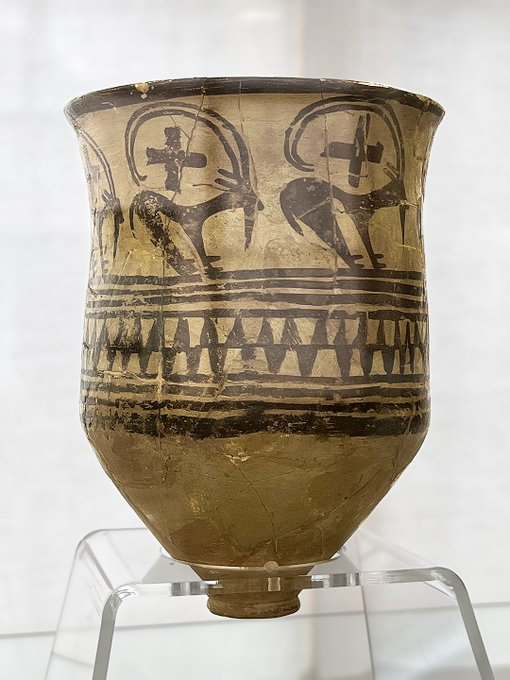
Between the two snakes we see crosses...I talked about crosses as ancient solar symbols in my post "The cross of Shamash" about this beaker, Sialk South Mound, Kashan, Isfahan, Late Calcolithic period, Sialk III7 period, ca. 3750-3350 BC, the National Museum of Iran, Tehran, Iran


In short, the cross was since the earliest times in Mesopotamia used as the symbol for the sun (god)...

And on both sides of the two snakes we see swastikas, another ancient solar symbol. I talked about it in my post "Kolo-vrt", about this ancient (officially medieval???) standing stone, Bosnia. Depicting solar wheel (swastika) and solar dance (kolo)... Pic by Kemal Čolak...


Anyway, on the sides of our pyxis, we have more swastikas, crosses and horses...Why horses?

Horses are solar animals.

Roman silver coin of the Pyrrhic war (275-270 BC) Apollo wears a laurel- wreath & a galloping horse beneath the "star".  Thanks @HawkeJon for the pics.


The "star" is The Sun...Above The Solar Horse...Symbol of The Sun God Apollo...

And articles about solar horse (equid):

Mesopotamia "Shamash playing with the solar horse"

India "Hayagriva"

China "Longma"

Europe "Archaic rider"

The reason why equids are solar animals and the reason why they are linked with Sun gods, stems from the fact that horse fertility is governed by sunlight and their mating season peaks at the summer solstice...

Sun god in his horse drawn chariot...


So, we have an interesting situation where the mating season of the most common Eurasian snakes, vipers, and the mating season of the wild Eurasian horses, the two animals depicted on our pyxis, with crosses and swastikas, both start in Apr/May, beginning of summer, the time of the year dominated by the sun...

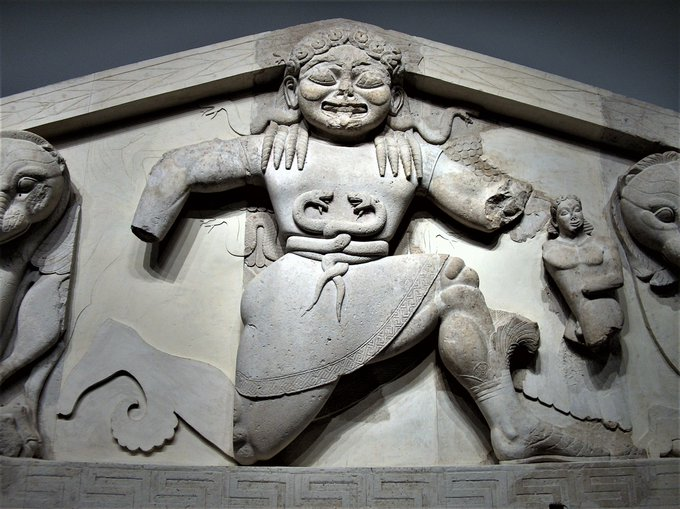
Finally, the "Mistress of the Animals" is Artemis, the "terrible" twin sister of the "terrible" sun god Apollo...This girl: Artemis, of the original, archaic type, before people forgot her real meaning...From the Temple of Artemis, Corfu

Definitely not moon goddess here with all these snakes. And lions (wink wink, notch notch)

On our pyxis, the Winged Archaic Artemis is holding two ducks or gees...Both migratory water birds...Spring bird migration in Greece peaks during late April-early May...

The "rosettes" are another symbol of the sun...Or Sirius...Which is in the sky with the sun, during the day, between Apr/May and Jul/Aug. At least it was during the time when our mythologies were made. Will write about this soon...

But it could also just mean "spring flowering season" which in Greece also peaks in Apr/May...

Soooo...Not only are all the symbols on this Larnax solar symbols, but they also all seem to point at the same time of the year, Apr/May, beginning of summer...

To read more about ancient animal and plant calendar markers, start here…then check the rest of the blog posts related to animal calendar markers I still didn't add to this page, and finally check my twitter threads I still didn't convert to blog post...I am 9 months behind now...