Showing posts with label sacred fig. Show all posts

Monday, 20 July 2026

King killing Bull

A very strange 5th c. AD Sassanian silver dish, with even stranger provenience story. 

The dish depicts a warrior with a spear sitting on a bull, about to stab another bull. His headdress indicates that he is the Persian ruler Yazdagird I (399–421)...

Does anyone have any idea if this is a depiction of some kind of mythological, religious scene? 

The dish was not discovered by archaeologists, but by ethnographer Arkady Baulo, who was in 2001 working with Ob-Ugric peoples in Khanty-Mansiysk, Western Siberia, Russia...

It was kept in the antechamber of the living room, a cult area on the right side of the room where women were not allowed to enter.

According to the owner, the dish was found by his great-grandmother, near the Sinja River...

She saw something shiny in the grass. Scraping the ground, she discovered several bronze pots, containing this dish but also silver and bronze figurines depicting various animals...

Apparently pile of Sassanian artefacts were discovered in similar settings, being used as cult objects by the local people, in Western Siberia...

Info from this article...

I wonder if this "tree" with three leaves is actually the sacred fig from Indian mythology.

And which has been used as a plant calendar marker with bulls as animal calendar markers in Indian Subcontinent since Indus Valley Civilisation...

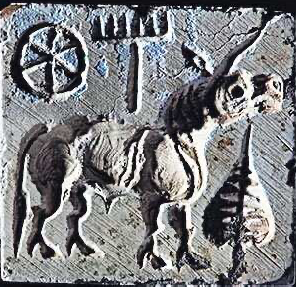
I talk about this in my post "Harappan wheel seal", in which I analyse this seal from the mature Harappan period, the time when the civilisation was at its peak (2600 BC to 1900 BC), which was discovered in Rajasthan few years ago...


I also talk about sacred fig and bull as calendar markers in my post "Kharif and Rabi seasons" about the depiction of the Kharif (wet) season (May to November)  and the Rabi (dry) season (November to May) through animal and plant calendar markers on an Indus Valley civilisation vase...


And in my post "Sacred fig goddess" about these deified fig trees which we find in both Ancient Egypt and Ancient Indus Valley civilisations...

Anyway, I wonder what Sassanians turned all this into...If anyone knows, please post your comments here...

Now, I want to thank @iphone10fan for this info: "This appears to be Lord Shiva riding Nandi. The three leaf plant in the bottom left could be this. Often associated with Lord Shiva. The bull in the bottom right could be Mahishasura? I'm not sure..."

And you'll love this: "The Indian bael tree, also known as Aegle marmelos, flowers in Apr/May, at the start of the rainy season. The flowers are aromatic and greyish-white in colour".

Another plant calendar marker for monsoon season...

I talked about Shiva, bulls, and monsoon here:

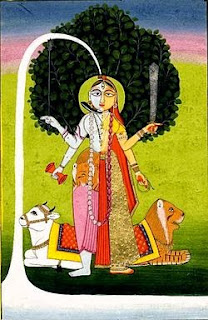
Ardhanarishvara, the union of Shiva and Parvati, produces (the tree of) life and the river Ganges. 

This is a complex calendar marker for the peak of the monsoon season, Jul/Aug, where bull=summer=May/Jun/Jul  meets  lion=autumn=Aug/Sep/Oct... 


Which fills Ganga river with water...


I talk about this in my post "Ardhanarishvara"...

"Bael tree leaves and fruit play a main role in Shiva worship, because the leaf's trifoliate shape is seen to symbolise his trident. Another belief is that the trifoliate shape of Bael leaf is symbolic representation of three eyes of Lord Shiva"...

Now remember this?

What made Indian Devas (good guys, gods) turn into Iranian Daevas (bad guys, false gods)? The answer is (I think🙂): the opposite climate in India and Iran...


Jul/Aug, the wettest time of the year in India, the time of life, is the driest time of the year in Iran, the time of death...

Which causes that the religious symbols (deified calendar markers) have opposite meanings in these two places...

I talk about this in my post "Daevas vs Devas"...

So bull rider killing the bull...In Jul/Aug...When bael tree flowers...Jul/Aug...Which marks the end of summer which starts in Taurus, Apr/May...

I don't think that the bull being killed is Mahishasura. Mahishasura was buffalo, not bull, demon. I talked about him in my post "Mahishasuramardini", about Durga, goddess created by Devas, and armed with all their weapons, and who rides on a lion, avenging their defeat by evil Asura Mahisha (Buffalo). 


What's this all about? Climate in India. Oct/Nov is when wild buffalos start mating. This is also the start of the dry season, which eventually leads to drought...Drought which is killed (ends) in Jul/Aug, Leo, peak of the wet monsoon season...

The "eternal" (read annual) struggle between wet and dry seasons in India, probably mythologised even before  the Indus Valley Civilisation. I talk about this in my post "Proto Durga" about this Is this 3rd mill BC Harappan tablet which could be depicting Proto Durga, the Warrior Goddess, the killer of the buffalo Asura who scared the Devas shitless?


But because of the opposite climates in India and Mesopotamia/Iran, buffalo as a (deified) animal calendar marker has opposite meaning in these two places...

In Mesopotamia/Iran, bulls were linked to the annual flood, which peaks in Apr/May, Taurus...I talked about it my post "Dedicated to Inshushinak" about this 3200 years old Elamite silver pouring vessel dedicated to the Elamite equivalent of Enki/Ea, god of fresh water and flood...

Remember this? The meaning of the lion killing bull?

Lion (autumn, starts in Leo) killing Bull (summer, starts in Taurus) depicted on the wall of the Great Mosque of Diyarbakir the oldest mosque in Anatolia.

I talk about the meaning of this complex animal calendar marker in my posts "Mystery seal", "Angra Mainyu" "Bull leaping in Syria", "Lion killing bull under date palm", "Butt chewing" and many others....

Guess who else killed bull every year in Leo? 

I talk about the true nature of Mithras in my post "Mithras", in which I also ask: Was Mithraism so popular among soldiers in the Imperial Roman army because Mithras was the personification of "Inevitable Victory"? After all, Lion (Autumn) inevitably kills (ends) Bull (Summer)...

In this article I also talk about the "triformed Mithras", which appears on a relief panel from Dieburg, showing a tree with three branches, each ending in a head wearing a Phrygian cap...

Jul/Aug. When Shiva tree blooms and bull gets killed...

And guess what: In Iran and Central Asia, the 3rd-century Kushan coinage featured a syncretic god with attributes of both Shiva and Mithra...You can read about this here...

Could this mean that the King riding a bull and killing a bull could be king as Mithra/Shiva killing a bull?

Mad...

Wow...This turned out to be some ride...I honestly had no idea where this (originally an X thread) will end up when I started writing it...Big, HUGE, thanks again to @iphone10fan for his nudge in the right direction.

If you are interested in reading more about ancient animal and plant calendar markers, which are at the root of all our mythologies, start here…Then check my twitter threads I still didn't convert to blog post...I am way way behind...

Friday, 8 May 2026

Sycamore tree goddess

Sycamore tree goddess, originally Hathor, and later Isis, both goddess of flood, or Nut, goddess of Heavenly Nile (Milky Way), pouring water which is depicted with ankh (life) symbols inside it...Tomb, Siwa Oasis, 400-600 BC. Egypt...

Why would a goddess of flood be depicted as a sycamore fig tree?

Most likely because sycamore bears fruit between May and Sep...

The time of the rise of the water level in the Nile. Which means that the sycamore full of fruit announces the arrival of the flood, the thing that makes life possible in Egypt...

I talked about Hather, the sycamore tree and the Nile flood in my post "Holy cow"...

And in my post "The white calf", in which I tried to answer the question why is this white calf standing between two sycamore trees under a red sun? 

Why was Nile Flood water depicted containing ankh (life) symbols? Cause the Annual Nile flood is what makes life possible in the Nile Valley, what originally created Egypt and what recreates it every year...Without the annual Nile flood there would be no Egypt...I talk about this in my post "Beautiful boy"...

BTW, Speaking about Ankh = Water, check my post "Goddess on a horse"...

Post in which I talk about the link between ankh, papyrus (flowers at the beginning of the Nile flood), lotus (flowers at the peak of the Nile flood) and the flood...And few other related things...

You also might like this: Baboons feed on figs in a sycamore tree on a painting in the tomb of Khnumhotep at Beni Hasan c. 1950 BC…

Both Sycamore tree and Baboons were animal calendar markers found imbedded in parts of Egyptian mythology related to water and flood. I talk about this in my post "Baboon"...

Finally I think that it's very interesting that we find "sacred fig goddess" in both Ancient Egypt and Ancient Indus Valley civilisations...


Check my post "Sacred fig goddess", in which I talk about the Indian one (different fig same link to water, this time monsoon rain water) with references to the Egyptian one...And about plant and animal calendar markers in both cultures...

That's that. 

If you are interested in reading more about ancient animal and plant calendar markers, which are at the root of all our mythologies, start here…Then check my twitter threads I still didn't convert to blog post...I am way way behind...

Tuesday, 7 December 2021

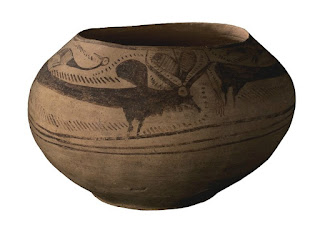
Mehrgarh Crane bowl

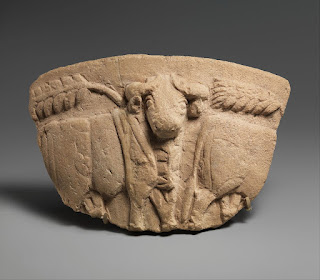
A Terracotta Bowl, Mehrgarh, Balochistan, Indus Valley, 3500–3000 BC...

Decorated with three elongated zebu bulls, each with a water bird perched on its back and a leaf motif between the horns... 

Just a decoration? Don't think so...

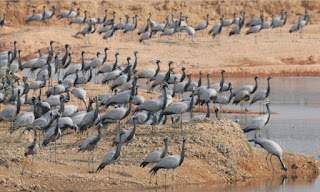
These birds are Siberian cranes, native to Russian Arctic...Every Sep-Oct, they fly over 4,000 miles southward, to spend winters in India. When winter is over, the cranes fly back to native northern habitats and nesting grounds by the end of April...


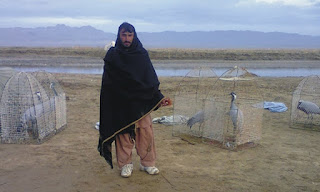
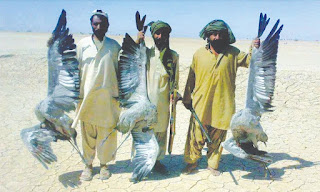
But not for much longer...Every year thousands of these beautiful birds are captured and killed by the locals in Pakistan Pouting face...You can read more about it in this post entitled "Balochistan's Siberian secret"...


That bird depicted on the pot looks very much like a crane...But why would it stand on a bull's back? Well cause Taurus, the ancient animal calendar marker for Apr/May, calving season of Eurasian wild cattle, is also when cranes land in Balochistan on their way back to Siberia...

I talked about "the old Taurus" in many of my posts. This is a good example "Bulls and grain bowls"...

I couldn't find any data about the natural mating or calving season of the wild ancestors of zebu cattle. But considering that they belonged to the same auroch species, they probably had the same or similar reproductive cycle as the rest of the aurochs of Eurasia...

And certainly, bull was used as a symbol for the beginning of summer and for summer itself in India...I talked about this in many of my posts and threads...For instance "Ardhanarishvara"... 

But how can we be sure that this is really a depiction of "Cranes in Taurus"? Because of the leaf depicted between bull's horns. The lief belongs to Ficus religiosa or sacred fig (also known as bodhi tree, peepal tree...)


This tree is Drought deciduous plant. It sheds its leaves during the peak of the dry season, between February and April. And new leaves start growing in end of April beginning of May, during Taurus...Beginning of summer, season marked by Bull...I talked about this in my posts "Harapan wheel seal", "Fig with bulls"...

Right at the time when cranes fly over Indus Valley on their way to Siberia...Or used to...

Saturday, 23 January 2021

Sacred fig goddess

Here is another "seal with a narrative scene", one of many made by people of the Indus Valley civilisation between 2200BC and 1900BC. The problem is, no one has a clue what the "narrative" is about. So let's see if I can shed any light on this mysterious "narrative scene"

This seal is rom Mohenjo-daro. The description of the scene is: "The horned image is standing amid a sacred fig or pipal tree, and a second horned image is kneeling in front of the tree, presenting an offering of a human head on a short stool"...

The interpretation of the scene is: "The standing figure is probably a deity while the kneeling figure could be a shaman or devotee"...Nothing about the tree, nothing abut the animal, nothing about the weird marching impish figures...No wonder we have no idea what's going on here

Ok. Let's start with the the climate in the area where this seal was made. We can see that the year consists of winter and spring with a little bit of precipitation, a summer with a lot of precipitation, and two dry part, Apr-May and Oct-Nov...


This two little dry periods are very very interesting. Why? Because Oct-Nov is when you sow grain in Indus Valley, and Apr-May is when you harvest grain in Indus Valley...For a civilisation dependent on grain farming, like the Indus Valley Civilisation, these are important dates...

So let's have a look at the seal, and check if the tree, the animal and the imps have anything to do with the grain farming agricultural year...(Spoiler: they all do)

The tree is the "sacred fig". 

It flowers in Nov-Dec (during grain sowing) it's leaves fall off in Mar-Apr and regrow in Apri-May (during grain harvest) and the fruit ripens in May-Jun (beginning of monsoon)...Interesting... 


Is the deity standing in the tree? Or is the deity "growing out of the tree"? Or is the deity actually the tree? 


I don't know. But there is another deity which was depicted standing in a tree, growing out of a tree, being the tree at the same time. And not just any tree. Fig tree.

This deity was Egyptian Hathor. The goddess with cow horns...


The goddess with cow horns...Just like the goddess on the Indus Valley seal...

Hathor, whose sacred tree was Sycamore fig. 


And who was actually identified with the fig tree itself. 


Why? Well, "no one knows"...I think because the Sycamore fig harvest coincided with beginning of Monsoon in Egypt... I talked about this in my post "Holy cow"...

I think that the fig tree deity from Indus Valley is a goddess too. A goddess associated with life giving Indus river. Just like Hathor was associated with life giving Nile river. Both goddesses also associated with a fig that ripens when monsoon that feeds her river arrives...

Ok...So what about the animal? 


Well originally I thought that this was a Markhor goat. 

The same animal depicted on this Indus Valley Civilisation "Narative seal"

In "Conservation and status of markhor (capra falconeri) in the northen parts of north west frontier province, Pakistan" we can read that Markhor goats mating season in Indus Valley is Oct-Dec. And that the baby goats are born Apr-Jun. 

This would make a lot of sense from the animal calendar marker point of view. Oct/Nov is the beginning of the Rabi, dry season in Pakistan. And the time when grain is sown. And Apr/May is the end of the Rabi, dry season. And the time when grain is harvested. Just before the beginning of the monsoon...I talked about this in my post "Kharif and Rabi season".,..

But actually, it could be better than this...The animal on the seal could be a "mythical" composite animal. 

It has a head of a Markhor goat, (possibly) neck of an Indian tiger although these stripes could just be the long Markhor neck hairs, (possibly) body of an Indian rhino although it could just be a body of a bull and (possibly) legs of a bull although they could just be legs of a rhino...

WTF???

Well, look at this:

In "Conservation and status of markhor (capra falconeri) in the northen parts of north west frontier province, Pakistan" we can read that Markhor goats mating season in Indus Valley is Oct-Dec.

On the "Wild life protection society of India" website page "The Indian Tiger - Quick Facts" we can read that "Although tigers mate and produce cubs throughout the year in India, peak breeding activity is in winter and early summer." Now in India, the seasons are as follows:

Winter: December to February.

Summer or pre-monsoon season: March to May.

Monsoon or rainy season: June to September.

Post-monsoon or autumn season: October to November.

Which means that Indian tigers mate between December and March

In the "Social and Reproductive Behaviour of Great Indian One-horned Rhino, Rhinoceros unicornis in Dudhwa National Park, U.P., India" we can read that "Indian rhinos prefer to breed between the months of March to June"

And Apr-May is the time when Eurasian wild cattle, Aurochs, started calving. These guys...I talked about this in my post "Ram and bull"...


 Also depicted on Indus Valley seals...You can see why I am not sure about necks bodies and legs...


So if we put all these animals, and the beginnings of their mating or birthing periods, together we get our mythical animal: 

Head: Markhor goat, start mating Oct/Nov

Neck: Indian tiger, start mating Dec/Jan

Body: Indian rhino, start mating Mar/Apr

Legs: Aurochs, start calving Apr/May

Put together, the time periods these animal calendar markers mark, we get a complex animal calendar marker, which marks the period between the planting of the grain and harvesting of the grain...Rabi season...Just like the Markhor goat alone with its mating-birthing...

Do we have any other indication on the seal that this could be right? Well yes. So what about the imps? 

Well many people have already suggested that these are "7 sisters" or "7 mothers", the Pleiades...Interestingly, around 2000BC the evening rising of Pleiades was Oct-Nov (grain sowing) and morning rising of Pleiades was Apr-May (grain harvest)...

So, the same period...

Now what's the story with the so called "bangles" worn by the imps and the deity? Are they bangles at all?


Or are they stylised grain bristles?


You know what else can be represented by 7 grain imps with what looks like crescent moons coming out of their heads?

The time between the sowing and harvesting of grain. Oct/Nov - Apr/May...

So these could be these 7 grain growing months??? It all fits...

During which time you open 7 sealed grain storage pithos jars...

7 seals...Have you seen this article about "7 seals"?

So...We have: 

1. Sacred fig flowering and leaf regrowth + ripening

2. Markhor goat mating and birthing

3. Pleiades evening and morning rising

All marking the grain sowing and grain harvest + monsoon

All on one seal, all neatly arranged into a "narrative scene", whose narrative we can hopefully now understand a bit better. What do you think?

To read more about ancient animal and plant calendar markers, start here…then check the rest of the blog posts related to animal calendar markers I still didn't add to this page, and finally check my twitter threads I still didn't convert to blog post...I am 9 months behind now...