Showing posts with label mountain mythology. Show all posts

Tuesday, 3 February 2026

Mountain god with streams

Fragments of an ivory frieze, representing a "mountain god with streams, surrounded by trees". Middle Assyrian Period (14th century BC.). Found in the New Palace of Assur. Vorderasiatisches Museum of Berlin...

Who is this "Mountain god"? And what is really depicted here?

Let me try to explain:

Remember this:

Why did so many Mesopotamian "Supreme" gods have an attribute "The Great Mountain"? Cause they all wanted to be Enki...But there is only one Enki, who is (in) Abzu, "place that is a big mountain"...All the others are just imposters...I talked about this in my post "The great imposter"...

So this is Enki, the god who is simultaneously said to "rule Abzu" and "to be Abzu", Abzu being the source of Tigris and Euphrates"...

I talked about this in my posts "Problems with Abzu", "Shamash young and old", "When Utu steps up into heaven"...

In them I explained that because the source of Tigris and Euphrates is in the mountains north east of Mesopotamia, Abzu is described as a mountain...

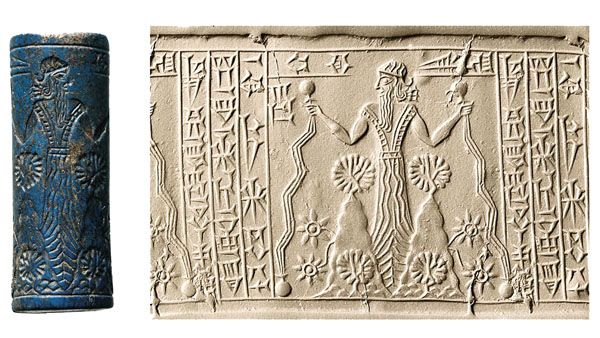
You can see that on both depictions, there are two jars in the sky pouring water and two jars in on the ground gathering water. What does this mean?

I already talked about this in my post "Water basin from Assur" about the 7th century BC basalt water basin from Assur, Iraq. Pergamon Museum, Germany...

Basically he two jars in the sky are clouds, and the two jars on the ground are human water receptacles... And Enki, who is (in) Abzu, is the intermediary...

I also talked about this in my post "Kassite seal with Apkallu", about this Kassite seal (18th-12th centuries BC) from Syria. National Museum of Damascus...

And in these posts I also explain the meaning of the fish men, if anyone is interested...

Oh, and the two trees on the ivory freeze...They are the trees of life. Life which exists in Mesopotamia because of the grace of Enki, who is (in) Abzu...

To read more about ancient animal and plant calendar markers, start here…Then check my twitter threads I still didn't convert to blog post...I am way way behind...

Saturday, 25 October 2025

Anavlochos mountain

This is The Anavlochos mountain range, located in the Lasithi, Crete. This naturally defensible ridge controls the major communication axis linking Central and Eastern Crete...

Between 1200-1100 BC, small settlement sites were scattered all along the ridge. At around 1100 BC most of them have been abandoned and a large settlement that remained continuously occupied until around 650 BC started developing in the highest part of the central valley...

oldeuropeanculture

Archaeologists from the University of Cincinnati, are currently involved in the excavation of the site known as Deposit 1, a bedrock outcrop with deep crevices. 3D animated model of Deposit 1 showing some of the teracottas...

There, they have discovered huge number of figurines and moulded plaques embedded deep in the crevices of the bedrock.

All were depictions of women or female sphinxes...

What is interesting, is that Anavlochos was settled between 1200 and 650 BC. The figurines date between 900 BC and 350 BC, which means that many of them were deposited after people left the settlement..

Which means that people considered the actual ridge bedrock sacred...And sacrificed to it. Or should I say to her...Mother Earth...Cause:

Great pic by @another_barbara Bedrock is in the Balkans known as "živi kamen, živa stena" (living stone, living rock) because it is believed to be still part of the living body of the Mother Earth which gives birth to all life...I talk about this in my post "Living stone"...

Again this ritual deposit site from Crete proves that people saw symbolic link between earth and female fertility. 

Among Slavs, the last sheaf of wheat was commonly called Baba. 

This word means grandmother, mother, midwife, birth giver...In some places the woman binding the last sheaf the last sheaf of wheat is also called Baba...

I talked about this link in my posts "Baba - the last sheaf of wheat" and "Baubo"...

I talked about the link between the veneration mountain peaks and female and earth fertility in Minoan Crete in my post "Sanctuary rhyton", about this amazing rhyton, discovered in the palace of Zakros, the most isolated of all the Minoan Palaces and was dated to 1550-1500 BC. The decoration on the rhyton depicts a "mountain sanctuary". Were these mountain sanctuaries centres of Ibex "goat of rain" cult? 


As we can see, it seems that this veneration continued after the collapse of the Minoan civilisation...

As we can see from the type of figurines deposited in the bedrock, people saw symbolic link between female lactation and earth producing spring water...

How do I know this? Rain, Water magic was among Slavs always female magic. I talked about this in my post "The last megalithic ritual in Europe", about a ritual which was until recently performed during severe draughts in Belarus to appease the Slavic Sun God Dabog (Giving god) who was also known as Daždbog (Rain giving god). 


And in my post about the "Weather stones", stones used in weather magic...

I talked about women being in charge of weather magic in Europe in my post "De Lamiis et Pythonicis Mulieribus" about this depiction of the two witches conjuring a hailstorm from a medieval manuscript on witchcraft. 

BTW, did you know that the sudden climate change which resulted in the medieval mini ice age was blamed on the weather controlling witches and was the excuse for the subsequent witch-hunt? 

I also talk about this in my post "Pozoj" about male and female dragons from Slavic folklore. In South Slavic folklore, it is a female dragon, ala, that brings hailstorms and unseasonably cold, wet weather during summer months, which destroys crops...In South Slavic folklore, cold, wet weather is "feminine"...

So Mother's milk = symbolically = Mother Earth's spring water...

More about Anavlochos excavation project can be found here.

PS: Just remembered I wrote about this a year ago in my post "Goddess of Myrtos" in which I analysed this 3rd millennium Minoan rhyton in the form of a female deity with pitcher.

Sunday, 18 September 2022

The great imposter

A Kassite seal, dated to ca. 1350 BC, currently in the Archaeological Museum in Thebes, Greece. One of several Kassite seals listed in "Reflecting on the Thebes Treasure and its Kassite Findings The Glyptic Art and its Geo-Political Context and Distribution"...

It depicts Enki/Ea, the god of sweet water standing between two mountains, with trees and flowers...Enki is identifiable by the fact that he is holding two jars from which a water is pouring out, and which are symbols of the source of Tigris and Euphrates... 

Super important image. Important cause of this: "Enki lives in Abzu, the source of Tigris and Euphrates"...The official explanation is that Abzu is "an underground aquifer"...

Which I think is completely wrong. I think Abzu was the name for the great mountains from which Tigris and Euphrates emerge...


That Abzu is a mountain is actually spelled for us in the Early Dynastic Za-me hymns where we read:

"Abzu, place that is a big mountain, princely crown of the heaven and earth. To the lord Nudimmud (Enki), (give) praise!"

Also, the late 3rd millennium BC text "Debate between Bird and Fish" tells us that it was Enki who: "laid out side by side the Tigris and the Euphrates, and caused them to bring water from the mountains"...

Do we need any more hints that Abzu is not underground?

And on the original image we see Enki, in Abzu (mountain) pouring out Tigris and Euphrates...Or Enki as Abzu, as Enuma Elish tells us that Enki killed Abzu, and then replaced Abzu and made Abzu his home...

I talked about Abzu in several of my posts: "Maran", "Utu or Enki", "Goatfish", "When Utu steps up to heaven", "Shamash young and old"...

And so we get the above image depicting Enki, as Abzu, The Great Mountain, source of Tigris and Euphrates...

Wait...Wasn't "Great Mountain" the title of Enlil? Hmmm...I will have to write another thread about this (imposter 🙂???) soon...

If you think Enlil is bad, wait until you meed Ashur (Assur), another god who also had the epithet "The Great Mountain"...I talked about this in my post "Ashur"...And some say that the above image actually depicts Ashur, not Enki...

Recently my friend @TheAncientWorld posted this reply to one of my twitter threads:

"Did you know that Tukulti-Ninurta & Tukulti-apil-Esharra are basically the same name? Ninurta was the son of Enlil (chief of Sumerian pantheon) but was also 'adopted' by both Marduk (chief of Babylonian pantheon) and Ashur (chief of Assyrian pantheon). Hence  'apil-Esharra' = son of Ashur = Ninurta..."

Of course they did...This is all the same play with different actors and slightly different choreography 🙂...But the important thing is that all of them point at "The Great Mountain" which is Abzu, where Enki resides...

To read more about ancient animal and plant calendar markers, start here…then check the rest of the blog posts related to animal calendar markers I still didn't add to this page, and finally check my twitter threads I still didn't convert to blog post...I am 9 months behind now...