Showing posts with label The Great Mountain. Show all posts

Wednesday, 15 April 2026

Mesa Mouliana vessel

A very interesting Minoan vessel found in Mesa Mouliana and dated to 1200-1100BC. Do you see the two nipple like things just under the spout? And wavy lines originating from each "nipple " and [my interpretation] symbolising the flow of water (milk of Mother Earth)?

This object is extremely stylised version of this. Ceramic vessel form Crete dated ca 2200-2000 BC. Probably during rituals the liquid would pour out of her breasts symbolically providing nourishment. It’s believed to represent the mountain goddess of Crete...

Both objects are in the Archaeological museum in Heraklion, Crete, Greece. 

What was poured out of this vessel was drinking water. I explained why in my post "Anavlochos mountain" about ancient Mother Earth sanctuaries found on it.

Now here is something that just occurred to me. Look at this beauty: Minoan jug decorated with flying swallows and small breast-like buttons - 1700-1650 BC, discovered in Akrotiri, Santorini. Currently at the Prehistoric Thera Museum, Santorini, Greece

Similar kind of jug, with nipples, but instead of water pouring out of the nipples, a swallow in flight is depicted  on the jug's belly. Why? I already talked about swallows as animal calendar marker for Apr/May, the beginning of summer, in Minoan art in my post "Minoan spring fresco". In it I analysed the animal (swallow) and plant (lily) calendar markers depicted on the "Spring Fresco" from the Akrotiri Site at Thera (Santorini), dated to 1550 – 1500 BC, and I suggested that based on the link between swallows nesting season and the lily blooming season, the fresco should be called "Summer fresco"...


But just now, I discovered that swallows were also linked with saffron crocuses. This is a strainer found in room 3 of the Xeste 3 house in Akrotiri. It is decorated with swallows flying over flowering saffron crocuses...The pic is from this paper...

Crocus flowers in Oct/Nov and is used in Minoan art as a plant calendar marker for Oct/Nov. I talked about this in my post "Male - female Minoan vessel", where I analysed this 16th c. BC Minoan vessel found on Thera, Akrotiri, depicting (according to the museum curators) on one side wild goats and saffron crocuses and on the other side dolphins and sea grass...


What is very very interesting is that swallows are summer visitors to Crete, arriving in Apr/May and leaving in Oct/Nov...

Minoans were maritime people and the swallow migrations marking the beginning and the end of the sailing season must have had a special place in Minoan culture...This veneration of swallows was also found in Ancient Greece. I talked about it in my post "Herald of spring". Did you know that Ancient Greeks had a constellation swallow (Ancient Greek: χελιδών). "...The sun entered into this constellation, when the swallow appeared in Greece as the herald of Spring..." 


And the same link between swallows and sailing was found in Roman culture and later European cultures...I talked about it in my post "Swallow tattoo"...

The period between the arrival of swallows (Apr/May) and the departure of swallows (Oct/Nov) marks the hot, dry half of the year on Crete.

How can this explain the nipple jugs with swallows? Well, the swallow migrations divide the year into female (Wet, Cool, Yin, Sowing - Creating life, No Sailing, Peace) and male (Dry, Hot, Yang, Harvesting - Destroying life, Sailing, War) halves...


The wet half being linked to the (earth) goddess, symbolised by saffron crocuses, goats and boobs 🙂 and the dry half being linked to the (sea/sun) god, symbolised by lilies, bulls and no boobs 🙂...


This is seriously cool...BTW, I already talked about the calendric symbolism of flowers in Minoan art in my post "Three Minoan flowers"...


That's it. To read more about ancient animal and plant calendar markers, start here…Then check my twitter threads I still didn't convert to blog post...I am way way behind...

Tuesday, 3 February 2026

Mountain god with streams

Fragments of an ivory frieze, representing a "mountain god with streams, surrounded by trees". Middle Assyrian Period (14th century BC.). Found in the New Palace of Assur. Vorderasiatisches Museum of Berlin...

Who is this "Mountain god"? And what is really depicted here?

Let me try to explain:

Remember this:

Why did so many Mesopotamian "Supreme" gods have an attribute "The Great Mountain"? Cause they all wanted to be Enki...But there is only one Enki, who is (in) Abzu, "place that is a big mountain"...All the others are just imposters...I talked about this in my post "The great imposter"...

So this is Enki, the god who is simultaneously said to "rule Abzu" and "to be Abzu", Abzu being the source of Tigris and Euphrates"...

I talked about this in my posts "Problems with Abzu", "Shamash young and old", "When Utu steps up into heaven"...

In them I explained that because the source of Tigris and Euphrates is in the mountains north east of Mesopotamia, Abzu is described as a mountain...

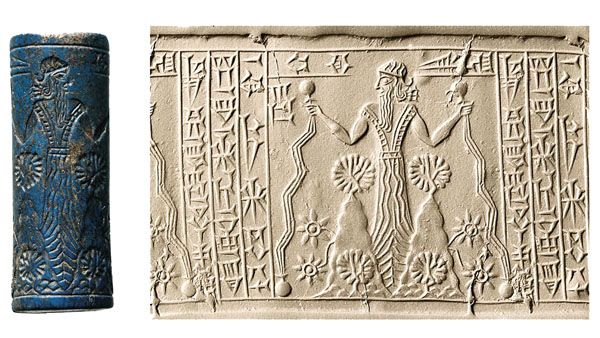
You can see that on both depictions, there are two jars in the sky pouring water and two jars in on the ground gathering water. What does this mean?

I already talked about this in my post "Water basin from Assur" about the 7th century BC basalt water basin from Assur, Iraq. Pergamon Museum, Germany...

Basically he two jars in the sky are clouds, and the two jars on the ground are human water receptacles... And Enki, who is (in) Abzu, is the intermediary...

I also talked about this in my post "Kassite seal with Apkallu", about this Kassite seal (18th-12th centuries BC) from Syria. National Museum of Damascus...

And in these posts I also explain the meaning of the fish men, if anyone is interested...

Oh, and the two trees on the ivory freeze...They are the trees of life. Life which exists in Mesopotamia because of the grace of Enki, who is (in) Abzu...

To read more about ancient animal and plant calendar markers, start here…Then check my twitter threads I still didn't convert to blog post...I am way way behind...

Sunday, 18 September 2022

The great imposter

A Kassite seal, dated to ca. 1350 BC, currently in the Archaeological Museum in Thebes, Greece. One of several Kassite seals listed in "Reflecting on the Thebes Treasure and its Kassite Findings The Glyptic Art and its Geo-Political Context and Distribution"...

It depicts Enki/Ea, the god of sweet water standing between two mountains, with trees and flowers...Enki is identifiable by the fact that he is holding two jars from which a water is pouring out, and which are symbols of the source of Tigris and Euphrates... 

Super important image. Important cause of this: "Enki lives in Abzu, the source of Tigris and Euphrates"...The official explanation is that Abzu is "an underground aquifer"...

Which I think is completely wrong. I think Abzu was the name for the great mountains from which Tigris and Euphrates emerge...


That Abzu is a mountain is actually spelled for us in the Early Dynastic Za-me hymns where we read:

"Abzu, place that is a big mountain, princely crown of the heaven and earth. To the lord Nudimmud (Enki), (give) praise!"

Also, the late 3rd millennium BC text "Debate between Bird and Fish" tells us that it was Enki who: "laid out side by side the Tigris and the Euphrates, and caused them to bring water from the mountains"...

Do we need any more hints that Abzu is not underground?

And on the original image we see Enki, in Abzu (mountain) pouring out Tigris and Euphrates...Or Enki as Abzu, as Enuma Elish tells us that Enki killed Abzu, and then replaced Abzu and made Abzu his home...

I talked about Abzu in several of my posts: "Maran", "Utu or Enki", "Goatfish", "When Utu steps up to heaven", "Shamash young and old"...

And so we get the above image depicting Enki, as Abzu, The Great Mountain, source of Tigris and Euphrates...

Wait...Wasn't "Great Mountain" the title of Enlil? Hmmm...I will have to write another thread about this (imposter 🙂???) soon...

If you think Enlil is bad, wait until you meed Ashur (Assur), another god who also had the epithet "The Great Mountain"...I talked about this in my post "Ashur"...And some say that the above image actually depicts Ashur, not Enki...

Recently my friend @TheAncientWorld posted this reply to one of my twitter threads:

"Did you know that Tukulti-Ninurta & Tukulti-apil-Esharra are basically the same name? Ninurta was the son of Enlil (chief of Sumerian pantheon) but was also 'adopted' by both Marduk (chief of Babylonian pantheon) and Ashur (chief of Assyrian pantheon). Hence  'apil-Esharra' = son of Ashur = Ninurta..."

Of course they did...This is all the same play with different actors and slightly different choreography 🙂...But the important thing is that all of them point at "The Great Mountain" which is Abzu, where Enki resides...

To read more about ancient animal and plant calendar markers, start here…then check the rest of the blog posts related to animal calendar markers I still didn't add to this page, and finally check my twitter threads I still didn't convert to blog post...I am 9 months behind now...