Showing posts with label Roman culture. Show all posts

Monday, 28 September 2026

Living with the dead

As I said many times before, Serbs are a mix of many different people, which all had different languages and customs, including the funerary customs. Look at the genes of Serbian people. You'll find genes of pretty much everyone who ever lived in the Balkans...I will call all these people old Serbs for short, because they all are the ancestors of today's Serbs. 

Some of these old Serbs used to bury their dead under their houses, and particularly under house doorstep. Even today in some parts of Serbia, and Montenegro, funerary customs remind us of this ancient tradition. 


After the wake, which takes place in the house, the dead person is taken to the graveyard. The custom is that while leaving the house, the coffin is lowered on to the doorstep and lifted three times. The explanation in Zeta region of Montenegro is that this is done so that the dead person doesn't turn into a Vampire. In other areas the explanation is that this is done so that no one else dies in the house. Most ethnographers believe that this symbolises burying of the dead in the house, under the doorstep, as it was done in the ancient times. It is a symbolic apology to the dead and an expression of the desire of the people of the house to keep the dead with them. In some other parts of Serbia, the custom is completely the opposite. People pay particular attention not to touch the doorstep with the coffin,  to ensure that the soul of dead does not stay in the house under the doorstep where it wants to be. In Vasojevic area of Montenegro people say that this if the doorstep or door frame is touched by the coffin, then someone else from the house will die. Ethnographers however agree that these customs show us that from the point of view of the old Serbs the preferred place for burying of the dead was under the house doorstep, and that that custom was at some stage suppressed by force. 

These exact customs are found in many ethnographic zones of Ukraine, excluding Polesye. The tradition is to lower the coffin to the doorstep and to knock it against the door jamb three times. The explanation of this custom is that this allows the deceased to say goodbye to his or her home and it is believed that, having bid the house farewell, the dead person has no reason to return again. This is basically the inversion of the original belief which was that ancestors stay with the family in the house where they originally lived. 

In some parts of Serbia, after taking the coffin in front of the house, all the family members have some bread, then they all grab the coffin and pull it back towards the house. The explanation is that this is done so that the deceased doesn't pull someone else with him. But this is strange considering that they are pulling towards the house, not away from the house. This is probably the example of attributing the opposite meaning to the original ritual, which probably had the purpose to show to the deceased that the family wanted to bury him in the house, but had to take him to the graveyard.

Finally, in some parts of Serbia dead person's nails were buried under or near the doorstep...

In Serbia, the doorstep was considered and is still considered one of the most sacred places in the house and is not supposed to be stepped on. 

I think that this is where the custom of carrying the bride over the doorstep comes from. Stepping on the doorstep would bring a bad luck to the house and to insure that that did not happen, the groom would carry the bride across the doorstep. This is the same belief which stops people walking over graves. 

Romans also believed that tripping or striking the threshold with your foot when entering the home for the first time was a terrible bad omen. Carrying a bride inside avoided that risk.

"A Roman marriage custom" by artist André Castaigne, depicting a groom carrying his bride across the threshold of their new home. This drawing was published as an illustration in the 1911 book The Women of the Caesars by Guglielmo Ferrero.


But Romans had no explanation why. By the time first mentions of the ritual were writtne down, Romans were apparently already asking themselves why they did something whose original significance was no longer entirely transparent.

c. 190 BC — Plautus, Casina
Earliest surviving literary evidence. A bride is instructed to raise/lift her feet over the threshold. The scene parodies a genuine wedding ritual.

c. 60 BC — Catullus 61
Bride is told to cross the threshold with her “golden feet” and a good omen. This strongly establishes the avoidance of threshold contact and its auspicious/inauspicious character.

1st century AD — Roman antiquarian/literary tradition
Other evidence increasingly associates the bride's feet not touching the limen with ritual propriety and auspiciousness.

c. AD 100 — Plutarch, Roman Questions 29
First surviving explicit statement that the bride is physically lifted over the threshold, followed by attempts to explain why.

c. AD 100 — Plutarch, Life of Romulus 15
Most explicit ancient explanation: the ritual commemorates the forcible carrying-in of the Sabine women, the explanation which was already criticised in antiquity.

The doorway/threshold was itself a ritually significant boundary in Ancient Rome.

At the Roman wedding the bride:

Arrives at the groom's house.
Interacts with the doorposts. Traditionally winds wool around them and anoints them.
Avoids touching the threshold.
Is introduced to fire and water inside. 
Becomes incorporated into the husband's household.

At the Serbian wedding the bride:

Before crossing the threshold the bride is expected to bend down and kiss the doorpost. In some areas, instead of kissing it, she raises her right hand to touch or strike the upper door frame firmly while the groom carries her across...

In some parts of Serbia the bride kisses the doorstep of the groom's house before she enters it for the first time, making sure that she doesn't step on it.

Upon entering, the bride often drapes a handwoven, decorated towel over the upper doorpost or the door handle itself. In some eastern and southern parts of Serbia, the mother-in-law gives the bride honey or fat, and the bride uses her hands to smear the doorpost and the upper door frame...

There is also an interesting old Serbian wedding custom, in which the bride severs the link to her mother's hearth and establishes the link to her mother in law's heart...This is done through special rituals performed at the grooms house hearth, including food and drink sacrifices to the hearth...

This is because Serbs believe that apart from the doorstep, the dead ancestors also gathered under the fireplace (when they were in the house visiting the living)... 

In Kruševac area of Serbia, a deceased person was measured for the coffin using a red thread, and that thread was then buried next to the fireplace in hope that the thread will protect the family. This is again a remnant of the old practice of actually burying the deceased near or under the fireplace in hope that the dead ancestors will protect the family...

I talk about house hearth as the seat of the house cult in Serbia in several of my posts: New house, Fire goddess, Bride and hearth, Verige


Considering that Serbian wedding ritual tradition contains all the Roman rituals and can explain all of them as interaction with the seats of the (dead) ancestors, I think we can conclude that "Maybe Romans didn't want to step on the doorstep because they didn't want to offend the house gods, Lares, except they forgot that that was the reason..."

Lares where who? I should really find and publish my notes on Lares...

In Late Antiquity/Medieval Europe, people believed that doorways and thresholds were hotspots for evil spirits and bad luck. Again they had no explanation why. There was a specific belief that a new bride was extra vulnerable, and that evil spirits could enter her body through the soles of her feet. By lifting her completely off the ground, the groom created a protective barrier that kept those lingering doorway spirits away from her.

This is an inversion of ancestor spirits (who can be good or bad depending on how you treat them) into evil spirits (cause you forgot about them)...

This again comes from Romans who really really feared the dead...I wrote about Roman, Greek, Etruscan attitude towards the dead in one of my X threads from a month, two months ago...

I talk about why this "care of the dead by the living" was so important in many of my posts. 

For instance, 

Oct/Nov is when the "days of the dead" were (and still are) celebrated across Europe. In Slavic countries they are celebrated with parties for (with) the dead...During these parties people bring food and drink to the graves of their loved ones and symbolically have party together...


This is part of the cult of the dead which is based on the belief that the dead ancestors can influence the amount of rain (flood) and consequently grain that their living descendants will reap depending on how the (well/badly) the living tread the dead...

If the living leave the dead thirsty, don't (ritually) give them drink, the dead will "drink" the rain/flood and the living will suffer drought. And if the living leave the dead hungry, don't (ritually) give them food, the dead will "eat" the grain, and the grain harvest will be poor and the living will suffer hunger...

So it is fitting that these feasts for (with) the dead are held in Oc/Nov, the end of the harvest (the word harvest literally means autumn), and were a kind of "thanksgiving" ritual, where the living, through ritual feast, gave thanks to the dead for providing them with bountiful harvest...

I talk about the cult of the dead in Slavic cultures in many of my articles: Thirst, White feast, Dead man loaf, Soul breads, Diduch...

This belief that the living have to feed and water the dead so that the dead will feed and water the living was very strong in all the farming cultures across Eurasia and North Africa...

"...humiliation of the Hittite kingdom is the result of the fact that the Hittites have forgotten to respect the sacred bond with their dead..." - Last Hittite king Suppiluliuma II.  

From my article Care of the dead about the care of the dead in Anatolia, Mesopotamia and Elam... 

Statue of Suppiluliuma II, looking pretty miserable, cause Hittite kingdom was being destroyed by terrible droughts and consequent grain harvest failures...

Hatay Archeology Museum


Interestingly, in the past in Serbia, during family meals, and especially during important family celebrations linked to the cult of the dead, like Christmas and Slava (Family Saint day), a bit of food and drink was always thrown on the ground "For the dead". Another memory of the time when the dead were actually lying under the house floor?

Because the living were so dependant on the dead, preserving the remains of the dead so that sacrifices could be offered to them, was super important. 

Which is why (of course it's Assyrians):

Two Assyrian soldiers forcing Elamite captive to grind bones of his family, 7th - 6th c. BCE. This wasn't an act of random cruelty...This was making someone from a culture based on ancestor cult commit an act of worst sacrilege...

Also this destroyed the most powerful protective force that the living had: their dead...

Is this one of the reasons why the dead were originally buried under house doorsteps, hearths, floors? So they can be venerate, fed, watered, and protected?


As I said, the cult of the dead was and still is the most important cult of the Serbs. There are even records from this, 21st century, of Serbs digging out and carrying away their dead with them when they were forced to move or relocate. Here is an example from last Serbian exodus from Kosovo: 
Most of the minority Serbs live in Kosovo's north. Many were forced to leave their homes after the war, fearing revenge attacks from ethnic Albanians. Serbs still bear a grudge in isolated villages like Staro Gracko, 70 kilometers (45 miles) east of Bela Crkva.  There, on a scorching summer day in 1999, 14 men were bringing in the wheat harvest as NATO and the U.N. were still moving in to secure the province. Shots rang out, but no one came to help. Later, British peacekeepers found the 14 dead in a field fringed with poplar trees, in an attack blamed on ethnic Albanians. Local Serb Ljubica Zivic didn't hear the shots that day, but felt an ominous breeze that seemed to foretell that both of her sons, Radovan and Jovica, would not return home. 
"I waited and waited. There was an eerie wind blowing," Zivic said, clasping her hands together in grief. "In the evening I went inside and said, 'It's all over.'" 
Zivic ekes a living on euro40 (US$60) a month, struggling to feed seven grandchildren who survived their slain fathers. She did not join the 200,000 Serbs who sought shelter in Serbia, some unearthing their dead and carrying away the bones as they left. 
Clad head to toe in black, the tiny woman is bound to the dead in a village that now has the air of a ghost town. 
"This is my village and this is where my dead are," she said. "I will stay." 

Tragedies like these have made reconciliation a daunting task in a Kosovo still gripped by ethnic tensions and bitterness. 

I talk about this in my post House of bones, where I talked about the mystery of the missing bones of the Hittite royals. And I proposed that the bones were taken by the Hittites with them, when they abandoned their capital Hattusa, because they wanted to be able to continue to sacrifice food and drink to the dead...


Because doorstep was considered to be a magical place, a lot of house and family magic in Serbia was performed at the doorstep. If a prayer is said at the doorstep, the person saying the prayer, kneels on the doorstep like you would kneel at the altar. Sometimes magical rituals, including animal sacrifices are performed at the doorstep in the same way they are performed at the altar. Here we can see a ritual slaughtering of a cockerel on the house doorstep.

Serbs believed that someone from the family will soon die after they move into the new house, cause each house needs a protective spirit. I believe that this is directly linked to once practiced burial of the dead under the doorstep (and house floor in general). To prevent this, a cockerel (ritual replacement for a human) was killed on the doorstep (the seat of the dead). I talked about this and many other beliefs and rituals from Serbia related to the building and moving into a new house in my post New house...


That cockerel here is replacement (symbolic equivalent) for a human, in this case a member of the family, can be seen from this: Serbs had an interesting ritual from the cult of the dead which involved roosters. When two members of the family die close together, Serbs then bury "a live cockerel" with the dead "to fool Death" or more precisely "as a replacement for the third death"...I talk about this in my post Third death...


A black cockerel was also sacrificed on Mratin dan, the day of the dead, which falls at the beginning of November...


After the cockerel is slaughtered, a hair from every animal in the household is placed in its beak.

The beak is then tied with a red thread and is hanged over the door or is buried under the doorstep to protect the house and its animals from the evil spirits. The wings and sometimes the head were hanged on the cauldron chain over the fire. I talked about this in my posts Bleeding for Martin and Verige...

The fact that the head of the cockerel (replacement for a human) ritually slaughtered (sacrificed) on the doorstep is then buried under the doorstep explains why Serbs used to bury their dead under their doorsteps. 

One of the reason is to insure the protection of the house from evil spirits which were "out there". Burying the dead under the doorstep would insure that the spirits of the ancestors would hang around the house door and protect the house from bad spirits by forming a spirit guard at the house door. Serbs consider the house, the place where the people and their gods (ancestors) are, the centre of the world. So the door is more the exit into the rest of the world than the entrance into the house. And to enter or exit this holy space you have to step over the dead.

This is why all the foundational human sacrifices were performed all around Eurasia...To generate a protective spirit for the building...I talk about this in my post Foundational sacrifice...

Interestingly, in a lot of cultures it was children who were placed in foundations of important buildings to create protective spirits for them. Is this why in Ukraine unbaptised babies were buried under house doorsteps?


I think all this would explain why in Serbian, the expression "leaving your doorstep" is an expression meaning leaving your home for good, which equates to a tragedy, loosing your roots.

BTW, the ritual parallels between Serbian and Polesian customs from the cult of the dead are very interesting. There are some "weird" Slavic legends, like this one, which talk about direct link between Balkan Serbia and Polesye: "Serb tribes were great enemies of the Romans. Finally a Roman emperor got really angry and sent an army to attack them. The Serbs were driven out of their homeland and came and settled down here, in the Pinsk Marshes, in Polesye..."


I talked about this first 9 years ago in this post David Gorodok Turov style. This pic shows a traditional female dress from Polesye... 


This is just one of several similar legends. There is also the 14th century "Chronicle of Dalimil", the first chronicle written in the Old Czech language. 


It lists the chronological history of the Slavs, starting with the most ancient of times and finishing with the important events of the 14th century. 

The Chronicle alleged that all Slavs originated "in the south", in the "land of Serbs". That their original name was Serbs. And that Czech was a Serbian chieftain who murdered someone and had to flee north to what is now Czech Republic.

Weird right?

Add to that the legend found written in medieval church books in the Balkans and in Russia, which claim that Slavs were baptised by St Paul in the Balkans...


I talk about all this in my post "St Paul among Slavs" about the baptising of Slavs by St Paul...

Interestingly, Polesye, the place where people preserved a legend that they originally arrived from the Balkans, is by some historians marked as the birth place of Slavs, from which they spread in all directions, including back to the Balkans, starting in the 5th century AD.

Now the population associated with the Early Slavic expansion is by archaeologists identified by the fact that they are also spreaders of the Prague/Korchak-type material culture...and cremation burials...

The genetic studies of the Early Slavs note that early Slavic cremation severely limits the availability of ancient DNA. The Slavic immigrants generally only become genetically visible when they stop cremating and begin using inhumation...


Now, when Early Slavs appeared on the historical stage, they emerged from the area, between Baltic and Balkans, where cremation burials have been the predominant type of burial since Late Bronze Age...


Now check the image on the right. The image is from the paper "Diffusion of cremation in LBA Europe and the Mediterranean", by M. Pellicer...

In it, we can read that [paraphrased]: "...in the Late Bronze Age and Early Iron Age (c. 1300–750 BC) the Urnenfeld (Cremation burial) phenomenon spread from two centres: Lausitz (Poland), Baltic zone and the Middle Danube (Serbia, Romania, Hungary) Balkan zone..."


The author then goes on to suggest that the Balkan focus was the primary centre for the expansion of cremation toward both eastern and western Europe...

That's thousands of years of cremation burials during the most important formative period of the Slavic culture...

So where did all this stuff related to the burying of the dead under the doorsteps, hearths, floors of the houses come from?

Well, remember the legends about original Slavs being Serbs who came to Baltic from the Balkans?


According to this study, Early Slavs were a mix of Baltic population and a mysterious "Balkan population"...

2025 Nature study by Gretzinger et al. analysed 555 ancient individuals and found that the early-medieval population associated archaeologically with the Slavic period had a characteristic mixture:

Roughly 71% Baltic/Baltic-Bronze-Age-related ancestry
Roughly 29% ancestry enriched in Early European Farmer (EEF), for which the authors could find suitable proxies in Southeastern and East-Central Europe.

Hmmmm who could these guys be????

Old Serbs, according to the Slavic legends...

I would propose that it was these Old Serbs that brought the cult of the dead and all the stuff related to the burying of the dead under the doorsteps, hearths, floors of the houses to Polesye.

These same Old Serbs (whoever they were) were still in the Balkans when the Slavs (the mix of some of these Old Serbs that at some point went to the Baltic and the Baltic population) came to the Balkans in 6th/7th century...

So the new Serbs, the ones you find today, are a mix of these Old Serbs, Slavs (who were themselves the mix of Old Serbs and Baltic people) and many other people who at some point in time passed through the Balkans and decided to stay...

There is no surprise then that the Balkan Serbs preserved the most of the cult of the dead and all the stuff related to the burying of the dead under the doorsteps, hearths, floors of the houses. And that some of the same folklore was also found in Polesye...

Read this thread from the beginning if you are confused with all this...

What is interesting is that the origin of this cult of the dead and all the stuff related to the burying of the dead under the doorsteps, hearths, floors of the houses, originated around 14,000 years ago among the Early Natufian Farmers in the Levant part of the Fertile Crescent, and it seems to have spread through Eurasia exclusively with the Early Farmers...

I will talk about this next at some stage soon...

For now I will leave the mystery identity of these EEF Old Serbs here unsolved...

Friday, 3 February 2023

Four Seasons from the House of Bacchus

Romans, using plant calendar markers to depict seasons 🙂

Roman mosaic of the Four Seasons from the House of Bacchus in Complutum, today's Alcalá de Henares, Spain.

Counterclockwise from top right: spring, summer, fall, and winter.


Thursday, 3 March 2022

Ancile

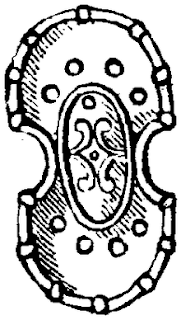
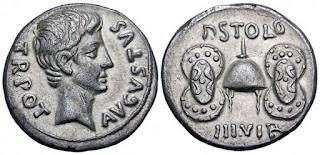
This is a silver denarius from the time of Augustus. On the reverse you can see the sacred shield (ancile) that is said to have fallen from heaven, during the reign of Numa Pompilius, the second king of Rome...


Apparently the ancient sources gave many different potential etymologies for the word "ancile". Like being derived from Greek ankylos (ἀγκύλος) meaning crooked...Crooked what? Basically etymology was and still is unknown... 

Now I am beginning to believe that god has a very good sense of humour and is basically taking the piss...This is Coat of Arms of Serbia. Stemmatographia by Hristofor Zhefarovich (1741)...


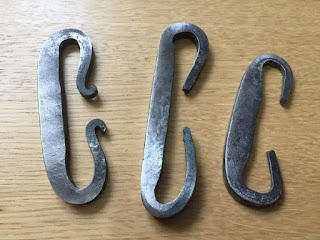
It is a cross with 4 fire-steels, of the type used since Roman times...These are used to strike a piece of flint to produce a spark when kindling fire...

In Serbian, and many other Slavic languages, these fire-steels are called "ocila", which basically just means "steels", plural of "ocil" meaning steel... 

The word is cognate with Medieval Venetian azzal (steel) and Medieval Greek ἀτσάλιν (iron)...Both apparently from Late Latin acies (steel) which originally meant sharp and which comes from Indo-European root h₂eḱ - ( sharp )...

Now look at the ancile shield again. What do you see in the centre of the shield? Four arches. Four crooked irons? 4 fire-steels?

Or maybe not...Romans would have surely known this...Or Maybe not...Numa Pompilus, to whom many of Rome's most important religious and political institutions are attributed to, including ancile, was Sabine not Roman...

Now I am not saying that ancile and ocila has anything to do with each other...Just that God has a wicked sense of humour...

Why? Cause I don't think that Slavic "ocila" is linguistically linked to "ancile"...But it is possible that the Serbian cross with 4 ocila might point at what "ankylos" (ἀγκύλος), "crooked" thing could have given the name to "ancile": crooked steel...fire-steel...Maybe...

Friday, 27 August 2021

Fige

When I was a little kid, this was "the rude gesture" before I learned the other ruder gestures 🙂. 


It turns out this gesture has been used at least since the Roman time...Apparently in Roman times it was known as "manu fica" (fig sign) "for the resemblance to female genitalia" (???)  Does this remind you of a female genitalia?

Also, this sign "was made by the pater familias to ward off the evil spirits of the evil dead" (???) during Lemuria, the festival of "cleansing the home from the evil dead" (???) 

Are the dead really afraid of the female genitalia?

I actually think that the Romans had actually forgotten the original meaning of this sign. This sign represents male genitalia. Which is why it is pater familias (the father of the family) who is making it.

Here is the origin of the sign

So not a female genitalia, right? That this is actually a sign represented male genitalia, can be seen from the fact that in Poland this gesture, also called figa, means "nothing" as in "you will get nothing (from me)", while in Serbia, the expression "dobićeš kurac" (literally you will get dick) means you will get nothing...

Also the whole "evil spirits of the dead" is another sign that the Romans had forgotten the "old ways"...The dead, the ancestors, were not god or bad...They were good to the living if they respected them, remembered them, and bad if they didn't...

It is the dead, the ancestors who brought all the good things to the living...In return for regular mention, food and drink...I talked about this in my posts "Diduch", "Thirst", "Blood red wine" and "Wolf feast"...

And originally this sign was probably not made "to ward off the evil spirits of the dead"...The pater familias was making it to remind the ancestors that they are all part of the the same family...Paternal family...Symbolised by the...

Or I wonder, was pater familias actually telling the ancestors that they will get dick if they don't behave? Risky, very risky...Look what happened to the Hittites when they forgot their ancestors "House of the bones"...

Saturday, 12 June 2021

Overpowering

Roman stone sculpture of a bear overpowering a boar, from an ancient tomb monument, Trier...🙂 I think that "overpowering" is a nice way to "put it"...


Hmmm...Should I talk about obvious or hidden...

Considering everyone else is going to talk about animal sex,  I will talk about it too...And animal calendar markers derived from mating seasons of animals caught here in the act....

The wild boar mating season in Eurasia starts in November...At the beginning of winter...Which is why wild boar has been used to represent winter...

I talked about wild boar symbolism in my posts "Calydonian boar" and "Double headed eagle"...

Bears don't like shagging in the snow...They are asleep while boars are having fun...Bears emerge from their hibernation in spring, and are seen in some parts of the world, like Slavic countries, Romania as heralds of Spring...Which is why bears are part of Spring festivals...

I talked about bear symbolism in my post about "Bear dancers"...

There disappearance underground at the beginning of the winter and there reemergence from the underground at the end of the winter is seen as a symbolic death and rebirth...Just like sun and nature die and are reborn every winter...

The Christian holiday known as "Presentation of Jesus at the Temple" is celebrated on February the 2nd. In Serbia known as "Sretenje" (Meeting)... Serbians say that this is the day when "winter meets summer"...

Which is interesting because this is actually the beginning of spring...

I talked about this "Natural year division" in my post "Two crosses"...

Now Serbian tradition says that on this day, bears will awaken from their winter hibernation. If a bear comes out of his den and sees his shadow, he will get frightened back into hibernation, and winter will last 6 more weeks...Otherwise, winter will end soon...

So what about bear shagging??? Well, bear mating season stats in May...At the beginning of summer...This makes bear the opposite to boar from the symbolic point of view...

Bear is basically a solar symbol, because it is in our world during the warm part of the year, when sun is here too, and is in the underworld during the cold part of the year, when sun is there too...

This is why in Slavic mythology, the God Veles, the enemy of the Thunder God Perun, is represented as bear...Now it is well known that Thunder God's enemy is The Summer Sun, which causes drought...

So back to our "bear overpowering boar"...Knowing all this, this statue could be interpreted as summer overpowering winter...

But, whether whoever made this statue knew any of this or whether he had any ulterior motives or he was just a lover of bestiality, I honestly don't know...But this was a great excuse to talk about animal symbolism and animal calendar markers 🙂

To read more about ancient animal and plant calendar markers, start here…then check the rest of the blog posts related to animal calendar markers I still didn't add to this page, and finally check my twitter threads I still didn't convert to blog post...I am 9 months behind now...

Friday, 12 March 2021

Scullball

Of the 52 skeletons discovered in the fourth-century A.D. Roman cemetery discovered in the village of Great Whelnetham in Suffolk, England, 17 had been decapitated and the heads were placed between their owner's legs or feet. Why? Well... 

When archaeologists opened medieval graves at a highway construction site near Gliwice, Poland, they came across skeletal remains of humans whose severed heads rested upon their legs...


Apparently this is an ancient Slavic burial practice for disposing of suspected vampires, in hopes that decapitated individuals wouldn't be able to rise from their tombs...Practiced by the Western Slavs mainly...

Now the article about the English Vampire burials says that: "The decapitations might be related to pagan belief systems that held that spirits need to be released for the afterlife or even that the head was a container of the soul."

Which is why the head was cut off...The vampire was "the undead", the body which soul never left...So kind of linked...Otherwise all the dead would have been decapitated, right?

So the question is who were the people buried following Western Slavic vampire burial rituals in the late Roman cemetery in England? Or how did Medieval Western Slavs got to practice Roman Vampire burial rituals???

By the way you do know that Vampire is a Serbian word? 

Few articles related to the Serbian (Slavic) vampire lore: Vampires, Tombstones, Stake, Enemy of demons

Wednesday, 1 January 2020

Janus

Article, in which, considering that today is the 1st of January, I would like to ask few questions about Janus, Ancient Roman god of beginnings (and ends), gates, transitions, time...and the god after which January was named...


So to start: Happy new beginning (and end)

Question 1: Why is Janus the god of beginnings? 

This is a valid question that I couldn't find answer to...Romans believe that he was the Primordial god with no parents. His main epithet, Pater, means that for Romans Janus was the first of the gods and thus their father...But why?

To understand this we need to look at the rights performed in honour of Janus. They were performed at the beginning of the Year, at the beginning of each month and at the beginning of each day...Nothing strange here, god of the beginnings...

Well...

First strange thing: Why was the beginning of the year celebrated on the 1st of January, after Winter Solstice which was celebrated on the 25th of December? 

Remember my post about the end of time (calendar) and the dead days? In it I talked about Lunisolar calendar which is at the base of Serbian ritual calendar. It consist of a Solar year, solar "kolo" (wheel) which is ever turning...This solar year has 12 full moons. The last full moon of the solar year ends on the 30X12=360th day. What is left are 5 "extra" days. Five days which lay outside of the "calendar" (koledar?). Five "dead days" as they are called in Serbia. 

Beginning of this 5 day period is the end of the old Solar year and the end of this 5 day period is the beginning of new Solar year. They are not the same day...In Serbia dead days are still marked as last five days before winter solstice (Christmas). In Bulgaria they marked after winter solstice (Christmas)...

Romans probably also did what Bulgarians do today...Which is a later change as Solar year is calculated from Winter Solstice to Winter solstice Solstice using full moons...

Janus had another epithet: Iunonius (Junonius). He was the patron of all 12 kalends (moons) from the republican calendar, which were associated with Juno. Macrobius says that: "Iunonium...not only does he hold the entry to January, but to all the months...all the kalends being under the jurisdiction of Juno"...

At the time when the rising of the new moon was observed by the pontifex minor the rex sacrorum assisted by him offered a sacrifice to Janus in the Curia Calabra while the regina sacrorum sacrificed to Juno in the regia...Why?

Well because we are talking about lunisolar calendar here. 

Solar year, which starts on winter solstice, indeed holds the key to all 12 moons which comprise it...Juno does rule the moons, small "kola" (wheels)... But Janus rules both the solar year, big "kolo" (wheel) and all 12 small "kola" (calends, wheels). 

All this points at Janus being the Solar year and Juno being the lunar month...Together they create Time...And interestingly, it is this cyclic "Time", the result of the continuous oscillating, rhythmic interplay between Sun and Earth, which drives the change of seasons. And the change of seasons is what is behind all the phenomena which we built our gods from...

This is why Janus is the god of gods...

Was he seen as Sun himself? 

Well he has another interesting attribute: Janus Quadrifrons ("Janus Fourfaced")...Why? Well, interestingly Slavic sun god Svetovid (the one who alights and "sees" everything) was depicted with 4 faces... 

Is this in anyway linked? 

Well maybe...

Here is when I will ask my second question: Why is Ianus (Janus) called Ianus??? 

No one really knows...Romans couldn't agree on the meaning of his name, which means that it had no obvious etymology in Latin. 

To me this is very very strange. The primordial god, god of beginnings, the god of new solar year, the god of new calendar, the father of all gods, if he was indeed Native Roman god as they claimed, had to have name which clearly depicted his function in Latin. But he didn't...

Interestingly (again) the name of this god of new beginnings has perfect etymology in Slavic languages...Etymology which describes his role of god of new beginnings: "Ja+Nov" (pronounced as Janov, Janow, Janou) meaning "I+New"...

Now the Slavic word "nov" (new) is an ancient PIE word with cognates in every IE language, including Italic languages, where we find "*nowos". So this part could have come from some Italic language... 

But the problem is the beginning of Janus's name. In Latin, the word for I, Me is "ego", from Proto-Italic *egō,  from Proto-Indo-European *éǵh₂. If we look at the descendants of this root, we see that the only one which sounds like "Ia" (Ja) are Slavic languages...

This of course makes no sense. If this is a coincidence, this is bloody crazy coincidence:

Fourfaced epithet of Janus - Slavic 4 faced sun god
Solstice and New Year are different days - 5 dead days, days outside calends (full moons) in solar calendar of Slavic folklore
Kalend and Great Kalend - kolo wheel in Slavic, 
Janus has no Latin etymology - Janov, Janow, Janou+s (I new in Slavic), great name for the God of Beginnings

Anyone has any idea what's going on here?

In the end, there is also a hidden message in the two faced image of Janus. 


It describes the biggest predicament of humanity: inability to be in "now"...

Every moment in time is "now", the only moment in time that really exists. Yet in every one of these moments, we are either focused on the past or on the future, completely forgetting about the fact we only exist when we are focused on that ever changing "now"...


Which unfortunately results in most of us never really existing or experiencing during our journey between our beginning and our end...