Showing posts with label I2a. Show all posts

Monday, 29 November 2021

Neolithic massacre

The other day I came across the article entitled: "Unraveling ancestry, kinship, and violence in a Late Neolithic mass grave". It talks about the discovery of a very strange grave, during the 2011 archaeological excavations conducted on site 3 in Koszyce, Poland. 


The grave, dated to the turn of the Late and Final Neolithic, 2875–2670 BC, is believed to belong to the Globular Amphora Culture (3400–2800 BC), which got its name from the characteristic vessels found in their graves...

The first grave contained the remains of 15 individuals of various ages and both sexes. 

Plague victims? Like the people from the grave from the same time period from Sweden? The one I talked about in my post "Burned house horizon"?


Nah. These people from Poland were brutally murdered. Bone examination showed numerous unhealed injuries on the skeletons, mostly traces of skull strikes. Each of the victims got up to four blows to the head probably with an axe...
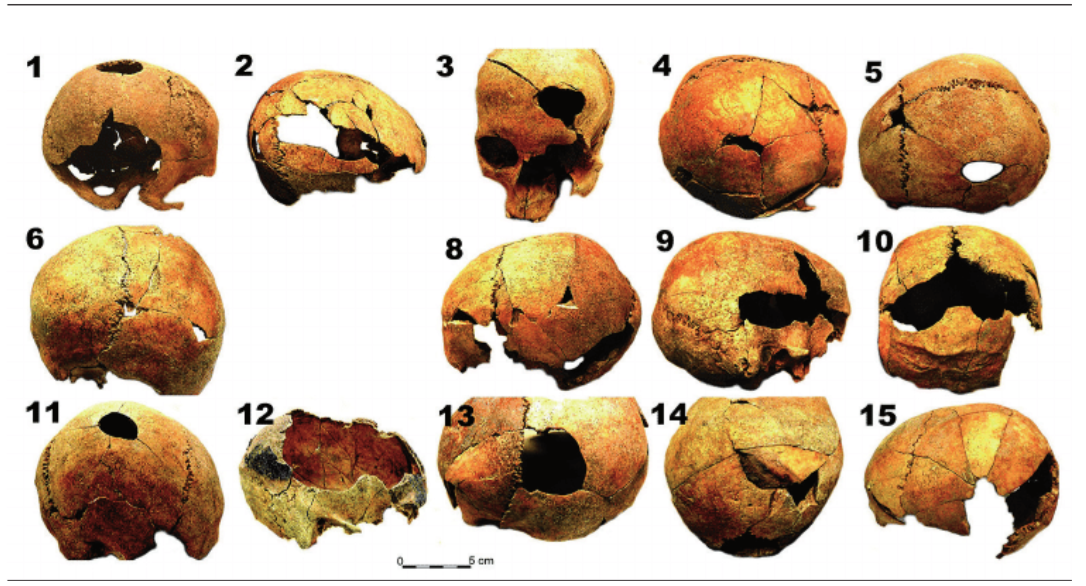
You can read the detailed forensic analysis of the bodies in the article entitled "Evidence of interpersonal violence or a special funeral rite in the Neolithic multiple burial from Koszyce in southern Poland – a forensic analysis"...

The two smallest children's skulls were almost completely destroyed, indicating that the kids were held by their legs, and their heads were smashed against something hard, a stone or a tree...

Almost complete absence of upper limbs damage and injury character indicate that these people did not defend themselves. They were executed rather than killed in battle. But then they were buried with rich burial goods...

Placed into the grave with the bodies were many pottery vessels, flint axes and other flint artifacts, bone tools, boar tusks, amber ornaments, bone pendants and animal bones...

And close to the human grave, an animal burial was discovered, which contained skeletal remains of seven pigs...


This originally "completely threw" the archaeologists...They could not imagine the scenario that could explain such a "bizarre" burial...Except of course "a ritual"...

Apparently, according to Gimbutas: Globular Amphora culture classed social structure and the dominant position of men is demonstrated by richly equipped graves which contained astounding numbers of sacrificed human beings and animals...

...In such graves, the chief adult male occupied the central position in the stone cist and was accompanied into the afterlife by family members, servants, animals...

But of course, what we find in this grave in Koszyce is not such a ritual burial of a "dominant male" with "many sacrificed family members, servants and animals"...

Actually this burial makes me wonder if the "identification" of Globular Amphora culture burials as such, is just a loads of bollocks and none of them are in fact ritual burial of a "dominant male" with "many sacrificed family members, servants and animals"...

When genetic analysis of the remains was done, scientists identified four nuclear families in the grave, for the most part represented by mothers and their children...


Closely related kin were buried next to each other: a mother was buried cradling her child, and siblings were placed side by side...

These people were buried by someone who knew them well and who carefully placed them in the grave according to familial relationships...

For example, the oldest individual in the grave, was buried close to her two sons, whereas a 30–35-y-old woman, was buried with her teenage daughter and 5-year-old son...

Interestingly, the older males/fathers are mostly missing from the grave, suggesting that it might have been them who buried their kin. Only one father is present in the grave, and his partner and son are placed together opposite him in the grave...

In addition, there is a young boy, aged 2–2.5 years, whose parents are not in the grave, but he is placed next to other individuals to whom he is closely related through various second-degree relationships...

Finally, there is an adult female, who does not seem to be genetically related to anyone in the group. However, her position in the grave close to a young man, suggests that she may have been as close to him in life as she was in death...

This archaeological site tells a terrible story. While most men (and some women) were away from the settlement, working in a field, foraging, hunting, herding animals...A band of armed men (and most likely women) came into the settlement...

Considering that there were no signs of fighting injuries, these people could have even been welcomed by their victims who could have known them as neighbours. The villagers were then captured, held or tied, and executed, one by one...

The murderers then most likely plundered the settlement and left...Why do I think this is what probably happened here? Because the same things were still happening in Europe (Balkans) as late as the 20th century...

People from neighbouring villages killing their neighbours, men, women and children in most brutal ways, and then plundering their homes, and even moving into them...Like what happened in Serbian village of Prebilovci in Bosnia in 1941...

We don't know why this terrible crime was committed in Koszyce...Was it the hatred of "them" because they are different from us (look different, speak different language, pray to different gods)?

Or was it pure greed and material gain that motivated the murderers? One of those "capture the animals and beautiful women and kill the rest" raid, which could explain "some women missing from the pile of dead bodies". The fit ones...

We just don't know...But it is very likely that they were murdered by their neighbours coming from the villages of the Corded Ware culture...

What we know is that when the men (and women) who were away returned to the settlement and found their loved ones butchered, they decided to give them "proper burial"...Only the one who knew the victims intimately could have arranged the bodies in the way they were arranged...

And only the one who cared about the victims would have "equipped them for the journey to the otherworld", with jewellery, tools, weapons, food and water (contained in vessels placed next to the bodies) and animals (the pigs placed in the separate grave next to the human grave)...

This burying of animals with the dead, so they can have animals in the otherworld seem to have been a common practice in Central Europe during Copper and Bronze age...I talked about this in my post "Group portrait"...

The Koszyce archaeological site shows I was probably right when in this article entitled "One for the road" I suggested that if we want to understand ancient burial rituals in Central Europe, all we have to do is look at current burial folklore practices in the same area. Not much has actually changed...

This archaeological site also shows how genetics is cool, and how it is "improving" archaeology. Not just because by determining the relationship between the buried people, we can now much better understand what happened in Koszyce 5000 years ago...

But also because of this: All males carried the same Y chromosome haplotype: I2a. So did all the other male individuals found buried in the Globular amphora culture graves. They all carried I2a genes...How is this improving archaeology? Like this: It wrecks havoc in the field...

Marija Gimbutas in "The Indo-Europeanization of Europe: the intrusion of steppe pastoralists from south Russia and the transformation of Old Europe" hails the Globular Amphora as an "exemplary Indo-European steppe male dominated warrior culture"...

She says that: "It is apparent that the emergence of the Globular Amphora culture in the north European plain (around 3400BC) is crucial to an understanding of the Indo-Europeanization of this part of Europe"...

She also says that: "The fact that the Globular Amphora culture is so homogenous suggests that if these people were indeed IE speakers, they completely succeeded in subverting the indigenous population or in converting them to their own creeds, customs, and language"....

Ah I am so sorry that she is not around any more...It turns out that Gimbutas was soooo sooo wrong about the Globular Amphora culture. They have nothing to do with steppe "Indo-Europeans". They were a forest culture of the mountainous Central Europe...

The fact that their economy was based on raising mostly pigs in its earlier phase, is a dead giveaway that they didn't come from the steppe...Pigs live in forests...Steppe people were cattle and horse herders...

Gimbutas and co must have known this...Or should have known it anyway...

But what they didn't know, cause they couldn't have known it at the time, is that all the macho warrior patriarchal males of the Globular Amphora culture carried I2a genes. The earliest I2a genes in Central Europe were found in Mesolithic Lepenski Vir culture in Serbia, and predate the arrival of the Neolithic farmers...

So the I2a people watched the arrival to the Central Europe with Neolithic farmers. And they watched the arrival to the Central Europe of the Kurgan people. And these people are still in Central Europe...

Here is even cooler result of the latest genetic data. Gimbutas also says that: There is similarity between the burial rites of the Globular Amphora people and those of the "Kurgans of the Maikop culture" in the North Pontic region.

Both used mortuary houses built of stone slabs and practiced the ritual burial of horses, cattle, and dogs, as well as human sacrifice in connection with funeral rites honoring high-ranking males...

According to Gimbutas, Maikop people were "part of the Kurgan II invasion wave"...Guess what haplogroups were found inside the "Kurgans of the Mayop culture"? G2a, I2a, R1a, J2a1b...

G2a and I2a were two dominant haplogroups of the late Neolithic, Copper Age central Europe...

Remember the article I wrote about the origin and spread of the Megalithic culture through Europe, the one entitled "Childe was right"?

In the comments someone asked me "What about Russian dolmans?" These things:

Well Russian dolmens, which were built between the end of the 4th millennium and the beginning of the 2nd millennium BC. are concentrated around, guess??? Maykop culture territory...

As the new data shows that the Megalithic culture seem to have spread rapidly across Europe, most likely by the people of the same tribe, people linked to seafaring, mining...and Russian dolmens are also located on the coast. Of the area rich in ores...

And as we can read in the article entitled "Megalithic tombs in western and northern Neolithic Europe were linked to a kindred society": "males from megalith burials belong almost exclusively to YDNA haplogroup I2a"...Interesting...

So did Maykop people start building Megalithic "mortuary houses built of stone slabs" under the influence of I2a people from central or western Europe?

Did these I2a people arrive to Caucaus by land from Central Europe, more specifically Balkans, together with G2a people? After (or maybe before) the Balkan Neolithic collapse (4000 BC)?

Remember my article "Vinča warriors" in which I asked if we should look for the origin of the militaristic Copper and Bronze Age societies in Neolithic Central European cultures, like Vinča culture...Does this figurine group from Vinča settlement Stubline depict an army? Or at least and armed mob...

Or did they arrive by sea, from Mediterranean, where we find I2a and G2a people spreading together along the coast. Here is a study entitled "Ancient DNA reveals male diffusion through the Neolithic Mediterranean route" which shows that these guys were spreading together along Mediterranean coast around 3000 BC... 

By boat? By boat. Did they also bother checking the Black Sea coast too? I mean this is right around the time when Russian dolmens are beginning to be built...In the Mykop territory...

I talked about Neolithic seafarers in Mediterranean and Atlantic, who were linked to Neolithic miners in my posts "Neolithic seafarers" and "Giant's ring"...

Were they the "prospectors, missionaries" that Childe talked about who spread the Megalithic culture wherever they went looking for stones and then metal from which to make tools and weapons?

The "Kurgan" Maykop culture (3700 BC–3000 BC) guys were mad about making metal weapons and were very good at it (the most ancient bronze sword on record, was made by Maykop people), were also a male dominated society...How did they learn their craft?

You know how copper and bronze metallurgy was invented in the Balkans? Mining and metallurgy are difficult things to figure out yourself and are much easier learned from someone who already knows how to do it...

Like emigrant metallurgists from the Balkans (G2a and possibly I2a) who left during the Balkan Neolithic collapse??? Or earlier??? 

And did these I2a and G2a people, produce Mykop Kurgan culture, after mixing with other people from the Steppe and Caucasus?

So who invaded whom? Did Caucasus people get Europeanised? What influence did these G2a and I2a people have on local cultures? Just technological? Religious? Cultural? Linguistic? Genetic definitely...

So, were Globular Amphora people product of "Kurgan" Maykop "invasion"? Or if there was a population movement from east to west (I talked about this in my post "Not so mobile riders"), was this in fact more like a "going back home to visit the relatives" kind of trip?

Because, there is a big problem with Maykop guys undertaking any mass long distance invasions...

Just like Balkan Neolithic people and Cucuteni-Tripillia people, Maykop people lived sedentary lives...

They were farmers who built terraces for growing their crops...People who build terraces don't go invading countries thousands of miles away...

But Maykop guys sold loads of its metal stuff to their Yamna neighbours. The Maykop guys also taught their Yamna mates a thing or two about how to mine, smelt and cast metal. Into weapons...Some of the Mykop guys possibly even joined the Yamna gangs...For a laugh...And profit...

Well not possibly. Definitely...Did you know that apart from dominant R1b genes (southern Yamna) and R1a genes (Northern Yamna), Yamna men also carried I2a genes? And so did some of the men of pretty much all the cultures surrounding Maykop and Yamna cultures...

How did these I2a guys (from Europe) end up there? And what influence, technological, cultural, linguistic, did these I2a guys (from Europe) have on all these "Indo-European" cultures? Which then "Indo-Europienised" Europe when they wandered (back) into Europe the 4th millennium BC???

So where does this leave Gimbutas theories? And the whole Indo-European thingy? It's a mess...And fun to watch...

Saturday, 23 October 2021

So Indoeuropean

Have a look at these two vessels:

Neolithic Lengyel culture (5000-3400 BC)

Chalcholitic Baden culture (3600–2800 BC) which developed from Lengyel culture...
Lengyel culture guys, were neolithic farmers who, just like their neighbors, Stroke-ornamented ware culture guys, liked building giant henges, enclosures oriented to the sunrises at solstices and stuff...

I talked about this in my post "Henges - Rondel enclosures"

Then (apparently) came Indo-Europeans and turned Neolithic, Old Europe, Matriarchal, Peaceful, Farming Lengyel culture into Chalcholitic, Indo-European, Patriarchal, Warrior, Cattle herding Baden culture...By presumably killing the men, taking the women...

Gimbutas and then Mallory and Adams talk about Baden culture as one which is associated with the spread of Indo-Europeans because "It possesses a number of cultural traits that have been regarded as diagnostic markers of Indo-European society"...

Like:

1. Use and breeding of domesticated horses...


3. Use of wheeled vehicles, probably pulled by cattle...


Typical: Drunk cowboys....

So no wonder Baden dudes were seen as "Prototypical Indo-Europeanised culture dominated by Kurgan males"...

Which is funny, considering that Baden guys had Neolithic Megalith builders (I2a) and farmers (G2a) male genes...The same ones we find in their Neolithic ancestors...

Now look at the original two vessels again. Both depict a young woman. The Baden one is actually an elaboration on the Lengyel one. It actually gives us a clue who this "young woman" could be: a grain maiden from later folklore...Look at the grain sheaves arms...I talked about this in my post "Baden culture grain maiden"...

Not very Indoeuropeany...

Friday, 27 August 2021

Childe was right


This is Dolmen of Pierre-Alot, France...I would here like to talk about three interesting articles I read this week, which together, might shed some new light on the origin, spread and reason for megalithic culture...Or not...

There are over 35,000 currently accounted megaliths in Europe, including megalithic tombs, standing stones, stone circles, alignments, and megalithic buildings or temples...

Most of these were constructed during the Neolithic and the Copper Ages (5th - 3rd millennium BC) and are located in coastal areas...

Their distribution is along the so-called Atlantic façade, including Sweden, Denmark, North Germany, The Netherlands, Belgium, Scotland, England, Wales, Ireland, northwest France, northern Spain, and Portugal...

And in the Mediterranean region, including southern and southeastern Spain, southern France, the Islands of Corsica, Sardinia, Sicily, Malta and the Balearics, Apulia, northern Italy. And Montenegro, which is not widely known. Like this one. 


You can read more about Montenegrin Tumuli and how they fit into the wider European Megalithic - Metal working culture in these articles...

Interestingly, all these megaliths share similar or even identical architectonic features. Which is why in the later 19th and the first two-thirds of the 20th centuries, archaeologists, like Childe, supported a single origin of megaliths and their spread by a process of diffusion

Childe also, supported the idea of a diffusion by maritime exchange. According to him, the expansion was supported by a megalithic religion of migrant priestly elites who settled down long enough among local societies for the new ideas to take root...

Later, Childe expanded his theory about the spreading of a megalithic religion along the coastlines of western Europe by way of missionaries or prospectors...

With the introduction of radiocarbon dates and processual approaches, the idea of an independent emergence of the same kind of stone architecture in several regions arose in the late 20th century, because early C14 results did not support the diffusion model...

Renfrew was the first to exploit the new chronological results and proposed five independent nucleus centers, including Portugal, Andalusia, Brittany, southwest England, Denmark, and possibly Ireland for the emergence of megaliths in Europe...

The model of an independent emergence of megaliths in several regions and sedentary, immobile farming communities has remained dominant in the research literature since then...

However, since the 1970s, the number of C14 dates of megaliths has expanded enormously. And it turned out Childe was right...

The radiocarbon results suggest that megalithic graves emerged within a time interval of 200 to 300 years in the second half of the fifth millennium cal BC in northwest France, the Mediterranean, and the Atlantic coast of the Iberian Peninsula...

Northwest France is, so far, the only megalithic region in Europe which exhibits a pre-megalithic monumental sequence and transitional structures to the megaliths, suggesting northern France as the region of origin for the megalithic phenomenon...

For the remaining regions with an early megalithic proliferation in the fifth millennium cal BC (Catalonia, southern France, Corsica, Sardinia, Portugal and Italy), megaliths are found in small clusters as exceptional grave forms for this period in their respective regions...

A fresh expansion occurred during the first half of the fourth millennium cal BC when thousands of passage graves were built along the Atlantic coast of the Iberian Peninsula, Ireland, England, Scotland, and France...

In the second half of the fourth millennium cal BC, the passage grave tradition finally reaches Scandinavia and the Funnel Beaker areas. Again, there is evidence for the spread of megalithic architecture along the seaway...

In the second half of the fourth millennium cal BC, the passage grave tradition finally reaches Scandinavia and the Funnel Beaker areas. Again, there is evidence for the spread of megalithic architecture along the seaway...

Here is what this looks like visually

The fast coastal distribution emphasizes the maritime linkage of these societies and a diffusion of the passage grave tradition along the seaway...

So, the older generation of archaeologists (like Childe) were correct concerning a single origin and maritime diffusion of the megalithic concept and accompanying radical economic and social changes. Ha!

This is the gist from the paper: "Radiocarbon dates and Bayesian modeling support maritime diffusion model for megaliths in Europe"

Now at the end of the paper the author says: 

"The megalithic movements must have been powerful to spread with such rapidity...and the maritime skills, knowledge, and technology of these societies must have been much more developed than hitherto presumed"

In my article "Neolithic seafarers" I talked about the neolithic mining and seafaring societies whose trading routes seem to have spanned the whole of Mediterranean  sea. 

In my article "Giant's ring" I talked about the possibility that these seafarers probably reached Ireland in the early 4th millennium BC and brought with them Megalithic culture and genes...

So we know that there was a mining/seafaring culture, caste, elite...in Neolithic Mediterranean...

And guess what: In the article entitled "Megalithic tombs in western and northern Neolithic Europe were linked to a kindred society" we can read that "males from megalith burials belong almost exclusively to YDNA haplogroup I2a"...

Interesting...Kind of like a mining/seafaring culture, caste, elite...

According to the author of the article I am talking about here Childe was wrong in one thing: he believed that the source of the Megalithic culture was in Mediterranean...

But was he? I am not contradicting the data that points at Northern France as the first place where we find Megaliths...But were the people who built these first megaliths originally from Northern France? Or from Mediterranean? The seafarers/miners/prospectors/missionaries...

And even if the Megalithic idea originated in the Northeastern France, were the people who spread it the same Mediterranean seafarers/miners/prospectors/missionaries who scoured European coast looking for best obsidian, flint, amber and later copper, zinc...

Mining, metalworking, ship building and seafaring are all extremely specialised activities, which require long training which can be only obtained from people who already know how to do it. Which in Neolithic was your own kin...

So it is very likely that these Neolithic seafarers/miners...and megalithic builders, were all related...Which is what the genetic data obtained from the early megalithic graves is confirming...

This is very interesting, right?

Tuesday, 28 April 2015

Ri - to cut with something toothed

In this post I would like to talk about the development of the toothed (serrated) cutting implements and the words used to describe these implements and the actions performed with them. I started my investigation as a pure linguistic one. But this investigation lead me to discovery of how humans invented toothed (serrated) blades by literally making artificial jaws. What is amazing is that the word cluster from Serbian (Slavic languages) which describes these toothed tools and their use actually describes the way these tools were developed in Paleolithic, Mesolithic and Neolithic, through people imitating nature.

Here it goes.


In Slavic languages we have these words meaning to cut: Sek - ti and Riz, Rez - ti. The first word,  Sek - ti, comes from the root "sk" and means to cut with a smooth blade. There are large word clusters built on this root in both Irish and Serbian and I already wrote about this in detail in my post about the "People of the blade". This word cluster is based on an onomatopoeic root “sk” which makes it very old. The sound which a smooth blade makes when pulled across something in order to cut it is “sssssssk”, "sek".  Here you can hear sounds of flesh being cut with a blade. When you cut something off with a sudden hit of blade sound shortens to "tsk" or "tsak". Here you can hear sounds of chopping with a blade.

In this post I would like to talk about the other word for cutting, Riz (Rez) - ti, which comes from the root "r, ri, re, ro" and which means to cut with something toothed. 

r - sound made when you cut, rip, puncture with something toothed, like sharp stone or point or a blade which is not smooth, like a saw or a primitive stone blade like this one:


"rrrrrrrrrrrrr" is onomatopoeic sound of cutting with a toothed blade like a saw. This is the sound of a wood saw and this is the sound of a hack sow. "rrrrrrrrrrrrrrrr" is also a sound which is produced when we scratch or scrape over a rough, toothed surface.

"rrrrrrrrrr" is also the sound of growling. Growling means making a "rrrrr" sound while showing you teeth before you bite:


The word for growling in Serbina is "režati". What is interesting about the sound of režanje (growling) is that it is the sound "rrrrr" made in the throat ("grlo" in Slavic languages). You can hear this sound here. What is interesting is that the sound of resembles the sound of "režanje", growling, resembles the sound of "rizanje, rezanje", cutting with a toothed blade, saw. 

The official etymology of the word growl says that it comes from Middle English growlen, related to Middle Dutch grollen ("to make a noise, rumble, murmur, grunt, croak, be angry"; Dutch grollen (“to grumble”)), German grollen (“to rumble, be angry, bear ill will”), Old English grillan, griellan (“to provoke, offend; gnash the teeth”). But there is no further etymology provided. 

In Serbian we have word "grlen" meaning guttural, produced in the throat. The root of this word is word "grlo" meaning throat. In "grlo" meaning throat we find "grkljan" meaning larynx. When something gets stuck in your "grlo" throat is blocked or cut, you start to "krkljati" meaning to choke, wheeze. You can "grgoljiti" gurgle water in your "grlo" throat.  Grlo is actually a word built from all the base sounds which can be made by using your tong while it is rolling outward from the root to the tip: g - r - l. This is onomatopoeic description of human throat. Is "grlo" meaning the throat and rumbling "grlen" meaning guttural sound "rrrr" the root of all the above words? Is this where growl and gargle come from as well?

The growling dog is sounding a warning that it will bite. In Serbian the word for biting is "grizti, gristi".

gristi, grizti - to bite (after you growl as a warning). gristi = ga + ris + ti = it, him + cut + you
griz - sawdust, bits that fall off when wood is sawed. This gives us direct link between biting and sawing. This is extremely important for finding the origin of the word "rez" meaning to cut. 

Serbian word "režati" which means to growl, to show your teeth, to warn that you will bite (griz) is pointing to the fact that the original sharp toothed cutting implement used for "rezanje, rizanje" were jaws and teeth. In Slavic languages word for tooth is "zub". "Z" is the sound made using your teeth. And when you make sound "z" you bare your teeth. This is why zub is called zub. It is z + u + b = that makes z sound + in + gums (the b being the sound of toothles gums). 

You can see clear similarity between carnivore jaws and particularly canine, human and shark jaws and their ability to cleanly cut they pray in half and later human toothed cutting implements like saws.

Canine jaws with teeth


Shark jaws with teeth


Human jaws with teeth


The jaws are natural "sharp toothed" cutting implements. Here are some early human imitations:


People even used teeth (shark teeth) embedded into wood to create a cutting implement, which was literally an artificial jaw full of real teeth. For those of you who are wondering how you weaponise shark teeth, which are already regenerating, serrated meat knives at the business end of a streamlined, electric-sensing torpedo, here’s how. You drill a tiny hole in them, and then bind them in long rows to a piece of wood to make a sword. Or a trident. Or a four-metre-long lance. And then, presumably, you hit people really hard with them.

That’s what the people of the Gilbert Islands have been doing for centuries. Sharks are an ingrained part of their culture and their teeth have been an ingrained part of their weapons. Tiger sharks feature heavily – they have thick, cleaver-like teeth that can slice through turtle shells so they make a good cutting edge. But the weapons also include the teeth from spottail, dusky and bignose sharks (you can identify species from their teeth), and none of these actually live around the Gilbert Islands today.


 This is a modern version of the same tool, a saw:


Basically people noticed that jaws with teeth are good for cutting through hard things. They recognised a link between jaws teeth and cutting and then tried to create artificial jaws with teeth. This is why I believe that the oldest words for cutting with toothed implements have to be linked with words for biting. And this is exactly the case in Serbian where the word for growling (showing teeth) is "režati", the word for biting is "grizti" and the word for cutting with toothed implement is "rezati, rizati".

The Serbian word "rezati, rizati" has these cognates in other Slavic languages:

Old Church Slavonic рѣзати (rězati), Russian резать, Ukrainian різати (rizaty), Bulgarian режа (reža), Serbo-Croatian резати, Slovenian rezati, Czech řezat, Slovak rezať, Polish rzezać, Upper Sorbian rězać, Lower Sorbian rězaś.

On top of this in Serbian, Croatian and Bosnian we also have these words, which form a large cluster of words all related to the meaning "to cut the surface, to make groves, cuts, trenches... with something pointy (like a tooth) or toothed (like a jaw), or are directly linked to teeth" :

ri, re, ro - the root meaning cut, gauge, dig with something toothed, pointy. This is an onomatopoeic word derived from the sound "rrrrrr".

režati - to growl, to show teeth while making "rrrrr" sound
grizti - to bite
rez, riz - sharp blade
rezi, rizi - has a sharp taste
riz, ris, rez - a cut

rizati, risati, rezati, rozati, rosati, roškati - cut, engrave, gouge, draw. urizati, urezati - chisel. from u + rizati, rezati = in + cut
razrezati, razrizati - divide. from ras, raz + rezati = spread + cutrežanj - slicezarez, zariz, recka, ricka - cut mark, notch
riza, risa, reza - a cut line, a gouge

krezav - gappy (of teeth)
hrid - sharp rocks, cliffs 


rinati - work with a shovel or with pitch fork, with something pointy and sharp used for stabbing, poking
rinuti - to push, to gush, to stab, to stick a sharp object into something. "rinuti nož" stick a knife into someone. 
zarinuti - plunge, stick something sharp into something. 
porinuti - plunge, push into something, launch a missile, push a boat into water
rintati - hard work, probably digging soil or harvesting, agricultural work
porez, poriz - tax, the cut the state gets. 


grizlica - peptic ulcer, something that it eating at the lining of the stomach.
grinja - mites, ticks, moths. biting, gouging, hole making insects. grinja = ga + ri + na = it + cut + on
gagrica - moth = ga + grica = it + nibbles
grizina, grizlica, griznica - moth. from griz - bite, biting insect

The following two words are very interesting because they show that the full etymology of the English words "gristle", and "grits" come from Slavic "griz-ti" meaning to bite, to chew. 

griz - groats, grits. Wheat either whole or crushed, which needs to be chewed, milled. 
grizka, griska - cartilage, the chewy bits. 

gristle - From Middle English gristel, grystyl, from Old English gristel, gristle (“gristle, cartilage”), formed from a diminutive of Old English grist (“a grinding”), from Proto-Germanic *gredaną (“to crunch”), equivalent to grist +‎ -le. Cognate with Old Frisian gristel, gerstel (“gristle, cartilage”), Middle Low German gristel (“gristle”).

grist - From Middle English grist, gryst, from Old English grist, gyrst (“the action of grinding, corn for grinding, gnashing”), from a derivative of Proto-Germanic *gredaną (“to crunch”), from Proto-Indo-European *ghrēu- (“to rub, grind”). Cognate with Old Saxon gristgrimmo (“gnashing of the teeth”), German Griesgram (“a grumbler, a grouch, peevishness, misery”), Old English gristel (“gristle”). 

It all points to the fact that the original grinding was done in our mouths using our teeth to griz (bite, chew). 

There is also the English word "grisly". The official etymology says that it comes from Old English grislic (in compounds) "horrible, dreadful," from root of grisan "to shudder, fear," a general Germanic word (cognates: Old Frisian grislik "horrible," Middle Dutch grisen "to shudder," Dutch griezelen, German grausen "to shudder, fear," Old High German grisenlik "horrible;" of unknown origin; 

I believe that the word comes from "griz" meaning bite. An attack by a predator with bared teeth, biting and tearing people in bits will cause horror, fear, dread and will leave the site which is "grizli" basically half eaten carcass, horrible, dreadful looking site.

These next to words, found in Croatian and western dialects of Serbian are particularly important:

ris, risa - harvest, land given in dowry, cut
rista, risar - harvester, cutter. 
rištati, ristati - cut wheat, harvest (from ri(že) + šta + ti = cut + what + you)
risno - the time of harvest

The tool we all know is being used for cutting wheat is sickle.


We can see that the blade is smooth. So you would expect the words for the harvester and harvest to be derived from the root "sk", to cut with smooth blade. Instead we find that the Serbian words for the harvester and harvest are derived from the root "r" which means to cut with a toothed, serrated blade. Why?

A sickle is a curved, hand-held agricultural tool typically used for harvesting cereal crops or cutting grass for hay. The inside of the curve is the cutting edge, and is serrated. The farm-hand swings the blade against the base of the crop, cutting through the stems with a sawing action. The sickle was superseded in the nineteenth century by the scythe which was more comfortable and by mechanised combine-harvesters and tractor machinery. The reason why the wheat sickle blade was originally made serrated is that the serrated blades are more suitable for cutting dry and tough stems and are self sharpening by nature. Smooth sickles require constant sharpening and are only good for cutting wet and soft things like grass. This is an old iron wheat sickle from England. You can see that the blade is serrated.


The sickles my grandparents used in Serbia were also toothed, serrated. So the reason why "ris" and "risa" are the words for harvest and "rista" and "risar" are the words for harvester is because wheat sickles are toothed, serrated tools which produce "rrrr" sound when used to cut wheat stalks. This can help us to determine the true etymologies for the following words:

reap - to cut with a sickle, scythe, or reaping machine, as grain; to gather, as a harvest, by cutting. The official etymology says that the word reap comes from Middle English repen, from Old English ripan, reopan, from Proto-Germanic *rīpaną (compare West Frisian repe, German reifsen ‘to snatch’, Norwegian ripa ‘to score, scratch’), from Proto-Indo-European *h₁rep- ‘to snatch’ (compare Latin rapere ‘to seize, plunder’, Lithuanian aprépti 'to seize, embrace', Albanian rrjep ‘to peel, tear off’, Ancient Greek ἐρέπτομαι (eréptomai, “I feed on”)).

I actually believe that this word has the same etymology as the Serbian word "srp", meaning sickle. I believe that it comes from ri + po = cut + on, over, across. 

Serbian word "srp" meaning sickle is said to have this etymology: form Proto-Slavic *sьrpъ, from Proto-Indo-European *sr̥p-. Cognate with Old Church Slavonic срьпъ (srĭpŭ, “sickle”), Bulgarian сърп, Czech srp, Polish sierp; and with Latvian sirpis, Greek ἅρπη (ἅrpi). 

I believe that this word comes from s + ri + po =  with + cut + on, over = the thing you use to cut across. This is exactly what you do with the sickle, you use it to cut across the wheat stalks....

korist - gain. Could this word come from ko + ri + sto = like + cut + something = something we cut for ourselves or what is cut for us, our cut

Were sickles always toothed, serrated? They were. This is what we can read about the history of sickle

The development of the sickle in Mesopotamia can be traced back to times that pre-date the Neolithic Era. Large quantities of sickle blades have been excavated in sites surrounding Israel that have been dated to the Epipaleolithic era (18000-8000 BC). Formal digs in Wadi Ziqlab, Jordan have unearthed various forms of early sickle blades. The artifacts recovered ranged from 1 to 2 cm in length and possessed a jagged edge. This intricate ‘tooth-like’ design showed a greater degree of design and manufacturing credence than most of the other artifacts that were discovered. Sickle blades found during this time were made of flint, straight and used in more of a sawing motion than with the more modern curved design. Flints from these sickles have been discovered near Mt. Carmel, which suggest the harvesting of grains from the area about 10,000 years ago. 

Unfortunately I can't find any examples of these early sickles. I would be grateful to anyone who can provide me with the link to pictures showing these Mesolithic sickles. But we have examples of early neolithic sickles:


I remember seeing these pictures for the first time years ago and thinking "these sickles remind me of something". It only occurred to me what they reminded me of recently, while I was translating data about the early agricultural site Blagoting, from Serbia. You can read the full article about Blagoting here.

Blagotin is the early Starčevo  culture site, dated to late 7th millennium bc. The earliest feature of the site is a 2,5 meter deep sacrificial pit, around which the temple was later built. At the bottom of the pit archaeologists have found a ritually broken deer scull with separated mandibles positioned at a certain angle. I remember thinking that this seems to connect the Starčevo culture to the much older Paleolithic deer cultures of Europe from the time before the last Ice Age. Deer is also a very important symbol found in in many agrarian cultures which come after Starčevo cultures. This makes Starčevo culture a link between the Paleolithic Mesolithic Hunter gatherer cultures and Neolithic agrarian cultures. This could also be an indicator of the mixing between the local European hunter gatherers and the incoming Levantine farmers. It is possible that the Blagotin culture is a product of this mix. But then I went to look at the pictures of deer mandibles and I was shocked. Have a look for yourself:


Now have a look again at the early Neolithic sickles:


And now have a look at this deer bone sickle from USA:


Bone sickles for cutting grass, made from the lower jaw of deer, are found most commonly in central and western Oklahoma. Only one side of the jaw was used and this was lashed onto a wooden handle for service as a grass cutting tool. Actual examples of mounted specimens have been recovered intact from dry caves or rock shelters in the Ozarks area of Arkansas.

Were the deer mandibles, deposited as the first offerings in the temple in Blagotin actually deer mandible sickles? I believe so. I believe that this shows us that the "ri" meaning to cut with something toothed originally literally meant to cut with teeth, "griz" - ga + ri + z = it + cut + teeth = bite. Originally people didn't cut, they literally bit the wheat using real deer jaws. The first improvement was to replace the real teeth with sharpened stones and then to replace the jaw bone with wood handle...Through this proces "griz" - biting became "riz" - cutting with toothed implement.

Apart from cutting with something toothed we can also gouge, dig, scrape with something toothed. In Serbian we find that the words related to these actions are also based on the same root "ri".

riti - to cut the surface, to make groves, cuts, trenches, to gouge, make tunels... with something pointy, sharp, like a spade (which again looks like a tooth): 


This word has these cognates in other Slavic languages: Old Church Slavonic рити (riti), Russian рыть (ryt’), Belarusian рыць (ryc’), Old East Slavic рыти (ryti), Polish ryć, Upper Sorbian ryć, Czech rýt, Slovak ryť, Lower Sorbian ryś, Polabian råjě, Bulgarian рия (ríja), Macedonian рие (rie), Serbo-Croatian ри̏ти (rie), Slovene ríti, Old Church Slavonic рыти (ryti).


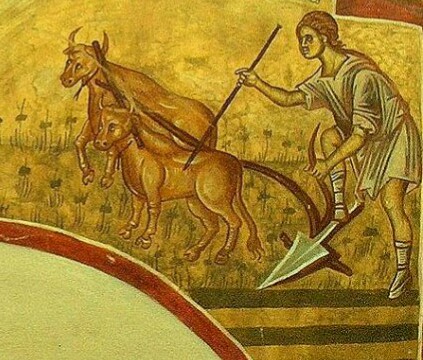
rilo - sharp pointy tool for making holes or gouges, snout, plow
ralo, ral, ralica, oral - plow, sharp pointy stick for making furrows, gouges in the ground. This is extremely important example of the mutation of middle "i" rilo into "a" in ralo (both meaning plow, tool for making gouges, furrows, paths), which is also found in Irish. 

Ranik, raonik, ralnik, ralo = plowshare

Here is a fresco from medieval Serbian monastery Dečani (14th century) depicting plowing using ralo (plow):


Here is a picture from Serbia (20th century) depicting plowing using ralo (plow):


These two pictures show the how tools and tool names survive for centuries and millenniums until they get replaced by better more cost effective tools. 

Rilica is protruding organ on heads of insects which bite, burrow, gouge skin, like in ticks called hypostome


Or a protruding organ on heads of insects which suck juices like bees, butterflies called proboscis...


From Latin proboscis, from Ancient Greek προβοσκίς "elephant's trunk,"??? In Serbian "probosti" means to puncture, to bore through, which is is exactly what these organs are for.

Rilica is a diminutive of rilo, rila, meaning something small pointy, sharp used for gouging, cutting, sticking into, poking, making holes...Something pointy used to cut a surface...

riljati - dig with a spade, cut the soil
riljač - spade
rana - wound. Probably from ri, ra + na = cut + on

rita - rag, ripped cut clothes. rita = ri + ta = cut, scraped, ripped + that, something

rnj, rnje - snout, what pigs use to gouge. From ri + nj = cut, gouge + with it = the thing with which you gouge. In Serbian the pig rije, ruje meaning it gouges the ground...

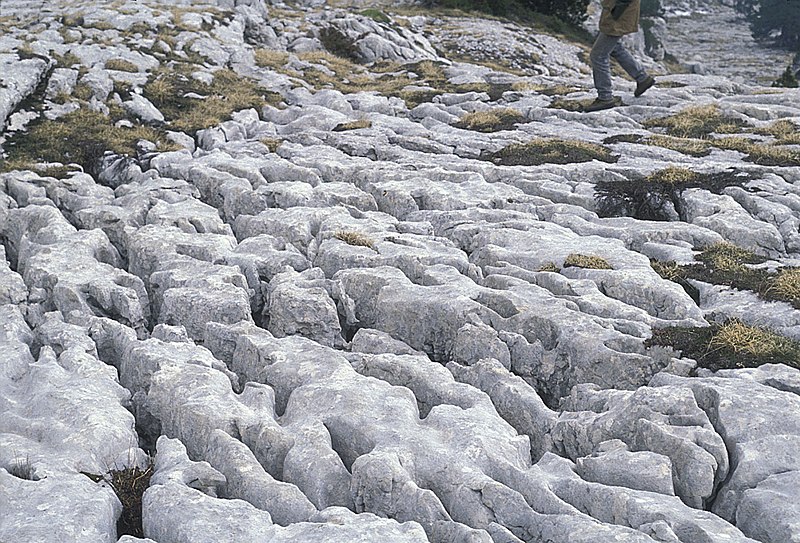
A very interesting word is word Krist meaning Karst, cut stony landscape.


The English word karst was borrowed from German Karst in the late 19th century. The German word came into use before the 19th century. According to the prevalent interpretation, the term is derived from the German name for the Kras region (Italian: Carso), a limestone plateau surrounding the city of Trieste in the northern Adriatic (nowadays, located on the border between Slovenia and Italy, in the 19th century part of the Austrian Littoral). Scholars however disagree on whether the German word (which shows no metathesis) was borrowed from Slovene. The Slovene common noun kras was first attested in the 18th century, and the adjective form kraški in the 16th century. As a proper noun, the Slovene form Grast was first attested in 1177, referring to the Karst Plateau—a region in Slovenia partially extending into Italy, where the first research on karst topography was carried out. The Slovene words arose through metathesis from the reconstructed form *korsъ, borrowed from Dalmatian Romance carsus. Ultimately, the word is of Mediterranean origin, believed to derive from some Romanized Illyrian base. It has been suggested that the word may derive from the Proto-Indo-European root karra- 'rock'. The name may also be connected to the oronym Kar(u)sádios oros cited by Ptolemy, and perhaps also to Latin Carusardius.


You can see that wiki says that "Ultimately, the word is of Mediterranean origin, believed to derive from some Romanized Illyrian base." However the word has full etymology in SerboCroatian: Krist, Karst = ka + r(i)s + t(o) = like + cut, chiseled, gouged + it 

What is interesting is that the only other language that has a large word cluster which is based on the "ri" root, meaning to cut with something pointy, toothed, is Irish. Have a look at these Irish words. You will see that most of the words are archaic words some of them not used any more. The words can be found in these dictionaries:


Foclóir gaedhilge agus béarla - compiled and edited by the Rev. Patrick S. Dineen.

Foclóir Gaeilge–Béarla (Ó Dónaill)

Etymological Dictionary of the Gaelic Language, MacBain, Alexander

The etymologies given using root "ri" are mine.

críadaire - peasantry.  "cré" means soil. "daire" is ending meaning man, person. Peasants dig, cut ground. críadaire = cré + ria + daire = soil + digging, cutting + person

riadaire, in phr. sean-riadaire, a cunning old fellow; also applied to beasts (Con.). From ria + daire = cut + person = cutting, crafty person.

riaghaim - I tear, rend, lacerate; gibbet, hang, crucify. ria + ga = cut + it, him

aimh- (amh-), neg. pref., un-, in-, dis-, not. 
aimríata ( 1 ríata) - unbroken (usu. of oxen, horses) 

This means that ríata means broken, cut, chipped, toothed. Comes from ri = to cut. ríata = ri + je + to = broken + is + that

riodán, -áin, pl. id., m., a woodworm. See readán. The worm which digs, tunnels, rije through the wood. Comes from ri = to cut.

riastáil, -ála, f., the act of turning sods in the marking off and preparation of grass-land for 
tillage; taking the surface off the furrows in the lazy-bed system of tillage; a severe cutting, a lacerating. Comes from ri = to cut.

riach - cut the surface, graze. Greek @Ge@'reíkw, tear, Lithuanian raiky/ti, draw a furrow, German reihe, row, English row.... Comes from ri = to cut.

riasail - tear asunder, riasladh, mangling, tearing asunder: *reik-so-, root reik, notch, break; Greek @Ge@'reíkw, tear. Comes from ri = to cut. Cognate with Serbian risa + ti, reza+ ti = cut into, cut off

All these words stem from the root "ri" meaning to cut, gauge, dig with something toothed, pointy, sharp. But that root does not exist in Irish. We do however have this word in Irish:

rinn, g. -e and reanna, pl. id., f. a point; sharpness; climax, intensity; the top of anything; line (of battle: acies); a promontory, a foreland, a headland; common in topography. From ri + on(o) = toothed, sharp and pointy + it. 

rinneach, -nighe, a., sharp, pointed, barbed. From ri + on(o) + je + ko = toothed, sharp and pointy + it + is + like.

rian - mark, path, power of movement. Comes from ri + na = cut, gouge + on
rianaigh - to mark, gouge, make path. Comes from ri + na = cutting, gouging + on

Ogham stones are an example of rian marks, marks gouged on the surface of the stone. 


rianta, p. a., marked out, arranged (of a place). Probably from cutting , gouging... Comes from ri + na + to, ta = cut, gouged + on + that 

rianughadh, -uighthe, m., act of marking. Probably by cutting, gouging... Comes from ri = to cut.

Here is the picture of the Offa's dyke. large linear earthwork that roughly follows the current border between England and Wales. The structure is named after Offa, the 8th century king of Mercia, who is traditionally believed to have ordered its construction. Although its precise original purpose is debated, it delineated the border between Anglian Mercia and the Welsh kingdom of Powys. In Ireland the example of such gouged in border is Black Pig's dyke. Both were made by gouging the land: rianta = ri + na + to, ta = cut, gouged + on + that 


risteal - a surface plough, used in the Hebrides, drawn by one horse and having a sickle-like coulter, Scottish ristle; from the Norse ristill, ploughshare, from rísta, cut. Comes from ri + tlo , tle = cut + land, soil.


These last four words are very interesting. Word rian has a variant "raon" meaning path, range, track, line. Word rianaigh has a variant raonach meaning having paths, routes...You can see how this forest path looks as if it was cut, gouged into the soil and vegetation:


Just like a furrow is cut into the soil with a plow:


Now remember Serbian Ranik, raonik, ralnik = plowshare. The tool that makes paths, lines, tracks, furrows....

In the end let's have a look at the Irish word "ri". 

rí (rígh), g. ríogh and rígh, d. rígh pl. ríghthe (in sp. l. ríghte), pl. ríogha (Kea.), gpl. ríogh; (Kea.), m., a king, a sovereign, a prince; as prefix, excellent, princely, as rí-fhear or rígh-fhear, an excellent man; tá sé go ríogh-mhaith, it s excellent.  

Wiktionary says that the Irish "rí" comes from Proto-Indo-European *h₃rḗǵs (“ruler, king”) which is said to come from h₃reǵ- which means "to straighten, to right oneself, right, just". I know this is what kings would like us to think they are, but I think that the root of these words is different. 

Is it possible that the word for king "ri, righ" comes from "ri" to cut, meaning the person who had right to cut, divide? If so is it possible that this word dates to the time of hunter gatherers, when the tribal leader was the one who cut the carcass of hunted animal, deciding who gets which piece of meat. Later on the tribal chief was the one deciding who gets which cut of the battle spoils and and in the end the who gets which cut of land. The role of the king, was always to divide, to give out cuts, to "ri" or "righ" = ri + ga = cut, divide + it. 

That this is the etymology of the word "Ri" can be seen from these Irish words:

riar - administer, manage, distribute. Comes from ri = to cut. ri + ar = the one that cuts, distributes.

riar, g. réir and -rtha, m., act of serving, attending, dividing, partitioning; division, allotment; tá riar a cháis aige, he has as much as he needs (Con.). Comes from ri = to cut. ri + ar = to cut, distribute.

frithríar, ríar - subsidy given by the chief to the tenant in return for the tenant`s riara, rents and services. Comes from ri = to cut. My cut, my percentage...

riar - will, division of property from brehon law. Comes from ri = to cut. We cut, divide everything...

riara - rent in brehon law. Comes from ri = to cut. In the old times person renting the land would work it and would keep all the produce from the land except for the agreed percentage, cut which he would give to the landlord as a rent...

riaraiste, g. id., m., arrears; r. cíosa, arrears of rent. Comes from ri = to cut. In the old times person renting the land would work it and would keep all the produce from the land except for the agreed percentage, cut which he would give to the landlord as a rent...

And from the etymology of the English word rich meaning wealthy. The official etymology says this:

The word rich comes from old English rice "strong, powerful; great, mighty; of high rank," in later Old English "wealthy," from Proto-Germanic *rikijaz (cognates: Old Norse rikr, Swedish rik, Danish rig, Old Frisian rike "wealthy, mighty," Dutch rijk, Old High German rihhi "ruler, powerful, rich," German reich "rich," Gothic reiks "ruler, powerful, rich"), borrowed from a Celtic source akin to Gaulish *rix, Old Irish ri (genitive rig) "king,"

The form of the word was influenced in Middle English by Old French riche "wealthy, magnificent, sumptuous," which is, with Spanish rico, Italian ricco, from Frankish *riki "powerful," or some other cognate Germanic source.

Old English also had a noun, rice "rule, reign, power, might; authority; empire." The evolution of the word reflects a connection between wealth and power in the ancient world.


This connection between the power and wealth lies in the fact that the power is the power to cut, distribute the wealth, to ri + ga = cut + it...

The English language has a lot more words based on the root "ri". And interestingly they all have full etymology in Slavic languages:

ridge - a long, narrow elevation of land; a chain of hills or mountains. the long and narrow upper edge, angle, or crest of something, as a hill, wave, or vault. the horizontal line in which the tops of the rafters of a roof meet. The official etymology says that this word comes from the Old English hrycg "back of a man or beast," probably reinforced by Old Norse hryggr "back, ridge," from Proto-Germanic *khrugjaz (cognates: Old Frisian hregg, Old Saxon hruggi, Dutch rug, Old High German hrukki, German Rücken "the back"), of uncertain origin. Also in Old English, "the top or crest of anything," especially when long and narrow. The connecting notion is of the "ridge" of the backbone. Spelling with -dg- is from late 15c.

Probably from the toothed appearance of the back bone vertibrae and the mountain ridges. Also possible cognate with Serbian hrbat - back, ridge and grba - hump, bump. 


rill - small brook, rivulet, furrow. The official etymology says that this word comes from or is related to Dutch and Frisian ril, Low German rille "groove, furrow, running stream," probably from Proto-Germanic *ril- (cognates: Old English rið, riþe "brook, stream," which survives only in dialects), a diminutive form from PIE root *reie- "to run, flow". I believe that the word is derived from "ri" to cut, gouge, make mark, furrow, ditch using a pointy tooth like instrument. Serbian riti, riljati - gouge land, rilo - what is used for gouging, making furrows.


river - early 13c. The official etymology says that this word comes from Anglo-French rivere, Old French riviere "river, riverside, river bank" (12c.), from Vulgar Latin *riparia "riverbank, seashore, river" (source also of Spanish ribera, Italian riviera), noun use of fem. of Latin riparius "of a riverbank". Gener lized sense of "a copious flow" of anything is from late 14c. The Old English word was ea "river," cognate with Gothic ahwa, Latin aqua (see aqua-). Romanic cognate words tend to retain the sense "river bank" as the main one, or else the secondary Latin sense "coast of the sea" (compare Riviera). Another direct cognate from Latin is rivus ‎(“stream”). Cognates  from other languages are Middle Irish rian ‎(“river, way”), Sanskrit ऋति ‎(ṛti, “course, way”), रीणाति ‎(rīṇāti, “causes to flow”) and Gaulish *Renos ‎(“that which flows”). The rivers cut, gouge their sides into the land like Sanskrit rti (riti, to gouge), Irish rian (ri unj = gouge in), Sanskrit rinati, Gaulish renos (push through, cut through), so I believe that this word also comes from the root "ri" to cut with something toothed, to gouge. In the case of river it is ri + v = cut, gouged + in. This is exactly what rivers do.


Interestingly in Serbian the words for river are "rika", "rijeka", "reka". The are all also based on the root "ri", "re" meaning to cut with something toothed, to gouge. rika = ri + ka =  ri + ga = cuts, scrapes + it. rijeka = rije + ka = rije + ga = gouges + it. reka = re + ka = re + ga = cuts + it....

rim - the upper or outer edge of an object. The official etymology says that this word comes from Old English rima "edge, border, verge, coast," as in særima "seashore," literally "rim of the sea," and dægrima "dawn," literally "rim of the day." Related to Old Norse rime, rimi "a raised strip of land, ridge," Old Frisian rim "edge," but with no other known cognates. I believe that this also comes from the toothed appearance of the coast when viewed from the sea. Probably from ri + mar = toothed, chiseled, gouged + sea.


rime - hoarfrost. The official etymology says that this word comes Old English hrim, from Proto-Germanic *khrima- (cognates: Old Norse hrim, Dutch rijm, German Reif). Old French rime is of Germanic origin. Rare in Middle English, surviving mainly in Scottish and northern English, revived in literary use late 18c. This is obvious if you have a look at the picture of the hoarfrost ans see how much it is "toothed"....


riot - 12th century. Originally meant debauchery, extravagance, wanton living.The official etymology says that this word comes from Old French riote (12c.) "dispute, quarrel, (tedious) talk, chattering, argument, domestic strife," also a euphemism for "sexual intercourse," of uncertain origin. Compare Medieval Latin riota "quarrel, dispute, uproar, riot." Perhaps from Latin rugire "to roar." Meaning "public disturbance" is first recorded late 14c. The meaning in English is I believe more linked to the word Ri meaning king and reffering to the way kings lived. The meaning dispute, quarrel, (tedious) talk, chattering, argument, domestic strife could be linked to the bearing of teeth and sharp noise which characterizes these situations.

rip - tear apart c. 1400.
rough water,  1775, perhaps a special use of rip. Originally of seas. The official etymology says that this word is probably of North Sea Germanic origin (compare Flemish rippen "strip off roughly," Frisian rippe "to tear, rip") or else from a Scandinavian source (compare Swedish reppa, Danish rippe "to tear, rip"). In either case, from Proto-Germanic *rupjan-, from PIE root *reup-, *reub- "to snatch." Meaning "to slash open" is from 1570s. Related: Ripped; ripping. Ripping is done with a sharp pointy object, like a hand, nails, sharp rock, a knife or teeth. I believe that the root for these words is not *reup-, *reub- to snatch but "ri" to cut with toothed object. The actual etymology is ri + po = cut + on, over, across.

ripple - early 15c, to crease; 1660s, to present a ruffled surface.
very small wave, from earlier meaning "stretch of shallow, rippling water", from verb to ripple. The official etymology says that this word is of unknown origin, perhaps a frequentative of rip (v.). Rippled surface is "toothed". We can see this clearly if we look at the picture of the rippled water or material. So I believe that the root of this word is also "ri" meaning toothed, choppy, serrated...The actual etymology is ri + po + le = cut, gouge + on, over + surface, particularly the horizontal and even more particularly water surface. 


rive - tear in pieces, strike asunder - c. 1200. 

riven - split, cloven, rent - c. 1300, past participle adjective from rive "to tear, rend." 
The official etymology says that this word comes from a Scandinavian source akin to Old Norse rifa "to tear apart" (compare Swedish rifva, Danish rive "scratch, tear"), from PIE root *rei- "to scratch, tear, cut" (see riparian). These words come from the same root "ri" meaning to cut, split with something pointy, toothed like a sharp stone, nail or a wedge. The actual etymology is ri + v = cut + into or ri + v + nj = cut + into + it.


rift - early 14c, a split, act of splitting. The official etymology says that this word comes from a Scandinavian source (compare Danish and Norwegian rift "a cleft," Old Icelandic ript (pronounced "rift") "breach;" related to Old Norse ripa "to break a contract" (see riven). If you look at the split material or a rift in the land you will see how much they resemble something that was gouged with something sharp tooth like like a plow or split with something toothed like a wedge. The actual etymology is ri + v + to = cut + into + that.


rivet - c. 1400. The official etymology says that this word comes from Old French rivet "nail, rivet," from Old French river "to clench, fix, fasten," possibly from Middle Dutch wriven "turn, grind," related to rive (v.). The English word may be directly from Middle Dutch. Again this comes from the shape of the old rivets, nails which were sharp toothed objects. The actual etymology is ri + v + to = cut, gouge, stick something like a tooth  + into + that (which is stuck into)


reef - rock ridge underwater. 1580s. The official etymology says that this word comes from riffe, probably via Dutch riffe, from a Scandinavian source such as Old Norse rif "ridge in the sea; reef in a sail". The most important characteristics of riffs is that they are sharp toothed rocks which can rip you and your boat to bits. So I believe that this word also comes from the root "ri" meaning to cut with a toothed point. The actual etymology is ri +  v = the toothed thing + in. Sharp rocks in water. 


Interestingly most of these words are said to have Scandinavian origin. 


So to conclude:

Serbian seems to have preserved the ancient root "ri" meaning to cut with something toothed, to gauge, chisel with something sharp and pointy like a tooth. Serbian has also preserved a large set of related derived words. 

How old are these Serbian words? I believe that they could be some of the oldest words preserved in European languages. The way the word cluster is built around the natural sounds related to showing teeth, biting, using teeth, suggests that this is the case. I believe that this word cluster is at least as old as Blagotin archaeological site, (7th millennium bc) and probably even older.

Irish has preserved the word "rinn", meaning a point; sharpness; climax, intensity; the top, tip of anything. Irish has also preserved a large set of words derived from the root "ri" meaning to cut with something toothed, to gauge, chisel with something sharp and pointy like a tooth. 

English also has many words based on the root "ri" which all seem to come from Scandinavian roots. 

The distribution of this word cluster suggest that this word cluster came to us from the ancient tribal languages of the I2a or maybe even older I haplogroup people..


How old are these words? I think that they could date to  Mesolithic or early Neolithic times.  I think that here we have a true linguistic fossil. What do you think?