Showing posts with label Yamna. Show all posts

Monday, 29 November 2021

Neolithic massacre

The other day I came across the article entitled: "Unraveling ancestry, kinship, and violence in a Late Neolithic mass grave". It talks about the discovery of a very strange grave, during the 2011 archaeological excavations conducted on site 3 in Koszyce, Poland. 


The grave, dated to the turn of the Late and Final Neolithic, 2875–2670 BC, is believed to belong to the Globular Amphora Culture (3400–2800 BC), which got its name from the characteristic vessels found in their graves...

The first grave contained the remains of 15 individuals of various ages and both sexes. 

Plague victims? Like the people from the grave from the same time period from Sweden? The one I talked about in my post "Burned house horizon"?


Nah. These people from Poland were brutally murdered. Bone examination showed numerous unhealed injuries on the skeletons, mostly traces of skull strikes. Each of the victims got up to four blows to the head probably with an axe...
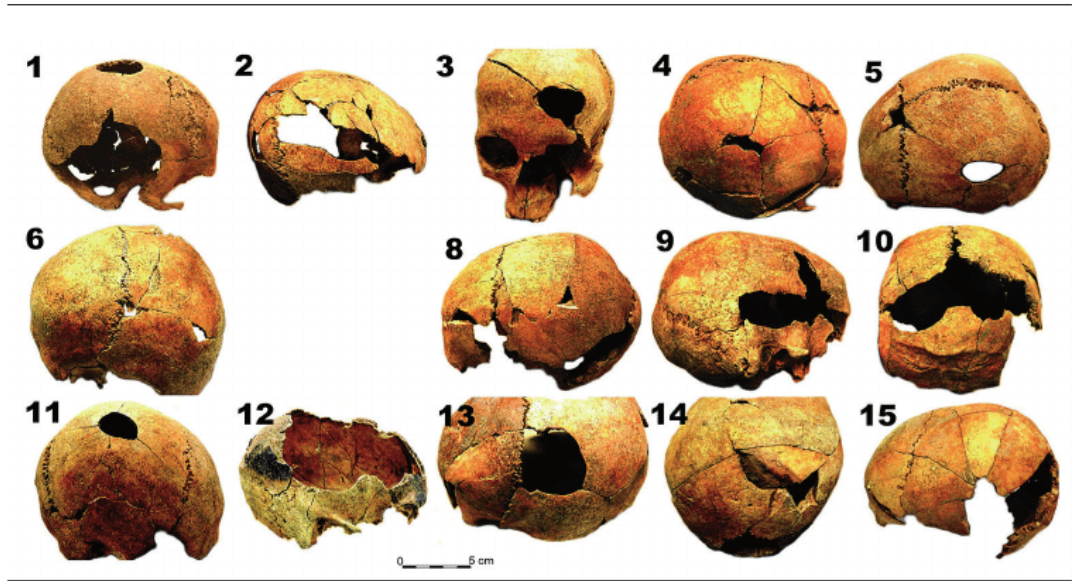
You can read the detailed forensic analysis of the bodies in the article entitled "Evidence of interpersonal violence or a special funeral rite in the Neolithic multiple burial from Koszyce in southern Poland – a forensic analysis"...

The two smallest children's skulls were almost completely destroyed, indicating that the kids were held by their legs, and their heads were smashed against something hard, a stone or a tree...

Almost complete absence of upper limbs damage and injury character indicate that these people did not defend themselves. They were executed rather than killed in battle. But then they were buried with rich burial goods...

Placed into the grave with the bodies were many pottery vessels, flint axes and other flint artifacts, bone tools, boar tusks, amber ornaments, bone pendants and animal bones...

And close to the human grave, an animal burial was discovered, which contained skeletal remains of seven pigs...


This originally "completely threw" the archaeologists...They could not imagine the scenario that could explain such a "bizarre" burial...Except of course "a ritual"...

Apparently, according to Gimbutas: Globular Amphora culture classed social structure and the dominant position of men is demonstrated by richly equipped graves which contained astounding numbers of sacrificed human beings and animals...

...In such graves, the chief adult male occupied the central position in the stone cist and was accompanied into the afterlife by family members, servants, animals...

But of course, what we find in this grave in Koszyce is not such a ritual burial of a "dominant male" with "many sacrificed family members, servants and animals"...

Actually this burial makes me wonder if the "identification" of Globular Amphora culture burials as such, is just a loads of bollocks and none of them are in fact ritual burial of a "dominant male" with "many sacrificed family members, servants and animals"...

When genetic analysis of the remains was done, scientists identified four nuclear families in the grave, for the most part represented by mothers and their children...


Closely related kin were buried next to each other: a mother was buried cradling her child, and siblings were placed side by side...

These people were buried by someone who knew them well and who carefully placed them in the grave according to familial relationships...

For example, the oldest individual in the grave, was buried close to her two sons, whereas a 30–35-y-old woman, was buried with her teenage daughter and 5-year-old son...

Interestingly, the older males/fathers are mostly missing from the grave, suggesting that it might have been them who buried their kin. Only one father is present in the grave, and his partner and son are placed together opposite him in the grave...

In addition, there is a young boy, aged 2–2.5 years, whose parents are not in the grave, but he is placed next to other individuals to whom he is closely related through various second-degree relationships...

Finally, there is an adult female, who does not seem to be genetically related to anyone in the group. However, her position in the grave close to a young man, suggests that she may have been as close to him in life as she was in death...

This archaeological site tells a terrible story. While most men (and some women) were away from the settlement, working in a field, foraging, hunting, herding animals...A band of armed men (and most likely women) came into the settlement...

Considering that there were no signs of fighting injuries, these people could have even been welcomed by their victims who could have known them as neighbours. The villagers were then captured, held or tied, and executed, one by one...

The murderers then most likely plundered the settlement and left...Why do I think this is what probably happened here? Because the same things were still happening in Europe (Balkans) as late as the 20th century...

People from neighbouring villages killing their neighbours, men, women and children in most brutal ways, and then plundering their homes, and even moving into them...Like what happened in Serbian village of Prebilovci in Bosnia in 1941...

We don't know why this terrible crime was committed in Koszyce...Was it the hatred of "them" because they are different from us (look different, speak different language, pray to different gods)?

Or was it pure greed and material gain that motivated the murderers? One of those "capture the animals and beautiful women and kill the rest" raid, which could explain "some women missing from the pile of dead bodies". The fit ones...

We just don't know...But it is very likely that they were murdered by their neighbours coming from the villages of the Corded Ware culture...

What we know is that when the men (and women) who were away returned to the settlement and found their loved ones butchered, they decided to give them "proper burial"...Only the one who knew the victims intimately could have arranged the bodies in the way they were arranged...

And only the one who cared about the victims would have "equipped them for the journey to the otherworld", with jewellery, tools, weapons, food and water (contained in vessels placed next to the bodies) and animals (the pigs placed in the separate grave next to the human grave)...

This burying of animals with the dead, so they can have animals in the otherworld seem to have been a common practice in Central Europe during Copper and Bronze age...I talked about this in my post "Group portrait"...

The Koszyce archaeological site shows I was probably right when in this article entitled "One for the road" I suggested that if we want to understand ancient burial rituals in Central Europe, all we have to do is look at current burial folklore practices in the same area. Not much has actually changed...

This archaeological site also shows how genetics is cool, and how it is "improving" archaeology. Not just because by determining the relationship between the buried people, we can now much better understand what happened in Koszyce 5000 years ago...

But also because of this: All males carried the same Y chromosome haplotype: I2a. So did all the other male individuals found buried in the Globular amphora culture graves. They all carried I2a genes...How is this improving archaeology? Like this: It wrecks havoc in the field...

Marija Gimbutas in "The Indo-Europeanization of Europe: the intrusion of steppe pastoralists from south Russia and the transformation of Old Europe" hails the Globular Amphora as an "exemplary Indo-European steppe male dominated warrior culture"...

She says that: "It is apparent that the emergence of the Globular Amphora culture in the north European plain (around 3400BC) is crucial to an understanding of the Indo-Europeanization of this part of Europe"...

She also says that: "The fact that the Globular Amphora culture is so homogenous suggests that if these people were indeed IE speakers, they completely succeeded in subverting the indigenous population or in converting them to their own creeds, customs, and language"....

Ah I am so sorry that she is not around any more...It turns out that Gimbutas was soooo sooo wrong about the Globular Amphora culture. They have nothing to do with steppe "Indo-Europeans". They were a forest culture of the mountainous Central Europe...

The fact that their economy was based on raising mostly pigs in its earlier phase, is a dead giveaway that they didn't come from the steppe...Pigs live in forests...Steppe people were cattle and horse herders...

Gimbutas and co must have known this...Or should have known it anyway...

But what they didn't know, cause they couldn't have known it at the time, is that all the macho warrior patriarchal males of the Globular Amphora culture carried I2a genes. The earliest I2a genes in Central Europe were found in Mesolithic Lepenski Vir culture in Serbia, and predate the arrival of the Neolithic farmers...

So the I2a people watched the arrival to the Central Europe with Neolithic farmers. And they watched the arrival to the Central Europe of the Kurgan people. And these people are still in Central Europe...

Here is even cooler result of the latest genetic data. Gimbutas also says that: There is similarity between the burial rites of the Globular Amphora people and those of the "Kurgans of the Maikop culture" in the North Pontic region.

Both used mortuary houses built of stone slabs and practiced the ritual burial of horses, cattle, and dogs, as well as human sacrifice in connection with funeral rites honoring high-ranking males...

According to Gimbutas, Maikop people were "part of the Kurgan II invasion wave"...Guess what haplogroups were found inside the "Kurgans of the Mayop culture"? G2a, I2a, R1a, J2a1b...

G2a and I2a were two dominant haplogroups of the late Neolithic, Copper Age central Europe...

Remember the article I wrote about the origin and spread of the Megalithic culture through Europe, the one entitled "Childe was right"?

In the comments someone asked me "What about Russian dolmans?" These things:

Well Russian dolmens, which were built between the end of the 4th millennium and the beginning of the 2nd millennium BC. are concentrated around, guess??? Maykop culture territory...

As the new data shows that the Megalithic culture seem to have spread rapidly across Europe, most likely by the people of the same tribe, people linked to seafaring, mining...and Russian dolmens are also located on the coast. Of the area rich in ores...

And as we can read in the article entitled "Megalithic tombs in western and northern Neolithic Europe were linked to a kindred society": "males from megalith burials belong almost exclusively to YDNA haplogroup I2a"...Interesting...

So did Maykop people start building Megalithic "mortuary houses built of stone slabs" under the influence of I2a people from central or western Europe?

Did these I2a people arrive to Caucaus by land from Central Europe, more specifically Balkans, together with G2a people? After (or maybe before) the Balkan Neolithic collapse (4000 BC)?

Remember my article "Vinča warriors" in which I asked if we should look for the origin of the militaristic Copper and Bronze Age societies in Neolithic Central European cultures, like Vinča culture...Does this figurine group from Vinča settlement Stubline depict an army? Or at least and armed mob...

Or did they arrive by sea, from Mediterranean, where we find I2a and G2a people spreading together along the coast. Here is a study entitled "Ancient DNA reveals male diffusion through the Neolithic Mediterranean route" which shows that these guys were spreading together along Mediterranean coast around 3000 BC... 

By boat? By boat. Did they also bother checking the Black Sea coast too? I mean this is right around the time when Russian dolmens are beginning to be built...In the Mykop territory...

I talked about Neolithic seafarers in Mediterranean and Atlantic, who were linked to Neolithic miners in my posts "Neolithic seafarers" and "Giant's ring"...

Were they the "prospectors, missionaries" that Childe talked about who spread the Megalithic culture wherever they went looking for stones and then metal from which to make tools and weapons?

The "Kurgan" Maykop culture (3700 BC–3000 BC) guys were mad about making metal weapons and were very good at it (the most ancient bronze sword on record, was made by Maykop people), were also a male dominated society...How did they learn their craft?

You know how copper and bronze metallurgy was invented in the Balkans? Mining and metallurgy are difficult things to figure out yourself and are much easier learned from someone who already knows how to do it...

Like emigrant metallurgists from the Balkans (G2a and possibly I2a) who left during the Balkan Neolithic collapse??? Or earlier??? 

And did these I2a and G2a people, produce Mykop Kurgan culture, after mixing with other people from the Steppe and Caucasus?

So who invaded whom? Did Caucasus people get Europeanised? What influence did these G2a and I2a people have on local cultures? Just technological? Religious? Cultural? Linguistic? Genetic definitely...

So, were Globular Amphora people product of "Kurgan" Maykop "invasion"? Or if there was a population movement from east to west (I talked about this in my post "Not so mobile riders"), was this in fact more like a "going back home to visit the relatives" kind of trip?

Because, there is a big problem with Maykop guys undertaking any mass long distance invasions...

Just like Balkan Neolithic people and Cucuteni-Tripillia people, Maykop people lived sedentary lives...

They were farmers who built terraces for growing their crops...People who build terraces don't go invading countries thousands of miles away...

But Maykop guys sold loads of its metal stuff to their Yamna neighbours. The Maykop guys also taught their Yamna mates a thing or two about how to mine, smelt and cast metal. Into weapons...Some of the Mykop guys possibly even joined the Yamna gangs...For a laugh...And profit...

Well not possibly. Definitely...Did you know that apart from dominant R1b genes (southern Yamna) and R1a genes (Northern Yamna), Yamna men also carried I2a genes? And so did some of the men of pretty much all the cultures surrounding Maykop and Yamna cultures...

How did these I2a guys (from Europe) end up there? And what influence, technological, cultural, linguistic, did these I2a guys (from Europe) have on all these "Indo-European" cultures? Which then "Indo-Europienised" Europe when they wandered (back) into Europe the 4th millennium BC???

So where does this leave Gimbutas theories? And the whole Indo-European thingy? It's a mess...And fun to watch...

Sunday, 1 November 2015

Gruda Boljevica

In my series of articles about Late Copper - Early Bronze age tumuluses from Montenegro, I already talked about Bjelopavlići tumulus, Mogila na Rake tumulus and Mala and Velika Gruda tumuluses. In this post I will talk about Gruda Boljevića tumulus.

Gruda Boljevića tumulus is one of the most interesting and most important archaeological sites of the Montenegrin Late Copper - Early Bronze age. It is also probably one of the most important archaeological sites found recently in Europe. 

Gruda Boljevića tumulus is located in the fertile Zeta valley in the area of the Montenegrian Capital Podgorica.


Tumuli are well known archaeological features in Montenegro, which is why Gruda Boljevića was also assumed to be a prehistoric grave even before the excavation. The local legend says that two wedding parties met and fought and that the victims of this tragic fight were buried under the Gruda Boljevića tumulus. This type of legends is often linked to ancient burial type archaeological sites in Serbia, Bosnia and Montenegro. I already wrote about this type of sites in my post about wedding party graveyards. So it was assumed that Gruda Boljevića was one of such ancient burial sites. This assumption was confirmed during building of a house south of the tumulus, when one of many medieval stone cist graves,  which were dug into the original bronze age tumulus was discovered. This is the plan of the Gruda Boljevića tumulus with the locations of the medieval graves in and around the tumulus.


The aforementioned legend and knowledge of the existence of the graves, saved the mound from destruction, which was not the case with other mounds which allegedly existed nearby.

The tumulus had an irregular shape and had a diameter of 24 m. It was clearly recognizable between the existing houses in spite of its moderate height of 1.5 m. Its northwestern part was damaged by the building of a local road. Before the survey the mound was covered with grass. The grave pit was dug in gravel subsoil with an east-west orientation was discovered. On its bottom there were just small fragments of human bones and stone flint found. The deceased was obviously laid out in flexed position, but it is not clear whether on their back or on their side. The profiles shows that initial barrow had a diameter of approximately 10 m and a height of 0,8 m, and was made of red soil,with visible layers of clay in spaces of 20 cm. Above this follow layers of clear red soil, then a layer of red grey soil mixed with gravel, then humus. The prehistoric finds are located in the first barrow or on top of it. Approximately 0.4 m above the northern part/edge of the grave pit, objects of attire were placed. Even higher, 0.7 m above the eastern edge of the grave pit a ceramic set was deposited. Such a stratigraphic position is unique and without parallel in this cultural region. The fact that clay inter beds are disrupted exactly above both find concentrations and that personal belonging are normally placed beside the deceased, stimulated us to look for separate explanations for the grave and the finds above it.


Central grave

The grave pit of the central grave was dug more than 1 meter deep into the gravel substrate of the tumulus. This substantially distinguishes it from other “princely” graves from Montenegro. Such grave pits are typical for the Yamnaya culture, which at the end of the 4th and in the first half of the 3rd millennium dominates a significant part of Eastern Europe. For the Gruda Boljevića tumulus the best parallels can be found in the hinterland of the eastern Adriatic, between present day Albania and Hercegovina. Here, the deceased are normally laid down in a contracted position on their back or on their side, and oriented in an east-west direction. Grave goods are few or absent. Barrows are of moderate dimensions, made of soil and frequently surrounded with band of stones or a stone circle. On the basis of the observed larger pebbles and stone zones it is not impossible that Gruda boljeviča was also surrounded with such a construction, but that it was later destroyed by medieval inhumations. It is not possible to determine whether the stone flint from the grave pit is an actual grave good or a chance intrusion from the filling of the pit. Such artefacts are also reported from the covering layers of some other tumuli, e.g. Mala gruda and Piskovë.

Deposition above the central grave

Considering the good preservation and the completeness of the inventory, its concentration in two groups on a uniform level, the reopening of the grave and the displacement of grave goods is not likely. Objects were therefore found in situ. What is unclear, but a crucial question, is the relation of these finds with the grave below them. Two basic assumptions seem possible: they are connected to this grave and lay above it during or some time after burial. They are not connected to this grave and were deposited only after a considerable period of time. Both hypotheses can be supported with certain arguments. Elements of ritual practices are known from some tumuli, like Mala and Velika Gruda for example. In both cases with these rituals only smaller fragments of ceramics can be connected. Whole pots or other finds placed above the grave are known only from a few concurrent sites (Shtoj, Neusiedl). The find from Gruda Boljevića is exeptional by quantity and composition and exceeds all known examples of ritual enclosures. This and the stratigraphic position indicates that items were not placed above the grave during the burial ceremony as assumed by Govedarica and Baković. If really connected to the grave, then they were added after a certain period, interrupting the layers above the grave. Analogies for such complicated activity are however not known. That is why the second explanation of the situation is more probable namely, that the grave pit and the objects above it are not directly connected. In this case the grave pit represents a primary burial, which by its structure and the absence of grave goods fits well among typical Yamnaya culture graves, while the two concentrations of finds above it are the remains of a later, independent deposit. Comparison with inventories of other princely graves shows considerable similarities in the concentration, allocation and orientation of objects. With extreme caution this can be understood as a sign of another grave. In this case, in the centre of Gruda Boljevića two princes were buried, one above another! Of course, this hypothesis also has some open questions and uncertainties. The most essential is the absence of bones. But if bad preservation of the skeleton in the primary grave and in the central grave of Mala Gruda is taken into consideration, we must allow the possibility of the decomposition of the osteological material due to acidic soil. The second possibility is that it was a burial without a corpse, i.e. a cenotaph. In contrast with other rich “princes” buried in stone cists in a contracted position, the distribution of goods in the alleged secondary grave also allow an extended body position. The difference in the heights of the vessels and parts of attire could be caused by the subsidence of the primary grave pit fill or with the intentional deposition above or near the grave. As seen from the profiles, this grave would be dug into the primary barrow, but the building up of the barrow with an additional layer of soil in the context of this burial is also possible. Secondary graves that express chronological and cultural continuity of the tumuli use are quite a frequent feature in Yamna culture. For our case the most important are examples from neighbouring regions (Pazhok, Cerujë, Shtoj). The third event in the construction of the tumulus is the deposition of the pottery vessel found in the eastern part of the tumulus. Because of scarce data it is not possible to say with certainty when that happened; considering its location out of the centre in the layer of red soil (or on the border between the first and second barrow), this was probably the latest prehistoric activity. Also this vessel was found practically whole, but without any additional features or objects.  Therefore it is unclear if it was ritually placed, randomly discarded, or even used as part of a grave ensemble.

The grave goods found in the Gruda Boljevića tumulus show us that people who built this tumulus belong to the same culture, and I believe the same tribe, clan, as the people who built Bjelopavlići tumulus, Mogila na Rake tumulus and Mala and Velika Gruda tumuluses.

This is the list of all the grave goods found in the Gruda Boljevića tumulus.

The Golden lockrings


This type of jewelry (lockrings made of precious metals) were one of the distinctive elements of the Yamnaya culture and were widespread in Eastern Europe. They are also a typical personal ornament of early Montenegro tumuli. However the lockrings of this particular type with profiled terminals are extremely rare. Apart from Gruda Boljevića, lockrings of this type are known only from Mala nad Velika Gruda tumuluses:


The stone battle axe

In my post about the Irish gold I talked about the mysterious golden cross discs which were found in Ireland and Britain and were all dated to 2400 BC - 2100 BC. I said that it is commonly believed that these ornaments originated in Ireland. In my post about the Mala and Velika Gruda tumuluses I have shown that in fact this type of golden cross discs were made in Montenegro 300 - 400 years before the first such discs appeared in Ireland and Britain. This is the golden cross disc from Mala Gruda tumulus, which was used for making the axe shaft cap:


I also said that there is even older golden cross disc, which was used in the same way like the Mala Gruda one. That other golden cross disc was found in Gruda Boljevića tumulus: 


At the very least these golden cross discs show cultural link between the people who built Mala Gruda and Gruda Boljevića tumuluses. The form and the material from which these discs are made indicates that they are objects with the symbolic status. The way in which the discs are used indicates that they could even have a meaning of insignia. They represent status, and probably also have religious significance and may even be a tribal, clan, family symbol. 

This stone battle axe exceeds ordinary and older examples in elegance and superior craftsmanship. Stone battle axes with elaborate forms and of high quality are popular in the primary regions of the Yamnaya and Catacombe cultures, but because of some closer typological parallels the workshop of the Gruda Boljevića example should be searched for in the region of the western Balkans. The best quality stone battle axes of this type are found in Troy (Hansen 2001, 45, Abb. 35). However all these stone battle axes from the Black Sea and the Eastern Mediterannean have the hammer end with the circular profile and biconnically widenned central part. The stone battle axes which are closest to the the Gruda Boljevića axe are the one axe from Lugansk and the axes of the Mihajlovka type (Gimbutas 1965, Fig. 330:1; Kaiser 1997, 105–108, T. 25: 9).

The curved shape is not usual for stone axes but was more common in metal forms. Typologically it is marked by curved shape, expanded blade, fasetted rectangular hamer end and rounded middle part. There are only few metal axes with similar characteristics: Two much cruder examples from Ljubljansko barje, one example from Vošanovac, and one from Bosanska Rača. (Korošec, Korošec 1969, T. 78: 1; Šinkovec 2014, kat. b. 110; Stojić, Jacanović 2008, 55 sl. 41, 315, T. 139: 1; Čović 1957, 249, sl. 8). Unfortunately all these four axes are only partially preserved.

What is interesting is that the oldest metal axe found so far which was discovered in the Vinča culture site Pločnik and was dated to the period between 5500 BCE and 4700 BCE, is of the same type as the Gruda Boljevića axe type.


 The copper dagger


The simple dagger with a triangular blade is badly preserved and corroded. Still some details are visible, like the imprint of the handle around the upper edge and two holes for attaching the handle with rivets. Those were put very close to each other, which opens up the possibility that one of them is the result of an antique repair. The triangular form is quite common and chronologically and geographically widespread. For a more precise determination, analysis of material should be done. It would answer the question of whether the object is made of copper or early bronze, and point to a direction for its origin.

The axe pendant


The shape and different traces on the trapezoidal, perforated pendant of red stone allow two interpretations of its use: as an amulet or as a whetstone. In favour of the first interpretation speaks the small size, careful production and red colour, and in favour of the second are the traces on the surface and a possible combination with the equally small dagger. Of course, there is also the possibility that it had a double purpose: both as an amulet and as a whetstone.

The pottery set

Three aspects should be taken in consideration when analysing the pottery set from the centre of Gruda Boljevića: ornament, forms, and the combination of objects. Also, it must be emphasized that all three vessels are similar in structure and decoration, therefore allowing the hypothesis of simultaneous production – perhaps even especially for burial purposes.Ornament has a decisive role in the cultural determination of Montenegro tumuli. In it we can recognize the “fashion trends” that reach from the Carpathian basin to the Adriatic, but which is not uniform. Obviously in most cases we cannot speak about imports or direct influences, but more likely about local variations that developed in different regions and cultures. The Montenegro material is usually classified as part of the “Adriatic type of Ljubljana culture”, although it has some peculiar features and shapes, which has caused M. Primas to speak of a “facies Kotor”. In fact the “Adriatic” elements are quite rare in the broader region and are always found in layers of local cultures. Their exposure therefore creates an exaggerated impression of cultural unity. The explanation of this pottery is perhaps hidden in its cult purpose. In contrast with settlement layers, where such sherds are rare, all vessels from princely tumuli are decorated in this style. Are they luxury variants used by the upper class or were they produced as funeral vessels with specific symbolism?

The plate


This is the plate from the Mogila na rake tumulus:


The plate found in Gruda Boljevića is almost identical to the one found in Mogila na rake tumulus except for the motif on the plate:


Plates with a fanshaped extension are prominent ceramic grave goods in Montenegrin tumuli, known from Gruda Boljevića, Mala and Velika Gruda, Mogila na Rake, as well as in a destroyed tumulus Rubeži. They are all richly decorated both outside and on the interior, and differ primarily in the base modelling that can be in the form of a low or high foot, sometimes with apertures.

The funnel


The funnel with a decorated exterior and plain interior is a unique find in the assemblages of Montenegrin tumuli and a rare ceramic form also in the wider region. Similar funnel shaped clay artefacts of a different form and function dating from the 3rd millennium BC and the early 2nd millennium BC are known from the Lower Austria, the southern Russian steppe (Black Sea region) and Hungary. Here are the examples from Unter-Mamau, Austria dated to the second millennium BC (1,2) and Kalmykia, Black Sea region Catacombe culture dated to the mid third millennium BC (3).


Here is an example of such funnel from Somogyvár-Vinkovci Culture from Balatonőszöd-Temetői dűlő in Transdanubia, Hungary, which was dated to 2110 BC.


None of these other known funnels are ornamented like the example from Gruda Boljevića and are all younger than the Montenegrian example.

The jug


Jugs with a long handle that connects the rim and shoulder or belly, are a widespread functional form. It should be noted that among such vessels from the princely tombs of Montenegro we can observe different shapes: the high and elegant pitcher from Gruda Boljevića, the small compact one from Mala Gruda, or the asymmetrical Sutomore example. They are, therefore, a popular and longlasting vessel type, produced by various local workshops. The combination of three vessels from Gruda Boljevića for now represents the largest known set. We can compare the pitcher and plate with sets from Mala Gruda and Mogila na rake. 


It is worth mentioning grave 6/15 from Shtoj with the same combination, but with other forms: a smaller jug and conical bowl. The plate/bowl and pitcher are therefore the basic service used in the funeral cult (and possibly everyday life), which is supplemented with funnel in Gruda Boljevića.

The ceramic pot


The ceramic pot is of a simple spherical shape, but with a typical reinforced rim. From Albania to Dalmatia (and beyond) this detail is often found in settlements and is considered to be the characteristic of the late Eneolithic.The cultural significance of this vessel is very interesting. Unlike ceramics from the centre of the tumulus, which are typical grave goods, this pot is characteristic settlement pottery, which allows us to connect the tumulus phase with the corresponding settlement layers.

 Absolute and relative chronology


Radiocarbon dating was done on fragments of bone from the central grave of Gruda Boljevića. the analysis was conducted by laboratories in Kiel, Germany. The results date the time of burial around 3050 BC (3090 - 3044 cal BC). The high dating of skeleton in the central grave actually confirms the hypothesis of a secondary deposit of the finds above it. The C14 sample dated only the primary tomb, while the complex above it should be compared with the dates obtained by analysing samples from the Velika Gruda tumulus. There the central grave with a similar inventory is dated in the period 2800-2700 BC. The final prehistoric activity at the Boljevića Gruda tumulus is the deposition of a ceramic vessel with a reinforced rim. Such ceramics are known from Odmut (layer VI), where it is dated to 3036 - 2754 cal/1σ, while at the Ljubljana marsh settlements such rims are known from about 2500 BC. Absolute dating of the grave with figurines from the Kuće Rakića tumulus also falls at 2500 BC. The presented dates again confirm the possibility of paralleling Adriatic culture with classical Vučedol and EH II, as proposed by Philippe Della Casa and marked as the 2nd phase of the Late Copper Age. In these nearly 500 years of cultural and sociological development we can distinguish at least three different forms of burial. Somewhat surprisingly, in the settlement layers (usually caves) these differences are not visible. According to existing studies and analogies, this is the time when the Odmut VI, Varvara A1, Ravlića Cave IIIa, Hateljska cave III and Nezir cave IV layers are formed. they are attributed to the developed Eneolithic, while simultaneous graves, due to the considerable social differences and the new economy, are often attributed already to the Early Bronze Age.

You can find additional information and detailed description of the tumulus in the article entitled "Podgorica praistorijske humke i srednjovjekovne nekropole Gruda Boljevića".

So at the beginning of this post I said that I believe that Gruda Boljevića tumulus is one of the most important archaeological sites found recently in Europe. The reason why I believe that this tumulus is so important, is because it shows that the dolmen building, golden cross disc making culture which developed in Montenegro in the first half of the third millennium BC, has its direct cultural roots in Yamna culture of the Black Sea steppe. Why is this important?  

I have already shown that the golden cross discs which appear in Ireland and Britain around 2500 BC have their predecessors in golden cross discs from Montenegro which were dated to 2700 BC (Mala Gruda) and some time between 3050 BC and 2700 BC (Gruda Boljevića). Considering that these golden cross discs first appear in Montenegro and then in Ireland and Britain and nowhere else in between suggests that this cultural trait could have been a result of a direct cultural transfer between Montenegro and Ireland and Britain. Irish archaeologists are reluctant to say whether this cultural influence was due to trade or missionary contacts, or whether it was a consequence of a migration of a group people into Ireland. This is because Irish archaeologists don't read pseudo histories like the Irish annals. If they did they would have seen the old Irish annals tell us that right at the time when the metallurgy and the first golden cross discs appear in Ireland, a group of people, a tribe a clan lead by Partholón arrives in Ireland. Partholón and his people are credited with introducing cattle husbandry, plowing, cooking, dwellings, trade, and dividing the island in four and most importantly for this story, they are credited with bringing gold which before them was not used in Ireland. They bring the golden cross discs. But where did Partholón and his people come from? The Irish annals tell us that too. They tell us that Partholón arrived to Ireland from the Balkans via Iberia. The Lebor Gabála Érenn, an 11th-century Christian pseudo-history of Ireland, tells us more. It tells us that Partholón came to the Balkans from the Black Sea steppe, the land where at the beginning of the 3rd millennium BC we find Yamna culture...I will talk about this in detail in one of my next posts. 

Montenegrian archaeologists are still hesitant to say whether Yamna cultural influence on Montenegro was due to trade or missionary contacts, or whether it was a consequence of a migration of a group of Yamna people into Montenegro. If only Montenegrian archaeologists read Irish pseudo histories....

Sunday, 27 September 2015

Mala and Velika Gruda tumuluses

Among many tumuluses, cairns, which are strewn over the hills of Boka Kotorska bay, the two stand out: Velika and Mala Gruda.


While the other tumuluses in the area are located on tops of hills, these two tumuluses are located in the middle of the Tivat field. The local people preserved the legends that these two stone tumuluses were Prokletije, piles of stones accumulated through centuries as part of the cursing ceremony. I wrote about Prokletija ceremony in my post entitled "Prokletija - The cursing ceremony". As a result, these tumuluses were preserved as the taboo linked with Prokletije forbids removal of even a single stone.

Velika Gruda and Mala Gruda tumuluses are only 270 meters away from each other. Mala Gruda is a single phase burial tumulus and has only a late Copper Age (early Bronze Age) tumb. Velika Gruda is a multi phase burial which has late Copper age (Early Bronze age), Iron age and Medieval burials. The late Copper Age (early Bronze Age) burial from Velika Gruda is equivalent to the late Copper Age (early Bronze Age) burial from Mala Gruda. These were rich princely graves, full of well made and decorated ceramics and metal objects made from silver, gold and copper alloys. The archaeologists who excavated these burials postulated that the people who were buried inside the Velika and Mala Gruda late Copper Age (early Bronze Age) burials were involved in trades between the Balkan Hinterland and Southern Italy and probably the rest of the Mediterranean.

So who was buried in these tumuluses? The archaeologists admit that despite all the modern procedures, analysis and equipment used it is "difficult to understand who built the Mala and Velika Gruda burials. This is because there is at present so little knowledge about what was going on in the Southwestern Balkans during the time when these tumuluses were built. Basically the problem is that the way these tumuluses were built, the way they were positioned in the  low lying landscape as well as some of the burial rite details have no parallels in the Mediterranean basin except in a small area of Montenegro and Northern Albania. The first next similar late Copper Age (early Bronze Age) burial is found in the steppe of the Yamna culture homeland....


The investigation of the Velika Gruda tumulus was completed in the early 1990s and the results were published in these two books:

"Tumulus burials of the early 3rd millenium BC in the Adriatic - Velika Gruda, Mala Gruda and their context" which was published in 1996 by Margarita Primas who excavated the late Copper Age (early Bronze Age) burial.

"The Bronze Age necropolis Velika Gruda (Ops. Kotor, Montenegro) : middle and late Bronze Age groups between Adriatic and Danube" published in 1994 by Philippe. Della Casa who excavated the Middle and Late Bronze Age burials.

A short review of both works by John Bintliff was published in the American Journal of Archaeology.

Archaeological investigation of the Mala Gruda tumulus was performed during the period 1970 - 1971. The tumulus was damaged during the First World War, when Austrian army built a bunker on top of it. The tumulus height in the middle is about 4 meters and the diameter is about 20 meters. Originally it was proposed that the tumulus dated to the period 1900 to 1800 BC. Howevere the latest dating pushes the date when this tumulus was built almost 1000 years back into the past to the period between 2800 to 2700 BC.

The Mala and Velika Gruda tumuluses have very unusual structure. Remember the Bjelopavlovic tumulus and Mogila na Rake tumulus that I already talked about? They both had central dolmen cists which were built on the surface of the earth. Mala and Velika Gruda tumuluses also have central dolmen cists built from massive stone plates. But these stone plates were placed inside the grave pit which was dug into the earth to the depth of half a meter. First the bottom of the grave pit was covered with a stone plate and then the vertical stone plates were placed on top of it to form the dolmen cist. The cover stone plate was then placed on top of it. The stone dolmen cist was then covered with a tumulus pile of yellow - brown clay. The surface of this clay inner tumulus was then burned using very strong fire, probably during the sacrificial rite which took place on top of this inner tumulus. This resulted in the whole inner clay tumulus being covered with a layer of ash which contained the most of the ceramic and stone finds. The clay inner tumulus was then covered with the layer of stones (large river pebbles) which varied in thickness between 0.3 - 0.5 meters. This stone layer was then covered with earth (humus). It is unclear if his layer of humus was natural or artificial.


The orientation of the dolmen cist was north - south. The body which was placed inside the dolmen cist was very badly preserved and was not possible to determine its precise position, but it is presumed that it was placed into the cist in the fetal position.

In the north part of the stone cist, next to the scull of the deceased, archaeologists have found five golden lock rings.


Lock rings are a type of jewelry from Bronze Age Europe.  They are made from gold or bronze and are penannular, providing a slot that is thought to have been used for attaching them as earrings or as hair ornaments. Ireland was a centre of production in the British Isles though rings were made and used across the continent, notably by the Unetice culture of central Europe. But these lock rings from Mala Gruda tumulus predate all the examples from northern Europe by many centuries and millenniums.

The only other lock rings from the late Copper Age (early Bronze Age) period which are similar to the lock rings from Mala gruda tumulus were found in Velika Gruda tumulus and in Gruda Boljevića tumulus, which is even older than the Velika and Mala gruda tumuluses. I will write about the Gruda Boljevića tumulus in my next post. Velika gruda tumulus also had lock rings of the type found in the Lefkas (Leukas) cemetary. But these Lefkas type rings are much simpler than the Mala Gruda type rings, and look like an inferior quality imitation of the Mala Gruda type lock rings. Here are the Lefkas type lock rings from Lefkas cemetary.


Next to the feet of the deceased, next to the eastern edge of the stone cist, archaeologists have found a set of ceramic dishes in fragments.

First is a shallow bowl with the ring leg:


Again we find the cross in the circle symbol which we see in the plate which was found in the Mogila na rake tumulus. 


Second is a jug with one handle:


Both dishes were made from reddish brown clay and were richly decorated and polished.


In that respect the plate from the Mala Gruda tumulus is very similar to the the ceramic bowls from the Vučedol culture from the same period like these two: 


In the past when it was believed that Mala and Velika Grida tumuluses were build at the beginning of the second millennium bc, it was proposed that the culture which built these Montenegrian tumuluses was influenced by late phases of Vučedol culture. But now that we know that Velika and Mala Gruda tumuluses were contemporary with the early period of the Vučedol culture things become much more complicated and confusing.

The most important artifacts were discovered at the eastern edge of the grave cist, at the waist level. These were a golden dagger and a silver axe. Actually both objects were made from complex alloys and not of pure gold and silver. Spectrographic analysis had shown that the dagger was made from the alloy of silver, gold and copper in proportion 3:2:2 and that the axe was made from the same alloy but in proportion  4:1:1.

The golden dagger:


The dagger  is leaf shaped with straight edges and rounded top. It has a short tong for attaching it to the handle and a triple profiled central ridge. Similar daggers are found in Anatolia dating to the mid 3rd millennium bc. Her is the Mala Gruda dagger and its Anatolian comparisons:


1. Mala Gruda: N. TASIĆ (ed.), Praistorija Jugoslavenskih Zemalja III. Eneolitsko doba (1979) pl. 42:8.
2. Karataş: M. MELLINK, “Excavations at Karataş-Semayük 1970,” AJA 73 (1969) pl. 74:21 (drawing J. Maran) dated to 2900 - 2600 BC.
3. Bayindirköy: K. BITTEL, “Einige Kleinfunde aus Mysien und aus Kilikien,” IstMitt 6 (1955) fig. 1 dated to 2500 - 2200 BC.
4. Bayindirköy: BITTEL (supra) fig. 4 dated to 2500 - 2200 BC.
5. Alaca Höyük: STRONACH (supra n. 47) fig. 3:4 dated to 3rd millennium bc.


The silver axe:


This silver axe is the last and the most important find from the Mala Gruda tumulus. For two reasons. Firstly the new dating of this axe opens some interesting questions about our understanding the chronology of the distribution of the shaft hole axes in the Balkans. Secondly the new dating of this axe opens some very interesting questions about our understanding of the Early Bronze Age Irish and British history. 

So, why is Mala Gruda axe important for our understanding the chronology of the distribution of the shaft hole axes in the Balkans?

The silver axe has a thin and narrow triangular blade with a cylindrical socket.  In the literature we read that "this type of axe belongs to the Vučedol Kozarac type axes". However no axes like the Mala Gruda axe have been found in Vučedol culture.

Shape wise Mala gruda axe does look like Vučedol culture axes with one blade and a cylindrical extension for a handle haft. These type of axes were exported to the Eastern Mediterranean including to Troy via Lemnos. This is a picture of a hoard of such axes from Brekinjska (Pakrac) in Croatia.


However the axe from Mala Gruda tumulus is of an exceptional quality and made of Gold + Silver + Copper alloy and not bronze. Silver axes were found in Vučedol site of Stari Jankovci.


You can read about them in this Croatian article and this English article. The Stari Jankovci axes are also silver shaft-hole axes, but their shape is completely different from the shape of the Mala Gruda axe. So we can't talk about direct link between these Vučedol silver axes and the silver axe from Mala Gruda. However this shows that both the knowledge how to make Mala Gruda type axe shape and material existed in the Vučedol culture, so we can say that it is possible the people who made the Mala Gruda axe were influenced by the Vučedol culture. So we could say that the Mala Gruda axe could have indeed been made by Vučedol metalworkers. Except that the site where the above two silver axes ware found was dated to 2500 - 2040 BC wheres Mala Gruda was dated to 2800 - 2700 BC. This means that the Mala Gruda axe is hundreds of years older. This is a very good article on the dating of the Vučedol culture sites .This opens a big question: who influenced who? Who learned from who?

It is assumed that the earliest shaft-hole axes were developed in the the north Caucasus by the Maikop culture sometime between 3500 and 3128 BC.


From here they spread within few hundred years to a large area in Central and Western Asia and Eastern and Central Europe and the Balkans.


This picture shops main types of shaft-hole axes and axe molds from the above distribution area from the period late fourth millennium bc - early third millennium bc:


Aegean: 1 Thebes, 2 Servia, 3 Petralona, 4 Triadi, 5 Poliochni;Montenegro: 6 Mala Gruda;
Hungary: 7 Zók-Várhegy;
Rumania: 8 Virgis;
North Caucasus: 9 Lebedi, 10 Novosvobodnaya/Klady;
Daghestan: 11 Velikent;
East Anatolia: 12 Arslantepe, 13 Norşuntepe.


You can read more about the early shaft-hole axes in this great article entitled: "Indications for Aegean-Caucasian relations during the third millennium BC". The most interesting part of this article I believe is this:

"...The earliest axes in Southeastern Europe are assumed to be the Baniabic type (Vîlcele) axes because their blade is not differentiated from the shaft. The upper edge of the axe is straight, while in the case of the axes of the Fajsz type and Corbasca type this edge is convex. At least some of the axes can be dated to the early Vučedol Culture (c. 31th – 28th century BC). The problem is that this dating is based on the fact that their shape is generally comparable to axes or moulds for axes from the northern Caucasus and Koban region, like the mold from Lebedi or from the Kura-Araxes Culture which were dated to that period. But the type is so simply shaped that even comparisons to much later axes are possible, and this makes the dating of the Baniabic type axes uncertain. The southeast European types of Dumbrăvioara, Izvoarele, Darabani and Kozarac have short shaft tubes and can be grouped to the second morphological trend. In some cases their tubes are faceted or ribbed. This feature is also found on one axe from the hoard of Stublo (Steblivka) in the western Ukraine. These types can be dated mainly to the earlier half of the third millennium BC.... "

So Vučedol culture Kozarac type axes are dated to the same period to which the Mala Gruda tumulus axe was dated. So is it possible that the Mala Gruda axe predates the Vučedol culture Kozarac type axes? And is it possible that knowledge how to make this type of axes was transferred from the South of the Balkans up North and not the other way round?

Finally why is Mala Gruda axe so important for our understanding of the Early Bronze Age Irish and British history? 

According to the archaeological data, a new people appeared out of nowhere on the Atlantic coast of Europe around the mid 3rd millennium BC: The Bell Beaker people. The Wiktionary says: "Bell Beaker is a complex cultural phenomenon involving metalwork in copper, gold and later bronze, archery, specific types of ornamentation and shared ideological, cultural and religious ideas....Several proposals have been made  as to the origins of the Bell Beaker culture, notably the Iberian peninsula, the Netherlands and Central Europe. And debates are still continuing. Archaeologists and historians are still debating whether the spread of Beaker culture was due to the migration of people or spread of ideas or both...". 

Well for Ireland we know that the arrival of the Beaker culture was due to the arrival of the Beaker people. Before 2500 BC there was no metalwork in Ireland and no beakers. After 2500 BC there was as thriving sophisticated metalworking culture in Ireland and beakers. That can only happen if we have an influx of people with metalworking skills into Ireland around 2500 BC. And archaeologists and historians all agree on this. But where did these metalworking beaker using new Irish come from and who they were is "a mystery".


But as I already said in my post about the Irish Gold, the answer to this "mystery" has been hidden in plain view in the ancient Irish annals. If only the archaeologists and historians read the ancient Irish annals as histories and not as "pseudo histories" as they like to call them.

So what can the Irish annals tell us about the arrival of the Beaker people to Ireland?

Well the old Irish annals don't talk about Bell Beaker people of course. But they tell us that: "...after the flood, came Partholón with his people..." The Annals of the Four Masters says that Partholóin arrived in in Ireland 2520 Anno Mundi (after the "creation of the world"), Seathrún Céitinn's Foras Feasa ar Érinn says they arrived in 2061 BC, Annals of Four Masters says that they arrived at 2680 BC. So Sometimes in the second half of the 3rd millennium.

Partholón and his people are credited with introducing cattle husbandry, plowing, cooking, dwellings, trade, and dividing the island in four and most importantly for this story, they are credited with bringing gold which before them was not used in Ireland. As I already said in my post about the Irish gold, this has was actually confirmed by the archaeological finds from Ireland. Some people came to Ireland around the 2500 BC or there after, and brought with them copper metalworking knowledge. They opened the first copper mine in Ireland in Ross Island and started making copper axes. The archaeologists originally believed that these immigrant copper metalworkers also started mining gold in Ireland. And that they used that gold to make golden ornaments. The reason for this belief is that around the same time when the Beaker copper metalworkers arrived to Ireland, we suddenly see gold being used for making ornaments, mostly gold lunulae, about which I wrote in my post about the Irish Gold, and gold cross discs like these ones:


But as I already said in my post about the Irish gold, it turns out that the gold from which the Irish lunulae and cross discs were made was not mined in Ireland, but that it was brought into Ireland from somewhere else. Archaeologists are now saying that the gold was brought into Ireland from Cornwall. The local Irish craftsmen then used it to make the lunulae and cross discs. In my post about the Irish gold I argued that these gold ornaments were probably not made in Ireland from imported gold, but that they were made wherever the gold was mined and smelted (Cornwall???), and that the finished gold lunulae and cross discs were imported into Ireland.

The archaeologists believed that these types of ornaments originated in Ireland because they have no precedence in Europe. Until the discovery that the gold from which these ornaments were made did not come from Ireland but from Cornwall. Now they believe that these types of ornaments originated in Ireland or Britain. And I would agree with them when it comes to lunulae. So far there is no precedence for this type of gold ornaments. But I have to say that now we have a proof that the golden cross discs did not originate in Ireland or Britain. I can say this because now we know that hundreds of years before these gold cross discs appeared in the British isles, they were made and used in the Balkans, more precisely in Montenegro. 

Have a look again at the silver axe from Mala Gruda tumulus. 


This silver axe was found together with a strange golden cap covering the the top of the axe shaft. The cap was made from a golden disk which is a thin embossed sheet of gold with a cross at the centre, surrounded by a circle. 


The design on the gold disc cap resembles the most the design found on the gold sun disc which was found in a burial mound at Monkton Farleigh, just over 20 miles from Stonehenge, in 1947 along with a pottery beaker, flint arrowheads and fragments of the skeleton of an adult male.


The two pence piece sized gold disc was made in about 2,400 BC, soon after the Sarsen stones were put up at Stonehenge, and is thought to represent the sun.It was kept safe by the landowner since its discovery and has only now been given to the Museum. The disk is a thin embossed sheet of gold with a cross at the centre, surrounded by a circle, and between the lines of both the cross and the circle are fine dots which glint in sunlight.

The golden cross discs found in Ireland and Britain were all dated to 2400 BC - 2100 BC. The golden cross disc from Mala Gruda was originally dated to the period 1900 to 1800 BC. I believe that this is why no one before made a connection between the Mala Gruda golden cross disc and the cross discs found in Ireland and Britain. Even if someone did make a connection, the Mala Grida golden cross disc was probably classified as being made under the influence of the late Beaker culture. However the latest dating pushes the date when Mala Gruda tumulus was built almost 1000 years back into the past, to the period between 2800 to 2700 BC. Now this changes everything. Someone in Montenegro was making golden cross discs 300 - 400 years before the first such disc appeared in Ireland and Britain. The thing is that this golden cross disc from Mala Gruda has no precedence. Except for another golden cross disc which was used in the same way, for making the axe shaft cap. And this other golden cross disc was found in an even older Montenegrian tumulus, which was dated to the end of the 4th - beginning of the 3rd millennium bc and which was linked directly to the late Yamna culture. I will write about this tumulus in one of my next posts. This means that we can say that unless new archaeological data emerges, the origin of these golden cross disc ornaments is in the early 3rd millennium BC Montenegrian tumulus building culture. 

Now the big question: Is it possible that people who made these golden cross discs in Montenegro or their descendants, were the same people who later made the golden cross discs in Ireland and Britain? Was there a migration from Montenegro to British Isles around the middle of the 3rd millennium BC? I believe so. And guess what, the Irish annals says so too. But I will talk about this more in one of my next posts. 

Until then stay happy and keep smiling.