Showing posts with label Grain goddess. Show all posts

Tuesday, 22 August 2023

Sabi Abyad venus

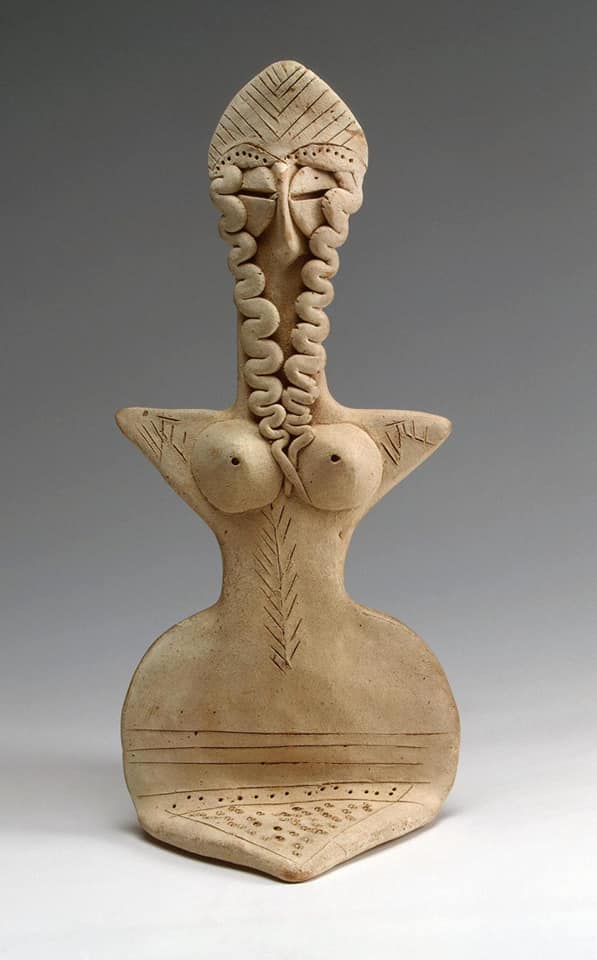
A figurine from the Late Neolithic and Early Halaf Village at Sabi Abyad, Northern Syria, part of Fertile Crescent. dated to 7th mill BC...Depicting Mother Earth turning into Mother of Grain...From "A Late Neolithic and Early Halaf Village at Sabi Abyad, Northern Syria". 

On the front you see what you would expect to see on any female fertility (Mother Earth) figurine: Large vulva and large breasts...


What is depicted on the sides and the back of the legs is what transforms this Mother Earth into Mother of Grain figurine: ears of grain...

How do we know this is grain?

Remember my post about the Mother of Grain?

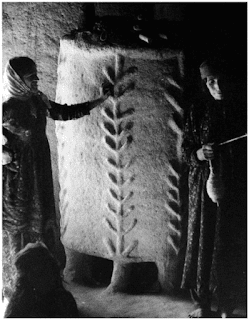
Aliabad women standing beside a grain bin, Iranian Kurdistan...From "Home is where we keep our food: The origins of agriculture and Late Pre-Pottery Neolithic food storage". Very important image, as it confirms that this design pattern, found on pottery and figurines since the Earliest Neolithic all over Eurasia, means "grain"... 

I first talked about this in my post "Scarlet ware harvest vase"...


I then talked about this symbol in my post "Mother of grain"...


And in "Altyn tepe mother of grain"...

And in my post "Arjoune venus"...


And here they all are (so far):


We find the same symbolism on figurines found from the Balkans to Iran. They use similar combination of vulva + grain to depict the same thing: Mother Earth turning into Mother of 

BTW, have you ever heard of the Grain spirit? That "lives in the corn dolly made from the last sheaf of grain"?

I talked about it in my post about it in my post "The old woman of the mill dust

In Gaelic, the word Cailleach means both an old woman and the last sheaf of wheat and the corn dolly made from it. Corn dolly which represents Mother Earth, the life (grain) giving mother...


Who is this "Grain spirit"? Well the mother of grain of course. The mother earth...The mother of all of us (and grain)...The Proto Mother...The ancestor...

I also talked about this in my post "Diduch", the representation of an ancestor "who gives us wheat"...

And my post "Wheat cross"...About living corn dollies from Eastern Europe...

The wheat wreath was the most important part of the Romanian end of harvest ceremonies. It was made from the last sheaf of wheat...

It was normally then used to "crown" the "most beautiful unmarried girl" that participated in the harvest, who then carried it back to the village on her head...Love these pics of the reenactment of this ceremony by Vasile Sarb


Interesting, right?

To read more about ancient animal and plant calendar markers, start here…then check the rest of the blog posts related to animal calendar markers I still didn't add to this page, and finally check my twitter threads I still didn't convert to blog post...I am 9 months behind now...

Saturday, 13 May 2023

Inanna and dove

A pottery cup, Syria, dated to 1800-1600 BC. The rounded body tapering to a flat base, with 26 bird heads. Christies auction... 


Doves??? Similar objects were interpreted as votive objects dedicated to Ishtar/Inanna, whose sacred bird was dove...

And Demeter...

I explained why dove was sacred to Demeter in my post "Demeter with dove"... 

Demeter was the goddess of grain (harvest)...And European doves nesting season overlaps with the grain harvest season in Europe...So...

Interestingly, Inanna/Ishtar, was in "A song of Inanna and Dumuzid" described as: "Maiden, glossy mane, lovely beauty...colourful as a pile of grain, fit for the king, fit for Dumuzid! Maiden...a stack of...barley, fully developed in loveliness"...

I talked about this in my post "Demeter riding a panther"...

Remember this thread about the grain symbol? See all these female bodies with grain symbol on their bellies?

This is Inanna/Ishtar speaking: 

"...Before my lord, Dumuzi,

I poured out plants from my womb.

I placed plants before him,

I poured out plants before him.

I placed grain before him,

I poured out grain before him,

I poured out grain before my womb..."

I talked bout this in my post "Mother of grain"...The symbolic link between women and earth depicted on this Early Vinča Culture terracotta figurine from Jela, Iron Gate region of the Danube, Serbia, c. 5200 BC, H. 5.3 cm, which has a branching plant (grain?) growing out of the womb...

This is Inanna again:

...

As for me, Inanna,

Who will plow my vulva?

Who will plow my high field?

Who will plow my wet ground?

...

I talked about this in my post "Mother of grain from Yarim Tepe". Figurine of a nude woman form Yarim Tepe, 5000-4000 BC. Iraq Museum...

This is threshing floor, somewhere in Mesopotamia, recently...

This is threshing floor, in upper Mesopotamia, Arslantepe, Turkey, 4th millennium BC

If it works...🙂

From "Insights from a tribological analysis of the tribulum"...

In "Threshing floor in reality and metaphor", we can read that "The annual sacred marriage reenactment between Ea/Enki and Ishtar/Inanna was performed on a threshing floor"...

Fitting for the goddess that "pours grain out of her womb"...And is as lovely as as ripe barley...

Homer says this about Demeter, the goddess of grain harvest, and threshing floors:

"And even as the wind carries chaff about the sacred threshing-floors / of men that are winnowing, when fair-haired Demeter / amid the driving blasts of wind separates the grain from the chaff"...

Which is why Eugene Vanderpool in "ΕΠΙ ΠΡΟϒΧΟΝΤΙ ΚΟΛΩΝΩΙ: The Sacred Threshing Floor at Eleusis" proposes that threshing floors were sacred to Demeter and were in fact her temples...

I talked about this in my post "Sacred marriage on the threshing floor"...

And here I come back to doves...


The breeding season of most common Eurasian doves, collared dove (top) and turtle dove (bottom) starts in Apr and lasts until Sep. So it overlaps with the grain harvest season in Europe and Western Asia...Which is why, I think, this bird is associated with Demeter...Goddess of grain harvest...

Is this why dove was also sacred to Inanna, who is as lovely as ripe barley and who pours barley out of her womb and who marries the god of water on a threshing floor?

I think so...

To read more about ancient animal and plant calendar markers, start here…then check the rest of the blog posts related to animal calendar markers I still didn't add to this page, and finally check my twitter threads I still didn't convert to blog post...I am 9 months behind now...

Wednesday, 22 February 2023

Demeter with dove

Terracotta statuette of Demeter enthroned with a turtle-dove. The cult image of the harvest goddess was likely venerated in a sanctuary. From Sicily, 5th century BC. Milan Archaeological Museum. Pic by Gareth Harney


Demeter was Olympian goddess of grain harvest...Why was the goddess of harvest associated with turtle doves? I would like to answer this question in this article...

Well I think that Demeter was associated with turtle doves for the same reason she was associated with snakes...Because the grain harvest season in Ancient Greece started in Apr/May, when the most common Eurasian snakes start to mate...

I talked about Demeter and snakes in my posts "Who are Persephone's parents" and "Demeter riding a panther"...

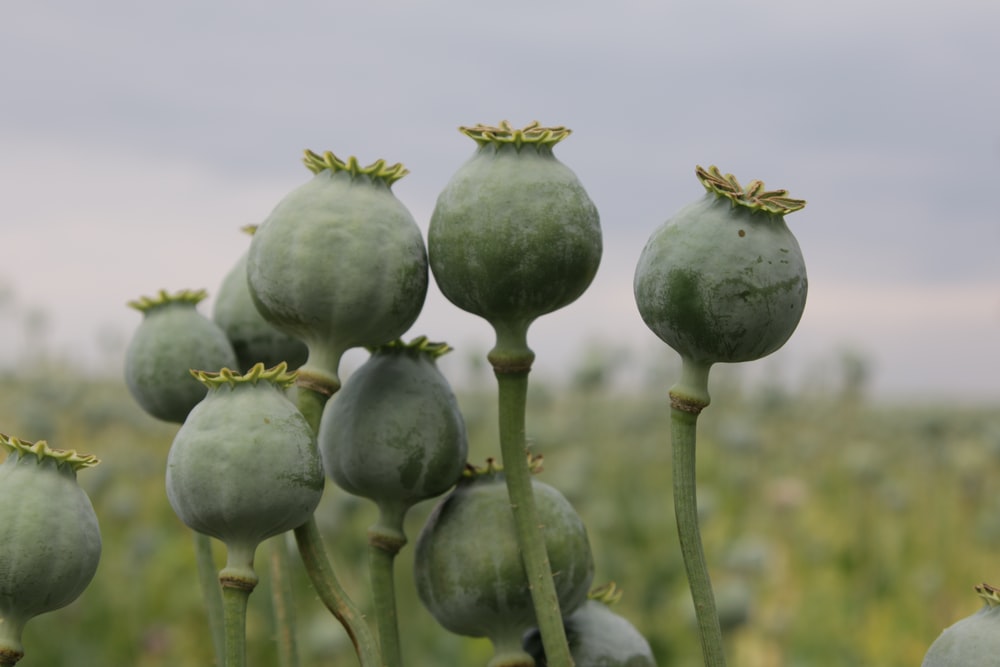
This is the same reason she was associated with opium poppies...Because opium poppies harvest in Ancient Greece started in Apr/May, at the same time when grain harvest started...


I talked about Demeter and poppies in my posts "Poppies and pomegranates", "Kubaba with grain and poppies", "Demeter riding a panther"...

As I said, snakes and opium poppies are animal and plant calendar markers for Apr/May, the beginning of the grain harvest season in Eastern Mediterranean - Levant - Mesopotamia - Iran area...

I believe that turtle doves are also such calendar marker.

This is European Turtle Dove. Beautiful bird...

Despite its name it is actually native to both Europe and Western Asia...

Now remember, animal calendar markers are ancient calendar markers derived from the annual mating (most often) or birthing or migrating or hibernating habits of the animal in question...

The breeding season of European turtle doves starts in Apr and lasts until Sep. So it overlaps with the grain harvest season in Europe and Western Asia...Which is why, I think, this bird is associated with Demeter...Goddess of grain harvest...

By the way, doves were also associated with Inanna/Ishtar...Who was also associated with grain...

Now in Iraq, apart from European Turtle Dove, we also find Eurasian Collared Dove...

In Iraq, in it's native range, turtle dove nests between Apr and Aug... Again overlapping with the grain harvest season in Mesopotamia...

So both most common Mesopotamian dove types start their nesting at the beginning of the grain harvest in Mesopotamia...Which is why, I think, dove was Inanna's bird. I will write another article specifically about Inanna/Ishtar and doves...Tonight I will stope here. Time for bed 🙂

To read more about ancient animal and plant calendar markers, start here…then check the rest of the blog posts related to animal calendar markers I still didn't add to this page, and finally check my twitter threads I still didn't convert to blog post...I am 9 months behind now...

Friday, 15 July 2022

Kubaba with grain and poppies

Very interesting: A drawing of a relief from the great staircase from the Luwian city of Carchemish. It depicts the storm god Tarhunt, holding an axe and vajra (lightning trident), leading the earth goddess Kubaba, holding grain and poppies...🙂 Sounds familiar?

The drawing is from this great article: "Building Inscriptions of Carchemish: The Long Wall of Sculpture and Great Staircase" by J. D. Hawkins

So why is this drawing interesting?

Here's Demeter holding grain and poppies

The reason why Kubaba and Demeter hold grain and poppies is that in Europe and Middle East, opium poppies harvest coincides with the beginning of the grain harvest...I talked about poppies harvest and poppies as a plant calendar marker in my article "Poppies"... 

Now check these articles about Demeter and Middle Eastern grain goddesses: "Demeter riding a panther", "Fertility goddess with poppies", "Sacred marriage on a threshing floor", "Jerusalem of gold"...Then have a look at this: 

The grain goddess follows the storm god...Why? Because in the area where Carchemish is located, without rain, the land ends up looking like this...No grains (or poppies)...


This is the climatic year in the area of Carchemish. You can see that the year is clearly divided into hot/dry half and and cool/wet half...


The hottest and driest part of the year is the end of Jul beginning of Aug. Leo...The time of death...Ruled by the god of death...Mot...Nergal...Another name for the destructive burning sun...I talked about this in my post "The oldest Arabic poem"...

The hottest, driest part of the year is marked by the lion animal calendar marker...Leo...The reason for this is that this is when the Eurasian lions main mating season starts...


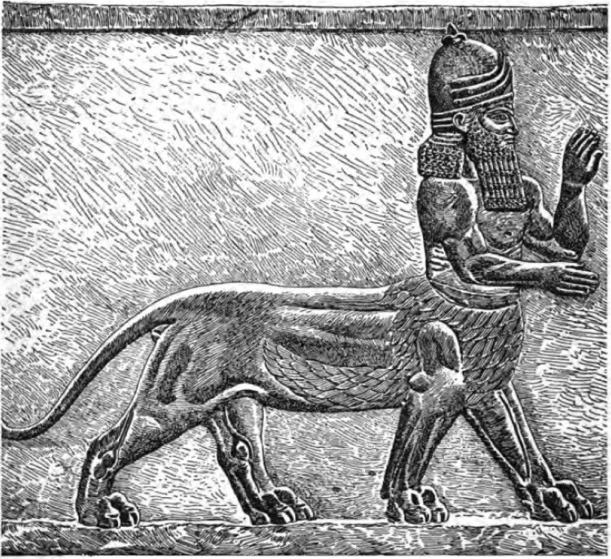
Which is why Nergal, the deified destructive burning sun, was depicted as a lion (man)...I talked about this in my post "Winged superhuman hero"...

This is the reason why in Carchemish we also find this relief depicting the above mentioned storm god killing a lion. The image is from this great article "Carchemish ša kišad puratti" by Irene J. Winter 

The other guy helping the storm god is probably the local king, not another god...The role which later became the main role of local kings, who were "(storm) god's incarnation on earth"...I talked about this in my post "The king killing Angra Mainyu"...


Hope you enjoyed this...

To read more about ancient animal and plant calendar markers, start here…then check the rest of the blog posts related to animal calendar markers I still didn't add to this page, and finally check my twitter threads I still didn't convert to blog post...I am 9 months behind now...

Thursday, 16 June 2022

Fertility goddess with poppies

Akkadian seal, currently in the University of Chicago


Official description: "Sun god in a boat. On prow long-haired crowned figure with punting pole and human-headed lion, snake's head for stern, plow, vase and two objects above, fertility goddess beside boat, fish below"...

That's it??? Of course not...I wrote a whole article about what is actually depicted on this super interesting seal: "Sun god in a boat". But I missed few bits, which is why I am writing this article today...

In a nutshell, this is a complex calendar marker, which depicts beginning of summer (Apr/May), just after the grain and poppy harvest. This is symbolised by the goddess, with grains growing out of her body, holding poppies, standing behind the boat and waving it goodbye...

This girl is the same as this girl...Corinth plate with Demeter...Demeter is holding a torch in her right hand, symbolising winter. I love the fact that in her left hand she is holding grain and poppies, symbolising summer...Man can't live on bread alone. He needs drugs too :) 

Kind of important, right?

I talked about this link between grain goddesses and poppies in my posts "Demeter riding a panther"...

About torches...Check my articles "Abduction of Persephone", "Woman with torches and swans", "Thyrsus"...

I identified the seated figure holding the rudder and steering the boat as Shamash/Utu, the sun god...You can see this from the sun/heat rays coming out of his shoulders...

Sun god which rules summer, the dry, hot half of the year (Apr/May - Oct/Nov). I talked about him in my posts "Shamash young and old", "Canals", "When Utu steps up into heaven"...

On the above seal, Shamash is standing in a dry irrigation canal bed "between lions", meaning in Leo (Jul/Aug), the hottest and driest part of the year in Mesopotamia...


This part of the year is marked by a lion, because this is when Eurasian lions mating season starts...


So in my original post about the "Sun god in a boat" Akkadian seal, I proposed that the lion is in the boat, because the boat is sailing from the beginning of the Mesopotamian summer (harvest, Apr/May) to the middle of the Mesopotamian summer (Jul/Aug), Leo...

But somehow I completely missed the implications of the fact that the lion has a human head...

This is not an ordinary lion...This is Nergal, the god of death, who rules the hottest and driest part of the year...The Bad Shamash...The deadly sun in Leo, which brings drought and death. I talked about him in my post "Winged superhuman hero"...

So there are actually 3 gods in the boat

So we have Shamash steering the boat of summer towards the hottest part with Nergal hitching a lift towards Leo...So the third god. In my original post I completely ignored the "long-haired crowned figure with punting pole standing on the prow". Didn't know what to make of him...


Until recently, when I came across stories about Enki, the god of fresh water and the good of the annual flood of Tigris and Euphrates and his little boat...I wrote few articles about this: "Goatfish", "Enki's little boat", "Rain and flood"...


The above seal shows Enki in a boat, which represents the annual flood. The flood starts in (Apr/May), the time of the peak water levels in Tigris (left) and Euphrates (right)...And the grain harvest time. See the grain sheaf on the right of the boat?

By the way this part of the year (Apr/May) is marked by a bull, Taurus, Because this is the beginning of the calving season of wild Eurasian cattle. I talked about this in my post "Ram and bull", "Cow and calf ivory"


It's the snowmelt in the Anatolian and Zagros mountains, caused by the sun (Shamash/Utu) that releases the flood waters (Enki/Ea) which cause the flood during the calving season of Aurochs...Hence Both Shamash and Enki being linked to bulls...I talked about this in my post "Butt chewing"...


On the above relief you can see Triumphant Shamash, as a bull, in Taurus, which marks the beginning of the flood, Climbing up the mountain, to melt the snow and release Enki, the flood...His butt is being chewed by a winged lion though...Leo, which marks the end of the flood...


Back to Enki's boat, which represents the summer flood. 

On one side is grain (Apr/May). On the other side of the summer flood (Jul/Aug) is a star...Any random star? Of course not...

Sirius, rising before the sun, pretending to be "the morning star"... Otherwise known as Inanna/Ishtar "The queen of heaven"...The one that poses on the lion...In Leo...Girl which has some serious "conflicts of interest" with Nergal, Shamash, Sun in Leo...I talked about this in my post "Ninshubur", "Sacred marriage on a threshing floor"...

So, who is this guy? 

He is Enki depicted as being the flood boat...

BTW, do you see the fish underneath the boat? Check my post about "Goatfish", which explains why the annual flood was in Sumer known as "Carp flood"...And why fish always swims around Enki...

So that't it...Few bits which fell into place since I wrote the original article...

Hope you enjoyed this...

To read more about ancient animal and plant calendar markers, start here…Then check my twitter threads I still didn't convert to blog post...I am way way behind...