Showing posts with label Harvest goddess. Show all posts

Sunday, 7 September 2025

7 maidens

Recently I watched a tv program called "The Silk Roads - Wonders of Azerbaijan" by Bettany Hughes. In it she talked about this ancient petroglyph from Gobustan, which, if I remember correctly, she called "7 maidens"...

Unfortunately I can only find this copy of this program online in, I guess, Azerbaijani, so I can't confirm this myself. If anyone has access to the English version, I would really appreciate if you cold confirm this for me. Thanks. Or alternatively, I would rally appreciate if @bettanyhughes could confirm that this is indeed what she called the petroglyph in question. And if she could clarify if this was a nickname given to the petroglyph by the local archaeologists, or was it her own poetic invention ๐Ÿ™‚

The reason why I ask is that on the highlighted image from the program, I could only see 6 figures, not 7. Is there a 7th figure that wasn't highlighted, or that is not visible from the angle from which the petroglyph was filmed?

Why I would like to determine if there are indeed "7 maidens" depicted on this petroglyph, is because in the program, Bettany proceeded to talk about how "the meaning of the petroglyph is unknown".

Now if there are indeed 7 female figures depicted on this petroglyph (I guess we think they are females because of the public triangles ???, but they could just be as easily men wearing some kind of weird loincloths), then maybe I could offer a possible explanation...

Is this a bovine, depicted behind the human figures? It certainly looks like one. If so, then the meaning of the "7 maidens" petroglyph could be the "7 sisters", the Pleiades, which rise with the sun in Apr/May...

Apr/May, when wild Eurasian cattle start to calve...


Which is why this time of the year is is still marked with a bovine, Taurus...

I talked about this animal calendar marker in many of my posts, for instance "Cow and calf ivory", "Foundation peg of the goddess Nanshe", "Elamite water bull", "Human bull hybrid", "White calf", "Calydonian boar"...

According to this paper, "Agricultural Practices at Mentesh Tepe (Kura Valley, Azerbaijan) during the Neolithic, Chalcolithic and Bronze Age: An Overview from Sickle Elements and Botanical Remains", the main Neolithic, Bronze Age crop grown in Azerbaijan was barley, which was sown in the Oct/Nov, and harvested in May/Jun...Using sickles with composite stone blades...

Basically small sharp stone flakes, inserted into crescent shaped wooden frame...Something like this.

These sickles evolved from wild ass, deer jaw bones. 

We know that some primitive jaw bone sickles actually had long handles.


The sickles then evolved into wild ass, deer jawbones with artificial flint teeth

Then into artificial wooden jawbones with artificial flint teeth

And finally into serrated (toothed) jawbone shaped piece of metal...

I talked about the evolution of sickles in my post "Sickle"...

So it is quite possible that the things held by the figures are long handle sickles...Or maybe what is depicted on this rock engraving from Azerbaijan is something like this: Cain (farmer) killing Abel (shepherd) with a "ass jawbone", [my comment: the earliest form of a sickle]. 

New York, Pierpont Morgan Library: Ms 43, Huntingfield Psalter, XII Century, fol. 8. Pic from "Cain's Jaw-Bone that Did the First Murder"

Taking all this into account, is this image a calendar marker for harvest your barley when wild cattle starts to calve and Pleiades rise with the sun? I talked about Pleiades, barley harvest and animal calendar markers in my post "Pleiades". In it, explained why, according to the Greek mythology, the Pleiades, the seven daughters of Atlas, were transformed by Zeus first into doves, and only then into stars...


It's all to do with the link between doves and grain harvest (goddess)...Like Demeter, who was depicted on this terracotta statuette enthroned with a turtle-dove on her lap. The cult image of the harvest goddess was likely venerated in a sanctuary. From Sicily, 5th century BC. Milan Archaeological Museum. Pic by Gareth Harney


I explained this link in my posts "Demeter and dove" and "Cup of Nestor"...

This link between grain goddess and doves also existed in Mesopotamia, where Inanna was also linked with doves. 1800-1600 BC pottery cup, Syria. The rounded body tapering to a flat base, with 26 bird heads. Similar objects were interpreted as votive objects dedicated to Ishtar/Inanna. 

I talked about this in my post "Inanna and dove"... 

The reason why doves are linked with grain goddesses and with pleiades is because doves, both European and Asian, nest during the grain harvest which starts in Apr/May, when pleiades rise with the sun, in Taurus...


But maybe there are no 7 but indeed only 6 figures depicted on this petroglyph, and they are not female but male figures with (admittedly weird) loin cloths, and these are not sickles they are holding but battle axes...

In which case this is just a depiction of a bovine hunt ๐Ÿ™‚

To read more about ancient animal and plant calendar markers, start here…Then check my twitter threads I still didn't convert to blog post...I am way way behind...

Saturday, 29 June 2024

A person in a little boat

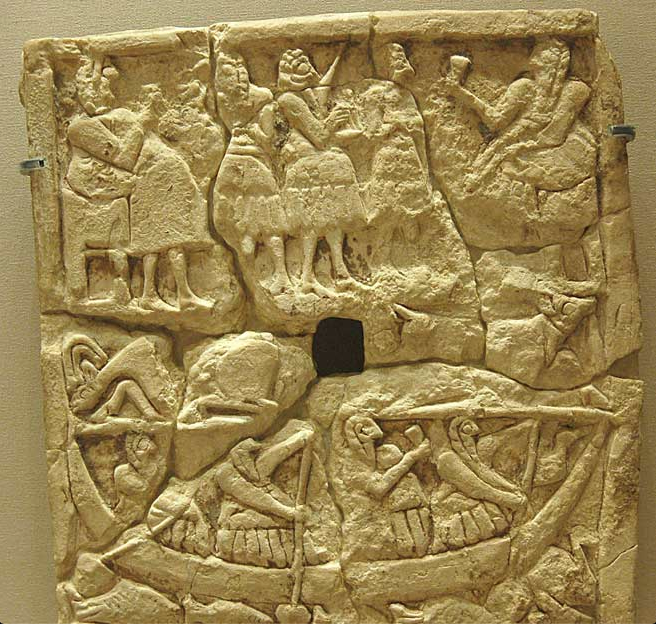
Proto-Elamite tablet, Iran 3400-3100 BCE...Interestingly, the other side depicts "A person in a little boat" with a giant fish swimming underneath...Pic by Osama Shukir Muhammed Amin.

Soooo what is depicted on this tablet?

Well, this must have been something important, cause there is another tablet with the same scene imprinted on it...Pic by Jacob L. Dahl

First a thought that the "person" is Enki (or his local equivalent), the god of fresh water, and annual flood, in his little boat, the symbol of the annual flood of the rivers in Mesopotamia and Iran. I talked about it in my post "Feast plaque from Louvre"...


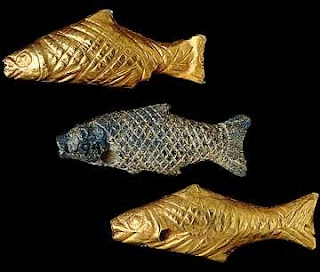
This would tie with the giant fish, which would then be a giant Mesopotamian carp, which swims upstream during the annual flood to its spawning grounds in the upper reaches of Tigris and Euphrates and their tributaries...


I talked about this in my post "Apkallu"...

But something was funny about the "person" in the boat. The position of the arms is commonly seen on mother goddesses squeezing their breasts. Like this Elamite one from the 2nd millennium BC from Met Museum...

Also, is this a "pregnant" belly? So could this "person" in the boat be a female? And what is that sticking out of the person's butt (sorry back ๐Ÿ™‚)? Is this symbol for grain? This thing

So how does this "grain goddess" fit into the "boat floating on the carp flood"? Well this is the water level chart in Tigris and Euphrates system...The water level peaks in Apr/May...

And this is Mesopotamian grain harvest calendar...


This is Inanna/Ishtar speaking: 


"...Before my lord, Dumuzi,

I poured out plants from my womb.

I placed plants before him,

I poured out plants before him.

I placed grain before him,

I poured out grain before him,

I poured out grain before my womb..."


I talked about this in my article "Mother of grain"...

BTW, every year during the harvest, a man and a woman performed ritual sexual act on a threshing floor, imitating Inanna (earth, womb) and Enki (sweet water, seed) consummating their holy marriage. I talked about this in my article "Sacred marriage on the threshing floor"...

Soooo...Is this Inanna (or some local equivalent) arriving in Enki's little boat floating on the waters of the "carp flood"? I would love to know what is written on this tablet...Do we know how to read Proto-Elamite script?

That's it. To read more about ancient animal and plant calendar markers, start here…then check the rest of the blog posts related to animal calendar markers I still didn't add to this page, and finally check my twitter threads I still didn't convert to blog post...I am 9 months behind now...

Wednesday, 22 February 2023

Demeter with dove

Terracotta statuette of Demeter enthroned with a turtle-dove. The cult image of the harvest goddess was likely venerated in a sanctuary. From Sicily, 5th century BC. Milan Archaeological Museum. Pic by Gareth Harney


Demeter was Olympian goddess of grain harvest...Why was the goddess of harvest associated with turtle doves? I would like to answer this question in this article...

Well I think that Demeter was associated with turtle doves for the same reason she was associated with snakes...Because the grain harvest season in Ancient Greece started in Apr/May, when the most common Eurasian snakes start to mate...

I talked about Demeter and snakes in my posts "Who are Persephone's parents" and "Demeter riding a panther"...

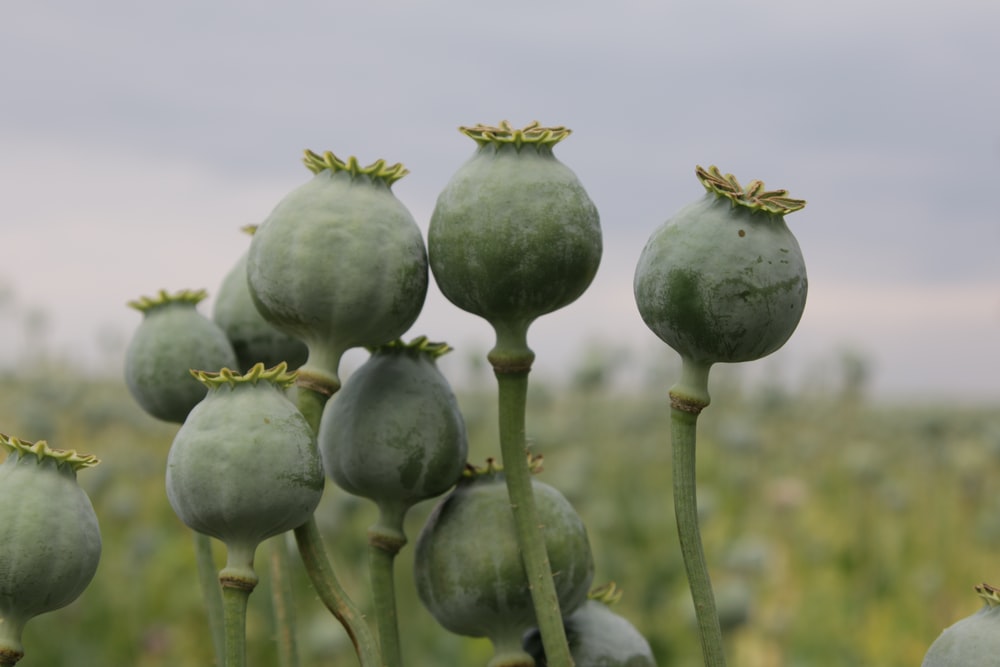
This is the same reason she was associated with opium poppies...Because opium poppies harvest in Ancient Greece started in Apr/May, at the same time when grain harvest started...


I talked about Demeter and poppies in my posts "Poppies and pomegranates", "Kubaba with grain and poppies", "Demeter riding a panther"...

As I said, snakes and opium poppies are animal and plant calendar markers for Apr/May, the beginning of the grain harvest season in Eastern Mediterranean - Levant - Mesopotamia - Iran area...

I believe that turtle doves are also such calendar marker.

This is European Turtle Dove. Beautiful bird...

Despite its name it is actually native to both Europe and Western Asia...

Now remember, animal calendar markers are ancient calendar markers derived from the annual mating (most often) or birthing or migrating or hibernating habits of the animal in question...

The breeding season of European turtle doves starts in Apr and lasts until Sep. So it overlaps with the grain harvest season in Europe and Western Asia...Which is why, I think, this bird is associated with Demeter...Goddess of grain harvest...

By the way, doves were also associated with Inanna/Ishtar...Who was also associated with grain...

Now in Iraq, apart from European Turtle Dove, we also find Eurasian Collared Dove...

In Iraq, in it's native range, turtle dove nests between Apr and Aug... Again overlapping with the grain harvest season in Mesopotamia...

So both most common Mesopotamian dove types start their nesting at the beginning of the grain harvest in Mesopotamia...Which is why, I think, dove was Inanna's bird. I will write another article specifically about Inanna/Ishtar and doves...Tonight I will stope here. Time for bed ๐Ÿ™‚

To read more about ancient animal and plant calendar markers, start here…then check the rest of the blog posts related to animal calendar markers I still didn't add to this page, and finally check my twitter threads I still didn't convert to blog post...I am 9 months behind now...