Find a ripe acorn and separate cap from the seed.

Hold the cap between both thumbs and both pointer (index) fingers, as shown below. Make the "Y" shape with your thumbs and position them to show only the small, top, triangular section of the acorn.

Constrict your lips a little and blow hard, just as if you were blowing out a candle that was 3 feet away from you. The knuckles of your thumbs will rest right in between your lips. The thumb knuckles won't get past your lips into your mouth, though, because your lips are pursed.

Or you can do it like this with a single hand:
Get an acorn cap

Put it between your pointer and middle finger like this

Squeeze you hand in a fist like this

Put the pointer and middle finger knuckles into your mouth and blow like this

When you get it, you'll know it. You will hear a shrill whistle.

However skilful musicians can produce many different notes even with a single flute tube. These are called overtone flutes.

Here is Michal Smetanka, a famous Slovak musician playing traditional flute music from the Carpathian mountains (notably regions of Spis and Saris in Slovakia) using a flute with no holes. This is the most primitive flute there is, basically a hollow stick or reed or bone that you blow into

Now there is an easier way to produce multiple notes with a single flute tube. You bore several (up to 8) holes into the flute tube. When you cover them all with the tips of your fingers, you have again the full tube length as a sound generator. As you lift up different fingers you change the length of the tube which acts as the sound generator and you also change the flow of air through flute tube, resulting in the production of different notes.

Here is great Serbia flute player Vitomir Stanojević playing traditional music from Serbia using flute with holes.

Now all of these flutes are made either from reads or from wood. These are extremely perishable materials and it is no surprise that we didn't find any really old wooden or reed flutes. Maybe people have been making wooden or reed flutes for hundreds of thousands of years, but we will never know that.
However there is another material that people have been making flutes from which is a lot more durable: bone. So how do you make a flute from a bone? This is a cross section of a long bone from a leg, arm or wing.

To make a bone flute from a bone you need to roast or cook the bone, then you need to brake or cut off the solid bone ends (Proximal epiphysis and Metaphysis). This will leave the middle hollow part of the bone (Deaphysis).

Basically what you have is a bone flute tube. That is when you suck out all the bone marrow. Which is why people have been cooking and breaking bones since at least the Palaeolithic.
Bone marrow is delicious. And it is also highly nutritious, full of good fats and proteins and packed with energy. 100 grams of bone marrow has over 700 calories. So if you were Palaeolithic hunter gatherer you were definitely not going to waste such delicious and calorific treat...
By the way, marrow isn’t just delicious and nutritious, it’s healthy, too. According to an article that appeared few years ago in the online issue of Cell Metabolism, University of Michigan researchers concluded that the fat tissue that makes bone marrow so tasty is a significant source of adiponectin, a hormone that helps maintain insulin sensitivity, break down fat and has been linked to a decreased risk of cardiovascular disease, diabetes and obesity-associated cancers. Also proteins contained inside the bone marrow are the best thing you can eat if you are recovering from bone and cartilage injuries...
So once you have eaten all the bone marrow and you have you bone tube all nice and clean you have yourself a flute. Remember flute does not have to have holes. All you need to do is blow over one end under the correct angle and you will make a sound.
But who was the guy who first blew into a bone tube? And why? He definitely didn't look at the bone tube and said: "you know what, I am going to blow into this thing to make a sound". What I think happened is this:
Mister Joe Neanderthal or mister Jim Homo sapiens was happily sucking on his bone full of yummy marrow. He has already sucked out most of it, but there was still some left at the bottom. He was about to start poking through the bone with a stick, when the stupid greasy thing slipped our of his hand and fell on the dusty (or sooty) ground. So what did Joe or Jim do? He was not going to just throw half eaten bone away and he was certainly not going to stuff it in his mouth covered in dust or soot. No he picked the bone and blew over the top to get the dirt off. And most of the time nothing spectacular happened. Except the dirt was blown off. But once, when he blew over the bone top under the angle that was just right a sound came out.
Heads exploding and such stuff...
How long was it before everyone wanted to do the same? Entertainment was crap at those days, so a bone that makes a sound must have been viewed as something special. And soon when Joe, Mick and Mark Neanderthal (or Homo sapiens) all had their own sound making bones, and blew them all together they realised that they are all making different sounds. I don't know how long it took for someone to figure out that the longer the bone the deeper the sound, but that is not really important here...
Anyway once you have you sound making bone tube, otherwise known as flute, all you need to do to make a flute with holes is to drill few holes in it and hay presto. If you are interested in making bone flute yourself, have a look at excellent tutorial by Andy J. Letke which explains in detail how to make a bone flute from a turkey leg bone. Here is the final product:

Now we know that people have been making bone flutes for a very very long time.
This one is from the 18th century and was found during the excavations at Konserthusparken in Linköping, a city in southern Sweden.

This is a deer bone flute from Keynsham Abbey dated to 1344 - 1351

This is a crane ulna flute from Wicken Bonhunt dated 1100 – 1150

This is a crane ulna flute from Lincoln dated 930 - 940

You can read more about medieval from England in these two papers:
"English Medieval Bone Flutes c.450 to c.1550 AD" by Helen Leaf
This is the so called Malham Pipe, a musical instrument formed from the tibia of a sheep originally thought to be Iron Age but now thought to be post-Roman (Anglo-Saxon) in origin.

These are two ancient Roman bone flutes with six finger holes, Museum het Valkhof, Nijmegen

These are bone flutes from Laconia, Artemis Orthia Sanctuary, dated to the second half of 7th century BC

This is a bone flute found in Samtavro Bronze Age warrior grave, Georgia, dated to the 11th - 12th c. BC

A small bone flute (whistle) probably made of an animal’s long bone, was discovered at the acropolis of Sesklo, Thessaly, Greece. It was dated to the 6th millennium BC. Information from: "Flutes of the first European farmers" by Beate-Maria Pomberger, Nadezhda Kotova & Peter Stadler

Also three bone flutes were found in the Dispilo Neolithic settlement in Greece dated to 5th millennium BC. I want to thank Michel Dreher for sending me this pic of the two of these flutes from the site catalogue. The bigger one was made from a human bone :)

These are two out of 22 bone flutes from Isturitz, French Pyrenees, most from later Upper Palaeolithic proveniences, circa 30,000 - 10,000 years BP.

Then there is this one, until recently known as "the oldest-known musical instrument fashioned by human hands". It's a delicate flute made from the wing bone of a vulture that was dated to 35,000 BC. The team of archaeologists discovered the flute littered among a trove of early-human loot at a mountain cave called Hohle Fels in southwest Germany, just north of the Danube valley.

The flute which replaced the Hohle Fels flute as "the oldest-known musical instrument fashioned by human hands" is this one. This is one of the several bone flutes found in Geißenklösterle cave also in the Danube valley. Originally it was thought that these flutes are about 35,000 years old, but recent re-dating revealed them to be far older, with an age of 42,000 to 43,000 years.

Now this is exactly the time when, it is believed, Homo sapiens, entered Europe walking up the Danube valley. There they found Neanderthals and for a long time lived in the same area with them. The archaeologists say that all these flutes were found in caves with only Homo sapiens and not Neanderthal artefacts and remains.
These Palaeolithic flutes dated to the early period of the Homo sapiens settlement in Europe have been used as a proof that Modern Humans were much more "human" than Neanderthals. Because everyone knows that music is one of the most refined things that Homo sapiens, and only Homo sapiens, are capable of producing.
Interestingly it is the cultured higher human, Homo sapiens, who made musical instruments and obviously enjoyed music, who wiped out the uncultured lower human, Neanderthal, probably between two music sessions...
There are several problems with this story.
Many archaeologists think the story is probably more complicated than that because, they argue, the art and musical instruments that appeared in Europe around 40,000 years ago are so sophisticated that they must have evolved out of earlier musical and artistic traditions.
So big questions is: where are the earlier, more primitive flutes that must have predated the sophisticated examples from Danube valley caves?
Well there is one earlier, more primitive example, but it is not found in a cave inhabited by "cultured, sophisticated higher human" Homo sapiens.
This is it:

This 43,000 years old bone flute was found in a Divje Babe cave in Slovenia where only Neanderthal remains and artefacts were found. The flute is made out of a cave bear femur that was pierced with spaced holes. Archaeologists who discovered the flute, and many other, suggested the holes were man made and that there may have been four originally before the item was damaged. Two of middle holes are still intact and what looks like remains of two more holes can still be seen on either end.
But not everyone thinks that this a flute. Other archaeologists have argued that the holes are the result of the bone fragment having been chewed by an animal rather than by human design.
The debate (fight) is still raging. It’s a debate that highlights some of the difficulties in identifying early musical instruments. For one thing, they may not have been made entirely from scratch but from materials that, through natural processes, were suitable for making music.
Now remember the acorn cup whistles? Is an acorn cup whistle a musical instrument? It is. Is it made by a man? No. The invention of the acorn cup musical instrument consisted of the process of recognising how to use this naturally occurring object to produce sound.
Knowing this, let's say that the holes on this bone were indeed made by a hyena and not by a Neanderthal. Does this mean that this bone was not used as a flute? We can't say. It could have been. We know that flute does not have to have holes. A flute is a tube which produces sound from the flow of air across an opening.
 We have no idea for how long have Homo sapiens and possibly Neanderthals been making music by blowing into reads and bone tubes with no holes.
Even bigger question is how did they get idea to start boring holes in these bone tubes in the first place. This is not something that could have been deduced by either of these humans.
My guess is that one day, one of them, maybe even a Neanderthal from the Divje babe cave, came across a dried hollow bone with few holes in it made by a hyena. And maybe, he could not resist to blow across the bone opening because he already had a bone flute with no holes. And maybe he then fiddled a bit with the holes on the side of the bone tube putting his fingers over them and moving them away causing the sound to change.
The realisation that something really important was going on must have been instant: "If I have a bone tube with holes on its side, and I blow into it, and I close and open the holes with my fingers, I get to make a lot more sounds"!!!
Get an acorn cap

Put it between your pointer and middle finger like this

Squeeze you hand in a fist like this

Put the pointer and middle finger knuckles into your mouth and blow like this

When you get it, you'll know it. You will hear a shrill whistle.
How did the first person figured out that this will produce a whistling sound? How did he get the idea to even try this is beyond me. But he did. What he did not do was make the whistle. He just picked an acorn cup, fiddled with it for a bit, and decided to blow on it to see what happens...And an acorn cup whistle was born.
Could we say that that person invented an acorn cup whistle even though he didn't make it?
Why am I asking this questions?
Because there is currently a debate raging in archaeological community about who invented the first flute. And it is completely concentrated around the question who made the first flute as if making a flute and inventing a flute is the same thing. But as we have just seen making a musical instrument and inventing a musical instrument can be two completely different things...
The first flute
In its most basic form, a flute is an open tube which is blown into. There are several broad classes of flutes. With most flutes, the musician blows directly across the edge of the mouthpiece, with 1/4 of their bottom lip covering the embouchure hole. The vibration of the air column inside the flute tube produced the sound. The longer the flute tube the deeper the note. If you want to produce two different notes, cut two flute tubes of different length. Put several of these flute tubes of different length together and you get pan flute.

However skilful musicians can produce many different notes even with a single flute tube. These are called overtone flutes.

Here is Michal Smetanka, a famous Slovak musician playing traditional flute music from the Carpathian mountains (notably regions of Spis and Saris in Slovakia) using a flute with no holes. This is the most primitive flute there is, basically a hollow stick or reed or bone that you blow into

Now there is an easier way to produce multiple notes with a single flute tube. You bore several (up to 8) holes into the flute tube. When you cover them all with the tips of your fingers, you have again the full tube length as a sound generator. As you lift up different fingers you change the length of the tube which acts as the sound generator and you also change the flow of air through flute tube, resulting in the production of different notes.
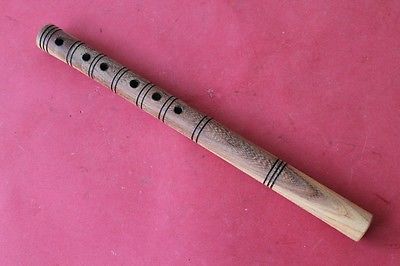
Here is great Serbia flute player Vitomir Stanojević playing traditional music from Serbia using flute with holes.

Now all of these flutes are made either from reads or from wood. These are extremely perishable materials and it is no surprise that we didn't find any really old wooden or reed flutes. Maybe people have been making wooden or reed flutes for hundreds of thousands of years, but we will never know that.
However there is another material that people have been making flutes from which is a lot more durable: bone. So how do you make a flute from a bone? This is a cross section of a long bone from a leg, arm or wing.

To make a bone flute from a bone you need to roast or cook the bone, then you need to brake or cut off the solid bone ends (Proximal epiphysis and Metaphysis). This will leave the middle hollow part of the bone (Deaphysis).

Basically what you have is a bone flute tube. That is when you suck out all the bone marrow. Which is why people have been cooking and breaking bones since at least the Palaeolithic.
Bone marrow is delicious. And it is also highly nutritious, full of good fats and proteins and packed with energy. 100 grams of bone marrow has over 700 calories. So if you were Palaeolithic hunter gatherer you were definitely not going to waste such delicious and calorific treat...
So how to eat bone marrow?
Well you can roast the bones over fire then break them and suck the bone marrow out. You can see how to do this in this great video "Eating bone marrow like a caveman in the forest" from The Wooded Beardsman.
Get a bone

Place it on fire and leave it there to roast

Then get an axe and cut one end off

Or just break the bone in half using a stone

Get a stick and poke the bone marrow to dislodge it

Then suck it out

Get a bone

Place it on fire and leave it there to roast

Then get an axe and cut one end off

Or just break the bone in half using a stone

Get a stick and poke the bone marrow to dislodge it

Then suck it out

Or you can cut bones in bits and boil them to make a delicious soup.

Some people think that the first pots were invented so that people could cook bone marrow soups...

Some people think that the first pots were invented so that people could cook bone marrow soups...
By the way, marrow isn’t just delicious and nutritious, it’s healthy, too. According to an article that appeared few years ago in the online issue of Cell Metabolism, University of Michigan researchers concluded that the fat tissue that makes bone marrow so tasty is a significant source of adiponectin, a hormone that helps maintain insulin sensitivity, break down fat and has been linked to a decreased risk of cardiovascular disease, diabetes and obesity-associated cancers. Also proteins contained inside the bone marrow are the best thing you can eat if you are recovering from bone and cartilage injuries...
So once you have eaten all the bone marrow and you have you bone tube all nice and clean you have yourself a flute. Remember flute does not have to have holes. All you need to do is blow over one end under the correct angle and you will make a sound.
But who was the guy who first blew into a bone tube? And why? He definitely didn't look at the bone tube and said: "you know what, I am going to blow into this thing to make a sound". What I think happened is this:
Mister Joe Neanderthal or mister Jim Homo sapiens was happily sucking on his bone full of yummy marrow. He has already sucked out most of it, but there was still some left at the bottom. He was about to start poking through the bone with a stick, when the stupid greasy thing slipped our of his hand and fell on the dusty (or sooty) ground. So what did Joe or Jim do? He was not going to just throw half eaten bone away and he was certainly not going to stuff it in his mouth covered in dust or soot. No he picked the bone and blew over the top to get the dirt off. And most of the time nothing spectacular happened. Except the dirt was blown off. But once, when he blew over the bone top under the angle that was just right a sound came out.
Heads exploding and such stuff...
How long was it before everyone wanted to do the same? Entertainment was crap at those days, so a bone that makes a sound must have been viewed as something special. And soon when Joe, Mick and Mark Neanderthal (or Homo sapiens) all had their own sound making bones, and blew them all together they realised that they are all making different sounds. I don't know how long it took for someone to figure out that the longer the bone the deeper the sound, but that is not really important here...
Anyway once you have you sound making bone tube, otherwise known as flute, all you need to do to make a flute with holes is to drill few holes in it and hay presto. If you are interested in making bone flute yourself, have a look at excellent tutorial by Andy J. Letke which explains in detail how to make a bone flute from a turkey leg bone. Here is the final product:

Now we know that people have been making bone flutes for a very very long time.
This one is from the 18th century and was found during the excavations at Konserthusparken in Linköping, a city in southern Sweden.

This is a deer bone flute from Keynsham Abbey dated to 1344 - 1351

This is a crane ulna flute from Wicken Bonhunt dated 1100 – 1150

This is a crane ulna flute from Lincoln dated 930 - 940

"English Medieval Bone Flutes c.450 to c.1550 AD" by Helen Leaf
This is the so called Malham Pipe, a musical instrument formed from the tibia of a sheep originally thought to be Iron Age but now thought to be post-Roman (Anglo-Saxon) in origin.

These are two ancient Roman bone flutes with six finger holes, Museum het Valkhof, Nijmegen

These are bone flutes from Laconia, Artemis Orthia Sanctuary, dated to the second half of 7th century BC

This is a bone flute found in Samtavro Bronze Age warrior grave, Georgia, dated to the 11th - 12th c. BC

This is so called "The Flute of Veyreau", a beautifully decorated flute made of a wing bone (ulna) of a Griffon (or a Black) vulture. It was found in a burial cave in the South of France together with other artefacts and human bones from which the flute was dated by carbon isotope analysis to the end of 2nd millennium BC


A bone flute made from sheep femur was found in Severn-Cotswold tomb, a type of megalithic chamber tomb built by Neolithic people in Wales and South West England around 3500 BC. Unfortunately I don't have any picture of this flute. Information from: "Catalogue of the mesolithic and neolithic collections at the National Museums and Galleries of Wales" by Steve Burrow.
A small bone flute (whistle) probably made of an animal’s long bone, was discovered at the acropolis of Sesklo, Thessaly, Greece. It was dated to the 6th millennium BC. Information from: "Flutes of the first European farmers" by Beate-Maria Pomberger, Nadezhda Kotova & Peter Stadler

Also three bone flutes were found in the Dispilo Neolithic settlement in Greece dated to 5th millennium BC. I want to thank Michel Dreher for sending me this pic of the two of these flutes from the site catalogue. The bigger one was made from a human bone :)

These are two out of 22 bone flutes from Isturitz, French Pyrenees, most from later Upper Palaeolithic proveniences, circa 30,000 - 10,000 years BP.

Then there is this one, until recently known as "the oldest-known musical instrument fashioned by human hands". It's a delicate flute made from the wing bone of a vulture that was dated to 35,000 BC. The team of archaeologists discovered the flute littered among a trove of early-human loot at a mountain cave called Hohle Fels in southwest Germany, just north of the Danube valley.

The flute which replaced the Hohle Fels flute as "the oldest-known musical instrument fashioned by human hands" is this one. This is one of the several bone flutes found in Geißenklösterle cave also in the Danube valley. Originally it was thought that these flutes are about 35,000 years old, but recent re-dating revealed them to be far older, with an age of 42,000 to 43,000 years.

Now this is exactly the time when, it is believed, Homo sapiens, entered Europe walking up the Danube valley. There they found Neanderthals and for a long time lived in the same area with them. The archaeologists say that all these flutes were found in caves with only Homo sapiens and not Neanderthal artefacts and remains.
These Palaeolithic flutes dated to the early period of the Homo sapiens settlement in Europe have been used as a proof that Modern Humans were much more "human" than Neanderthals. Because everyone knows that music is one of the most refined things that Homo sapiens, and only Homo sapiens, are capable of producing.
Interestingly it is the cultured higher human, Homo sapiens, who made musical instruments and obviously enjoyed music, who wiped out the uncultured lower human, Neanderthal, probably between two music sessions...
There are several problems with this story.
Many archaeologists think the story is probably more complicated than that because, they argue, the art and musical instruments that appeared in Europe around 40,000 years ago are so sophisticated that they must have evolved out of earlier musical and artistic traditions.
So big questions is: where are the earlier, more primitive flutes that must have predated the sophisticated examples from Danube valley caves?
This is it:

This 43,000 years old bone flute was found in a Divje Babe cave in Slovenia where only Neanderthal remains and artefacts were found. The flute is made out of a cave bear femur that was pierced with spaced holes. Archaeologists who discovered the flute, and many other, suggested the holes were man made and that there may have been four originally before the item was damaged. Two of middle holes are still intact and what looks like remains of two more holes can still be seen on either end.
But not everyone thinks that this a flute. Other archaeologists have argued that the holes are the result of the bone fragment having been chewed by an animal rather than by human design.
The debate (fight) is still raging. It’s a debate that highlights some of the difficulties in identifying early musical instruments. For one thing, they may not have been made entirely from scratch but from materials that, through natural processes, were suitable for making music.
Now remember the acorn cup whistles? Is an acorn cup whistle a musical instrument? It is. Is it made by a man? No. The invention of the acorn cup musical instrument consisted of the process of recognising how to use this naturally occurring object to produce sound.

Even bigger question is how did they get idea to start boring holes in these bone tubes in the first place. This is not something that could have been deduced by either of these humans.
My guess is that one day, one of them, maybe even a Neanderthal from the Divje babe cave, came across a dried hollow bone with few holes in it made by a hyena. And maybe, he could not resist to blow across the bone opening because he already had a bone flute with no holes. And maybe he then fiddled a bit with the holes on the side of the bone tube putting his fingers over them and moving them away causing the sound to change.
The realisation that something really important was going on must have been instant: "If I have a bone tube with holes on its side, and I blow into it, and I close and open the holes with my fingers, I get to make a lot more sounds"!!!
That Homo sapiens or Neanderthal just invented a bone flute with finger holes. He didn't make it. He invented it. He discovered how to use accidentally punctured bone tube as flute with holes.
Maybe that first bone flute with holes was the very one found in Divje babe cave. Maybe not. Maybe it was some other one which is now lost, or which is yet be found in some Neanderthal or Homo sapiens cave.
Now I believe that this first bone flute must have been a sensation. It was for one the only one of its kind, so it must have been sort of a status symbol. And I would bet that the word soon spread that Joe Neanderthal or Jim Homo sapiens had this magic flute with holes.
So I wonder how long did it take before someone decided to get a bone tube with no holes and then drill one or two or three or even more holes into it to see what happens.
Now I have a bone flute with holes too! Ho! Ho! Ho!
And maybe the man who first blew into a punctured bone tube was Neanderthal and the man who first made his own punctured bone tube was Homo sapiens? Or maybe they were both Neanderthals or both Homo sapiens? We will never know.
The rest is history of gradual improvement of flute as a musical instrument.
The rest is history of gradual improvement of flute as a musical instrument.
But who made the first flute?
The hyena who bit off the ends of the bone making the bone tube which it then accidentally punctured while gnawing on it?
The man who found this dried punctured bone tube with holes and blew into it while pressing on the holes and producing variable sound?
The man who decided to make his own bone tube with holes so that he can make variable sounds too?
The man who found this dried punctured bone tube with holes and blew into it while pressing on the holes and producing variable sound?
The man who decided to make his own bone tube with holes so that he can make variable sounds too?
What do you think?


