Friday, 28 August 2015

Krkava Triglav stone


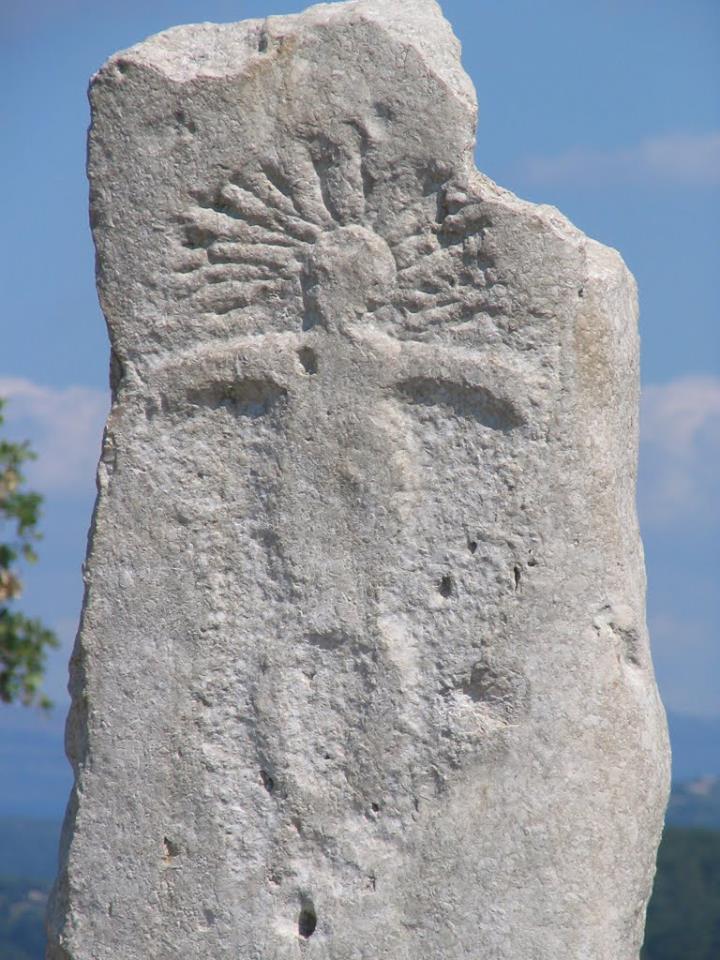
This is Krkavški Kamen (Krkava stone) also known as Triglav stone from Istria. Dating of the stone is uncertain but it is proposed that it was not built later than the 12 century and that it could be much older. It stands 400 metres southeast of the Krkavče cemetery, north of the path leading past the Gradišče field towards the Škrljevec hamlet.

The monolith is approximately 2.5 metres high and roughly hewed. Only 1.6 m still stand above ground and the upper part of the monolith is partially damaged. There is a stylised human image carved on both sides. 


It is an anthropomorphic image with widely spread arms, erect penis and with a crown of sun rays. 


In this the image from the Krkava stone resembles the "Lion man" stone from Armagh in Ireland. 


I wrote about this stone and its link with the Slavic Triglav worship in my post about Radegast.

The surface of the two images shows different treatment and the reliefs were probably made in two if not even three phases. 

The locals say that the stone once had three heads carved on its top which are now missing. Some say that it was only one head with three faces. Maybe like this one from Ireland:


This is why the stone is called Troglav, Triglav, the Three headed one. This Triglav is the the old European Trinity, Sun, Fire, Thunder, the three in one, the one which is three, the Trinity known in India as Trimurti. I wrote about Triglav worship in Serbian tradition in my post about Triglav.  

There are local legends that claim that in the field called Gradišče, which means "Fortified city" once stood a stone city and that the Triglav stone was erected by the people who built the city. Other legends say that the stone is older than the city. People say that the city was built by the king who had a golden calf...Other legends say the it was the Devil himself who lived in the old stone city and who had the golden calf. They say that the Devil went under ground to protect his gold. This is very interesting as in Serbia we also have legends of the evil king Trojan (Triglav) who lived in the old stone city on top of the mountain. Trojan, Triglav was in Serbia identified with Dabog, who later became Christian Devil.. Archaeologists have found Roman villa in the field, but there is an Illyrian fortress nearby. 

Locals say that the stone was once worshiped as holy. They say that according to the local lore, the stone is dedicated to the sun god. On the day of St. Vid people used to come to the stone to lay hands on the stone. St Vid is Christianized Slavic sun god Svetovid, who was originally celebrated on the day of the Summer Solstice. On Christmas eve, which is Christianized Winter Solstice celebration, people used to spend all night burning oak logs around the stone. This is the ceremony of rekindling of the fire of the Sun which is still performed in the Balkans for Orthodox Christmas. At the dawn the whole village would gather around the stone and celebrate the rising of the first sun of the new solar year. This is the rebirth of the young Sun god which Christians turned into the birth of Christ. In Serbian the word for god is "bog" and the word for young god is "božić", which is what Serbians call Christmas. The whole Winter Solstice ceremony around the stone was linked to fertility. I already wrote about similar ceremonies from Serbian territories in the Balkans in my post about threshing floors. These pagan ceremonies were condemned by the Christian clergy and were performed in secret and eventually abandoned. They were replaced by church processions following the same routes that the old pagan processions probably followed.  


There were many Christian processions which either started or ended at the stone or passed by the stone. The main one started from the stone and and ended in front of  the Church of St. Michael the Archangel. These processions took place on Rogation Days preceding Accession Day. The Accenssion Day is the old Beginning of the Summer ceremony, Beltane, the day of Jarilo, the Fire part of the Triglav. I wrote about Beltane, the Day of Jarilo in my post about the Beltane circle. It is very interesting that the procession ends at the church dedicated to the Archangel Michael. In Serbian tradition, Triglav was replaced by Archangel Michael who represents the lightning part of the Triglav trinity.

According to the local tradition the stone used to be used as a punishment, shaming stone. People who committed a crime were tied to the stone. They were then spat on and had insults and curses hurled at them. In recent times children were threatened with being tied to the stone when they did something wrong. Was this an ingenious way devised by Christians to replace the veneration of the holy Triglav Sun Stone with loathing of the Punishment and Humiliation stone? Or was the stone used as a shame stone even before the arrival of Christianity? In Serbian we still have an expression "to put someone on the pillar of shame" when you want to expose and shame someone for the bad deeds that he had committed. Is this somehow linked with the "prokletija" stoning ceremony about which I wrote in my last post? Were people who were tied to the Triglav stone originally stoned? Was spitting and hurling of abuse originally spitting and hurling of stones and abuse?

Archaeologists Pleterski and Puhar have proposed that the stone is part of a large spatial alignment. The stone and the four surrounding churches form perfect Latin Cross. 


The churches are all linked to the stone with well trodden paths once used for annual processions.  Local legends say that the churches were deliberately build like this around the stone so that they would "destroy the devil's power residing in the stone". But they were probably built on top of the old holy places which with the Triglav stone once formed the larger holy landscape dedicated to the celebration of Triglav, the old Trinity. 

You can read detailed study of the stone written by Jana Puhar and Andrej Pleterski in Slovenian here.

Sunday, 23 August 2015

Prokletija - The cursing ceremony

The English nursery rime says:

Sticks and stones will break my bones
But words will never harm me.

But people didn't always think this way. In the past when people swore or cursed at someone, they weren't just being rude. Every curse or a swear was a prayer to God(s) to do something bad to someone, because the person who was cursing or swearing could not do it himself. This is still clearly visible in Serbian curses. 

In Serbian the standard list of curses starts with "Jebi se" meaning "F*@k yourself",  "Jebem te" meaning "I F*@k you",  "Jebem ti majku, oca, sestru, decu..." meaning "I F*@k your mother, father, sister, children..." all the way to "Jebem ti mrtvu majku" meaning "I F*@k your dead mother" and "Jebem ti celu familiju, i one koje znas i one koje neznas, i one sto je zivo i one sto je mrtvo" meaning "I F*@k all your family, all that you know of and all that you don't, all that are alive and all that are dead" and such things... On top of the curses which have to do with f*@king of the family members, there are also"Jebem ti lebac" meaning "I F*@k your bread", "Jebem ti sunce" meaning "I F*@k your sun" and "Jebem ti boga" meaning "I F*@k your god" and so on. 


What is interesting is that these "F*@king" Serbian curses are structure as a bad wish which one man wishes on another man. This I believe shows that "F*@king" is here seen as act of defiling,  humiliating, desecrating and not as a sexual act. It is related to the loss of power, enslavement, putting a man into a situation where he can not prevent other men taking, defiling, desecrating what was his like family, food, god, honor. "F*@king" here is act of ultimate submission. This shows that these curses are deeply linked to the patriarchal clan society. The proof for this is the fact that in Montenegro, where this patriarchal clan society still survives, the curse "Jebem ti oca" meaning "I F*@k your father" is worse than the curse "Jebem ti majku" meaning "I F*@k your mother".

All of these curses actually have an implicit  "Da Bog da", now spelled as "Dabogda" meaning "May God give, allows, lets it happen..." which used to precede the actual bad wish, but are omitted in the F*@king curses. However this explicit prayer to God is still present in many other Serbian curses. Like "Da bog da ti se vino ukiselilo" meaning "May god give that your vine gets sour", "Da bog da ti se žito osušilo" meaning "May god give that your wheat dries in drought", "Da Bog da crko" meaning "May God let you die", "Da  Bog da ti se seme zatrlo" meaning "May god give that your seed (line of descendants) disappears", "Da bog da te majka prepoznala u bureku" meaning "May God give that your mother recognizes you inside the meet pie", "Da bog da ti svi u kući plakali, a samo pop da ti peva" meaning "May god give that everyone in your house cries and only priest to sing (requiem)", "Dao bog da ti ispadnu svi zubi osim jednog a da te taj zadnji zub boli" meaning "May god give that all your teeth fall out except one which will hurt you for the rest of your life",  "Da bog da ti konj (pas) krvavim kurcem jebao sestru na majčinom grobu" meaning "May god give that a horse (dog) f*@ks your sister with a bloody dick on your mother's grave"...This goes on and on and on. The list of curses is only limited by your hatred and imagination...

My "favorite" Serbian curse is "Da bog da imao pa nemao" which means "May god give that you have and then have not". This curse is not rude but it is devastating. Having something, family, health, possession and losing it is one of the worse things that can happen to anyone. This is why this curse is so bad. 

In Serbian the word for curse is "klet". The words "uklet", "proklet" mean "cursed", the verb "prokleti" means "to succeed in cursing someone".


Interestingly the word "zakletva" means oath and "zakleti" means to swear oath. Ancient oaths were basically magical contracts which consisted of a promise and the curse which will befall the person who breaks the promise. Something like this:

"If I don't (pledge goes here) may God(s)...(list of curses, curse goes here)"

This is why we say "to swear the oath" and why "to swear" means to curse.

An example of such ancient "oath - curse" is the "The Kosovo curse" or "Prince's curse" which is, according to legend, a curse said by Serbian Prince Lazar before the Battle of Kosovo. Lazar curses those Serbs who ignored his call for war against the Ottoman Empire. Constantine of Kostenets, a medieval Bulgarian writer and chronicler best known for his biography of Serbian despot Stefan Lazarević, recorded that Lazar issued "invitation and threat" to Serbian states which is preserved in the Serbian epic poetry in the form of the curse.

Whoever is a Serb and of Serb birth,
And of Serb blood and heritage,
And comes not to fight at Kosovo,
May he never have progeny born from love,
Neither son nor daughter!
May nothing grow that his hand sows,
Neither red wine nor white wheat!
And may he be dying in filth as long as his children are alive!

So what does all this have to do with the Irish the word "cleath" which means a goad, a wattle, pole, stake? 

Well let me tell you a story:

Stoning is a form of capital punishment whereby a group throws stones at a person accused of a capital crime until he or she dies. On the Wiki page on stoning I read that the stoning is done so that "...no individual among the group can be identified as the one who kills the "subject"..." But stoning is not done so that no one can be identified as the person who kills the "subject". Stoning is done so that everyone in the group can be identified as the person who killed the "subject". Stoning is not just an execution. It is also an act of group bonding. It is the group who kills the "subject", and casting a stone is a symbol of being part of the group, of agreeing with the group, of obeying the group's will. Casting a stone is an act of communion. 


But what happens if a capital crime is committed, but the perpetrator is not known or was not caught? Well in Serbia, and in other parts of the Balkans where we find Serbian population, he is symbolically stoned and cursed in a ceremony known as "Prokletija" meaning punishment through cursing a stick.

Prokletija is a custom of cursing of an unknown perpetrator of a capital crime or some other serious crime, like theft, arson, killing of livestock, betrayal... In the ceremony, god and saints are summoned to identify and punish the culprit. This custom survived until the present time in Eastern Serbia and in the last century was still practiced in Eastern Nercegovina, Montenegro and few other parts of Serbia. Prokletija, also known as Temija (from Anatema) and Amen, ceremony takes place on Sunday or on some Red Letter church holiday. Injured party reports the damage, crime to the village elders, and asks that the village curses the unknown culprit. On a certain holy day, all the people from the village gather at the place where the crime was committed, or on a crossroads, or at the "an unmarked grave of an unknown person" (tumulus), or at the holy oak tree, or on top of a conical (tumulus like) hill or at the village court house.

At the place where the Prokletija ceremony is performed, a stake is stuck into the ground, or a wooden cross, often made from the burned support columns of a burned building. People gather around the stake or the cross. They take their caps and hats off, like they do in a church during the mass. They cross themselves looking at the stake or the cross, then they turn to the sun, and curse the one who committed the crime, asking god and saints to bring misfortune to the perpetrator of the crime. 

This is extremely interesting. Is the stake a totem, obelisk, as the earthly seat, the temple of the God which the people are praying to? Or is the stake the representation of the missing criminal? I am not sure. But I am sure that we can identify the God the people are praying to. It is the Sun. The cross, the crossing are later additions, a Christianization. What happens next during the Prokletija ceremony is even more interesting. 

During the cursing, every member of the group curses the perpetrator of the crime and throws several stones onto or next to the stick, cross. Remember that every person from the village has to be present at the ceremony, and that usually it is someone from the village who committed the crime. This means that the person who committed the crime has to curse himself and his family, or that the people related to the person who committed the crime, have to curse their relative and his family. 

After the ceremony is finished, the stake or cross is surrounded, or covered depending on the number of people participating in the ceremony, by a pile of stones, a small stone cairn. 


The stake, cross and stones are never removed. The place is protected by a village taboo and is from that day on known as Prokletija which literally means "The place where I curse you". Moreover, from that moment on, anyone who passes by this cursing stake throws more stones on the pile of stone and utters more curses. Eventually the stake, cross would rot away and only a pile of stone, a kind of a stone cairn would remain. 

Now what is the word for a curse in Serbian? It is "klet". What is the word for a pole, a stake in Irish? It is "cleath". Is Serbian word for a curse derived from the Irish word for a stick, pole, stake, the cursing stick which is used to summon the God of wrath, or to represent the cursed criminal? 

Remember the Eastern Serbia is the place where people still use "Celtic" crosses as their village crosses, like this one from Crna Trava area in Eastern Serbia: 


Or this one from Vlasotince area, also in Eastern Serbia:


So if this word was indeed borrowed from Irish, when did this happen? Celtic times? Or much much earlier, during early Bronze Age, or even earlier, during the spread of agriculture?

Here is a list of the descriptions of the recorded Prokletije ceremonies from various parts of Serbia, Montenegro and Eastern Hercegovina.

In the villages of the Upper Nišava area in eastern Serbia, there is a Prokletija stone pile which is fenced off, and everyone who passes by, throws a stone on top of it and says: "Cursed be who killed (the name of the murdered person)". In the villages of Vlasotince area in eastern Serbia, Prokletije ceremony is always organized when someone had something burned down by arsonists. There people stick the charred piece of wood from the burned building into the ground and then everyone throws stones at it cursing the person who started the fire. The stone pile is never removed. We find the same custom in western Bulgaria in near by villages of Zaplanje and Znepolje. 

In Montenegro, Prokletije ceremony is called "Amen". This type of ceremony was performed when someone was killed or betrayed, or when someone broke the personal or village (clan) oath. Kuči tribe in Montenegro performed the Prokletija ceremony like this: One person would utter a terrible curse, asking God and saints to bring misfortune on the perpetrator of the crime, and everyone else would say "amen" and through stones on the pile around the stake. When a theft, burning or other destruction of property was committed, the same ceremony was performed but a sort of a delay clause was added to the curses, giving the perpetrator chance to secretly return the stolen property or leave the money to repay the damage. Vasojevići tribe from Montenegro organized these ceremonies until the mid 19th century. During these ceremonies a village elder would hold a stone in one hand and a dry stick in the other. He would raise his hands and curses the person who committed the crime wishing that "every thing he owns turns to stone, that his arms dry out, that evil befalls him, that every trace of him disappears, that his house gets swallowed by earth, that his Slava candle (Christian replacement for the house holy flame) gets extinguish, and that the curse falls on next nine generations of his descendants". The rest of the participants of the Prokletije ceremony exclaim "amen" after every curse. There are records that Prokletije ceremonies were performed in Zeta area of Montenegro at the end of the 19th century. One of them was performed to curse someone who stole someone's beehives. The ceremony was performed on top of the hill in the middle of the village (probably tumulus).

There is a record that a cursing ceremony was performed in Bjelopavlovići area of Montenegro in 1751. In Popovo area, when something is stolen, and the perpetrator can't be found, the victim asks the village elders to help him find who committed the crime by organizing the Amen (Prokletije) ceremony. The elders would then gather the villagers making sure that the ones who are suspected of committing the crime are among them. Everyone who is asked to come to the gathering has to come. After the reason for the gathering is announced, a cursing ceremony is organized. First to curse the criminal is the victim. He takes his hat off, crosses himself and curses: "who ever stole from me or knew who stole from me. May god give that he suffers from terrible wounds and illnesses and that he never dies or recovers". And all the other people respond with "amen". Then the victim curses: "May god give that he loses his site and that living flesh falls off his bones. That he never has any happiness and prosperity or descendants..." And so on. And everyone again responds with "amen". In upper Hercegovina, people sometimes say to the priest after a mass in a church: "Common father say amen (say the curse). Someone stole my horse (or burned my hay or committed some other crime)" and I can't find who, so may God punish him, so that he doesn't do the same bad deed to others. The priest would then say that who ever did the bad deed didn't know what he was doing out of drunkenness or rage and is now feeling guilty. Then the priest would announce that who ever committed the crime should come to the church and confess and that he should repay the damage in secret and that then the debt will be re-payed and that there will be no need for the Prokletije (Amen). It is said that in Eastern Hercegovina everyone is afraid of Prokletije (Amen). 

Old Montenegro is full of toponyms "Gomila" meaning pile of stone, earth, tumulus. Several hill tops are also called "Gomila". What is interesting is that a lot of conical hills in Montenegro and Hercegovina have stone cairns built on top of them. One hill is actually called "Kletvena gomila" which means cursing pile of stones. Below is an actual ancient stone cairn tumulus from Hercegovina. 


An old cursing stone pile looks exactly like this. Many ancient stone tumuluses have been preserved because of the taboo attached to the cursing stone piles, which forbids removal of the stones from the pile. 

How old is this custom? Where did it originate? Does it exist anywhere else?

You can read more about Prokletije in 

Friday, 14 August 2015

Svatovsko groblje - Wedding party graveyard

In Serbia, Montenegro, Bosnia and Croatia, there are many places, usually with ancient stone slabs or standing stones, which local population calls "svatovska groblja" or "wedding party graveyards". These places are often found in remote areas, like this one located in the Katun Ljuban in Montenegro. 


Legends linked to these places are always the same or very similar. They say that these were the places where in some distant past, two wedding parties met and for various reasons the fight broke out between them. The fight then turned into a full scale battle in which many, sometimes all the wedding party members died. They were all then buried on the site of the battle. In Hercegovina, in Katun area, people say that in some distant time, when two wedding parties met by accident, they would not step aside to let each other pass, and that would often lead to a battle. In the village of Jezero, in old Crna Gora, there is a two places linked to such wedding party battles. One is called "Svatovska glavica" meaning "the wedding party hill" and the other is known as "Svatovsko groblje" meaning "The wedding party graveyard". The locals say that this was where at least a dozen wedding party members died in a battle between the two wedding parties. They also say that this happened in a very distant past when some other people lived in the area. In Serbia on mountain Kosmaj, there is a "wedding party graveyard" on Vlaško brdo (The hill of the Vlachs). The local villagers say that this was the place where two wedding parties met, fought and died. And so on and so forth...In Hercegovina on Morine plateau, there is a "wedding party graveyard" which apart from its usual legend about the two fighting wedding parties, has another, a bit different story that explains its existence. Apparently a curse was placed on the wedding party which died in freak snow storm in the middle of the summer. This is the "wedding party graveyard" from Morine plateau:


So why "wedding party graveyard"? Was there ever a custom of wedding parties fights and battles? It seems that this is quite possible. 

In Serbia even today a wedding party is a strictly organized group, which has its strict hierarchy, members which all have their own set ritual roles and costumes. The whole wedding party is completely choreographed and organized almost like a military expedition to the point where the head of the wedding party is called "Vojvoda", which means "battle leader, commander". The wedding party goes to the bride's house to "get the girl" and bring her home to the groom's house. In the Balkans, as I already explained in my post entitled "the embassy", there is a taboo forbidding marriage between close blood relatives. This means that in the past when people lived in villages where every person belonged to the same blood related clan, the groom had to look for his bride in far away villages belonging to people from unrelated clans and tribes. So the wedding party would have had to travel far to the bride's village in order to "get the girl" and bring her home to the groom's village. This is why many of the "wedding party graveyards" are on the sides of the ancient roads between old villages or on mountain passes and plateaus. That was a long and dangerous trip specially because originally "getting the bride" meant kidnapping her from her village. This is why the groom's wedding party was organized and equipped like a military unit. Even today wedding parties in Serbia, Montenegro, Bosnia are armed with guns. Shooting in the air during the wedding is a big part of the wedding ceremony. I remember once being at the wedding where there was a sign next to the entrance into the marquee which read:

"I would politely ask the wedding guests to step out of the marquee if they want to shoot in the air. Every hole in the marquee will be charged 10 euro!"


So basically a wedding party in the Balkans was and still is a well equipped army consisting of blood relatives who all belong to the same clan. If such a group, on their way to the bride's village, or on their way back to the groom's village, did indeed meet a wedding party from another, enemy clan, it would be very easy for the two wedding parties to get into a fight, which could quickly turn into a full blown battle. 

The book "Serbia; her people, history and aspirations" which was published in London in 1915 by Voislav Petrović, gives a pretty good description of a traditional Serbian wedding party:

The Wedding Procession 

A week before the wedding-day both families prepare their houses for numerous guests, whom they will entertain most hospitably for several days. Until very recent times, if the bride lived in some distant village the wedding procession had to travel for several days to fetch her, and, in the absence of good roads for carriages, the entire party had to ride on horseback. The wedding party includes:

1. The dever (that is, leader of the bride), who remains in constant attendance upon the bride throughout the ceremonies, being, in a sense, her guardian. This personage is usually a brother or very intimate friend of the bridegroom. He corresponds somewhat to the ' best man ' at an English wedding, but his functions are more important, as will be seen.  
2. The kum who is the principal witness and who in due course becomes a sort of sponsor or godfather to the children. 
3. Stari-svat, who is the second witness of the wedding ceremony. 

Throughout the wedding ceremonies the kum has to stand behind the bridegroom and the stari-svat behind the bride. The stari-svat is also a kind of master of the ceremonies on the wedding-day ; he keeps order among the guests and presides at the nuptial banquets. With the dever come also his parents, and the kum and stari-svat must bring one servant each, to attend them during the ceremony. These two witnesses must provide themselves with two large wax candles, generally adorned with transparent silk lace and flowers, which they must present to the bride in addition to many other gifts. 

Before the procession sets out, the young people fire pistols, sing, and dance, whilst the elders sit and take refreshment. The appearance of the bridegroom in his wedding garments, and wearing flowers in his hat, is the signal for the traditional nuptial songs from a chorus of girls. The bridegroom, the standard bearer, and other young people mount their horses, all gaily bedecked with flowers, and the procession starts for the bride's house, its members riding, generally, two and two, firing pistols, rifles and singing. The procession is always led by a frolicsome youth who carries a čutura (a flat, wooden vessel) containing red wine. It is his duty to offer this to every person the wedding party may meet on the road, and he is privileged to make, during the wedding festival, jokes and witticisms at the expense of everybody. He enjoys the licence of a court jester for that day, and nobody must resent his witticisms, though they be, at times, indelicate and coarse. 

A few steps behind the čutura-bearer ride the voyvode (general, or leader), whose office it is to support the former in his sallies, and the standard-bearer, who carries the national flag ; after them, in a carriage profusely decorated with flowers, ride the bridesmaids, who are selected from among the relatives of the bridegroom. With other presents the maidens carry the wedding dress and flowers which the bridegroom's father has bought for his future daughter-in-law. Immediately following the bridesmaids rides the bridegroom between the kum and the stari-svat. Then come other relatives and guests, two and two in procession. At times these wedding processions offer a very impressive sight. 

The Arrival 

When the wedding procession approaches the house of the bride, its arrival is announced by the firing of pistols and guns, whereupon a number of girls appear and sing various songs expressive of sorrow at the bride's departure from her old home. In some parts of Serbia still survives a strange old custom ; the bride's father requires that certain conditions be fulfilled before the gates of the courtyard are opened for the procession. For example, he sends a good wrestler to challenge any or every man of the bridegroom's party, and one of the wedding party members must overpower the challenger before the gates are opened. Of course, the wrestling bout is not serious, as a rule. Another condition, obtaining in other parts, is that the new-comers are not to be admitted before one of them, by firing his pistol, has destroyed a pot or other terra-cotta vessel fastened at the top of the chimney. 

When such, or other, conditions have been successfully negotiated, the wedding party is admitted to the house and led to tables loaded with roast lamb or pork, cakes, fruit, wine, and brandy. The bride's father places the father of the bridegroom in the seat of honor, and immediately next to him the stari-svat, then the kum and then the bridegroom. When the guests are seated, a large flat cake (pogača) is placed before the bridegroom's father, and he lays upon it some gold coins ; it may be a whole chain made of golden ducats, which the bride is to wear later round her neck. His example is followed immediately by the stari-svat, the kum, and all the other guests. Finally the bride's father brings the dowry which he has determined to give to his daughter and lays it on the cake. All the money thus collected is handed over to the stari-svat, who will give it in due course to the bride. Next the bridesmaids take the wedding dress to the bride's apartment, where they adorn her with great care and ceremony. Her toilet finished, one of her brothers, or, in the absence of a brother, one of her nearest male relatives, takes her by the hand and leads her to the assembled family and friends. The moment she appears, the wedding party members greet her with a lively fire from their pistols, and the bridesmaids conduct her to the bridegroom, to whom she presents a wreath of flowers. She is then led to the stari-svat and the kum, whose hands she kisses. This ordeal concluded, she goes into the house, where, in front of the hearth, sit her parents on low wooden chairs. There she prostrates herself, kissing the floor in front of the fire. This is obviously a relic of fire-worship ; now, however, symbolical of the veneration of the centre of family life. When she rises, the maiden kisses the hands of her father and mother, who, embracing her, give her their blessing. Now her brother, or relative — as the case may be — escorts her back to the bridegroom's party and there delivers her formally to the dever, who from that moment takes charge of her, in the first place presenting to her the gifts he has brought. 

The Return from Church 

After they have feasted the guests mount their horses and, firing tirelessly their pistols, set out with the bride for the nearest church. When the religious ceremony is over the wedding party returns to the bridegroom's home, and the bride has to alight from her horse (or carriage) upon a sack of oats. While the others enter the courtyard through the principal gate, the bride usually selects some other entrance, for she fears lest she may be bewitched. Immediately she enters, the members of the bridegroom's family bring to her a vessel filled with various kinds of corn, which she pours out on the ground in order that the year may be fruitful. Next they bring her a male child whom she kisses and raises aloft three times. She then passes into the house holding under her arms loaves of bread, and in her hands bottles of red wine — emblems of wealth and prosperity. 

Although the wedding party members have been well feasted at the bride's house, the journey has renewed their appetites, therefore they seat themselves at tables in the same order as we have already seen, and are regaled with a grand banquet. Throughout the meal, as at the previous one, the voyvodes and the čutura-bearer poke fun and satire at the expense of everybody. These mirthful effusions are, as we have already said, not always in very good taste, but no one takes offence, and everybody laughs heartily, provided there be wit in the jokes. After this feast, during which the young people perform the national dances (kolo) and sing the traditional wedding songs, the dever brings the bride to the threshold of her apartment and delivers her to the kum, who, in his turn, places her hand in that of the bridegroom and leaves them alone. The guests, however, often remain in the house until dawn, drinking and singing. 

In the past the wedding party members would have been armed with swords, axes, spears instead of rifles, and the pot stack on top of the bride's house would have been knocked down using bow and arrow, but the rest of the above wedding ceremony description would have been pretty much the same. 

So  the legends are probably based on actual events. But does that mean that these "wedding party graveyards" are really sites of old wedding parties battles? E, not really. Some could be, but the ones that I know of are actually not. What we do know is that most of the places which were identified by the local population as "wedding party graveyards", turned out to be actual ancient necropolises which date from the the beginning of the fourth millennium BC to the early medieval time. Some very important archaeological localities were preserved because of the taboo linked to the "wedding party graveyards" which placed them off limits. It is very interesting that apart from using the name "the wedding party graveyard", people also called these ancient necropolises "Greek graveyards", "Jewish graveyards" and "Giant's graveyards".

Here is one of the most spectacular "wedding party graveyards" which is also known as the "Greek graveyard" and is located in Donji Močioci in Bosnia. It dates to the early medieval times. The graveyard contains 61 stećak  standing stones containing a mixture of pre Christian and early Christian iconography.  


One of the most important ancient monuments, that I know of, which was preserved by the taboo of the "wedding party graveyard" is the fourth millennium tumulus called Gruda Boljevića from Montenegro. I will write about this tumulus in my next post. 

This is it. I hope you liked this post. If you have any information about whether there are any other part of Europe or Asia where we find these types of legends about "wedding party graveyard", please let me know so that I can update my post. Until then stay happy and keep smiling. 

Thursday, 30 July 2015

Mogila na Rake


Several early Bronze age tumulus graves have been discovered and excavated in Montenegro in last 10 years. They are concentrated in the fertile Zeta and Bojana valleys, both of which are linked to the Skadar lake. I already wrote about the Bjelopavlići tumulus. This time I will write about the tumulus known as "Mogila na rake" or "Spič tumulus" which was discovered in 2011.

Spič tumulus (Mogila na rake)

Tumulus which was found in the Spič field just south of Sutomore, under the Nehaj fortress is a tumulus type grave with a central dolmen cist which was built from a massive stone plates. It is estimated to be almost 5000 years old, dating to the early 3rd millennium BC, more precisely to 2700 BC. This is one of the so called princely graves common for southern Europe of that period.

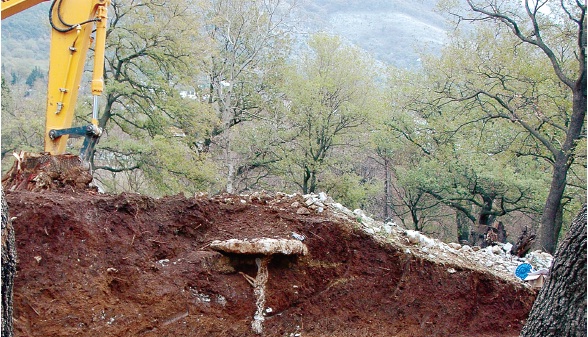
This is a completely new archaeological locality. It was discovered by pure accident while people were clearing part of an old forest to build a house. Here is a picture of the first sight of the dolmen cist emerging from the tumulus mound.


This is what the dolmen cist looks like after all the soil was cleared away.


According to the archaeologists the tumulus was built by the people who belonged to the early bronze Age Ljubljana culture. This culture seem to have stretched along the whole East Adriatic coast. It also seem to have stretched inland into Bosnia and all the way to Sava and Danube where it could have had contacts with Vučedol culture.

The original tumulus had the radius of about 15 m and the height of about 1.80 m. The dolmen cist is surrounded by a ring of stones, which ritually separates the land of the dead from the land of the living. The sacred area was carefully cleared and compacted. It was then covered with fine dry soil and then treated with fire. Only then the central dolmen was built. The dolmen was made from massive stone plates. The person buried inside this dolmen cist was buried in a foetal position. This symbolizes rebirth after death and points to a belief that the death was seen as a new birth. Once the deceased was placed inside the cist, the cist was sealed with several types of clay, making the grave completely watertight The inside of the grave was as dry as when it was initially sealed almost 5000 years ago.  

This is the translation of the excavation report filed by archaeologist Mladen Zagarčanin who lead the excavation:

The Early Bronze Age tumulus “Mogila na Rake“ from Sutomore was found on the northeastern part of Spič field, about 1 km from the sea. The big earth-stone tumulus which had diameter of about 15 m, and height of about 1.80 m. It was discovered during the works related to the clearing of a private land with the use of diggers. During the dig the majority of the western and northeastern part of the tumulus was destroyed. The excavation work stopped when the digger uncovered the cover plate of the central tomb dolmen cist.

This is a rough cross section diagram of the tumulus:


The tumulus was covered with a layer consisting of large river pebbles.


After removing the stone layer the removal of the red-brown earth layer, about 0.80 to 1.00m thick, was carried out. There were almost no stones in this layer, although now and then one could notice particles of grime, small fragments of broken flint and small pieces of atypical pottery. The excavation of the earth mound confirmed the dense concentration of small and big stones, about 1.20 m thick, from which the stone layer was formed, covering the middle of the conical pile of pressed red coloured clay. The diameter of this layer was about 3.20 m, and the height about 0.80 m.
Further excavation revealed, the layer of green-dark earth, partly mixed with grime, which was roughly piled along the dolmen cist walls up to 0.60 cm height. Several fragments of pottery were found in this layer, as well as larger amount of chipped stone , while a smaller flat stone construction was confirmed on the north side of the same layer. We can assume that this construction represents a stair abutting the tomb, and it could have served as a platform from where the person in charge of the burial carried out the ritual.

With the removal of the green-dark layer the base of lower stone covering was revealed, round in shape, and made of medium and small pieces of limestone (0.5 to 0.20 m) mixed with red-brown earth. The cist was built on this layer using local stones. The sides were  constructed from massive trapezoidal shape stone plates (1.40 × 1.00 m, about 20 cm thick), which were bonded with yellow waterproof clay.

The cist was covered with two massive rectangle shaped plates (1m x 1.20m and 1.80 × 1 m; 20 cm thick), a large amount of yellow green clay was added to the layer of green-dark clay, whose purpose was to cover the plates both above and below, providing in that way the hydro insulation of the tomb interior.

Before the funeral ceremony, the interior of the cist was covered with a layer of fine sea sand, and the body was put on top of it in a foetal position, with the head directed toward to west, arms folded at the elbow, and with folded legs.


The anthropological analyses showed that the buried person was a man in his forties or fifties who had serious problems with his spine during his lifetime. During the detailed bone examination, it was concluded that he suffered of osteoporosis, or bone loss. It was also concluded that arthrosis, or arthritis was present among the ilium bones, as well as diseases of peripheral joints because of degenerative changes in joint cartilage. The third bone disease was found in the lumbar area and sacrum. The deformation found here indicates that the deceased walked with problems during his lifetime and that he suffered great pain in his back. These diseases suggest that he spent much time on horse back, because those deformities are characteristic for riders.

What is very interesting is that this was not the only skeleton found in the cist.

The bones of a child 8-10 years old (teeth and parts of other bones were preserved) were found his legs, as well as a smaller number of bones of a person 25-30 years old. The archaeologists assume that those are the bones of close family members, perhaps his son and wife who died before him. The missing skull and other bones of the buried skeletons point to the possibility that their bones were excavated from some other place and put in this tomb later on. But there is also a possibility that the woman and the child were sacrificed and then buried with the man. 

The cist did not contain any metal objects which is strange for these types of graves from this period. This could mean that this is not a grave of a warrior but a person who was in some other way important. Like a priest.

What was found in the cist are two ceramic vessels: a jug and a shallow plate.

The plate has a thick ring shaped stand and was thus interpreted as a thurible, a vessel used for burning incense during rituals. The thurible is richly decorated on both sides. The cross shaped detail was drawn on the upper surface which was shaped as a shallow plate with the extracted front and rounded back part, formed by the ribbons filled with the crossed lines. The ribbon ornaments formed borders which go along the edge of the vessel. Two holes were made on the corners of the extracted part of the thurible. On the bottom, a star shaped detail was engraved, formed of triangle fields and filled with crossed lines.


Now have a look at the cross symbol drawn on the top surface of the thurible. Remember the grave is dated to 2700 BC:


Is this pattern just a decoration with no meaning? Well if the above incense burning vessel was the only vessel with this symbol found in Montenegro we could say that this is indeed just a meaningless decorative pattern. But exactly the same vessels were found in other tumuluses and some of them are even older than this tumulus and were dated to the end of the 4th millennium BC. Surely the pattern choice was deliberate and must have had some cultural or maybe even religious meaning. I will talk about these other tumuluses and why they are extremely important for understanding of the Early Bronze Age Irish history in my next post. For now, let me just ask you a question: do you remember the gold cross discs which the Early Bronze Age Irish copper miners loved so much? The ones I wrote about in my post Or -Ireland's gold

This is the pair of these "Irish" golden discs found in Monaghan, dated to 2200 - 2000 BC.


Remember that I said that these "Irish" cross discs were made from gold that was brought into Ireland from Cornwall? The gold which was, according to the Irish annals, brought to Ireland by Partholon? The same Pathalon which according to the Irish "pseudo histories" came from the Balkans, via Iberia sometime during the second half of the 3rd millennium BC? 

Please note the cross symbols on the discs. This is the same cross symbol found on the thurible from the Sutomore dolmen. Is this just a coincidence? I don't think so. Not just because there are several incense burning vessel with this symbol found in Montenegro. But also because the same tumuluses which contain the incense burning vessel with this symbol also contain golden discs with this symbol... And all of them predate the Irish gold cross discs and because it all fits perfectly into the story of Partholon found in the old Irish histories.

But more about it in my next posts. Until then stay happy.

Sunday, 26 July 2015

Ór - Ireland's Gold

The earliest evidence for gold working dates to the fifth millennium BC. This is based on the discovery of the Varna cemetery which is located approximately half a kilometer from Lake Varna and 4 km from the Varna city centre in Bulgaria. The cemetery was dated to the period 4,600 BC to 4,200 BC. The cemetery belonged to the Charcolitic Varna culture. The graves of this cemetery were full of  golden artifacts and they are considered to be the oldest golden artifacts in the world.


These Varna guys were obsessed with gold. As a matter of fact, just one of the graves from the Varna cemetery, the so called golden grave (grave 43) contained more gold, than has been found in all the other archaeological sites in the world from that epoch...

It seems that this love of gold was not universal. The surrounding Balkan cultures like Vinca Culture seem not to care very much for gold and the situation was pretty much the same in the rest of Europe at that time.

It took over a 1500 years for gold work to reach Britain and Ireland. The first gold objects appear in Ireland at the end of the third millennium (2200 BC). But it seems that once the Irish discovered gold, they became obsessed with it and couldn't have enough of it. But it seems that the Irish had a very peculiar and exclusive taste when it came to the type of gold objects they liked. A few of these kind of thingies were found in the Early Bronze age archaeological site:


But it seems that the favorite type of golden trinkets of the late 3rd millennium Irish were these two types of gold objects: a peculiar gold lunulae and even more peculiar gold cross discs:


The Gold lunula (plural: lunulae) is a distinctive type of late Neolithic, Chalcolithic or (most often) early Bronze Age necklace or collar shaped like a crescent moon. Most have been found in Ireland, but there are moderate numbers in other parts of Europe as well, from Great Britain to areas of the continent fairly near the Atlantic coasts. Although no lunula has been directly dated, from associations with other artefacts it is thought they were being made sometime in the period between 2200–2000 BC. A wooden box associated with one Irish find has recently given a radiocarbon dating range of 2460–2040 BC.

Beautiful things don't you think? The Irish seem to think so too. Of the more than a hundred gold lunulae known from Western Europe, more than eighty were found in Ireland.


Here some examples of European (Non Irish) gold lunulas and gold discs from "'Here comes the sun....' solar symbolism in Early Bronze Age Ireland" by Mary Cahill.

Lunula and a pair of gold discs from Cabeceiras de Basto, Portugal (© MuseuNacional de Arqueologia)


Pair of gold discs from Oviedo,Spain (© J. Camino Mayor, MuseoArqueológico de Asturias)


This is what you can read on the National Museum of Ireland's website about the 3rd millennium Bronze Age Irish gold craze:

The National Museum of Ireland’s collection of Bronze Age gold work is one of the largest and most important in western Europe. The immense quantity of Bronze Age gold from Ireland suggests that rich ore sources were known. 

Gold has been found in Ireland at a number of locations, particularly in Co. Wicklow and Co. Tyrone. The gold is found in alluvial deposits from rivers and streams. This gold is weathered out from parent rock and can be recovered using simple techniques such as panning. These gold deposits are still exploited today.

This gold is weathered out from parent rock and can be recovered using simple techniques such as panning. In Wicklow mountains this technique is still used today by prospectors to find gold nuggets as you can see on the below picture and this video.


The Wicklow Mountains form the largest continuous upland area in Ireland. They occupy the whole centre of County Wicklow and stretch outside its borders into Counties Carlow, Wexford and Dublin. Where the mountains extend into County Dublin, they are known locally as the Dublin Mountains


Wicklow mountains are criss-crossed with thousands of streams and a lot of them carry gold and some of them carry a lot of gold.

This is the Wicklow gold nugget (or more precisely its replica).


This gold nugget, weighing 682 grams is the biggest gold nugget found on British Isles. It was found in the Ballin valley stream which is located near the town of Avoca in County Wicklow, Ireland, in September 1795. A cast of the ‘Wicklow Nugget’ is held in the Natural History Museum in London. The stories of how the nugget was discovered are many. One story is it was found by workers felling trees on an estate owned by Lord Carysfort. Another that it was found by a local school teacher walking on the banks of what is now the Goldmines River. Either way the nugget sparked the first and only gold rush in Ireland. The search for the source of the gold that can still be panned today in the rivers of Wicklow has gone on since 1795 but the mother lode has never been found.

So there is plenty of gold in Ireland. But how did the Irish learn how to find it, exploit it and make these amazing gold artifacts from it? The National Museum of Ireland's website say this:

While we do not know precisely how the late Neolithic people of Ireland became familiar with metalworking, it is clear that it was introduced as a fully developed technique. Essential metalworking skills must have been introduced by people already experienced at all levels of production, from ore identification and recovery through all stages of the manufacturing process....Basically the gold working had become well established in Ireland and Britain together with a highly productive copper and bronze working industry. 

What this basically says is that gold working was brought to Ireland by the outsiders, invaders, by the same people who brought copper mining and metallurgy. These guys arrived to Ireland between 2400 BC and 2200 BC looking for copper. And they found it. In huge quantities.


Records of mining in Ireland date back to the Early Bronze Age when southwest Ireland was an important copper producer, with evidence of old copper workings at Ross Island located in Killarney, Co Kerry.

Ross Island is a claw-shaped peninsula in Killarney National Park, County Kerry. Copper extraction on the site is believed to be the source of the earliest known Irish Pre-Bronze Age metalwork, namely copper axe heads, halberds and knife/dagger blades dating from 2,400 - 2,200 BC. These finds have been distributed throughout Ireland and in the West of Britain - in South Britain the metalwork was imported from across the Channel.

The archaeology of the site has unearthed both mining operations and a smelting camp where the Copper ore was processed into a type of metal distinctive enough to be traced these early tools. As there is no evidence that the complex technology had developed spontaneously, this early metallurgy would indicate contacts with mainland Europe - in particular, extending along the coastline from Spain through Normandy. The Ross island operation was associated with beaker pottery and continued until ca 1,900 BC


And at the same time we see the appearance of the gold artifacts in Ireland too. So something very interesting happened between the 6th millennium BC and the 3rd millennium BC on the European Metal scene. As I already said the earliest evidence for gold working dates to the fifth millennium BC Varna culture. The earliest evidence for copper working dates to the 6th millennium Vinča culture. And as I said already, for a while the gold dudes from Varna and the copper and bronze dudes from Vinča didn't really go out much and didn't mix with one another or anyone else for that matter. They were too busy digging, smelting and making Metal, perfecting their art you know. But then one day, probably at the end of the 4th millennium, the beginning of the 3rd millennium, they must have been invited to a party organized by these new foreign kids who just came to Europe, from the steppe. I mean those steppe dudes were mixing some strong stuff in them pots they had, and their parties were the hottest thing in town. So I guess the Copper dudes kitted themselves out with all the copper tools and the Gold dudes kitted themselves out with all the gold bling and went to the party. What happened at that party is a bit hazy. But at some stage someone, and I would bet it was one of those steppe kids, said something like this: "Hey you, the copper dudes! Have you ever thought of making weapons out of copper?! I know the agricultural tools are useful but they are not cool man! You know what's cool?! Daggers! And Axes! And you really have to start working on your image! You look too rough, too uncultivated, too like "Neolithic" or something! You need something like what those gold dudes are wearing! But you can't just wear shit loads of gold bling and expect girls to say "He is so cool"! No, that just makes you look like a sissy! What you really want is shit loads of copper weapons and shit loads of gold bling! Then you gonna look like gangstas! Girls love gangstas man!" The rest is history. From that moment on, a once relatively peaceful Europe is overrun by a bunch of copper weapons wielding, beaker quaffing gangstas, covered in gold...

The guys who jumped out of the boat on the Irish shore in the late 3rd millennium BC were one of those guys. But these were no sissies, a peace loving people who kept themselves to themselves. They came to Ireland to mine and process copper to make weapons and I am sure they knew how to use them. It is very possible that they very quickly make themselves the only gang in town. O and these gangstas loved gold. So they, employed the same mining and metallurgical skills they used to find, mine and process Irish copper to find and process Irish gold and turn it into gold lunulae and gold cross discs that they loved so much. Right? Not exactly.

Back to the National Museum of Ireland's website then goes on to say this:

Although gold has played an important part in the cultural history of Ireland, notably in the wealth of recovered gold ornaments,  records of gold extraction or its occurrence are relatively sparse and poorly documented prior to the 17th century....Although gold has been found in Ireland at a number of locations, particularly in Co. Wicklow and Co. Tyrone, it has not yet been possible to identify the ancient sources where gold was found (which was used for the Early Bronze Age gold artifacts found in Ireland)....

The National Museum of Ireland's website is basically saying that even though the Early Bronze Age Irish were heavily blinged, we have no idea where the gold used to make this bling came from. Well, it seems that the information on the National Museum of Ireland's website is slightly out of date. We actually now know where the gold used to make the early Bronze Age Irish bling came from, and it didn't come from Ireland. This is the result of the latest study conducted by the scientists from the Bristol university who recently, together with the scientists from Leeds university, compared the gold from which the early Irish gold artifacts were made, with the naturally occurring gold deposits in the British Isles. The results were published in the paper entitled: "The genesis of gold mineralisation hosted by orogenic belts: A lead isotope investigation of Irish gold deposits". You can also find them in the paper entitled "A Non-local Source of Irish Chalcolithic and Early Bronze Age Gold".

Chris Standish, an archaeology PhD student in Bristol University used the latest advances in geochemistry to compare Irish native gold and museum gold using variations in the four natural types of lead atoms, or lead isotopes. The quantities of lead are tiny, around 0.002 per cent, and were measured using a mass spectrometer. The chemical composition of the material used to make the  early Bronze Age, 2,200 to 1,800 BC gold artifacts was cross checked and proved to be consistent. This suggests that all the early Bronze Age Irish gold have come from one area, possibly from river gravels. This chemical composition was then compared with the composition of all known Irish natural gold deposits. The chemical composition of the naturally occurring gold in Ireland was collected by the geologist Rob Chapman from Leeds University, who has spent hours standing in ice-cold streams and rivers across Ireland panning for gold. 

Scientists couldn’t find a match between any of the Irish gold deposits and the Museum gold. They examined likely areas, including the gold deposits from Mournes, Croagh Patrick, Counties Wicklow, Wexford and Waterford. Looking purely at the lead isotopes, gold in the artifacts is most consistent with gold from the southeast (Wicklow). But there is too little silver and trace metal for it to be a proper match. Standish suggests there may be gold he has yet to analyse, but another, controversial, explanation is gold imports. According to Chapman,The lead signature he [Standish] gained from the early Bronze Age artifacts corresponded to the granite rocks in Cornwall”. This means that the Early Bronze Age Irish gold artifacts were made from gold found and panned in Cornwall. 

This is a golden lunula from Cornwall dated to the period 2400BC-2000BC. Does it predate the Irish ones?


Chapman then went to say that the results of the study "have irritated some archaeologists".

So Chapman then had to add this to his paper:Natural gold does occur in Cornwall, but it is difficult to find and we cannot say categorically whether the gold content is compatible or not. Since the early Bronze Age, the land has changed so much that you cannot visit the same sites available to the Bronze Age people; some lie underwater. One possibility is that there is a deposit of gold somewhere in Ireland which has eluded modern prospectors but was used by Bronze Age people...."

Given extensive gold exploration in Ireland since the 1980s, a hidden source is somewhat unlikely, say geologists, dimming hopes of an Irish El Dorado. But it’s a possibility. And archaeologists and historians, who were irritated by the results of this study and who are refusing to accept the new geological data are clinging to it. 

One of those irritated archaeologists is Mary Cahill, curator of the National Museum of Ireland’s Bronze Age collection, who had this to say about the whole thing: "...there is no supporting archaeological evidence for extensive gold imports to Ireland at this time. We know that Irish copper and bronze objects turn up in Britain, but there are no signs of gold coming in. And clues pointing to southern Britain as a source for Irish gold are not conclusive....". This is a perfect example of how archaeologists and historians are refusing to accept the latest scientific data because it contradicts with commonly accepted theories of what happened. 

I also love the way these finds were actually interpreted by Standish: 

Lead author Dr Chris Standish says: “This is an unexpected and particularly interesting result as it suggests that Bronze Age gold workers in Ireland were making artefacts out of material sourced from outside of the country, despite the existence of a number of easily-accessible and rich gold deposits found locally.

“It is unlikely that knowledge of how to extract gold didn’t exist in Ireland, as we see large scale exploitation of other metals. It is more probable that an ‘exotic’ origin was cherished as a key property of gold and was an important reason behind why it was imported for production.

Isn't a much simpler and more logical explanation that the Early Bronze Age gold objects found in Ireland were made in the same place where the gold was found, in Cornwall and that they were then brought to Ireland as finished products? But that would make even more people even more irritated. This would effectively put an end to the accepted history and the story of the Early Bronze Age Ireland being the Golden Isle, the center of the European gold working crafts of that time ...So the official archaeology and history is surprised and irritated with the new data showing that the "Irish gold" was brought to Ireland. 

But guess what? The old Irish annals, the so called "pseudo history" tells us that the gold was "brought into Ireland" and that it was brought right about the time when the first gold artifacts start appearing in Ireland.

The old Irish annals tell us that the first race that lived in Ireland were Fomorians. Then, after the flood, came the people of Partholón who are credited with introducing cattle husbandry, plowing, cooking, dwellings, trade, and dividing the island in four. But Partholon also brought gold. 

Labor Gabala Erenn tells us that Partholon had with him two merchants: Biobhal (Bibal) and Beabhal (Babal). Babal brought cattle to Ireland, and Bibal brought gold.

So when did Partholon come to Ireland? 

The Annals of the Four Masters says they arrived in 2520 Anno Mundi (after the "creation of the world"), Seathrún Céitinn's Foras Feasa ar Érinn says they arrived in 2061 BC, Annals of Four Masters says that they arrived at 2680 BC. So Sometimes in the second half of the 3rd millennium. 

So far the "pseudo history" is right on the money. 

And finally where did the Parthalon come from?

The earliest surviving reference to the Partholóin is in the Historia Brittonum, a 9th-century British Latin compilation attributed to one Nennius. Here, "Partholomus" is said to have come to Ireland from Spain.

Seathrún Céitinn's 17th century compilation Foras Feasa ar Érinn, says that Partholón was the son of Sera, the king of Greece, and fled his homeland after murdering his father and mother. He lost his left eye in the attack on his parents. He and his followers set off from Greece, sailed via Sicily, around Iberia, and arrived in Ireland from the west, having traveled for seven years.

The Lebor Gabála Érenn, an 11th-century Christian pseudo-history of Ireland, tells us more. It tells us that Partholón came from either Sicily or Mygdonia which was an ancient territory, part of Ancient Thrace. According to the Lebor Gabála Érenn Partholon was the son of Sera, son of Sru, a descendant of Magog, son of Japheth (see Japhetites), son of Noah. Partholón and his people sail to Ireland via Gothia, Anatolia, Greece, Sicily and Iberia, and landing at Inber Scéne (Kenmare in County Kerry). This is the closest landing point next to the ancient Ross Island copper mine. This mine was the reason why the pot loving, copper weapons making and gold bling wearing Beaker gangstas came to Ireland. 


So is the Irish "pseudo history" right about the Balkans being the birth place of Partholon like it was about when he landed in Ireland, where he landed in Ireland and the fact that he and his people had brought gold to Ireland? I believe so. But I will talk about this in one of my next posts.