
Several early Bronze age tumulus graves have been discovered and excavated in Montenegro in last 10 years. They are concentrated in the fertile Zeta and Bojana valleys, both of which are linked to the Skadar lake. I already wrote about the Bjelopavlići tumulus. This time I will write about the tumulus known as "Mogila na rake" or "Spič tumulus" which was discovered in 2011.
Spič tumulus (Mogila na rake)
Tumulus which was found in the Spič field just south of Sutomore, under the Nehaj fortress is a tumulus type grave with a central dolmen cist which was built from a massive stone plates. It is estimated to be almost 5000 years old, dating to the early 3rd millennium BC, more precisely to 2700 BC. This is one of the so called princely graves common for southern Europe of that period.
This is a completely new archaeological locality. It was discovered by pure accident while people were clearing part of an old forest to build a house. Here is a picture of the first sight of the dolmen cist emerging from the tumulus mound.
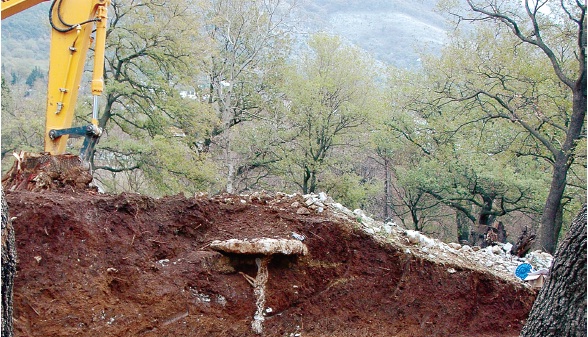
This is what the dolmen cist looks like after all the soil was cleared away.


According to the archaeologists the tumulus was built by the people who belonged to the early bronze Age Ljubljana culture. This culture seem to have stretched along the whole East Adriatic coast. It also seem to have stretched inland into Bosnia and all the way to Sava and Danube where it could have had contacts with Vučedol culture.
The original tumulus had the radius of about 15 m and the height of about 1.80 m. The dolmen cist is surrounded by a ring of stones, which ritually separates the land of the dead from the land of the living. The sacred area was carefully cleared and compacted. It was then covered with fine dry soil and then treated with fire. Only then the central dolmen was built. The dolmen was made from massive stone plates. The person buried inside this dolmen cist was buried in a foetal position. This symbolizes rebirth after death and points to a belief that the death was seen as a new birth. Once the deceased was placed inside the cist, the cist was sealed with several types of clay, making the grave completely watertight The inside of the grave was as dry as when it was initially sealed almost 5000 years ago.
This is the translation of the excavation report filed by archaeologist Mladen Zagarčanin who lead the excavation:
The Early Bronze Age tumulus “Mogila na Rake“ from Sutomore was found on the northeastern part of Spič field, about 1 km from the sea. The big earth-stone tumulus which had diameter of about 15 m, and height of about 1.80 m. It was discovered during the works related to the clearing of a private land with the use of diggers. During the dig the majority of the western and northeastern part of the tumulus was destroyed. The excavation work stopped when the digger uncovered the cover plate of the central tomb dolmen cist.
This is a rough cross section diagram of the tumulus:

The tumulus was covered with a layer consisting of large river pebbles.

After removing the stone layer the removal of the red-brown earth layer, about 0.80 to 1.00m thick, was carried out. There were almost no stones in this layer, although now and then one could notice particles of grime, small fragments of broken flint and small pieces of atypical pottery. The excavation of the earth mound confirmed the dense concentration of small and big stones, about 1.20 m thick, from which the stone layer was formed, covering the middle of the conical pile of pressed red coloured clay. The diameter of this layer was about 3.20 m, and the height about 0.80 m.
Further excavation revealed, the layer of green-dark earth, partly mixed with grime, which was roughly piled along the dolmen cist walls up to 0.60 cm height. Several fragments of pottery were found in this layer, as well as larger amount of chipped stone , while a smaller flat stone construction was confirmed on the north side of the same layer. We can assume that this construction represents a stair abutting the tomb, and it could have served as a platform from where the person in charge of the burial carried out the ritual.
With the removal of the green-dark layer the base of lower stone covering was revealed, round in shape, and made of medium and small pieces of limestone (0.5 to 0.20 m) mixed with red-brown earth. The cist was built on this layer using local stones. The sides were constructed from massive trapezoidal shape stone plates (1.40 × 1.00 m, about 20 cm thick), which were bonded with yellow waterproof clay.
The cist was covered with two massive rectangle shaped plates (1m x 1.20m and 1.80 × 1 m; 20 cm thick), a large amount of yellow green clay was added to the layer of green-dark clay, whose purpose was to cover the plates both above and below, providing in that way the hydro insulation of the tomb interior.
Before the funeral ceremony, the interior of the cist was covered with a layer of fine sea sand, and the body was put on top of it in a foetal position, with the head directed toward to west, arms folded at the elbow, and with folded legs.

The anthropological analyses showed that the buried person was a man in his forties or fifties who had serious problems with his spine during his lifetime. During the detailed bone examination, it was concluded that he suffered of osteoporosis, or bone loss. It was also concluded that arthrosis, or arthritis was present among the ilium bones, as well as diseases of peripheral joints because of degenerative changes in joint cartilage. The third bone disease was found in the lumbar area and sacrum. The deformation found here indicates that the deceased walked with problems during his lifetime and that he suffered great pain in his back. These diseases suggest that he spent much time on horse back, because those deformities are characteristic for riders.
What is very interesting is that this was not the only skeleton found in the cist.
The bones of a child 8-10 years old (teeth and parts of other bones were preserved) were found his legs, as well as a smaller number of bones of a person 25-30 years old. The archaeologists assume that those are the bones of close family members, perhaps his son and wife who died before him. The missing skull and other bones of the buried skeletons point to the possibility that their bones were excavated from some other place and put in this tomb later on. But there is also a possibility that the woman and the child were sacrificed and then buried with the man.
The cist did not contain any metal objects which is strange for these types of graves from this period. This could mean that this is not a grave of a warrior but a person who was in some other way important. Like a priest.
What was found in the cist are two ceramic vessels: a jug and a shallow plate.
The plate has a thick ring shaped stand and was thus interpreted as a thurible, a vessel used for burning incense during rituals. The thurible is richly decorated on both sides. The cross shaped detail was drawn on the upper surface which was shaped as a shallow plate with the extracted front and rounded back part, formed by the ribbons filled with the crossed lines. The ribbon ornaments formed borders which go along the edge of the vessel. Two holes were made on the corners of the extracted part of the thurible. On the bottom, a star shaped detail was engraved, formed of triangle fields and filled with crossed lines.


Now have a look at the cross symbol drawn on the top surface of the thurible. Remember the grave is dated to 2700 BC:


Is this pattern just a decoration with no meaning? Well if the above incense burning vessel was the only vessel with this symbol found in Montenegro we could say that this is indeed just a meaningless decorative pattern. But exactly the same vessels were found in other tumuluses and some of them are even older than this tumulus and were dated to the end of the 4th millennium BC. Surely the pattern choice was deliberate and must have had some cultural or maybe even religious meaning. I will talk about these other tumuluses and why they are extremely important for understanding of the Early Bronze Age Irish history in my next post. For now, let me just ask you a question: do you remember the gold cross discs which the Early Bronze Age Irish copper miners loved so much? The ones I wrote about in my post Or -Ireland's gold?
This is the pair of these "Irish" golden discs found in Monaghan, dated to 2200 - 2000 BC.

Remember that I said that these "Irish" cross discs were made from gold that was brought into Ireland from Cornwall? The gold which was, according to the Irish annals, brought to Ireland by Partholon? The same Pathalon which according to the Irish "pseudo histories" came from the Balkans, via Iberia sometime during the second half of the 3rd millennium BC?
Please note the cross symbols on the discs. This is the same cross symbol found on the thurible from the Sutomore dolmen. Is this just a coincidence? I don't think so. Not just because there are several incense burning vessel with this symbol found in Montenegro. But also because the same tumuluses which contain the incense burning vessel with this symbol also contain golden discs with this symbol... And all of them predate the Irish gold cross discs and because it all fits perfectly into the story of Partholon found in the old Irish histories.
But more about it in my next posts. Until then stay happy.


