Showing posts sorted by date for query chariot sun. Sort by relevance Show all posts

Saturday, 31 October 2026

A Gaulish coin with a lyre

A very interesting Gaulish coin indeed...

Obverse: Unidentified diademed head, but I can bet this is Apollo (as Maponos, his Gaulish clone), as this is exactly how Apollo was depicted on Macedonian (solar horse) coins which were originally copied by the Celts...

That this is indeed Apollo/Maponos is confirmed by what is depicted on the reverse of the coin: a (solar) horse with the sun above its back, and a (solar) lyre, favorite instrument of Apollo/Maponos, under its belly...

Here is English equivalent:

A Celtic coin from Sussex, minted by the Atrebates and Regini tribes, 55-45 BC.   


Obverse: Unidentified diademed head, but I can bet this is Apollo...

Reverse: A (solar) horse with the (solar) wheel above its back, and a (solar) lyre under its belly...

Horse (equid) is one of the most common solar symbols found all over Eurasia since Bronze Age...This is because horse (equid) fertility and their mating season, which is marked by wild stallion fights, is governed by the sunlight. It starts in Apr/May, peaks on summer solstice, and ends in Sep/Oct...

This is why horse (actually equid in general) was the preffered ride of the sun gods (and kings who worshiped them) from Mesopotamia onwards...

I talked about Horse (Equid) as a solar symbol in many of my posts: 

Iran "Water carrier equid", "Dioscuri plate from Iran"

Mesopotamia "Shamash playing with the solar horse", "Sun god from Tell Brak", "7 heads"

India "Hayagriva"

China "Longma", "Three legged crow", "Mythical beast from Xian"

Levant "Alexamenos graffito", "Goddess on a horse", "Unicorn", "Sun god from the first temple"

Europe "Archaic rider", "Beotian solar pyxis", "Pegasus and chimera", "King John", "White stag" "The horseman", "Artemis Orthia", "Curlew", "Poseidon pursuing Demeter"...

Anatolia "Cilician Nergal"

Another celtic coin, from Eastern Europe, Hungary, this time with the sun depicted as solar rider. With the sun god Apollo depicted on the other side...

Now on the Gaulish coin, the (solar) horse is depicted prancing above the waves...

This scene is actually a complex calendar marker for the sailing season in Gaul, Apr/May - Sep/Oct...

In Roman times, the official and safe sailing season (mare apertum) along the French coast ran from Apr/May to Sep/Oct...I talk about Roman sailing season in my post "Swallow tattoo"...


Which overlaps with the horse mating season...

This is also the reason why horse was the sacred animal of Poseidon (Greek) and Yamm (Phoenician) sea gods. 

Horse mating season overlaps with the sailing season in Eastern Mediterranean too. I talked about this in my posts "Trojan horse", "Three sacrifices"...

BTW, the lyre of Apollo is also a calendar marker. 

The lyre was made by Apollo's younger brother Hermes, who later swapped it with Apollo of caduceus...  

And interestingly, every single plant and animal that features prominently in Hermes's mythology is a calendar marker for Apr/May...Beginning of the sailing season...  

I talk about Hermes in these articles... 

Oh yeah, did I mention that Hermes was patron of commerce, and because most commerce was conducted by boat, by extension seafaring...

Hermes features prominently in Celtic mythology together with Apollo...Sometimes two are actually merged into a single Celtic equivalent...

I talk about this in my post "Pillar of the boatmen" in which I give symbolic analysis of the second row of the 1st c. AD Roman monument known as the "Pillar of the Boatmen" found in Paris, France...

Diodorus Siculus, citing Timaeus of Tauromenium, who lived in 4th-3rd century BC says: "The Celts dwelling along the Ocean have a particular veneration for the Dioscuri; according to one of their ancient traditions, these gods arrived by way of the Ocean"...

The sailing season in Gaul started when horses started mating, in Apr/May and peaked when horses mating season peaked, on Summer Solstice...

I think this is why Dioskuri mark Summer Solstice, and that this is why they were venerated by maritime Celts...

I talked about the (horse) twins marking Summer Solstice in different cultures in my post "Little horses"...

I also think this specific type of gold stater, made in 2nd-1st c. BC by Celtic tribes in Gaul, actually depicts "Sailing season" through depiction of Poseidon (as one of his Celtic clones), in a chariot pulled by a solar horse, depicted above a seahorse...

BTW, I find it really neat that horses and sea horses, which are both linked with sea gods in the Eastern Mediterranean, have the same breeding season, Apr/May - Sep/Oct, which is also the sailing season in the Eastern Mediterranean. Where all these animal calendar markers originate...I talk about seahorses in my post "Seahorse ring"...

To read more about ancient animal and plant calendar markers, which are at the root of all our mythologies, start here…Then check my twitter threads I still didn't convert to blog post...I am way way behind...


Friday, 9 October 2026

Don't eat the food of the dead

Hades, the god of the underworld fell in love with beautiful Persephone, daughter of Zeus and Demeter. He asked his brother Zeus for permission to marry her and Zeus agreed. But knowing that Demeter would not agree to the marriage, Zeus permitted Hades to abduct Persephone. So one day while she was gathering flowers with her friends, Hades burst out of the ground in his chariot, snatched Persephone and took her into the underworld...

Demeter, when she found her daughter had disappeared, disguised herself as an old woman and with lighted torches in her hands roamed the Earth looking for her daughter. In the depth of her despair, she forbade the earth to produce fruit (or she neglects the earth which results in nothing growing).

Finally, Demeter met Hekate, the old Witch. Hekate took pity on Demeter and told her to seek help from the all seeing Helios, the sun god. She did and Helios told Demeter all about how Hades had dragged Persephone into the underworld.

Persephone’s mother, Demeter, then begged her brother Hades to allow Persephone to come back to the world of the living, saying that the young Persephone was not supposed to live in the world of the dead. Hades first ignored her pleadings. But finally Zeus intervened and forced Hades to let Persephone leave. He did that because he was pressed by the cries of the hungry people and by the complaints of other deities, who because of the famine, weren't getting their sacrifices...

Hades complied with Zeus's order. But first he tricked Persephone, giving her some pomegranate seeds to eat. And because she had tasted food in the underworld, she was obliged to spend a third of each year (the winter months) there, and the remaining part of the year with the gods above.

I explained why why pomegranate is the fruit Hades gave Persephone to eat in the underworld in these two posts: Poppies and pomegranates and Abduction of Persephone...

Interestingly the same motif of 

dead person (lord of the dead) → appears to living person (in reality or in a dream) → offers food → living person accepts/eats → the person dies or remains trapped in the land of the dead

is found in several cultures across the world. 

I will post the data about each one here:

Brittany — France

W. Y. Evans-Wentz, reporting Breton traditions, says that a mortal may encounter one of the dead, who may induce him to eat their food.

If he does: "he will never be able to return among the living."

You can read more about this in The Fairy-Faith in Celtic Countries by W. Y. Evans Wentz

Denmark

In the Danish Saxo Grammaticus we read of King Gorm who went with several companions to seek a treasure-land in the north ruled by King Geirröd in the underworld. After many adventures they reached the hall of Gudmund, Geirröd’s brother, where Thorkill, the guide and adviser to the expedition, warned them not to touch food or drink. In spite of the warning some were tempted and were unable to return. 

You can read more about this in The Science of Fairy Tales An Inquiry into Fairy Mythology by Edwin Sidney Hartland. In chapter 3, Hartland gives Swabian, Lapp, Swedish, Manx, Scottish and Jewish versions of this folk tale. 

Scotland

The chief Scottish analogue appears in connection with Thomas of Erceldoune, the Rhymer. See also J. G. Campbell, Superstitions of the Highlands and Islands of Scotland, Glasgow, 1900, p. 17.

When one visits the land of the fairies (the dead)..."wise people recommend that, in the circumstances, a man should not utter a word till he comes out again, nor, on any account, taste Fairy food or drink. If he abstains he is very likely before long dismissed, but if he indulges he straightway loses the will and the power ever to return to the society of men". 

Māori — New Zealand

One account concerns a woman who believes she has died and visits the spirit land. There she encounters her dead father. He tells her that she must return to earth to care for her child, and warns her: "if she eats the food there, she cannot return to life". She refuses food offered by the dead and returns to the land of the living.

You can read more about this in Primitive culture by John Murray

Another Māori story talks aout a man who descends to the realm of the dead and was given food to bring with him with a warning to avoid eating the food from the land of the dead, "because doing so would prevent his return".

You can read more about this in Te Ika a Māui, or, New Zealand and its inhabitants : illustrating the origin, manners, customs, mythology, religion, rites, songs, proverbs, fables and language of the Māori and Polynesian races in general ; together with the geology, natural history, productions, and climate of the country by Taylor, Richard

Eastern Melanesia

A woman goes to Panoi, the abode of the dead, specifically to see her dead brother. Her brother warns her not to eat anything there: "If she eats the food of the dead, she will be permanently retained in the underworld".

You can read more about this in The Science of Fairy Tales An Inquiry into Fairy Mythology by Edwin Sidney Hartland.

New Caledonia

According to the 19th-century account when a newly dead person arrives in the spirit world, he is welcomed by other souls and invited to a banquet. He is offered food, especially bananas. If he tastes them: "his doom is fixed forever and he cannot return to earth".

You can read more about this in Apollodorus. The Library, with an English translation by James George Frazer

Sioux / Dakota — North America

Ahak-tah (“Male Elk”) appears to die and his soul travels into the country of the dead. He reaches the houses of his dead ancestors and encounters his uncle. He sees wild rice and wants to eat it, but his uncle prevents him because: "if he had eaten the food of the spirits, he would never have returned to earth".

You can read more about this in Primitive culture by John Murray

West Africa

Mafa people believe that if in a dream, you are visited by a dead person, who tries to persuade you to follow him/her to the underworld, and you accept something to eat from the dead, this means you are giving consent to follow the dead into the underworld...You can read more about this in The Mafa belief system by Godula Kosack.

Palawan/Palawano — southern Philippines

"Seeing a dead relative in a dream and being offered food by him or her is very dangerous; one will die if one accepts the food in the dream"...

You can read more about it in UNCULTURAL BEHAVIOR, An Anthropological Investigation of Suicide in the Southern Philippines by Charles J-H Macdonald

Ancient Egypt

The ancient Egyptian conception described in the classical comparative literature has the soul travelling toward the realm of the dead, where a goddess — identified in different accounts as Hathor, Nut or Neith — offers fruit, bread and water. If the soul accepts them, it cannot return to earth.

You can read more about this in Apollodorus. The Library, with an English translation by James George Frazer

Mesopotamia

That the knowledge of the danger of eating in another world was fully recognised in the earliest times known to us is clear from a curious use made of it in a Babylonian myth. The motif occurs in the Adapa Legend, as described and translated by M. Jastrow, Religion of Babylonia and Assyria, Boston, 1898, pp. 544-555. 

The beginning of the story is missing, but when the tablet becomes intelligible we find Adapa, a fisherman, engaged in a contest with the South wind, which is represented in the form of a bird. In anger Adapa breaks the wings of the South wind, and for seven days [ i.e. an indefinite period] the wind does not blow. Anu, the God of Heaven, inquires into this strange phenomenon, and on hearing the reason, summons the fisherman into his presence. The god Ea is told to yield him up. Before doing so, however, Ea gives him advice as to how he should behave before Anu. Among other injunctions he says:

“When thou comest before Anu they will offer thee food of death. Do not eat. They will offer thee waters of death. Do not drink. They will offer thee a garment. Put it on. They will offer thee oil. Anoint thyself. The order that I give thee do not neglect....”

Adapa follows his instructions carefully, but as he has now viewed the secrets of heaven, there is nothing left for the gods to do but to admit him to their circle. Accordingly they must make him immortal, and the story continues:

“Now what shall we grant him? Offer him food of life, that he may eat of it. They brought it to him, but he did not eat. Waters of life they brought him, but he did not drink. A garment they brought him. He put it on. Oil they brought him. He anointed himself.”

Adapa has followed his instructions too carefully, and has failed to notice the trick that Ea has played on him. It was food and waters of death he was not to touch, but Adapa was following the principle of taboo for personal safety. Ea, as the god of humanity, would not want his creatures to gain immortality, and so adopted a plan he knew would work.

Japan 

Izanami has died and gone to Yomi, the land of the dead. Izanagi follows her and asks her to return. She replies that she has already eaten the food cooked in the hearths of Yomi and therefore cannot simply return.

You can read more about this in Shinto myths.

India 

In the Katha Upanishad we read about Nachiketas who goes to the house of Yama, Death, and remains there for three nights. He is specifically praised because he has remained there: "without eating": "Three nights within his mansion stay, / But taste not ... his food."

You can read more about this in Metrical translations from Sanskrit writers by J Muir

To read more about ancient animal and plant calendar markers, which are at the root of all our mythologies, start here…Then check my twitter threads I still didn't convert to blog post...I am way way behind...


Tuesday, 29 September 2026

Dancing sun god

😂😂😂 Wow!!! Animation made by overlying two Celtic Silver Quinarius coins from Central Europe (Rhineland), minted between 65 BC - 1 AD, both featuring slightly different version of the same scenes:

Obv: dancing mannikin right, head turned left, holding snake in right hand [me: which is biting his nose], torque in left hand. 

Rev: horse standing right, head turned left [me: wandering WTF is going on on the other side of the coin]; around, zig zag border. 

Animation and data from this great page...

What I think is that the "dancing mannikin" is actually The Sun God. His spiky hair symbolising the sun rays. Just like here, on this coin of Alexander the Great depicting the face of Helios. 350-331 BC - British Museum, London...

That this is indeed The Sun God is indicated by the fact that he is holding a snake. Snake is a pure solar animal. It is in our world when sun is here (day, hot half of the year) and it is in the underworld when sun is there (night, cold half of the year)...  


I talked about snake as the solar symbol from around the world in many of my posts...

BTW, because snake also spends half of the time in the underworld, snake is also a chthonic animal. So no contradiction here...

Just like the Sun God who also spends half of the time in the underworld, making the Sun God also a chthonic deity...

Think about this for now, will talk about this more soon...

Also, Apr/May, the beginning of summer, is when most common Eurasian snakes, vipers, start mating, and fighting...

I talked about this in many of my posts...

BTW, Hermes/Mercury, who features prominently in Celtic mythology, carries caduceus (staff with two intertwined snakes) because he himself was a deified calendar marker for Apr/May...Every single plant and animal that features prominently in his mythology is a calendar marker for Apr/May...I talk about Hermes/Mercury in these posts...

And remember the dual, solar/chthonic aspect of snakes? Which links them to both the land of living and the land of the dead, and makes them the messengers of the dead, the carriers of their will (prophecies)? This is why Apollo, who also features prominently in Celtic mythology, is associated with a (is basically a deified) snake...

I talk about the link between Apollo and Python (snake) in several posts: Apollo and Python, Marble throne of Apollo, Kassandra

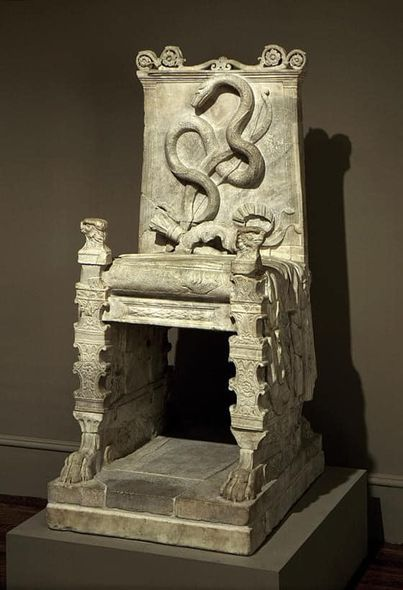
Pic: Marble Throne of Apollo, Roman, late 1st c. AD. Currently in the Los Angeles County Museum of Art. Whoever made this, knew who Apollo really was and wanted to show Apollo in his true shape (serpent, dragon), sitting on his throne...

One last thing about snakes, solar animals number one, the symbols of sun's heat.

3rd millennium BC, Bactrian seal depicting the sun god (see heat rays emanating from his shoulders) holding snakes, symbols of sun's heat...

I talk about it in my post Nude winged hero dominating snakes...

Vipera Pythia, c. 1651, by Marco Aurelio Severino. Some people still knew what snakes were until recently. But for some reason this was a secret...

What about the horse? Horse (actually equid in general) is another animal calendar marker for summer. The fertility of equids is linked to sunlight. Which is why the mating of equids starts in Apr/May, lasts until Sep/Oct and peaks on Summer Solstice, and is characterised by wild stallion fights for mares...

I talked about this first in my post Trojan Horse...

This is why horse (actually equid in general) is together with snake one of the most widespread solar symbols. 

Here it is, sun above the midle of the horse (on summer solstice) depicted on a 

Roman coin

Celtic coin 

This is even better. Another Celtic coin, this time with the sun depicted as solar rider. See the spiky hair symbolising sun rays? With the sun god Apollo depicted on the other side...Eastern Europe. Hungary. 

BTW, this is another Celtic copy of a Macedonian coin...

This is why horse (actually equid in general) was the preferred ride of the sun gods (and kings who worshiped them) from Mesopotamia onwards...

Pic: Helios on a chariot pulled by 4 white horses. Apulian vase dated to 350BC

I talked about Horse (Equid) as a solar symbol in many of my posts. Here are just a few: 

Mesopotamia 

Shamash playing with solar horse

Sun god from Tell Brak 

Seven heads

Iran

Water carrier equid

Dioscuri plate from Iran

India 

Hayagriva

China 

Longma

Mythical beast from Xian

Europe 

Curlew

White stag

Archaic rider

Beotian solar Pyxis

Pegasus and Chimera

King John

Svetovid

Poseidon pursuing Demeter

Anatolia

Cilician Nergal

Levant 

Sun god from the first temple

Alexamenos graffito

Goddess on a horse

This is also why we find horse animal calendar marker disguised in our western Zodiac as Dioskuri, divine twin horsemen, marking the Summer Solstice. The guys who wanted to marry "the daughters of the white horse". 

I talked about the horse twins in my post Little horses

O yeah, almost forgot. Unicorn is also a solar symbol, symbol of summer. 

I talked about this in several of my posts:

Reem

Unicorn

Stag and unicorn

BTW, Unicorn horn is described as "being cubit and a half (28 inches) in length". Erect horse's penis length 🙂 is max 28 inches...

Oh and guess when the horse (equid) mating season ends? In Virgo...

The virgin, which calms the unicorn 🙂...

So, what is depicted on this funny coin is the dancing sun god with his pet snake and his pet horse...Is dancing here supposed to represent some king of celebration? Beltane (Apr/May), beginning of summer and the beginning of Celtic White Half of the year, celebration? Marked by the beginning of mating seasons of snakes and horses? 

Here is a post Horse and boar about the series of Celtic coins which depict horse as animal calendar marker for (the beginning of) the Celtic White Half of the year (Mating of horses starts in Apr/May)...And boar as animal calendar marker for (the beginning of) the Celtic Black Half of the year (Mating of boars starts in Oct/Nov)... 


That's it for today. If you are interested in reading more about ancient animal and plant calendar markers, which are at the root of all our mythologies, start here…Then check my twitter threads I still didn't convert to blog post...I am way way behind...

Tuesday, 28 April 2026

Fallow deer

Just came across this interesting paper which states that Fallow deer (both European and Persian) was part of the "Neolithic Package" together with cattle, sheep, goats, and pigs...

This means that Neolithic farmers brought these deer with them when they migrated, like to Mediterranean islands Chios and Rhodes. Interestingly, the deer taken to Neolithic Chios and Rhodes derived not from nearby Anatolia, but from the Balkans...

The paper then goes to say that it was specifically fallow deer, and not just any deer, that was originally associated with the cult of Artemis...

This is explicitly depicted on many artefacts, like this Boeotian red-figure calyx, dated to 450–425 BC, depicting Artemis riding in a chariot pulled by fallow deer does, currently in Louvre...

From the paper: "There is debate about the geographical genesis of the Artemis myth but the possibility she originated in the Balkans is given credence by the density of both fallow deer remains and Artemis-related paraphernalia depicting fallow deer"...

Further on, the paper, citing "Approaches to Artemis in Bronze Age Greece" goes to say that:

"In Late Minoan Crete (c.1550–1100 BCE), Linear B texts mention not only fallow deer but also provide the earliest reference to Artemis (10, 53)"

Hinting that the link between fallow deer and Artemis already existed in Bronze Age Crete...

Possibly this link also existed in Bronze Age Anatolia. 

This Beautiful Hittite, fallow deer shaped vessel, dated to ca. 14th–13th century BC, is currently in the Met Museum.

Along the rim of the vessel is an engraved relief depicting some kind of (religious) scene. 

There is an ongoing discussion about whether the sitting deity depicted on the stag rhyton is a god or a goddess, unfortunately the hieroglyphs above the deity's head does not help the discussion.

The current consensus leans favourably for it being a female. And I agree it is. Here is why:

Is this a dead fallow deer behind the seated deity separated from the seated deity by two spears? A dead fallow deer lying under a stylised date palm tree with a quiver hanging on the wall above it? 

This is why this could be interesting. 

First we need to determine which fallow deer it is, European or Persian. Persian fallow deer (Dama mesopotamica) is today only found in Iran and Israel, but it inhabited parts of Anatolia, particularly the southern regions bordering Syria and the Levant, during the Bronze Age. They were widespread in Southwest Asia at that time and co-existed in Anatolia with the European fallow deer (Dama dama), though their distribution was limited by human activity...

Now the mating season of Persian fallow deer is Jul/Aug - Sep/Oct and the mating season of European fallow deer is Sep/Oct...

This would make fallow deer animal calendar marker for autumn, Jul/Aug - Oct/Nov, in Anatolia. I already talked about this in my post "Deer and bee", in which I analysed this Silver tetradrachm of Ephesos, dated to 390–380 BC.   

This coin also depicts a fallow deer lying under a date palm tree...Date palm tree is a plant calendar marker for Jul/Aug first appearing in Mesopotamia. Date harvest season starts in Jul/Aug, in Leo, when Lion (autumn) kills (ends) Bull (summer) and lasts until Oct/Nov. I gave full symbolic analysis of this seal in my post "Lion killing bull under palm tree"...

I talked about date palm as a plant calendar marker in many of my posts...

So fallow deer lying (dead) under a date palm tree is an animal calendar marker for Jul/Aug, Leo...

BTW, Leo (Jul/Aug), originally had nothing to do with stars either. It is the ancient animal calendar marker marking the beginning of the main mating season of the Eurasian lions. 


Talked about lion as an animal calendar marker in many of my posts...

Now fallow deer was directly linked to Artemis from the Minoan times. And Artemis is also linked with bow and arrow and lions...

I talked about this in many of my posts. 

Like my post "Winged Artemis", about this shard of a late 7th c. BC amphora, found on the island of Paros, showing a winged Artemis holding a lion by its tail and ear, surrounding by what looks like sun symbols, swastikas and crosses...Artemis in Leo, Jul/Aug...


Or my post "Artemis Orthia", about this drawing of an archaic carving of a chariot on ivory plaque from the Sanctuary of Artemis Orthia in Sparta. The chariot is pulled by winged (solar) horses and is driven by a female (goddess?) charioteer. A lion is depicted lying behind the horses...Again, Artemis in Leo, Jul/Aug...

Artemis, the twin sister of Apollo, the destructive sun (dragon) of Jul/Aug, Leo, whose holy month was Jul/Aug and who was also linked to lions...Apollo...The dragon...This dude:

Marble Throne of Apollo, Roman, late 1st c. AD. Currently in the Los Angeles County Museum of Art. Whoever made this, knew who Apollo really was and wanted to show Apollo in his true shape (serpent, dragon), sitting on his throne. 

I talked about Apollo, the god of the sun in Leo, Jul/Aug, the Greek equivalent of Mesopotamian Nergal, in this series of posts: "Palil", "Lord of the flies", "Lions of Delos", "Apollo and dolphins", "Marble throne of Apollo", "Apollo and Python", "White raven", "Threshing floor of Apollo", "Apollo the great archer", "Apollo Sminthius"

Artemis, the twin sister of Apollo, who was also the terrifying archer of whom it is said: 

"I will remember and not be unmindful of Apollo who shoots afar. As he goes through the house of Zeus, the gods tremble before him and all spring up from their seats when he draws near, as he bends his bright bow..."

Artemis, the feared archer herself, and the girl whom Hera accuses of being "a lioness between women"...Strange...But familiar? At least it should be...Ever heard of the Lioness of heaven? Ishtar? This girl...


I talked about her in my posts "Gisgis relief", "Sirius the mother of Venus", "Apocalypse", "The brightest star", "Inana and Šukaletuda"...

Artemis, who liked showing off by holding two lions, like on this Ancient Greek jug from Louvre, dated to 560-550 BC...

BTW, between two lions means "In Leo"...Oh and do you see how she is flanked by two spear men (two spears)?

The reason why Artemis is standing in Leo, Jul/Aug, is because Artemis is just another name for the ancient Archer Warrior Goddess, Ishtar...Deified Sirius in Leo, Jul/Aug...

For those who will say "Ishtar was the morning star", yes she was, in Leo (Jul/Aug), when Sirius rose in the morning with the sun...Which is why Ishtar stands on a lion (with sun above the lion) and why Ishtar is known as "The Lioness of heaven"...

For those who will still say Ishtar is Venus and not Sirius. This post, "Sirius the mother of Venus", and linked articles might be of interest: You know how everyone thinks that Inanna/Ishtar (Morning Star) is Venus and how I think that it was originally Sirius, and only later became Venus? 

Well, it seems that Ancient Egyptians preserved the proof of this switch in their mythology. 

Meet Sopdet...

Sopdet, the personification of Sirius, was the consort of Sah, the personification of Orion. And their child was Sopdu, the personification of Venus, "Lord of the East" (Venus as morning star)....

Ta Ta Taaaaaaa!!!!

And the reason why deified Sirius goddesses are archers is this: In Mesopotamia, Sirius was seen as an arrow and the surrounding stars were seen as a bow...And they were stars of Jun/Jul/Aug...

I already talked about this in my post "The brightest star" about the link between Sirius and Inanna...

So Jul/Aug, the time of the year ruled by Nergal/Apollo, and his twin sister Ishtar/Artemis is the time when Sirius (bow and arrow) rises with the sun...

But why did Mesopotamians see Sirius as arrow? Remember my post "Invisible archer"? If arrows are shooting down from the night sky, there must be an [invisible] archer shooting them from up there...  

This article was about Orion and Orionids meteorite shower. Orionids shoot down on earth during Sep/Oct/Nov. But there is another meteroite shower that rains light arows down on earth in Jul/Aug. Perseid Meteor shower...

And guess when this meteor shower is most intense? When the most light arrows are being shot down on earth? Right before dawn. You can even see them at dawn, together with Sirius and the sun...Destructive sun of Leo, Nergal, Apollo...


I talked about deified Perseids in many of my posts...

Now knowing all this might help us determine who is actually sitting goddess depicted on our Hittite rhyton...I think it is most likely some Hittite version of Ishtar/Astarte/Asherah/Artemis...

One other thing. I presume the bird sitting on the hand of the seated deity is a Peregrine falcon. 

Peregrine falcons migrate over Turkey, following mapped bird migration route used by all the birds migrating over Turkey, northwards in Apr/May/June and southwards in Sep/Oct/Nov.

Interesting, right? The deity standing on the stag is also holding a peregrine falcon...

This means that all the animal calendar markers depicted on this image point at Aug/Sep/Oct...So who is sitting pretty in Sep sipping (what?)...

The grape harvest season in Anatolia, Turkey, generally falls in Aug/Sep/Oct...

BTW, do you see the mushroom shaped thingy in front of the seated deity? The main mushroom season in Anatolia and across Turkey is autumn, specifically Sep/Oct/Nov...How interesting...


Now this is climate chart for Çorum province, the old Hittite heartland. The autumn rains arrive in Sep/Oct/Nov...


Interesting, right? Considering that there is a guy pouring water libation in front of the god standing on a stag and holding a peregrine falcon...

To read more about ancient animal and plant calendar markers, which are at the root of all our mythologies, start here…Then check my twitter threads I still didn't convert to blog post...I am way way behind...