Showing posts with label Wolf folklore. Show all posts

Monday, 26 December 2022

Wolf moon

The January full moon is referred to as the "Wolf Moon," because traditionally, "wolves can be heard howling at the moon more this time of year". Why?
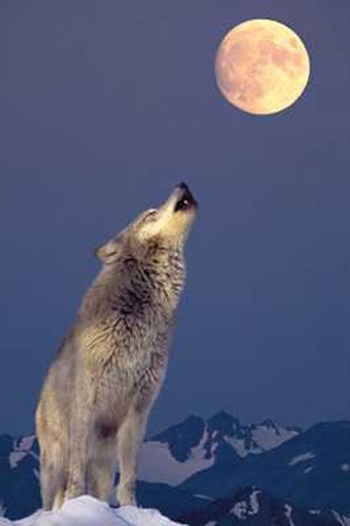
Cause wolves mating season starts in mid January.

MacBain's Gaelic dictionary says that period from mid January to mid February was once called "faoilleach", "faoillteach", Irish "faoillidh", "faoilleach"...From "faol", wolf, meaning "wolf-month". The month when wolves mate...

Anglo-saxons also called January "Wulf-monath" (meaning "wolf month"). For the same reason: wolves are much louder and more noticeable in January, which is when breeding season begins...

Interestingly, in Serbian tradition, 14th of January (Julian) or 27th of January (Gregorian) calendar, is the day of the Serbian patron saint, St Sava...

Who was known as "The wolf shepherd"...

St Sava's cult replaced the cult of the Serbian supreme god Dabog who was also known among other things as "Wolf Shepherd". Both originally Dabog and later St Sava were believed to be able to command the wolves who and when to attack, and whom not to attack...

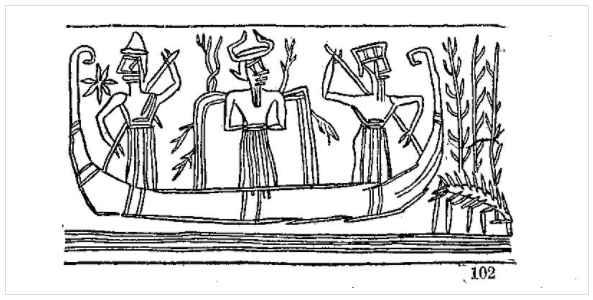
So remember how animal calendar markers are made? The fact that wolves mate during Jan/Feb, something that is hard to miss if you live in a wolf country, makes wolf a great animal calendar marker for Jan/Feb, the end of winter. Like in this Sumerian story: 

"When Enki set sail...against the lord a storm...arose...The waves at the bow of the boat rose to devour the lord like wolves and the waves at the stern of the boat were attacking Enki like a lion..."

All the animals in these scene are animal calendar markers for the beginning of the flood season in Mesopotamia, which starts when wolves mate (Jan/Feb) and ends when lions mate (Jul/Aug)...I talked about this in my post "Enki's little boat"...
Because of their mating season at the end of winter, wolves are used for creating composite "mythical animals", that represent winter...Like on this "Scythian" gold belt buckle depicting a "fight between a wolf and a snake"...Wolf is here depicted with boar tusks...Wild boar mate in Oct/Nov, beginning of winter, while wolves mate in Jan/Feb, the end of winter...In the world of animal calendar markers, this would mean "division of the year into winter (boar, wolf) and summer (serpent)"...I talked about this object in my post "Volf vs snake"...


When I originally posted the belt buckle article as a twitter thread
@Peter_Nimitz sent this reply:

Fascinating thread on animal calendars. Wonder if the wolf Fenrir & serpent Jormungandr are distant descendants of this mythology - compare the belt buckle to this Norse stave church with the serpent & the wolf...


Jörmungandr, the Great Serpent and Fenrir, the Great Wolf, are brothers...Brothers are usually used to specify that we are talking about two aspects of the same thing, in this case solar year: serpent (summer, heat) and wolf (winter, cold)...

Anyway, we started with "wolf moon is called wolf moon cause wolves like howling at it"...So let's finish with this...

The howling wolf. Wood with shell inlay, Southern Siberia, 3rd c. BC. Nomadic steppe art. Cleveland Museum of Art, Ohio, USA. 

I wonder if people, when they invented "old style" polyphonic singing, actually imitated wolf pack howling? I talked about this in my post "Ojkanje, the wolf singing"...

To read more about ancient animal and plant calendar markers, start here…then check the rest of the blog posts related to animal calendar markers I still didn't add to this page, and finally check my twitter threads I still didn't convert to blog post...I am 9 months behind now...

Saturday, 24 April 2021

Sugreb


Here is, at first glance, a very strange Serbian superstition about dogs: A place where a dog has scratched the ground is in Serbian called "sugreb". It is believed that stepping on this place can cause person to get sick "and even to go mad"!

This is why when you see that the dog has scratched the soil, you should spit on that spot, and that would "cure it"...

This is very interesting. Why would people believe this?

Well Serbs also believed that "dogs are unclean" and that "god's breath can reach 100 cubits into the earth"...What does this mean? Why did people believe this?

Maybe this is the clue: "The first puppies are thrown into a river because they can get rabies"...Now this is very interesting...

"Furious rabies occurs when the rabid dog becomes aggressive, highly excitable, and displays evidence of a depraved appetite, eating and chewing stones, earth..."

 I presume after furiously scratching the earth...

This is why "you can get mad" if you step on the place scratched by the dog" and why "dog's breath is so poisonous"  and why "spitting on the place scratched by the dog cures the place of the disease"...

A lot of Serbian wolf folklore is also directly linked to rabies...I talked about this in my post "Goropad"...

People were so afraid of wolves and the "great disease that they carry" that Serbs believed that even other diseases are scared of wolves too. And so wolves feature prominently in spells used for protection of diseases...

Like this: Serbian ritual practice recorded in Serbia, Montenegro, and East Bosnia, performed to ensure lasting health and strength of children, involved pulling the newborn baby through "vučiji zev" (wolf's yawn), the skin cut from around a wolf’s jaws...

I talked about this in my post "Enemy of demons"

Source of this Serbian superstition about dogs: "Srpski Mitoloski Recnik, grupa autora" (Serbian mythological dictionary)


Tuesday, 21 January 2020

Enemy of demons

In the past Serbs believed that wolves were "enemies of demons". Which is why when the devil, a vampire, or an "unclean" deceased person was mentioned in conversation in Central Serbia and Montenegro people always added: "Vuk mu na put!" (May a wolf stand in his path!)


Serbs from Bosnia and Croatia drank rainwater from a wolf's paw-prints believing it had magic properties. This was because "wherever a wolf's paw treads, all evil is fended off from people, cattle, and crops"...
 

In Hercegovina, a hot arid area of the Balkans, people shouted "Vuk, vuk, oro krstaš!" (Wolf, wolf, imperial eagle!) to protect themselves from rising whirlwinds – which were believed to be of demonic origin and said to cause disease and insanity...


Incantation from Central Serbia "against any disease": "U kurjaka četir’ noge, dva uva, rep i zev. U kurjaka strašan zev: boljku će zazenut! Ustupi i beži!" (Wolf has four legs, two ears, a tail, and jaws, terrible jaws: it will devour the disease! Back off, go away!)


Serbian ritual practice recorded in Serbia, Montenegro, and East Bosnia, performed to ensure lasting health and strength of children, involved pulling the newborn baby through "vučiji zev" (wolf's yawn), the skin cut from around a wolf’s jaws...


Serbian incantation from Vojvodina "against any disease": "Spusti se kurjak nizbrdo da uhvati ovcu. Ne uhvati ovcu neg' uhvati svo zlo" (The wolf came down the hill to seize a sheep. But instead of seizing a sheep he seized all evil)...


In the past, when a son was born, it was customary in Serbian villages for the father to open the house door, stand on the doorstep, and announce the birth of the son by shouting: "Rodila vučica vuka!" (A she-wolf just gave birth to a wolf cub!) 


More wolf lore in my post "Wolf feast".

When in some family male children kept dying, Serbs would give the next boy to be born name "Vuk" (Wolf). It was believed that this name would scare away demons which cause illnesses...


Wolf teeth were considered to be particularly magically potent. Serbs put them in bed around mother and baby as protection against demons. Children wore them as talismans which were meant to give them good strength and health. Serbs also used to call first child's teeth "wolves".


This magic ritual was recorded in Eastern Serbia and Kosovo. Local Serbs would look at a house through a wolf larynx (throat) if they wanted to cause quarrel in the family that lived in it. "Da bi se pojeli ko vuci" (So they would kill each other like wolves)...


In Serbia (and other Slavic countries and Finland), horse skull was placed on top of beehives to protect bees from pests and diseases. Particularly powerful was a scull of a horse killed by a wolf...Wolf sculls were also used for this purpose... 


More bee related Slavic folklore in my post "bees".

It's getting late. In the mountains of the Balkans we find a peculiar type of "old style" singing which can only be compared with the howling of wolves. It is called "ojkanje" and could be the oldest polyphonic singing that has survived til today. 


More about this ancient singing style in my post "Wolf singing". 

Riddle:

Q: "Kroz goru odilo, kući ne doodilo?" (Wanders through mountain/forest, never comes home?) 

A: Wolf

Symbolically this riddle is also a magic spell which forbids wolf to come from his mountain/forest to "our" human home...


In Serbia, when shepherds lost their sheep in the mountain, they ritually tied "verige" (chain on which cauldron is hang over the hearth). This was done to "close wolf's jaws" and protect the sheep...


More cauldron chain folklore in my post "Verige".