
Here we see the "dude dressed in white" being driven in a "bird chariot" with one bird pointing forward and the other backward...

Who is this "dude dressed in white"? Why is he driven in "bird chariots"? What is the symbol under the chariots? The Sun?
Have a look at the drawings of the Vače Situla decorations.

The same dude we see being driven in the bird chariot, is also depicted sitting on a throne holding a scepter with two bird heads facing away from each-other...

Why?
Originally I thought that maybe this is somehow related to the two headed eagle dude found in Central Asia...This guy:


Which from the ground look like two headed eagles
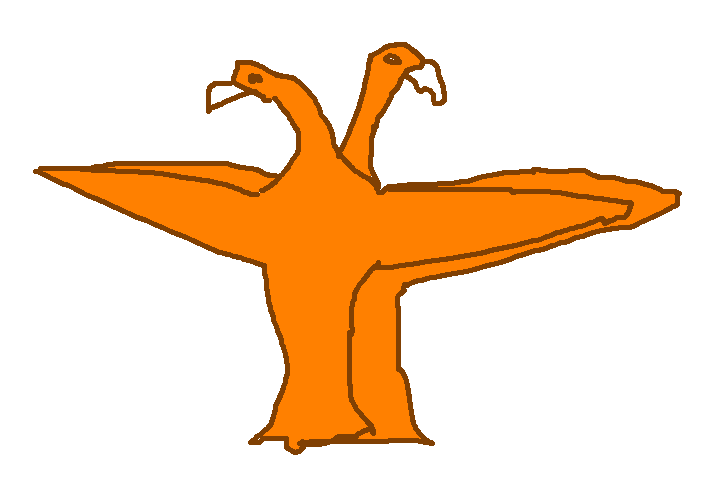
But maybe this Illyrian bird iconography has nothing to do with vultures. The bird definitely doesn't look like a vulture. It is a raptor though. But which one...
Enters this cool dude: The short-toed snake eagle (Circaetus gallicus), a medium-sized bird of prey, found throughout the Mediterranean basin, into Russia and the Middle East, and parts of Western Asia, and in the Indian Subcontinent and also in some Indonesian islands...

This eagle, as its name says has short toes 🙂 And eats snakes. I talked about this eagle in my post "Eagle calendar marker"...

And in Europe, it is a migratory bird, arriving into Europe from Africa in Apr/May and leaving Europe for Africa in Sep/Oct...
Remember that snakes are solar animals. They are in our world when sun is in our world (hot part of the year) and they are in the underworld when sun is in the underworld (cold part of the year)

I talked about this in my posts "Enemy of the sun", "The chthonic animal" and "Bactrian snakes and dragons"...
Not just that, but mating season of European snakes take place at the beginning of summer, in Apr/May...

Which makes snake animal calendar marker for the beginning of summer...
In Slavic mythology, dragon is "an old snake"...What this means is that dragon is the animal calendar marker for the late summer, the hottest part of the year...Which is by South Slavs called "Kresovi" (fires)...
Which is why in Slavic mythology, dragon, always breathes fire.

He is the symbol of destructive sun's heat. I talked about this in my post "Dragon who stole rain"...
This is also why in Slavic languages, the word for dragon "zmaj" is masculine form of "zmija", snake.
And why the oldest dragons, Mesopotamian ones, have snake heads. 7 snake head, for 7 hot, dry summer months...And the body of a lion...Cause Leo, Jul/Aug, is the hottest part of the year. The time of the fire breathing dragons..

I talked about this in my post "Seven headed dragon"...
Anyway, back to the snake eating eagle...This eagle disappears from Europe when the the sun goes to the underworld, followed by snakes...And this eagle reappears in Europe when the sun returns from the underworld followed by snakes...
And the only time you can see this amazing scene of eagle fighting snake is during summer and autumn...
Now remember my pos "Leto", about migratory birds and their significance in Slavic mythology?


And how they are directly linked with the departure of Jarilo (pronounced Yarilo), the sun god to the land of the dead in the autumn, and his return from the land of the dead in the spring?
To the point where the word leto (summer, year) can be derived from let (flight) of the migratory birds...
Is it possible that the raptors depicted looking into opposite directions are migratory snake eagles? If only there was an Illyrian artefact, from the same area and the same time period, showing a raptor with a snake in it's beak...
Now have a look at this: a (ritual) boxing match over a helmet depicted on the Vače Situla.

Now have a look at this: Belt buckle (Illyrian or Etruscan or...) from Magdalenska gora. From this amazing paper "Podobe zivljenja in mita"... It depicts the same (ritual) boxing match over a helmet depicted on the Vače Situla. But, in the top left corner, there is a bird of pray with a snake in its beak...

So I think I am right about the identity of the raptor from the Vače Situla...
So who is this dude dressed in white, on an Illyrian situla, being driven in the chariot with two birds pointing in two opposite directions and holding a scepter with with two birds pointing in two opposite directions (departure and return of migratory birds)??? I wonder...
No suggestions?
Well Belenus (Belinus and Bellenus), a sun god from "Celtic" mythology, whose name can be derived from "bel", Slavic word for white, making him the equivalent of the Slavic Belbog (White god)???
"The historically favoured interpretation of the name is a "bright/shining one," from a Proto-Indo-European root *bhel (to shine)"
Belenus was associate with horses...Just like Svetovid, Slavic sun god who was also associated with horses. White horses, which were kept in his temples...I talked about this in my post "Horseman"...

The reason why solar deities are linked to horses is because mating of wild horses begins in Apr/May...At the beginning of summer. And it peaks during summer solstice...Which is why horse was used as animal calendar marker for the beginning of summer and for summer solstice...I talked about this in my posts "Unicorn" and "Trojan horse"...
This is also why horses usually pull sun chariots...

So is the guy in white, driven in a horse pulled chariot, Belenus (Belbog) = White god, Sun...


