Showing posts with label Axe of Perun. Show all posts

Monday, 2 March 2026

Thunder axe

Few days ago @CotswoldArch posted this on X:

Imagine digging Iron Age and Roman pits in central Bedfordshire, and coming across 𝘡𝘩π˜ͺ𝘴 Neolithic beauty? 🀯

This polished Late Neolithic axehead is made of a volcanic rock called gabbro. These axeheads were widely exchanged around the British Isles, and sometimes even across the Irish Sea into Ireland, but that doesn't explain how it ended up in a pit some 2000 years after its creation!

Older artefacts found in newer archaeological features are often termed as 'residual' – redeposited from earlier activity – yet our pit appeared undisturbed. We want to think it was intentionally kept – possibly a prehistoric "curiosity", treasured by the people living centuries later...

I don't think this stone axe was kept as "curiosity". I think it was kept as a protective talisman known as "thunder axe"...

Check this out:

Prehistoric axe head, engraved during the medieval time (9th–early 13th century.) with the image of Christ and St Elijah (Byzantine, Balkan???). Currently kept in Met museum...

Balkan Slavs believed that these stone axes fell from the sky when lightning struck the ground and were attributed to Perun. They were known as thunderstones...Hence Perun's axe...I talked about this in my post "Axe or hammer"...

St Elijah was in Balkan Slavic countries known as St Elijah the Thunderer...So a thunder god replaced with a thunder saint...

I talked about Elijah in my post "Thundering sun god"...

Here is also a very interesting article about Elijah and Teshub, which proposes that Elijah was just a thinly disguised Sky (Thunder) god...

So that explains St Elijah being depicted on the Thunder Axe...

Interestingly, Zeus's thunderbolt was imagined to be a stone or a stone axe. Hence the belief that stone axes had protective powers which is why they were used as magical amulets. 

I talked about (stone) axe as a symbol of Zeus/Jupiter and thunder (gods) in general in my post "Kataibates"...

I also talked about why storm gods from different cultures carry (stone) axes in my post "Mamaragan"...

Adad, Mesopotamian storm god, holding an axe and lightning bolt...


Teshub, Hittite thunder god, also wielded a (thunder) axe. While standing on a bull...About to kill a snake/dragon...I talked about this relief in my post "Teshub killing snake"...

How old is this association between storm (thunder) gods an (stone) axes? 

I suggested that this link between a stone, more specifically flint axes, and thunder gods, already existed in the 4th millennium BC Europe...I explained why I thought so in my post "Sun stones" about exploding flint axes rituals fron Neolithic Denmark...

Knowing all this, it is no wonder that people believed that thunderbolts were made of stone well into middle ages...A 15th-century engraving depicts the town of Ensisheim in present-day France being struck by a thunderbolt (stone)...I talked about this in my post "Jack and magic beans", about giants who lived on a stone sky and who hurled giants rocks down on earth...The original sky (stone) thunder gods...

One of these "thunderbolts" was found and secured in a church to ensure it wouldn’t escape back into the sky...


Wednesday, 5 February 2020

Axe of Martin

Willibrord  (658 – 739 AD) was a Northumbrian missionary saint, known as the "Apostle to the Frisians" in the modern Netherlands. He became the first Bishop of Utrecht...


Bede says: "Pepin gave Willibrord a place for his episcopal see in his famous castle, which, in the ancient language of those people (who originally built it), is called Wiltaburg (the town of the Wilti), but in the French tongue Utrecht..."

Wilti, of Wiltzi were a West Slavic tribe. During the time of Charlemagne, Wilti were in alliance with the Saxons, fighting against the Franks who were allied with another Slavic tribe, Obodriti...

You can read more about Slavs among Anglo Saxons in my post which talks about the 1906 book "Origin of the Anglo – Saxon race" by Thomas William Shore...

Now this is very interesting. Here is why:

The Museum Catharijneconvent in Utrecht has a relic in its collection which is called "the hammer of St. Martin of Tours". It was made in the 13th or 14th century from a late Bronze Age stone axe from ca. 1,000 - 700 BC, though the dating is uncertain...


It is interesting Slavs believed that Perun's lightning bolts were made of stone... According to folk beliefs, prehistoric stone axes found in the ground were remains of these weapons...

As bishop, Martin set to enthusiastically destroy pagan temples, altars and sculptures. And to cut holy trees. I love how in this story from St Martin's biography, people who stood and watched Martin destroy an ancient temple, revolted when he decided to cut an ancient holy tree.

Saint Martin's day, Martinmas, is the alleged Funeral day of Saint Martin. It is celebrated on November 11 each year....

Interestingly, Saint Martin's day is also known as "Ould Halloweve" or "Old Halloween"... This came about as a result of the removal of ten days from the calendar when the Gregorian calendar replaced the Julian in 1582...

Now, Halloween is the old Celtic Samhain, which was celebrated on the 1st of November. That day marks the end of Autumn... The beginning of autumn Lughnasa, which is celebrated on the 1st of August...


You can read more about the parallels between Celtic and Serbian calendars in my post "Two crosses

Again interestingly πŸ™‚ Celtic calendar is also Serbian calendar. Where we find Lughnasa in Celtic calendar, we find St Elijah day in Serbian calendar, also known as Perun day...


You can read more about the link between St Elijah the Thunderer and Perun in my posts "The thundering sun god" and "Alidjun".

Perun's symbol was an axe. Like this one I talked about in my post "The axe of Perun". 


And I believe that the axe of Perun was originally a stone axe...Just like St Martin's axe...

Have you ever thought why? Lightning was the original source of fire. Which is why fire was "the property of gods"...And not just any gods. Thunder gods. Like Perun. Now neolithic stone axes (not all of them, but a lot of them) were made of flint. And flint can be used for making sparks which can can be used for lighting fire. These sparks are miniature human made lightnings...So if humans can make small lightning with flint, gods probably also use flint for making big lightning...Hence stone axes (or hammers) becoming the weapons of thunder gods, and being viewed as "petrified lightning bolts"...

As I said, Autumn, season brought by axe wielding Slavic thunder god Perun, ends on Samhain, Old Halloween...The day of the funeral of the axe wielding Saint Martin...What a coincidence...

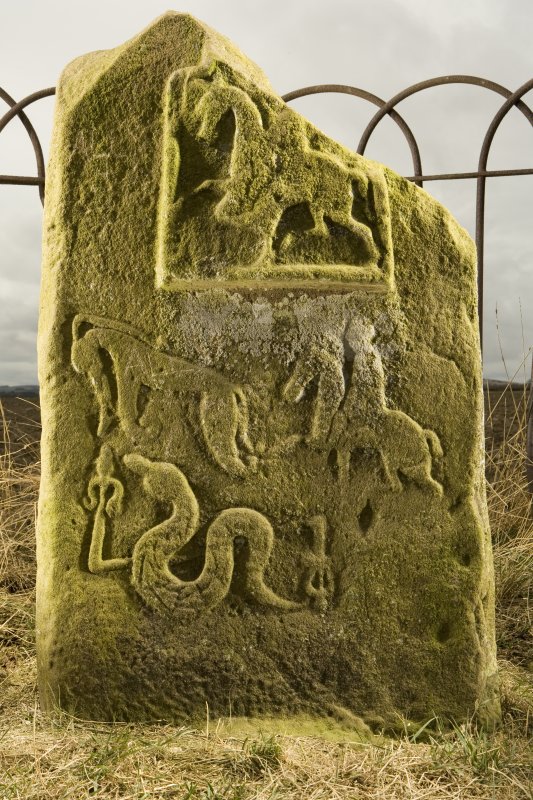
And according to Scotish (Pictish?) lore, St Martin was, just like Perun, a "Dragon (Serpent) killer"...I talked about this in my post "Balluderon stone"...


As I said in this post: 

Dragon killing is done by Perun. It is him who inflicts the deadly wound with his thunderbolt (spear, arrow, axe, club)... But Dragons are "nasty beasts" πŸ™‚ and they don't die easily...So it is at the end of autumn that they finally go "to the land of the dead"...By "coincidence" the same time when the sun goes to the "land of the dead" too...

The end of autumn, the end of harvest, Samhain, Halloween, Martinmas, Mratinci was the day when our ancestors made thanks giving blood sacrifices to their ancestors and their ancestral deity, Irish to Dagda (Chrom Dubh) and Serbs (Slavs) to Dabog (Hromi Daba)...I talked about this in my post "Thanksgiving". 

This practice of blood letting at the end of autumn, was preserved to this day by the Irish and the Serbs. It is done on Martinmas in Ireland and Mratinci in Serbia. More about that soon. Watch this space :)