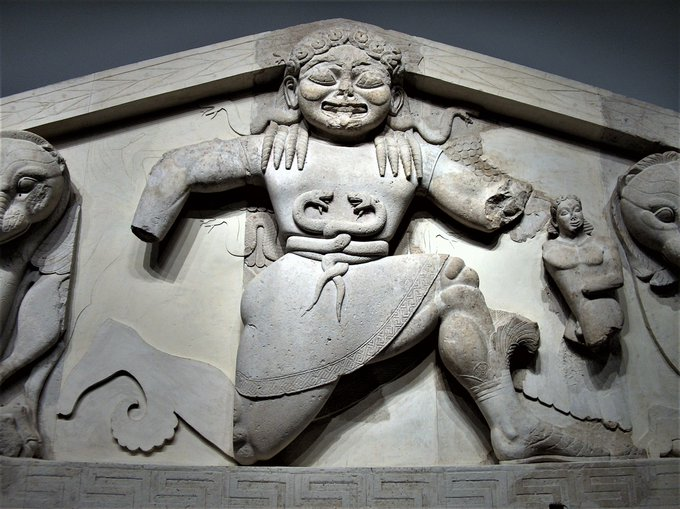
Sunday, 3 March 2024

El Argar culture

The late 3rd millennium BC, was a time of huge upheaval in Iberia. The existing social structures collapsed...When the dust settled, around 2200BC, a new civilisation, known as El Argar culture, emerged in this area...
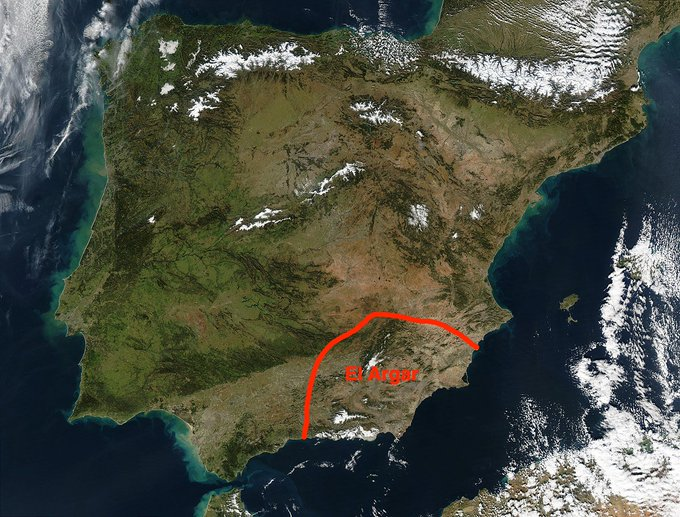
People of this culture built amazing hillforts, like the La Almoloya citadel...Which were at the time also built in Eastern Mediterranean (including Greece)...And nowhere in between...


They were metalworkers and warriors...Who were buried in single graves...Located under the floors of houses...Again feature of the cultures in Eastern Mediterranean (including Greece)...And nowhere in between, and nowhere else in Iberia...

Eventually they started burying their dead in pithoi (large grain jars)...Again feature of the cultures in Eastern Mediterranean (Greece)...And nowhere in between, and nowhere else in Iberia...


This is only possible if there was a direct maritime link between somehow culturally related groups of people in Greece and Southern Spain...We know that these kind of maritime links existed since Neolithic, so no surprises there...I talked about this in my post "Neolithic seafarers"...

BTW, these maritime routes probably facilitated extremely fast spread of Megalithic culture throughout Europe. I talked about this in my post "Childe was right"...And they stayed in use ever since...

You also might want to have a look at this post, "Giants ring", about the arrival of the first farmers to Ireland...By boat of course...

These warriors used deadly halberds as their titular weapons...Warrior grave with halberd...You can read about this in "Halberdiers and Combat Systems in the Argaric" and "The absolute chronology of Argaric halberds"...


Halberds, the scull slicers I talked about in my post "Halberds" about the reconstruction of the Bronze Age halberds from Ireland, which seem to have been propagated through a maritime trade links going along Atlantic and North Mediterranean coast.

Interestingly, El Argar warriors (apparently) could have been either ruled by women, or there was a group of elite women who could have played some significant role in the society (priestesses)...

Archaeologists came to this conclusion based on the same type of diadems found on the heads of women buried in the El Algar culture graves with extremely rich burial offerings...

For instance, burial from La Almoloya, with remains of a man aged 35-40, and a woman aged 25-30, buried with over 30 prestigious objects, many of which were made or embellished with silver and almost all belonging to the female. Including the diadem...

Hmmm...Bronze Age warrior society with high status women...This sounds so Old Europe...

My favourite bit: El Algar culture marks the beginning of complete male genes replacement in Iberia. All males found in El Algar burials are R1b, Yamna related...

Ancient human DNA from southern Iberia reveals social and genomic changes during the emergence of the Bronze Age in Europe.

Sooo...You know the story about bad macho warrior Indo-Europeans who killed all the peaceful farmer Old-European, and replaced Neolithic matriarchate with Bronze Age patriarchate and ruined everything...Things were a bit more complicated than that, it seems...

But we already saw that Indo-European vs Old-European thing is pretty much dead and buried by genetic data...I talked about this here in my post about Lengyel vs Baden culture...I talked about this in my post "So Indoeuropean"...

So more reason to laugh at the whole Indo-European vs Old-European thingy. BTW, I started laughing here, in my post "Vinca culture fortifications" about Vinča warriors (Army figurine group from Stubline)...

But the important thing for me, is that here again we have proof of long distance maritime links in Bronze Age, this time between Eastern Mediterranean and South Iberia...

Which is important when we know about Irish legends talking about Bronze age immigrants (the guys who brought R1b genes, metalwork, single cyst burials, bling...) arriving to Ireland using this maritime route...
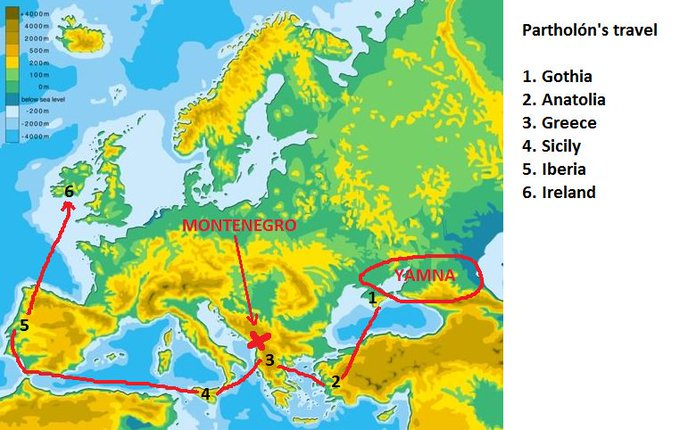

I talked about the Irish oral histories and archaeology which seems to support them in "Montenegrian tumuluses"...

See these gold discs with crosses? These ones are from the Balkans, dated first half of the 3rd mill. BC. They appear in Ireland in the second half of the 3rd mill. BC.


Halberds

One of many Bronze Age halberds found in Ireland...

You know when you were a kid, and you were told that you can't play until you finish your homework? 

This must have been how Ronan O'Flaherty felt when he started work on his archaeology PhD in UCD, Ireland...

The title of his thesis was "The Early Bronze Age Halberd in Ireland - Function and Context" and in it he tried to see if he could disprove this:

"Irish halberds have traditionally been regarded as non functional, ceremonial artefacts. In particular, the mode of hafting and the slightness of the haft head have been cited as reasons why this artefact could not have been put to any practical use"...

I know that all he wanted to do was: 

1. Cast replicas (Left) of the Bronze Age halberds from the National museum (Right), using the same copper with a very low arsenic level of 0.2%, and without cold-hammering or sharpening of the blades...


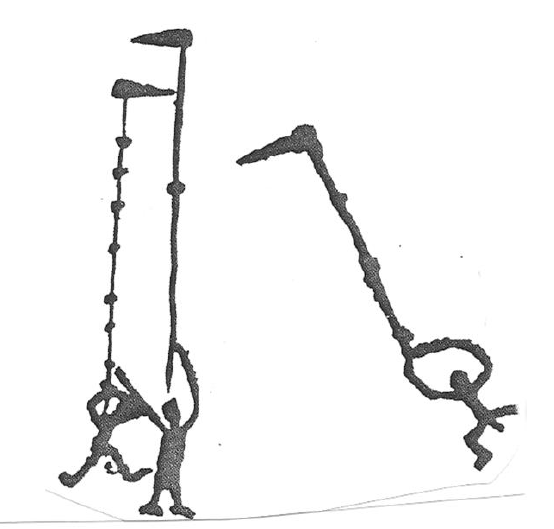
2. Haft the halberd replica (Left) based on rock carvings from Mt. Bego, Italy (Right), showing people using (well at least holding high above their heads) the original Bronze Age halberds...


3. Whack some sculls, of the same strength as human sculls, like sheep ones, repeatedly, with the replica halberds, to see what happens...

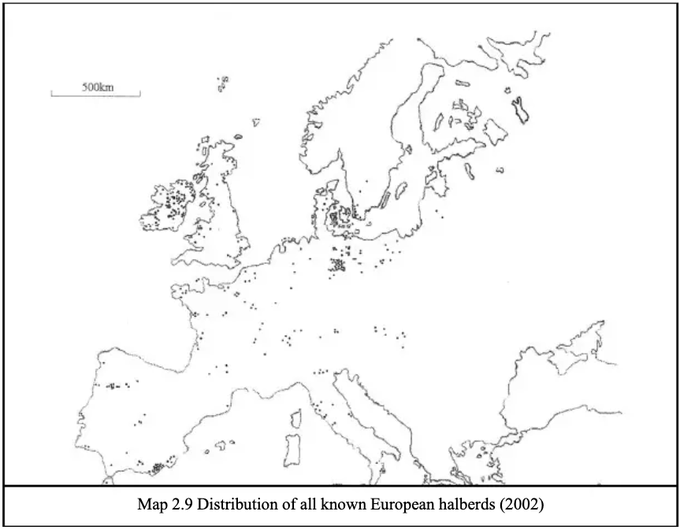
But before Ronan could do all this fun stuff, he had to do the homework...He collected all the available data about all the so far discovered European Bronze Age halberds...


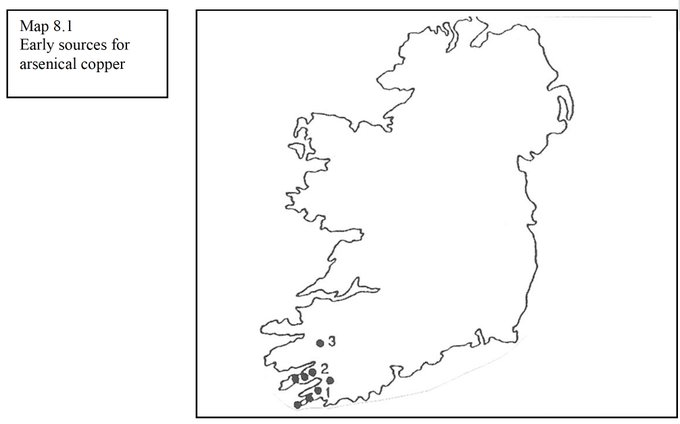
He then investigated the Early Bronze Age mining and metalworking industry in Ireland and the type of metal and metal artefacts produced during that time, so that he could try to replicate the material and the production of the Bronze Age halberds as closely as possible...

Then he investigated the hafting of Bronze Age halberds...


And finally the use of halberds in battle (from available medieval sources)...

Once he did his homework, Ronan went out to play...

And this is his report:

The replica halberd...revealed itself to be a frighteningly effective weapon, slicing skulls open with disturbing ease and proving very comfortable to handle. A short (couple of feet) chopping blow, was sufficient to pierce the skull, often very deeply indeed...

[The weapon would have been even more efficient] "if it was used by an expert", and "if it wasn't for a certain 21st century distaste of committing such violence in the first place"...Love this 🙂

Repeated blows against twenty sheep skulls, of similar strength to a human skull, failed to inflict all but the most minor damage to the halberd and there was no indication that it could not continue in such use for a prolonged period of time.

The small rounded end of the blade ensured that the full force of the blow is administered to a tiny area of the skull first, virtually guaranteeing a puncture each time.

The fact that the end of the blade was rounded rather than brought to a sharp point added strength to this area, which otherwise might have bent or even snapped on first impact.

This suggests that the blade was designed for impact on bone rather than muscle, where a sharp pointed weapon would seem more appropriate than a blunt-nosed one.

Ronan conclusion: There is no doubt in my mind that the Irish halberd is very carefully designed as a most effective weapon. [Maybe not all] Irish halberds were used in this way, but they certainly could have been and it certainly appears to be the basis for their design.

In addition, the replica halberd survives in a condition which I would categorise as "perfect" in a museum example, suggesting that even these perfect halberds could have seen some use.

Ronan's papers:

"The Early Bronze Age Halberd in Ireland - Function and Context"

"Up close and personal - impact damage on Irish helberds"

To me, most interesting bit of his work is found in boring homework section: the distribution of high concentration halberds sites  indicates that they were connected by a well established maritime trading route...

Central European Unetice culture was built around navigable rivers which empty into Baltic sea...From there you can navigate around Scotland to Ireland, Wales and England and along the French coast to Brittany, and then to Iberia, Italy, Greece...

I can bet that all the other inland sites with halberds lie on navigable rivers which empty into the seas along this route...

The existence of maritime trading routes along Mediterranean and Atlantic coast has been attested since Neolithic. 

And it was always linked with mining, first for material for stone tools and weapons and then metal for metal tools and weapons...I talked about this in my post "Neolithic seafarers"...

These maritime routes probably facilitated extremely fast spread of Megalithic culture throughout Europe. I talked about this in my post "Childe was right"...

I think this is very very interesting...Particularly when we look at the Irish oral histories, first time recorded in Medieval time, which talk about the existence of such maritime routes along Mediterranean and Atlantic coast during Bronze Age...

I talked about the Irish oral histories and archaeology which seems to support them in the posts linked from this jump page "Montenegrian tumuluses"...

That's it for today...

Saturday, 2 March 2024

Boeotian solar pyxis

Boeotian clay pyxis depicting the "Mistress of the Animals and some animals"; Late 7th century BC. Currently in the Antikensammlung Berlin


You see, it is because of "some animals" that we have no idea what most of our archaeological artefacts mean...

These are not some random animals. They are all solar symbols.

On the lid we see  two snakes.

Snake is a pure solar animal. It is in our world when sun is here (day, hot half of the year) and it is in the underworld when sun is there (night, cold half of the year)...I first talked about it in these posts: "The chthonic animal" and "Enemy of the sun", but have since then talked about "solar snakes" in many other posts, like "Letnitsa treasure", "Nude winged hero dominating snakes" "Mystery seal", "Snake god from Hatra", "Goat and snake from Kortik tepe", "Goat petroglyphs from Iran", "Pegasus and Chimera"...

Even more interestingly, two snakes have a specific meaning as a calendar marker for Apr/May, beginning of summer, domain of the sun. Why? Cause the mating season of the most common Eurasian snakes starts in Apr/May...


And which is why Hermes (who was born in Apr/May) was by Apollo (the sun god) given the Caduceus, staff with two entwined snakes...I talked about this in my post "Lyre of Apollo

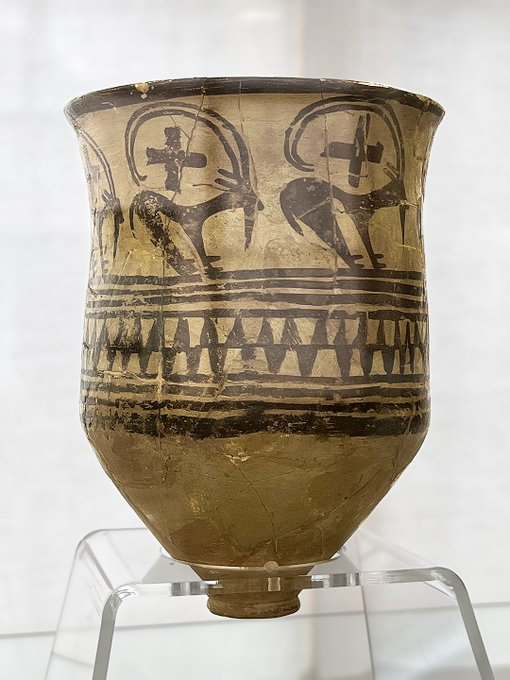
Between the two snakes we see crosses...I talked about crosses as ancient solar symbols in my post "The cross of Shamash" about this beaker, Sialk South Mound, Kashan, Isfahan, Late Calcolithic period, Sialk III7 period, ca. 3750-3350 BC, the National Museum of Iran, Tehran, Iran


In short, the cross was since the earliest times in Mesopotamia used as the symbol for the sun (god)...

And on both sides of the two snakes we see swastikas, another ancient solar symbol. I talked about it in my post "Kolo-vrt", about this ancient (officially medieval???) standing stone, Bosnia. Depicting solar wheel (swastika) and solar dance (kolo)... Pic by Kemal Čolak...


Anyway, on the sides of our pyxis, we have more swastikas, crosses and horses...Why horses?

Horses are solar animals.

Roman silver coin of the Pyrrhic war (275-270 BC) Apollo wears a laurel- wreath & a galloping horse beneath the "star".  Thanks @HawkeJon for the pics.


The "star" is The Sun...Above The Solar Horse...Symbol of The Sun God Apollo...

And articles about solar horse (equid):

Mesopotamia "Shamash playing with the solar horse"

India "Hayagriva"

China "Longma"

Europe "Archaic rider"

The reason why equids are solar animals and the reason why they are linked with Sun gods, stems from the fact that horse fertility is governed by sunlight and their mating season peaks at the summer solstice...

Sun god in his horse drawn chariot...


So, we have an interesting situation where the mating season of the most common Eurasian snakes, vipers, and the mating season of the wild Eurasian horses, the two animals depicted on our pyxis, with crosses and swastikas, both start in Apr/May, beginning of summer, the time of the year dominated by the sun...

Finally, the "Mistress of the Animals" is Artemis, the "terrible" twin sister of the "terrible" sun god Apollo...This girl: Artemis, of the original, archaic type, before people forgot her real meaning...From the Temple of Artemis, Corfu

Definitely not moon goddess here with all these snakes. And lions (wink wink, notch notch)

On our pyxis, the Winged Archaic Artemis is holding two ducks or gees...Both migratory water birds...Spring bird migration in Greece peaks during late April-early May...

The "rosettes" are another symbol of the sun...Or Sirius...Which is in the sky with the sun, during the day, between Apr/May and Jul/Aug. At least it was during the time when our mythologies were made. Will write about this soon...

But it could also just mean "spring flowering season" which in Greece also peaks in Apr/May...

Soooo...Not only are all the symbols on this Larnax solar symbols, but they also all seem to point at the same time of the year, Apr/May, beginning of summer...

To read more about ancient animal and plant calendar markers, start here…then check the rest of the blog posts related to animal calendar markers I still didn't add to this page, and finally check my twitter threads I still didn't convert to blog post...I am 9 months behind now...

Dancing with deer and birds

Medieval "stećak" standing stone, Bosnia, with the depiction of the ritual circular solar dance "kolo", meaning wheel, solar wheel, solar year. There are also depictions of birds and deer...

I talked about "kolo", also known as "oro", in my post "Kolo-vrt". 

Kolo is a common motif on these standing stones. But, it is interesting that on this stone there are 9 dancers in both groups...

I wonder if this is deliberate? Here's why:

Deer are depicted during rut, Sep/Oct/Nov, the only time when bucks can be seen with fully grown antlers and their harems of does...

These are Croatian Slavic month names...Number 9 is...

So the birds could then depict migratory birds, which leave Bosnia in Sep/Oct/Nov...

All very interesting...


Kolo-vrt

Good morning! The sun is shining, time to get up and have some fun!

Ancient (officially medieval???) stećak standing stone, Bosnia. Depicting solar wheel (swastika) and solar dance (kolo)... Pic by Kemal Čolak...

The swastika represents spinning motion...Of what? Big Dipper around the Northern Star? Possibly...But also the ever spinning solar year, as one spin of the Big Dipper around the Northern Star marks one solar year...


These are Neujährchen (New Year sweet breads) from Rheinland. They are baked fresh on New Year's Eve and are given as presents to friends and family on New Year's morning. Apparently they represent solar year with 4 seasons...

Same curly swastika was found on solar bread from the Balkans. I talked about them in my post "Solar breads from Croatia"...

I talked about solar bread representing solar wheel in my article about Koloocheh, Persian ceremonial New Year cakes. In the article I talk about the origin of the name Koloocheh and about Slavic kolač (kolach) ceremonial wheel shaped cakes and breads...

The spiral on the Koloocheh also represents a spinning motion...

The word "kolač" comes "kolo" (wheel, spinning circle). Hence "kolo" also being the name for the Slavic ceremonial circular dance...

The depiction or the Serbian circular dance "kolo" or "oro" from the 14th century Serbian monastery Lesnovo which is located in today's Republic of Makedonija...It is danced "under the sun"...Or god...  

I talked about this in my posts "Oro" and "Shield of Achilles"...