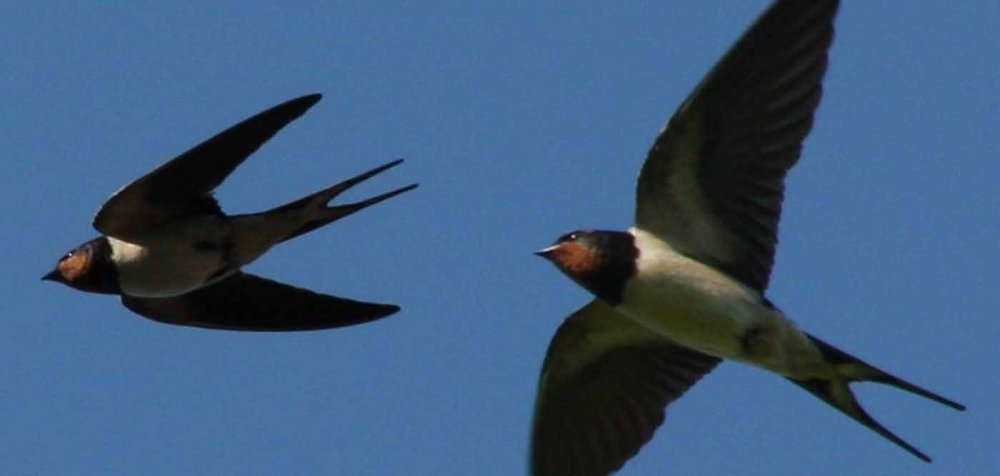
A swallow tattoo means 5000 nautical miles a sailor has traveled. For regular seamen, this is about 5,750 miles (ca. 9,254 km).
This article is about swallows as animal calendar markers for the beginning of the sailing season in Ancient Rome, about Isis, as the goddess of the sea, and about the climate change...and roses...
A group of children, somewhere in Greece, holding wooden spinners decorated with flowers, with a model of a swallow on a spindle, acting as a weathervane. They are getting ready to sing the "swallow song", a song welcoming swallows as the heralds of spring...
You can actually hear the children singing the "swallow song" in this documentary:
Χελιδονίσματα στο Σιτοχώρι Σερρών την 1η Μαρτίου 1967
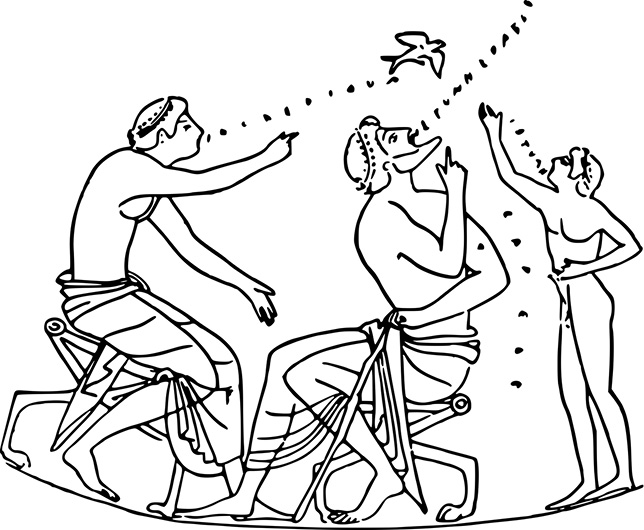
Athenaeus of Naucratis (3rd c. CE) writes that after the first swallow was spotted, the Rhodians would hold a festival.
During the festival the Rhodian children would sing:
He comes! He comes!
Who loves to hear
Soft sunny hours, and seasons fair:
The swallow hither comes to rest
His sable wing and snowy breast.
The children then ran to different houses and "played the swallow", demanding food.
Ashleigh Green then goes on to talk about animal calendar markers 🙂 without knowing that she is talking about animal calendar markers: "In ancient times, people did not rely on calendars or clocks to tell them the time or the passing of the seasons..."
"...They watched and listened to birds. Cockcrow heralded sunrise and roused them from sleep; cranes migrating told them it was time to sow; and swallows returning from worlds unknown told them spring had arrived."
And then she says: The sailing season was also marked by the swallow’s return. Taking the swallow’s appearance as their cue, centuries of Greek poets sang to sailors to weigh anchor and unfurl the sails...the swallows are here. Winter storms have passed, it is time to go to sea.
These poems are written by Leonidas, Antipater of Sidon, Marcus Argentarius, Thyillus and Agathias Scholasticus respectively, and although they stretch from the third century BCE to the sixth century CE, they are almost identical in form and substance.
Such evidence suggests that swallows truly were linked as closely to sailing as to spring. The spring wind was even called chelidonia after the swallow, and Horace suggests that the swallow actually helps to calm the sea...Very interesting...Why would people believe such a thing?
Cause the return of the swallows from Africa in Mar/Apr and their nesting in Apr/May coincides with the change of wind. Sun, heating up the Eastern Mediterranean, creates an updrift, which sucks the cooler air from Europe to start streaming southward, creating the etesian winds.
This table, from a South Aegean Yachting site, gives directions of the prevailing winds in Aegean sea during the sailing season: Apr-Oct...Even today, with much better boats, this is the safe sailing season...
I talked about Etesian winds and the sailing in the Eastern Mediterranean in this post about "Three sacrifices" performed during the Trojan war.
7th c. BC Mykonos pithos. It contains the oldest depiction of the Trojan Horse, the way Homer described it in Iliad
So, swallows return, start nesting, it's time to go sailing...Another animal calendar marker embedded into mythology. Swallow was apparently a holy bird of Isis, who also apparently, had a control of the sea, and was the goddess people prayed for calm waters and good winds...
The swallow was also associated by the Ancient Greeks, and the Romans, with "euploia" (a pleasant voyage). Indeed it is attested that during the Roman festival Navigium Isidis, the festival in honour of Isis for good sailing, the devotees held models of swallows...
The Navigium Isidis was an annual Roman religious festival, held on March the 5th, in honour of the goddess Isis, when people prayed for the safety of seafarers and then a model of a ship was carried in a procession from the local Isis temple to the sea or to a nearby river...
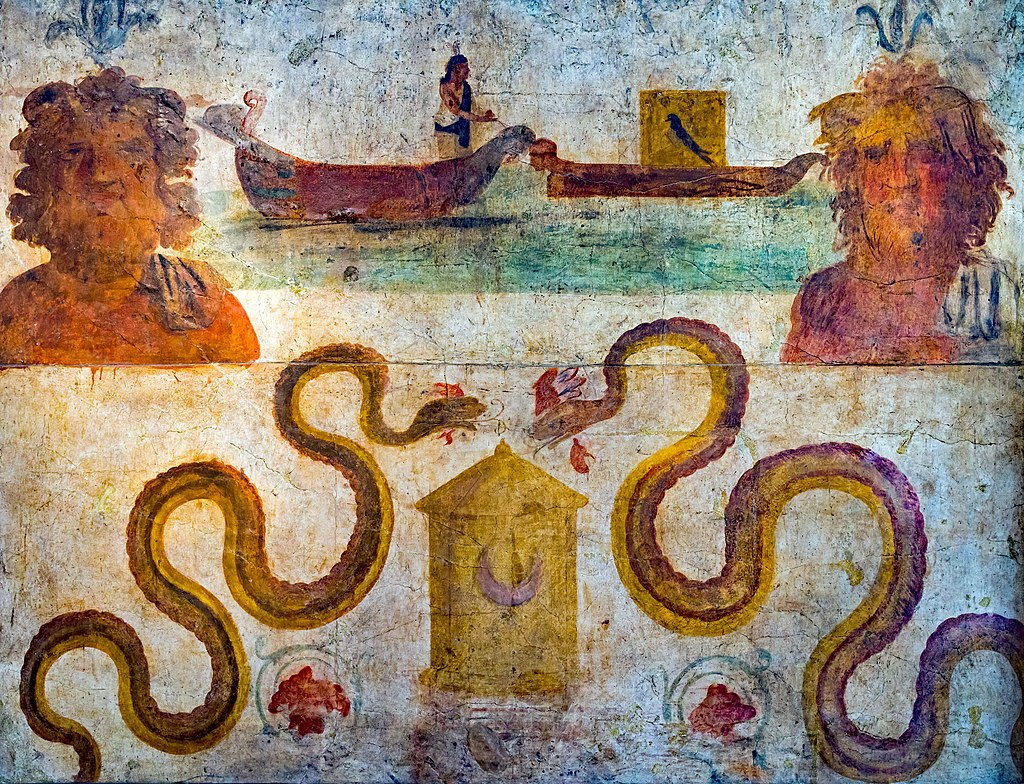
This is a fresco from the sanctuary of Isis in Pompeii, currently in the Museo Archeologico Nazionale, Napoli. It depicts cista mystica between two snakes (similar to a lararium) and above it navigium Isidis (boat of Isis) on the left and another boat with a swallow in it...
Why did sailors pray to Isis for calm seas and good winds? In the article entitled "Isis, goddess of the seas and the Navigium Isidis, Celebrate the beginning of the maritime season with Isis" by Rhakotis Magazine we can read:
By the Roman period, Isis has become the predominant sea goddess to such an extent that her festival marked the official beginning of the sailing season across the empire. This seems strange when we consider the fact that Egypt was not known for its maritime prowess.
River sailing was an important aspect of its society and economy for millennia. Indeed, the sail may have first emerged from Egypt, with south blowing winds powering ships up the Nile against the current. Yet Egypt did not really have any sea gods for much of its early history.
It was perhaps outside of Egypt that the association of Egyptian gods and the sea first began. Byblos was an important trade center with Egypt for centuries. A text from the Middle Kingdom calls Hathor "Mistress of Byblos [who] holds the rudders of barques" (!!!)
During the New Kingdom Isis took over more and more functions of Hathor, ultimately becoming the predominant goddess in the Egyptian pantheon. About this time, she also became the Egyptian goddess in Byblos, "taking over" Hathor’s maritime goddess role.
Very interesting...
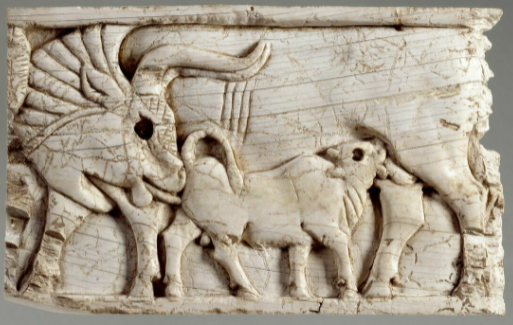
I talked about Hathor as a deified animal calendar marker for Apr/May, the beginning of the calving period of the the wild Eurasian cattle in my post "Cow and calf ivory". Which is exactly when etesian winds start blowing in the Eastern Mediterranean...
Navigating the Nile was fundamentally a seasonal occupation, closely tied to the cycle of the flood. Changing water levels meant variable navigability in the river channel, especially for larger cargo vessels. The optimal time for sailing was during the height of the inundation.
Even in the main channel of the Nile, water levels effected navigability. A dwindling river made sand banks an increasing hazard, threatening not only to block a vessel’s passage, but also to trap it and, at worst, capsize and wreck it...
By happy coincidence, it is also during this high-Nile season that the maxim of ‘current from the south, wind from the north’ is most valid. The Nile valley and the Nile Delta are subject to two quite different wind regimes.
In the Nile valley, northerly winds blow year round because of the cyclonic highs that sit over the Sahara desert year round...
In the Delta, northerly winds blow only during the summer...because the Delta is under the influence of Mediterranean weather systems...
And so, if you wanted to sail up the Nile delta and then further up the Nile river, you had to wait for Hathor, the holy cow to give birth to a holy calf in Apr/May. And then when the water level of the Nile starts to rise, in Jun/Jul, catch the northerly wind and sail south...
So is this why Hathor was associated with sailing and was the Goddess "who holds the rudders of barques"? And why Isis, Hathor's replacement, was known as the Goddess "that opens the seas"?
For the end I want to ask two questions:
Why was Navigium Isidis celebrated on the 5th of March, when all the old Roman texts tell us that the safe sailing season in the Mediterranean was Apr to Oct? In Ships and Fleets of the Ancient Mediterranean, J. Rouge summarised the problem of winter navigation as follows:
Vegetius (fourth century AD) says that the seas were (generally) closed between Oct/Nov and Apr/May
And in this article, Oded Tammuz goes on to propose that even though the main sailing season in the Mediterranean was Apr to Oct, the sea was never really closed. Here are 5th century BC Egyptian customs records, noting down ships that arrived to the Elephantine harbour.
We also have many Roman sources which say that opportunistic captains would sail outside of the main sailing season, because the gains that could be made were very high. But so were the risks...I wonder how many Mediterranean shipwrecks are ships trying to sail the closed seas?
Romans started celebrating Navigium Isidis, around 100BC. Now I wonder if the reason why the Romans celebrated the opening of the seas at the beginning of March, was because the Mediterranean sea was around 100BC indeed fully navigable in March. Due to climate change...
This chart shows polar temperature variation in last 10,000 years. We can see that the temperature has been going up and down madly all the time. And one of the big temperature spikes, which centres around 100BC, when Navigium Isidis became a thing, is marked as Roman warming.This warming must have affected the weather in Mediterranean. Making sailing safe a month earlier, in March? I think so. Which is why Navigium Isidis was celebrated on the 5th of March...
And here I come to the second question: Are there any roses blooming in Italy and Greece on the 1st of March?
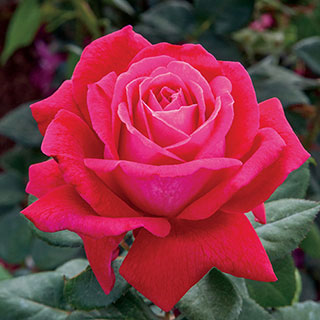
Why am I asking this? Because, according to Lucius Apuleius, who in the 2nd c. AD wrote "The Golden Ass", roses were already blooming on the 5th of Mar during his time.
The Golden Ass is a story about certain Lucius, who drank a magic potion which accidentally turned him into an ass. He spends the rest of the book trying to turn back into a man. Finally, he succeeds on the day of Navigium Isidis...
The night before the festival of the opening of the seas, Lucius, still an ass, is on the seashore watching the moon emerging from the sea. He prays to Isis to turn him back into a man.
He then falls back to sleep, and dreams (has a vision) of the goddess herself emerging from the sea. She tells him tomorrow there will be a festival "when the ocean’s storm-blown waves are calmed".
And then she tells him: "My priest...will be carrying in his right hand as part of his processional equipment a sistrum wreathed with a garland of roses...Approach the priest and...gently take a bite of the roses".
Here is a fresco from the Temple of Isis in Pompeii depicting priestesses of Isis holding a sistrum...Currently in the Naples National Archaeological Museum.
And so, on the morning of the 5th of Mar in the middle of the 2nd c. AD, an ass turned into a man on the streets of Corinth after eating a rose. Just like the Goddess Isis told him it would happen...
Today, in Italy and Grece, as far as I know, roses start blooming in Apr/May. Maybe (big maybe) you can find them blooming at the end of Mar. But, it is very unlikely, that a donkey wandering around Corinth on the 5th of Mar today would be able to find a blooming rose and eat it.
Yet Lucius Apuleius wrote that donkey ate a rose on the day of the opening of the sea, and no one batted an eyelid...Like of course, why wouldn't it? Roses are already blooming in and around Coritnh at the 5th of March. Everyone knows that...
Interesting right? Roman warming? Also, did you know that equids (horses and asses) start mating in Apr/May, at the beginning of the "safe sailing season"? Interestingly, all Eastern Mediterranean sea gods seem to be obsessed with horses...I talked about this in my post "Trojan horse"...
A type of merchant ship which had horse figurehead on its prow and which Greeks called "hippos" (horse), and used for delivering tributes...
And finally...I wonder if all this assing around in Golden Ass is kind of symbolic, in a calendaric kind of way? Maybe someone should look into it...That's it...That's all I have to say about that...
Thank you an I hope you enjoyed this meandering article, originally published as an X thread.
Spouted silver bowl decorated with entwined serpents. Southeastern Iran Mid 3rd millennium BC. From Al-Sabah collection.
Why was this vessel decorated with entwined serpents? Here's what I think:
I already talked about this type of vessels in my post "Elamite water bull" about this Proto-Elamite silver figurine of a clothed anthropomophised kneeling bull...holding a spouted [water] vessel. c. 3000BC. Currently in the Met Museum...
My guess that this figure is either Enki (Sumerian god of sweet water) or Utu (Sumerian sun god)...Or their unnamed Elamite equivalent who possibly combines both of them in one...
They were both described as bulls. Why?
These are yearly charts of the water levels in Tigris and Euphrates. You can see that they both peak in Apr/May, Taurus, Bull...
BTW, Taurus here is The Old Taurus, the animal calendar marker for the beginning of the calving season of wild eurasian cattle...
This rise in water levels in Tigris and Euphrates is the result of the sun heating up of the mountains which are the source of the two great rivers: Anatolian highlands and the Zagros mountains...Which causes the snow to melt, which causes the rivers to swell...
Snowmelt, Zagros
Hence the humanoid bull holding a spouted water vessel...Which looks just like the vessel from the Al-Sabah collection...
I talked about another water carrier figurine from Iran in my post "Water carrier equid", about this "Spouted Anthropomorphic Vessel", Western Iran, circa 1000-650 BCE. Currently in Los Angeles County Museum of Art...
Here the anthropomorphised animal water carrier is not a bull but an equid, horse or a donkey. Why? Cause equid mating season, starts in Apr/May, right when the water discharge peaks in the rivers in Mesopotamia/Iran...
But why was the vessel from the Al-Sabah collection decorated with entwined serpents?
First, snake is a solar animal, pretty much a universal symbol of the sun's heat. Snakes follow sun everywhere. They are in our world when sun is in our world (day, summer) and in the underworld when the sun is in the underworld (night, winter)...I talked about this in many of my posts. For instance "Snake god from Hatra"...
And it is the sun's heat that melts the snow...
Second, snake mating season, when snakes intertwine, starts in Apr/May, the time of the peak snowmelt runoff in Iranian mountains, and the peak discharge of the rivers in the Tigris/Euphrates system...
Which is why in the Deliver Me from Evil: Mesopotamian Incantations, 2500-1500 BC, By Graham Cunningham, we can read that in the Earliest Sumerian texts, Enki, the god of sweet flowing water and the source of Tigris and Euphrates, was associated with poisonous snakes...
“Twenty different officiants are attested in connection with Napiriša. Their designations vary from simple šatin (4) and makuš (7) to (makuš) pirramadda (3) and (makuš) haturmakša; their names are all Iranian except for two.”
“Elsewhere, the same individuals are associated with a range of other sacrifices, including sacrifices for or at various mountains, for Adad, Auramazdā, Išpandaramattiš, and (the) Mišebaka.”
(‘The Heartland Pantheon’, Henkleman, pg 1229)
“The syllabic spellings of the name (AN na‐pír‐šá‐ra, AN na‐pír‐ir‐šá‐ir‐ra) follow the development riša > irša, “great,” suggesting that the name of the god was still understood as a compound (logographic spellings: AN dingir.gal MEŠ, AN gal MEŠ).”
The origins of Napiriša, attested since the early second millennium BCE, may lie in the eastern highlands of Elam. This may also account for his popularity in the PFA*.
The water‐giving god and his wife are shown here at the open‐air sanctuary of Kūrāngūn:
It’s majorly held for the figures above that they are Napiriša (or Napiriša‐Inšušinak) and his spouse Kiririša, the ‘Great Goddess’ of Liyan/Būšehr.
Also, Mesopotamians identified “Naprušu/Napriš” as their own Ea/Enki.
(‘The Heartland Pantheon’, Henkleman, pg 1228)
*Persepolis Fortification Tablets
This deity is attested for 26 times and given Iranian epithets.
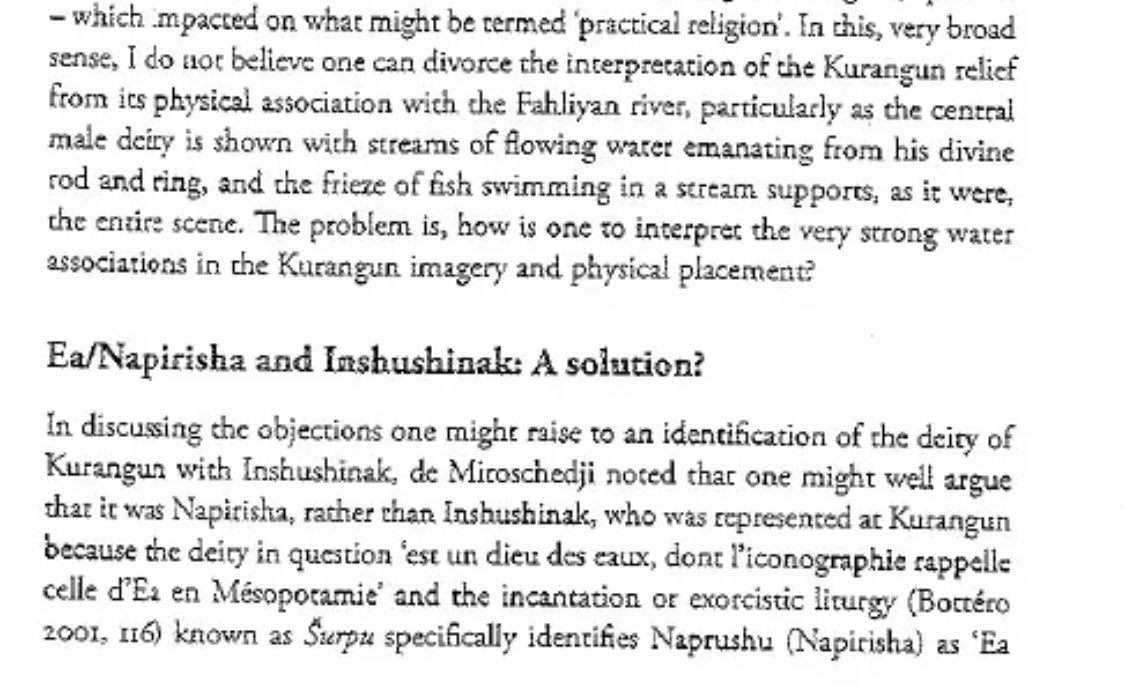
Here’s the Kurangun relief, which depicts a horned Elamite deity seated upon a snake-coiled throne. 17th century BCE. It’s in Fars, Iran.
“He is seated on a throne formed by the body of a snake, coiled back upon itself over and over again, and he grasps the tail of the snake in his left hand. In his right he holds the divine rod and ring [my comment, he is not holding rod and ring, he is holding a cup, just like Enki/Ea] from which two streams of water flow [...]”
"In terms of identification, he has been called Inshushinak, who was the patron of Susa anyways. Enki/Ea/Napirisha are mentioned as well; the author deduces that these names/figures are all in fact related, with the former being used as epithets, besides the shared identity"...
Just learned about Nefertem, the Egyptian Beautiful Boy, originally a lotus flower at the creation of the world, who had arisen from the primal waters.
Nefertem emerging from the lotus (blue water lily) blossom, from the tomb of Tutankhamun. Pic: Margarete Büsing...
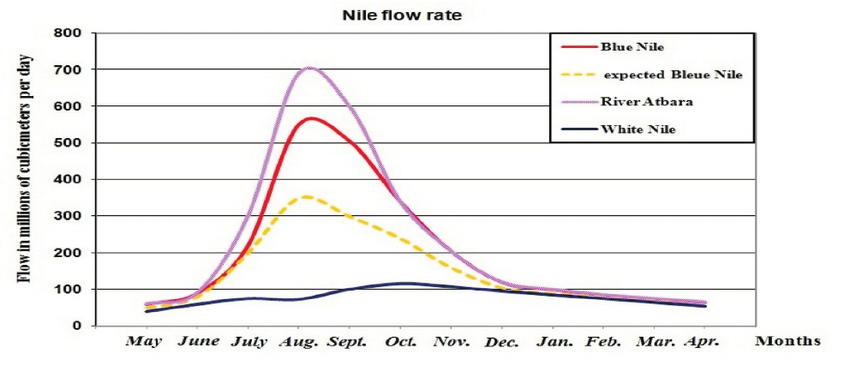
Now, blue water lily flowering season, Jul,Aug,Sep, is the same season when the Nile water level reaches its peak. During the annual Nile flood...
So I wonder if "lotus flower at the creation of the world, who had arisen from the primal waters" just means: "lotus flower who arrises from the waters of the Annual Nile Flood"...
The Annual Nile flood is after all what originally created Egypt and "The Egyptian World"...Without the annual Nile flood there would be no Egypt...
The time of the Annual Nile Flood is also the hottest time of the year in Egypt...Hence Nefertem's epithet "Water-Lily of the Sun"...
Aug, Leo, is also the time of Lionesses of the Eye of Ra, like Sekhmet...I talked about this in my posts "Holy cow" and "Baboon"...
Which is very interesting, cause apparently Nefertem also had a warlike aspect and could be depicted as a lion. And his mother was no other than Sekhmet...
He was most commonly represented holding a scimitar with a falcon’s head and wearing a headdress of a lotus with a menat (ritual necklace counterpoise) on each side and a pair of plumes above.
So I wonder if Nefertem has anything to do with this old post of mine "Golden boy" about this inlaid ivory panel depicting "lioness devouring a boy"...From the palace of Ashurnasirpal II, ca 899-700 BC. Currently in the British Museum.
Who is the golden boy depicted here? And who is the lioness?
This article was originally an X thread. So are most of my articles actually, as I publish all my stuff on X first. But this thread is different, as in it I wanted to show how I do my research and how fast you can find things if you know what you are looking for...
Before I saw this post 6 hours ago, I had never heard of "Meroitic language" and have never seen one of these objects before. But I had a funny feeling that I knew what was depicted on it...So I did some googling, and it turns out I was right.
Check this out:
So my hunch was that the relief depicted some kind of connection between water (obvious, as the wavy lines are water bing poured out of the two jars) and summer solstice (not so obvious, but these two jars, for some reason, reminded me of the "twins symbol")...
Twins which mark summer solstice...I talked about these twins in several of my articles. First in my post "Hayagriva".
Surya's wife Saranyu transforms into a mare and runs away from her husband. Surya eventually finds her, turns himself into a white stallion and...
After which Saranyu delivers horse head twins called Ashvins...
Horse zodiac symbol is disguised as Dioskuri, divine twin horsemen. The guys who wanted to marry "the daughters of the white horse".
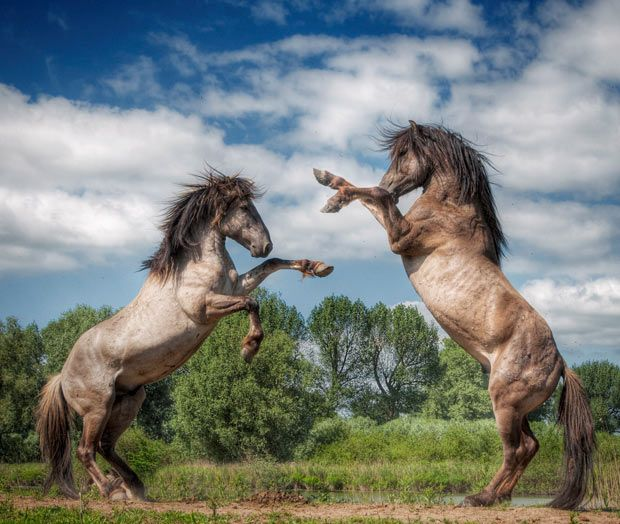
They mark Summer Solstice, the peak of the horse mating season, characterised by wild stallion fights for mares...
We find them in Sasanian Iran, on this plate with youths and winged horses drinking water from a jar ca. 5th–6th century AD. I talked about this in my post "Dioskuri plate from Iran"...
In Mesopotamia (no horses in site), they appear as these two charming gentlemen: Lugal-irra and Meslamta-ea, "who were both closely associated with Nergal, and could be either regarded as members of his court or equated with him"...
These two dudes "typically appear together in cuneiform texts and could be described as the "divine twins", and were linked to Gemini constellation. They were regarded as protectors of doors, "possibly due to their role as the gatekeepers of the underworld"...
Hmmm...Twins guarding doors (of the underworld)? This looks like a door to you?
Very interesting, knowing that right after the summer solstice, we enter the hottest time of the year, Jul/Aug, the domain of Nergal, the god of the underworld...
In Central America we find Hero Twins who pour the water of heaven (rains there arrive in Jun/Jul). I talked about this in my post "Resurrection of the maize god"...
And finally, and most importantly for our current thread, we find them in Egypt, where god Hapi, the god of the annual flooding of the Nile, was "often depicted as twins, tying papyrus and lotus flowers together". Papyrus flowers in Apr/May (beginning of summer), and lotus in Jul/Aug (end of summer) and the knot the twins tie is...Summer solstice...I talked about him/them 🙂 in my post "Lotus and papyrus"...
Anyway, now that you know why I thought twins were important,
So, I first went on the museum website and I found the official description of the object here:
"Offering table, from Ballana, dates to Meroitic phase IIIB-IV, decorated in relief with two kohl jars and four loaves and has a Meroitic inscription"...
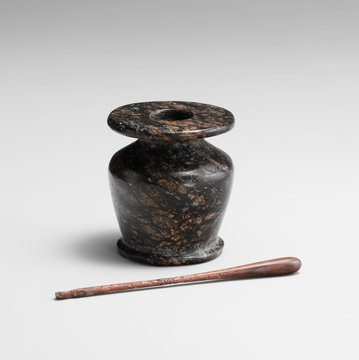
So I then went to find out what the hell were "kohl jars". Well, they were jars, like this one from New Kingdom, dated to 1492–1473 BC and currently in Met Museum.
Used for storing kohl, an ancient eye cosmetic, made by grinding stibnite.
The Ancient Egyptians (both men and women) wore kohl on their eyelids as protection against the glare of the sun. Outlining the eyes could also have been a way of drawing a protective amulet, such as the Wadjet Eye, right onto the skin.
Anyway, I couldn't find any link between kohl and kohl jars and water, so I was about to give up and write this off as a false hunch, but I decided to just do one last thing and check where exactly was the Meroitic language spoken.
It was spoken here. In the area between today's Aswan in Egypt and Khartoum in Sudan...
And so, in the spirit of "if all you have is a hammer (animal calendar markers), everything looks (actually is) like a nail (deified calendar)", I went to check the local climate...
And what is very interesting about this part of the world is that it has a very long dry season and very short wet season, and that the rains arrive right around...summer solstice...
So my hunch that the two jars with water pouring out of them somehow links water and summer solstice (and the start of the rain season) was right...
Which would then explain what is depicted on this very interesting offering table (altar), Ptolemaic Period, 306–30 BC. Northern Upper Egypt, Dendera, currently in the Met Museum, New York...
The flowers depicted on this altar are Sacred (blue) lotuses...
Which bloom during the annual Nile flood.
I wrote about the calendar marker meaning of these flowers in many of my posts...
Now look at the above rain chart and the above water flow chart. They overlap...Which means that the two jars are also linked to the start of the flood season...
But what does this have to do with kohl jars? Nothing. University of Chicago was wrong. These were not kohl jars at all. They are hes-vases...
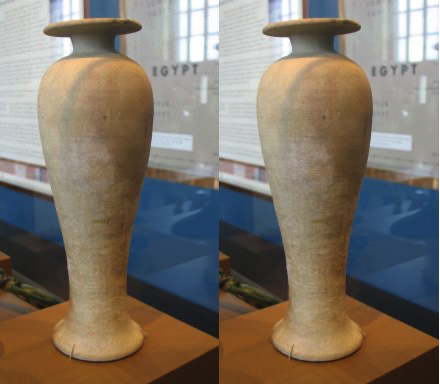
Here is one, currently in the Brooklin museum, from the Old Kingdom to 18th Dynasty. I have no idea how I came across this page. AI decided to help me I guess...I doubled it so you can see how they resemble the vases from the offering table...
The hes-vases were special vessels used to hold ritually purified water. These containers were frequently left as tomb offerings so the deceased could drink the water...
Thirsty dead? Again? I talked about the "thirsty" dead first in my posts "Drought" and "White feast" about South Slavic beliefs that the dead are linked to rain and grain fertility...And that thirsty ancestors will "drink rain from the clouds and will cause drought".
I then talked about "thirsty dead" in my post "Lapis Manalis" about Roman belief that the dead are linked to rain and grain fertility...BTW, do you see the similarity between cup and ring marked stones and rain caused ripples on water? Or is it just me?
I finally talked about "thirsty dead" in my post "Care of the dead" about Hittite and Sumerian belief that the dead are linked to rain and grain fertility...And if you forget to respect the sacred bond with the dead...
Hmmm ritually purified water...Was this purification intended to turn water back to rain? The pure water that falls from the sky that can be drank without fear of diseases?
So we have water pouring out of hes-vases, which normally contain water for the dead and loaves of bread...Again we see the link between water, the dead, rain and bread...
(This was not in the original thread, but I just remembered this thread:
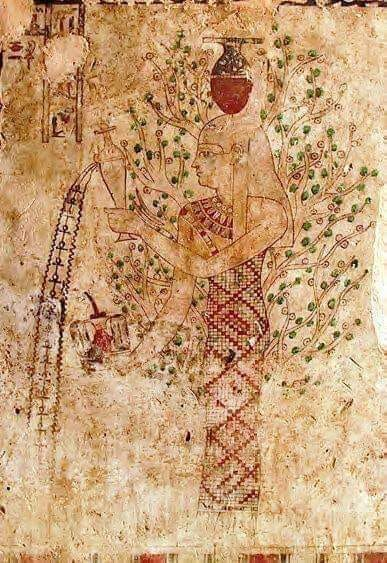
Sycamore tree goddess, originally Hathor, and later Isis, both goddess of flood, pouring water which is depicted with ankh (life) symbols inside it...Tomb, Siwa Oasis, 400-600 BC. Egypt...Is she pouring water of life from a "Hes-Vase"?
Now I was wondering why would water from the twin vases be pouring on the two loaves of bread. Maybe there is some kind of cereal that directly depends on the rain that starts falling around summer solstice...
And It turns out I was right again...Sorghum is a staple crop in Sudan. Sorghum grows during the rainy season (Jun-Sep). Once harvested, it is ground and stored for the dry season...and is used to make kisra flat breads...
And just when I decided I had found enough info to write this thread, while I was looking for a nice pic of traditional sorghum kisra flat breads, I stumbled across "Sky and Earth – A Nuba Mountains Folktale"...
Nuba Mountains lie just below Khartoum, and this story proves conclusively that my hunch about the twin(s) jars was 100% right. Here it goes:
“At the beginning of time, the sky and the earth lived together as one..."
"...The Nuba people remember a day when a young woman from the Nuba was grinding sorghum on the grindstone. As she worked, she unintentionally struck the sky with her elbow. The sky was insulted and decided to leave the place and take up residence far away from the earth..."
"...The people were unhappy about this and did not know how to continue their lives which had become gloomy and miserable without the sky, its rainy clouds and its shining sun..."
"...They held a meeting and agreed to send an envoy to the sky to persuade it to come back. The envoy somehow managed to convince the sky to come back. It agreed on one condition: that it would return only once a year and would be invited to return each time..."
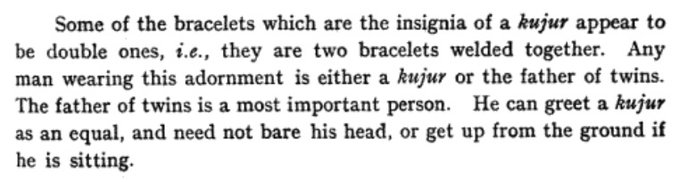
"...This is how the seasons were created and how the Nuba Mountains received their first Kujur, the rainmaker, who since that time has continued to mediate between the earth and sky. The kujur has passed on his ability to make rain to his children and the children of his children..."
The only person equal to the Kujur is "a man who fathered twins" as "father of twins is the most important person"...Why? The only explanation is that the ancient Sudanese associated rain season with twins...Gemini...
Neat...Oh and in September, right after the rains stopped and the first harvest started, Nuba people hold Kambala festival, which celebrates the harvesting of grain and is associated with initiation rites for young Nuba men.
And we know that rain is linked with grain, semen and male fertility...
PS: Dear @ISAC_UChicago I would really like to know what is written on this offering table, if you know yourself. But I find it interesting that in Meroitic language
at(a) means "bread" and ato means "water"...
PS: please correct the object's description...
That's it. It took about half an hour to find all this info...