Showing posts with label Khnum. Show all posts

Sunday, 8 March 2020

Menat


Have a look at this object.


This is a "menat" (a musical instrument/amulet) which consists of this strange phallic thingy to which a bunch of beads were attached to.


This instrument/amulet was worn by the Holy Cow Hathor/Mehet-Weret. In fact Menat was another name for Hathor. 


The above one, was made between 664 and 380 BC. On top of it we see the lion headed goddess Tefnut (another face of Hekhmet, another face of Hathor) on the left, with a solar disc and cobra on her head, and her husband-twin brother Shu on the right, with ostrich feathers on his head. 

Tefnut carries the solar disc and the snake because the sun's heat, represented by a snake, is the strongest at the end of July beginning of August, during Leo. 

But why is Shu carrying ostrich feathers on his head? 

Well ostrich mating season begins in March or April and ends sometime before September. During that time male ostriches become aggressive, fight with each other for harems and make loud booming mating sounds...

This is exactly the period when rain season starts in Ethiopian highlands. We see increase in rainfall starting from March, and then the arrival of the full blown monsoon starting from April/May/June, depending on the season...


So at the top of the Menat we have wind and moisture producing monsoon. 

This monsoon empties on Ethiopian highlands during the ostrich mating season. The rain water accumulates in the catchment area of the Lake Tana, the largest lake in Ethiopia, and it flows out as Blue Nile...


It then flows down towards Egypt as the Great Flood...

I think that the circular bit at the bottom represents the Great Flood. The circle is the summer sun which fills the Nile with water...

What is interesting is what is depicted inside the circle:

A strange looking fish with a huge dorsal fin, swimming at the bottom of the river or lake, near a flowering papyrus marsh. 
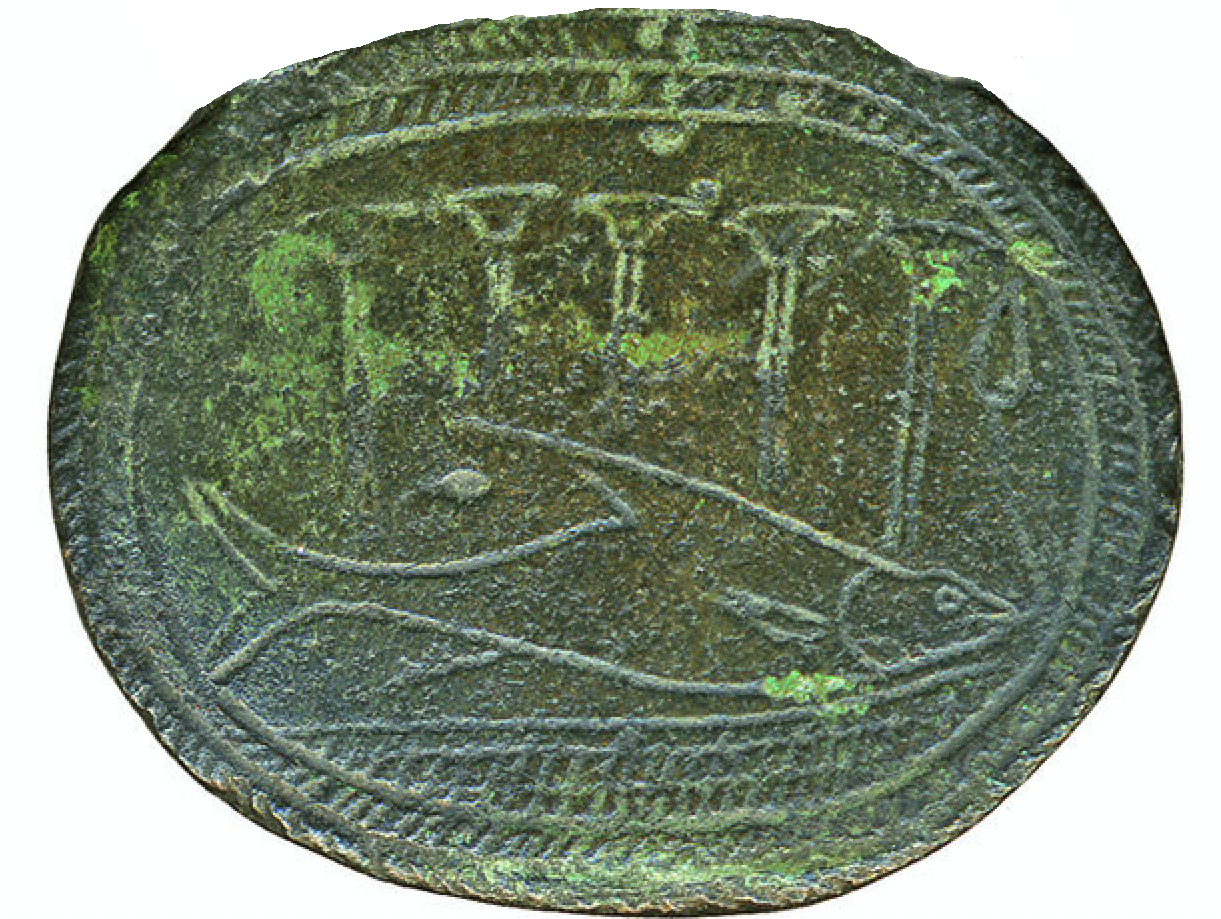


The strange fish is not just a bad fish doodle. It is a very precise depiction of a  Labeobarbus bynni, the Niger barb, Nile barb, a relatively large fish, up to 82 cm in total length and with a distinctive top fin. It is found all over the Nile river. 


This was one of three main fish species caught and eaten by Ancient Egyptians, together with Nile perch and Nile tilapia.

This fish was not chosen randomly. The Nile barb spawning (mating) season is March-April, right at the time when the first rains start falling in Ethiopian highlands. And flowering papyrus? 

So why was papyrus so important? As I explained in my post "Holy Cow" the main papyrus flowering season is April...Right at the time when Nile Barb spawns (swims along the bottom burying eggs into the gravel)


Another interesting detail on this Manet is the "squatting figure of the ram-headed sun god" (according to the official description) figure just above the circular part. 


The description alludes at Amun. The god of wind and the creator god. Following Amun's ascendancy during the New Kingdom, he was hailed as "The Self-created One" and "King of the Gods" who had created all things, including himself. But I don't think this is Amun. Before there was Amun, there was another ram headed god. Another creator god who created everything including other gods. Khnum


He was one of the oldest Egyptian deities. And guess what: he was venerated as the god of the source of the Nile ðŸ™‚ Is this cool or what? I talked about this good in my post "Khnum" and there I explained why he was depicted as a "ram" (???) headed deity. 

The horizontally twisted horns show that we are dealing with a ram of the species "ovis longipes palaeoaegyptiacus".


This was the earliest type to be domesticated in Egypt, but became extinct sometime in the New Kingdom. Nevertheless, the shape of the horns was preserved even in later depictions of Khnum. Now here is the interesting bit. We have no idea what this "ovis longipes palaeoaegyptiacus" was or whether it was even a sheep or a goat. Regardless, the only two potential candidates, for the place of the "ovis longipes palaeoaegyptiacus" both have their young during April. The time when the first rains, represented by Tefnut and Shu, arrive to Ethiopian highlands. Right when papyrus flowers and right when Nile barb spawns...

Tefnut and Shu, the creators of all life...


Interesting artefact indeed ðŸ™‚

Sunday, 28 April 2019

Khnum

The flooding of the Nile is the result of the yearly monsoon between May and August causing enormous precipitations on the Ethiopian Highlands whose summits reach heights of up to 4550 m. Most of this rainwater is taken by the Blue Nile and by the Atbarah River into the Nile, while a less important amount flows through the Sobat and the White Nile into the Nile. During this short period, those rivers contribute up to ninety percent of the water of the Nile and most of the sedimentation carried by it, but after the rainy season, dwindle to minor rivers.


Apparently, these facts were unknown to the ancient Egyptians who could only observe the rise and fall of the Nile waters. The flooding as such was foreseeable, though its exact dates and levels could only be forecast on a short term basis by transmitting the gauge readings at Aswan to the lower parts of the kingdom where the data had to be converted to the local circumstances.

The Egyptian year was divided into the three seasons of Akhet (Inundation), Peret (Growth), and Shemu (Harvest). Akhet covered the Egyptian flood cycle. This cycle was so consistent that the Egyptians timed its onset using the heliacal rising of Sirius, the key event used to set their calendar.

The first indications of the rise of the river could be seen at the first of the cataracts of the Nile (at Aswan) as early as the beginning of June, and a steady increase went on until the middle of July, when the increase of water became very great. The Nile continued to rise until the beginning of September, when the level remained stationary for a period of about three weeks, sometimes a little less. In October it often rose again, and reached its highest level. From this period it began to subside, and usually sank steadily until the month of June when it reached its lowest level, again.

Now meet Khnum.


Khnum was one of the earliest-known Egyptian deities, originally the God of the source of the Nile. In art, Khnum was usually depicted as a ram-headed man holding a jar from which flowed a stream of water.


I particularly love this depiction of Khnum, with water pouring out of a snake mouth. As I explained in my post "Apep", snake is the symbol of the sun's heat, the symbol of the sun's fire, which swallows the water (moisture). And here the snake seems to be offered to Khnum  as a sacrifice. At the same time Khnum is holding the Was staff (the weapon that kills Apep, The Dragon, The destroyer of life) and Ankh (symbol of life).  A very very interesting relief. If anyone knows where this relief is and if you have the full image, please let me know. 


Since the annual flooding of the Nile brought with it silt and clay, and its water brought life to its surroundings, he was thought to be the creator of the bodies of human children, which he made at a potter's wheel, from clay, and placed in their mothers' uteruses. He later was described as having moulded the other deities, and he had the titles "Divine Potter" and "Lord of created things from himself". So he was also depicted working at a potter's wheel, with recently created children's bodies standing on the wheel...

The horizontally twisted horns show that we are dealing with a ram of the species "ovis longipes palaeoaegyptiacus".


This was the earliest type to be domesticated in Egypt, but became extinct sometime in the New Kingdom. Nevertheless, the shape of the horns was preserved even in later depictions of Khnum.


Now this type of sheep is a bit of a mystery. There are two thing you can find about its origin. 

One says that it came from wild Barbery Sheep, which came from Numbia. The problem with this is that Barbery Sheep is not a sheep but a goat...And it doesn't look anything like the Egyptian sheep, Khnom's sheep. Look at the horns


The other says that it came from Iranian Red Sheep, and that it came to Egypt via Sinai. This sheep is indeed a wild sheep of a Muflon family. But this sheep also doesn't look anything like the Egyptian sheep, Khnom's sheep. Look at the horns


I don't know if any genetic analysis was done on the remains of "ovis longipes palaeoaegyptiacus", or if such remains were ever found. But considering that these two animals, one goat and the other sheep, neither of which looks like the depictions of the "ovis longipes palaeoaegyptiacus" were proposed as its ancestors, I could bet that we have no clue what "ovis longipes palaeoaegyptiacus" actually was...

If we disregard the horns, what is interesting is that both of these animals mate in late autumn and give birth to their young in late spring, finishing their birthing season in April...You will see why this is important in a sec. But first, have a look at this:


This is "Balkanska koza" (Balkan goat) also known as "Hrvatska Å¡arena koza" (Croatian colored goat), direct descendants of wild goats. And like many other old Southern European goat breeds it has horizontal horns. 

Balearic goat

Balkan black goat

Kalofer goat

Old Irish goat

What all goats have in common is that their natural mating season is in the autumn and that their kidding season is in the spring, ending in April...

Did such goat once live in Egypt too?

As I said, we don't have any data for the ancient Egyptian goats, but I would bet that their kidding season also ended in April...As is normal for most Northern Hemisphere wild goats and sheep...

And coincidentally, the monsoon that is the source of the nile flood, begins during the birthing season of the above animals (March/April). These are rain charts for two areas of the Ethiopian highlands... 


I talked about this in my post "Menat"...

It is this rain that is the source of the Nile...And interestingly, the rise of the nile water level, the beginning of the annual inundation of the Nile starts right after that, in May. 


Do you think that this is why Khnum, the God of the source of the Nile, has a head of the "ovis longipes palaeoaegyptiacus" ram (or male goat)???

Are there any other goats or sheep that look like this in Africa or Asia? This definitely needs more investigation...

Well I just found this representation of Khnum, harvesting wheat. 


Harvest time in the Nile River Valley occurred between April and June, depending on the weather. So the harvest also starts after Aries (Ram) ends. 

Interesting...


PS: 

I came across this interesting article today: "EVOSHEEP: the makeup of sheep breeds in the ancient Near East". An in it, I read this:

In northern Mesopotamia, an important increase in sheep husbandry during the fourth millennium BC (Uruk period) can be identified. Zooarchaeological studies have shown that these animals are larger than earlier sheep. Their horns form horizontal spirals, which are similar in shape to those of contemporaneous Levantine and Egyptian sheep. At the beginning of the third millennium BC (Early Bronze Age), the average sheep size was smaller, and the horns were coiled.


I went and I checked the modem sheep breeds, and I came across this one, Damara sheep, which can today be found in Central and Southern Africa, but which arrived there from Egypt. Is this Khnom's sheep?


I also found out that sheep that were a result of back breeding with wild sheep, mouflon, have horizontal spiral horns...Like this Hawaiian black sheep...


Very interesting. So Khnum could have been a deified ram after all...

The thing is, that the reason why a deified ram would be worshiped as the god of the source of Nile stil stands, as these old sheep are also seasonal breeders, which mate in autumn and lamb in spring...

PPS: Both Barbery sheep and Mouflon mate in Oct/Nov and give birth Mar/Apr...