Showing posts with label Hathor. Show all posts

Sunday, 10 May 2026

Nut

This is my 4th Horus post...

Ra-Horakhty (Ra as Horus) in his Solar Barque, traversing the horizon on a Heavenly Nile, during the day (the time when we can see the world) from east, dawn (left eye) to west, dusk (right eye). From a Book of the Dead dated to 1552–1069 BC, Currently in Louvre, Paris...

The same scene, from another Book of the Dead, dated to 1387–1350 BC, currently in Egyptian Museum, Cairo. Except here instead of Heavenly Nile, the Solar Barque of Ra-Horakhty (Ra as Horus) is traversing the horizon on the Milky Way...

I talked about the (symbolic) link between sun (light) and eye (sight) first in my post "Svetovid"...

Utu, Sun: 𒀭𒌓

According to this table, this means god, heaven + day = sun...

Did the god sign originally mean shiny thing? Did the day sign originally mean "eye"? 

If so: shiny thing + eye = to see = sun? 

Like Slavic Svetovid = light + to see  

And then in my post "Sun eyes"...

Skull with amber discs on clay in eye-sockets. Dated to the 4th mill BC. Latvia. One of many amber "sun" disc (obverse (sun cross), reverse (sun rays) and cross-section) made by the same culture...


Rememeber, the Sumerian symbol for sun was Sun + Eye = Sight

Ancient Egyptians believed in a "Heavenly Nile" that mirrored the earthly Nile and flowed through the sky as its divine counterpart. and they linked this celestial Nile with Nut, the Sky Goddess...

She is typically depicted as a  naked woman, arched over the earth god Geb...Like on the outer coffin of  Butehamun dated to 1076–944 BC and currently in the Turin Museum....

She was believed to stretch across the sky from eastern horizon to western horizon, and that she swallows the sun every evening and gives birth to it every morning...

This is why on this papyrus from the Bibliothèque nationale de France, the sun god Ra was depicted as sailing across her body in his solar barque...

Nut was often depicted with stars in her body. There's been suspicion that she might have been in some way linked to the Milky Way, and recent discovery of this depiction of Nut from the outer coffin of Nesitaudjatakhet (I think) has finally confirmed this...

You can see that Nut’s body is covered in stars as well as a thick, undulating black curve that runs from the soles of her feet to the tips of her fingers. This curve, surrounded by stars on both sides, is reminiscent of the Milky Way’s Great Rift...

You can read more about this in the latest study by Dr. Or Graur, Professor of Astrophysics at University of Portsmouth

In which he builds on his previous work, in which he cross-referenced ancient Egyptian texts with astrophysical simulations...

And had concluded that references to Nut found in the Pyramid Texts, Coffin Texts, and the Book of Nut are descriptions of seasonal changes of the sky in correlation with Nut which can only be understood if Nut was in some way linked to Milky Way...

There is (I think) one more proof that Nut was (linked with) Milky Way and Heavenly Nile.

In the Egypt, the brightest part of the Milky Way, its galactic core, is visible towards the south, from Feb to Oct...

During Apr/May/Jun it can be seen in the southeast/south as a bright (roughly) East - West oriented arch stretching across the sky...

Going across and above the Nile river...


During Jul/Aug/Sep it can be seen in the south/southwest, as towering vertical "river" in the sky...

Running parallel to the Nile and touching it far down south/southwest, at it's source...

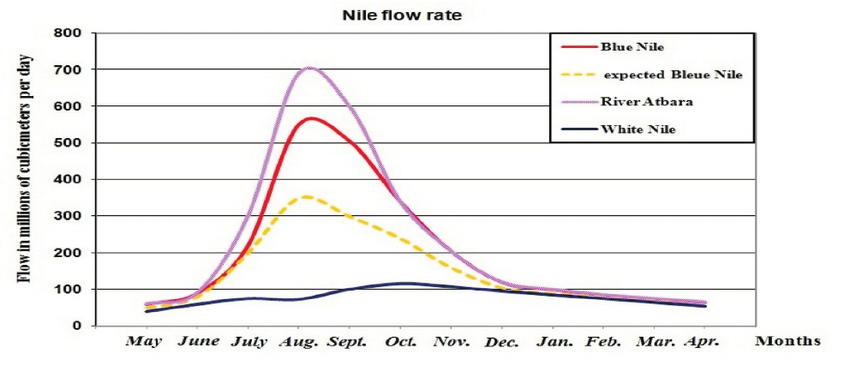
Which is very interesting because Jul/Aug/Sep is the time of the annual Nile flood, and this is the same time when the Milky Way, the Heavenly Nile truly becomes the reflection of the Terrestrial Nile. Or is it the other way round? As above so below?

In the this paper we can read that in the Book of Nut,  the centre of Nut’s torso was marked with "I Akhet when Sothis rises".

The heliacal rising of Sirius, known in Egypt as Sothis or Sopdet in the month of I Akhet, Jul/Aug, marks the beginning of the annual Nile flood...

So it is not surprising then that Nut was one of the Sycamore goddesses (Hathor and Isis, both linked to the annual flood were the other ones)...

Texts from the Book of the Dead directly invoke this aspect: "Hail, thou Sycamore Tree of the Goddess Nut! Give me of the water...which is in thee..."

Here is Nut, standing upright (just like Milky Way during the peak of the annual flood), pouring "the water of life", the flood water of both terrestrial and heavenly Nile, and giving bread (of life) which is the result of the flood which makes agriculture in the Nile valley, Egypt, possible...

I talked about this in my post "Sycamore tree goddess"...

Nut was also directly linked to the annual Nile flood through the celestial cow goddess Mehet-Weret whose name means "Great Flood" and, in some cases, the two were equated...

Nut herself was sometimes depicted as a Heavenly Cow, eating the stars each morning and giving birth to them at twilight...

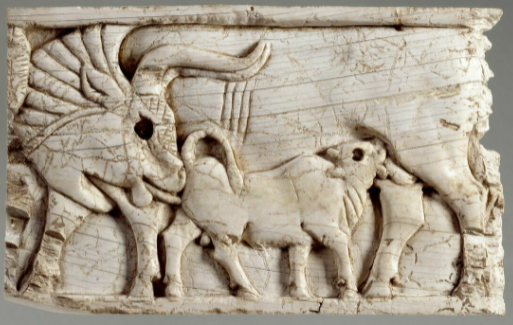
I talked about celestial cows in my posts "Holy cow", "Cow and calf ivory" and "Inanna in Egypt", in which I explained why is Hathor as Mehet Weret (flood) was depicted as a cow and why she was depicted emerging out of papyris thickets...

But at the time when I wrote these posts, I didn't think of this:

Auroch calving season starts in Apr/May. After calving, cows would begin producing milk, with milk production rising until it reaches peak after 40 - 60 days, with peak lasting 20 days...

That's Jun/Jul, just before Jul/Aug, the beginning of the Akhet season, the season of the annual Flood...The milk of the celestial cow, who was the Milky Way, and the Celestial Nile, filling the Terrestrial Nile and causing the annual flood...

Now this is all super cool, but it gets cooler. Here is something I have stumbled across while reading this article:

"...birds [with] human faces [that speak] in human language [come from] Nut's northwest side to her northeast side, from the primeval darkness, the ḳbḥw of the gods [from] Duat, located on [Nut's] northern side..."

These "birds with human faces" are Ba birds. 

I talked about the link between birds as carriers of souls in European and Mesopotamian cultures in several of my articles:

In my post "Nav", in which I talked about how in Slavic mythology, souls of the dead entered birds, like these cranes, who brought them to Irij, paradise. Birds then brought the souls back when they were ready to be reborn...

And in my post "Soul birds" about the Ancient Greek depictions of human souls as birds with human heads...


And in my post "Bes" in which I explained why a
mong the Lake Onega petroglyphs, Russia, made c. 4000BC, the only two petroglyphs which were Christianised were "The Devil" and a swan... 


The term "qbḥw", often-abbreviated in writing to only the sign representing a tall water-jug with liquid pouring from it, is generally translated as "cool waters"...

This term was also used as a designation of the celestial vault, because of the belief that the sky is a liquid surface between the atmosphere and outer space, on which the celestial bodies were imagined to navigate during the day and the night...

Additionally, "qbḥw" is used to mean the source of Nile and its inundation, which issued directly from the Nun, the primordial ocean, which lay on the other side of Nut...

Dr Graur interprets the above depiction of the arrival of the Ba birds from Duat as the autumn bird migration into Egypt, which starts in Aug and ends in Nov. During this time the Milky Way orientation flips from northeast - southwest to northwest - southeast...

Dr Graur then goes to say that "the [above] passage, however, notes that the entrance to the Duat is 'on Nut's northern side', not the west, where the Sun sets daily"...

And then he suggests, "this tension may be due to evolving perceptions of the Duat between the era of the Old Kingdom and the era(s) when the Fundamentals (The Book of Nut) and its commentaries were written"...

But I think that this is just another proof that when Ancient Egyptians are talking about Nut, they are indeed talking about the Milky Way. Remember, Jul/Aug/Sep/Oct is when Milky Way assumes vertical, North - South position over Egypt...

Which means that if the Duat is at the end of Nut, then the position of Duat is not fixed, but instead it moves as Nut moves across the sky. And when the autumn bird migration starts in Aug, Duat is indeed North of Nut, because Nut is now pointing North - South...

How cool is this? But there is something even cooler.

There are two bird migration seasons during which millions of birds fly along the river Nile over Egypt:

Northward spring migration to Duat, Feb/Mar - Apr/May

Southward autumn migration from Duat, Aug/Sep - Oct/Nov


The beginning of the spring migration and the end of the autumn migration mark the beginning and the end of the period during which the galactic core, Nut's body, can be seen in the skies over Egypt...

This would explain Nut’s role in the transition of the deceased to the afterlife (as described in spells from the Pyramid Texts and  Coffin Texts)...

Cool? I think so...But there is something even even cooler:

Now on the corner of this map found in in this paper, which depicts the northern portion of the cosmos, the same area where the Book of Nut situates an opening of the Duat, we find the phrase "Qbḥw Ḥrw" meaning "the cool waters/firmament of Horus"...

How cool is this? The North, the direction from which migratory birds come to Egypt in the Autumn following the "Path of Birds", the Milky Way, Celestial Nile as well as Terrestrial Nile is marked as "The part of the sky of Horus"??? Why?

Well...Because of animal calendar markers...Deified animal calendar markers...Of course...I will talk about this soon...I promise...

In the meantime you might want to also read my first Horus post "Great duel", my second Horus post "Horus the Elder", and my third Horus post "Horizon...

That's it. If you are interested in reading more about ancient animal and plant calendar markers, which are at the root of all our mythologies, start here…Then check my twitter threads I still didn't convert to blog post...I am way way behind...

Friday, 8 May 2026

Sycamore tree goddess

Sycamore tree goddess, originally Hathor, and later Isis, both goddess of flood, or Nut, goddess of Heavenly Nile (Milky Way), pouring water which is depicted with ankh (life) symbols inside it...Tomb, Siwa Oasis, 400-600 BC. Egypt...

Why would a goddess of flood be depicted as a sycamore fig tree?

Most likely because sycamore bears fruit between May and Sep...

The time of the rise of the water level in the Nile. Which means that the sycamore full of fruit announces the arrival of the flood, the thing that makes life possible in Egypt...

I talked about Hather, the sycamore tree and the Nile flood in my post "Holy cow"...

And in my post "The white calf", in which I tried to answer the question why is this white calf standing between two sycamore trees under a red sun? 

Why was Nile Flood water depicted containing ankh (life) symbols? Cause the Annual Nile flood is what makes life possible in the Nile Valley, what originally created Egypt and what recreates it every year...Without the annual Nile flood there would be no Egypt...I talk about this in my post "Beautiful boy"...

BTW, Speaking about Ankh = Water, check my post "Goddess on a horse"...

Post in which I talk about the link between ankh, papyrus (flowers at the beginning of the Nile flood), lotus (flowers at the peak of the Nile flood) and the flood...And few other related things...

You also might like this: Baboons feed on figs in a sycamore tree on a painting in the tomb of Khnumhotep at Beni Hasan c. 1950 BC…

Both Sycamore tree and Baboons were animal calendar markers found imbedded in parts of Egyptian mythology related to water and flood. I talk about this in my post "Baboon"...

Finally I think that it's very interesting that we find "sacred fig goddess" in both Ancient Egypt and Ancient Indus Valley civilisations...


Check my post "Sacred fig goddess", in which I talk about the Indian one (different fig same link to water, this time monsoon rain water) with references to the Egyptian one...And about plant and animal calendar markers in both cultures...

That's that. 

If you are interested in reading more about ancient animal and plant calendar markers, which are at the root of all our mythologies, start here…Then check my twitter threads I still didn't convert to blog post...I am way way behind...

Monday, 29 April 2024

Hathor grain pendants

Golden pendant with the image of Khathor. From Tel el Adjul. Gaza, middle of the 2nd mill BC.


Gold pendant depicting goddess, dated 1400-1200 BC. It is 4.9 cm in height and was found in Ugarit, Syria. Louvre Museum, Paris, France. See grain growing out of her pubic area? 

A group of gold and electrum pendants, found in Levant and dated to the Middle-Late Bronze Age, depicting "female form reduced to head with Hathor wig and body, with breasts navel and pubic triangle". Pic from "Western Asiatic Treen Goddesses"...


According to the paper author: "A branch grows from the pubic triangle...The branch is not easily distinguished, it may represent the tree as a whole, an offshoot or a frond"...

I would propose that the "branch" growing out of the vulva is not a branch at all, but a stylised depiction of grain...And that this would make this "female figure" a symbolic depiction of "Mother of grain"...


The paper author then says that "These Syrian-Palestinian pendants have been associated with an Old Assyrian silver pudendum dedicated to Ishtar...In this light, these...pendants should be seen as signifying the sexual aspect of a local goddess, whose symbol was the tree..."

I would say that these pendants should be seen as depicting a local goddess of (grain) fertility (grain growing out of her womb), who was a mixture of Hathor and Ishtar/Inanna...Hathor, because of the headdress and because she is directly linked to the grain fertility through flood. I talked about this in my post "Cow and calf ivory"...Inanna because declares herself to be the Mother of Grain:

"...Before my lord, Dumuzi,

I poured out plants from my womb.

I poured out plants before him.

I poured out grain before him,

I poured out grain before my womb..."

You should check the article "Inanna and dove" as well as the articles linked from this article, which all talk about Inanna and her link to grain...


To read more about ancient animal and plant calendar markers, start 
here…then check the rest of the blog posts related to animal calendar markers I still didn't add to this page, and finally check my twitter threads I still didn't convert to blog post...I am 9 months behind now...

Saturday, 20 April 2024

Swallow tattoo

A swallow tattoo means 5000 nautical miles a sailor has traveled. For regular seamen, this is about 5,750 miles (ca. 9,254 km).


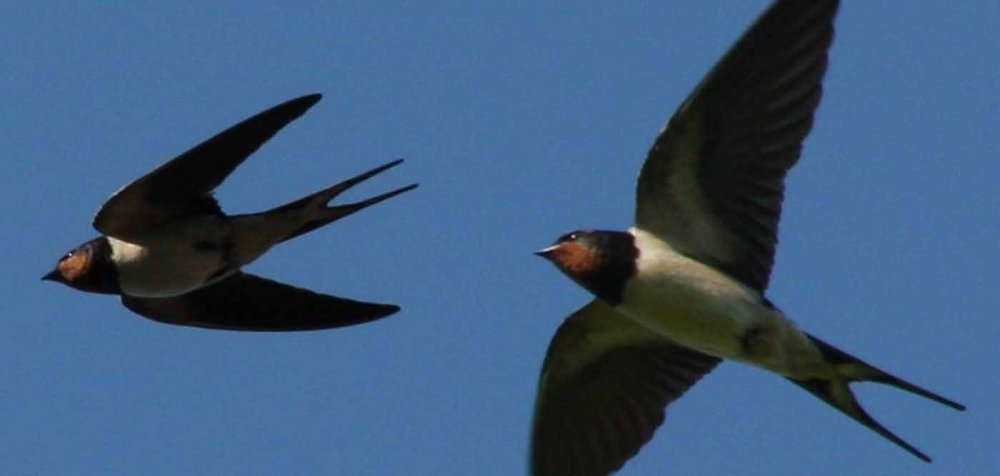
This article is about swallows as animal calendar markers for the beginning of the sailing season in Ancient Rome, about Isis, as the goddess of the sea, and about the climate change...and roses...

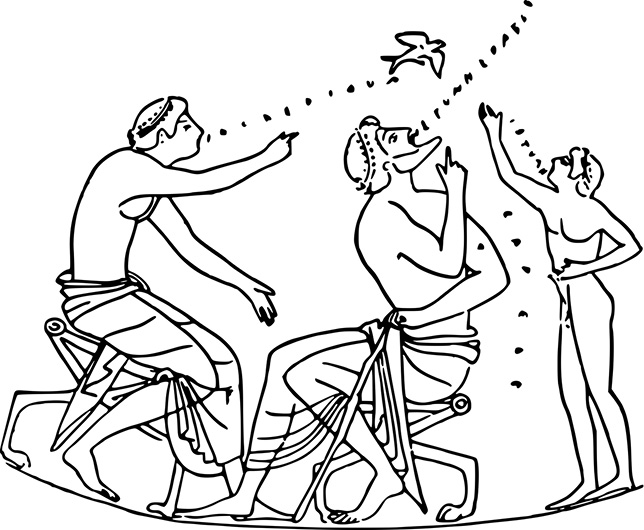
A group of children, somewhere in Greece, holding wooden spinners decorated with flowers, with a model of a swallow on a spindle, acting as a weathervane. They are getting ready to sing the "swallow song", a song welcoming swallows as the heralds of spring...


You can actually hear the children singing the "swallow song" in this documentary:

Χελιδονίσματα στο Σιτοχώρι Σερρών την 1η Μαρτίου 1967

This is an ancient custom. In "Cultural responses to the migration of the barn swallow in Europe" by Ashleigh Green we can read that:

Athenaeus of Naucratis (3rd c. CE) writes that after the first swallow was spotted, the Rhodians would hold a festival.


During the festival the Rhodian children would sing: 

He comes! He comes! 

Who loves to hear

Soft sunny hours, and seasons fair:

The swallow hither comes to rest

His sable wing and snowy breast.

The children then ran to different houses and "played the swallow", demanding food.

Ashleigh Green then goes on to talk about animal calendar markers 🙂 without knowing that she is talking about animal calendar markers: "In ancient times, people did not rely on calendars or clocks to tell them the time or the passing of the seasons..."

"...They watched and listened to birds. Cockcrow heralded sunrise and roused them from sleep; cranes migrating told them it was time to sow; and swallows returning from worlds unknown told them spring had arrived."

And then she says: The sailing season was also marked by the swallow’s return. Taking the swallow’s appearance as their cue, centuries of Greek poets sang to sailors to weigh anchor and  unfurl the sails...the swallows are here. Winter storms have passed, it is time to go to sea.

These poems are written by Leonidas, Antipater of Sidon, Marcus Argentarius, Thyillus and Agathias Scholasticus respectively, and although they stretch from the third century BCE to the sixth century CE, they are almost identical in form and substance.

Such evidence suggests that swallows truly were linked as closely to sailing as to spring. The spring wind was even called chelidonia after the swallow, and Horace suggests that the swallow actually helps to calm the sea...Very interesting...Why would people believe such a thing?

Cause the return of the swallows from Africa in Mar/Apr and their nesting in Apr/May coincides with the change of wind. Sun, heating up the Eastern Mediterranean, creates an updrift, which sucks the cooler air from Europe to start streaming southward, creating the etesian winds.

This table, from a South Aegean Yachting site, gives directions of the prevailing winds in Aegean sea during the sailing season: Apr-Oct...Even today, with much better boats, this is the safe sailing season...

I talked about Etesian winds and the sailing in the Eastern Mediterranean in this post about "Three sacrifices" performed during the Trojan war. 

7th c. BC Mykonos pithos. It contains the oldest depiction of the Trojan Horse, the way Homer described it in Iliad

So, swallows return, start nesting, it's time to go sailing...Another animal calendar marker embedded into mythology. Swallow was apparently a holy bird of Isis, who also apparently, had a control of the sea, and was the goddess people prayed for calm waters and good winds...

Marisa Marthari in "From swallows to figure-of-eight shields: detecting the substrate of ideas behind the depiction of the swallow in Theran and South Aegean iconography" tells us this about swallows and sailing:

The swallow was also associated by the Ancient Greeks, and the Romans, with "euploia" (a pleasant voyage). Indeed it is attested that during the Roman festival Navigium Isidis, the festival in honour of Isis for good sailing, the devotees held models of swallows...

The Navigium Isidis was an annual Roman religious festival, held on March the 5th, in honour of the goddess Isis, when people prayed for the safety of seafarers and then a model of a ship was carried in a procession from the local Isis temple to the sea or to a nearby river...

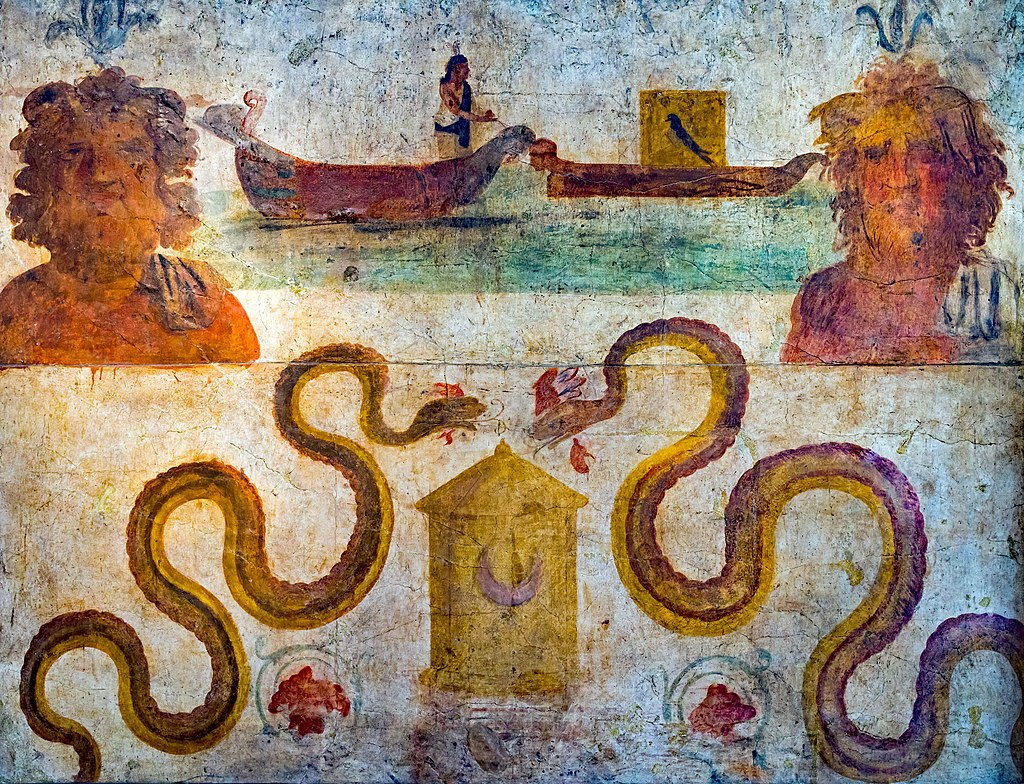
This is a fresco from the sanctuary of Isis in Pompeii, currently in the Museo Archeologico Nazionale, Napoli. It depicts cista mystica between two snakes (similar to a lararium) and above it navigium Isidis (boat of Isis) on the left and another boat with a swallow in it...

Why did sailors pray to Isis for calm seas and good winds? In the article entitled "Isis, goddess of the seas and the Navigium Isidis, Celebrate the beginning of the maritime season with Isis" by Rhakotis Magazine we can read:

By the Roman period, Isis has become the predominant sea goddess to such an extent that her festival marked the official beginning of the sailing season across the empire. This seems strange when we consider the fact that Egypt was not known for its maritime prowess.

River sailing was an important aspect of its society and economy for millennia. Indeed, the sail may have first emerged from Egypt, with south blowing winds powering ships up the Nile against the current. Yet Egypt did not really have any sea gods for much of its early history.

It was perhaps outside of Egypt that the association of Egyptian gods and the sea first began. Byblos was an important trade center with Egypt for centuries. A text from the Middle Kingdom calls Hathor "Mistress of Byblos [who] holds the rudders of barques" (!!!)

During the New Kingdom Isis took over more and more functions of Hathor, ultimately becoming the predominant goddess in the Egyptian pantheon. About this time, she also became the Egyptian goddess in Byblos, "taking over" Hathor’s maritime goddess role. 

Very interesting...

I talked about Hathor as a deified animal calendar marker for Apr/May, the beginning of the calving period of the the wild Eurasian cattle in my post "Cow and calf ivory". Which is exactly when etesian winds start blowing in the Eastern Mediterranean...

Speaking about sailing in ancient Egypt, in the "No easy option: Nile versus Red Sea in ancient and medieval north-south navigation" by John P. Cooper there is some interesting data about sailing on the Nile:

Navigating the Nile was fundamentally a seasonal occupation, closely tied to the cycle of the flood. Changing water levels meant variable navigability in the river channel, especially for larger cargo vessels. The optimal time for sailing was during the height of the inundation.

Even in the main channel of the Nile, water levels effected navigability. A dwindling river made sand banks an increasing hazard, threatening not only to block a vessel’s passage, but also to trap it and, at worst, capsize and wreck it...

By happy coincidence, it is also during this high-Nile season that the maxim of ‘current from the south, wind from the north’ is most valid. The Nile valley and the Nile Delta are subject to two quite different wind regimes.

In the Nile valley, northerly winds blow year round because of the cyclonic highs that sit over the Sahara desert year round...

In the Delta, northerly winds blow only during the summer...because the Delta is under the influence of Mediterranean weather systems...

And so, if you wanted to sail up the Nile delta and then further up the Nile river, you had to wait for Hathor, the holy cow to give birth to a holy calf in Apr/May. And then when the water level of the Nile starts to rise, in Jun/Jul, catch the northerly wind and sail south...

So is this why Hathor was associated with sailing and was the Goddess "who holds the rudders of barques"? And why Isis, Hathor's replacement, was known as the Goddess "that opens the seas"?

For the end I want to ask two questions:

Why was Navigium Isidis celebrated on the 5th of March, when all the old Roman texts tell us that the safe sailing season in the Mediterranean was Apr to Oct? In Ships and Fleets of the Ancient Mediterranean, J. Rouge summarised the problem of winter navigation as follows:

Vegetius (fourth century AD) says that the seas were (generally) closed between Oct/Nov and Apr/May

So why were the Romans opening the seas on the 5th of March then? Maybe some people sailed in March too? Well, yes, they did. The above quotes are from the article "Mare Clausum? Sailing Seasons in the Mediterranean in Early Antiquity" by Oded Tammuz.

And in this article, Oded Tammuz goes on to propose that even though the main sailing season in the Mediterranean was Apr to Oct, the sea was never really closed. Here are 5th century BC Egyptian customs records, noting down ships that arrived to the Elephantine harbour.

We also have many Roman sources which say that opportunistic captains would sail outside of the main sailing season, because the gains that could be made were very high. But so were the risks...I wonder how many Mediterranean shipwrecks are ships trying to sail the closed seas?

Romans started celebrating Navigium Isidis, around 100BC. Now I wonder if the reason why the Romans celebrated the opening of the seas at the beginning of March, was because the Mediterranean sea was around 100BC indeed fully navigable in March. Due to climate change...

This chart shows polar temperature variation in last 10,000 years. We can see that the temperature has been going up and down madly all the time. And one of the big temperature spikes, which centres around 100BC, when Navigium Isidis became a thing,  is marked as Roman warming.This warming must have affected the weather in Mediterranean. Making sailing safe a month earlier, in March? I think so. Which is why Navigium Isidis was celebrated on the 5th of March...

And here I come to the second question: Are there any roses blooming in Italy and Greece on the 1st of March?

Why am I asking this? Because, according to Lucius Apuleius, who in the 2nd c. AD wrote "The Golden Ass", roses were already blooming on the 5th of Mar during his time.

The Golden Ass is a story about certain Lucius, who drank a magic potion which accidentally turned him into an ass. He spends the rest of the book trying to turn back into a man. Finally, he succeeds on the day of Navigium Isidis...

The night before the festival of the opening of the seas, Lucius, still an ass, is on the seashore watching the moon emerging from the sea. He prays to Isis to turn him back into a man.

He then falls back to sleep, and dreams (has a vision) of the goddess herself emerging from the sea. She tells him tomorrow there will be a festival "when the ocean’s storm-blown waves are calmed".

And then she tells him: "My priest...will be carrying in his right hand as part of his processional equipment a sistrum wreathed with a garland of roses...Approach the priest and...gently take a bite of the roses". 

Here is a fresco from the Temple of Isis in Pompeii depicting priestesses of Isis holding a sistrum...Currently in the Naples National Archaeological Museum.

And so, on the morning of the 5th of Mar in the middle of the 2nd c. AD, an ass turned into a man on the streets of Corinth after eating a rose. Just like the Goddess Isis told him it would happen...

Today, in Italy and Grece, as far as I know, roses start blooming in Apr/May. Maybe (big maybe) you can find them blooming at the end of Mar. But, it is very unlikely, that a donkey wandering around Corinth on the 5th of Mar today would be able to find a blooming rose and eat it.

Yet Lucius Apuleius wrote that donkey ate a rose on the day of the opening of the sea, and no one batted an eyelid...Like of course, why wouldn't it? Roses are already blooming in and around Coritnh at the 5th of March. Everyone knows that...

Interesting right? Roman warming? Also, did you know that equids (horses and asses) start mating in Apr/May, at the beginning of the "safe sailing season"? Interestingly, all Eastern Mediterranean sea gods seem to be obsessed with horses...I talked about this in my post "Trojan horse"...

A type of merchant ship which had horse figurehead on its prow and which Greeks called "hippos" (horse), and used for delivering tributes...

And finally...I wonder if all this assing around in Golden Ass is kind of symbolic, in a calendaric kind of way? Maybe someone should look into it...That's it...That's all I have to say about that...

Thank you an I hope you enjoyed this meandering article, originally published as an X thread.

To read more about ancient animal and plant calendar markers, start here…then check the rest of the blog posts related to animal calendar markers I still didn't add to this page, and finally check my twitter threads I still didn't convert to blog post...I am 9 months behind now...