Sunday, 11 January 2015

Pit ovens


An earth oven or cooking pit is one of the simplest and longest used cooking structures. It is  also the oldest oven type used by people. The earliest ones were found in Central Europe, and dated to 29,000 BC. They were situated inside mammoth bone yurts and were used to cook mammoth meat. 

So what is an earth pit oven?

At its simplest, an earth oven is a pit dug in the the ground. A fire is lit at the bottom of pit and let to burn until only hot coals are left behind. The pit walls and the stones placed in the fire absorb and then radiate the heat back towards the center of the pit. This heat is then used to bake, smoke, or steam food inside of the pit. To make the earth ovens more efficient you can line them with stones as they are much better at absorbing and radiating back heat than the ordinary dirt. 

So how do you make a pit oven? First you dig a hole and line it with stones (optional).


The pit can be circular like the one on the picture above or rectangular like the one on the picture below.


Once we have a  pit, we need to light the fire inside the pit to heat the pit walls and to fill the pit with charcoal. 


Now that we have a pit full of hot coals, we can cook food in it or over it in variety of ways. 

For instance the food can be roasted on a spit over the pit oven. Because the heat is concentrated and preserved for a long time inside the pit by the stone walls, a small amount of wood can be used to roast a lot of meat.


In Serbia and in the rest of the Balkans, no major celebration can be imagined without a roasted pig or lamb on a spit. Where I come from, the roasting process always started with digging of a ditch, an oval shaped pit. The pit was then filled with slow burning hardwood which was burned and turned into a charcoal. Once the pit was full of the smoldering charcoal, the spit was put over the ditch and the roasting would start. Basically the pig was a spit roasted over a pit oven.


The modern version of this type of a pit oven for spit roasting is basically a brick, stone or metal tub, a "trough" filled with charcoal with a spit or spits placed over it.


If you only have a limited amount of wood or if you only want to roast a small amount of meat, or if you want to roast meat inside, you can use a small rectangular pit oven lined with stones. You can burn the wood directly inside the oven or you can fill the oven with charcoal from the hearth and then cook the small pieces of meat or fish on skewers. Barbecuing being national past time in Serbia, I know from my own experience that a shoe box size oven full of charcoal is more than enough to roast enough meat for 10 hungry adults providing you cut your meat in thin slices and roast them on skewers. 


That is one way to use pit ovens. But we can also use pit ovens for slow cooking. To do so, we first need to light the fire inside the pit. 


We need to burn enough wood to make enough charcoal to cover the bottom of the pit. We also need to add stones into the fire while it is still burning so that they absorb the heat of the fire and get really hot. Once the fire has burned out and we only have hot coals and hot stones left at the bottom of the pit oven, we can use wooden tongs to spread the stones over the coals. The pit oven with hot charcoals covered with hot stones and ready for cooking looks like this:


If we have covered the the charcoal with flat stones, or if we are cooking big lumps of meat, food can be placed directly on stones. If we are using round stones then stones are first covered with some edible green leaves and the food is placed on the leaves. The food is then covered with more stones and or branches and leaves. Then the whole contraption is covered with earth which seals the pit and keeps the heat and moisture inside it.


The food cooked in the covered pit can take from several hours to a full day to cook, but the advantage is that the cooking process does not require any additional attention. And the cooked food is delicious.

This is a very good video showing how to make one of these primitive cooking ovens using moss instead of leaves.

https://www.youtube.com/watch?v=MPWDp2DMMOo


Earth ovens have been used in many places and by many cultures in the past, and are still used today. 

Americas

Pit ovens were used in many areas in the past. In Central Texas there are large "burned-rock middens" apparently used for large-scale cooking. 


The Mayan pibil cooking from Yucatan peninsula in Mexico, Inka huatia cooking from Peru and Curanto cooking from Chiloé Archipelago in Chile are also examples of the similar pit oven cooking technique from central and south America. In North America we find a so called clambake, a pit oven cooking method invented by Native Americans on the Atlantic seaboard of New England which uses a pit oven dug on a beach and seaweed as stone and food cover. 


Middle East and North Africa

Earth oven cooking is sometimes used for celebratory cooking in North Africa, particularly Morocco; a whole lamb is cooked in an earth oven (called a tandir, etymologically related to the Central- and South Asian tandoor. 


Among Bedouin and Tuareg nomads a simple earth oven is used, often when men travel without family & kitchen equipment in the desert. The oven is mostly used to bake bread. The wheat or barley flour is mixed with water (and some salt) and then placed directly into the hot sands beneath the camp fire. It is then covered again by hot coal and left to bake. This bread is known as Arbut but may be known under other local names.


Asia

In Taiwan we find traditional kiln cooking which is, with Inka huatia kiln cooking and Slavic stone pile oven cooking an example of a precursor to a later kiln clay and stone ovens. In all three cooking methods a shallow fire burning pit is encased in a dome made from stones or clay pieces with a small door left on one side for lighting fire and inserting food. The fire is then lit up inside the dome in order to heat up the stones or clay from which the dome is made. When only the charcoal is left, the charcoal is removed and food is put into the dome. The dome is then collapsed onto the food and covered with soil. The food is cooked under the pile of hot stones and dirt. I will talk about these ovens in detail in my next post. This is an example of a Taiwanese clay kiln oven.


The Pacific

Earth oven cooking was very common in the past and continues into the present – particularly for special occasions, because of how labor-intensive the earth oven process was. In Melanesian Polynesian languages the general term is "umu", from the Proto-Oceanic root *qumun: e.g.; Tongan ʻumu, Māori umu or hāngi, Hawaiian imu, Sāmoan umu, Cook Island Māori umu. In some non-Polynesian, part-Polynesian and Micronesian parts of the Pacific, languages are more diverse so each language has its own term - in Fiji it is a lovo and in Rotuman it is a koua. 

In Papua New Guinea the name for the pit oven is "mumu", a word probably borrowed from Polynesian and used by Tok Pisin  and English speakers, but each of the other hundreds of local languages has its own word for pit oven.

Despite the similarities, there are many differences in the details of preparation, their cultural significance and current usage.

Australia

Murray River aborigines use clay pit ovens for cooking food. Great oven mounds made of clay can still be seen along the river. Local aborigines did most of their cooking in these clay pit ovens. The women dug a hole in the mound and set a fire in the oven hole to heat the lumps of clay. Then they swept out the fire and placed the animals and roots inside, wrapped in layers of damp grass. The hot clay lumps were placed on top and the meal was cooked in a few hours. 


Europe

The earth ovens were used from the Neolithic period onward with examples from this period found at the sites of Rinyo and Links of Notland on Orkney. Pit ovens are more commonly found in the Bronze and Iron Ages sites such as Trethellan Farm and Maiden Castle, Dorset. Examples from these periods vary in form but are generally bowl-shaped and shallow in depth (30–45 cm) with diameters between 0.5 and 2 metres. 

Also there is a possibility that the Bronze Age Irish fulacht fiadh cooking sites, at least the ones with stone lined troughs, were used for pit cooking and not for boiling. I will write a whole post about fulachts. They are extremely interesting and important.

The pit cooking method is thought not to be common in Europe today. The only two examples are Cretan kleftiko ("thief style") cooking, and peka or sač ("under the bell") cooking which is found in the Slavic countries of the Balkans. Kleftiko involves wrapping the food in clay and cooking in a covered pit with charcoal. In the Balkans the pit oven cooking evolved into slaw cooking inside of a fired clay dish heated on charcoal (pit),  under a fired clay (now days also cast iron) bell shaped baking lid covered with hot coals. 


Peka or sač is basically a portable transportable clay pit oven. You can cook anything inside it: bread, meat, whole meals. As far as I know this type of cooking is unique to the Balkans. I will dedicate a whole post to this type of cooking as it is extremely important for understanding cultural continuity on the Balkans. 

This is all I have to say about that (pit ovens). Hungry anyone?

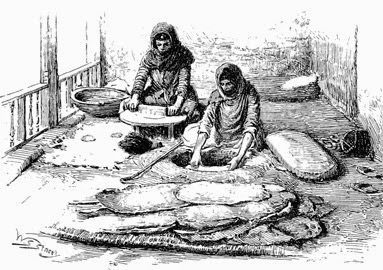
I believe that one of the most important human discoveries was accidentally made during the construction and use of these pit ovens. During the construction of a pit oven, once the hole is dug in the ground, it needs to be smoothed so that it doesn't crumble when it is used. So wet hands are used to smooth the pit walls. At some stage in the past people digging the hole for the pit oven must have by chance dug a hole in clay. If the pit was dug into clay, the smoothed pit walls will very much resemble unbaked clay pot walls. Once the fire is lit at the bottom of the clay pit, because the heat is concentrated inside the pit and into the walls, the clay walls will get fired. So by accident people would have ended up with a pit oven whose walls were made of a thin fired clay, ceramic layer. People would have soon realized that the walls of these clay pit ovens don't crumble and that they heat up well and retain heat for a long time, just like stones. And that if you make a small fire burn constantly at the bottom of the clay pit oven, then you can stick things like bread patties, to the walls of the pit where they would get cooked quickly and evenly. In the center of the below picture  you can see a 19th century example of this type of a primitive dug in clay oven from Kermanshah area of Iran. These ovens were used for both heating and cooking. Women on the picture are making breads.

The central Asian tandoor oven, used primarily for uncovered, live-fire baking and grilling, is essentially a permanent pit oven made out of clay or firebrick with a constantly burning, very hot fire at the bottom.


The tandoor was brought to India from Persia via the Afghanis. There is also evidence that tandoor was present to India as far back as 3000 BC as there have been small mud plastered ovens similar to tandoor found in Indus valley civilization sites of  Kalibangan and Banawali

In Armenia we find a version of tandoor oven called tanir. Tonir was worshiped by the Armenians as a sun symbol and it is known as a "sun in the ground".


Remember our lucky pit oven builders who dug their pit in clay? They would also have noticed that if the rain filled the fired clay pit, the water would remain inside the pit and would not dry through water seeping and absorption into the walls, and the walls would not get soggy and would not crumble. If one of people using the clay pit oven stood by mistake on the edge of a cool clay pit oven and broke the edge of the oven off, he would have noticed that the bit that was broken off was hard like a stone. What do you think, how long it would have taken for someone to made a clay figurine and throw it into a pit oven to see what happens? Is this what happened in Dolní Věstonice site dated to 24,000 BC, where the earliest objects made of ceramic, thousands of fired clay figurines, depicting human and animal forms were found? The most famous of these figurines is the so called "Venus from Dolni Vestonice".


This is the clay structure found in Dolni Vestonice. The figurines were found lying around it. 


This was interpreted as originally being this type of clay oven:


Doesn't it look like a covered cooking pit? Or a clay cooking pit turned on its side? There are actually some clay and stone cooking methods which can be regarded as direct precursors of these types of clay ovens. I will talk about them in my next post.This is a bread oven from Serbia still used in the 20th century. Do you see any similarity between the above "kiln" and this "bread oven"?


Archaeologists suggest that it is this type of clay oven that was used for pottery firing in Dolne Velstolnice. This is quite possible. The thing is we don't even need this type of oven to fire pottery. You can use plain and simple cooking pits to achieve this. We know they used cooking pits for cooking mammoth meat. These pits are perfectly capable of firing pottery as well. 
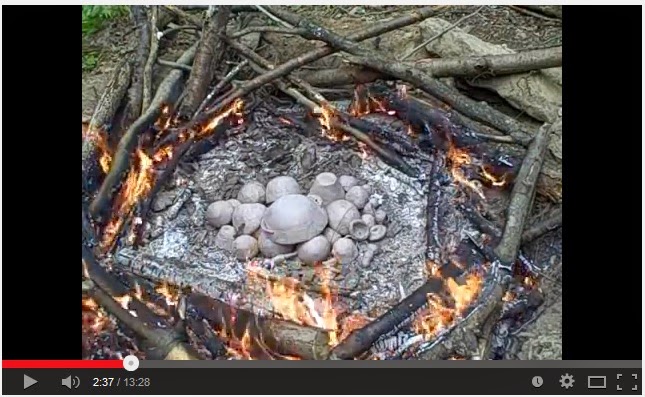
https://www.youtube.com/watch?v=9biM0ZRqri4
How to pit fire pottery by Mike Pewtherer

This is an example of a Japanese pit fired pottery:


https://www.youtube.com/watch?v=y7ZUVN-mUJw
Pit Fire pottery by Ryo Mikami

These are ery good videos showing how pit firing of pottery is done. 

Pit fired pottery video 1
Pit fired pottery video 2
Pit fired pottery video 3

Pit fired pottery video 4

So the pit firing method works. In the Japanese example you can see the circular wall which creates over ground pit. Doesn't it look very much like the clay structure found in Dolni Vestonice?

No pots or utensils were found on the sites of this culture. So how long do you think it took before someone realized that the same principle of baking clay in pit ovens can be used for a baking clay dishes? Well according to the archaeological data it only took about 8,000 years... But I believe that development thought process involved was the one I just described. I believe that this exactly how clay kiln and production of ceramic were invented. The reason why it took 8,000 year to get from fired clay figurines to fired clay pots was that until the first settled acorn eating cultures developed in the northern hemisphere, people did not have any practical need for making clay pots. But once people settled and started cooking acorn porridge, a need arose for a waterproof and fire proof container that could be used for cooking liquid food. Enter fired clay pit oven, a waterproof and fire proof container, a sort of a dug in clay pot. And from here all you need is to follow the above discovery steps and you end up with this, pottery from acorn eating Yomon culture dated to about 12,000 BC. 


Now people had portable fired clay pits that they could move around, and use for cooking. I will talk about the development of pottery in detail in one of my next posts. 

Have fun, Stay happy and healthy.

Tuesday, 23 December 2014

Christmas trees from garden of eden


What is the origin of Christmas trees? We can read that the Christmas tree customs are the Christianized versions of the older pagan Winter Solstice customs involving evergreen trees. But why are the two main European Chrismas trees Oak and Pine (Spruce, Fir)? Are these two trees somehow connected to the ancient idea of the garden of Eden? And if so, how are they connected? These are the questions that I would like to try to shed some light on.


A few days ago I came across this early christian relief from Naxos depicting the nativity (birth) of Jesus scene. Unlike the later representations of the Nativity which take place in a stable, the Nativity scene on this early marble slab is framed by two trees, which means that the scene takes place in a forest, a grove. I found a good high resolution picture of the above image in Wikipedia. 

 
When I looked at trees depicted on the relief more closely, I discovered, to my astonishment, that these two trees were a Pine and an Oak, the two Christmas trees of Europe. You can clearly see the pine cone on the left tree and the acorn on the right tree. But these were not just any pine tree and any oak. Based on the shape of the trees, their leaves and fruit, I think that I managed to identify these two trees as the Stone Pine and the Downy Oak, ancient species used and cultivated by people as food since prehistory. 

The downy oak (qercus pubescens), is a white oak. It is native to southern Europe and southwest Asia, from northern Spain (Pyrenees) east to the Crimea and the Caucasus. It is also found in France and parts of central Europe. Downy oaks typically grow in dry, lime-rich soils. It is a submediterranean species, growing from the coastline to deep in the continent. Its optimum is in the submediterranean region, characterized by hot dry summers and cold winters with little rainfall. In western and central Europe, downy oak is confined to areas with a submediterranean microclimate (gorges, sandplains, steppe slopes) or to coastlines of former lakes. In Serbian, this oak is known as "medun", "medunac" or honey oak referring to its sweet taste.


The stone pine (Pinus pinea), also called Italian stone pine, umbrella pine and parasol pine, is a tree from the pine family (Pinaceae). It has been used and cultivated for its edible pine nuts since prehistoric times. The tree is native to the Mediterranean region. At present it is found in Europe ( Iberia, Italy, Southern France, Balkans, Aegean and Western Turkey), Western Asia (Southern Anatolia, Lebanon, Syria, Northern Israel) and North Africa (Morocco and Algeria). It grows in dry arid areas mixed with oaks and shrubs.
 
 
Here are the tree details enlarged so you can see the leaves and fruit:

Stone Pine with pine cones:


Downy Oak with acorns:


So what we have here is the nativity of Christ taking place in the Garden of Eden which consists of the edible wild trees, oaks and pines, the oldest starch foods of the Mediterranean from Upper Paleolithic onward. Both acorns and pine nuts were found among the oldest plant food remains in Upper Paleolithic and Mesolithic archaeological sites in Europe, Western and Eastern Asia, North Africa and North America. Even though the types of Oaks and Pines used as food sources by people differ from area to area, wherever we find major acorn eating cultures we find that pine nuts were also collected and used as food. 

So Here is the above Nativity scene again with the trees and fruits identification.


Is this a coincidence considering that most of the European Christmas (Winter solstice) traditions and customs are in some way related to the agricultural and particularly the corn, bread fertility?

In Genesis we can read this description of Eden: 

A river rises in Eden[a] to water the garden; beyond there it divides and becomes four branches. The name of the first is the Pishon; it is the one that winds through the whole land of Havilah, where there is gold. The gold of that land is good; bdellium and lapis lazuli are also there. The name of the second river is the Gihon; it is the one that winds all through the land of Cush. The name of the third river is the Tigris; it is the one that flows east of Asshur. The fourth river is the Euphrates.

In Genesis we also find this: 

Then God said, “Let the land produce vegetation: seed-bearing plants and trees on the land that bear fruit with seed in it, according to their various kinds.” And it was so. 12 The land produced vegetation: plants bearing seed according to their kinds and trees bearing fruit with seed in it according to their kinds. And God saw that it was good....Then God said, “I give you every seed-bearing plant on the face of the whole earth and every tree that has fruit with seed in it. They will be yours for food. 30 And to all the beasts of the earth and all the birds in the sky and all the creatures that move along the ground—everything that has the breath of life in it—I give every green plant for food.” And it was so.

In the brilliant book: Oak: The Frame of Civilization,  William Bryant Logan has this to say about the garden of Eden:


The above excerpt from the Genesis is a description of the area comprising of the Zagros Mountains, Oak Pistachio uplands, Assyrian steppe and alluvial Mesopotamian bottom land. This is where we find some of the earliest settled villages in the world. While excavating these settlements, archaeologists found many grinding stones and underground storage pits. But very few sickles. And those sickles that were found were not the right kind for harvesting wheat. So what were the people in these first settled communities grinding, storing and eating? 

As I have shown in my last few posts about acorns in archaeology, eating acorns and grinding acorns, they were grinding, storing and eating acorns. 

Oak uplands can easily support large villages of up to 1000 people and these people could harvest in 3 weeks enough acorns to last them 2 to 3 years. Acorns could be stored in above ground aerated bins, in underground pits or they can be buried at the edge of streams where they can get leached while they keep fresh. The people of these oak cultures could, with very little effort, provide their daily bread doing what god told them to do: eat the fruit of the trees and plants that bear seeds. With plenty of free time people could enjoy life and develop their culture and technology. With plentiful supply of food there was no need to kill and eat all the animals that were caught. So people could catch and keep the animals, breed them and eventually domesticate them. It was these animals that were probably first fed the wild grasses which later became our grains. 

If we look at the word Eden we see that the origin and the meaning of the word "Eden" is uncertain. The official etymology says that it comes from Hebrew עדן (eden), perhaps from Sumerian e-den "Steppe, garden".

But I believe that the root of this word is much simpler. In Serbian we have word "jede" which is in the old south Serbian dialect found in a form "ede". This word means eat. It comes from the Proto Indo European root "*h₁ed" meaning to eat from which the English word eat also comes from. In Serbian we have the following words derived from the root "ede, jede":

jelo, jedja, jedivo, jestivo – food
edenje, jedenje - food (south Serbian dialect). Literally means eating and is the direct cognate of the English word eating.
eden, jeden - eaten

The garden of Eden was the garden of edible trees. It was the garden of god given food, of edenje, jedenje, eating. Is this the actual original, simple meaning of the word Eden = Eating, Food? Was the garden of Eden the post glacial Northern hemisphere, which was going through an incredible transformation from a cold wasteland into a lush garden full of easily obtainable abundant food? And was then, as William Bryant Logan says, this garden of Eden responsible for human transformation from humans into modern humans? I believe so. If we look at the Mesolithic northern hemisphere, we see first civilizations hatching in Western and Easten Asia, In the Balkans and Iberia, in north Africa and in Mexico, all situated in "gardens of edenje", gardens of eating, food, full of easy to collect and store acorns, nuts, roots, wild grains, and easy to catch small game, fish, shellfish and snails. The garden of Eden was the old Golden Age of the Greeks and Romans, the post glacial northern hemisphere.


That this is the actual meaning of the garden of Eden we can see from the choice of the trees present on the above Nativity scene. Thees trees turn out to be the two main Winter Solstice (Christmas) trees in Europe

In the northern hemisphere, the shortest day and longest night of the year, the winter solstice, falls on the 21st of December. Many ancient people believed that the sun was a living god and that winter came every year because the sun god had become old, sick and weak. The sign of this was the fact that the days were getting shorter and colder, and that the vegetation was dying. Winter solstice was the turning point when the days start getting longer again heralding the arrival of spring, warmth and new vegetative cycle. People who depended on this vegetative cycle celebrated the solstice as the rebirth of the sun god.

The accepted theory is that around the time of the Winter Solstice, people decorated their homes and temples with evergreen branches and worshipped evergreen trees and plants in general, because the evergreen plants reminded them of all the green plants that would grow again when the sun god gets reborn after the Winter Solstice. This is a good enough explanation. But it is the choice of these Winter Solstice (Christmas) trees which is very interesting: Oak and Pine (Spruce, Fir). I believe that the choice of the choice of these trees has as much to do with the fact that they were the oldest starch (bread) bearing trees, as with the fact that they were evergreen. To illustrate this I will here give the list of the European Winter Solstice (Christmas) traditions involving trees to show that all of these trees are Either Oak or Pine (Spruce, Fir), the oldest starch (bread) bearing trees, the trees that appear on the Naxos stelle.

Romans

Romans marked the solstice with a feast called the Saturnalia in honor of Saturn, the god of agriculture. In Roman mythology, Saturn was an agricultural deity who was said to have reigned over the world in the Golden Age, when humans enjoyed the spontaneous bounty of the earth without labor in a state of social egalitarianism. The revelries of Saturnalia were supposed to reflect the conditions of the lost mythical age, not all of them desirable. The Greek equivalent was the Kronia. The Romans knew that the solstice meant that soon farms and orchards would be green and fruitful. To mark the occasion, they decorated their homes and temples with evergreen boughs. We are told that it was holly tree branches that were used because they don't lose their leaves during the winter. But is it possible that it wasn't holly tree branches that were used, but the branches of the evergreen Mediterranean oaks, such as Quercus coccifera (Kermes Oak), Quercus suber (Cork Oak) and  Quercus ilex (Holm Oak)? Holm oak is called Holm oak because its leaves resemble holly tree leaves, holm being the old name for holly. The thing is the other two evergreen oak trees have leaves which resemble holly leaves even more.  Have a look at these pictures and tell me if it was easy to confuse the evergreen oaks and holly:
Holly


Kermes oak. The Kermes Oak was historically important as the only food plant of the Kermes scale insect, from which a red dye called crimson was obtained. Red berries, red dye...


Cork oak


Holm (Holly) oak


Which of these trees do you think is a more appropriate symbol of the god of agriculture, the god of food, the god of the old Golden Age "when humans enjoyed the spontaneous bounty of the earth without labor"? Do you thing that it is the one that bears edible acorns like oak, or the one that bears poisonous berries like holly? Who got it wrong, the Romans who misunderstood or forgot the old customs of their forefathers, or us who misinterpreted Roman customs? Or did roman customs change and adopt as they migrated further and further up north where these evergreen oaks are not found and so they had to replace them with what every looked the most like these evergreen oaks, and that is holly tree?

Celts

Apparently Druids, the priests of the ancient Celts, also decorated their temples with evergreen boughs as a symbol of everlasting life. The evergreen plant that the Druids used is said to have been Mistletoe. Mistletoe which is said to have been used by Druids actually grows on Oaks. The Druids preached in oak forests, and considered oaks sacred. Young deciduous oaks keep their leaves through the winter.  Also a lot of Southern European oaks are evergreen, like the sweet Holm Oak or Holy Oak.

Pliny the Elder, writing in the first century AD, describes a religious ceremony in Gaul in which white-clad druids climbed a sacred oak, cut down the mistletoe growing on it, sacrificed two white bulls and used the mistletoe to cure infertility:

“ The druids — that is what they call their magicians — hold nothing more sacred than the mistletoe and a tree on which it is growing, provided it is Valonia oak..."

Quercus macrolepis, (Valonia oak), is another Mediterranean oak with leaves which look like holly tree leaves. The trees of this oak species shed leaves in October through January with a peak in December–January, but even during these months at least 10% of the trees remained evergreen.

 
Quercus macrolepis is found in the Southern Mediterranean, in the Balkans including the Greek Islands, in Morocco, and in Anatolia....


Quercus macrolepis has a subspecies known as Quercus ithaburensis (Mount Tabor oak). Quercus ithaburensis is found in Southeastern Europe, from Southeastern Italy across Southern Albania to Greece, and in Southwestern Asia from Turkey South through Lebanon, Israel, and neighbouring Jordan.

Mount Tabor (Hebrew: הַר תָּבוֹר, Modern Har Tavor Tiberian Har Tāḇôr, Arabic: جبل الطور, Jabal aṭ-Ṭūr, Greek: Όρος Θαβώρ) is located in Lower Galilee, Israel, at the eastern end of the Jezreel Valley, 11 miles (18 km) west of the Sea of Galilee. It was the site of the Mount Tabor battle between Barak under the leadership of the Israelite judge Deborah, and the army of Jabin commanded by Sisera, in the mid 12th century BC.

It is believed by many Christians to be the site of the Transfiguration of Jesus.The Transfiguration of Jesus is an episode in the New Testament narrative in which Jesus is transfigured (or metamorphosed) and becomes radiant upon a mountain.In these accounts, Jesus and three of his apostles go to a mountain (the Mount of Transfiguration). On the mountain, Jesus begins to shine with bright rays of light. The fact that Christ started shining on the mount Tabor became very significant when you see the acorns of the mount tabor oak:

They look like a shining sun. Is the reason why the druids would prefer this oak to all the other oaks is because of the shape of its acorns which are shaped like a blazing sun? Is the transfiguration of Jesus in some way linked to the transfiguration of mount tabor oak acorns as they ripen?

Any sun worshipper would prefer this oak to any other. But these oaks don't grow in the Northwest of Europe. Where did Celts and Druids come from and who were they if their sacred acorn, the sun acorn, only grew in Southern Mediterranean, in the Balkans including the Greek Islands, in Morocco, and in Levant??? Are the Irish legends about the migration from the Balkans true?
I believe that the main solstice tree of the Celts was the Oak tree. In the areas where the "sun acorn" oaks grow, the acorns generally begin to ripen in November and the shedding of acorns extends from December until January. Right through the solstice time. So on the day of the Winter Solstice, the "sun oaks" are full of evergreen leaves and full of acorns, food. I believe that if there was mistletoe worship among Celts, it was a substitution for the evergreen sun oak worship. When Celts migrated from the Mediterranean to the Northwest of Europe they adopted their belief system to the new type of oaks which weren't evergreen but which had evergreen mistletoe growing on them. Evergreen mistletoe leaves became the substitute for the evergreen oak leaves. And mistletoe, became a substitute fertility symbol for acorns...

Germanic, Scandinavian

According to the Encyclopædia Britannica, "Tree worship was common among the pagan Europeans and survived their conversion to Christianity in the Scandinavian customs of decorating the house and barn with evergreens at the New Year to scare away the devil and of setting up a tree for the birds during Christmastime."

A yule log is a large wooden (oak) log which is burned in the hearth as a part of traditional Yule or modern Christmas celebrations in several European cultures.

In Scandinavian mythology, the oak was sacred to the thunder god, Thor. Here I would need help in clarifying something. Is there any reference in Norse mythological sources to any tree being used during Winter solstice celebrations? I found some vague references to Yule log. 

It was apparently a large oak log decorated with sprigs of fir, holly or yew. Runes were carved on it, asking the Gods to protect the people from misfortune. The log was struck by a smith with a hammer, playing the role of Thor the thunder god. The new fire was kindled on log. A piece of the log was saved to protect the home during the coming year and light next year's fire....

But I could not find any concrete reference to any of these customs. Are there any sagas, historical texts, ethnographic records that record any such customs among the Scandinavians? Was Yule log actually part of the Yule celebration in the Scandinavian countries during old pagan times?


Georgian

In Georgia people have their own traditional Christmas tree called Chichilaki, made from dried up hazelnut or walnut branches that are shaved to form a small coniferous tree. 


These pale-colored ornaments differ in height from 20 cm (7.9 in) to 3 meters (9.8 feet). Chichilakis are most common in the Guria and Samegrelo regions of Georgia near the Black Sea, but they can also be found in some stores around the capital of Tbilisi. Sometimes the Christmas tree is hazelnut branch which is carved into a Tree of Life-like shape and decorated with fruits and sweets.

Slavic Polish

In Poland there was an old pagan custom of suspending at the ceiling a branch of fir, spruce or pine called Podłaźniczka associated with Koliada the ancient Slavic winter solstice festival. The name Koliada comes from the word "kolo" meaning wheel, spinning circle and representing the spinning of the circle of sun and therefore of life.

 
The branches were decorated with apples, nuts, cookies, colored paper, stars made of straw, ribbons and colored wafers. Some people believed that the tree had magical powers that were linked with harvesting and success in the next year. In the late eighteenth and early nineteenth century, these traditions were almost completely replaced by the German custom of decorating the Christmas tree.

Slavic Serbian and Bulgarian

For the Serbs, all trees have always been considered sacred, but the Oak was and still is the most sacred tree of all. This is why in Serbia oak is also the Christmas tree in a shape of a Christmas log and the Christmas boughs. The tree from which the log and the boughs are cut, has to be a young and straight oak, which is ceremonially felled early on the morning of Christmas Eve. 


It is then brought into the house and placed on the fire on the evening of Christmas Eve where it is supposed to burn through the whole night. The felling, preparation, bringing in, and laying on the fire, are surrounded by elaborate rituals, with many regional variations. This is the central tradition in Christmas celebrations among the Orthodox Serbs and Bulgarians, much like a yule log in some other European traditions. In Serbian language the oak Christmas tree is called Badnjak and in Bulgarian language it is called Budnik. This literally means the awoken one, the one that stays awake, that keeps you awake. In Serbian the Christmas Eve is called Badnje Veče and in Bulgarian the name for Christmas Eve is Budni Večer which means "The evening when we stay awake". Serbs believed that the sun is a living being which has a lifespan of one year. On the winter solstice night, the old sun dies and on the winter solstice morning the new sun is born. The burning of the Christmas tree log ritual is the remnant of the ancient wither solstice ritual performed to help rekindle the sun and to insure that the sun's fire starts blazing and producing heat again. The ceremony also includes the feast which is organized to celebrate the birth of the new sun, the young sun. Christmas itself is in Serbian called Božić (Cyrillic: Божић, pronounced [ˈbɔ̌ʒitɕ]), which is the diminutive form of the word bog ("god"), and can be translated as "young god". The whole ritual is also linked to fertility, particularly grain fertility, bread fertility. In Serbian tradition we find the direct link between the old bread source (oak and acorn) and new bread source (grain). This can even be seen from the fact that both oak branches and grain sheaves and hay are used in ceremonies.


I will dedicate a whole post to this Christmas tradition (Badnjak - Yule log).

As you can see, the choice of trees used as Winter Solstice (Christmas) trees is very consistent. It is Oak (acorns), Pine, Spruce, Fir (pine cones), Walnut, Hazelnut. You can also add to this list Chestnut, as chestnuts are also roasted for Winter Solstice (Christmas). These are all the large seed bearing trees, the trees which provided the humans on the northern hemisphere with the first starch food, first bread during the Golden Age time. These trees were the main sources of food for the Mesolithic cultures living in the Oak - Pine ring of the northern hemisphere, the Garden of Eden, and they must have been worshipped as gods. That this was the case can be seen from the worship of the Oaks which still exists in Serbia and the adoration of the Oak tree itself during the Winter Solstice (Christmas) ceremonies. The worship of these trees continued even when the grain replaced the acorns and pine nuts as the main starch source. The main old "bread" trees, Oak and Pine, Spruce, Fir are still used as central symbols in the Winter Solstice (Christmas) agricultural grain fertility festival. This shows that the transition from the old tree bread to the new field bread was slow and long, allowing the preservation of the old tree fertility customs albeit thinly disguised as grain fertility customs. Like a Serbian Badnjak oak wrapped in a wheat sheaf...
Merry Christmas.