Friday, 25 February 2022

Sirens

This is a very strange object. Hydria. Kerameikos,  Athens, Archaeological Museum in Athens. 660-580 BC. 

Why is it strange? Well, the vessel's body is divided into three friezes. From the bottom up:

1. Lion and red deer

2. Leopard (panther is the melanistic color variant of the leopard ) and wild boar

3. Sirens (the strange bit)

And I think that these are all animal calendar markers...

I think that the bottom frieze represents autumn, Jul/Aug-Oct/Nov. 

Both Eurasian lions and red deer mate during autumn, lions starting at the beginning of autumn and red deer at the end...


I also think that the middle frieze represents winter (Oct/Nov-Jan/Feb). 

Both Eurasian wild boar and leopard mate during winter, wild boar starting at the beginning of  winter and leopard at the end...


These animals have been used as calendar markers for these parts of the year throughout Eurasia. To read more about ancient animal and plant calendar markers, start here…then check the rest of the blog posts related to animal calendar markers I still didn't add to this page, and finally check my twitter threads I still didn't convert to blog post...I am 9 months behind now...

Anyway if the animals on the bottom frieze are calendar markers for autumn, and the animals on the middle frieze are calendar markers for winter, what are sirens doing on the top? Where logically we should find calendar markers for spring???

Well, if my logic is correct, and not completely bonkers, sirens should in some way be linked to spring...Are they? Well I couldn't find any mention of spring in relation to sirens...But I found this:

Sirens were formerly handmaidens of the goddess Persephone, and they were with her when she was abducted by Hades. 

There are two different stories about what happened to them then...

In one story, Demeter gave them the bodies of birds to assist in the search. They eventually gave up and settled on the flowery island of Anthemoessa...

In the other, Demeter cursed the Sirens for failing to intervene in the abduction of Persephone and turned them into birds with human heads...

You can read more about Sirens here. Anyway, whatever way the Sirens ended up the way they are, as birds with human heads, that happened after Persephone was abducted...When did that abduction happen?

Well, did you know that all the plants and animals featuring in the legend about the abduction of Persephone are linked to winter? Beginning of winter to be precise. You can read the full discussion in my post "Abduction of Persephone"...

So if Persephone was abducted at the beginning of winter, then the Sirens acquired their wings, either through curse or blessing, during the winter...As this is the time of the year Persephone spends in the underworld, and when the search for her takes place...

But considering that they are depicted standing and not flying, the top frieze could be depiction of the time when "...they eventually gave up and settled on the flowery island of Anthemoessa..."??? Which would be in spring...

Which means that they could be a symbol of the end of winter or spring...And which means that they do logically fit to the top frieze. And that my logic is not bonkers 🙂 Well, not always...

Oh yeah, sorry, here is the strange bit 🙂 Remember this article, in which I talked about the Ancient Greek soul bird?

And in this article I talked about the proposal (not mine btw), that during the same period when the Siren hydria we are talking about was made, human soul was by Ancient Greeks depicted as a bird with a human head...

Before the soul became completely anthropomorphised, it was depicted as bird with the head of the deceased person...Like on this Attic red-figure crater, c. 460BC-430BC, depicting the death of Procris...

And this is because the souls fly to the otherworld...

And guess who was Persephone abducted by? No other than the lord of the otherworld. And where was she taken? To the otherworld. And who can fly to the otherworld? Soul birds of course...Birds with human heads...Like Sirens...

And you know how there is this ancient belief, preserved in Slavic folklore, that it was the migratory birds which took souls of the deceased to the otherworld at the beginning of winter, and how they brought sous of the babies from the otherworld at the end of winter...

Migratory birds which were by Slavs believed to spend winter in the otherworld...The same time Persephone spent there...Soul birds...Birds with human heads...And so while they were there, they might as well search for Persephone...

And so are the Sirens the returning migratory birds which gave up looking for Persephone in the otherworld, and have returned to our world in spring? 

This is the strange bit...Very very strange...

Soul bird


Attic red-figure lekythos, c. 500–450 BC, showing Charon welcoming a soul into his boat. Charon was the boatman that took souls across the river Styx that divided the world of the living from the world of the dead...

The soul, psyche (ψυχή) was here depicted as a miniature version of the deceased person with wings...

Before the soul became completely anthropomorphised, it was depicted as bird with the head of the deceased person...Like on this Attic red-figure crater, c. 460BC-430BC, depicting the death of Procris...

Well, whether this is indeed the depiction of the soul of Procris leaving his body or not is debated...The description on the British Museum page for this object says " a Harpy (?) waiting for her soul"...

The first depiction of the human headed bird in a funerary contexts are found on Attic funerary plaques from the Archaic period (650-480BC) depicting a prothesis (wake).

Like this one, where we see the "soul bird" standing with its wings outstretched, under the funeral bier on which the body lies in state, as if ready to take flight. Above the body, we see three birds in flight. As I said, some people believe that this is a depiction of a soul...

If, whether these human headed birds are representations of a human soul is debatable, then this next thing is highly controversial...

From "Kerameikos" publication comes this "Black-figure miniature plate with an illegible scene, probably a funeral...A flute-player playing a dirge on a double flute, as the deceased receives his due. The bird is interpreted as the soul of the deceased..." Late 6th c. BC, Greece...

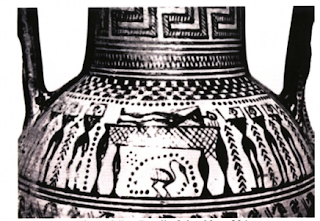
This is very interesting...Did Ancient Greeks really depict the souls of the deceased as birds? Like on these depictions of the prothesis (wake) from a Geometric period (900 to 700BC) amphorae?

We see birds under the funeral bier with the deceased...In the same place where the human headed bird is later found on Archaic period prothesis scenes?

Are these really depictions of the souls? Well, in "Winged representations of the soul in ancient Greek art from the late Bronze Age through the Classical period", we read that this is a possibility...

This is a thesis written by Tina Ross, a student from the University of Victoria. In it Tina lists all the "important" 🙂 people who do think that the depictions of birds in funerary context on Ancient Greek artefacts symbolise human souls. There are handful of them...

Tina actually says that "this is not a mainstream opinion", and that she just wants "to assert and highlight another possible interpretation in order to open up other avenues of interpretation"...

What do you think?

I don't know how Ancient Greeks arrived to the idea of the winged psyche, and whether at some stage in the past they did depict souls as birds. One interesting thing is that none of the people who supported this idea put forward explanation why would Greeks do so?

But I know that Slavs believed that birds carry souls between this and the otherworld. In both directions...I talked about this in my posts "Nav" and "Bird wedding"...

More specifically, Slavs believed that it was migratory birds that acted as the soul carriers. Slavs believed that every autumn, migratory birds took away the sun to Iriy, Slavic Otherworld, World of the Dead, where he spent winter. And that every spring, migratory birds brought the sun back into our world...

"...the souls of our ancestors shine every morning from Iriy (Slavic Paradise)..."

There are two worlds, the world of the living and the world of the dead. The sun spends the day in the world of the living and the night in the world of the dead...

And there are two gates that stand on the border between these two worlds: the eastern gate and the western gate...

Every morning the eastern gate is opened by Danica, the day star, which is in the morning called Zornjača, the morning star, and the sun comes from the world of the dead into the world of the living...

And every evening the sun goes from the world of the living into the world of the dead through the western gate, which is then closed behind him by Danica, the day star, which is in the evening called Večernjača, the evening star...

The souls of the dead follow sun to the western gate, which is where the entrance into the land of the dead is...

And there they enter Iriy, the ever green land of eternal spring, full of cattle...Raj..Paradise. And every morning, when the eastern gate of the world of the dead is opened, they smile on us...

BTW, in Ireland also, there was a belief that the souls of the dead departed westwards over the sea with the setting sun...

Where does the sun come from in the morning and where does it go back in the evening?

The same observation resulted in Dabog, Serbian Sun god, Serbian ancestral deity, having all the characteristics of the god of the dead, and having the cult which is in its essence a cult of the dead...According to Serbian ethnographers...

People are logical...

This is also the reason why the dead play such a huge role in Slavic agricultural cult...

Not only that the life literally grows out of the dead...

But Dabog, The Sun, the father of the living, and the dead, resides among the dead...

And if the dead are not happy with the living, and if they complain to "Their Father", Dabog, about the living...Then the living are basically fucked...

I talked about this in my post "Diduch"...

Hittites forgot about their dead, and look what happened to them

"...humiliation of the Hittite kingdom is the result of the fact that the living Hittite kings and their subjects have forgotten to respect the sacred bond with their dead..." - From the last Hittite king, Suppiluliuma II's letter...

I talked about this in my post "The house of bones"...

By the way this link between the souls, the birds and the sun, found in Slavic mythology is also found in Ancient Egypt and Mesopotamia...

In Ancient Egypt we find the human headed Ba bird which can fly between this world and the otherworld...And we find Ra, the sun god, traveling through the otherworld, which was imagined as green watery paradise, every night...

And in Mesopotamia we also find the sun god Utu/Shamash in the land of the dead. The Sumerian poem "Enki and the World Order" exclaims: Young Utu (the sun), father of the Great City (the realm of the dead, underworld)

But the land of the dead was by Mesopotamians not seen as paradise...It was a place of dread...But souls there were still seen as birds...In a myth called "The Descent of Ishtar to the Underworld" we read that the dead "live in darkness, eat clay, and are clothed like birds with wings"...

It is strange that the otherworld was imagined as dark, horrible place, considering that it was the sun god who was the ruler of the underworld, just like in Slavic (Dabog) and Egyptian (Ra) mythology...

And not just any sun god. Young Utu, the good sun, the sun of life, not death...

This makes me wonder if Mesopotamian mythology was, like all the other mythologies, a compendium of various belief systems which preceded it? Which is why we find these "inconsistencies"...

Knowing all these ancient links between birds, souls, otherworld and sun I would say that the (Very) Ancient Greeks could have once themselves believed in the same things we find in Slavic folklore...

Migratory birds carrying the souls to and from the otherworld...


Sunday, 20 February 2022

Jerusalem of Gold

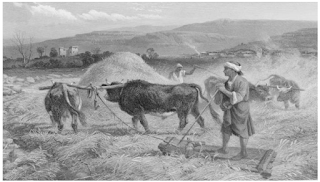
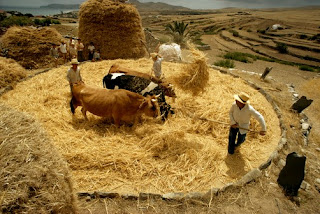
The Babylonian Talmud (Nedarim 50a) relates that one of the greatest sages, Rabbi ’Akkiva (2nd century AD), who started out as a poor, ignorant shepherd, slept with his beloved wife on the threshing floor...

He is described as pulling straw out of her hair and saying that if he could afford it, he would crown her with a "Jerusalem of Gold" – a "headgear shaped like the battlements or towers of a city", which was worn by "women of high status"...

Is this just a random innocent love scene? Or is there something more here, hidden in plain sight? I think the latter...

In my post about the sacred marriage on the threshing floor, I mentioned this:

"Threshing floors were used for religious ceremonies in Mesopotamia too. The annual sacred marriage reenactment between Ea and Ishtar (Asherah) was performed on a threshing floor".

You know how Asherah was associated with "High places"...Were these originally threshing floors?

As you can see from this article, the choice of the two protagonists of the scared marriage ceremony (sex) is not random. They mark the beginning (Ea- Apr/May) and the end (Ishtar - Jul/Aug) of the grain harvest in Mesopotamia...

Interestingly, the main consort of Ishtar (Inanna) was Tamuz (Dumuzid, Dumuzi), Mesopotamian god associated with shepherds...Whose sister Geshtinanna, was conveniently, the goddess of agriculture...

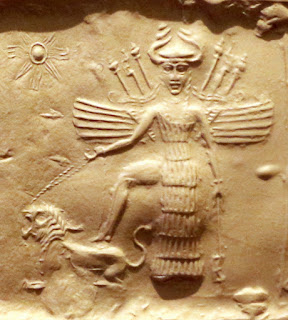
Ishtar, the queen of heaven, the morning star, is often depicted standing on a lion with the sun above it...

Why? Cause Jul/Aug, Leo, is the time when Sirius rises in the morning with the sun...

Anyway, Ishtar was not the only goddess that that stands on a lion, stands between lions, is driven in a chariot pulled by lions, or sits on a throne between two lions (all meaning "in Leo")...There is one for everyone in the audience, and I listed most of them in my post "Assumption of Mary"...

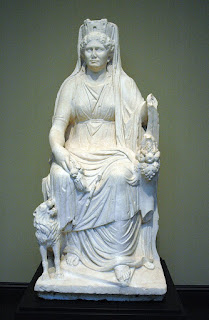
One of these lion goddesses was Cybele. Here she is, enthroned, with her pet lion, holding cornucopia, and wearing a "crown depicting city walls"!!!. This is a Roman marble made c. 50 AD...

Now Cybele was in turn associated with Greek Demeter, the Grain goddess. The main ceremony of her festivals called Haloa (from "halōs", "threshing floor"), took place in Eleusis, at the threshing floor of Triptolemus, Demeter's first priest and inventor of grain agriculture...

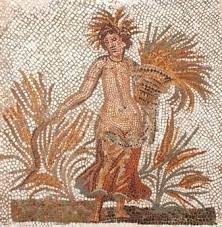
Romans knew Demeter as Ceres, Roman goddess of grain and grain harvest. Here she is, holding a sickle, with ears of grain in her hair and a grain sheaf in her hands...3rd century AD, Roman from Uthina, Tunisia...

Sooooo...After having sex with his wife on a threshing floor, Akkiva, the shepherd, picks the grain out of her hair and promises that he will buy her a golden crown in a shape of city walls...Scene depicting an Ordinary Marriage or a Sacred Marriage? What's going on here?

It's a mess, right?

The King killing Angra Mainyu

This is a drawing of a relief from Persepolis, depicting "The King killing Angra Mainyu", the main adversary of Ahura Mazda, the highest deity of Zoroastrianism...

In the earliest texts, Angra ("destructive", "chaotic", "disorderly", "inhibitive", "malign") Mainyu ("Energy", "Force", "Sprit", "Mind") was the antithesis of Spenta ("Holy", "Creative", "Bounteous") Mainyu ("Energy", "Force", "Sprit", "Mind")...

Eventually Angra (Destructive) Mainyu became Aka (Evil) Mainyu...Because of course everything destructive caused disorder and disorder is evil...And so Zoroastrian devil, Ahriman, was born...

However originally Angra Mainyu and Spenta Mainyu were, I believe, and will explain here why I believe so, just two opposing natural forces, at work in Persia: sun and rain...


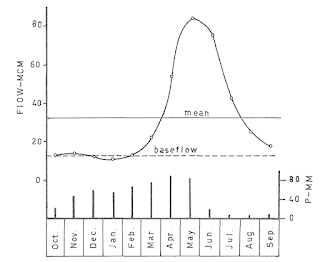
This is the climatic year in the area of the ancient Persopolis

You can see that the climatic year is divided into 2 halves: Cool, Wet half (Nov-Apr),  the time of life, Spenta Mainyu and Hot, Dry half (May-Oct), the time of death, Angra Mainyu...

Eeee what? Why?

Look again at the "monster" the king is slaying. It has lion's body, eagle's talons and wings, and bull horns...

Apr/May, Taurus, Beginning of the calving season of the Eurasian wild cattle. 

Jul/Aug, Leo, Beginning of the main mating season of Eurasian lions.

Oct/Nov, Eagle, Beginning of the main mating season of Eurasian Vultures.

Beginning, middle, end of the hot, dry season...

The half of the year dominated by the beast...The dragon...The symbol of the sun's destructive heat... 

I talked about it in my post "Seven headed dragon"...

These are all well known animal calendar markers found all over Eurasia and North Africa since Neolithic. Check this page with links to animal calendar markers related articles then the rest of the blog (I still didn't add all posts here), and then my twitter account threads (I still didn't convert all to blog posts)...

Sun's heat is the strongest and the most destructive, deadly, at the end of summer, start of autumn. This moment is "marked" by all those "lion killing bull" images from Persepolis...Lion (autumn) killing (ending) Bull (summer)...Like this one from Persepolis...

And the hottest and driest part of the dry  at the moment when bull meets lion. At the end of summer, beginning of autumn. This moment is "marked" by all those "lion killing bull" images, like this one from Persepolis...Lion (autumn) killing (ending) Bull (summer)...

So the Persian king is slaying the monster, which is a composite animal calendar marker for the hot, dry half of the year, the half of the year ruled by the sun. Destructive, deadly sun. This "destructive, deadly" sun in Leo had a name in ancient Mesopotamia: Nergal...

I talked about him in my post "Winged superhuman hero"...

In Levant, this destructive, deadly sun of the late summer, early autumn was the God of Death, Mot...I talked about him in my posts "Oldest Arabic poem" and "Anat"...Same climate, same mythology...Different names..."We are all individuals" 🙂 after all...

Anyway, it is funny that only 2 days, in my post "Sacred hunt" ago I asked "Why were Assyrian kings so obsessed with killing lions"...

And I proposed that it was a symbolic killing of the hot dry half of the year...And today, this... 

Achaemenids have actually spelled it out for us, so we don't have to wonder any more...The king is killing the hot dry half of the year...Well he is not really killing the sun's heat. He is pretending to be Ninurta, the Old Storm god, killing the sun's heat...

Ninurta, who was, in the earliest times, imagined as an "enormous black bird with outstretched wings".

Basically a vulture performing mating areal dance, which coincides with the end of the hot, dry half and beginning of the cool, wet half of the year...

I talked about him in many posts, like "Abu", "The judgement of the birdman", "Mysterious creature", "Eagle dance" "Pero"...

Also Ninurta, the hunter, the guy with the bow and arrow...Killing The Blazing Sun (Nergal)...Sagittarius...Which marks the same moment in the solar year...The end of the half of the year dominated by the sun...The Irish will love this. Remember the legends about Balor with the scorching eye being killed by Lugh? 

By the way, the tree animals marking the beginning, middle and end of "the beast" are 3 out of 4 "living creatures" which Ezekiel saw in his vision, around the same time when Persepolis was made...

I talked about them in my post "Four living creatures"...

What we have is Taurus (Apr/May), Leo (Jul/Aug), Eagle/Scorpio (Oct/Nov)...What's missing is the man, Aquarius (Jan/Feb)...

The four symbols which mark the beginning of Spring (Man), Summer (Bull), Autumn (Lion) and Winter (Eagle/Scorpion)...

Now in the area of the Persian empire, Aquarius marks the exact period of the solar year when the snowmelt started in Zagros mountains, including the area around Persepolis. The period when the water level in the rivers that made the Persian fields fertile began to rise...

Just to see how persistent these symbols are, here they are surrounding the Christ, as "Evangelists"

Christs with "the symbols of 4 evangelists". Original and fixed version with the correct sequence of "evangelists"...


It seems that "mad prophetic visions of Ezekiel and John, could be hidden remnants of old knowledge"...

So more of the same...Ninurta,  Ahura Mazda...God, as they say, has thousand names...And so does the devil...

I want to thank great Italian archaeologist, Gabriella Brusa-Zappellini, for drawing my attention to this image...

Oh, BTW, guess who was worshipped in Iran, including parts which later became Achaemenid Persia, since Neolithic? Ibex Goat...


Why? Because the Ibex goats in Iran mate at the beginning of the cool wet part of the year, and baby goats are born at the the end of the cool wet part of the year...

Hence, "Goat of rain"...You can read more about on my blog. Start here in my post about "Goat carrier"...

So if Angra Mainyu, bull-lion-eagle, is the hot dry part of the year, is the devil, then his antithesis, goat is god? It's complicated...

Saturday, 19 February 2022

Blood and mortar

Saint Tsar Lazar fresco from Curtea de Arges Monastery, Romania. Pic from the paper: "Medieval name and ethnicity: Serbs and Vlachs" by Ştefan Stareţu, University of Bucharest.

This beautiful monastery church was built in the early 16th c. by Princess Milica Despina Branković, wife of the Duke Neagoe Basarab, Ruler of Wallachia... Milica was of Serbian origin, and closely related to Serbian noble houses of Branković and Lazarević...

Now there is an interesting legend about the building of the church. For some reason, the builders were not able to keep the church walls standing up. Whatever they build during the day, collapsed during the night...

Finally, the architect in charge of the build, certain Master Manole, was threatened with death by his employers if he didn't finish the church...

After much deliberation with his masons about what to do,  Manole remembered an ancient custom of placing a living woman into the foundations of buildings in order to insure they don't collapse...
So he suggested that the first woman who came to the building site the following day, with the food for her husband, should be the one used as the sacrificial victim...

All the other masons, of course, warned their wives not to come to the building site then next day, except Manole. And so Manole was forced to sacrifice his own wife Ana. And that is how the church was built...

Interestingly, there is an identical legend about the building of the Fortress of Deva, also in Romania...

In this legend, a stonemason named Kőműves Kelemen – finds that the castle he’s trying to build keeps falling down, and is forced to sacrifice his beloved wife and mix her remains into the mortar in order to make the castle stand...

Another legend with the same plot is the legend about the building of the Bridge of Arta, a stone bridge that crosses the Arachthos river in the west of the city of Arta (Άρτα) in Greece...

According to the legend, the builders could not build the bridge, because, the foundations they built during the day, would collapse and were swept by the river during the night...

Finally "a bird with a human voice" informed the Head Builder that, in order for the bridge to remain standing, he should sacrifice his wife...He did, and this is how the bridge was built...

There is also an identical Serbian legend about the building of the Skadar fortress. The legend, in a form of an epic poem, was published for the first time in 1815 in a version recorded by Vuk Karadžić from the singing of a Herzegovinian storyteller named Old Rashko...

In 1824, Vuk Karadžić sent a copy of his folksong collection to Jacob Grimm, who was particularly enthralled by "The Building of Skadar" epic poem. Grimm translated it into German, and described it as "one of the most touching poems of all nations and all times"...

The poem describes the building of a fortress on the Bojana river at Skadar, today in Albania, in the 14th c. by the Serbian Mrnjavčević brothers (King Vukašin and his brothers Uglješa and Gojko)...

Whatever the brothers built during the day, was pushed into the river during the night by Vila (a mountain fairy). 

Eventually, vila said to the king Vukašin, that if he wanted his fortress to stand, he would have to build a living person into the fortress foundations...

And, the Vila said, it will have to be one of the brothers' wives. Whichever one comes to the building site first the next day, with the food for the builders, will have to be sacrificed...

Vukašin and Uglješa both warn their wives, and so Gojko, the youngest brother, had to wall up his young wife alive within the walls of the fortress...

As his wife just gave birth to the twins, boy and girl, called Stojko and Stoja (Stoj means stand, be upright), she begged the builders to leave her breasts exposed, so she can feed her babies...

This relief, currently in Vienna, made in 1906 by Croatian sculptor Ivan Meštrović, depicts the scene of the sacrifice...

You can find the full English translation of the poem (in a somewhat archaic English) here...

Anyway, I believe that this legend could be of Serbian in origin. The reason for that is that the custom of making blood sacrifices on the foundations of buildings, in order to make them stand, is still common among Serbs...

Not only that, According to Vuk Karadžić, there was a belief still strong during the 19th c. that it was impossible to build a large building without a human sacrifice...

Because, of course, you could't build people alive into buildings any more, builders "stole people's shadows and built them into the foundations or the walls"...

Vuk Karadžić claimed that people even avoided the building sites because they were afraid their shadow could be walled-up and they could die without it...

This belief and custom were recorded by ethnographers in many parts of the Balkans inhabited by Serbs. I talked about this belief and practice in my post "New house"...

But to me, very interesting thing about these legends is that the sacrificial victim is always a woman, the wife of one of the builders...

This gives a completely new meaning to the Serbian proverb: "Ne stoji kuća na zemlji nego na ženi" - The house doesn't stand on the ground but on the woman...I talked about this proverb in my post "Baba - the main beam that supports the house"...