Showing posts sorted by relevance for query poseidon. Sort by date Show all posts

Wednesday, 16 April 2025

Poseidon pursuing Demeter

Symbolic analysis  of this Tetradrachm minted in Byzantium, Thrace, ca 240–220 BC. 

It depicts:

Veiled head of Demeter, wreathed with corn

Poseidon seated right on rock, holding aphlaston in extended right hand and trident over shoulder

So why Demeter and Poseidon?

According to Greek mythology, Demeter's daughter Persephone was abducted by Hades and taken to the underworld. I talked about the abduction of Persephone in my post "Abduction of Persephone". This is my favourite depiction of the abduction of Persephone by Hades. Fresco from the small royal tomb at Vergina, 340 BC, Macedonia, Greece.

While Demeter was searching for her daughter, Demeter was "pursued" by Poseidon, her brother, who "lusted after her"...Poseidon pursuing a woman, 480-450BC. Currently in the Metropolitan Museum of Art, Manhattan NY. Could this unidentified "woman" actually be Demeter?

To escape Poseidon, Demeter turned herself into a mare and hid among the mares of Oncius, king of Thelpusa in Arcadia. But Poseidon turned himself into a stallion and mated with Demeter, fathering Arion, a magic stallion...I'll talk more about Arion in one of my next posts...

This myth makes no sense, until you realise that here we are here dealing with horse as an animal calendar marker for the beginning of grain harvest season and sailing season in the Eastern Mediterranean...

Poseidon was god of the sea, storms...and horses. This is reflected in his epithets: Nauklarios (Ναυκλάριος) "belonging to the ship-owners", Pelagikos (Πελάγίκος) "belonging to the sea"...and Hippeios (ἲππειος) "belonging to a horse"...

Sailors prayed to Poseidon for a calm seas and safe voyage, "sometimes drowning horses as a sacrifice"...

In Greek art, Poseidon rides a chariot that was pulled by a hippocampus or by horses that could ride on the sea...
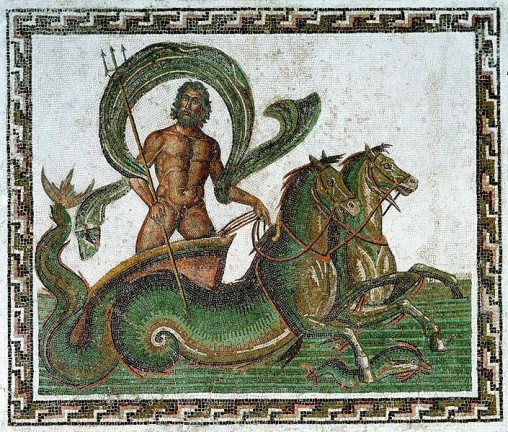
Poseidon is apparently "...more often regarded as the tamer of horses, but in some myths he is their father, either by spilling his seed upon a rock or by mating with a creature who then gave birth to the first horse..."

In Arcadia, one of the most conservative parts of Ancient Greece, Poseidon was worshipped as a stallion...

Why? Why?

Cause mating season of horses, marked by wild stallion fights, also marks the sailing season in the Eastern Mediterranean. Both start in Apr/May and finish in Sep/Oct...

I talked about this in my post "Trojan horse", in which I asked a question: was Trojan horse "hypos" - a wooden horse left as tribute, or  "hypos" - a wooden boat with a horse head used for transporting tributes...
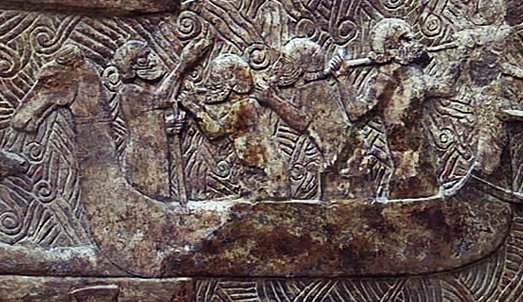
So that would explain Poseidon part of the the myth. But what about Demeter?

Demeter is the mother of grain, deified grain harvest. Persephone is the grain, deified grain seed.

Grain seeds are sown in Oct/Nov and are harvested (given birth to) starting from Apr/May

Why are opium poppies sacred to Demeter, goddess of grain harvest, while pomegranates are sacred to her daughter, Persephone? Check this chart out...More details can be found in my post "Poppies and pomegranates"...

It is during this period between the sowing and harvesting that Demeter is looking for Persephone. 

And it is towards the end of this period, most likely in Apr/May, when the horse mating season starts, that Poseidon (as a stallion) elopes with Demeter (as a mare)...Guess what begins in Apr/May? Grain harvest season...

Hesiod declares: "When the Pleiades, daughters of Atlas, are rising, begin the harvest". At the mid 8th century BCE in Bœotia, the heliacal rising of the Pleiades occurred about 47 days after spring equinox, which corresponds approximately to the first week of May...I talked about this in my post "Hesiod on grain"...

Grain harvest season, when Demeter brings Persephone back from the underworld (sown grain seed, sprouts, grows, ripens, gets harvested), while stallions are prancing around fighting for mares...

Ever seen this? Demeter in her horse-drawn chariot with her daughter Persephone, driving between two prancing stallions. I wonder why??? 🙂 Selinunte, Sicily 6th c. BC

And so, Demeter with beautiful golden hair full of ripe ears of grain and Poseidon holding a trident and aphlaston...aphlaston...the most sacred part of every Ancient Greek warship...Interesting...Very interesting...I will talk about this in one of my next posts...

To read more about ancient animal and plant calendar markers, start here…Then check my twitter threads I still didn't convert to blog post...I am way way behind...

Monday, 4 August 2025

Taranto

A silver didrachm from Taranto in southern Italy minted during the period 355-340 BC. It features on obverse a male youth riding a dolphin.

Dolphins and a dolphin-rider feature so prominently on the coinage of Taranto. This is unsurprising, given the mythological aetiology of the city from the hero Taras, the son of Poseidon (Pausanias 10.10.8). who was shipwrecked and then rescued by a dolphin. 

On this coin from Taranto minted during the period 355-340 BC, Taras is depicted holding his father's trident...


The dolphin-rider motif appears early on the coins of Taranto. For instance, a silver didrachm from Taranto minted during the period 510-450 BC


With a Reverse this time featuring a winged hippocamp symbol of Poseidon.

Poseidon was god of the sea, storms...and horses. This is reflected in his epithets: Nauklarios (Ναυκλάριος) "belonging to the ship-owners", Pelagikos (Πελάγίκος) "belonging to the sea"...and Hippeios (ἲππειος) "belonging to a horse"...

Sailors prayed to Poseidon for a calm seas and safe voyage, "sometimes drowning horses as a sacrifice"...

In Greek art, Poseidon rides a chariot that was pulled by a hippocampus or by horses that could ride on the sea...

Poseidon is apparently "...more often regarded as the tamer of horses, but in some myths he is their father, either by spilling his seed upon a rock or by mating with a creature who then gave birth to the first horse..."

In Arcadia, one of the most conservative parts of Ancient Greece, Poseidon was worshipped as a stallion...

Why? Why?

The natural breeding season of horses starts in Apr/May and ends in Sep/Oct and is marked by wild stallion fights for mares...

The horse fertility is governed by the sunlight and peaks on summer solstice. I heard summer solstice was a big thing for sun worshipers....

Hence solar horses all over Eurasia...

Articles about solar horse (equid):

Iran "Water carrier equid", "Dioscuri plate from Iran"

Mesopotamia "Shamash playing with the solar horse", "Sun god from Tell Brak"

India "Hayagriva"

China "Longma", "Three legged crow", "Mythical beast from Xian"

Levant "Alexamenos graffito", "Goddess on a horse", "Unicorn"

Europe "Archaic rider", "Beotian solar pyxis", "Pegasus and chimera", "King John", "The horseman"

Ok, but what does this have to do with Poseidon? Well, mating season of horses, overlaps with the sailing season in the Eastern Mediterranean. Both start in Apr/May and finish in Sep/Oct...

I talked about this in my post "Trojan horse", in which I asked a question: was Trojan horse "hypos" - a wooden horse left as tribute, or  "hypos" - a wooden boat with a horse head used for transporting tributes...


As for dolphins, they are animal calendar markers for Apr/May-Oct/Nov.

The reason for this is that dolphin mating and calving season in Mediterranean spans period May-Oct.

It takes place in the shallows, and is therefore easily observable by people living and fishing along the coast...

So there is actually a symbolic link between the horses and dolphins. Their mating seasons overlap and they overlap with the sailing season in the Eastern Mediterranean...

I talked about dolphin as an animal calendar marker in many of my posts, like "Boat of Dyonisus", "Apollo and dolphins", "Horned animal attacked by a dolphin", "Minoan dolphin fresco", "Coin from Byzantion", "Eagle eating dolphin"

One other thing...A lot of the coins from Taranto depict a mounted warrior on the obverse. You can find them all here... 


This one even depicts a mounted warrior and Nike, the goddess of victory...

Why?

Because Apr/May - Sep/Oct was not only the sailing season but also the war season...

BTW, some of the Taranto coins only depict horse on both sides, like this one minted during the period  325-280 BC...So horses were definitely important symbol on its own...BTW, one is bridled and the other unbridled...Sailing and non sailing season? What do you think? 


Knowing this makes the original coin even cooler...I think...

To read more about ancient animal and plant calendar markers, start here…Then check my twitter threads I still didn't convert to blog post...I am way way behind...

Tuesday, 23 June 2020

Trojan horse

Everyone knows what Trojan Horse is: a wooden horse  which Greeks left on the beach of Troy as a "present" to the Trojans... 
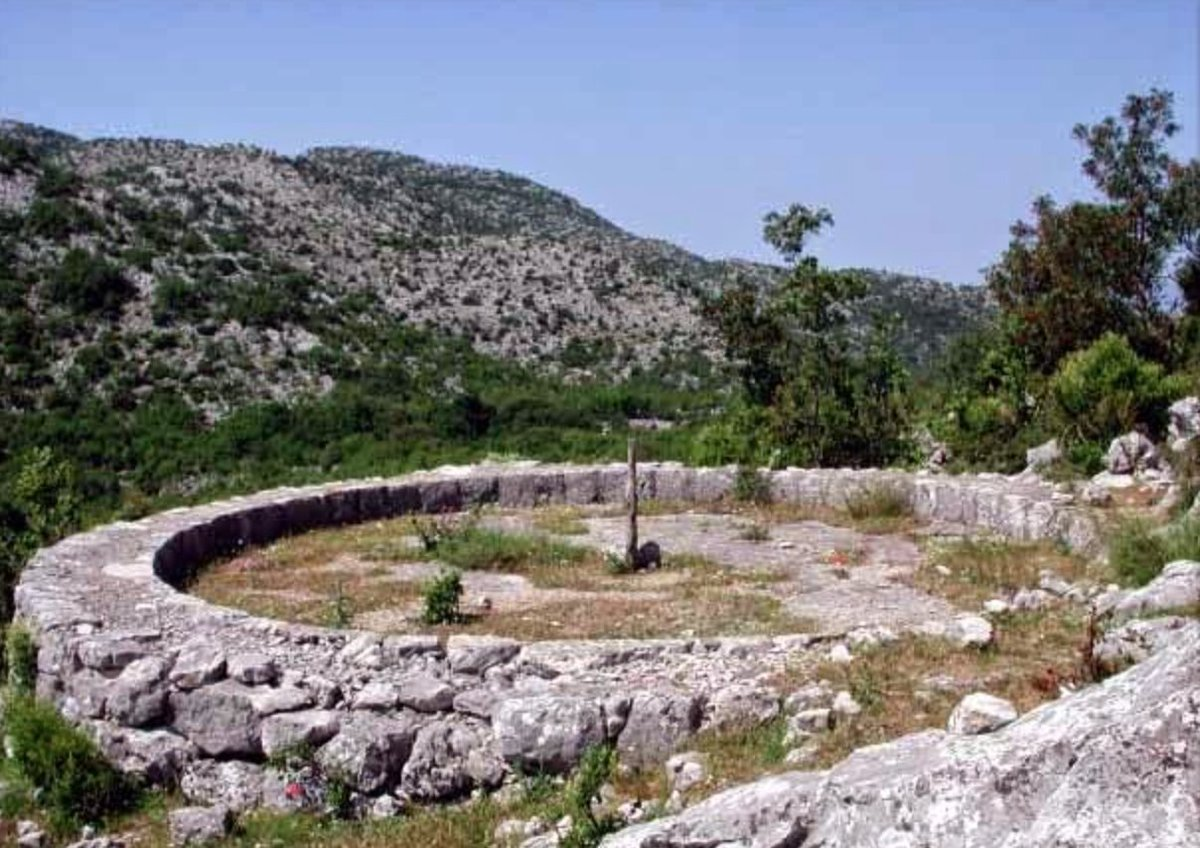
Here it is, depicted on Vase, found on Mykonos, dated to ca. 670 BC, which makes it the earliest known graphic depiction of the Trojan Horse...


"...the city was doomed when it took in that 'horse', within which were all the bravest of the Greeks waiting to bring death and destruction on the Trojans..." wrote Homer, describing the scene.
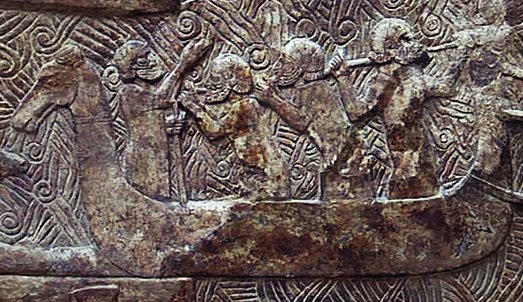
But the interpretation of what Homer was talking about as a giant wooden horse, could be a result of an misinterpretation of the term "hippos"...

Already in the 2nd century AD, Greek geographer Pausanias wrote that the idea of Greeks using a wooden horse was "not credible, even if the figure of the horse was in use to represent this legend"...

Today, Italian naval archaeologist, Francesco Tiboni says that he has found "the proof" that the famous horse was actually a type of merchant ship which had horse figureheads on their prows and which Greeks called "hippos" (horse).

Like this one, from a depiction of Phoenician ships found in the palaces of Assyrian kings from the 7th and 8th centuries BCE.


It is because of this that the Greeks called the Phoenician ships "horses", and the Phoenicians "the horse people". 

"Over the course of history, lots of academics have put forward the nautical interpretation" of the term 'hippos' Tiboni says, "But there was always something missing. As a naval archaeologist, I managed to put all the pieces together."

He says it would make far more sense to think of the Greeks' treacherous gift to the Trojans as a ship, because nautical "hippos" were commonly used to carry tributes to the enemy - such as precious metals - after defeats.

A ship's hold would also have made a better hiding place for soldiers than a wooden horse's belly. And a reference in Virgil's Aeneid to wary Trojans calling for the sinking of the Greek gift seems odd outside of a nautical context, Tiboni suggests.

"Many aspects of the events narrated by ancient authors appear to be more clear and obvious than they are now if we use 'hippos' in the sense of a ship," the researcher wrote in 2016 in the academic journal "Archaeologia Maritima Mediterranean".

Apparently, "...the fellow classicists are having a hard time accepting this...".


"...it is impossible to separate fact from fiction when you are dealing with a legend based on an almost 3,000-year-old epic poem...We will probably never find out what really happened..." archaeologist Eleni Stylianou said.

Eleni Stylianou is of course right. We will never know for sure what happened at Troy. But I personally believe that Francesco Tiboni is right...His theory makes a lot of sense...

But I am not writing this article to prove that the Trojan horse was a boat with a horse head on its prow. 

I am writing this article to answer the question: why did the Phoenician built ships with horse heads on their prows?

A horse head is a very strange thing to put on a boat...But wait until you hear why Phoenicians did it...

Apparently, these horse heads were purposeful tributes to the might of Phoenician sea god Yamm and were used on the ships to placate the god who, like the Greek god Poseidon, was associated with horses, and who had to be constantly appeased to prevent his wanton destruction of the ships at sea.

Now why would the two most important sea gods of the ancient world be associated with horses?

Read on...

In the Phoenician religion, there was a tripartite division of power between Baal (Storm god), Mot (God of death) and Yamm (Sea god). This "seems to have" (first understatement of a millennium) influenced the Greek division between Zeus (Storm god), Hades (God of death) and Poseidon (Sea god)... 

Are you kidding me? How many other tripartite divisions of power like this do we have?

It "is possible" (second understatement of a millennium) that Poseidon/Neptune was directly inspired by a Phoenician counterpart Yamm...

Eeeee WTF? Two sea gods associated with horses? How weird is this? And what is the chance that this is a coincidence? 

I mean look at Poseidon:

Poseidon was god of the sea, storms...and horses. This is reflected in his epithets: Nauklarios (Ναυκλάριος) "belonging to the ship-owners", Pelagikos (Πελάγίκος) "belonging to the sea"...and Hippeios (ἲππειος) "belonging to a horse".

Sailors prayed to Poseidon for a calm seas and safe voyage, "sometimes drowning horses as a sacrifice"...

In Greek art, Poseidon rides a chariot that was pulled by a hippocampus or by horses that could ride on the sea. 


Why is a sea god associated with horses?

Poseidon is apparently "...more often regarded as the tamer of horses, but in some myths he is their father, either by spilling his seed upon a rock or by mating with a creature who then gave birth to the first horse..."

In Arcadia, one of the most conservative parts of Ancient Greece, Poseidon was worshipped as a stallion...And, according to Pausanius, also in Arcadia, they preserved a myth that says that: "When Rhea had given birth to Poseidon, she hid him...and she then declared to Cronus that she had given birth to a horse, and gave him a foal to swallow instead of the child..." 

Why? Why?

Well, to understand why, we need to look at the ancient sailing calendars. 

Hesiod, writing in the 8th century BC says that:

In spring's another chance to sail
When figs put forth their new leaves from the topmost twigs, 
The size of crow's feet
That's when first the sea is passable...


This happens in April

Then he proceeds to say that:

Fifty days after the solstice, 
when the season of wearisome heat is come to an end, 
is the right (best) time for men to go sailing. 

This is end of July beginning of August

Finally he says:

 But make all haste you can to return home again 
 and do not wait till the time of the new wine 
 and autumn rain and oncoming storms 
 with the fierce gales of Notus 
 who accompanies the heavy autumn rain of Zeus 
 and stirs up the sea and makes the deep dangerous.


This happens in September

So according to Hesiod, the sailing season in Ancient Greece was between April and September...

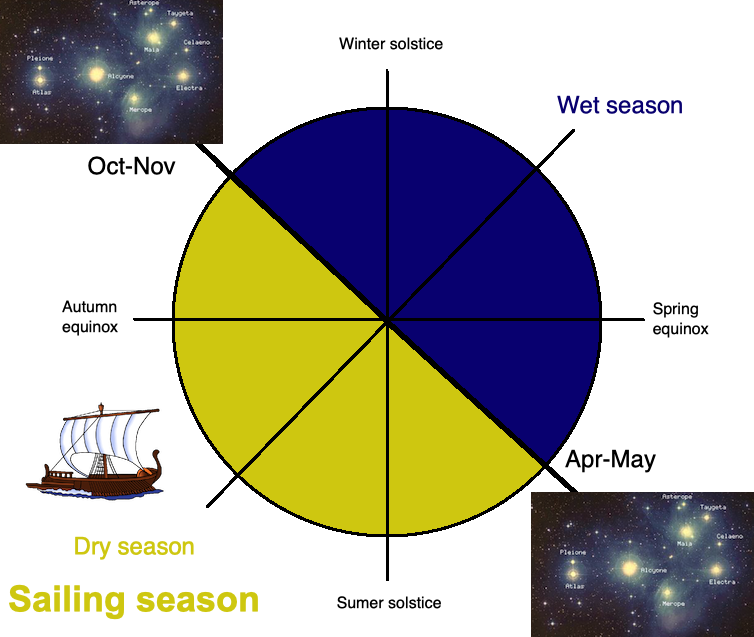
Interestingly, in the Ancient Greece, another marker used for the beginning and the end of the sailing season was the heliacal rising and setting of Pleiades, whose ancient Greek name "Πλειαδες" comes from πλεω, which means “to sail”)...

Now because of the precession, heliacal rising of the Pleiades is not a fixed event on the solar year. 

Have a look at this table:

Approximate time of the heliacal rising of the Pleiades (according to Stellarium computer program)

2500BC - 20th of April
2000BC - 24th of April
1500BC - 28th of April
1000BC - 1st of May
  800BC - 3rd of May 

So when Hesiod was writing, around 800BC, the heliacal rising of the Pleiades was already too late to mark the beginning of the sailing season which started every year "when figs put forth their new leaves from the topmost twigs, the size of crow's feet", in April...

Which is why I think he didn't use heliacal rising of the pleiades to mark the beginning of the sailing season in his "Works and days". Instead he used something that happens every year at the same time in the same climatic zone: the emergence of the new leaves on fig trees...He used an reoccurring annual event form the lifecycle of the fig tree as a calendar marker, to mark the beginning of the sailing season in the Eastern Mediterranean...

Interesting, very interesting...

If we look at the above table of the dates of the heliacal rising of Pleiades, we can see that they were rising during the second part of April during the period 2500BC - 1000BC, which is the period between the emergence of the first Phoenician cities and the peak of Phoenician dominance of the Eastern Mediterranean seas... 

So did Phoenicians link the heliacal rising and setting of the Pleiades with the beginning and the end of the sailing season in the Eastern Mediterranean?

I believe so...

And Phoenicians did something else as well: They linked their sea god with a horse and built ships with horse head prows...

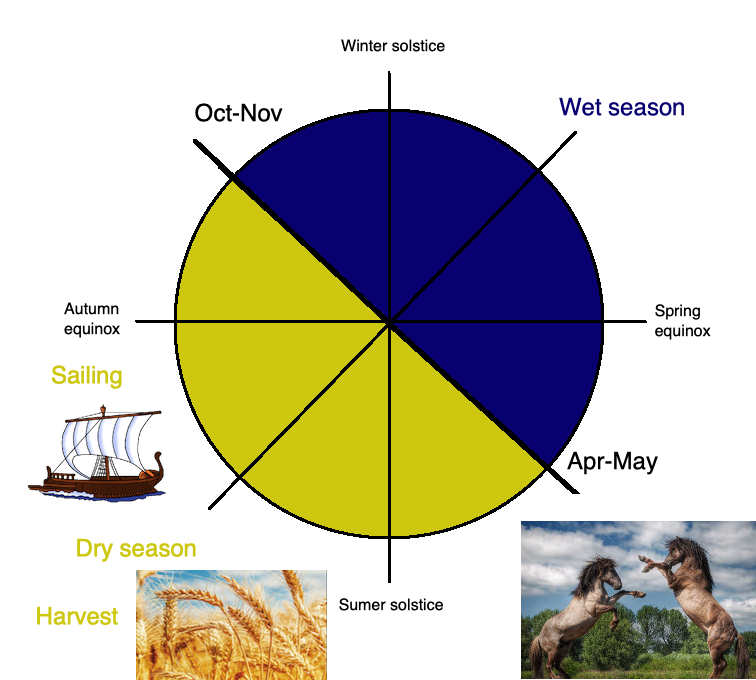
And finally, here is why:


Oh and because horse gestation lasts 11-12 months, the beginning of the mating season is announced by the beginning of the foaling season...

This means that natural foaling/breeding season of horses coincides exactly with the sailing season in the Eastern Mediterranean...

How do we know that the natural breeding season of horses has started? Because stallions start fighting each other for the right to mate...


This means that the horse is a perfect animal to use as a calendar marker that specifies when to sail and when not to sail...

In the words of immortal Phoenician poet (whose name and work everyone forgot unfortunately):

"When the stallion fighting you see, it means it's ok to take to the sea"

This also means that the horse is the perfect symbol for a patron god of sailing: the sea gods Yamm and Poseidon...Gods of the sailing season...Who arrived on chariots pulled by horses and brought with them good sailing weather...

It is even possible, that Phoenicians originally saw the horse as the one who brings the good sailing weather? Or maybe Phoenicians never equated Yamm with the horse, but instead just saw horse as Yamm's herald and hence his sacred animal...And the reason why Mountain Greeks from Arcadia worshiped Poseidon as a stallion is because by the time this Phoenician cult reached them, it was already mangled beyond recognition, and the god's herald and symbol became the god himself???

By the way, the dancing ponies also herald the beginning of summer...Which explains few other things about Yamm and Poseidon...But I will leave this for another article...

Does all of the above make a bit more sense now?

Now if you think that this is just a fluke, please have a look at all these other animal and plant calendar markers which I have mapped so far...

Sunday, 18 May 2025

The oldest Demeter depiction

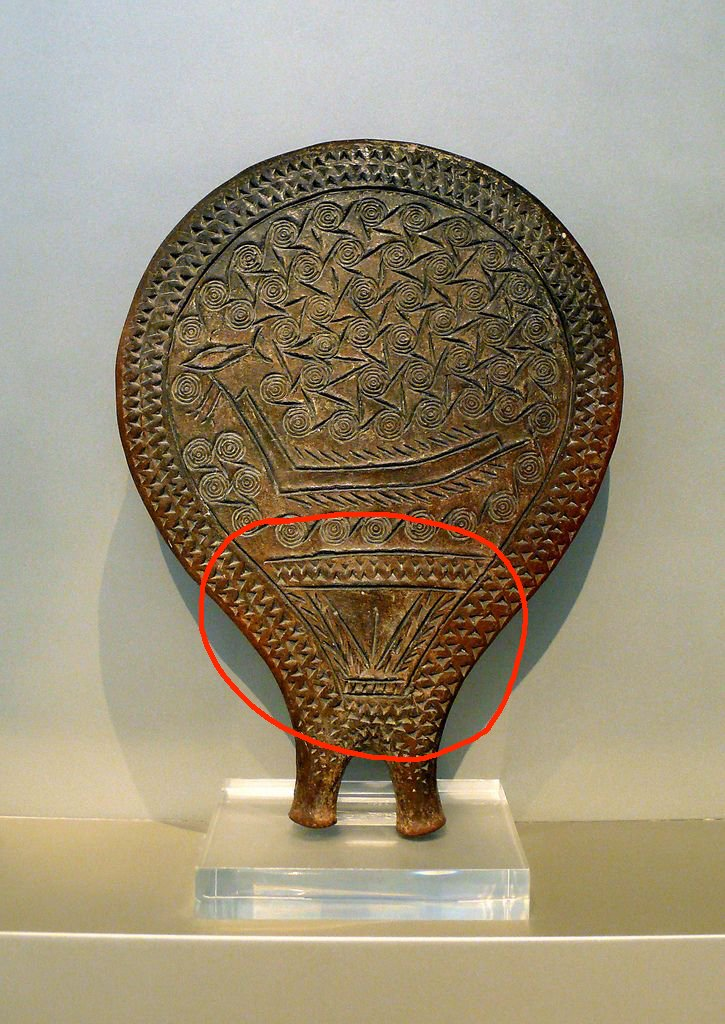
So...How old is the oldest depiction of Demeter, Greek Mother of Grain? How about 4500-4200 years old? Do you want to see it? Here she is in all her glory...

Mother (vulva) surrounded with grain...This symbol is hidden in plain sight on this strange object. This is one of many mysterious Early Cycladic "Frying Pans" found on Cycladic islands in Greece and dated to the second half of the 3rd mill BC

I talk about this particular frying pan, in my post "Tuna boats" about Bronze Age Cycladic tuna fishermen, in which I was discussing the ancient fishing/sailing calendar for the Cyclades. A lot of these "Frying Pans" depict boats, tuna fish and swirling waves...

And of course I completely missed the most important bit: vulva surrounded with grain, symbolic depiction of the Mother of Grain...

We know that this has been a grain symbol in Eastern Mediterranean, Mesopotamia, Central Asia, Iran, since at least Sumerian times...

I talk about this symbol being used in combination with vulva to depict the mother of grain in many of my posts. Like this post, "Arjoune Venus", about the 6th mill BC Halaf culture figurines from Syria. This one has vulva on front and ears of grain on the back...

We even have this symbol described in "The Courtship of Inanna and Dumuzi" where Inanna, Sumerian Mother of Grain, says:

Before my lord, Dumuzi...

I poured out grain before my womb...


I talked about this in many of my posts...

BTW, we find the same symbolism (grain before womb) described in the Greek legends about Baubo and Demeter...I talked about this in this recent post "Baubo", in which I explain why she is one of the most misunderstood figures from Ancient Greek mythology. 

This is one of many "Baubo" figurines which were found in the Sanctuary of Demeter and Kore at Priene and dated to the 2nd c. BC. 

The fact that we find the earliest use of this symbolism in the Fertile Crescent is important. You'll see why soon.

Anyway, I suddenly remembered the vulva with grain "detail" from our Cycladic "Frying Pan" while I was writing my post "Poseidon pursuing demeter", in which I gave symbolic analysis of this Tetradrachm minted in Byzantium, Thrace, ca 240–220 BC, which depicts veiled head of Demeter, wreathed with corn and Poseidon seated right on rock, holding aphlaston in extended right hand and trident over shoulder. 

In it, I tried to answer the question: why were Demeter, Goddess of grain harvest (season) and Poseidon, God of sailing (season) paired together? As horses?

Basically, horse mating season, Apr/May-Sep/Oct overlaps with both grain harvest and sailing season in Ancient Greece...

Hence the link between Demeter (Mother of grain), Persephone (Grain) and horses. Here is Demeter in her horse-drawn chariot with her daughter Persephone, driving between two prancing stallions. 🙂 Selinunte, Sicily 6th c. BC

And the link between Poseidon and horses. I talked about this link in my posts "Trojan horse", "Three sacrifices", "Tetradrachm from Byblos", "Seahorse ring"...

Anyway, I expanded on it in my post "To sail - To harvest", about the heliacal rising of Pleiades being a calendar marker for the start of both harvest and sailing season in Ancient Greece...Greek name "Πλειαδες" comes from πλεω, which means "to sail"...

I think we find proof for this link between the goddess of grain (harvest) and god of the sea (sailing) in Minoan Crete in the 2nd mill BC.

Actually goddesses of grain, Persephone (grain seed) and Demeter (grain harvest)...

Here they are, in a horse drawn chariot, depicted on a late Minoan limestone sarcophagus, dated to around 1400 BC, excavated from a chamber tomb at Hagia Triada, Crete, Greece...

I just remembered I wrote a whole post, "Agia Triada Sarcophagus", about this a while back where I actually talk about this link between Poseidon, Demeter, Persephone and horses in detail. I am getting old and forgetful...

This link between grain harvest season (Demeter) and sailing season (Poseidon) is I think what is depicted on our Cycladic "Frying Pan":

Tuna fishing boat (Poseidon)

Vulva surrounded with grain (Demeter)

What do you think?

But 🙂 there is something that makes me wonder...

This stele, most likely from the ancient city of Mari in Syria, depicts the Mother of Grain in exactly the same symbolic way...And dates from...🥁🥁🥁...the beginning of the third mill BC...Pretty much the same time as our Cycladic "Frying Pan"...

I talk about this amazing object in my post "Mother of grain from Mari"...

So what I am wondering is, does the vulva surrounded with grain depicted on our Cycladic "Frying Pan" depict Demeter...Or maybe her Levantine double, Inanna/Ishtar/Asherah/Astarte...

I already talked about the possibility that the 2nd mill BC Mycenaean Greeks worshipped Asherah who eventually turned into Demeter in my post "Cup of Nestor"...

Cup from Mycenae with doves. 

And the lions flanking a pole depicted above the main gate of the Mycenae fortress.

Interestingly, Asherah, who was symbolically depicted as an Asherah Pole, was associated with both lions and doves...And so were Inanna and Demeter...

Asherah the goddess represented as a wooden pole erected on "high places". We have no idea what this means, but I have a hunch that the "high places" were threshing floors and that Asherah poles were central poles of the threshing floors...

I talked about this in my post "Sacred marriage on the threshing floor"...

And this is what Homer says about Demeter and threshing floors:

"And even as the wind carries chaff about the sacred threshing-floors / of men that are winnowing, when fair-haired Demeter / amid the driving blasts of wind separates the grain from the chaff"...

Which is why Eugene Vanderpool in "ΕΠΙ ΠΡΟϒΧΟΝΤΙ ΚΟΛΩΝΩΙ: The Sacred Threshing Floor at Eleusis" proposes that threshing floors were sacred to Demeter and were in fact her temples...I talked about this in my post "Demeter riding panther"...

But as we can see from the our "Frying Pan", I think that this "Mother of Grain" from the Fertile Crescent came to Greece much earlier...In the 3rd mill BC. Via Greek Islands...Already linked with the god of the sea...

Look at this:

Asherah's son is Yam, god of the sea, or more precisely Yam, deified sea itself. And because of all this, Asherah's title "Rabat Athirat Yam", found in the Baal Cycle, can be translated as "Lady Aṯhirat (Asherah) of the Sea"...

The same sea god Yam, who in Phoenician and Canaanite mythology, was associated with horses?🙂

Phoenician ships often adorned with horse heads as tributes to Yam, who was believed to be appeased with such offerings to prevent destructive storms.

Reproduction of a Phoenician ship from the Archaic era, called a hippoi by the Greeks (due to the horse head at the bow), carved in bone, c. 11th-9th centuries BC, Ifergan Collection, Malaga, Spain (2019)

I talked about this in my post "Trojan horse", in which I asked a question: was Trojan horse "hypos" - a wooden horse left as tribute, or  "hypos" - a wooden boat with a horse head used for transporting tributes...

And in this article I also pointed at this "coincidence":

In the Phoenician religion, there was a tripartite division of power between Baal (Storm god), Mot (God of death) and Yamm (Sea god)...

This "seems to have" (first understatement of a millennium) influenced the Greek division between Zeus (Storm god), Hades (God of death) and Poseidon (Sea god)...

Are you kidding me? How many other tripartite divisions of power like this do we have?

It "is possible" (second understatement of a millennium) that Poseidon/Neptune was directly inspired by a Phoenician counterpart Yam...

Is Asherah/Astarte then "inspiration" for Demeter? I just realised I wrote another post, "Goddess on a horse", about this 13th c. BC levantine gold plaque, depicting a lady on a horse, probably Astarte or Anat (according to Israel Museum), who was linked to grain and sailing...

Sooooo...What do you think of all this? 

The oldest symbolic depiction of Demeter and Poseidon? 

Or 

The oldest depiction of Asherah and Yam?

Or both?

I hope you had fun reading this thread. I definitely had a lot of fun researching it, thinking about it and writing it...

That's it. To read more about ancient animal and plant calendar markers, start here…Then check my twitter threads I still didn't convert to blog post...I am way way behind...